서 론
세계보건기구에 따르면 세계적으로 3억 4천만 명 이상의 인구가 당뇨병을 앓고 있고, 당뇨병은 매년 150만 명 사망의 직접적 원인이 다. 또한 2030년에는 7번째로 흔한 사망 원인이 될 것으로 예측된다.1) 2013년 기준 우리나라 30세 이상 성인에서의 당뇨병 인구는 약 270만 명(8.03%)이고, 당뇨 전단계로 분류되는 공복혈당장애 유병률은
25.0%이다. 2006년 기준 당뇨병 인구가 160만 명(5.6%)이었던 것에 비 하면 당뇨병 유병률이 급격히 증가하는 추세이다.2)
당뇨병의 진단은 공복혈당 측정, 경구 당부하 검사, 당화혈색소 수 치를 측정하여 이루어지는데, 당뇨병의 기준에 해당되지는 않지만 정상 혈당 수치 범위보다는 높은 수준을 내당능장애(75 g 경구 당부 하 2시간 후 혈장 혈당 140–199 mg/dL), 공복혈당장애(공복 혈장 혈 당 100–125 mg/dL), 당뇨병 고위험군(당화혈색소 5.7%–6.4%)으로 분
Original Article
30세 이상 성인에서 과일 섭취 빈도와 공복혈당장애의 관계:
제5기 국민건강영양조사자료 2011
서지원, 정은영, 이재혁, 김대현, 서영성*
계명대학교 동산의료원 가정의학과
Association between Impaired Fasting Glucose and Frequency of Fruit Intake in over Thirty Year Olds: Fifth Korean National Health and Nutrition Examination Survey 2011
Ji-Won Seo, Eun-Young Jung, Jaehyuck Lee, Dae-Hyun Kim, Young-Sung Suh*
Department of Family Medicine, Keimyung University Dongsan Medical Center, Daegu, Korea
Background: There are insufficient studies on the association between fruit intake and the risk of diabetes mellitus among non-diabetic subjects;
however, some previous studies have reported a lower frequency of diabetes in subjects with high fruit intake. In this study, we investigated the relationship between impaired fasting glucose (pre-diabetes mellitus; a high-risk group for developing diabetes; HbA1c level, 5.7%–6.4%) and the frequency of fruit intake in Korean adults.
Methods: We included 3,674 adult participants (>30 years old; 1,467 men, 2,207 women) who were a part of the fifth Korea National Health and Nutrition Examination Survey in 2011. The participants were categorized into four groups based on the frequency of their fruit intake: daily group, more than once per week group, more than once per month group, and less than six times per year group. We compared the risk of pre-diabetes mellitus in these four fruit intake-based groups.
Results: We observed a significantly lower risk of impaired fasting glucose in women who consumed fruits daily compared to women who consumed fruits less than six times per year (odds ratio, 0.34; 95% confidence interval, 0.129–0.893). However, in men, we did not observe any significant association between impaired fasting glucose and fruit intake.
Conclusion: Impaired fasting glucose is less frequent with daily fruit intake, indicating a lower risk of pre-diabetes mellitus; however, this association is only observed in adult Korean women.
Keywords: Fruits; Impaired Fasting Glucose; Pre-Diabetes; Korean National Health and Nutrition Examination Survey
https://doi.org/10.21215/kjfp.2016.6.5.441eISSN 2233-9116
Korean J Fam Pract. 2016;6(5):441-445
KJFP
Korean Journal of Family PracticeReceived March 30, 2016 Revised April 27, 2016 Accepted June 24, 2016 Corresponding author Young-Sung Suh
Tel: +82-53-250-7675, Fax: +82-53-250-7675 E-mail: [email protected]
Copyright © 2016 The Korean Academy of Family Medicine
This is an open-access article distributed under the terms of the Creative Commons At- tribution Non-Commercial License (http://creativecommons.org/licenses/by-nc/4.0) which permits unrestricted noncommercial use, distribution, and reproduction in any medium, provided the original work is properly cited.
Ji-Won Seo, et al. Impaired Fasting Glucose and Fruit Intake in over Thirties
Korean Journal of Family Practice
KJFP
류하였다.3) 이들은 당뇨병의 전단계일 뿐만 아니라 심혈관질환 발생 의 위험요인이기 때문에 생활습관 및 식습관을 통해 당뇨로의 진행 을 막아야 한다.4)
당뇨병의 위험인자로는 체질량지수(body mass index, BMI) ≥25 kg/
m2 (또는 ≥23 kg/m2; 아시아계), 당뇨병 가족력, 임신성 당뇨병 과거력, 고밀도지단백 콜레스테롤 <35 mg/dL, 중성지방 >250 mg/dL, 고혈압 (≥140/90 mmHg 또는 치료 중), 당화혈색소 ≥5.7%, 이전 검사에서 내 당능장애 또는 공복혈당장애 등이 있다.5) 이런 위험인자가 있는 환 자들에게는 주기적인 당뇨 검사를 시행해야 한다. 특히 당화혈색소
≥5.7%이거나, 내당능장애 또는 공복혈당장애인 환자에서는 2형 당 뇨를 예방하거나 지연시키기 위해서 규칙적 운동과 같은 신체활동, 적절한 체중조절, 그리고 건강하고 균형 잡힌 식사가 필요하다.5,6)
현재까지 공복혈당장애와 내당능장애에 관해 시행된 국내 연구 는 공복혈당장애나 내당능장애의 진단기준에 관한 연구7)나, 연구자 대상이 농촌 지역 주민으로 우리나라 국민을 대표할 수 없는 경우8), 또는 복부 비만과의 관련성에 대한 연구9) 등이 있었다. 또한 당뇨병 전단계에서 지방 섭취와 식이섬유 섭취와 관련된 연구는 있었지만10) 아직 공복혈당장애나 당뇨 고위험군과 과일 섭취에 대한 연구는 부 족한 실정이다.
그러므로 본 연구는 2011년 국민건강영양조사를 이용하여 우리 나라 30세 이상의 성인을 대상으로 과일 섭취 빈도와 공복혈당 및 당화혈색소를 분석하여, 과일 섭취 빈도에 따른 공복혈당장애와 당 뇨병 고위험군과의 관계를 파악하고자 하였다.
방 법
1. 연구 대상자
2011년 국민건강영양조사(제5기 2차년도)의 검진 및 영양조사에 모두 참여한 16,576명 중 30세 미만 5,178명, 암에 걸린 460명, 임신 중 36명, 당뇨 569명, 결측 인원 6,659명을 제외하였고, 최종적으로 30세 이상 성인 3,674명(남자 1,467명, 여자 2,207명)을 대상으로 하였다.
2. 연구 도구
1) 대상의 일반적 특성대상의 일반적 특성으로 흡연 여부, 음주 여부, 배우자 유무, 운동 유무(중증도 이상), 교육 정도(고졸 이상), 수입(하위 1/4), 대사증후 군 유무를 %로 나타내었다. 그리고 연령, BMI, 허리둘레, 수축기 혈 압, 이완기 혈압, 총 콜레스테롤, 공복혈당, 당화혈색소, 에너지 섭취 량, 지방 섭취율의 평균을 조사하였다.
2) 과일 섭취 정도
과일 섭취 빈도에 따른 내당능장애와 공복혈당장애를 보기 위해 과일 섭취량은 1년에 6회 미만, 월 1회 이상에서 주 1회 미만(이하 월 1회 이상), 주 1회 이상에서 하루 1회 미만(이하 주 1회 이상), 하루 1회 이상의 총 네 그룹으로 분류하였다.
3) 혈당값
혈당값은 공복혈당값과 당화혈색소를 이용하였고, 당뇨 진단 기 준에 따라 공복혈당의 기준은 100 mg/dL 미만, 100 mg/dL 이상 126 mg/dL 미만, 126 mg/dL를 기준으로 각각 정상혈당군, 공복혈당장애 군, 당뇨혈당군으로 나누었다.
당화혈색소는 5.7% 미만, 5.7% 이상 6.5% 미만, 6.5% 이상을 기준으 로 했고, 각각 정상혈당군, 당뇨 고위험군, 당뇨혈당군으로 나누었다.
당뇨로 이미 진단받은 환자들은 식이제한을 하고 있을 가능성이 많고, 약으로 혈당을 조절하고 있을 가능성이 많으므로 제외하였다.
3. 통계 분석
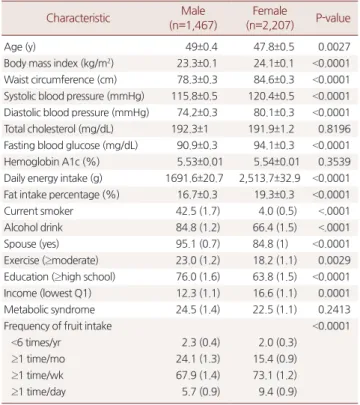
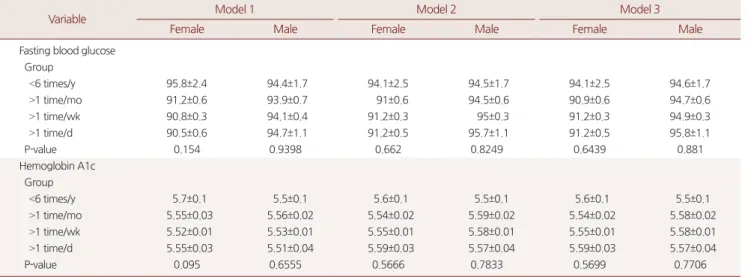
대상자의 일반적 특성(Table 1)은 백분율(표준오차), 평균±표준오 차로 표시하였고, t-test와 카이제곱을 이용하였다. 과일 섭취 빈도와 공복혈당값과 당화혈색소값(Table 2)의 관계는 보정평균±표준오차
Table 1. Baseline characteristics of the participants Characteristic Male
(n=1,467)
Female
(n=2,207) P-value
Age (y) 49±0.4 47.8±0.5 0.0027
Body mass index (kg/m2) 23.3±0.1 24.1±0.1 <0.0001 Waist circumference (cm) 78.3±0.3 84.6±0.3 <0.0001 Systolic blood pressure (mmHg) 115.8±0.5 120.4±0.5 <0.0001 Diastolic blood pressure (mmHg) 74.2±0.3 80.1±0.3 <0.0001 Total cholesterol (mg/dL) 192.3±1 191.9±1.2 0.8196 Fasting blood glucose (mg/dL) 90.9±0.3 94.1±0.3 <0.0001
Hemoglobin A1c (%) 5.53±0.01 5.54±0.01 0.3539
Daily energy intake (g) 1691.6±20.7 2,513.7±32.9 <0.0001 Fat intake percentage (%) 16.7±0.3 19.3±0.3 <0.0001
Current smoker 42.5 (1.7) 4.0 (0.5) <.0001
Alcohol drink 84.8 (1.2) 66.4 (1.5) <.0001
Spouse (yes) 95.1 (0.7) 84.8 (1) <0.0001
Exercise (≥moderate) 23.0 (1.2) 18.2 (1.1) 0.0029 Education (≥high school) 76.0 (1.6) 63.8 (1.5) <0.0001
Income (lowest Q1) 12.3 (1.1) 16.6 (1.1) 0.0001
Metabolic syndrome 24.5 (1.4) 22.5 (1.1) 0.2413
Frequency of fruit intake <0.0001
<6 times/yr 2.3 (0.4) 2.0 (0.3)
≥1 time/mo 24.1 (1.3) 15.4 (0.9)
≥1 time/wk 67.9 (1.4) 73.1 (1.2)
≥1 time/day 5.7 (0.9) 9.4 (0.9)
Values are presented as mean±SE or % (SE).
Q1, lowest 1/4; SE, standard error.
서지원 외. 30세 이상에서의 과일 섭취와 공복혈당장애 Korean Journal of Family Practice
KJFP
로 제시하였고, 공분산분석을 이용하였다. 과일 섭취 빈도와 공복혈 당장애 및 당뇨 고위험과의 관계(Table 3)는 교차비(95% 신뢰구간)로 나타내었고, 다중 로지스틱 회귀분석을 이용하였다. 모든 통계분석 은 SAS ver. 9.2 (SAS Institute Inc., Cary, NC, USA)를 이용하였으며 통 계적 유의성은 P<0.05로 정의하였다.
결 과
연구 대상자들의 일반적 특성(Table 1)은 성별로 나누어 흡연 여 부, 음주 여부, 배우자 유무, 운동(중증도 이상), 교육수준(고졸 이 상), 소득수준(하위 1/4), 대사증후군 유무, 연령, BMI, 허리둘레, 수축 기와 이완기 혈압, 총 콜레스테롤, 공복혈당치, 당화혈색소, 총 에너 지 섭취량, 지방 섭취율을 조사하였다. 남성에서의 과일 섭취 빈도는 Table 2. Fasting blood glucose and hemoglobin A1c by fruit intake group
Variable Model 1 Model 2 Model 3
Female Male Female Male Female Male
Fasting blood glucose Group
<6 times/y 95.8±2.4 94.4±1.7 94.1±2.5 94.5±1.7 94.1±2.5 94.6±1.7
>1 time/mo 91.2±0.6 93.9±0.7 91±0.6 94.5±0.6 90.9±0.6 94.7±0.6
>1 time/wk 90.8±0.3 94.1±0.4 91.2±0.3 95±0.3 91.2±0.3 94.9±0.3
>1 time/d 90.5±0.6 94.7±1.1 91.2±0.5 95.7±1.1 91.2±0.5 95.8±1.1
P-value 0.154 0.9398 0.662 0.8249 0.6439 0.881
Hemoglobin A1c Group
<6 times/y 5.7±0.1 5.5±0.1 5.6±0.1 5.5±0.1 5.6±0.1 5.5±0.1
>1 time/mo 5.55±0.03 5.56±0.02 5.54±0.02 5.59±0.02 5.54±0.02 5.58±0.02
>1 time/wk 5.52±0.01 5.53±0.01 5.55±0.01 5.58±0.01 5.55±0.01 5.58±0.01
>1 time/d 5.55±0.03 5.51±0.04 5.59±0.03 5.57±0.04 5.59±0.03 5.57±0.04
P-value 0.095 0.6555 0.5666 0.7833 0.5699 0.7706
Values are presented as mean±standard error.
Model 1, unadjusted; Model 2, age, body mass index (BMI) adjusted; Model 3, age, BMI, smoke, drink, exercise adjusted.
Table 3. Impaired fasting glucose and high risk group of diabetes mellitus (DM) by fruit intake group
Variable Impaired fasting glucose* High risk group of DM†
Male Female Male Female
Model 1 Group
<6 times/y 1.375 (0.491–3.851) 0.19 (0.081–0.445) 0.426 (0.169–1.073) 0.37 (0.167–0.821)
>1 time/mo 1.121 (0.497–2.527) 0.337 (0.157–0.72) 0.744 (0.353–1.57) 0.397 (0.204–0.774)
>1 time/wk 1.207 (0.548–2.661) 0.412 (0.188–0.903) 0.823 (0.382–1.771) 0.457 (0.215–0.969)
>1 time/d 1 1 1 1
Model 2 Group
<6 times/y 1.614 (0.533–4.89) 0.306 (0.117–0.8) 0.569 (0.208–1.554) 0.736 (0.29–1.867)
>1 time/mo 1.296 (0.543–3.094) 0.518 (0.213–1.261) 0.976 (0.417–2.287) 0.761 (0.327–1.772) >1 time/wk 1.312 (0.564–3.053) 0.536 (0.224–1.285) 0.984 (0.416–2.328) 0.644 (0.255–1.623)
>1 time/day 1 1 1 1
Model 3 Group
<6 times/y 1.613 (0.518–5.028) 0.34 (0.129–0.893) 0.605 (0.218–1.682) 0.723 (0.279–1.877)
>1 time/mo 1.228 (0.505–2.983) 0.558 (0.224–1.391) 1.006 (0.423–2.393) 0.758 (0.32–1.793) >1 time/wk 1.315 (0.561–3.085) 0.542 (0.22–1.334) 0.967 (0.404–2.318) 0.636 (0.248–1.629)
>1 time/d 1 1 1 1
Values are presented as odds ratio (95% confidence interval).
Model 1, unadjusted; Model 2, age, body mass index (BMI) adjusted; Model 3, age, BMI, smoke, drink, exercise, daily energy intake adjusted.
*Above 100 mg/dL of fasting blood glucose. †Above 5.7% of hemoglobin A1c.
Ji-Won Seo, et al. Impaired Fasting Glucose and Fruit Intake in over Thirties
Korean Journal of Family Practice
KJFP
1년에 6회 미만이 2.3%, 월 1회 이상이 24.1%, 주 1회 이상이 67.9%, 매 일 섭취가 5.7%였고, 여성에서는 각각 2.0%, 15.4%, 73.1%, 9.4%였다. 대 상자들의 성별에 따른 공복혈당은 남성에서 90.9±0.3 mg/dL, 여성에 서 94.1±0.3 mg/dL로 통계적으로 유의하게 여성에서 높았다. 당화혈 색소 수치는 각각 5.53%±0.01%, 5.54%±0.01%로 비슷하였으나 통계적 으로 유의하지는 않았다.
남성과 여성에서 각각 과일 섭취 빈도에 따른 평균 공복혈당값과 평균 당화혈색소값은 모두 큰 차이는 없었고, 통계적으로 유의하지 않았다(Table 2).
Table 3는 1년에 6회 미만 과일을 섭취한 군을 기준으로 각 과일 섭 취군에서의 공복혈당장애 위험도와 당뇨 고위험의 위험도를 교차 비로 나타냈다. 여자에서 공복혈당장애는 과일을 매일 섭취하는 군 에서 0.34 (0.129–0.893)로 나타났다. 주 1회 이상 섭취하는 군과 월 1 회 이상 섭취하는 군에서는 각각 0.558, 0.542로 나타났으나 통계적 으로 유의하지는 않았다. 반면 남자에서는 1년에 6회 미만 과일 섭취 빈도군을 기준으로 하여 각 군을 비교하였을 때, 공복혈당장애 발생 이 과일 섭취 빈도가 높은 군부터 각각 1.613, 1.228, 1.315로 일관성 없 는 경향이 관찰되었으나 통계적으로 유의하지는 않았다. 또한 당화 혈색소 5.7% 이상의 당뇨 고위험군과 과일 섭취 빈도에 대한 관련성 에 대해서는 남자와 여자 모두에서 일관된 결과를 나타내지는 않았 고 통계적으로 유의하지 않았다.
고 찰
과일 섭취 빈도와 당뇨 전단계인 공복혈당장애, 당뇨 고위험군과 의 관련성이 어떻게 나타나는지 알아보기 위해 본 연구를 실시하였 고, 30세 이상 성인 여성에서 과일을 매일 섭취하는 경우 1년에 6회 미만으로 섭취하는 경우보다 공복혈당장애가 낮음을 보여주었다.
2형 당뇨병이 체중감량, 운동, 식사 등의 생활습관의 개선으로 예 방 및 지연이 가능하다는 것은 여러 연구를 통해 확인되었다.11-13)
Finnish Diabetes Prevention Study에서는 내당능장애가 있는 중년 의 과체중 환자 522명을 대상으로 체중감소, 식사요법, 운동 등의 생 활 습관을 개선하였을 때 평균 3.2년 동안 당뇨병 발생이 58% 감소함 을 보여주었다.6) 또한 Diabetes Prevention Program에서는 과체중, 내 당능장애 및 공복혈당장애 환자 3,234명을 대상으로 체중감소, 운 동, 신사요법의 생활습관 개선을 하였을 때, 평균 2.8년의 관찰기간 동안 당뇨병 발생이 대조군에 비해 58% 감소하였다.14) 또한 Da Qing Study에서는 내당능장애 환자 577명을 대상으로 대조군, 식사요법 군, 식사와 운동을 병행한 군, 운동요법군의 네 군으로 분류하여 평 균 6년간 관찰하였고, 그 결과 당뇨는 대조군 68%, 식사요법군 48%,
운동요법군 41%, 운동과 식사 병행군 46%에서 발생하였다.15) 이처럼 당뇨 전단계인 내당능장애와 공복혈당장애, 당뇨 고위험 군 환자들에 있어서 생활습관 교정은 당뇨의 예방에 필요한 요소로 체중감량, 운동뿐 아니라 식습관 교정도 이루어져야 한다. 본 연구 는 식습관 교정 중 특히 과일과의 관련성을 조사하고자 하였다.
과일과 당뇨 전단계와의 관계에 대한 연구는 아직 부족한 반면, 과일과 당뇨와의 관계에 대해서는 여러 연구가 시행되었다. 외국에 서 선행된 한 연구에 따르면 25세 이상 74세 이하 성인 여성에서 과일 과 야채 섭취가 많을수록 당뇨 발생률이 감소하는 결과를 보여주었 다.16) 같은 연구에서 남성에서는 과일과 야채 섭취가 뚜렷한 효과는 없었다. 다른 연구에서도 38세에서 63세 여성에서 녹색 채소와 과일 을 섭취가 많을수록 당뇨 발생이 낮은 결과를 보였다.17) 본 연구에서 도 이 결과와 유사하게 매일 과일을 섭취하는 여성에서 공복혈당장 애가 낮아지는 결과를 보였다.
본 연구의 제한점은 첫째, 국민건강영양조사에서는 공복혈당값 과 당화혈색소값만 조사되었고 식후 2시간 혈당값이 조사되지 않아 내당능장애에 대해서는 연구가 시행될 수 없었다. 둘째, 국민건강영 양조사의 설문지에 따라 최근 1년간 과일 섭취 빈도를 조사한 것이 기 때문에 개인의 기억에 의존하였다. 셋째, 과일 섭취 빈도에 대해서 설문지로 조사하였고, 섭취량은 평가되지 않았다. 넷째, 당뇨를 진단 받은 환자는 제외하였기 때문에 높은 혈당 수치와 과일 섭취와의 전 반적인 관계에 대해서 조사할 수 없었다. 다섯째, 본 연구는 단면 연 구이기 때문에 과일 섭취 빈도와 공복혈당장애 및 당뇨 고위험군과 의 인과관계를 제시할 수는 없다.
본 연구의 장점은 첫째, 2011년 국민건강영양조사 자료를 활용하 였기 때문에 3,674명에 해당되는 많은 수의 30세 이상 성인을 대상으 로 하였다는 것이다. 둘째, 당뇨로 진단받은 환자와 공복혈당값이 126 mg/dL 이상이거나 당화혈색소값이 6.5% 이상인 사람은 제외하 였기 때문에 당뇨 전단계에서 과일 섭취 빈도와의 관계를 파악하는 데 있어 당뇨와 당뇨 약물에 의한 영향을 받지 않았다는 점이다.
결론적으로 본 연구에서는 30세 이상 성인 여성에서 과일을 매일 섭취하는 경우 1년에 6회 미만으로 거의 섭취하지 않는 경우보다 공 복혈당장애 발생이 낮다는 것을 보여주었다. 과일 섭취에 따른 당뇨 전단계 발생과의 관계를 정확하게 알아보기 위해서는 과일 섭취 빈 도뿐 아니라 양을 보정하여, 대규모의 인구집단을 표본으로 한 전향 적 연구가 필요할 것으로 생각된다.
서지원 외. 30세 이상에서의 과일 섭취와 공복혈당장애 Korean Journal of Family Practice
KJFP
요 약
연구배경:
당뇨가 없는 사람에서 과일 섭취와 당뇨 발생 위험성과 의 연구는 아직 미흡한 실정이지만, 몇몇 연구들에 따르면 과일 섭취 가 많은 사람에서 그렇지 않은 사람보다 당뇨 발생이 더 낮다고 보고 되었다. 본 연구는 비당뇨군에서 과일 섭취에 따른 공복혈당장애 및 당뇨 고위험군(당화혈색소 5.7%–6.4%)과의 관련성을 관찰하고자 하 였다.방법:
2011년 국민건강영양조사에 포함된 16,576명 중, 30세 미만, 암 이 있는 사람, 임신 중인 사람, 당뇨 환자, 결측치를 제외하여 총 3,674 명을 대상으로 시행했다. 과일 섭취 빈도에 따라 매일, 주 1회 이상, 월 1회 이상, 1년에 6회 미만 섭취한 군의 4그룹으로 나누었고, 남성과 여성에서 각 그룹별 공복혈당장애 및 당뇨 고위험군 발생 빈도를 비 교하여 관련성을 분석하였다.결과:
여성에서 1년에 6회 미만 과일 섭취를 기준으로 과일 섭취 빈 도에 따른 공복혈당 장애를 교차비로 나타냈을 때, 하루에 1회 이상 섭취한 군에서 공복혈당장애 비중이 더 낮게 나타났고, 통계적으로 유의하였다(교차비 0.34, 95% 신뢰구간 0.129–0.893). 반면, 여성에서 매일 섭취하는 군이 1년에 6회 미만 섭취하는 군에 비해서 당뇨 고위 험군(당화혈색소 5.7%–6.4%)일 비중은 더 낮았으나 유의하지 않았 다(교차비 0.723, 95% 신뢰구간 0.279–1.877).결론:
30세 이상 남성에서는 과일 섭취 빈도와 공복혈당장애 및 당 뇨 고위험군과는 서로 유의한 관계를 나타내지 않았으나, 30세 이상 여성에서 과일을 매일 섭취할 때 1년에 6회 미만으로 섭취하는 경우 보다 공복혈당장애 발생이 의미 있게 낮았다.중심단어:
과일; 공복혈당장애; 당뇨전단계; 국민건강영양조사REFERENCES
1. World Health Organization. 10 facts about diabetes: diabetic programme [Internet]. Geneva: World Health Organization; 2014 [cited 2015 Nov 20].
Available from: http://www.who.int/features/factfiles/diabetes/facts/en/.
2. Korean Diabetes Association. Fact sheet: diabetes fact sheet in Korea 2015 [Internet]. Seoul: Korean Diabetes Association; 2015 [cited 2015 Nov 20].
Available from: http://www.diabetes.or.kr/temp/KDA_fact_sheet%202015.
pdf.
3. Korean Diabetes Association. 2013 update treatment guideline for diabetes.
1st ed. Seoul: Korean Diabetes Association; 2013.
4. Unwin N, Shaw J, Zimmet P, Alberti KG. Impaired glucose tolerance and impaired fasting glycaemia: the current status on definition and interven- tion. Diabet Med 2002; 19: 708-23.
5. American Diabetes Association. (2) Classification and diagnosis of diabetes.
Diabetes Care 2015; 38 Suppl: S8-16.
6. Tuomilehto J, Lindström J, Eriksson JG, Valle TT, Hämäläinen H, Ilanne- Parikka P, et al. Prevention of type 2 diabetes mellitus by changes in lifestyle among subjects with impaired glucose tolerance. N Engl J Med 2001; 344:
1343-50.
7. Ryu S, Shin H, Chang Y, Sung KC, Song J, Lee SJ. Should the lower limit of impaired fasting glucose be reduced from 110 mg/dL in Korea? Metabolism 2006; 55: 489-93.
8. Yun HE, Han MA, Kim KS, Park J, Kang MG, Ryu SY. Associated factors of impaired fasting glucose in some Korean rural adults. J Prev Med Public Health 2010; 43: 309-18.
9. Ryu SH, Beck SH, Chang YS, Kim DI, Suh BS, Kim WS, et al. Abdominal obesity in relation to the incidence of type 2 diabetes mellitus and impaired fasting glucose among some Korean adults: a retrospective cohort study. J Prev Med Public Health 2004; 37: 359-65.
10. Finnish Diabetes Association. Programme for the prevention of type 2 dia- betes in Finland 2003-2010. Jyväskylä: Finnish Diabetes Association; 2003.
p. 29-53.
11. Hu FB, Manson JE, Stampfer MJ, Colditz G, Liu S, Solomon CG, et al. Diet, lifestyle, and the risk of type 2 diabetes mellitus in women. N Engl J Med 2001; 345: 790-7.
12. Manson JE, Rimm EB, Stampfer MJ, Colditz GA, Willett WC, Krolewski AS, et al. Physical activity and incidence of non-insulin-dependent diabetes mellitus in women. Lancet 1991; 338: 774-8.
13. Salmerón J, Ascherio A, Rimm EB, Colditz GA, Spiegelman D, Jenkins DJ, et al. Dietary fiber, glycemic load, and risk of NIDDM in men. Diabetes Care 1997; 20: 545-50.
14. Knowler WC, Barrett-Connor E, Fowler SE, Hamman RF, Lachin JM, Walk- er EA, et al. Reduction in the incidence of type 2 diabetes with lifestyle inter- vention or metformin. N Engl J Med 2002; 346: 393-403.
15. Pan XR, Li GW, Hu YH, Wang JX, Yang WY, An ZX, et al. Effects of diet and exercise in preventing NIDDM in people with impaired glucose tolerance.
The da qing IGT and diabetes study. Diabetes Care 1997; 20: 537-44.
16. Ford ES, Mokdad AH. Fruit and vegetable consumption and diabetes melli- tus incidence among U.S. adults. Prev Med 2001; 32: 33-9.
17. Bazzano LA, Li TY, Joshipura KJ, Hu FB. Intake of fruit, vegetables, and fruit juices and risk of diabetes in women. Diabetes Care 2008; 31: 1311-7.