Obesity, hypertension, Type 2 diabetes mellitus (T2DM), and hypertriglyceri- demia are risk factors for cardiovascular disease (CVD), and associations among risk factors for CVD have been reported in many studies.1-3Obesity is a predictor of impaired fasting glucose (IFG), pre-diabetic state, and hypertriglyceridemia.4 Insulin resistance is increased by abdominal obesity, and fasting hyperinsulinemia has been identified as a risk factor for the development of IFG.5-7It has also been reported that the risk of IFG and T2DM increases with the severity of abdominal obesity. Waist circumference (WC) was the measure of obesity more strongly associated with the metabolic glucose disorders.8Prevention of IFG and hypertriglyceridemia are closely linked to reduction in the body weight.
The prevalence of T2DM is growing rapidly, the prevalence of the IFG and T2DM were 4.1%, 6.4% in Korea.9 Framingham heart study reported that impaired glucose tolerance (IGT) occurs frequently in obese people and that obese people with IGT are at a high risk of developing T2DM.6
Hypertriglyceridemia is known to be an independent risk factor for cereb- rovascular accident (CVA).10The triglyceride (TG) tends to be related to obesity in comparison with total cholesterol (TC).11Hypertriglyceridemia is caused by obesity, smoking, drinking, T2DM, and chronic renal failure.12A 10% increase in weight above ideal body weight was associated with increases in serum cholesterol and fasting blood sugar (FBS) by factors of 12 mg/dL and 2 mg/dL, respectively.13
Does Abdominal Obesity Accelerate the Effect of Hypertriglyceridemia on Impaired Fasting Glucose?
Soojin Lee,
1Kihong Chun,
1Soonyoung Lee,
1and Daejung Kim
2Departments of 1Preventive Medicine and Public Health, 2Endocrinology and Metabolism, Ajou University School of Medicine, Suwon, Korea.
Purpose:This study sought to determine whether abdominal obesity is a risk factor for impaired fasting glucose (IFG) and hypertriglyceridemia and to verify whether moderate effect of abdominal obesity on the relationship between IFG and hypertriglyceridemia in Korea. Materials and Methods:Data from the Korean National Health and Nutrition Examination Survey was used for the analysis. The study population included 5,938 subjects aged 20 year old drawn from non-diabetic participants in a health examination survey. The subjects were classified according to the presence of abdominal obesity based on waist circumference, IFG based on their fasting blood glucose level, and hypertriglyceridemia on their fasting triglyceride. Results:The multivariate-adjusted odds ratios for the occurrence of hypertriglyceridemia were 2.91 in the abdominal obesity group as compared with the nonobesity group and 1.31 in subjects with IFG compared with the normoglycemia controls. Abdominal obesity was found to be positively moderated in the interaction between waist circumference and fasting blood sugar.
Conclusion:The moderate effect between abdominal obesity and IFG contributes to the development of hypertriglyceridemia in Korea.
Key Words : Moderator effect, abdominal obesity, impaired fasting glucose, hypertriglyceridemia
Received: October 6, 2009 Revised: July 7, 2009 Accepted: July 9, 2009
Corresponding author: Dr. Kihong Chun, Department of Preventive Medicine and Public Health, Ajou University School of Medicine, San 5 Woncheon-dong, Yeongtong-gu, Suwon 443-749, Korea.
Tel: 82-31-219-5082, Fax: 82-31-219-5084 E-mail: [email protected]
∙The authors have no financial conflicts of interest.
© Copyright:
Yonsei University College of Medicine 2010 This is an Open Access article distributed under the terms of the Creative Commons Attribution Non- Commercial License (http://creativecommons.org/
licenses/by-nc/3.0) which permits unrestricted non- commercial use, distribution, and reproduction in any medium, provided the original work is properly cited.
INTRODUCTION
Gerald studied the relationship between diabetes and hypertriglyceridemia, and reported that hypertriglyceri- demia could be caused by the level of very low-density lipoprotein (VLDL) and a TG secretion increase due to diabetes.14In addition, hypertriglyceridemia differs depend- ing on the degree of glucose intolerance.15On the other hand, hypertriglyceridemia is an independent risk factor for the development of IFG and T2DM, which was dif- ferent from Western studies.1
Abdominal obesity is a risk factor of IFG and hypertri- glyceridemia. But the causal relationships between IFG and hypertriglyceridemia are not yet clear. Therefore, the present study was performed to determine the relationships between IFG and hypertriglyceridemia in subjects without T2DM and to examine whether there are moderate effects between changes in abdominal obesity according to IFG and hypertriglyceridemia.
Research subjects
This study was based on the 2001 Korean National Health and Nutrition Examination Survey (KNHANES II). Com- plete data was obtained for 9,770 of 12,647 individuals who participated in the survey. Subjects who had T2DM, had taken medications for T2DM, or had FBS of ≥ 126 mg/dL were excluded. Consequently, 5,938 adults aged 20 years or older were selected for the study.
The KNHANES II is a national survey conducted jointly by the Korea Institute for Health and Social Affairs and the Korea Health Industry Development Institute, and is commissioned by the Ministry of Health and Welfare in accordance with the regulations in the National Health Promotion Act. Selection methods for a nationwide rep- resentative sample of Koreans and other survey methods are detailed elsewhere.16,17The data used in this study was originally provided by the Korea Institute for Health and Social Affairs and the Korea Health Industry Development Institute, and was analyzed again with their permission.
Measurements
WC was used as a measurement of abdominal obesity. The diagnostic criteria of abdominal obesity is mostly provided for Europeans and North Americans, and the criteria differs depending on race, sex, and age. With reference to the World Health Organization (WHO) Asia-Pacific Obe- sity Criteria, the normal WC of Asian men was set at < 90 cm and that of women was set at < 80 cm; WC values above this cutoff were classified as abdominal obesity.18
In the case of FBS criteria, the WHO lowered the criteria to 126 mg/dL in accordance with new diagnostic criteria of
the American Diabetes Association (ADA) in 1999. FBS levels of 110-125 mg/dL are classified as IFG. The ADA recommended that the diagnostic criteria of IFG should be lowered from 110 mg/dL to 100 mg/dL in 2003.19With re- ference to the above levels, FBS values below 100 mg/dL were subsequently classified as normoglycemia, while FBS values of 100-125 mg/dL and above were classified as IFG in this study.
In the case of TG classification, levels below 150 mg/dL and 150 mg/dL and above were defined as normotrigly- ceridemic and hypertriglyceridemia, respectively, based on the National Cholesterol Education Program Adult Treatment Panel III (NCEP-ATP III).20
In the evaluation of education level, high school gradua- tion and above was set as the 13th grade, and the education level was classified as either below 13th grade or 13th grade and above. The income level was classified according to the monthly income on the basis of Korean currency (1,000 Won = US$ 1.08).
Health examination survey
WC, FBS, and TG were measured during the KNHANES.
WC was measured to the nearest 0.1 cm at the narrowest point between the lowest rib and the uppermost lateral border of the right iliac crest. Blood samples were collected from the antecubital vein to measure serum concentrations of TG and glucose after a fast of 10-12 hours.
Statistical analysis
Statistical analyses were performed using Statistical Pack- age for the Social Sciences (SPSS) version 15.0 (SPSS Inc., Chicago, IL, USA) for Windows. Chi-square analyses were used to compare categorical variables. Multiple logist- ic regression models were constructed for modeling in- teraction between FBS, WC, and TG. A value of p < 0.05 (two-sided) was taken to indicate statistical significance.
Features of the population
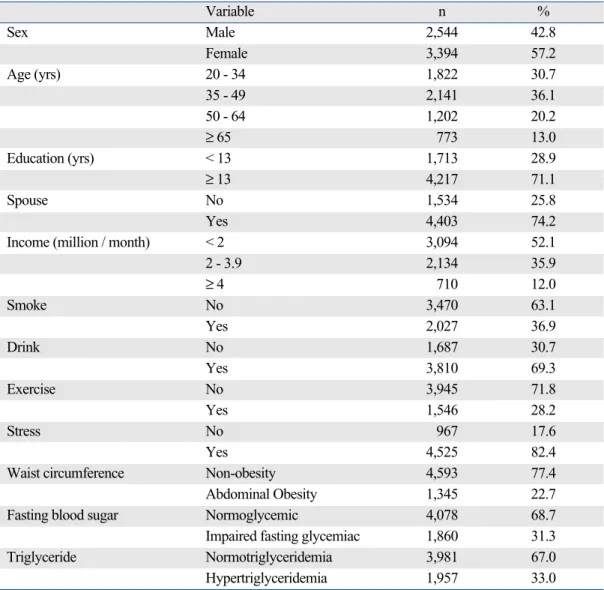
The study population included more females (3,394, 57.2%) than males (2,544, 42.8%). Nonobese subjects comprised 77.4% of the study population, while 22.7% of the subjects had abdominal obesity based on WC. Normoglycemia levels were seen in 68.7% of the participants, and IFG was found in 31.3% on the basis of FBS. Normotriglyceridemic was seen in 67.0% of the participants, and hypertrigly- ceridemia was seen in 33.0% on the basis of TG (Table 1).
Analysis of the relationships between WC, FBS, and TG As shown in Table 2, on the basis of WC, the relationship
MATERIALS AND METHODS
RESULTS
between FBS and TG was examined by classifying the subjects into two groups: nonobesity and abdominal obesity.
Compared to subjects with normal FBS levels, nonobese subjects with IFG had a statistically significant higher rate of hypertriglyceridemia (p < 0.001). Additionally, com-
pared to subjects with normal FBS levels, abdominal obesity subjects with IFG had a slightly higher rate of hypertriglyceridemia, but the difference was not statisti- cally significant .
As shown in Table 3, the relationship between WC and Table 1. Characteristics of the Study Subjects
Variable n %
Sex Male 2,544 42.8
Female 3,394 57.2
Age (yrs) 20 - 34 1,822 30.7
35 - 49 2,141 36.1
50 - 64 1,202 20.2
≥ 65 773 13.0
Education (yrs) < 13 1,713 28.9
≥ 13 4,217 71.1
Spouse No 1,534 25.8
Yes 4,403 74.2
Income (million / month) < 2 3,094 52.1
2 - 3.9 2,134 35.9
≥ 4 710 12.0
Smoke No 3,470 63.1
Yes 2,027 36.9
Drink No 1,687 30.7
Yes 3,810 69.3
Exercise No 3,945 71.8
Yes 1,546 28.2
Stress No 967 17.6
Yes 4,525 82.4
Waist circumference Non-obesity 4,593 77.4
Abdominal Obesity 1,345 22.7
Fasting blood sugar Normoglycemic 4,078 68.7
Impaired fasting glycemiac 1,860 31.3
Triglyceride Normotriglyceridemia 3,981 67.0
Hypertriglyceridemia 1,957 33.0
Table 2. The Difference between FBS and TG by WC
NO AO
Total
NTG HTG NGT HTG
Normoglycemia 2,215 (75.6) 717 (24.4) 623 (54.4) 523 (45.6) 4,078 (100.0)
(75.4) (67.8) (59.7) (58.1) (68.7)
IFG 722 (68.0) 340 (32.0) 421 (52.8) 377 (47.2) 1,860 (100.0)
(24.6) (32.2) (40.3) (41.9) (31.3)
Total 2,937 (73.5) 1,057 (26.5) 1,044 (53.7) 900 (46.3) 5,938 (100.0)
(100.0) (100.0) (100.0) (100.0) (100.0)
p value < 0.01 0.485
WC, waist circumference; FBS, fasting blood sugar; TG, triglyceride; IFG, impaired fasting glucose; NTG, normotriglyceridemic; HTG, hypertriglyceridemia; NO, non-obesity; AO, abdominal obesity.
Values were expressed as n (%).
TG was examined on the basis of FBS by classifying the subjects into two groups: normoglycemia and IFG. In subjects with IFG, the rate of hypertriglyceridemia was higher in those with abdominal obesity as compared with the nonobese subjects. The result in the normoglycemia group was similar to that of the IFG group. These trends were statistically significant (p < 0.0001).
As shown in Table 4, the relationship between WC and FBS was examined on the basis of TG by classifying the subjects into two groups: normotriglyceridemic and hyper- triglyceridemia. In the hypertriglyceridemia group, the incidence of IFG was high in subjects with abdominal obesity as compared with the nonobese subjects. This difference was statistically significant (p < 0.0001). The result in the normotriglyceridemic group was similar to that in the hypertriglyceridemia group.
Moderate effect among WC, FBS and TG
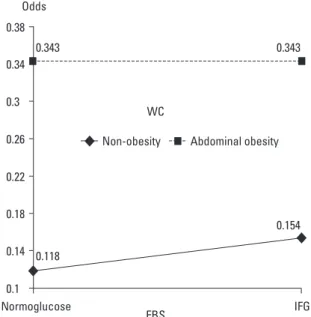
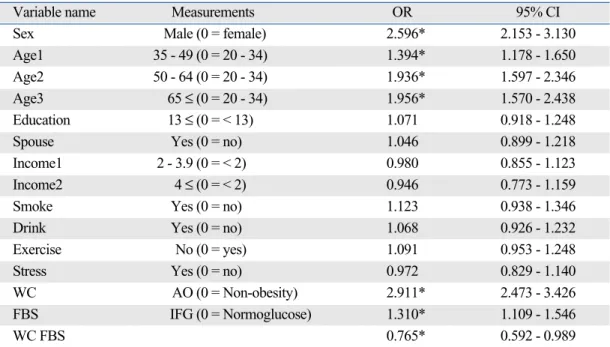
Multiple logistic regression with hypertriglyceridemia indicated that the dependent variables, WC and FBS, were significantly related. We examined whether there was a moderator effect by interaction between WC and FBS that had an effect on hypertriglyceridemia. The relationship is
described in Fig. 1, and the result was statistically signi- ficant (p < 0.05) (Table 5).
Table 3. The Difference between TG and WC by FBS
Normoglycemia IFG
Total
NTG HTG NTG HTG
NO 2,215 (75.6) 717 (24.4) 722 (68.0) 340 (32.0) 3,994 (100.0)
(78.0) (57.8) (63.2) (47.4) (67.3)
AO 623 (54.4) 523 (45.6) 421 (52.8) 377 (47.2) 1,944 (100.0)
(22.0) (42.2) (36.8) (52.6) (32.7)
Total 2,838 (69.6) 1,240 (30.4) 1,143 (61.5) 717 (38.5) 5,938 (100.0)
(100.0) (100.0) (100.0) (100.0) (100.0)
p value < 0.01 < 0.01
WC, waist circumference; FBS, fasting blood sugar; TG, triglyceride; IFG, impaired fasting glucose; NTG, normotriglyceridemic; HTG, hypertriglyceridemia; NO, non-obesity; AO, abdominal obesity.
Values were expressed as n (%).
Table 4. The Difference between FBS and WC by TG
NTG HTG
Total
Normoglycemia IFG Normoglycemia IFG
NO 2,215 (75.4) 722 (24.6) 717 (67.8) 340 (32.2) 3,994 (100.0)
(78.0) (63.2) (57.8) (47.4) (67.3)
AO 623 (59.7) 421 (41.3) 523 (58.1) 377 (41.9) 1,944 (100.0)
(22.0) (36.8) (42.2) (52.6) (32.7)
Total 2,838 (71.3) 1,143 (28.7) 1,240 (63.4) 717 (36.6) 5,938 (100.0)
(100.0) (100.0) (100.0) (100.0) (100.0)
p value < 0.01 < 0.01
WC, waist circumference; FBS, fasting blood sugar; TG, triglyceride; IFG, impaired fasting glucose; NTG, normotriglyceridemic; HTG, hypertriglyceridemia; NO, non-obesity; AO, abdominal obesity.
Values were expressed as n (%).
Fig. 1. The interaction effect between FBS and WC on TG. WC, waist circumference; FBS, fasting blood sugar; TG, triglyceride; IFG, impaired fasting glucose.
Various indices can be used to indicate abdominal obesity, and WC has been suggested to reflect visceral obesity better than the waist-to-hip ratio.21 Pouliot, et al.22 suggested that WC is a useful index for the measurement of abdominal fat.
Freedman, et al.23showed that WC has the highest correla- tion to TG, HDL-C/TC, and systolic blood pressure as compared with other variables for measuring the body, and that it is a risk factor for coronary artery disease (CAD).
WC was also suggested as a criterion of abdominal obesity in NCEP-ATP III. In the case of Western subjects, abdominal obesity is defined as WC of 102 cm and above in men and 88 cm and above in women. According to the recommendations of the WHO Asia-Pacific Region, abdominal obesity in Asians is best defined as a WC of 90 cm or above in men and 80 cm or above in women.11The cutoff point for the criteria of abdominal obesity differs depending on age, sex, and race. In Korea, abdominal obesity is defined as a WC of 90 cm or above in men and 85 cm or above in women.24We used the criteria of WHO Asia-Pacific Region for comparison with other countries, the prevalence of abdominal obesity is 22.7% on WC.
WC was a risk factor more strongly associated with the increased levels of IFG and IGT.25,26Guerrero-Romero, et al.8 reported that the probability of IFG, IGT, and IFG + IGT in obesity were 3.1, 3.2, and 2.8 times higher than in non-obesity, respectively. In this study, abdominal obesity was significantly related to IFG, regardless of hypertrigly-
ceridemia. The odds ratio of having IFG was 2.01 (95%
CI: 1.703-2.362, p < 0.05) higher in people with abdominal obesity than in nonobese individuals. The relationship bet- ween obesity and diabetes has been examined extensively.
IFG is a prediabetic state, and this study clearly demonstrated a relationship between abdominal obesity and glucose metabolism.
The increase of TG in obese patients is due to an increase in VLDL production in the liver and an increase in TG secretion into the blood due to insulin resistance and hyperinsulinemia. The TG rise is caused by increased TG resolution by free fatty acid (FFA), the concentrations of which are high in obese patients.27Wolf and Grundy28 reported that obese people who lost weight experienced reductions in their TG levels of about 40%.
In the present study, a statistically significant relation- ship was also seen between abdominal obesity and hyper- triglyceridemia regardless of IFG. The odds ratio of hypertri- glyceridemia was 2.9 times higher in people with abdominal obesity (95% CI: 2.473-3.426, p < 0.05) than in nonobese subjects. This finding was similar to the results reported previously.27,28
Gerald reported that hypertriglyceridemia is caused by the secretion increase of VLDL and TG due to diabetes.13 The PROCAM study indicated that hypertriglyceridemia and diabetes are independent risk factors for the incidence of CVA.29
Salomaa, et al.15compared the degree of hypertriglyceri- demia according to the degree of glucose intolerance in Fin- nish subjects aged 45 to 64 years old. In the case of men,
DISCUSSION
Table 5. Odds Ratio of the Multiple Logistic Regression for the Hypertriglyceridemia (ORs and 95% CI)
Variable name Measurements OR 95% CI
Sex Male (0 = female) 2.596* 2.153 - 3.130
Age1 35 - 49 (0 = 20 - 34) 1.394* 1.178 - 1.650
Age2 50 - 64 (0 = 20 - 34) 1.936* 1.597 - 2.346
Age3 65 ≤ (0 = 20 - 34) 1.956* 1.570 - 2.438
Education 13 ≤ (0 = < 13) 1.071 0.918 - 1.248
Spouse Yes (0 = no) 1.046 0.899 - 1.218
Income1 2 - 3.9 (0 = < 2) 0.980 0.855 - 1.123
Income2 4 ≤ (0 = < 2) 0.946 0.773 - 1.159
Smoke Yes (0 = no) 1.123 0.938 - 1.346
Drink Yes (0 = no) 1.068 0.926 - 1.232
Exercise No (0 = yes) 1.091 0.953 - 1.248
Stress Yes (0 = no) 0.972 0.829 - 1.140
WC AO (0 = Non-obesity) 2.911* 2.473 - 3.426
FBS IFG (0 = Normoglucose) 1.310* 1.109 - 1.546
WC FBS 0.765* 0.592 - 0.989
WC, waist circumference; AO, abdominal obesity; FBS, fasting blood sugar; IFG, impaired fasting glucose; OR, odds ratio; CI, confidence Interval.
*p < 0.05.
hypertriglyceridemia occurred in 47.6% of patients with diabetes, 21.9% with IGT, and 15.4% with normal glucose tolerance (NGT). In the case of women, hypertriglyceri- demia occurred in 51.9% of patients with diabetes, 25.7%
with IGT, and 10.7% with NGT. These differences were statistically significant after adjusting for age and BMI.
On the other hand, a 9-year longitudinal study perfor- med by Kametani, et al.1in Japan indicated that hypertri- glyceridemia and obesity are independent risk factors for the development of diabetes mellitus. The multivariate- adjusted relative risks for the development of IFG were 1.38 for hypertriglyceridemia and 1.30 for obesity. The relative risk for the development of diabetes mellitus was 1.003 for the TG level.1
St-Pierre, et al.2reported that IFG did not have an effect on the production of CAD in cases of nonobesity and normotriglyceridemic, but an effect was observed on the incidence of CAD in cases of abdominal obesity and hypertriglyceridemia when IFG was higher.
After controlling for age and abdominal obesity in this study, the odds ratio for hypertriglyceridemia in people with IFG was 1.31 (95% CI: 1.109-1.546, p < 0.05) times higher than in people with a normal glucose level. The results of the present study were also similar to other studies.1,15
Obesity was significantly associated with high serum triglycerides in all glucose tolerance groups.15Subjects in the present study were classified into nonobesity and abdominal obesity groups. The relationship between IFG and hypertri- glyceridemia was examined. IFG and hypertriglyceridemia were significantly related in nonobese individuals, as shown in Table 2, but there was no such relationship in abdominal obesity, indicating that there may be an interaction among WC, FBS, and TG. This was supported by the observation that WC and FBS were significantly associated with the dependent variable of hypertriglyceridemia.
This study has limitations. Because of the cross-sectional nature of the study, our study does not identify a causal relationship. Nevertheless, this study is important to deter- mine the relationships and examine the interactions among abdominal obesity, IFG, and hypertriglyceridemia.
This study was supported by a grant of the Korean Health 21 R&D Project, Ministry of Health and Welfare, Republic of Korea(A050463).
1. Kametani T, Koshida H, Nagaoka T, Miyakoshi H. Hyper-
triglyceridemia is an independent risk factor for development of impaired fasting glucose and diabetes mellitus: a 9-year longitu- dinal study in Japanese. Intern Med 2002;41:516-21.
2. St-Pierre J, Lemieux I, Vohl MC, Perron P, Tremblay G, Després JP, et al. Contribution of abdominal obesity and hypertriglyceri- demia to impaired fasting glucose and coronary artery disease.
Am J Cardiol 2002;90:15-8.
3. Schmidt MI, Watson RL, Duncan BB, Metcalf P, Brancati FL, Sharrett AR, et al. Clustering of dyslipidemia, hyperuricemia, diabetes, and hypertension and its association with fasting insulin and central and overall obesity in a general population. Atheros- clerosis Risk in Communities Study Investigators. Metabolism 1996;45:699-706.
4. Guthrie JR, Ball M, Dudley EC, Garamszegi CV, Wahlqvist ML, Dennerstein L, et al. Impaired fasting glycaemia in middle-aged women: a prospective study. Int J Obes Relat Metab Disord 2001;
25:646-51.
5. Cassano PA, Rosner B, Vokonas PS, Weiss ST. Obesity and body fat distribution in relation to the incidence of non-insulin-dependent diabetes mellitus. A prospective cohort study of men in the nor- mative aging study. Am J Epidemiol 1992;136:1474-86.
6. Wilson PW, McGee DL, Kannel WB. Obesity, very low density lipoproteins, and glucose intolerance over fourteen years: The Framingham Study. Am J Epidemiol 1981;114:697-704.
7. Ryu SH, Beck SH, Chang YS, Kim DI, Suh BS, Kim WS, et al.
Abdominal obesity in relation to the incidence of type 2 diabetes mellitus and impaired fasting glucose among some Korean adults: A Retrospective Cohort Study. J Prev Med Public Health 2004;37:359-65.
8. Guerrero-Romero F, Rodríguez-Morán M, Pérez-Fuentes R, Sánchez-Guillén MC, González-Ortiz M, Martínez-Abundis E, et al. Prediabetes and its relationship with obesity in Mexican adults:
The Mexican Diabetes Prevention (MexDiab) Study. Metab Syndr Relat Disord 2008;6:15-23.
9. The Third Korea National Health and Nutrition Examination Survey (KNHANES III) 2005-Health Examination-. Seoul:
Korean Ministry of Health and Welfare, Korea Centers for Disease Control and Prevention; 2006. p.58-62.
10. van Wijk JP, Halkes CJ, Erkelens DW, Castro Cabezas M.
Fasting and daylong triglycerides in obesity with and without type 2 diabetes. Metabolism 2003;52:1043-9.
11. Després JP, Allard C, Tremblay A, Talbot J, Bouchard C. Evidence for a regional component of body fatness in the association with serum lipids in men and women. Metabolism 1985;34:967-73.
12. Gopal L, Sunder KS, Rao SK, Soni M, Sharma S, Ramakrishnan S. Hyperlipidemia in a poorly controlled diabetic presenting with lipemic aqueous and lipemia retinalis. Retina 2004;24:312-5.
13. Kannel WB, Gordon T. Physiological and medical concomitants of obesity: The Framingham Study. In: Obesity in America.
Washington, D.C. : NIH Publication; 1979. p.125-63.
14. Gerald PS. X-linked mental retardation and the fragile-X syn- drome. Pediatrics 1981;68:594-5.
15. Salomaa VV, Tuomilehto J, Jauhiainen M, Korhonen HJ, Stengård J, Uusitupa M, et al. Hypertriglyceridemia in different degrees of glucose intolerance in a Finnish population-based study. Diabetes Care 1992;15:657-65.
16. Kim SM, Lee JS, Lee J, Na JK, Han JH, Yoon DK, et al. Pre- valence of diabetes and impaired fasting glucose in Korea:
Korean National Health and Nutrition Survey 2001. Diabetes Care 2006;29:226-31.
ACKNOWLEDGEMENTS
REFERENCES
17. Choi KM, Park HS, Han JH, Lee JS, Lee J, Ryu OH, et al. Pre- valence of prehypertension and hypertension in Korean population:
Korean National Health and Nutrition Survey 2001. J Hypertens 2006;24:1515-21.
18. World Health Organization (WHO)/International Association of the Study of Obesity (IASO)/ the International Obesity Task Force (IOTF). The Asia-Pacific perspective: redefining obesity and its treatment. Melbourne: Health Communications Australia;
2000. p.20.
19. Expert Committee on the Diagnosis and Classification of Dia- betes Mellitus. Report of the expert committee on the diagnosis and classification of diabetes mellitus. Diabetes Care 2003;26 Suppl 1:S5-20.
20. National Cholesterol Education Program (NCEP) Expert Panel on Detection, Evaluation, and Treatment of High Blood Choles- terol in Adults (Adult Treatment Panel III). Third Report of the National Cholesterol Education Program (NCEP) Expert Panel on Detection, Evaluation, and Treatment of High Blood Choles- terol in Adults (Adults Treatment Panel III) final report. Circula- tion 2002;106:3143-421.
21. Expert Panel on Detection, Evaluation, and Treatment of High Blood Cholesterol in Adults. Executive Summary of The Third Report of The National Cholesterol Education Program (NCEP) Expert Panel on Detection, Evaluation, And Treatment of High Blood Cholesterol In Adults (Adult Treatment Panel III). JAMA 2001;285:2486-97.
22. Pouliot MC, Després JP, Lemieux S, Moorjani S, Bouchard C, Tremblay A, et al. Waist circumference and abdominal sagittal diameter: best simple anthropometric indexes of abdominal visceral adipose tissue accumulation and related cardiovascular
risk in men and women. Am J Cardiol 1994;73:460-8.
23. Freedman DS, Srinivasan SR, Harsha DW, Webber LS, Berenson GS. Relation of body fat patterning to lipid and lipoprotein con- centrations in children and adolescents: the Bogalusa Heart Study. Am J Clin Nutr 1989;50:930-9.
24. Lee SY, Park HS, Kim SM, Kwon HS, Kim DY, Kim DJ, et al.
Cut-off points of waist circumference for defining abdominal obesity in the Korean population. Korean Journal of Obesity 2006;15:1-9.
25. Gómez-Ambrosi J, Pastor C, Salvador J, Silva C, Rotellar F, Gil MJ, et al. Influence of waist circumference on the metabolic risk associated with impaired fasting glucose: effect of weight loss after gastric bypass. Obes Surg 2007;17:585-91.
26. Thompson JL, Herman CJ, Allen P, Helitzer DL, Wilson ND, Whyte AN, et al. Associations between body mass index, cardio- respiratory fitness, metabolic syndrome, and impaired fasting glucose in young, urban native american women. Metab Syndr Relat Disord 2007;5:45-54.
27. Olefsky JM. Obesity. In: Harrison TR editor. Principles of internal medicine. 12th ed. New York: McGraw-Hill Inc.; 1991. p.411-4.
cited from Kook SR, Park YS, Ko YK, Kim SM, Lee DJ, Kang HC, et al. Relationship of body fat, lipid, blood pressure, glucose in serum to waist-hip ratio between obese and normal body mass index group. J Korean Acad Fam Med 1997;18:317-27.
28. Wolf RN, Grundy SM. Influence of weight reduction on plasma lipoprotein in obese patients. Arteriosclerosis 1983;3:160-9.
29. Assmann G, Schulte H, von Eckardstein A. Hypertriglyceridemia and elevated lipoprotein(a) are risk factors for major coronary events in middle-aged men. Am J Cardiol 1996;77:1179-84.