Isolation and Characterization of Bioactive Compounds from Root of Rubus coreanus Miquel and their
Antimicrobial Activity
Ha Na Jang, Ji Hoon Ha, Yoon Ju Lee, Min Min Fu, and Soo Nam Park*
Department of Fine Chemistry, Cosmetic R&D Center, Seoul National University of Science and Technology, Seoul 01811, Republic of Korea
Received: August 16, 2018 / Revised: October 18, 2018 / Accepted: November 5, 2018
Introduction
The unhealthy skin of modern people is likely to increase pathogen population by abnormal skin condi- tion due to irregular eating habits and sleeping time and environmental stress [1, 2]. As skin pathogens that induces inflammation of the skin, there are strains such as Staphylococcus aureus (S. aureus), Propionibacterium acnes (P. acnes), Bacillus subtilis (B. subtilis), Escherichia
coli (E.coli), Pseudomonas aeruginosa (P. aeruginosa). In particular, P. acnes is widely distributed in hair follicles and sebaceous glands, and is known to cause pyogenic infection and atopic dermatitis [3, 4]. S. aureus is dis- tributed in the nasal passages and skin, leading to the formation of purulent dermatitis and pus through skin wounds [5]. B. subtilis is a cause of conjunctivitis, and P.
aeruginosa causes meningitis and sepsis [6]. Especially, E. coli, P. aeruginosa and S. aureus are pathogenic strains and are regulated by the cosmetic raw. Most bio- compatible product such as cosmetics, containing rich in nutrients and water, can be contaminated with microor- ganisms, leading to infection of bacteria in skin and Rubus coreanus Miquel (RCM), also known as Korean blackberry or bokbunja, is used as a South Korean traditional medicine to treat acne and inflammatory skin conditions. The antimicrobial activity of RCM root and its active compounds remain unclear. In this study, we prepared a 50% ethanol fraction, ethyl ace- tate fraction, and acid-treated ethyl acetate fraction (aglycone fraction) of RCM root, and evaluated anti- bacterial activities against the skin pathogens Staphylococcus aureus, Pseudomonas acnes, Bacillus subtilis, Escherichia coli, and Pseudomonas aeruginosa. In a paper disc assay, all fractions of RCM root showed antimicrobial activities against the five skin pathogens. The ethyl acetate fraction displayed 6-, 12-, and 2-fold higher minimal inhibitory concentration (MIC) than the 50% ethanol fraction against S.
aureus, E. coli, and P. acnes, respectively. The aglycone fraction displayed 2-fold higher MIC than methyl paraben against P. acnes, S. aureus, E. coli, and P. aeruginosa. The ethyl acetate fraction displayed a mini- mal bactericidal concentration (MBC) similar to that of methyl paraben, and the aglycone fraction showed 2- to 4-fold higher MBCs than those of methyl paraben. In particular, the ethyl acetate fraction was not cytotoxic and showed thermal stability after incubation at high temperatures (60−121℃). Finally, the ethyl acetate fraction was separated and four components were identified: procyanidin C, propelagonidin dimer, ellagic acid, and methyl ellagic acid acetyl pentose. The compounds showed high antibacterial activities.
These results suggest that RCM root is potentially applicable as a natural preservative in cosmetics.
Keywords: Rubus coreanus Miquel root, antibacterial activity, identification, natural preservative, ellagic acid, methyl paraben
*Corresponding author
Tel: +82-2-970-6451, Fax: +82-2-972-9585 E-mail: [email protected]
© 2019, The Korean Society for Microbiology and Biotechnology
eyes. Also proliferation of bacteria changes in flavor, color and viscosity of the cosmetics [7].
Preservatives are used to protect cosmetics from vari- ous problems caused by microorganisms, and parabens (such as methyl paraben) are commonly used preserva- tives [8]. However, a recent research indicated that par- abens can act as environmental hormones, and it has raised concerns about the safety [9]. Therefore, the natu- ral preservatives, including the anti-microorganism materials such as alkaloids, flavonoids and phytoalexin, were developed to use in the field of cosmetics and food [10, 11].
To resolve the problem of safety using plants as tradi- tionally to manage microbial infection or contamination, we targeted R. coreanus Miquel (RCM) [12−14]. RCM is a kind of rubus belonging to Rosaceae, which grows in South Korea, China and Japan [15]. Especially, RCM root was registered as skin conditioning agents at Inter- national Cosmetic Ingredient Dictionary (ICID) and Cos- metic ingredient dictionary in our country. Additionally, related patents were registered to use in cosmetic in Korea [16, 17]. RCM root is reported to have the anti- inflammation effects through the reduction of produc- tion of NO and cytokines (IL-1β, IL-6 and IL-10) and expression of cyclooxygenase (COX)-2 and prostaglandin E2 (PGE2). RCM root has the anti-bacterial activities against resistant bacteria containing methicillin-resistant Staphylococcus aureus (MRSA) as dangerous skin micro- organism, carbapenem-resistant Acinetobacter baumannii (CRAB) and Bacillus anthracis [10]. RCM root was stud- ied that it improved acne skin and chronic relapsing inflammatory skin disorder were improved in clinical test. Phenolic compounds and nutrients (minerals, phos- phorus, iron, potassium, organic acids, etc.) are present in RCM, which is known for various antioxidant, anti- cancer and the enhancement effect of immunity [12, 18].
However, the research of RCM root has not been deeply known on the antibacterial activity against skin pathogen (S. aureus, P. acnes, B. subtilis, E. coli and P. aeruginosa).
The purpose of this study was to evaluate the antimi- crobial activity of extracts and fractions from RCM root on the paper disc, minimal inhibitory concentration (MIC) and minimal bactericidal concentration (MBC) methods, time-kill curve assay, and to identify the main active compound.
Materials and Methods
Equipment and chemicals
An ultraviolet-visible (UV-VIS) spectrophotometer was used for Cary 50 (Varian, Australia), high-perfor- mance liquid chromatograph (HPLC, Shimadzu, Japan).
A pH meter was used for Metter Toledo (Europe).
Methyl paraben, the positive control in the antimicrobial activity studies was purchased from Sigma Chemical Co., USA). The solvents including ethanol, methanol, ethyl acetate, n-hexane, formic acid, acetonitrile, and dimethyl sulfoxide (DMSO) were a special grade chemi- cal from the Daejung Chemicals & Metals Co., Ltd., Korea).
Plant material
The R. coreanus (RCM) root was purchased from Cos- metic Research and Development Center (Korea) in which all traditional Korean herbs were deposited and identified by herbal expert according to the Korean herbal pharmacopoeia. A voucher specimen of R.
coreanus was deposited at our laboratory in Seoul Uni- versity of Science and Technology (# RCM_003). The plant material has been prepared in the form of dried powder at -70℃.
Preparation of RCM root crude extract and fractions Dried healthy RCM root (100 g) were successively extracted at room temperature with 1 L of 50% ethanol fraction for 24 h. The filtered ethanol fraction was then powdered using reduced pressure and enrichment using rotary evaporator. The organic and non-polar material was removed from the rest of the extract using n-hexane and then it was partitioned with ethyl acetate. In addi- tion, the aglycone was obtained by acidic hydrolysis with ethyl acetate fraction. ethyl acetate fraction was mixed with 5% H2SO4 and acetone and then refluxed, cooled, and heated with boiling water for 4 h. After the neutral- ization-titration reaction with 5% KOH-methanol, the powder obtained by fractionation with ethyl acetate was further dissolved in 100% ethanol. Yield of 50% ethanol fraction and ethyl acetate, aglycone fractions was 8.64, 2.68, and 0.98%, respectively. The components of all extracts were evaluated, and their antimicrobial activi- ties were evaluated. All samples were stored at -70℃.
Bacterial strains, media and buffers
The skin flora microorganisms tested were Gram-posi- tive bacteria including B. subtilis (ATCC19659), P. acnes (ATCC6919) S. aureus (ATCC6538); Gram-negative bac- teria including E. coli (ATCC23736), P. aeruginosa (ATCC29336); and the yeast P. ovale (ATCC12078). The organisms were obtained from the Korean Culture Cen- ter of Microorganisms (KCCM). P. acnes was cultured in reinforced clostridial (RC) broth (Merck, Germany) using an anaerobic jar with the Gaspak system (Merck Anaerocult® Gaspak System, Germany) for 48 h at 37℃.
Four strains were cultivated on Mueller-Hinton broth (Merck, Germany) for 24 h at 37℃.
Disc diffusion assay
The RCM root fractions and methyl paraben were respectively dissolved in DMSO, a negative control, to obtain a final concentration of 50 mg/ml. Briefly, a 100 μl sample of a suspension containing approximately 106− 107 colony-forming units (CFU)/ml of the bacterial cells was spread onto nutrient agar. For the antibacterial test, paper disc (8 mm in diameter, Roshi Kaisha Ltd., Japan) were separately impregnated with 50 μl of 50 mg/ml plant extracts (2.5 mg/disc) and placed on the inoculated agar. For the positive control, paper disc were impregnated with the same amount (50 μl) of methyl paraben (2.5 mg/disc) dissolved in both types of solvents used. Plates were incubated at 37℃ for 24−48 h for bac- terial strains. Antimicrobial activity was assessed by measuring the diameter of the growth inhibition zone (IZ) in mm (including disc diameter of 8 mm) for the test organisms, compared to controls.
Broth dilution assay
The broth dilution methods including MIC and MBC assay were used to evaluate the antibacterial activity in Iso-Standards Institute (CLSI, formerly NCCLS) proce- dures (NCCLS, 2003). The 48-well culture plates were inoculated 10 μl of a diluted bacterial suspension con- taining about 106−107 CFU/ml with the dissolved sam- ples (100 μl) in Mueller-Hinton broth or reinforced clostridial broth according to the bacterial species. Cell suspensions incubated with saline solution and without samples were used as controls. The incubation condi- tions were for 24 or 48 h at 37℃. The wells were re-inoc- ulated with the sterile medium to evaluate whether the
concentrations showed microbicidal effects by no observ- able growth in the wells treated by methyl praben.
Time-kill curve assay
Time-kill curve experiments were performed for each strain [19]. Based on results obtained from broth dilu- tion assay, particular concentrations of RCB root ethyl acetate and aglycone fractions against various microor- ganisms; B. subtilis, S. aureus, E. coli, P. aeruginosa, P.
acnes. Survival microbial counts were measured to con- firm the influence of RCB root fractions in microbial sus- pensions over time. Subsequently, to confirm populations of bacteria incubated for a period of time, suspensions were diluted by sterilized saline, spread on RC agar medium plates and incubated for 24 h or 48 h at 37℃.
Thermal stability
The stability of the ethyl acetate fraction following heat treatment was determined by disc diffusion assay using P. acnes. The 50 mg/ml fraction was dissolved in DMSO was incubated at different temperatures (60, 80, and 100℃ for 2 h) in a water bath and by auto clave (121℃ for 15 min). The samples were slowly cooled at room temperature for 1 h, and then thermal stability based on antimicrobial activity was measured by deter- mining the inhibition zone.
Cytotoxicity test
HaCaT cells (provided by the Kyung Hee University Skin Biotechnology Center) were incubated in Dulbecco’s modified Eagle’s medium (DMEM) supplemented with 10% FBS and 1% penicillin-streptomycin at 37℃ in an atmosphere of 5% CO2. Cell viability was determined using the 3-(4,5-dimethythiazol-2-yl)-2,5-di-phenytetra- zolium bromide (MTT, Sigma, USA) assay. HaCaT cells were seeded at a density of 1 × 10⁴ cells in a 96-well plate template at 37℃ in a 5% CO2 atmosphere. Samples of RCM root were added at varying concentrations (63− 1000 μg/ml) for 24 h. After washing two times, the MTT solution (2 μg/ml) was added to each well of a 96-well plate, and the samples were incubated for 1 h. The for- mazan crystals produced were dissolved in DMSO and quantified by measuring their optical density at 570 nm using an enzyme-linked immunosorbent assay (ELISA) reader (Tecan, Austria). These values were subtracted from the final absorbance reading to eliminate back-
ground interference. The value was expressed using the following equation.
Cell viability (%) = (Aexperiment/Acontrol) × 100
TLC and HPLC separations of ethyl acetate fraction com- ponents
For the phenolic-rich solids content analysis of the ethyl acetate fraction, it was dissolved in 100% ethanol and filtered through a syringe filter (Millipore 0.45-μm).
The filtrate was then used for the experiments. The TLC developing solvents was a mixture of acetonitrile : 0.4%
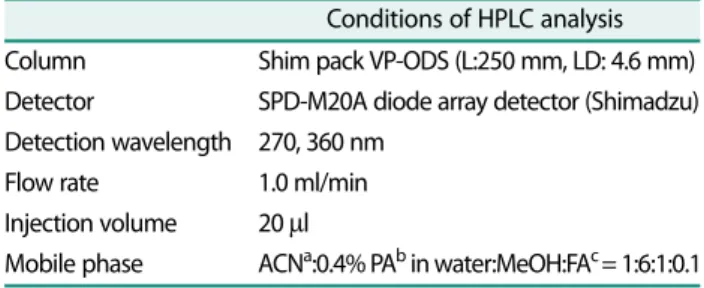
phosphoric acid : methanol : formic acid at a volume ratio of 4 : 6 : 1 : 0.1. HPLC analysis (Shimadzu, Japan) used a Shim pack VP-ODS (L: 250 mm, LD: 4.6 mm) col- umn as a stationary phase. The analysis conditions are shown in Table 1.
Liquid Chromatography (LC)/electrospray Ionization (ESI)-MS/MS analysis
The LC/ESI-MS/MS (Thermo Scientific, USA) was used to further characterize the five components (Peak 2−5) isolated from ethyl acetate fraction of RCM root.
The liquid chromatography (LC) parameters used for the
separation included column specifications of UVD Spher Pur C18-E 1.8 m, 50 × 2.0 mm (Cat.-No. N0520E181UVC).
The injection volume and flow rate were 5 μl and 200 μl/
min, respectively. The mobile phase consisted of 0.1%
formic acid (solution A) and acetonitrile (solution B).
Gradient elution at a flow rate of 200μl/min was per- formed as follows: total run time, 30 min; ionization of analysis was by ESI; capillary temperature, maintained at 275℃; ion source voltage, 5 kV; and sheath and aux gas, 30 and 5 units, respectively. The capillary voltage was set at 45 or -15 V in the positive or negative ioniza- tion modes.
Statistical analysis
All experiments were repeated in triplicate, and statis- tical analyses were performed using the student’s T-test at 5% a significant level.
Results
Antibacterial and bactericidal activities of RCM root The antimicrobial activities of the fractions were eval- uated using a disc diffusion assay against Gram-positive (B. subtilis, P. acnes, and S. aureus) and Gram-negative bacteria (E. coli and P. aeruginosa) constituting skin microflora. The 50% ethanol fraction, ethyl acetate frac- tion and aglycone fraction of RCM root indicated antimi- crobial activities as shown the growth inhibition zones against all bacteria (Table 2). The aglycone fraction of RCM root showed higher antibacterial activity than 50%
ethanol fraction and ethyl acetate fraction, and its activ- ity was similar to that of methyl paraben as positive con- trol. The 50% ethanol fraction and ethyl acetate fraction has antibacterial activity although their activities were lower than methyl paraben against all microorganisms Table 1. Conditions for high-performance liquid chromatog-
raphy (HPLC) analysis.
Conditions of HPLC analysis Column Shim pack VP-ODS (L:250 mm, LD: 4.6 mm) Detector SPD-M20A diode array detector (Shimadzu) Detection wavelength 270, 360 nm
Flow rate 1.0 ml/min
Injection volume 20 µl
Mobile phase ACNa:0.4% PAb in water:MeOH:FAc = 1:6:1:0.1
aACN, acetonitrile; bPA, phosphoric acid; cFA, formic acid.
Table 2. Antimicrobial activity of R. coreanus Miquel Root against microorganisms.
Microorganisms Strain Inhibition zone (mm)
50% Ethanol fraction Ethyl acetate fraction Aglycone fraction Methyl parbenb
B. subtilis ATCC19659 12.50± 0.50 12.83± 0.29 15.51± 0.11 16.83± 0.29
P. acnes ATCC6919 15.67± 0.58 18.08± 0.14 17.67± 0.58 19.33± 1.15
S. aureus ATCC6538 11.17± 0.29 12.83± 0.29 17.50± 0.50 17.67± 0.58
E. coli ATCC23736 12.17± 0.29 15.50± 0.50 18.17± 0.29 16.67± 0.58
P. aeruginosa ATCC29336 12.08± 0.14 14.50± 0.50 18.08± 0.14 18.67± 0.58
Concentration of fractions was 2.5 mg/disc. Zones of inhibition include diameter of disc (8 mm). The value expressed as mean ± SD (n = 3).
aNo inhibition. bPositive control.
on paper disc assay. These results suggest that the extract and fractions of RCM root have the antimicrobial activities.
The MIC and MBC of each fraction was evaluated based on the results of the disc diffusion assay. As shown in Table 3, MICs of the 50% ethanol fraction were 0.50, 1.00, 3.00, 3.00, and 0.50% against B. subtilis, P. acnes, S. aureus, E. coli, and P. aeruginosa, respectively. Espe- cially, 50% ethanol fraction showed high antimicrobial activities against B. subtilis and P. aeruginosa. The ethyl acetate fraction and aglycone fraction indicated high antibacterial effects against all microorganism. The ethyl acetate fraction showed a 6-, 12-, and 2-fold higher MICs than the ethanol fraction against S. aureus, E.
coli, and P. acnes respectively. However, the ethyl ace- tate fraction showed MICs similar or lower than methyl
paraben. In contrast, the aglycone fraction indicated 2- fold higher MICs than those of methyl paraben against P. acnes, S. aureus and P. aeruginosa.
In the MBC evaluation, the 50% ethanol fraction indi- cated 1.00, 1.00, 4.00, 4.00, and 1.00% against B. subtilis, P. acnes, S. aureus, E. coli, and P. aeruginosa. The 50%
ethanol fraction showed the same MBCs to methyl para- ben against B. subtilis and P. aeruginosa. The ethyl ace- tate fraction indicated the MBCs similar to those of methyl paraben against B. subtilis, P. acnes, E. coli and P. aeruginosa. Surprisingly, the aglycone fraction indi- cated 2- to 4-fold higher MBC than those of methyl para- ben against all bacterial spectra excluding P. acnes. The 50% ethanol fraction and fractions of RCM root exhib- ited a potent antimicrobial activity against P. aerugi- nosa, which is impressive because this species show high Table 3. MIC and MBC of extract and fraction of R. coreanus Miquel root against various bacteria.
Microorganisms MIC/MBC (%, w/v)
50% Ethanol fraction Ethyl acetate fraction Aglycone fraction Methyl paraben
B. subtilis 0.50/1.00 0.50/1.00 0.25/0.25 0.25/1.00
P. acnes 1.00/1.00 0.50/0.50 0.13/0.50 0.25/0.50
S. aureus 3.00/4.00 0.50/1.00 0.13/0.25 0.25/0.50
E. coli 3.00/4.00 0.25/0.50 0.13/0.25 0.13/0.50
P. aeruginosa 0.50/1.00 0.50/1.00 0.25/0.25 0.50/1.00
Fig. 1. HaCaT cell viability of R. coreanus Miquel root extract and fractions by MTT assay. (A) 50% ethanol extract, (B) ethyl acetate fraction, (C) aglycone fraction, (D) Methyl paraben.
resistance against to all kinds of preservatives.
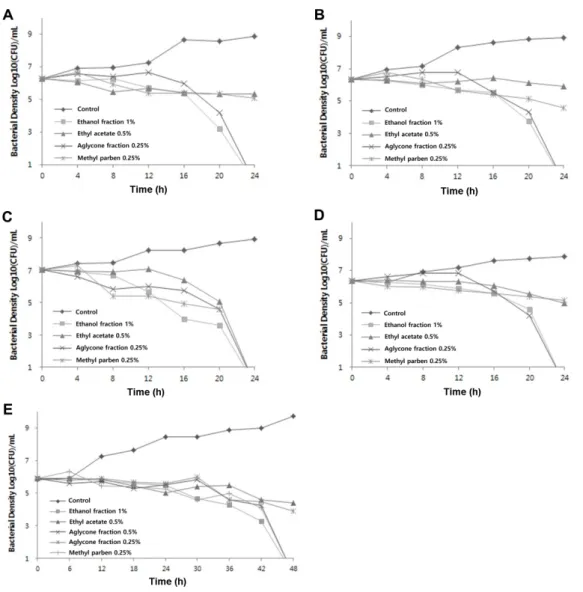
We attempted to determine whether the activity of the fractions is bacteriostatic or bactericidal by conducting time-kill studies against skin microflora. The used con- centrations were based on the MIC or MBC results of the ethyl acetate and aglycone fractions (Table 3). The fractions and methyl paraben (positive control) were incubated at 0.25−1.00% concentrations for 24−48 h with each bacteria. Then, the colonies analysis per time were observed to determine the growth inhibition changes of samples for the time interval (Fig. 1). Overall, while the untreated negative control (DMSO) showed a substan-
tial increase in colonies with time, sample groups indi- cated bacteriostatic activity at MICs and bactericidal activity at MBCs. 1% ethyl acetate fraction and 0.25 aglycone fraction immediately reduced, and killed all bacteria within 24 h except for P. acnes, which was bac- tericidal after 48 h. 0.5% ethyl acetate fraction and 0.25% methyl paraben only killed E. coli within 24 h.
These results suggest that effective compounds exist in RCM root against verious bacteria.
Cytotoxicity of RCM root extract and fractions
When preservatives are applied to human skin, their
Fig. 2. Time-kill curves of ethyl acetate and aglycone fractions of R. coreanus Miquel root, control (DMSO) and methyl paraben (MP) against various microorganisms; (A) B. subtilis, (B) S. aureus, (C) E. coli, (D) P. aeruginosa, (E) P. acnes. In the initial stages of the experiment, the microorganisms were inoculated with 106−107 colony-forming units (CFU)/ml, and then treated with various samples for 24 or 48 h. Values represent means ± SD at the following times after the treatment of indicated samples in triplicate measurements.
safeties are important. To determine the cell viabilities of RCM root extract and fractions, we carried out MTT assay (Fig. 2). 50% ethanol fraction and aglycone frac- tion of RCM root indicated low cell viabilities. Especially, the aglycone fraction indicated high cytotoxicity at 63μg/ml. On the other hand, ethyl acetate fraction of RCM root indicated cell growth activity rather than cyto- toxicity from 63 μg/ml to 500 μg/ml. Only the ethyl ace- tate fraction of all revealed nontoxic activity at all tested concentrations. Methyl paraben indicated no cytoxicity by 500 μg/ml (91% cell viability). This suggests that the RCM root ethyl acetate fraction is highly applicable for use as a natural antiseptic alternative to the synthetic methyl paraben. Therefore, we carried out the thermal stability analysis of RCM root ethyl acetate fraction.
Thermal stability of ethyl acetate fraction of RCM root To apply for cosmetic, we confirm thermal stability of RCM root ethyl acetate fraction. ethyl acetate fractions heated at various temperature (60, 80, 100 and 121℃).
Each fractions showed the same inhibition zone against P. acnes, which were equal to the values of the untreated samples (Fig. 3). These results indicate that the ethyl acetate fraction of RCM root is heat stable up to 121℃.
Therefore, the constituents of the ethyl acetate fraction would maintain their original efficacy following indus- trial applications required heating. These results sug- gest that the antibacterial compounds in ethyl acetate fraction of RCM root are thermodynamically stable mol- ecules, which are useful for cosmetic formulation.
Separation and identification of antibacterial effective components analysis of ethyl acetate fraction of RCM root To identify the antibacterial and thermodynamically
stable compounds of RCM root ethyl acetate fraction, we separated and analyzed by UV spectroscopy, HPLC and LC/ESI-MS. The HPLC data of the stable and high anti- bacterial effective ethyl acetate fraction separated four bands (RC-1, RC-2, RC-3 and RC-4) following determi- nation of the UV-visible spectrum (Fig. 4). Four peaks clearly separated bands. RC-1 and RC-2 were similar to a flavonoid wavelength, which absorbed at 270 and 365 nm together, but RC-3 and RC-4 just absorbed at 270 nm such as phenolic acid. Then, their molecular weights were analyzed by LC/ESI-MS (Thermo Scien- tific, USA) and referenced previously reported spectro- scopic information (Table 4). They were identified as follow RC-1 (procyanidin C), RC-2 (propelagonidin dimer), RC-3 (ellagic acid), and RC-4 (methyl ellagic acid acetylpentose) (Fig. 5). Finally, we confirmed that their retention times and absorption spectrums of RCs corre- sponded with those of the standards on HPLC analysis.
These results suggest that the antibacterial activities of RCM root ethyl acetate faction are contributed by procy- anidin C, propelagonidin dimer, ellagic acid, and methyl ellagic acid acetylpentose.
Antimicrobial activity of RCM root components
To confirm whether the components of RCM root con- tribute the antibacterial activities against skin micro- flora. We evaluated the MIC and MBC of the bioactive components to elucidate their antibacterial effects (Table 5). MICs of procyanidin C were 0.10% against P.
Fig. 3. Effect of heat treatment on antibacterial activities of ethyl acetate fraction from Rubus coreanus Miquel root against (A) P. acnes and (B) no bacteria. Each ethyl acetate fraction (5%) from RCM root was used after heating at (a) 60℃ , (b) 80℃ and (c) 100℃ for 2 h, and (d) 121℃ for 30 min.
Fig. 4. HPLC chromatogram of ethyl acetate fraction from R.
coreanus Miquel root. (A) 270 nm, (B) 360 nm.
acnes, S. aureus, E. coli, and P. aeruginosa, while it was 0.20% against B. subtilis [27]. The propelagonidin dimer had antibacterial activity against P. acnes, S. aureus, E.
coli, and P. aeruginosa at 0.20%, and B. subtilis at 0.40%. Ellagic acid acetylpentose showed antibacterial
activities against P. acnes, S. aureus, E. coli, and P.
aeruginosa at 0.40% but B. subtilis at 0.20%. In particu- lar, ellagic acid showed high anti-microorganism against B. subtilis, P. acnes, S. aureus, E. coli, and P. aeruginosa at 0.0062, 0.0625, 0.0015, 0.0015 and 0.0015%, respec- tively. Ellagic acid indicated lower MBC values than other compounds, furthermore it showed 3.2- to 266-fold higher anti-bacterial activities than methyl paraben against the bacteria spectrums.
Discussion
In this study, 50% ethanol fraction, ethyl acetate frac- tion of the RCM root are prepared and also the ethyl ace- tate fraction is deglycosylated (aglycone fraction) for enhancing antibacterial activity. The extract and frac- tions were investigated on antibacterial activities against skin pathogens. S. aureus, P. acnes, B. subtilis, E. coli, P. aeruginosa. 50% ethanol fraction and the frac- tions of RCM root showed antimicrobial activities on paper disc assay, MICs and MBCs as well as methyl par- aben. Especially, the ethyl acetate fraction showed more twice higher MICs than the 50% ethanol fraction against S. aureus, E. coli, and P. acnes. The ethyl acetate Table 4. Peak number, UV spectra, retention time, m/z [M-H]− ion, MSn fragments of compounds obtained by LC-ESI-MSanal- ysis of R. coreanus Miquel root.
Peak tRa (min) MW UV (nm) [M-H]−
(m/z)
[M-H]+
(m/z) Identified names Reference
1 4 866 243, 276 865 867 Procyanidin C [20, 21]
2 7 563 240, 279 562 564 Propelagonidin dimer [22, 23]
3 17 302 252, 360 301 303 Ellagic acid [24, 25]
4 35 490 252, 360 489 491 Methyl ellagic acid acetylpentose [26]
aRetention time.
Fig. 5. Chemical structures of the identified compounds in ethyl acetate fraction of R. coreanus Miquel root. (A) procy- anidin C, (B) propelagonidin dimer, (C) ellagic acid, (D) methy- lellagic acid acetylpentose.
Table 5. MIC and MBC of the compounds identified from R. coreanus Miquel root against various bacteria.
Microorganisms
MIC/MBC (%, w/v)
Procyanidin C Propelagonidin dimer Ellagic acid Methyl ellagic acid
acetylpentose Methyl paraben
B. subtilis 0.20/0.40 0.40/0.80 0.0062/0.0125 0.20/0.40 0.20/0.80
P. acnes 0.10/0.40 0.20/0.20 0.0625/0.2500 0.40/0.40 0.20/0.40
S. aureus 0.10/0.20 0.20/0.40 0.0015/0.0062 0.40/0.80 0.20/0.40
E. coli 0.10/0.20 0.20/0.80 0.0015/0.0062 0.40/0.80 0.10/0.40
P. aeruginosa 0.10/0.20 0.20/0.40 0.0015/0.0062 0.40/0.80 0.40/0.80
*Negative control (DMSO) indicated no anti-bacterial activity.
fraction possessed MBCs similar to that of methyl para- ben. ethyl acetate was also not cytotoxic and showed thermal stability after incubation at high temperatures (60−121℃) but not aglycone fraction. Four components (procyanidin C, propelagonidin dimer, ellagic acid, and methyl ellagic acid acetyl pentose) were identified from the ethyl acetate fraction. The compounds showed high antibacterial activities against skin pathogens. In partic- ular, ellagic acid showed 3.2- to 266-fold higher antimi- crobial activities than methyl paraben against all bacterial spectra. The antibacterial activity of ellagic acid was contributed by functional group as catechol, which is already reported to have greater activity against Gram-positive than Gram-negative bacteria [28]
through the perturbation in lipid bilayers, by directly penetration and induction of damage to disrupt the bar- rier function [29]. For this reasons, ellagic acid has vari- ous antibacterial activities. 1) Ellagic acid attenuates the function of many proton pumps, proteins, and recep- tors on the cell membrane. 2) It has an intramolecular catechol structure it can impair homeostasis or calcium signaling by chelating calcium and, thereby, disrupting the metabolism of the microorganism with resultant death. 3) It has antioxidative effect by phenolic struc- ture. Antioxidative effect can quench the electrons from free radicals and disrupt the flow of the electrons at the level of cytochromes and inhibit the growth of bacteria by disrupting oxidative phosphorylation. 4) It is made by partial hydrophobicity, which become stack or embed on the membrane surface. It induce a change in the mem- brane structure by creating a hydrophobic environment around the cell. In addition, this may inactivation pro- teins by inducing protein unfolding. A rigid membrane destabilizes the cell by weakening membrane integrity, which may disrupt critical transport processes and induce the collapse of the bacterial membrane [30, 31].
Thus, ellagic acid may contribute the antibacterial activ- ities of the ethyl acetate fraction of RCM root.
In conclusion, RCM root suggest that it is applicable to natural preservatives in cosmetics by high antimicrobial activities, no cytotoxicity and thermal stability. In fur- ther study, these preliminary results need to be improved by other works with in vivo study (pharmaco- kinetic, toxicity and etc.) in animal or human model for application of such compounds as natural preservatives in cosmetics.
Conflict of Interest
The authors have no financial conflicts of interest to declare.
References
1. Sofos JN, Beuchat LR, Davidson PM, Johnson EA. 1998. Naturally occurring antimicrobials in food. Regul. Toxicol. Pharmacol. 28:
71-72.
2. Cushnie TP, Lamb AJ. 2005. Antimicrobial activity of flavonoids.
Int. J. Antimicrob. Agents. 26: 343-356.
3. Gyawali R, Ibrahim SA. 2014. Natural products as antimicrobial agents. Food Control. 46: 412-429.
4. Jeong HS, Han JG, Han JH, Kim Y, Oh SH, Kim SS, et al. 2009. Anti- oxidant activities and skin-whitening effects of nano-encapsuled water extract from Rubus coreanus Miquel. Korean J. Med. Crop Sci. 17: 83-89.
5. Ju HK, Cho EJ, Jang MH, Lee YY, Hong SS, Park JH, et al. 2009.
Characterization of increased phenolic compounds from fer- mented Bokbunja (Rubus coreanus Miq.) and related antioxidant activity. J. Pharm. Biomed. Anal. 49: 820-827.
6. Lee MW, Lee YA. 1995. Tannins from Rubus coreanum. Korean J.
Pharmacogn. 26: 27-30.
7. Lee MW. 1995. Phenolic compounds from the Leaves of Rubus coreanum. Yakhakhoeji 39: 200-204.
8. Park SY, Chae KS, Son RH, Jung Jh, Im YR, Kwon JW. 2012. Quality characteristics and antioxidant activity of Bokbunja (Black Rasp- berry) vinegars. Food Eng. Prog. 16: 340-346.
9. Lim YY, Jang WS, Kim HM, Kim MY, Oh SA, Park JO, et al. 2011.
Study of potential application of Rubus coreanus Miquel extract for seborrheic dermatitis treatment. Korean J. Med. Mycol. 16: 1-8.
10. Kim JH, Do EJ, Lee GS. 2015. Investigation of anti-microbial activ- ity of herbal medicines used as natural preservatives based on the analysis of papers and patents. J. Physiol. Pathol. Kor. Med. 29:
101-113.
11. Lee JW, Do JH. 2000. Determination of total phenolic com- pounds from the fruit of Rubus coreanum and antioxidative activ- ity. J. Korean Soc. Food Sci. Nutr. 29: 943-947.
12. Do JC, Son KH, Kang SS. 1988. Studies on the constituents of the roots of Rubus parvifolius. isolation of (-)-Epicatechin-. Korean J.
Pharmacogn. 19: 170-173.
13. Gao F, Chen FH, Tanaka T, Kasai R, Seto T, Tanaka O. 1985. α- Hydroxyursane-type Triterpene Glucosyl Esters from the Roots of Rubus suavissimus. Chem. Pharm. Bull. 33: 37-40.
14. Choi YS, Son KH, Do JC. 1991. Triterpenoids from the roots of Rubus parvifolius. Arch. Pharm. Res. 14: 225-230.
15. Sung KC. 2012. A study on the pharmaceutical & chemical char- acteristics and analysis of natural bokbunja extract. J. Korean Oil Chemists Soc. 29: 402-411.
16. UCL Co. Ltd. 2012. Cosmetic composition containing active frac- tions of Rubus coreanus MIQ root. Korea Patent KR1020120091937.
17. Kim WY, Kim JS, Kim HA. 2005. Antimicrobial composition con- taining the root extract of R. coreanus MIQ or R. crataegifolius,
Korea Patent KR1020050005059.
18. Han SB, Kwon SS, Kong BJ, Kim KJ, Park SN. 2013. Antioxidative effect and tyrosinase inhibitory activity of the unripened fruit extract of Rubus coreanus Miquel. J. Soc. Cosmet. Sci. Korean 39:
295-302.
19. Hindler J. 1995. Clinical microbiology procedure handbook, pp. 1-36. American Society for Microbiology, 1.
20. Kajdzanoska M, Gjamovski V, Stefova M. 2010. HPLC-DAD-ESI- MSn dentification of penolic compouns in cultivated strawber- ries from from Macedonia. Maced. J. Chem. Eng. 29: 181-194.
21. Sakalem ME, Negri G, Tabach R. 2012. Chemical composition of hydroethanolic extracts from five species of the Passiflora genus.
Rev. Bras. Farmacogn. 22: 1219-1232.
22. Huang Y, Chen L, Feng L, Guo F, Li Y. 2013. Characterization of total phenolic constituents from the stems of Spatholobus sub- erectus using LC-DAD-MS(n) and their inhibitory effect on human neutrophil elastase activity. Molecules 18: 7549-7556.
23. Tala VR, Candida da Silva V, Rodrigues CM, Nkengfack AE, dos Santos LC, Vilegas W. 2013. Characterization of proanthocyani- dins from Parkia biglobosa (Jacq.) G. Don. (Fabaceae) by Flow Injection Analysis-Electrospray Ionization Ion Trap Tandem Mass Spectrometry and Liquid Chromatography/Electrospray Ioniza- tion Mass Spectrometry. Molecules 18: 2803-2820.
24. Galano A, Francisco Marquez M, Perez-Gonzalez A. 2014. Ellagic
acid: an unusually versatile protector against oxidative stress.
Chem. Res. Toxicol. 27: 904-918.
25. Jeong WS, Kong ANT. 2004. Biological properties of monomeric and polymeric catechins-Green tea catechins and procyanidins.
Pharm. Biol. 42: 84-93.
26. Paudel L, Wyzgoski FJ, Scheerens JC, Chanon AM, Reese RN, Smil- janic D. 2013. Nonanthocyanin secondary metabolites of black raspberry (Rubus occidentalis L.) fruits: identification by HPLC- DAD, NMR, HPLC-ESI-MS, and ESI-MS/MS analyses. J. Agric. Food Chem. 61: 12032-12043.
27. Orisakeye OT, Olugbade TA. 2014. Epicatechin and Procyanidin B2 in the Stem and Root bark of Sterculia tragacantha lindl(ster- culiaceae). Med. Chem. 4: 334-337.
28. Cushnie TT, Lamb AJ. 2005. Antimicrobial activity of flavonoids.
Int. J. Antimicrob. Agents. 26: 343-356.
29. Ikigai H, Nakae T, Hara Y, Shimamura T. 1993. Bactericidal cate- chins damage the lipid bilayer. Biochim. Biophys. Acta. 1147: 132- 136.
30. Bala I, Bhardwaj V, Hariharan S, Kumar MN. 2006. Analytical methods for assay of ellagic acid and its solubility studies. J.
Pharm. Biomed. Anal. 40: 206-210.
31. Vattem DA, Shetty K. 2005. Biological functionality of ellagic acid:
a review. J. Food Biochem. 29: 234-266.