Use of Health Information Systems for Evidence-based Practice Implementation: Literature review
Lee, Seonah
College of Nursing ․ Research Institute of Nursing Science, Chonnam National University, Gwangju, Korea
Purpose: Use of health information systems is a requisite to activate evidence-based practice (EBP) and there have been diverse attempts at implementation, but EBP remains a challenge. Little attention was paid to that different uses of health information systems would bring a difference in EBP implementation. This study aimed to explore the practical applications of health information systems for EBP implementation at the point of care. Methods: Studies published between 1995 and 2010 were retrieved using databases of Medline, CINAHL, and EMBASE. The search terms used were ‘nursing, evi- dence-based practice, information system’ and ‘nursing, evidence, a decision support system. Of 296 studies retrieved, twenty seven studies meeting the inclusion criteria were analyzed. Results: Use of health information systems designed for EBP implementation were divided to two categories: health information systems that provide electronic links to numer- ous evidence resources (9 studies) and health information systems that provide structured electronic formats embedding evidence systematically filtered and preprocessed from evidence resources (18 studies). The former was rarely useful for EBP implementation in clinical situations where organizational and individual barriers were common. These barriers made it difficult to handle plentiful evidence provided from evidence resources In contrast, the latter was useful for immediate use of evidence for EBP implementation. Electronic formats were embedding evident contents for assessments, diag- noses, care plans, outcome evaluation, and alerts. Conclusion: A strong culture for EBP implementation is required and it is necessary to improve use of health information systems for EBP implementation at the frontline nurse level.
Key Words: Evidence-based nursing, Evidence-based practice, Health information systems, Reviews
Corresponding author: Lee, Seonah
College of Nursing, Chonnam National University,160 Baekseo-ro, Dong-gu, Gwangju 61469, Korea.
Tel: +82-62-530-4945, Fax: +82-62-220-4544, E-mail: [email protected] Received: Jul 20, 2018 / Revised: Aug 16, 2018 / Accepted: Aug 20, 2018
INTRODUCTION
Evidence-based practice (EBP) is to integrate knowl- edge arising from the best research evidence, one’s clinical expertise, and patient preferences within the context of available resources into decision making about health care of individual patients. EBP is eventually to improve pa- tient safety and quality of health care [1,2]. However, uti- lization of research evidence is a challenge [3]. Research on health care phenomena starts from ideas to improve qual- ity of health care and findings of research are integrated into clinical practice. Clinical practice also generates the need for research to address problems arising in clinical spots and subsequently improve practice performance.
When the gap between research and practice narrows through a continuous connection between research activ- ity and clinical practice, implementation of EBP becomes easier. Recently, implementation of EBP in healthcare or- ganizations has been emphasized due to a rapid growth of
health information technology [4-6]. Today’s information technology (IT) makes it possible for new knowledge accu- mulated from research studies to be immediately pre- served and shared electronically. IT also provides links to Internet websites containing useful healthcare informa- tion so that nurses can get access to new knowledge any- time, anywhere. Furthermore, IT infrastructure involving library service allows nurses to readily access to research evidence [7]. Thus, implementation of health information systems has been highlighted as an essential strategy to support and enable EBP in the practice arena [6,8,9]. How- ever, despite the expectation of EBP implementation by use of health information systems, finding prevailing evi- dence and applying it to an EBP process in real time are still a challenge [3,10-12].
Many studies reported inconsistent findings about EBP
implementation by use of health information systems,
such as improvement and no change of clinical practice
by EBP implementation. To understand why EBP im-
Barriers to EBP implementation Organization or individual issue Insufficient time in searching, reading, and discussing literature
Lack of training a process of research evidence utilization Lack of basic research knowledge such as appraisal and statistics Lack of motivation
Lack of computer skills
Pressure to conform to ritualistic practice Poor team work
Individual issues
Guidelines competing with patient priorities Lack of agreed priorities
Lack of registered nurse authority to change practice Lack of administrative support
Lack of incentives
Lack of a system-level infrastructure Poor access to resources
Technological problems such as overloading, downtime, and poor computing support
Organizational issues
Figure 1. Barriers to EBP implementation.
plementation remains a challenge, studies investigated factors that contributed to EBP failure. Common barriers to EBP implementation are listed in Figure 1 [5,7,12-15].
These barriers are both organizational and individual is- sues in nature and explain the reasons about why nurses experience difficulties in implementing EBP.
1. Steps for an EBP Process
It is necessary to understand the steps of an EBP process in conjunction with the barriers to EBP implementation.
The key steps to implement EBP have been suggested in previous studies [2,4,9,15]. The steps identified commonly included: (1) forming well-designed clinical questions in response to a recognized information need; (2) searching for literature to obtain evidence that addresses that need;
(3) appraising the retrieved evidence in terms of useful- ness, relevance, accuracy, reliability, validity, and applic- ability; (4) applying the evidence to a client situation and, if necessary, changing practice; (5) evaluating the effects of any decisions and actions taken; and (6) building a credi- ble dissemination of the evidence and using it.
Developing well-designed clinical questions is neces- sary for identifying issues applicable to EBP. One method to do so would be to write the questions down on ‘post-it’
notes and then, categorize and prioritize them [4]. In order to search for literature to obtain evidence, published stud- ies recommended accessing a variety of websites operated by governments, medical and nursing societies, medical li- brarians, teaching hospitals, evidence-based journals and the Cochrane Library. To evaluate retrieved evidence, in- dividual nurses should critically analyze the information for applicability to a defined clinical situation, original clinical questions, and an individual client’s needs. Nurses
might use quality criteria to evaluate the retrieved evi- dence [4]. To apply the evidence to a client situation, a nurse should discuss the issues with healthcare providers, clients, and families, and then, provide the best interven- tion possible. To evaluate the effects of any decisions and actions taken, a nurse would determine how applying EBP affected patient’s outcome and if additional interventions are needed. Nurses might use a tool to measure effective- ness of the intervention [15]. Lastly, if the intervention was effective, the evidence needs to be disseminated to front- line staff nurses. While dissemination of evidence, such as distribution of text-based, lengthy documents, is ineffec- tive and can impede implementing EBP, active, rigorous, and well-planned strategies for dissemination bring an ac- tual change incorporating new evidence into policies, pro- cedures, and guidelines of clinical settings [5,15]. Gauging the level of staff understanding and verifying actual use of applied evidence are included as active strategies [4,15].
These EBP steps can be completed by individual nurses and/or healthcare provider teams [4,15].
Although these steps may appear to be a blueprint to re- alize EBP in nursing, they all are vulnerable to the barriers listed in Figure 1. If there is no strong support from an or- ganization (e.g. lack of administrative support and lack of system-level infrastructure to encourage EBP) and in- dividual nurses are not well prepared for EBP implemen- tation (e.g. lack of time to search for literature and lack of training on research evidence utilization process), EBP in nursing will remain elusive. EBP implementation is a com- plex, multifaceted process involving individual and or- ganizational issues [16]. As such, the EBP steps are not practical without eliminating the aforementioned barriers and nurturing a strong EBP culture.
Consequently, previous investigations of EBP imple-
mentation’s barriers overlooked the effect of different uses of health information systems designed to encourage EBP implementation. These studies did not clarify whether or not various uses of a health information system made a difference in EBP implementation, such as a difficulty and ease of EBP implementation. We need to examine past practices for EBP achievement in nursing through various uses of health information systems.
2. The Purpose of the Study
This study aimed to explore the practical applications of health information systems for EBP implementation at the point of care.
METHODS
Literature search was conducted with focusing on iden- tifying different types of uses of health information sys- tems designed for EBP implementation in the nursing field. Studies published between 1995 and 2010 were re- trieved using databases of Medline, Cumulative Index of Nursing and Allied Health Literature (CINAHL), and Ex- cerpta Medica dataBASE (EMBASE). The search terms used were ‘nursing, evidence-based practice, information sys- tem’ and ‘nursing, evidence, a decision support system.’
The inclusion criteria were studies that tried EBP imple- mentation with evidence from tested and accredited health and nursing-related information and peer-reviewed re- search information. Studies were excluded in the case of no or insufficient mentions of nursing literature used as evidence resources. The search was conducted between May and June, 2011.
Of 296 studies retrieved, studies not accessed to a full text (163), studies describing algorithm of health informa- tion applications (57), and studies not mentioning nurs- ing-related evidence resources (49) were excluded. Twenty seven of studies were finally included in analysis of this study.
RESULTS AND DISCUSSION
1. Use of Health Information Systems for EBP Implementation
Studies retrieved tried EBP implementation with a vari- ety of evidence resources including printed resources such as research articles and books and accredited electronic websites such as government websites, the Cochrane Li- brary, websites operated by nursing societies, websites op-
erated by professional organizations, and bibliographic databases (e.g. Medline and CINAHL). Use of health in- formation systems designed for EBP implementation were divided to largely two categories.
2. Encouragement of Evidence Utilization: Provid- ing Links to Evidence Resources
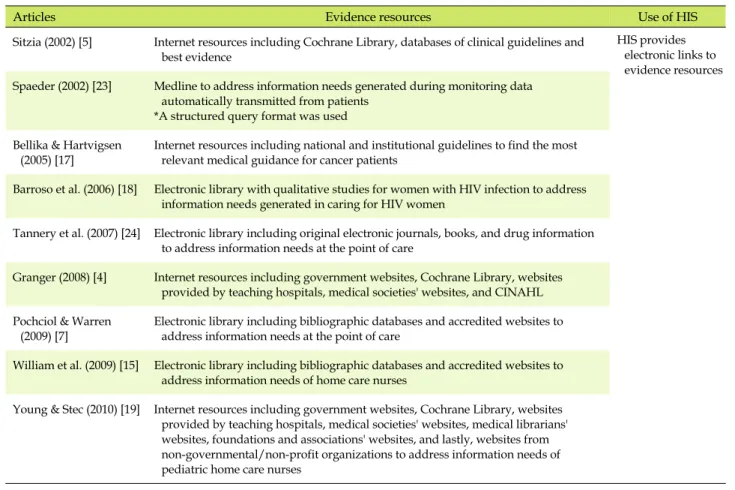
Several studies listed websites available for EBP. As shown in Table 1, Internet websites and an electronic (or digital) library containing voluminous evidence informa- tion were linked to a health information system. Particu- larly, Bellika and Hartvigsen [17] included Internet web- sites to identify the most relevant clinical guidance for can- cer patients. Barroso et al.[18] provided a link to an elec- tronic library with a collection of qualitative studies for women with HIV infection to address the information needs of nurses who cared for them. Granger [4] and Williams et al. [15] provided Internet resources explaining the steps of EBP. Pochciol and Warren [7] emphasized the use of library services to enable EBP. Young and Stec [19]
simply identified websites with a wealth of evidence-based information for pediatric home care clinicians.
The studies listed in Table 1 used health information systems as a bridge to provide links to a variety of web- sites containing accredited health-related information.
The second step of an EBP process also recommended us- ing many Internet resources to obtain evidence addressing an informational need. Unfortunately, the volumes of healthcare literature are unmanageably large, unwieldy, and highly diverse even though they are valid and ac- credited evidence [7]. In situations that do not control EBP barriers (Figure 1), it does not look possible that providing links to a variety of websites engages nurses to implement EBP or to follow the steps of EBP at the point of care. The health-related information on these websites mostly shows a display of copious amount of text-based documents [3].
This type of evidence dissemination is rarely useful for im- plementing EBP and changing practice because a display of text formats will not look specific and be meaningful to the target audience, such as nurses, in real time and in real practice [5,16,20]. Moreover, information from many of evidence resources can be redundant and inconsistent.
Inconsistencies will pose threats to safety and quality of patient care [6]. As a matter of fact, studies reported that in spite of easy access to evidence resources, actual utiliza- tion of research evidence to daily practice was very low.
Front-line nurses rarely searched for evidence related to
practice even though computer terminals were readily
Table 1. Health Information Systems (HIS) Providing Electronic Links to Evidence Resources
Articles Evidence resources Use of HIS
Sitzia (2002) [5] Internet resources including Cochrane Library, databases of clinical guidelines and best evidence
HIS provides electronic links to evidence resources Spaeder (2002) [23] Medline to address information needs generated during monitoring data
automatically transmitted from patients
*A structured query format was used Bellika & Hartvigsen
(2005) [17]
Internet resources including national and institutional guidelines to find the most relevant medical guidance for cancer patients
Barroso et al. (2006) [18] Electronic library with qualitative studies for women with HIV infection to address information needs generated in caring for HIV women
Tannery et al. (2007) [24] Electronic library including original electronic journals, books, and drug information to address information needs at the point of care
Granger (2008) [4] Internet resources including government websites, Cochrane Library, websites provided by teaching hospitals, medical societies' websites, and CINAHL Pochciol & Warren
(2009) [7]
Electronic library including bibliographic databases and accredited websites to address information needs at the point of care
William et al. (2009) [15] Electronic library including bibliographic databases and accredited websites to address information needs of home care nurses
Young & Stec (2010) [19] Internet resources including government websites, Cochrane Library, websites provided by teaching hospitals, medical societies' websites, medical librarians' websites, foundations and associations' websites, and lastly, websites from non-governmental/non-profit organizations to address information needs of pediatric home care nurses
available to them. They mostly sought information from experienced colleagues such as clinical nurse specialists, senior nurses and physicians. In addition, they were satis- fied with the verbal answers which exactly addressed their questions [3,21-25]. Nurses believed that their colleagues to be authoritative and trustworthy, and possessed more expert knowledge than themselves. Nurses thought this method of information gathering to be more convenient rather than searching for research articles and judging re- search evidence [2]. However, knowledge from experi- enced colleagues is often intuitive and subject to bias [26].
This ‘blind spot’ was overlooked during the efforts to pro- vide links to websites for access to health-related litera- ture. Although individual nurses might have every inten- tion to search for research articles, they may not be able to do so in a busy unit. In particular, a nurse may have a diffi- culty with interpreting quantitative research findings and statistics. While nurses may intend to change daily practi- ces based on recent evidence, they may not have the au- thority to do so. To become links that facilitate EBP im- plementation, coordinated efforts must first be made from an organization and individual staff nurses to address the EBP barriers listed in Figure 1.
As an alternative to providing links to numerous web-
sites, there was a successful example attempted by the
University of Iowa Nursing Informatics Research Team
that transformed text-based protocols into reference infor-
mation [6]. The reference information appeared as a num-
ber of essential recommendations artfully arranged on a
screen. The reference also contained electronic links to the
original full text research articles supporting the recom-
mendations. For example, the reference information on
how to assess pain in the elderly consisted of several re-
commendations including concrete examples of how to
ask about pain, pain-related words frequently used by the
elderly, and allowing sufficient time for the elderly to
process information and to respond. The reference in-
formation trimmed from the original full text research ar-
ticles was substantial for use at the point of care. First of
all, it would function as a clinical solution for nurses under
time constraints. This reference information is a type of the
structured electronic format that will be discussed in the
next section. In contrast, simply providing a display of
plentiful evidence from electronic resources (i.e. provid-
ing original full text research articles) is of little use for
nurses striving to implement EBP.
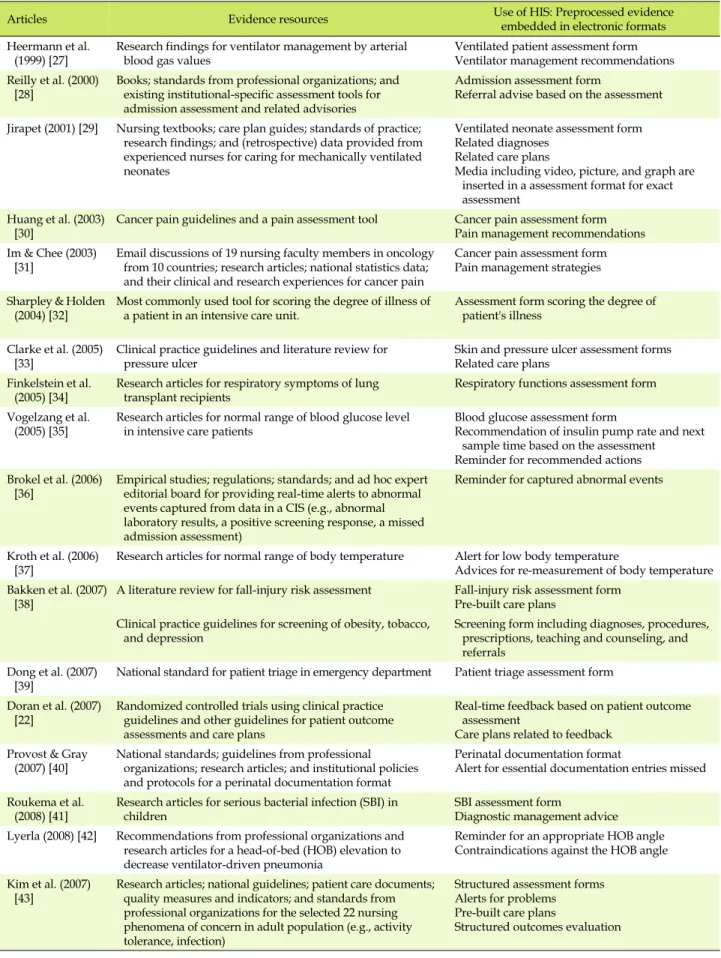
3. Encouragement of EBP Implementation: Provid- ing Electronic Formats Embedding Evidence Table 2 presents evidence embedded into electronic for- mats of health information systems. In these studies, evi- dence from selected evidence resources was reviewed, evaluated, filtered, and then embedded into required elec- tronic formats, for the purpose of eventual use in practice.
The electronic formats were embedding evidence in di- verse ways including patient assessments, diagnosis rec- ommendations, pre-built care plans, outcome evaluation recommendations, alerts and reminders, and creating a documentation format. Particularly, patient assessments were provided as forms to be filled out, whereas diag- noses, care plans, and outcome evaluations were mostly provided as structured reference information in drop- down boxes. Furthermore, many of the studies in Table 2 developed links between different electronic formats. It was mainly electronic links between patient assessment and care plan recommendations related to the assessment components [22,27,29-31,33,35,38,41,43]. The reminders or alerts based on documented values were electronically linked to reassessment to a plan of care or to an inter- vention [35-37,40,42].
Developing and using these electronic formats embed- ding evidence are actually to address most of the barriers to EBP implementation in Figure 1. Bulky evidence was filtered several times during the electronic formats were established and consequently, transformed into a final version containing evidence essential for specific practice.
The final version of evidence is meaningful to target nur- ses for use in real time. The amount of evidence (i.e. assess- ment forms to be filled out and recommendations) ar- ranged in the electronic formats was the level that nurses could deal with at the point of care. Thus, rather than that individual nurses had a hard time to search for relevant evidence literature and to choose the best from multiple evidence information at their busy time, they could effec- tively spend their time for applying the evidence system- atically preprocessed for immediate use. In addition, use of evidence embedded in this type of electronic formats was mandatory and users were not allowed to continue to the next screen without following the recommended pro- cedure. Thus, frontline nurses had no choice but to active- ly use evidence at the point of care.
A few studies gave weight to the method of embedding evidence into structured electronic formats for realization of EBP implementation. These studies reported nurses’
preferences on the use of evidence in real time. Doran et al.
[22] reported that frontline staff nurses preferred the use of
structured formats at the point of care, such as an elec- tronic intravenous medication guideline and ulcer risk as- sessment scale. Bellika and Hartvigsen [17] reported that searching for the most relevant information on websites was a time-consuming process that imposed a heavy bur- den on nurses. In addition to search activity, nurses had to judge what pieces of information were relevant. In the Tannery et al.’s study [24] which compared before and af- ter access to an electronic library providing various evi- dence collections, most nurses still kept consulting their colleagues to solve their informational needs. In another study [23], nurses said that the Medline query system was too time intensive and there was a mismatch between their information needs and query system capabilities. Nurses mostly used the query to obtain simple drug information, rather than to obtain extended information such as patient assessments, care plans and outcomes evaluation. These studies indicated that access to evidence alone was in- sufficient to implement EBP. They emphasized that evi- dence should be disseminated in a synthesized and pre- processed form to enable frontline staff nurses to apply the evidence at the point of patient care [33,44,45].
Yet, such concerns are only the starting point for EBP implementation as evidence embedded in structured elec- tronic formats does not cover all aspects of nursing care.
First, embedded evidence is not specific to all patient populations. For example, evidence for physical assess- ment will not address both a neonate and adult patient because of inherently different components. The format would provide a comprehensive assessment with com- mon content to be applied to all patients in a hospital.
Thus, evidence in electronic formats should be improved to include specificity depending on specific patient pop- ulation and their health status [44,45]. Second, all links be- tween assessment, diagnosis, care plan, outcome evalua- tion, and other relevant recommendations should be pro- vided in order to enable nurses to implement the nursing process based on EBP. In Table 2, a study [43] made such a full link between the nursing process steps. The links should naturally interface with the workflow of nurses at the point of care [46]. It will considerably reduce signifi- cant behavioral and system changes accompanied by EBP implementation. Lastly, evidence embedded in electronic formats should be updated at regular intervals with the most current evidence [44]. Despite the necessity of con- tinuous updates, because evidence is embedded into structured formats of a health information system, uti- lization of evidence in clinical practice can be much easily achieved [6,33].
This study focused on the use of health information sys-
Table 2. Health Information Systems (HIS) embedding Evidence
Articles Evidence resources Use of HIS: Preprocessed evidence
embedded in electronic formats Heermann et al.
(1999) [27] Research findings for ventilator management by arterial
blood gas values Ventilated patient assessment form
Ventilator management recommendations Reilly et al. (2000)
[28] Books; standards from professional organizations; and existing institutional-specific assessment tools for admission assessment and related advisories
Admission assessment form
Referral advise based on the assessment Jirapet (2001) [29] Nursing textbooks; care plan guides; standards of practice;
research findings; and (retrospective) data provided from experienced nurses for caring for mechanically ventilated neonates
Ventilated neonate assessment form Related diagnoses
Related care plans
Media including video, picture, and graph are inserted in a assessment format for exact assessment
Huang et al. (2003)
[30] Cancer pain guidelines and a pain assessment tool Cancer pain assessment form Pain management recommendations Im & Chee (2003)
[31] Email discussions of 19 nursing faculty members in oncology from 10 countries; research articles; national statistics data;
and their clinical and research experiences for cancer pain
Cancer pain assessment form Pain management strategies Sharpley & Holden
(2004) [32] Most commonly used tool for scoring the degree of illness of
a patient in an intensive care unit. Assessment form scoring the degree of patient's illness
Clarke et al. (2005) [33]
Clinical practice guidelines and literature review for pressure ulcer
Skin and pressure ulcer assessment forms Related care plans
Finkelstein et al.
(2005) [34] Research articles for respiratory symptoms of lung
transplant recipients Respiratory functions assessment form
Vogelzang et al.
(2005) [35] Research articles for normal range of blood glucose level
in intensive care patients Blood glucose assessment form
Recommendation of insulin pump rate and next sample time based on the assessment Reminder for recommended actions Brokel et al. (2006)
[36]
Empirical studies; regulations; standards; and ad hoc expert editorial board for providing real-time alerts to abnormal events captured from data in a CIS (e.g., abnormal laboratory results, a positive screening response, a missed admission assessment)
Reminder for captured abnormal events
Kroth et al. (2006)
[37] Research articles for normal range of body temperature Alert for low body temperature
Advices for re-measurement of body temperature Bakken et al. (2007)
[38] A literature review for fall-injury risk assessment Fall-injury risk assessment form Pre-built care plans
Clinical practice guidelines for screening of obesity, tobacco,
and depression Screening form including diagnoses, procedures,
prescriptions, teaching and counseling, and referrals
Dong et al. (2007)
[39] National standard for patient triage in emergency department Patient triage assessment form Doran et al. (2007)
[22] Randomized controlled trials using clinical practice guidelines and other guidelines for patient outcome assessments and care plans
Real-time feedback based on patient outcome assessment
Care plans related to feedback Provost & Gray
(2007) [40] National standards; guidelines from professional organizations; research articles; and institutional policies and protocols for a perinatal documentation format
Perinatal documentation format
Alert for essential documentation entries missed Roukema et al.
(2008) [41]
Research articles for serious bacterial infection (SBI) in children
SBI assessment form
Diagnostic management advice Lyerla (2008) [42] Recommendations from professional organizations and
research articles for a head-of-bed (HOB) elevation to decrease ventilator-driven pneumonia
Reminder for an appropriate HOB angle Contraindications against the HOB angle Kim et al. (2007)
[43]
Research articles; national guidelines; patient care documents;
quality measures and indicators; and standards from professional organizations for the selected 22 nursing phenomena of concern in adult population (e.g., activity tolerance, infection)
Structured assessment forms Alerts for problems Pre-built care plans
Structured outcomes evaluation
tems designed for utilization of nursing literature such as research findings in clinical practice. Patient data per se gathered for patient care are also evidence resources [6,26, 38,43], which is another aspect of EBP. Patient data contain a variety of information such as laboratory results, medi- cations, patients’ demographics, and nursing documen- tation records about patient care. The data provide im- portant clues in grasping causes of problems rising in clin- ical spots. When the data are appropriately sorted and an- alyzed, the outputs are represented as significant infor- mation and knowledge to improve practice [6,43]. In the studies retrieved in this study, seeking EBP using patient data were very rare. Only one study [43] used patient care documentations as evidence resources. Further research is required to study health information systems that analyze and evaluate patient data as significant evidence for EBP implementation.
For implication for nursing practice, this study pro- vided a comprehensive understanding of the state of EBP implementation depending on use of health information systems. It is hoped that this study can serve a foundation for development of smart health information systems to activate EBP implementation at the frontline staff nurse level.
4. Limitation of the Study
The findings of this study cannot be generalized be- cause non-English studies regarding using health infor- mation systems for EBP implementation were not in- cluded in this study.
CONCLUSION
Use of health information systems is a requisite to acti- vate EBP and while there have been various attempts to do so, true EBP implementation remains a challenge. This study reviewed the related literature to explore whether different types of uses of health information systems made a difference in actual implementation of EBP. The liter- ature review presented two different types of uses of health information systems to implement EBP at the point of care: health information systems that provide electronic links to numerous evidence resources and health infor- mation systems that provide structured electronic formats embedding evidence systematically filtered from evidence resources. Use of structured electronic formats embedding preprocessed evidence for immediate use actively engaged nurses into EBP implementation. In contrast, providing electronic links to copious evidence resources was rarely
useful for EBP implementation in clinical situations where organizational and individual barriers were not control- led. When a strong culture for EBP implementation exists, a provision of electronic links to evidence resources can definitely actualize EBP implementation.
REFERENCES
1. Royle J, Blythe J. Promoting research utilisation in nursing: The role of the individual, organization, and environment. Evidence- Based Nursing. 1998;1(3):71-72.
https://doi.org/10.1136/ebn.7.3.68
2. Thompson C, Cullum N, McCaughan D, Sheldon T, Raynor P.
Nurses, information use, and clinical decision making-The real world potential for evidence-based decisions in nursing.
Evidence-Based Nursing. 2004;7(3):68-72.
https://doi.org/10.1136/ebn.7.3.68
3. Thompson C, McCaughan D, Cullum N, Sheldon TA, Mulhall A, Thompson DR. Research information in nurses' clinical de- cision-making: What is useful? Journal of Advanced Nursing.
2001;36(3):376-388.
https://doi.org/10.1046/j.1365-2648.2001.01985.x
4. Granger BB. Practical steps for evidence-based practice: Putting one foot in front of the other. AACN Advanced Critical Care.
2008;19(3):314-324.
https://doi.org/10.1097/01.AACN.0000330383.87507.d1 5. Sitzia J. Barriers to research utilization: The clinical setting and
nurses themselves. Intensive and Critical Care Nursing. 2002;
18(4):230-243. https://doi.org/10.1016/S0964339702000125 6. Weaver CA, Warren JJ, Delaney C. Bedside, classroom and
bench: Collaborative strategies to generate evidence-based knowledge for nursing practice. International Journal of Me- dical Informatics. 2005;74(11-12):989-999.
https://doi.org/10.1016/j.ijmedinf.2005.07.003
7. Pochciol JM, Warren JI. An information technology infrastruc- ture to enable evidence-based nursing practice. Nursing Ad- ministration Quarterly. 2009;33(4):317-324.
https://doi.org/10.1097/NAQ.0b013e3181b9dd9d
8. Lundeen S, Harper E, Kerfoot K. Translating nursing knowl- edge into practice: An uncommon partnership. Nursing Out- look. 2009;57(3):173-175.
https://doi.org/10.1016/j.outlook.2009.03.005
9. Swan BA, Lang NM, McGinley AM. Access to quality health care: Links between evidence, nursing language, and informa- tics. Nursing Economics. 2004;22(6):325-332.
10. Randell R, Mitchell M, Thompson C, McCaughan D, Dowding D. From pull to push: Understanding nurses' information needs. Health Informatics Journal. 2009;15(2):75-85.
https://doi.org/10.1177/1460458209102969
11. Sandra J, Heller R. Improving the implementation of evidence-
based practice: A knowledge management perspective. Jour- nal of Evaluation in Clinical Practice. 2006;12(3):341-346.
https://doi.org/10.1111/j.1365-2753.2006.00534.x
12. Thiel L, Ghosh Y. Determining registered nurses' readiness for evidence-based practice. Worldviews on Evidence-Based on Nursing. 2008;5(4):182-192.
https://doi.org/10.1111/j.1741-6787.2008.00137.x
13. Fink R, Thompson C, Bonnes D. Overcoming barriers and pro- moting the use of research in practice. Journal of Nursing Ad- ministration. 2005;35(3):121-129.
https://doi.org/10.1097/00005110-200503000-00005 14. Weber S, Crago E, Sherwood P, Smith T. Practitioner ap-
proaches to the integration of clinical decision support system technology in critical care. The Journal of Nursing Admin- istration. 2009;39(11):465-469.
https://doi.org/10.1097/NNA.0b013e3181bd5fc2
15. Williams PR, Rachel M, Cooper J, Walker J, Winters K, Har- rington M, Askew R. Keeping it real: Evidence-based practice in home healthcare. Home Healthcare Nurse. 2009;27(9):522- 531. https://doi.org/10.1097/01.NHH.0000361922.20388.80 16. Bond P, French J. Implementing online tools and resources to
help nurses apply evidence based care. Nursing Times. 2010;
106(1):20-22.
17. Bellika JG, Hartvigsen G. The oncological nurse assistant: A web-based intelligent oncological nurse advisor. International Journal of Medical Informatics. 2005;74(7-8):587-595.
https://doi.org/10.1016/j.ijmedinf.2005.06.001
18. Barroso J, Edlin A, Sandelowski M, Lambe C. Bridging the gap between research and practice. Computers Informatics Nurs- ing. 2006;24(2):85-94.
https://doi.org/10.1136/ip.2006.014159
19. Young JS, Stec MT. Online resources for pediatric home care clinicians. Home Healthcare Nurse. 2010;28(1):45-52.
https://doi.org/10.1097/01.NHH.0000366797.16172.29 20. Payne TH. Computer decision support systems. Chest. 2000;
118(2 Suppl):47S-52S.
https://doi.org/10.1378/chest.118.2_suppl.47S
21. Fakhoury WKH, Wright D. Communication and information needs of a random sample of community psychiatric nurses in the United Kingdom. Journal of Advanced Nursing. 2000;32 (4):871-880.
https://doi.org/10.1046/j.1365-2648.2000.t01-1-01551.x 22. Doran DM, Mylopoulos J, Kushniruk A, Nagle L, Laurie-Shaw
B, Sidani S, et al. Evidence in the palm of your hand: Develop- ment of an outcomes-focused knowledge translation interven- tion. Worldviews on Evidence-Based Nursing. 2007;4(2):69-77.
https://doi.org/10.1111/j.1741-6787.2007.00084.x
23. Spaeder JA. Pilot study optimizing MEDLINE queries in an automated disease management telemedicine system. AMIA Annual Symposium proceedings. 2002;717-722.
24. Tannery NH, Wessel CB, Epstein BA, Gadd CS. Hospital nurses' use of knowledge-based information resources. Nursing Out- look. 2007;55(1):15-19.
https://doi.org/10.1016/j.outlook.2006.04.006
25. Spenceley SM, O'Leary KA, Chizawsky LLK, Ross AJ, Esta- brooks CA. Sources of information used by nurses to inform practice: An integrative review. International Journal of Nurs- ing Studies.2008;45:954-970.
https://doi.org/10.1016/j.ijnurstu.2007.06.003
26. Rycroft-Malone J, Seers K, Titchen A, Harvey G, Kitson A, McCormack B. What counts as evidence in evidence-based practice? Journal of Advanced Nursing. 2004:47(1):81-90.
https://doi.org/10.1111/j.1365-2648.2004.03068.x
27. Heermann LK, Thompson CB, East TD. Computerized proto- cols for ventilator management in ARDS patients. Computers in Nursing. 1999;17(6):247-250.
28. Reilly CA, Zielstorff RD, Fox RL, O'Connell EM, Carroll DL, Conley KA, et al. A knowledge-based patient assessment sys- tem: Conceptual and technical design. Proceedings of the AMIA Symposium. 2000;680-684.
29. Jirapaet V. A computer expert system prototype for mechan- ically ventilated neonates. Computers in Nursing. 2001;19(5):
194-203.
30. Huang HY, Wilkie DJ, Zong SP, Berry D, Hairabedian D, Judge MK, et al. Developing computerized data collection and deci- sion support system for cancer pain management. Computers Informatics Nursing. 2003;21(4):206-217.
31. Im EO, Chee WS. Decision support computer program for can- cer pain management. Computers Informatics Nursing. 2003;
21(1):12-21.
32. Sharpley JT, Holden JC. Introducing an early warning scoring system in a district general hospital. British Association of Criti- cal Care Nurses. Nursing in Critical Care. 2004;9(3):98-102.
https://doi.org/10.1111/j.1362-1017.2004.0063.x
33. Clarke HF, Bradley C, Whytock S, Handfield S, van der Wal R, Gundry S. Pressure ulcers: Implementation of evidence-based nursing practice. Journal of Advanced Nursing. 2005;49(6):
578-590. https://doi.org/10.1111/j.1365-2648.2004.03333.x 34. Finkelstein SM, Scudiero A, Lindgren B, Snyder M, Hertz MI.
Decision support for the triage of lung transplant recipients on the basis of home-monitoring spirometry and symptom re- porting. Heart & Lung. 2005;34(3):201-208.
https://doi.org/10.1016/j.hrtlng.2004.09.003
35. Vogelzang M, Zijlstra F, Nijsten MWN. Design and implemen- tation of GRIP: A computerized glucose control system at a surgical intensive care unit. BMC Medical Informatics and De- cision Making. 2005;5:38. https://10.1186/1472-6947-5-38 36. Brokel JM, Shaw MG, Nicholson C. Expert clinical rules auto-
mate steps in delivering evidence-based care in the electronic health record. Computers Informatics Nursing. 2006;24(4):
196-205.
37. Kroth PJ, Dexter PR, Overhage JM, Knipe C, Hui SL, Belsito A, McDonald CJ. A computerized decision support system im- proves the accuracy of temperature capture from nursing per- sonnel at the bedside. AMIA Annual Symposium Proceedings.
2006;444-448.
38. Bakken S, Currie LM, Lee NJ, Roberts WD, Collins SA, Cimino JJ. Integrating evidence into clinical information systems for nursing decision support. International Journal of medical Informatics. 2008;77(6):413-420.
https://doi.org/10.1016/j.ijmedinf.2007.08.006
39. Dong SL, Bullard MJ, Meurer DP, Blitz S, Holroyd BR, Rowe BH.
The effects of training on nurse agreement using an electro- nic triage system. Canadian Journal of Emergency Medicine.
2007;9(4):260-266. https://doi.org/10.1186/s13613-016-0114-z 40. Provost C, Gray M. Perinatal clinical decision support system:
A documentation tool for patient safety. Nursing for Women Health. 2007;11(4):407-410.
https://doi.org/10.1111/j.1751-486X.2007.00207.x
41. Roukema J, Steyerberg EW, van der Lei J, Moll HA. Random- ized trial of a clinical decision support system: Impact on the management of children with fever without apparent source.
Journal of the American Medical Informatics Association. 2008;
15(1):107-113. https://doi.org/10.1197/jamia.M2164 42. Lyerla F. Design and implementation of a nursing clinical deci-
sion support system to promote guideline adherence. Com- puters Informatics Nursing. 2008;26(4):227-233.
https://doi.org/10.1097/01.NCN.0000304800.93003.b4 43. Kim TY, Lang NM, Berg K, Weaver C, Murphy J, Ela S. Clini-
cian adoption patterns and patient outcomes results in use of evidence-based nursing plans of care. AMIA Annual Sympo- sium Proceedings. 2007;423-427.
44. Doran D, Paterson J, Clark C, Srivastava R, Goering PN, Kushniruk AW, et al. A pilot study of an electronic interprofes- sional evidence-based care planning tool for clients with men- tal health problems and addictions. Worldviews on Evidence- Based on Nursing. 2010;7(3):174-184.
https://doi.org/10.1111/j.1741-6787.2010.00191.x
45. Burkhart L, Androwich I. Measuring spiritual care with infor- matics. Advances in Nursing Science. 2009;32(3):200-210.
https://doi.org/10.1097/ANS.0b013e3181b0d6a6
46. Lee S, McElmurry BJ. Capturing nursing care workflow dis- ruption: Comparison between nursing and physicians work- flows. Computers, Informatics, Nursing. 2010;28(3):151-161.
https://doi.org/10.1097/NCN.0b013e3181d77d3e