Introduction
Acupuncture is widely used in the treatment of disease in China, Japan and Korea and it is increasingly requested by patients in some Western countries. It has specific effects on insomnia1),
allergic rhinitis2), premenstrual syndrome3), frozen shoulder pain4), chronic low back pain5), chronic headache6), primary dysmenorrhea7,8) and depression9). There have been many studies about autonomic nervous system and acupuncture.
Acupuncture is known to affect various autonomic
The Effect of Electroacupuncture on the Heart Rate Variability of Stroke Patients under Mental Arithmetic
Stress
Jae-gun Oh1, So-yeon Kwon1, Henja Yun2, Kang-Keyng Sung1
1Department of Internal Medicine, College of Oriental Medicine, Wonkwang University.
2Department of Oriental Medicine Prescription, College of Oriental Medicine, Wonkwang University Original Article
Received:
⋅ 22 October 2012 ⋅Revised:10 December 2012 ⋅Accepted:10 December 2012 Correspondence to:
⋅ Kang-keyng Sung
543-8, Juwol-dong, Nam-gu, Gwangju-si. Republic of Korea. Dept. of Internal medicine, Hospital of Oriental medicine Won-Kwang
Tel:+82-62-670-6411, Fax:+82-62-670-6767, Email:[email protected]
Objectives: This study aimed to compare the effects of high frequency electroacupuncture, low frequency electroacupuncture and manual acupuncture on the autonomic nervous system in stroke patients by using a heart rate variability measuring device.
Methods: Thirty-nine participants were recruited and each participated in the high frequency electroacupuncture group, low frequency electroacupuncture group, manual acupuncture group and non-acupuncture group. Some participants received needle insertion with 100 Hz stimulation, with 2Hz stimulation and manual stimulation under mental arithmetic stress during 2 sections. Other participants maintained in the supine position without acupuncture under mental arithmetic stress during the 2 sections. Acupuncture needles were directly inserted perpendicularly to the right Liv 3 acupoint followed by delivery of electric pulses to these points for 8 minutes. Heart rate variability was measured 8 minutes before and 16 minutes after acupuncture stimulation by a heart rate variability measuring system.
Results: We found a significant elevated HF total power between 1 section and 2 section and between 1 section and 4 section in the non-acupuncture group, between 3 section and 4 section in the 100Hz electroacupuncture group, and between 1 section and 2 section in the manual acupuncture group and with no change in the 2Hz electroacupuncture group. We also found a significant VLF total power between 2 section and 3 section in the 2Hz electroacupuncture group and between 1 section and 4 section and between 2 section and 4 section in the 100Hz electroacupuncture group.
All four groups showed no significant differences in other parameters including heart rate mean, low-frequency power, and the ratio of low-frequency power to high-frequency power.
Conclusions: This study may be a basis for research about effects of acupuncture and electroacupuncture because the parameters measured, heart rate variability, showed differences according to acupuncture.
Key Words : Heart rate variability (HRV), arithmetic stress, electroacupuncture, frequency, stroke
functions such as blood pressure regulation, immune modulation, and the improvement of disorders concerning autonomic functions10).
Some methods have been used to study autonomic responses following acupuncture.
Sympathetic nervous system activity has been evaluated indirectly by implementation of measures for skin sympathetic nervous activity11,12), microneurography13,14), skin temperature15), and thermography16).
In contrast, heart rate variability has been developed as a quantitative noninvasive marker calculated from the electrocardiogram, and it is usually used to assess the role of autonomic nervous system fluctuations with various cardiovascular and noncardiovascular disorders.
The present study aimed to investigate whether autonomic nervous system activity could change in accordance with EA frequency and manual acupuncture using a heart rate variability (HRV) measuring system in stroke patients.
Materials and Methods
A. Participants
Participants aged 66.41±11.09 years were recruited from inpatients at the Gwangju Wonkwang University Oriental medical center and were composed of 15 females and 24 males. All procedures were performed in accordance with the Institutional Review Board (IRB) and approved by the Institutional Review Board at Gwangju Wonkwang University Oriental medical center.
The subjects for the current study have been recruited according to the inclusion and exclusion criteria as below.
1. Inclusion criteria
a. Korean over fifty years and under eighty five years old
b. People that underwent an acupuncture procedure
2. Exclusion criteria
a. People with excessive fear of acupuncture b. People that have difficulty staying in the same (supine) posture longer than 30 minutes
c. People having sleeping hours within 4 hours on the day of the test
d. People taking antipsychotic drugs
e. People taking ß-blockers among antihypertensive drugs
f. People with previous cardiac or pulmonary disease (dynamic behavior of heart rate in ischemic stroke)
g. People with acute congestive cardiac failure
Participants were randomly divided into 4 groups. The non-acupuncture group had 11 (4 female, 7 male; mean age±SD 69.64±10.81; range 57-85). The 2Hz electroacupuncture group had 9 (3 female, 6 male; mean age± SD 63.89±12.59;
range 50-76). The 100Hz electroacupuncture group had 10 (4 female, 6 male; mean age± SD 65.40±10.30; range 50-73). The manual acupuncture group had 9 (4 female, 5 male; mean age± SD 66.33±11.32; range 50-80).
B. Experimental design
Each subject participated in four sections.
The data before (measurement 1 section), during (2), and after (3,4) needle acupuncture were measured and statistically analyzed.
In 2 section, all participants had arithmetic stress.
Figure 1 shows the experimental procedure. For each section, the participants first had a 5-minute rest in the supine position. This was followed by the measurement of HRV for 8 minutes in 1 section. Acupuncture needles were then inserted into two acupoints or 1 acupoint, right LR 3 (Taechung) under mental arithmetic stress.
Electroacupuncture or manual acupuncture was administered for 8 minutes and then needles were removed in 2 section. Then the participants remained for 8 minutes in the same supine position without acupuncture under arithmetic stress in 2 section. The participants rested for 8 minutes in the same supine position in 3 section and rested for 8 minutes in the same supine position during which HRV was measured again in 4 section. The participants remained in supine positions throughout the periods of resting, measurement of HRV, arithmetic stress and acupuncture stimulation. This experiment was conducted in a calm room indoors. The room temperature was maintained at 24-25℃.
C. Acupuncture
All the acupuncture insertions were performed by the same acupuncturist, licensed in Oriental medicine. The skin was cleaned with alcohol before each insertion. Acupuncture needles (0.30
×40 length; DongBang Acupuncture, Inc.,
㎜ ㎜
Korea) were inserted perpendicularly into Liv 3 of the right foot. Their locations were decided that Liv 3 is located on the proximal end of the 1st interosseous metatarsal space, where the pulsation of the dorsal artery is palpable. We selected two right Liv 3 points as close as possible for the two electric poles of EA. Manual acupuncture was inserted at one point on right Liv 3 and stimulated by turning once per second. Liv 3 has the effect of blood and circulation regulation17). So Liv 3 may have the effects of reducing the stress
responses.
D. Electroacupuncture
Electric pulses of either 2Hz (low) or 100Hz (high) EA were delivered to the two needles for 8 minutes with an electrical stimulator of a brand (ES-160; ITO Co., Japan) that has been used clinically in Korea. Electric pulse duration and width were 1 ms, electro current was 3 mA and electro waveform was rectangular. The electrical stimulator was placed in a location where the participants could not see the frequency being administered, and the acupuncturist was instructed only to insert needles and was blinded to the administration of the EA frequencies.
E. Measurement of heart rate variability Participants were connected to a HRV measuring device (ProComp Infiniti and BioGraph Infiniti 5.0; Thought Technology Co., Canada).
This device collects signals on a 3rd finder tip.
To calculate the HRV indices, the system analyzes the changes in heart rate using the methods of time domain and frequency domain.
F. Statistical analysis
The differences between the HRV indices measured before acupuncture stimulation and arithmetic stress and those measured after acupuncture stimulation and arithmetic stress were evaluated by using Wilcoxon signed ranks test. A value of p<0.05 was considered to be the level of statistical significance.
Results
HRV analysis uses time or frequency domain analysis. This study used both. The first method was the HR mean of time domain analysis.
Comparison of sections was checked for
significance.
The second method is power spectrum analysis of frequency domain analysis. Total power was divided by HF, LF, VLF and significances were checked though comparison among the sections.
The third method is the LF/HF ratio of frequency domain analysis. Comparison of sections was checked for significance.
A. Time domain analysis: HR (Heart rate) mean
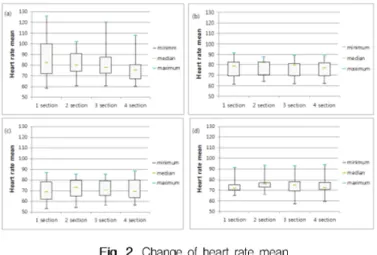
Results of HR mean before, during, and after arithmetic stress stimulation and non-acupuncture, 2Hz electroacupuncture, 100Hz electroacupuncture, and manual acupuncture of cerebral infarction patients are shown in Figure 2.
Boxplots show the distribution of the approximate values. The graph of cerebral infarction patients with non-acupuncture decreased in value; the graph of cerebral infarction patients with 2Hz electroacupuncture, 100Hz electroacupuncture stimulation and manual acupuncture stimulation had similar results. HR mean increased more in 2 section than 1 section and decreased more in 3 section and 4 section.
This study used the statistic method of Wilcoxon signed ranks test, but there was no significant difference (p>0.05).
B. Frequency domain analysis: power spectrum analysis
1. HF total power comparison
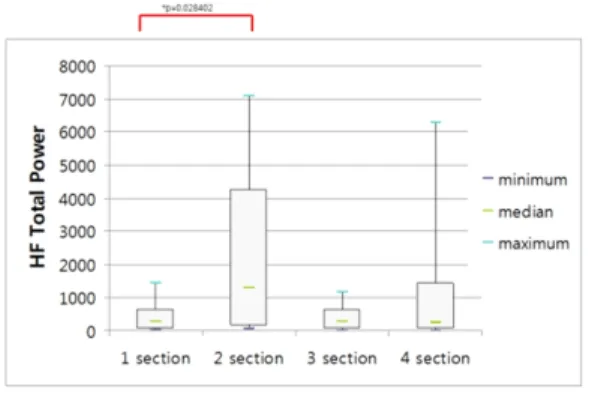
Figure 3 shows with boxplots the change of HF
Box plot illustraction before (1 section), during (2 section), and after (3, 4 section) arithmetic stress and acupuncture. No significant changes were found. The horizontal line in the box gives the position of the median. The end of the box defines the 25th and 75th percentile. (a)non acupuncture Group (b) 2Hz electroacupucnture group (c) 100hz electroacupuncture group (d) manual acupuncture group.
Box plot illustration before (1 section), during (2 section), and after (3, 4 section) only arithmetic stress. The horizontal line in the box gives the position of the median. The end of the box defines the 25th and 75th percentile.
* p<0.05 compared 1 section with 2 section.
** p<0.01 compared 1 section with 4 section.
total power when arithmetic stress is given without acupuncture stimulation in 2 section. HF total power value increased more in 2 section than in 1 section, it decreased more in 3 section than in 2 section and it increased again. There was significance of results when comparing 1 section with 2 section and 1 section with 4 section.
(p<0.05)
Figure 4 shows via boxplots the change of HF total power when arithmetic stress is given with 100Hz electroacupuncture stimulation in 2 section.
HF total power value increased in 4 section more than in 3 section. There was significance of results when comparing 3 section with 4 section.
(p<0.01)
Figure 5 shows with boxplots the change of HF total power when arithmetic stress is given with manual acupuncture stimulation in 2 section. HF total power value increased in 2 section more than in 1 section. There was significance of results when comparing 2 section with 1 section.
(p<0.05)
2. LF total power comparison
The result of Wilcoxon signed ranks test did not show significance in any sections. This signifies that arithmetic stress as well as acupuncture stimulation can not change LF total power.
3. VLF total power comparison
Box plot illustration before (1 section), during (2 section), and after (3, 4 section) arithmetic stress and 100Hz electroacupuncture. The horizontal line in the box gives the position of the median. The end of the box defines the 25th and 75th percentile.
** p<0.01 compared 3 section with 4 section.
Box plot illustration before (1 section), during (2 section), and after (3, 4 section) arithmetic stress and manual acupuncture. The horizontal line in the box gives the position of the median. The end of the box defines the 25th and 75th percentile.
* p<0.05 compared 1 section with 2 section.
Box plot illustration before (1 section), during (2 section), and after (3, 4 section) arithmetic stress and 2Hz electroacupuncture. The horizontal line in the box gives the position of the median. The end of the box defines the 25th and 75th percentile.
* p<0.05 compared 2section with 3section.
Figure 6 shows with boxplots the change of VLF total power when arithmetic stress is given with 2Hz electroacupuncture stimulation in 2 section. VLF total power value increased in 3 section more than in 2 section. There was significance of results when comparing 3 section
with 2 section. (p<0.05)
Figure 7 shows via boxplots the change of VLF total power when arithmetic stress is given with 100Hz electroacupuncture stimulation in 2 section.
VLF total power value increased more in 4 section than in 2 section. There was significance of results when comparing 4 section with 2 section and 4 section with 1 section. (p<0.05)
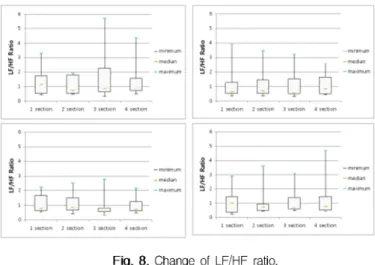
C. Frequency domain analysis: LF/HF ratio Figure 8 shows using boxplots the change of LF/HF ratio. We measured significance of comparison with each subject. There were no significant results. (p>0.05)
Discussion
Despite a lot of use and research in clinical settings, HRV analysis is still poorly supported by rigorous reliability studies15). The purpose of the present study was to examine the effect of acupuncture on the HRV of stroke patients under
Box plot illustration before (1 section), during (2 section), and after (3, 4 section) arithmetic stress and 100Hz electroacupuncture. The horizontal line in the box gives the position of the median. The end of the box defines the 25th and 75th percentile.
* p<0.05 compared 1 section with 4 section and 2 section with 4 section.
Box plot illustration before (1 section), during (2 section), and after (3, 4 section) arithmetic stress and acupuncture. No significnat changes were found. The horizontal line in the box gives the position of the median. The end of the box defines the 25th and 75th percentile.
(a) non acupuncture Group (b) 2Hz electroacupucnture group (c) 100Hz electroacupuncture group (d) manual acupuncture group
mental arithmetic stress.
In the present study, we did not observe a difference in effects on the heart rate mean under mental arithmetic stress with non-acupuncture, manual acupuncture, high frequency electroacupuncture or low frequency electroacupuncture. It is generally accepted that mental arithmetic stress tests have been shown to cause increases in heart rate and mean blood pressure18) and increased urinary excretion of adrenaline and noradrenaline19). However, more research will be needed in stroke patients.
The present study showed a significant elevated HF total power between 1 section and 2 section and between 1 section and 4 section in the non-acupuncture group, between 3 section and 4 section in 100Hz electroacupuncture group, between 1 section and 2 section in the manual acupuncture group and with no change in the 2Hz electroacupuncture group. HF represents the area from 0.15 to 0.4Hz20). In a previous study, HF was a major contributor of efferent vagal activity, as well as an index that reflects parasympathetic activation21), and stroke patients show a typical suppression of all the power spectral components of HR variability20) and mental stress increases LF activities but decreases HF activities22). However, the present study’s result was the reverse.
The present study showed a significant VLF total power between 2 section and 3 section in the 2Hz electroacupuncture group and between 1 section and 4 section and between 2 section and 4 section in the 100Hz electroacupuncture group. A VLF component was suggested by several physiological interpretations, but was not clearly conclusive23,24).
Low frequency electroacupuncture stimulation has the effects of cerebral blood flow increase25) and ovarian blood flow intensity26). On the other hand, high frequency electroacupuncture stimulation has the effects of bowel movement
hyperactivity suppression27) and blood pressure elevation28). Both low and high frequency electroacupuncture have effects of sweating rate reduction29).
The present study showed the LF/HF ratio.
During experiment, there was no significant result.
LF/HF ratio is generally accepted as a measure of sympatho-vagal balance30). In previous studies, LF/HF ratio correctly present sympatho-vagal balance in healthy subjects, while LF/HF ratio was useless in patients with seriously decreased overall HRV and sympathetic overactivity31,32). Furthermore, the possible explanation for limited benefit from LF/HF ratio in the analysis of sympatho-vagal balance in stroke patients is that disease progression shifts HRV spectra leftward33). These findings explain why we didn’t find significant changes between stroke patients when LF/HF ratio was analyzed.
The present study had limitations about small number of recruited subjects and wide age distribution. Nevertheless, the measured values will be useful for more future research which will be needed.
Conclusions
Cerebral infarction subjects were divided into 4 groups: arithmetic stressed, 2Hz electroacupuncture stimulated, 100Hz electroacupuncture stimulated, and manual acupunctured. HRV change was observed depending on arithmetic stress and acupuncture stimulation as time passed.
According to measured values, we saw the following results.
First, we saw a change of HR (heart rate) mean between sections. The HR mean without acupuncture stimulation subject decreased continuously, but the value with acupuncture stimulation 3 subjects increased more in section 2
than in section 1 and recovered in section 3 and section 4. However, there was no statistically significant difference.
Second, this study showed a significant elevated HF total power between 1 section and 2 section and between 1 section and 4 section in the non-acupuncture group, between 3 section and 4 section in the 100Hz electroacupuncture group, and between 1 section and 2 section in the manual acupuncture group, but no change in the 2Hz electroacupuncture group. This study showed a significant VLF total power between 2 section and 3 section in the 2Hz electroacupuncture group and between 1 section and 4 section and between 2 section and 4 section in the 100Hz electroacupuncture group.
Third, we measured LF/HF ratio in all 4 groups.
The result was no statistically significant difference.
The present study results showed that parameters measured with heart rate variability had differences.
This study may be the basis of research about effects of acupuncture and electroacupuncture.
Acknowledgement
This paper was supported by Wonkwang University in 2011.
References
1. Sok SH, Kim KB. The effect of auricular acupuncture pressure therapy on insomnia of elderly people [in Korean]. J Korean Acad Soc Adult Nurs 2000;12:222 33.–
2. Park YC, Jo JH, Hong KE, Kang WC, Choi SM.
Effect of acupuncture on nasal obstruction in patients with persistent allergic rhinitis: a randomized controlled trial [in Korean]. J Korean Acupunct Mox Soc 2005;22:229 39.–
3. Kim SC, Kim SN, Lim JA, Choi CM, Shim EK, Koo ST, et al. Effects of acupuncture treatment on the premenstrual syndrome: controlled clinical trial [in Korean]. J Korean Acupunct Mox Soc 2005;22:41 60.–
4. Lee H, Hong KE, Kim YI, Yim YK, Ahn TW, Kang WC, et al. A clinical trial of acupuncture treatment for frozen shoulder [in Korean]. J Korean Acupunct Mox Soc 2006;23:165 77.– 5. Kwon YD, Lee SG, Lee CW, Jung SK, Kim DE,
Choi SM. The short-term efficacy of acupuncture for chronic low back pain: randomized sham controlled trial. J Orient Rehab Med 2007;17:123 –32.
6. Choi DY, Lim S, Cha NH, Kim KS, Lee SH, Kim SY, et al. Effects on pain behavior in non-medicinal treatment applied to chronic headache patients [in Korean]. Korean J Meridian Acupoint 2005;22:55 66.–
7. Yuk SS, Lim EM. A clinical study on the effect of crossing over treatment of acupuncture and herbal medication for primary dysmenorrhea [in Korean]. J Orient Obstet Gynacol 2005;18:144–
52.
8. Kim ES, Cho JH, Jung WS, Lee SH. Effect of Acupuncture on Heart Rate Variability in Primary Dysmenorrheic Women. The American J Chin Med 2011;39(2):243 9.–
9. Sun H, Zhao H, Zhang J, Bao F, Wei J, Wang DH, et al. Effect of acupuncture at Baihui (GV 20) and Zusanli (ST 36) on the level of serum inflammatory cytokines in patients with depression. Zhongguo Zhen Jiu 2010;30(3):
195-9.
10. Kang SY, Jeong EW, Lee SK, Sung KK. Effects of Electroacupuncture on Immune Function. The J Korean Acupunct Mox Soc 2007;24(6):29-36.
11. Kimura K, Masuda K, Wakayama I. Changes in skin blood flow and skin sympathetic nerve
activity in response to manual acupuncture stimulation in humans. Am J Chin Med 2006;34:189-96.
12. Hsieh CL. Modulation of cerebral cortex in acupuncture stimulation: a study using sympathetic skin response and somatosensory evoked potentials. Am J Chin Med 1998;26:1-11.
13. Knardahl S, Elam M, Olausson B, Wallin BG.
Sympathetic nerve activity after acupuncture in humans. Pain 1998;75:19-25.
14. Middlekauff HR, Hui K, Yu JL, Hamilton MA, Fonarow GC, Moriguchi J, et al. Acupuncture inhibits sympathetic activation during mental stress in advanced heart failure patients. J Card Fail 2002;8:399-406.
15. Dyrehag LE, Widerström-Noga EG, Carlsson SG, Andersson SA. Effects of repeated sensory stimulation sessions (electroacupuncture) on skin temperature in chronic pain patients. Scand J Rehabil Med 1997;29:243-50.
16. Thomas D, Collins S, Strauss S. Somatic sympathetic vasomotor changes documented by medical thermographic imaging during acupuncture analgesia. Clin Rheumatol 1992;11:
55-9.
17. Choi YT. Jung-hae acupuncture. 1st edition.
Seoul: Hanglim publisher. 1974:228 9.~ 18. Brod J, Fencl V, Hejl Z, Jirka J. Circulatory
changes underlying blood pressure evaluation during acute emotional stress (mental arithmetic) in normotensive and hypertensive subjects. Clin.
Sc 1959;19, 269-79.
19. Nestel PJ. Blood pressure and catecholamine excretion after mental stress in labile hypertension. Lancet 1969;692-4.
20. Korpelainen JT, Sotaniemi KA, Mäkikallio A, Huikuri HV, Myllylä VV. Dynamic behavior of heart rate in ischemic stroke. Stroke 1999;30:1008-13.
21. Karemaker JM. Autonomic integration: the physiological basis of cardiovascular variability.
J Physiol 2012:316.
22. Lombardi F. Chaos theory, heart rate variability and arrhythmic mortality. Circulation 2000;101:
8-10.
23. Akselrod S, Gordon D, Ubel FA, Shannon DC, Berger AC, Cohen RJ. Power spectrum analysis of heart rate fluctuation: a quantitative probe of beat-to-beat cardiovascular control. Science 1981;213(4504): 220-2.
24. Pomeranz B, Macaulay RJ, Caudill MA, Kutz I, Adam D, Gordon D, et al. Assessment of autonomic function in humans by heart rate spectral analysis. Am. J. Physiol 1985;248(1):
151-3.
25. Moon SK, Kim YS, Park SW, Jung WS, Ko CN, Cho KH, et al. The Effect of L14-LI11 Electrical Acupuncture at Unaffected Limb on Cerebral Blood Flow in Ischemic Stroke Patients using SPECT. J Korean Acupunct Mox Soc 2004;
21(1):111-8.
26. Stener-Victorin E, Kobayashi R, Watanabe O, Lundeberg T, Kurosawa M. Effect of Electro-acupuncture Stimulation of Different Frequencies and Intensities on Ovarian Blood Flow in Anaesthetized Rats with Steroid-Induced Polycystic Ovaries. Reprod Biol Endocrinol 2004;2:16.
27. Cho MH, Choi BT, Jang KJ. The Effects of 120 Hz High Frequency Electroacupuncture on the Gastric Mucosa damage in Cold-Restraint Stressed Rats. J Korean Acupunct Mox Soc 2003;20(3):177-93.
28. Yun SH. Response of electrical stimulation at shuigou point (GV26) on blood pressure, pulse, and regional cerebral blood flow in rats. J Kyung Hee University Medical Center 1992;8(4):412-8.
29. Ogata A, Sugenoya J, Nishimura N, Matsumoto
T. Low and high frequency acupuncture stimulation inhibits mental stress induced sweating in humans via different mechanisms.
Auton Neurosci 2005;118:93-101.
30. Task force of the European Society of Cardiology and the North American Society of Pacing and Electrophysiology. Heart rate variability: Standards of measurement, physiological interpretation, and clinical use. J Eur. Heart 1996;17:354-81.
31. Lombardi F. Chaos theory, heart rate variability and arrhythmic mortality. Circulation 2000;101:
8-10.
32. Borne P, Montano N, Pagani M, Oren R, Somers V. K. Absence of low-frequency variability of sympathetic nerve activity in severe heart failure.
Circulation 1997;95:1449-54.
33. Milicevic G, Lakusic N, Majsec M. Disease progression shifts heart rate variability spectra leftward. Europace 2002;3(Suppl. A): A202.