In order to examine the immunoresponse of host cells to Enterococcus faecalis, this in vitro study monitored the production of Interleukin-2 (IL-2), Interleukin-4 (IL-4) and Transforming growth fac- tor-β1 (TGF-β1) in human lymphocytes. Lymphocytes were activated with PHA in the presence or abscence of sonicated extracts of E. Faecalis (SEF) and further incubated for 72 hours. The level of each cytokine was measured by ELISA. Data were analyzed with Kruskal-Wallis test and Mann- Whitney U test (P < 0.05). PHA-activated group did exhibit higher level of IL-2 and IL-4 than untreated control group. The levels of expression of both cytokines were significantly decreased fol- lowing the treatment of high (25 ㎍/㎖) and medium concentration (12.5 ㎍/㎖) of SEF (P <0 .05) than those of PHA activated group. But low concentration (5 ㎍/㎖) of SEF showed the similar level of IL-2 and IL-4 production as those of PHA activated group. TGF-β1 was unaffected by SEF treat- ment. These results suggested that E. faecalis may suppress IL-2 and IL-4 production by lympho- cytes and this could be one of possible factors why E. faecalis are found frequently in the teeth with failed endodontic treatment. [J Kor Acad Cons Dent 30(1):1-6, 2005]
Key words : Enterococus faecalis, Lymphocyte, IL-2, Il-4, TGF-β1, Sonicated extract
- received 2004. 3. 23, revised 2004. 9. 15, accepted 2004. 9. 17 -
Effects of Enterococcus faecalis sonicated extracts on IL-2, IL-4 and TGF-β 1 production from human lymphocytes
Hyeon-Sik Kim, Seok-Woo Jang, Wan-Jun Shon, Song-Takg Lee, Cheol-Ho Kim, Woo-Cheol Lee, Sung-Sam Lim*
Department of Conservative Dentistry, College of Dentistry, Seoul National University ABSTRACT
Ⅰ. Introduction
Bacteria and their by-products are considered to be the primary etiologic agents of pulpal necro- sis and apical lesions1). Therefore, the aim of endodontic treatment is the elimination of micr- oorganisms from the root canal system and the prevention of reinfection. But some cases fail even when apparently well treated. A number of fac-
tors have been identified as agents associated with failure of endodontic therapy. Most treat- ment failures are caused by microorganisms per- sisting in the apical parts of root canals of incom- plete obturated teeth. Especially, single species of gram-positive organisms.
Enterococcus faecalis had been found to be one of the predominant bacteria in teeth in which root canal therapy failed2). There are many studies to identify a possible mechanism that would explain how E. faecalis could survive and grow within root canal system and reinfect an obturated root canal. E. faecalis has low sensitivity to antimicro- bial agents and contribute to endodontic treat- ment failures3). E. faecalis persisted for at least 10 day after withdrawal of nutrient support,
* Corresponding author: Sung-Sam Lim Department of Conservative Dentistry, College of Dentistry, Seoul National University 28 YunGun-Dong ChongNo-Gu Seoul, Korea 110-749 Tel : 82-2-2072-2656 Fax : 82-2-2072-3859 E-mail : [email protected]
whereas the other organisms died within 4 to 48 hr4). E. faecalis maintained the capability to invade dentinal tubules and adhered to collagen in the presence of human serum5). Survival of E.
faecalis in calcium hydroxide at high pH was related to a functional proton pump6).
However, there have been few investigations about the immunologic effect of E. faecalis. In previous studies, sonic extracts from bacteria were studied for their effects on the immune response. For example, sonicated material of Fusobacterium nucleatum can evoke a concentra- tion-dependent stimulatory or suppressive effect on the proliferation rate of accessory cell7). Sonic- ated extract of Actinobacillus actinomycetemcomi- tans suppressed interleukin-2 production of T- cells8).
T helper cells have important roles in human immune system and are divided according to the production of cytokine. Th1 cells are primarily involved in macrophage-dependent immune responses, synthesize and secrete Interleukin-2 (IL-2), Interferon-γ(IFN-γ) and tumor-necrosis factor-β(TNF-β) and regulate cell-mediated immune response or delayed-type hypersensitivi- ty. Th2 cells facilitate the synthesis of subclasses of antibody, synthesize and secrete IL-4, IL-5, IL-6, IL-13 and regulate humoral immune response9). Th3 cells suppress immune response to ingested antigen and their main lymphokine is TGF-β.
In a study by Hahn et al.10) more lymphocytes were observed in inflamed pulps than in normal pulps, and the ratios of T4/T8 and B/T were changed with pulpal inflammation. T cells are responsible for the regulation of pulpal immuno- pathic changes under carious lesions.
IL-2 by Th1 cells is present in normal vital pulp and is significantly elevated in cases of sympto- matic irreversible pulpitis11). IL-4 by Th2 cells was detected in human periapical granulation tis- sue and intraosseous inflammation12,13). In our previous study, the level of IL-2 and IL-4 was increased in experimentally induced pulpitis by S.
mutans and P. endodontalis LPS14). Transforming growth factor-β(TGF-β) is a key mediator of
immunological homeostasis in pulp and periapical regions. TGF-β1 is of particular importance in regulating inflammation with effects that are pre- dominantly immunosuppressive. TGF-β1 exerts potent suppressive effects on the proliferation and differentiation of both T- and B-lymphocytes15,16).
The purpose of this study was to investigate the capacity of peripheral lymphocytes to secrete IL- 2, IL-4 and TGF-β1 after stimulation with soni- cated extract of E. faecalis under proper mito- genic activation.
Ⅱ. Materials and methods Preparation of bacterial sonicated extracts
Enterococcus faecalis (ATCC 29212) strains were used in this study. Strains were grown in 1- liter cultures in 85% N2-10% H2-5% CO2chamber for 3 days at 37℃. The medium was 3.7% brain heart infusion broth supplemented with 0.5%
yeast extract, 0.5 ㎎ L-cysteine hydrochloride, and 0.5% Sodium bicarbonate.
Bacterial fractions were prepared as previously described7). Briefly, bacterial cells harvested from 1-liter cultures were washed, suspended in 20 ㎖ of phosphate-buffered saline (PBS), to minimize the loss of protein, 1 mM of Phenylmethylsul-fonylfluo- ride (PMSF) were added. PMSF acts as protease inhibitor at protein extraction. And Suspensions of bacterial cells were disrupted by sonication (100W output, Fisher sonicator) on ice for 5 min with 30- sec pulses-on and 10-sec pulse-off in the presence of glass beads. Disruption of the cells was con- firmed microscopically. The sonicated material was centrifuged at 12000 rpm for 30min and at 30,000 rpm for 60 min. The protein that remained in sus- pension after high-speed centrifugation was desig- nated the sonic extract of E. faecalis (SEF) and contained both cytoplasmic and periplasmic pro- teins. The supernatant was filtered with 0.22 ㎛ syringe. The extractes was resuspended with 10-15
㎖ of Tris Buffer, Protein concentration was deter- mined by the Bicinchoninic acid (BCA) protein assay (Pierce Chemical Corp., Rockford, IL, USA), and stocked in deep-freezer at -20℃.
Preparation of Human peripheral blood lym- phocytes (HPBL)
HPBL were prepared from 20㎖ of EDTA-antico- agulated venous blood of healthy donors. The twice volume with Hanks balanced salt solution (HBSS) was added to the blood. The HPBL were isolated by buoyant density centrifugation on Ficoll-Hypaque (Phamacia LKB Biotechnology, Piscataway, N. J.; Lymphocyte separating medi- um). The blood was first centrifuged at 1500 rpm for 30min at room temperature. Lymphocytes were obtained by centrifugation layered over Ficoll-Hypaque using a clean Pasteur pipette. The HPBL were washed twice with HBSS, centrifuged at 1800 rpm for 10 min at 4℃, and diluted to 2×
106 viable cells per ml with Hematocytometer for cytokine assays. HPBL were suspended in RPMI 1640 supplemented with 100 U of penicillin/㎖, 100 ㎍ of streptomycin and 1% fetal bovine serum.
Bacterial stimulation and Cytokine production
HPBL suspension (500 ㎕) containing 1×10⁶ cells were placed into each well of flat-bottom 24- well plate. Each culture received medium or vary- ing concentrations of SBE diluted in medium (400
㎕). The cells were then incubated for 30 min at 37℃, at which time the cultures received an opti- mal mitogenic dose of Phytohemagglutinin (PHA) (4 ㎍/㎖; Sigma, 100 ㎕). The cells were incubated
for 72 hr at 37℃ in humidified air containing 5%
CO2.
Group 1: Medium only (negative control) Group 2: 0 ㎍ of SEF + PHA (positive control) Group 3: 5 ㎍ of SEF (low concentration) + PHA Group 4: 12.5 ㎍ of SEF (medium concentration)
+ PHA
Group 5: 25 ㎍ of SEF (high concentration) + PHA
After incubation, the amount of IL-2, IL-4, TGF-β1 present in the culture supernatants were assayed by Enzyme-linked immunosorbent assay (ELISA, R & D Systems, Minneapolis, USA) according to the manufacturer’s protocols.
Statistical analysis
Data were statistically analyzed using the Man- Whitney rank sum test and Kruskal-Wallis test.
A value of p < 0.05 was considered statistically significant
Ⅲ. Results
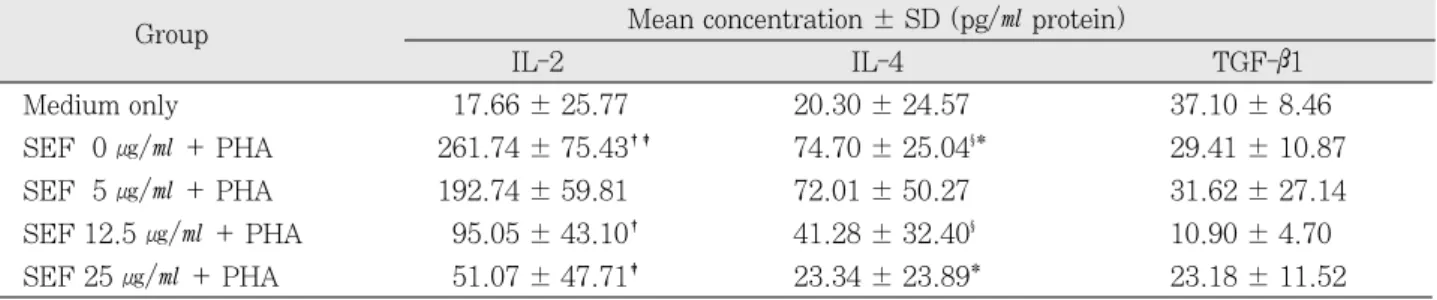
The results of this study are summarized in Table 1 and Figure 1.
Bacterial extracts were evaluated for their abili- ty to suppress the production of cytokine of lym- phocyte to mitogens of PHA. Data of Table 1 and Figure 1 are the representative results of experi- ments. Results are the mean values of six sam- ples of duplicate cultures. PHA-activated group
Table 1.Average concentration (± SD) of cytokines in cultures.
Group Mean concentration ± SD (pg/㎖ protein)
IL-2 IL-4 TGF-β1
Medium only 17.66 ± 25.77 20.30 ± 24.57 37.10 ± 8.46
SEF 0 ㎍/㎖ + PHA 261.74 ± 75.43�� 74.70 ± 25.04§* 29.41 ± 10.87
SEF 5 ㎍/㎖ + PHA 192.74 ± 59.81 72.01 ± 50.27 31.62 ± 27.14
SEF 12.5 ㎍/㎖ + PHA 95.05 ± 43.10� 41.28 ± 32.40§ 10.90 ± 4.70
SEF 25 ㎍/㎖ + PHA 51.07 ± 47.71� 23.34 ± 23.89* 23.18 ± 11.52
SEF = sonicated extract of Enterococcus faecalis
“�, �, §and * are statistically significant different (p < 0.05) between groups
(Group 2) exhibited higher level of IL-2 and IL-4 than medium only control group (Group 1) (p <
0.05). As compared with PHA-activated (Group 2), high and medium concentration of SEF (Group 4, 5) decreased the production of IL-2 and IL-4 from lymphocyte (p < 0.05), but there was no statistically significant difference between low concentration of SEF (Group 3) and PHA-activat- ed group (Group 2). So we can suggest that SEF cause a dose-dependent reduction in PHA- induced cytokine production of IL-2, and IL-4.
But the production of TGF-β1 was independent of concentration of SEF (p > 0.05).
Ⅳ. Discussion
Microbial products represent an important source of immunoregulatory agents. In particular, several microorganisms are capable of suppressing the immune response through various products, including toxins, enzymes, cell wall components, and metabolites. These immunosuppressive prod- ucts may alter the immune system via different mechanisms. In some instances these agents indi- rectly modify lymphocyte response by directly affecting monocytes or macrophage activities directly. For example, Spirochetes inhibited lym- phocytes function and Leishmania donovani
impaired the synthesis and release of IL-1 from macrophages17,18). Sonicated extract from Prevot- ella intermedia, Porphylomonas asaccharolytica, Porphyromonas endodontalis and Prevotella mel- aninogenica were capable of suppressing human T- and B-cell response in dose-dependent man- ner. The immunosuppressive activity is nondial- yzable and heat labile19).
This study showed that the level of IL-2 and IL- 4 in lymphocytes stimulated with PHA were sig- nificantly higher than those of the negative con- trol group. So, PHA can have sufficient mitogenic effect to lymphocytes. But sonicated extracts of E.
faecalis suppressed in vitro IL-2, IL-4 production of human lymphocyte in a dose-dependent man- ner. Ability of E. faecalis to impair the production of IL-2 and IL-4 may be related to the suppres- sion of T-cell activation. In our previous studies, in contrast, lipopolysaccharide of Porphyromonas endodontalis in vitro stimulated the production of macrophage inflammatory protein (MIP)-1 alpha and MIP-1 beta from human polymorphonuclear leukocyte20). In rat pulpitis experimentally induced by specific bacteria, Streptococcus mutans, Por- phylomonas endodontalis stimulated the produc- tion of Interferon-γ, IL-2 and IL-414). These stud- ies showed that P. endodontalis have inflammato- ry effects by stimulation, but in other reports, sonic extract of P. endodontalis in lymphocyte in vitro have immunosuppressive effects by inhibi- tion19), and in this study E. faecalis inhibited the cytokine production of lymphocytes. Much further investigation is required to clarify the stimulation and inhibition of cytokines. In contrast, there was no significant difference in the level of TGF-β1 in regardless of SEF, this results show that TGF-β1 is released by other mechanism.
When comparing with the level of each cytokine, Results showed that the level of IL-2 predominat- ed over those of other cytokine IL-4, and TGF-β1.
Considering the concentration of IL-2, Th1 lym- phocytes may be dominant in human peripheral blood lymphocytes.
It has been proposed that impaired host defense may play a pivotal role in the pathogenesis of many infections. The data presented in this study Figure 1. Response to SEF (Sonicated extract of E.
faecalis) of IL-2, IL-4 and TGF-β1 production in the supernatants of lymphocytes. The cell was treated with PHA and various concentrations of each SEF for 72 hr.
The data represent mean values (n = 6 duplicate culture for each group).
suggest that microbial mediated immunosuppres- sion may contribute to the pathogenesis of endodontic infection by altering the nature and consequences of host-parasite interactions21). Microbial virulence may be the consequence of several properties, including the ability of certain species to resist, escape, or pervert host defense mechanism. Some causative virus infects and destroys a subpopulation of T lymphocytes, such as human immunodeficiency virus. Such inhibito- ry factors could lead to a state of immunological hyporesponsiveness that favors colonization by the initiating organism or by other opportunistic organisms. Our current finding that E. faecalis inhibits the immune response suggests that imp- aired host defense mechanism may contribute to the disease process.
This results suggested that bacterial protein sonicated extract of E. faecalis can inhibit the immune response by lymphocyte and this could be one of possible factors why E. faecalis are found frequently in the teeth with failed endodontic treatment.
Ⅴ. Conclusion
According to this study we could summarize as follows: PHA activated expression of IL-2 and IL- 4 from lymphocytes compared with negative con- trol group (p < 0.05). As compared with PHA- activated group, high and medium concentration of SEF decreased the production of IL-2 and IL-4 from lymphocytes (p < 0.05). There was no statis- tically significant difference between low concen- tration of SEF and PHA-activated group. The production of TGF-β1 was independent of concen- tration of SEF (p > 0.05). So we can suggest that SEF cause a dose-dependent reduction in PHA- induced cytokine production of IL-2, and IL-4.
References
1. Kakehashi S et al. The effects of surgical exposures of dental pulps in germ-free and conventional laboratory rat. Oral Surg 20:340-344, 1965.
2. Sundqvist G et al. Microbiologic analysis of the teeth with failed endodontic treatment and the outcome of
conservative re-treatment. Oral Surg Oral Med Oral Pathol Oral Radiol Endo 85:86-93, 1998.
3. Dahlen G et al. Identification and antimicrobial sus- ceptibility of enterococci isolated from the root canal.
Oral Microbiol Immunol 15: 309-312, 2000.
4. Orstavik D and Haapasalo M. Disinfection by endodon- tic irrigants and dressings of experimentally infected dentinal tubules. Endo Dent Traumatol 6:142-149, 1990.
5. Love RM. Enterococcus faecalis - a mechanism for its role in endodontic failure. Int Endo J 34:399-405, 2001.
6. Evans et al. Mechanisms involved in the resistance of Enterococcus faecalis to calcium hydroxide. Int Endo J 35:221-228, 2002.
7. Yoshida H et al. Effect of sonicated material from Fusobacterium nucleatum on the functional capacity of accessory cells derived from dental pulp. Oral Microbiol Immunol 10:208-212, 1995.
8. Kurita-Ochiai T et al. Immunosuppressive effect induced by Actinobacillus actinomycetemcomitans:
effect on immunoglobulin production and lymphokine synthesis. Oral Microbiol Immunol 7:338-343, 1992.
9. Trowbridge H. Inflammation; A review of the process, 5thedition, Quintessence Publishing Co. p79-90, 1997.
10. Hahn CL et al. A study of T and B cells in pulpal pathosis. J Endodon 15:20-6, 1989.
11. Rauschenberger CR et al. Detection of human IL-2 in normal and inflamed dental pulps.J Endodon 23:366- 70, 1997.
12. Kawashima N and Stashenko P. Expression of bone- resorptive and regulatory cytokines in murine periapi- cal inflammation. Arch Oral Biol 44:55-66, 1999.
13. Walker KF et al. Cytokine expression in periapical granulation tissue as assessed by immunohistochem- istry. Eur J Oral Sci 108:195-201, 2000.
14. Kim SA and Lim SS. T lymphocyte subpopulations and interleukin-2, interferon-gamma, and interleukin-4 in rat pulpitis experimentally induced by specific bacteria.
J Endodon 28:202-5, 2002.
15. Wahl SM. Transforming growth factor beta in inflam- mation : a cause and a cure, J Clin Immunol 12:1-14, 1992.
16. Wahl SM. Transforming growth factor β; the good, the bad, and the ugly. J Exp Med 180:1587-1590, 1994.
17. Shenker BJ et al. Suppression of human lymphocyte responses by oral spirochetes: a monocyte-dependent phenomenon. J immunol 132: 2039-2045, 1984.
18. Reiner. Parasite accessory cell interactions in murine heishmaniasis. I. Evasion and stimulus-dependent suppression of the macrophage interleukin-1 response by Leishmania donovani. J Immunol 138:1919-1925, 1987.
19. Shenker BJ and Slots J. Immunomodulatory effects of Bacteroides products on in vitro human lymphocyte functions. Oral Microbiol Immunol 4:24-29, 1989.
20. Ko HJ and Lim SS. Production of macrophage inflam- matory protein (MIP)-1 alpha and MIP-1 beta by human polymorphonuclear neutrophils stimulated with Porphyromonas endodontalis lipopolysaccharide. J Endod 28:754-7, 2002.
21. Shenker BJ et al. Immunosuppressive effects of Prevotella intermedia on In vitro Human lymphocyte activation, Infect Immun 59: 4583-4589, 1991.
Enterococcus faecalis 추출물이 임파구의 IL-2, IL-4, TGF-β1 분비에 미치는 영향에 관한 연구
김현식∙이우철∙장석우∙손원준∙이상탁∙김철호∙임성삼*
서울대학교 치과대학 치과보존학교실
근관치료의 실패원인 중 중요한 세균으로 알려진Enterococcus faecalis는 최근에 중요성이 더해지며 많은 연구 들이 진행중이다. 여러가지 기전들이 보고되고 있으나 면역반응에 관한 연구는 거의 알려져 있지 않은 상태이다.
본 연구에서는Enterococcus faecalis의 초음파 분쇄 추출물을 성인의 말초혈액으로부터 얻은 임파구에 적용시 켜서 여기서 분비되는 interleukin-2, interleukin-4, transforming growth factor-β1의 농도를 Enzyme linked immunosorbent assay (ELISA)로 측정하여 비교, 평가하는 것을 목적으로 한다.
E. faecalis를 적절한 조건에서 배양한 뒤 초음파 분쇄를 하여 추출물을 얻어냈다. 임파구는 건강한 성인의 말초 혈액에서 추출하여 분리하였다. 임파구를 적절한 농도의 mitogen (Phytohemagglutinin: PHA)으로 자극시킨 뒤에 다양한 농도의E. faecalis 초음파 추출물을 적용시키고 72시간 동안 배양하였다. ELISA를 이용하여 IL-2, IL-4, TGF-β1의 농도를 측정하였다. 실험결과는 Kruskal-Wallis test, Man-Whitney rank sum test (p <
0.05)를 사용하여 통계처리 하였다.
실험결과 PHA로 처리한 군은 아무것도 처리하지 않은 군에 비해서 IL-2, IL-4의 수치가 유의성 있게 높았다 (p
< 0.05). PHA로 처리한 군중에서 고농도와 중농도의 sonic extract of E. faecalis (SEF)로 처리한 군은 그렇지 않은 군에 비해서 IL-2, IL-4의 농도가 유의성 있게 낮았다 (p < 0.05). PHA로 처리한 군중에서 저농도의 SEF 로 처리한 군은 그렇지 않은 군과 비교하여 유의할 만한 차이를 보이지 않았다. TGF-β1의 농도는 모든 군에서 유 의할 만한 차이를 보이지 않았다 (p > 0.05). 따라서, E. faecalis의 추출물은 임파구의 IL-2, IL-4의 분비능력을 저하시킨다고 할 수 있다.
주요어 :Enterococcus faecalis, 임파구, 초음파 추출물, IL-2, IL-4, TGF-β1, ELISA 국문초록