Facebook: Hate it or Love it, But Can You Ignore it?
A Comparative Study of US and India
Open Access
Accepted date: March 10, 2016 Received date: February 19, 2016 *Corresponding Author: Daniel Okunbor Professor
College of Arts and Sciences Fayetteville State University Fayetteville, North Carolina, USA E-mail: [email protected]
All JISTaP content is Open Access, meaning it is accessible online to everyone, without fee and authors’ permission. All JISTaP content is published and distributed under the terms of the Creative Commons Attribution License (http:/ creativecommons. org/licenses/by/3.0/). Under this license, authors reserve the copyright for their content; however, they permit anyone to unrestrictedly use, distribute, and reproduce the content in any medium as far as the original authors and source are cited. For any reuse, redistribution, or reproduction of a work, users must clarify the license terms under which the work was produced. ABSTRACT
Facebook has been a part of our lives for the last decade. For a company started in 2004 to have penetrated the lives of people across the globe is commendable. The perpetuation of Facebook has led to a phenomena called Facebook Addiction Disorder. Companies are using Facebook to promote their business and people are using it to promote themselves, in addition to staying connected. In this paper, an effort is made to study respondents from India and the United States of America in order to gauge their dependence on Facebook, and a comparative view of it is presented.
Keywords: Facebook, FAD, Facebook Addiction Disorder, Social Networking
Daniel Okunbor
*
College of Arts and Sciences Fayetteville State University Fayetteville, North Carolina, USA E-mail: [email protected]
Shivani Arora
SBS College, Delhi University Delhi, India
E-mail: [email protected]
1. INTRODUCTION
Facebook has been gaining ground since its in-ception in 2004. In less than a decade, it has become synonymous with the term Social Networking. The buzz around it has increased in the recent past in India,
which has the potential to provide Facebook with a stronger user base. India has huge untapped poten-tial for Facebook. The initiatives by the government of India, including the Digital India drive has further strengthened Facebook’s interest in India, with its CEO Mark Zuckerberg visiting India twice in around a year.
http://dx.doi.org/10.1633/JISTaP.2016.4.1.5 eISSN : 2287-4577 pISSN : 2287-9099
66 Indian Prime Minister Narendra Modi’s visit to Face-book headquarters has further strengthened the already sturdy growth of Facebook. The prime minister’s visit implies that being on social media isn’t a matter of choice; the sooner you start taking benefit from it, the better the advantage you will have.
With a strong hold in the US and building up in In-dia, there is a consensus on its advantages, especially the ease with which users can “connect,” irrespective of the geographical boundaries.
The team at Facebook has been working incessantly on changing and improving the experience of its cus-tomers. Zuckerberg’s Facebook has been anything but static since its inception, and the competitors that were complacent like Orkut and Google+ have lost ground. They are either abandoned or are not able to compete. Facebook studies its customers to offer them features, similarly introducing its “like” button, its click to “buy,” emojis, and so on. The customized offers it makes raises the question of privacy in the minds of users, again with Facebook making all its efforts to issue statements and figure out ways to address privacy issues.
Is there a perpetual need to study everything that Facebook does, or isn’t there? This question can best be answered through this paper.
Social networking, especially Facebook, has become an imminent part of life and discussions around it have grown, the flipside being that the dependence of people on Facebook has grown, at a fast pace. There’s a thin line between dependence and addiction, and this line is very easy to cross. Various psychologists and researchers in the field have established the symptoms and effects excessive usage can have on users once they become addicted. The symptoms have been defined for research based on the studies by the psychologists. This paper tries to study various aspects of its usage, by studying the respondents through a questionnaire and then com-paring respondents from India and the United States, in order to decipher the usage along with the differences, if any, and then comparing them to yield results for us to further investigate.
2. REVIEW OF LITERATURE
In this section a review of articles and studies related to Facebook’s focus on India, and on Facebook
Addic-tion Disorder and various aspects related to it, has been considered. The articles have been quoted and studied to analyze trends, and a review of empirical studies has been undertaken to observe which areas have been ex-plored, and which need further investigation. This was done in order to formulate objectives and undertake productive research. The review has also been undertak-en to earmark problem areas related to excess Facebook usage. Besides, these studies will provide insight into the various efforts directed towards better understanding of the complexities involved.
Facebook has been very positive about its Indian pres-ence and has been focusing on India since the Digital India initiative was launched. Mark Zuckerberg visited India in 2014 and met Prime Minister Modi to discuss various aspects of collaboration between the two. In the article “Facebook’s Mark Zuckerberg latest tech CEO to visit India” by Guynn (2014), she shares all that had been planned for the Indian focus. She also discusses Facebook’s Chief Operating Officer Sheryl Sandberg visit to India, Facebook’s second largest market. She also met with Modi, who used social media during his elec-tion campaign and also is using it in governance.
In the article “Facebook in India: Can Mark Zuck-erberg’s plan really help the poor?” by Suhay (2015), the controversial internet.org site is discussed in detail. Zuckerberg emphasized that free Internet should be a basic right, whereas some sections of people see an un-derlying marketing gimmick for Facebook rather than a philanthropic one.
As a result of the opposition Facebook is facing from many sections including e-commerce giants, in their study “Facebook addiction - New psychological scale,” Andreassen et al. (2012) show that
• Younger people are more at risk of developing Facebook addiction as compared to older ones •
Anxious and socially insecure people use Face-book more that those who are not, since they find it convenient to communicate via social media as compared to face-to-face
• Organized and ambitious people tend to stay away from addictive use; rather, they tend to use it for work
• Women are more at risk of developing Facebook Addiction Disorder (FAD) due to its social nature.
The study “Facebook addiction: Factors influencing an individual’s addiction,” by Sherman (2011) suggests that although Internet addiction has been studied, social networking addiction has not been researched. The study investigates how factors such as personality, gender, procrastination, boredom, and one’s values may affect amount of time spent on Facebook. It further concludes that users are either overly possessive about their usage thereof or not. The research conducted was a combination of qualitative and quantitative techniques, using scholarly articles that focused on personality types and Internet addiction. Based on the results from the qualitative study, a quantitative survey instrument was devised, which includes Likert-style statements that test personality type, values, boredom, and procrastination.
Psychologist Dr. Michael Fenichel (2010) describes Facebook Addiction Disorder (FAD) as a situation in which Facebook usage “overtakes” daily activities like waking up, getting dressed, using a telephone, or email checking. According to Joanna Lipari (as cited in Fenichel, 2010), a clinical psychologist at UCLA, some signs of Facebook addiction are:
i) Losing sleep over Facebook; staying logged in throughout the night and eventually becoming too tired for the next day;
ii) As a bench mark, spending one hour or more on Facebook is too much;
iii) Being obsessed with exes who reconnect on Face-book;
iv) Ignoring work for Facebook;
v) The thought of getting off Facebook leaving the user in cold sweat.
Shaw (2013), in the article “Status update: Facebook Addiction Disorder,” opines that a user is suffering from Facebook Addiction Disorder (FAD), a disease referred to by psychologists, if he/she has more online friends than real life friendships; also, if users check Facebook more than five times a day (spending hours updating their status), or if checking their Facebook account is the first thing that they do in the morning.
The excuses cited by Facebook addicts have included: i) The urge of human interaction and the ease of it
through Facebook/Twitter;
ii) Getting a message on Facebook/Twitter is exciting since it feels like someone is interested in “me.”
To check this urge to be on Facebook pages, a web ap-plication can be used which shuts off the computer after the user has spent a pre-determined amount of time.
Ellison, Steinfield, and Lampe (2007), in their study “The Benefits of Facebook ‘friends’: Social capital and col-lege students’ use of online social network sites,” provide scale items to judge addiction of social networks, viz.,
i. Facebook is a part of my everyday activities ii. I am proud to tell people, I am on Facebook iii. Facebook has become a part of my daily routine iv. I feel out of touch when I haven’t logged onto
Facebook for a while
v. I feel I am a part of the Facebook community vi. I would be sorry if Facebook shut down
vii. Approximately how many Facebook friends do you have?
viii. In the past week, on average, how much time per day have you spent actively using Facebook? Also, Agyemang (2009), in his article, “Infected with Facebook Addiction Disorder?,” refers to a study by Cambridge University suggesting an argument contrary to the belief that Facebook disrupts social life. It was asserted that it aids people to be more sociable, giving people more choice as to how and with whom they con-duct their relationships.
Haisha (2011), in her article “Is your Facebook addic-tion a sign of loneliness?”, discusses a unique aspect of Facebook addiction which differentiates it from other types of addictions. Unlike addictions to drugs, alcohol, and sex, where guilt is a major factor, Facebook addicts feel that they have reasons to be addicted, since they claim to be doing business. Some are self-employed professionals looking for clients, some are job seekers trying to network for a new job, and some are corporate employees trying to extending their company’s message. Their time on Facebook is actually escapism disguised as working. Also, most of these people are addicted to their past—reconnecting with their friends, old class-mates, former lovers, and so on.
In other research on social networks, Yang and Tang (2003) focused on students’ performance in an online course offered at the National Cheng-Chi University in Taiwan. They found that social networks that serve advising roles have a positive impact on students’ per-formance and that networks that are adversarial have a
68 negative impact.
The review of the available literature reveals that studies have included various aspects of Social Net-working Addiction (with special reference to Facebook) including its symptoms; positives of usage (as well as negatives); and the implications and impact of Social Networking Addiction. Among the studies listed here are also included the professional opinions of those psychiatrists and psychologists regarding the influx of Facebook Addiction Disorder (FAD) cases.
3. PURPOSES AND METHODOLOGY OF THE
STUDY
This research study will investigate the Facebook us-age of respondents. The focus will be on how often peo-ple use this tool to converse with or keep current with their friends’ social or personal lives. The significance of the study is to examine the impact of social networking on its users and the merits and demerits of Facebook usage, particularly the aspects that pertain to dysfunc-tional behaviors.
Facebook is growing bigger and worldwide, and there’s a need to study its impact. Research questions include:
• What is the threshold for Facebook usage to be classified as dysfunctional, such as causing addic-tion disorder?
• What are the differences in Facebook usage per-ception in a geographical context? In this case, usage in Western Asia (India) and North America (United States) will be compared.
The research design that will be used in this study is based on the mixed research model. This model is chosen in order to achieve full potential, including the benefits of mixed methodology, and to provide a comprehensive investigation of the research questions. These benefits include: 1) the ability to engage in both inductive and deductive reasoning, 2) allowing of a qualitative approach to complement the results of the quantitative approach and vice-versa, 3) maximizing of the advantages of quantitative and qualitative meth-odologies and minimizing of demerits, 4) application of both objective and subjective points of view, 5) al-lowing of researchers to choose explanations that best
produce desired outcomes, 6) researchers’ values play a large role in the interpretation of results, and 7) a mixed model is pragmatic and more realistic and serves as the middle ground for positivist and constructivist theo-ries (Tashakkori & Teddlie, 1998). These benefits of a mixed model are of great importance to this study. The open-ended questions are intended to complement the closed-ended questions and vice-versa to help produce stronger analyses and desired outcomes.
The qualitative approach of this research study will utilize content analysis based on open-ended questions of the survey questionnaire. Content analysis is chosen for this research because it is well suited to the study of the methodical and to the description of the content of recorded human communication. Babbie (2002) defines content analysis as “any technique for making inferences by objectively and systematically identifying specified characteristics of messages.”
Judgment sampling was used to study 151 undergrad-uate students from Delhi University and 120 from Fay-etteville State University, FayFay-etteville, North Carolina, USA. The questionnaire was sent to 1,000 respondents but as a limitation, only 151 and 120 respondents, re-spectively, filled it up. The quantitative portion of this research study will involve a cross-sectional approach for data collection. This data analysis will utilize a statis-tical package provided by Google Docs. The percentage of the total agreement has been taken by adding the strongly agree and agree percentages, and the same for disagreement levels. The simplicity of the method, combined with the qualitative discussions, will give us the real crux of the comparison. To keep it simple, the agreement levels of the two sets of respondents are compared and conclusions drawn accordingly. For this study, we will be using Google Forms’ spreadsheet that keeps the responses.
4. FINDINGS
The purview of the paper is to study the various as-pects of Facebook usage affecting the respondents from the United States (prefixed with the code U) and India (prefixed with I). The coding for various aspects is
1. RwF: Restless without Facebook
2. FGa: Prefer Facebook over family gathering 3. IPl: Facebook is an integral part of life
69 http://www.jistap.org Fig. 1Facebook unavailability leaves me restless
Fig. 2I prefer Facebook over a family gathering
4. FRe: Accepting friends’ requests 5. WT: Facebook is a waste of time
The responses are studied and analyzed; the findings are interesting, and in this area:
Symptom 1: RwF (Restless without Facebook): I feel
restless if I cannot connect whenever I want
34% of Indian respondents agree that they feel rest-less, as compared to only 11% of US respondents. Now, the agreement of one-third of Indian respondents with the statement is an indication of dependency on Face-book.
47% and 72% of respondents from India and the United States, respectively, disagreeing with the state-ment is a positive finding. That the feeling of restlessness
is not there if they are not able to log on is certainly a positive sign. US respondents seem stronger as com-pared to Indian respondents in their dependency. The informal discussions reveal that the possibility of not getting connected in the US is remote, so they do not know how that will make them feel.
To comprehend the same, very few (only 10%) from the US feel dependent on Facebook as compared to 33%, which makes a clear statement that US respon-dents are less addicted than Indian responrespon-dents in the case of Symptom 1.
Symptom 2: FGa (Prefer Facebook over Family gath-ering): I prefer to be on Facebook rather than going to
a family gathering.
There’s a general belief that Facebook keeps its users
0 15 30 45 60 SA A NAND D SD 8 26 19 30 17 3 8 17 18 54 IRwF URwF 0 15 30 45 60 SA A NAND D SD 0 6 9 26 59 3 4 9 26 58 IFGa UFGa 0 15 30 45 60 SA A NAND D SD 7 26 19 30 18 3 8 17 18 54 IIPl UIPl 0 15 30 45 60 SA A NAND D SD 3 7 3 29 58 3 7 10 24 56 IFRe UFRe 13 25 38 50 7 19 41 27 6 12 13 38 26 11 IWT UWT 0 15 30 45 60 SA A NAND D SD 8 26 19 30 17 3 8 17 18 54 IRwF URwF 0 15 30 45 60 SA A NAND D SD 0 6 9 26 59 3 4 9 26 58 IFGa UFGa 0 15 30 45 60 SA A NAND D SD 7 26 19 30 18 3 8 17 18 54 IIPl UIPl 0 15 30 45 60 SA A NAND D SD 3 7 3 29 58 3 7 10 24 56 IFRe UFRe 0 13 25 38 50 7 19 41 27 6 12 13 38 26 11 IWT UWT
70 away from their families, but the response to the state-ment clearly negates this. Similar response patterns to this statement reveal that the respondents do not pre-fer the pseudo-life of Facebook as opposed to family gatherings. Therefore, it is concluded that both sets of respondents are completely in sync as to their response to this statement. Both categorically reveal that they don’t prefer Facebook to family gatherings.
Symptom 3: IPl (Integral Part of Life): Facebook is an
integral part of my life
Established in 2004, within 12 years Facebook has attained a status which the other social networking sites can only dream of. Most of its competitors, such as Orkut and Google+, have not been able to keep pace with it. Hence the statement about Facebook being an integral part of their lives.
79% of US respondents disagree that Facebook is an integral part of their lives as compared to only 41% of Indian respondents. 31% of the Indian respondents agree that Facebook is an inseparable part of their lives as compared to only 9% from the US, thereby implying that respondents from India seem to be more depen-dent on Facebook than their counterparts.
Again, Symptom 3 is more pronounced in Indian re-spondents as compared to their US counterparts. Very few (only 11%) from the US consider Facebook an in-tegral part of their life as compared to 33% from India. Here again, the dependency and hence the chances of addiction are greater in respondents from India as
compared to the US.
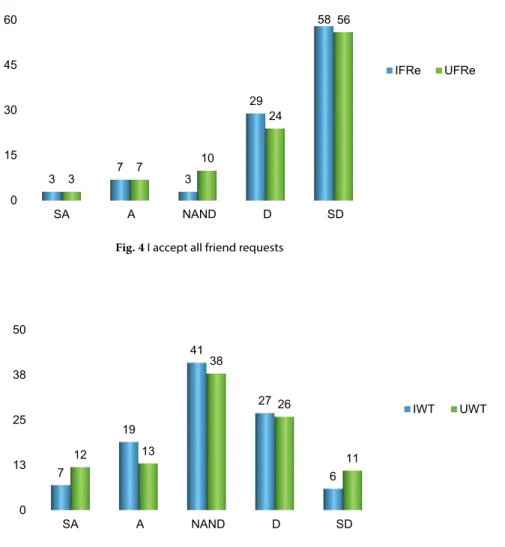
Symptom 4: FRe (Friends Request): I accept all friend
requests
This is an extremely pertinent statement to ensure safety and security online. The competition of having the maximum number of online friends was spotted, and the more the number of online friends, the more problems are associated with the same (Walton, 2013). Some experts advise that it is important to be conser-vative while accepting friend requests.
A very positive and uniform finding is that both set of respondents do not accept all the “friend requests” that come their way, implying that they try and evalu-ate before accepting requests from strangers.
The two sets of respondents are completely in sync and respondents do not accept all the friend requests that come their way.
Symptom 5: WT (Waste of Time): Facebook is a waste
of time
26% of respondents from India and 25% of respon-dents from the US agree that Facebook is a waste of time, whereas 32% from India and 38% from US dis-agree. In this particular case, 41% (Indian respondents) and 38% (US respondents) are indecisive regarding the same. What does that mean?
Informal discussions revealed that the response has a very interesting interpretation. The respondents sometimes find it useful and at other times a complete
Fig. 3Facebook is an integral part of life 0 15 30 45 60 SA A NAND D SD 8 26 19 30 17 3 8 17 18 54 IRwF URwF 0 15 30 45 60 SA A NAND D SD 0 6 9 26 59 3 4 9 26 58 IFGa UFGa 0 15 30 45 60 SA A NAND D SD 7 26 19 30 18 3 8 17 18 54 IIPl UIPl 0 15 30 45 60 SA A NAND D SD 3 7 3 29 58 3 7 10 24 56 IFRe UFRe 0 13 25 38 50 SA A NAND D SD 7 19 41 27 6 12 13 38 26 11 IWT UWT
A Comparative Study of US and India
waste of time. There’s unanimity in responses which implies something very close to our belief that neither its usefulness can be denied nor its flip/addictive side. Facebook is very useful and successful in spreading information, messages, causes, and so on, and at the same time it leads to a wasting of time, highlighting the addictive and useless angle of usage.
5. CONCLUSIONS
The comparison amongst the young respondents from India and the US has yielded some interesting expected results and at the same time, some
unexpect-ed results. Out of five symptoms, responses on the two are different and the other three show similar opin-ions. The respondents from India are more dependent on Facebook as compared to respondents from the US in the following two categories, i.e. feeling restless without Facebook and considering it an integral part of their lives. The two symptoms point out that the ad-dictive streak is conspicuous in Indian respondents as compared to their counterparts in the US.
Unanimous and positive results have been revealed in the following cases, which convey that the respon-dents from both categories prefer to be at family gath-erings as compared to preferring to spend time online. This is a very positive outcome and supports the
posi-Fig. 4I accept all friend requests
Fig. 5Facebook is a waste of time 0 15 30 45 SA A NAND D SD 8 26 19 30 17 3 8 17 18 IRwF URwF 0 15 30 45 60 SA A NAND D SD 0 6 9 26 59 3 4 9 26 58 IFGa UFGa 0 15 30 45 60 SA A NAND D SD 7 26 19 30 18 3 8 17 18 54 IIPl UIPl 0 15 30 45 60 SA A NAND D SD 3 7 3 29 58 3 7 10 24 56 IFRe UFRe 0 13 25 38 50 SA A NAND D SD 7 19 41 27 6 12 13 38 26 11 IWT UWT 0 15 30 45 60 SA A NAND D SD 8 26 19 30 17 3 8 17 18 54 IRwF URwF 0 15 30 45 60 SA A NAND D SD 0 6 9 26 59 3 4 9 26 58 IFGa UFGa 0 15 30 45 60 SA A NAND D SD 7 26 19 30 18 3 8 17 18 54 IIPl UIPl 0 15 30 45 60 SA A NAND D SD 3 7 3 29 58 3 7 10 24 56 IFRe UFRe 0 13 25 38 50 SA A NAND D SD 7 19 41 27 6 12 13 38 26 11 IWT UWT
72 tives given by Facebook.
The “friend requests” are not accepted blindly by either set of respondents. The flip side of accepting “friend requests” from all, whether known or unknown has put many people in trouble, so the respondents are mature enough to be selective. Both set of respondents agree that there are positives and negatives associat-ed with Facebook, which cannot be deniassociat-ed, so they consider it both a waste of time and at the same time, useful.
Based on the statements studied, the respondents from the US are not as much affected by the Facebook phenomena in an addictive way as compared to Indi-an respondents, who seem to be more dependent on Facebook and hence have a higher chance of addiction.
This research might come in handy when dealing with youths bordering on or suffering from Facebook Addiction Disorder. The differences in usage in the two sets of respondents would aid those concerned people in the two continents in dealing with them differently. It helps to deepen the understanding of the phenome-na called Facebook, which has changed the way people interact, socialize, and live their lives.
6. FURTHER RESEARCH/ LIMITATIONS OF
THE STUDY
The research in this field is imperative, and it mainly advocates against the raucous use of an important net-working tool. Social netnet-working websites are a boon when used judiciously. There are certain limitations of the study. The respondents have been chosen from Western Asia (India) and North America (United States) only, since the researchers belonged to these areas. That made data collection and discussion easier. The researchers feel that the geographical area can be expanded and so can the sample size. Both were re-stricted due to the restrictions of funds and time.
Another limitation is that Facebook is only a part of social networking, and so further research can be expanded to other social networking websites like Ins-tagram, Twitter, and so on.
Innumerable stories exist of people growing in their careers through LinkedIn, missing people being found with the aid of Facebook posts, and a never ending list. But when looked at on its flipside, it is the mental
health issues caused by excessive use, cyber bullying, terrorism, narcissism, and many problems which crop up. The use of any good thing is justified, but when it becomes an addiction or serious symptoms start show-ing up, it’s time to think and to start creatshow-ing awareness and providing solutions.
REFERENCES
Agyemang, F. (2009). Infected with Facebook Addic-tion Disorder? GhanaWeb. Retrieved from http:// www.ghanaweb.com/GhanaHomePage/features/ Infected-with-Facebook-Addiction-Disor-der-FAD-171018.
Andreassen, C., Andreassen, S., Torsheim, T., Brun-borg, S., & Pallesen, S. (2012). Development of a Facebook addiction scale. Psychological Reports, 110(2), 501-517.
Babbie, E. (2002). The basics of social research. Belmont, CA: Wardsworth Group.
Black, T. R. (1999). Doing quantitative research in the social sciences. London, UK: Sage Publications. Calderon, J. (2012, February 21). Facebook
Addic-tion Disorder in Malaysia. Newsweek (Japan). Retrieved from http://justincalderon.wordpress. com/2012/02/21/facebook-addiction-disor-der-in-malaysia-newsweek-japan/
EDUCAUSE Center for Applied Research (ECAR). (2008). Research study on social networking sites. ECAR Research Study 8. Boulder, CO.
Ellison, N.B., Steinfield, C., & Lampe, C. (2007, July). The benefits of Facebook “friends:” Social capital and college students’ use of online social network sites. Journal of Computer-Mediated Communica-tion, 12(4), 1143-1168.
Fenichel, M. (2010). Are you a Facebook addict? Re-trieved from http://www.addiction-intervention. com/addiction/process-addictions/are-you-a-face-book-addict/.
Guynn, J. (2014, October 1). Facebook’s Mark Zuck-erberg latest tech CEO to visit India. USA Today. Retrieved from http://www.usatoday.com/story/ tech/2014/10/01/facebook-mark-zuckerberg-in-dia-internetorg/16533515/.
Gadgets 360. (2016). Facebook spent Rs. 300 Crores on free basics ads in India: Report. Retrieved from
http://gadgets.ndtv.com/internet/news/facebook- spent-rs-300-crores-on-free-basics-ads-in-india-report-788348?site=classic.
Haisha, L. (2011). Is your Facebook addiction a sign of loneliness? SelfGrowth. Retrieved from http://www. selfgrowth.com/articles/is-your-facebook-addic-tion-a-sign-of-loneliness
Henderson, J. M. (2012). 3 reasons you should quit social media in 2013. Forbes. Retrieved from http://www.forbes.com/sites/jmaureenhender-son/2012/12/29/3.
Hopkins, W. G. (2000). Quantitative research design. Sportscience, 4(1). Retrieved from www.sportsci. org/jour/0001/wghdesign.html.
Indo-Asian News Service. (2015). Social media addic-tion affecting sex life of young Indians, claim ex-perts. NDTV. Retrieved from http://gadgets.ndtv. com/social-networking/news/social-media-ad- diction-affecting-sex-life-of-young-indians-claim-experts-699371.
Meikle, J. (2012, February 3). Twitter is harder to resist than cigarettes and alcohol. The Guardian. Re-trieved from http://www.guardian.co.uk
OFCOM. (2008, April 2). Social networking: A quan-titative and qualitative research report. Retrieved from http://stakeholders.ofcom.org.uk/binaries/ research/media-literacy/report1.pdf.
Paddock, C. (2012, April). Facebook addiction - New psychological scale. Medical News Today. Retrieved from http://www.medicalnewstoday.com/arti-cles/245251.php.
Tashakkori, A., & Teddlie, C. (1998). Mixed method-ology: Combining qualitative and quantitative ap-proaches. Thousand Oaks, CA: SAGE Publications. Sherman, E. (2011). Facebook addiction: Factors in-fluencing an individual’s addiction. Boston: Erica Sherman.
Shaw, E. (2013, January 29). Status update: Facebook Addiction Disorder. The Glen Echo. Retrieved from http://theglenecho.com/2013/01/29/status-update facebook-addiction-disorder
Suhay, L. (2015, December 28). Facebook in India: Can Mark Zuckerberg’s plan really help the poor? Chris-tian Science Monitor. Retrieved from http://www. csmonitor.com/Technology/2015/1228/Facebook- in-India-Can-Mark-Zuckerberg-s-plan-really-help-the-poor.
Walton, A. (2013). Jealous of your Facebook friends? Why social media makes us bitter. Forbes. Re-trieved from http://www.forbes.com/sites/ alicegwalton/2013/01/22/jealous-of-your-face- book-friends-why-social-media-makes-us-bit-ter/#48f0866d4c0dc37b2654c0d8.
Yang, H., & Tang, J. H. (2003). Effects of social network on students’ performance: A web-based forum study in Taiwan. Journal of Asynchronous Learning Networks, 7(3), 93-107.
Yuan, K., et al. (2011). Microstructure abnormalities in adolescents with Internet Addiction Disorder. Plos One. Retrieved from http://www.plosone.org/arti-cle/info:doi/10.1371/journal.pone.0020708.