Printed in the Republic of Korea DOI 10.5012/jkcs.2010.54.4.429
요약. Guanine (1)으로부터 생물활성이 있는 halogenopurines계 화합물을 합성하였다. Guanine을 acetic anhydride와 반응시 켜서 2,9-diacetylguanine (2-1)을 합성하여 얻어진 화합물을 POCl3와 반응시켜서 화합물 3a를 합성하고, 다음 단계에서 2-amino-6-halogenopurines (3b-d)를 합성하였다. 2-Halogenopurines (2-2a-d, 4-2a-d, 5a-d)을 2-amino-6-substituted purines (1, 3a, 4-1)로부터 효율적으로 합성한 후에, 새로운 화합물인 2-2a, 2-2c, 2-2d, 4-2c, 4-2d, 5b, 5c 및 5d를 합성하였다.
합성한 화합물의 구조를 원소분석, 1H NMR, mass spectral data로 확인하였으며, 합성한 화합물에 대한 항균 활성을 시험하였다.
주제어: Halogenopurines, 2-Amino-6-chloropurine, Phase transfer catalyst, Chlorine-exchange halogenation, Diazotization, Fungicidal activity
ABSTRACT. A series of some biologically active halogenopurines were synthesized from commercially available guanine (1).
The reaction of guanine with acetic anhydride yielded 2,9-diacetylguanine (2-1) by acetylation reaction. Further treatment of 2-1 with POCl3 by PEG-2000 phase transfer catalysis furnished the important compound 3a, then 2-amino-6-halogenopurines (3b-d) were obtained through chlorine-exchange halogenations between KX and 3a by TPPB phase transfer catalyst. Further, 2-halogen- opurines (2-2a-d, 4-2a-d, 5a-d) were efficiently prepared from 2-amino-6-substituted purines (1, 3a, 4-1) via a diazotization catalyzed by their corresponding CuX, and some new compounds 2-2a, 2-2c, 2-2d, 4-2c, 4-2d, 5b, 5c and 5d have been discovered. The structures of synthesized compounds were mainly established on the basis of their elemental analysis, 1H NMR, as well as their mass spectral data. All the title compounds were screened for their antifungal activities, and some of the compounds showed promising activity.
Keywords: Halogenopurines, 2-Amino-6-chloropurine, Phase transfer catalyst, Chlorine-exchange halogenation, Diazotization, Fungicidal activity
생물 활성이 있는 Halogenopurines의 합성
Yu Lin Hu, Xiang Liu, Ming Lu*, Qiang Ge, and Xiao Bin Liu
Chemical Engineering College, Nanjing University of Science and Technology, Nanjing 210094, PR China (접수 2009. 12. 1; 수정 2010. 1. 31; 게재확정 2010. 5. 4)
Synthesis of Some Biologically Active Halogenopurines
Yu Lin Hu, Xiang Liu, Ming Lu*, Qiang Ge, and Xiao Bin Liu
Chemical Engineering College, Nanjing University of Science and Technology, Nanjing 210094, PR China
*E-mail: [email protected]
(Received December 1, 2009; Revised January 31, 2010; Accepted May 4, 2010)
INTRODUCTION
The purine derivatives are of great importance to che- mists as well as to biologists as they have been found in a large variety of naturally occurring compounds and also in clinically useful molecules having diverse biological activi- ties.1-3 Halogenopurines are such an important purine deri- vatives that have been widespread applications of in the synthesis of a variety of biologically active purine deriva- tives, purine nucleoside derivetives, etc.4-6 Moreover, some halogenopurines displayed a wide range of biological activi- ties themselves such as fungicide, antitumour, immuno- suppressant and anticonvulsant, etc.7,8
2-Amino-6-halogenopurines are usually prepared by chlorine/halogen exchange reactions between potassium halide (KX) and 2-amino-6-chloropurine, and a variety of catalysts have been developed for such halogen exchanges, such as ammonium salts,9-11 metal carbonyls,12-14 chromium oxide on alumina,15-17 etc.18-21 Unfortunately, many of these procedures are associated with one or more disadvantages such as high cost, low selectivity, use of stoichiometric and even excess amounts of catalysts, complicate the separation of the products, and drastic reaction conditions. The classical method for synthesizing 2-halogenopurines constitutes the diazotization of 2-amino-6-substituted purines, although only a few publications in the open literature have been
N
N N
H N H2N
OCH3 N
N N
H N X
OCH3
4-1 5a-d
a: X = Cl b: X = F c: X = Br d: X = I
N
N N
H N X
Cl
4-2(a-d) N
N N
H N H2N
OH
N
N N
N HN
OH
(CH3CO)2 N
N N
H N H2N
Cl
COCH3 H3COC
POCl3,ClCH2CH2Cl
1 2-1 3a
CH3COOH
Diazotization
N
N N
H N
X OH
2-2(a-d)
Halogen Exchange
N
N N
H N
H2N X
3b-d CH3ONa, DMSO
Diazotization
Diazotization
Phase transfe
r catalysis PEG-2000
Scheme 1. Synthesis of halogenopurines
0 4 8 12 16 20 24
Time (h)
100
80
60
40
20
0
% Yield (No AcOH)
Yield (AcOH)
Fig. 1. Influences of the presence and absence of acetic acid on the acetylation degree of guanine. Reaction conditions: 1 (16.5 mmol), acetic anhydride (30 mL), 135 oC.
found in synthesis of them.22,23 The diazotization is generally carried out using accessible sodium nitrite in strongly acidic medium at reduced temperature.22-27 Alternative procedures involve more expensive alkyl nitrites as diazotizing agents in the presence of dihalogenomethane or other sources of halogeno.28,29 Other notable procedures for diazotization include the use of sodium nitrite in weakly acidic media created by p-toluenesulfonic acid,30,31 sulfonated cation ex- changers,32,33 etc.34-37 However, many of these procedures require high reaction temperature, expensive and special apparatus, troublesome work-up procedures, harsh reaction conditions, etc.
Phase transfer catalysis (PTC) is a versatile synthetic technique that has been widely applied to intensify other- wise slow heterogeneous reactions involving an organic substrate and an ionic reactant, either dissolved in water (liquid-liquid) or present in solid state (liquid-solid).38,39 In addition, phase transfer catalysis can make reaction condition gentle, can effectively avoid side reaction to occur, can reduce consumption of organic solvent and raw materials and enhance the efficiency of organic synthesis. At present, phase transfer catalysis has been applied in various organic syntheses, such as electrophilic substitution reaction, nu- cleophilic substitution reaction, hydrolysis and so on.40-43
As a part of a research program on the synthesis of vari- ous heterocyclic compounds containing nitrogen and on the basis of these observations, the present study describes an improved and economic procedure for synthesis of a variety of halogenopurines of interest as imaging agent pre- cursors for radiolabeling and unlabeled standard samples (Scheme 1) and an evaluation of their in vitro antifungal activities.
RESULTS AND DISCUSSION Preparation of 2-amino-6-chloropurine (3a)
In a preliminary study, the acetylation reaction of gua- nine (1) was carried out in the presence and absence of the solvent acetic acid at 135 oC. As shown in Figure 1, in the absence of acetic acid, the acetylation reaction proceeded slowly, the yield was only 78% after 20 h. Reaction per- formed with acetic acid at a amount of 63 equiv (60 mL) proceeded very rapidly and the yield increased to 95.2% in a shorter time (7.5 h). However, under the same conditions, the yield was not enhanced significantly with further increase in the reaction time.
In the process of chlorination, 2,9-diacetylguanine (2-1) was initially carried out by vigorously stirring the two phase system (solvent and chlorination agent) in absence of PEG- 2000 at 80 oC. As shown in Figure 2, the chlorination reaction proceeded not well, and the yield was only 47% after 8 h.
0 2 4 6 8
Time (h)
100
80
60
40
20
0
Yield (%)
No PTC BTEAC TOMAC TEMAC PEG-2000
Fig. 2. Relationship between yield and reaction time in the presence and absence of phase transfer catalysts. Reaction conditions: 2-1 (10 mmol), ClCH2CH2Cl (10 mL), POCl3 (35 mmol), phase trans- fer catalyst (2 mmol), 80 oC.
Table 1. The chlorination of 2,9-diacetylguanine with different type of solvents and chlorination agents by phase transfer catal- ysisa
Entry Solvent Chlorinati
on agent Time (h) Temp.
(oC) Yield (%)b
1 ClCH2CH2Cl POCl3 6 80 84
2 CH2Cl2 POCl3 10 40 51
3 CH3C6H5 POCl3 6 100 82
4 CHCl3 POCl3 8 60 64
5 CH3CN POCl3 6 80 81
6 - POCl3 12 90 43
7 ClCH2CH2Cl PCl5 6 80 68
8 ClCH2CH2Cl PCl3 12 80 37
9 ClCH2CH2Cl SOCl2 6 80 80
aReaction conditions: 2-1 (10 mmol), solvent (10 mL), chlorina- tion agent (35 mmol), PEG-2000 (2 mmol). bIsolated yield.
1 2 3 4 5 6 No catalyst TEMAC TOMAC TPPB BTEAC CTAB
Phase Transfer Catalyst
50
40
30
20
10
0
Yield of 3b (%)
Fig. 3. Influences of phase transfer catalysts on the chlorine-ex- change fluorination. Reaction conditions: 3a (10 mmol), sulfolane (30 mL), KF (50 mmol), phase transfer catalyst (0.5 mmol), 190 oC, 15 h.
However, when chlorination with PEG-2000 using a catalytic amount of 0.2 equiv proceeded very rapidly and the yield reached 84% in a shorter time (6 h), which displays distinctly the advantage of high efficiency of the phase transfer cataly- sis. Besides polyethylene glycol 2000 (PEG-2000), we also tried to use another types of phase transfer catalysts such as benzyltriethylammonium chloride (BTEAC), tri- octylmethylammonium chloride (TOMAC) and triethyl- methylammonium chloride (TEMAC) in the reaction, it was observed that the highest yield obtained was the reac- tion condition when using PEG-2000, which showed that PEG-2000 demonstrated the best performance. The different catalytic abilities of phase transfer catalysts may be attri- buted to their different solubilization abilities in the reaction.
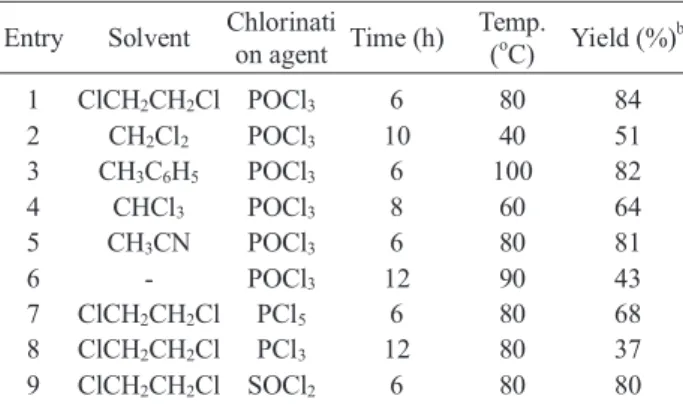
Table 1 shows the influences of type of solvents and chlo- rination agentson the reaction. The chlorination of 2,9- diacetylguanine (2-1) was examined with different type of solvents at first. Typical results are shown in Table 1, en-
tries 1-5. The solvents such as ClCH2CH2Cl, CH3C6H5 and CH3CN are all the excellent solvents for the chlorination (Table 1, entries 1, 3 and 5), and the yields were more than 80% under almost the same conditions, although their yields were decreased respectively in the order: ClCH2CH2Cl
> CH3C6H5 > CH3CN. The solvent was essential for the chlorination because the yield decreased to 43% in the ab- sence of solvent (Table 1, entry 6) but increased to 84% in the presence of ClCH2CH2Cl, which should be attributed to the solid state of the substrate (2) and its poor solubilization abilities with POCl3 in the reaction. When in the presence of ClCH2CH2Cl, the solvent fulfills several functions during a chemical reaction.44 One is that it solvates the reactans and reagents so that they dissolve, which facilitates collisions between the reactant(s) and reagents that must occur in order to transform the reactant(s) to product(s); the other is that it also provides a means of temperature control, either to increase the energy of the colliding particles so that they will react more quickly, or to absorb heat that is generated during an exothermic reaction. As a result, a high yield was obtained ccordingly. Besides the influences of different type of solvents, we also found the chlorination agents have great influences on the reaction, we tried to use chlorination agents such as POCl3, PCl5, PCl3 and SOCl2 in the reaction, how- ever, the yield were 84%, 68%, 37% and 80%, respectively (Table 1, entries 1 and 7-9). Thus, the best chlorination agent is POCl3.
Preparation of 2-amino-6-halogenopurines (3b-d) The chlorine-exchange fluorination taking place between KF and 2-amino-6-chloropurine is a solid (KF)-liquid (solu- tion of substrates) two-phase procedure in absence of whatso- ever phase transfer catalyst, the fluorination proceeded very slowly, and the yield was less than 10% after 15 h. So, an appropriate phase transfer catalyst for this reaction is essen-
Table 2. The halogeno exchange reaction of 2-amino-6-chloropurine with different type of solvents by phase transfer catalysisa
Entry Solvent Temp. (oC) Time (h) Yield (%)b
3b 3c 3d 3b 3c 3d 3b 3c 3d
1 - 200 80 80 24 10 10 0 7 9
2 DMF 190 40 35 15 2 2 12 62 74
3 DMSO 190 40 35 15 2 2 20 71 80
4 Nitrobenzene 190 40 35 15 2 2 40 83 88
5 Ketopyrrolidine 190 40 35 15 2 2 39 80 86
6 Sulfolane 190 40 35 15 2 2 43 88 92
aReaction conditions: 3a (10 mmol), solvent (30 mL), KX (50 mmol), TPPB (0.5 mmol). bIsolated yield.
Table 3. Fluoro-, bromo- and iodo-dediazoniations of 2-amino-6- substituted purinesa
Entry Compound Aqueous acid Temp. (oC) Yield (%)b
1 2‐2b 40%HBF4 ‐10 77
2 4‐2b 40%HBF4 ‐10 91
3 5b 40%HBF4 ‐10 64
4 2‐2c 40%HBr ‐5 67
5 4‐2c 40%HBr ‐5 54
6 5c 40%HBr ‐5 71
7 2‐2d 50%HI 5 57
8 4‐2d 50%HI 5 68
9 5d 50%HI 5 49
aReaction conditions: 1 or 3a or 4-1 (10 mmol), aqueous acid (40 mL), CuX (11 mmol), 7 h. bIsolated yield.
0 0.5 1 1.5
CuCl (mol/mol substrate)
%
80
60
40
20
0
Yield of 4-2a Yield of 2-2a Yield of 5a
Fig. 4. Influences of amount of CuCl on the diazotization. Reaction conditions: 1 or 3a or 4-1 (10 mmol), conc. HCl (40 mL), CuCl (11 mmol), –5 oC, 7 h.
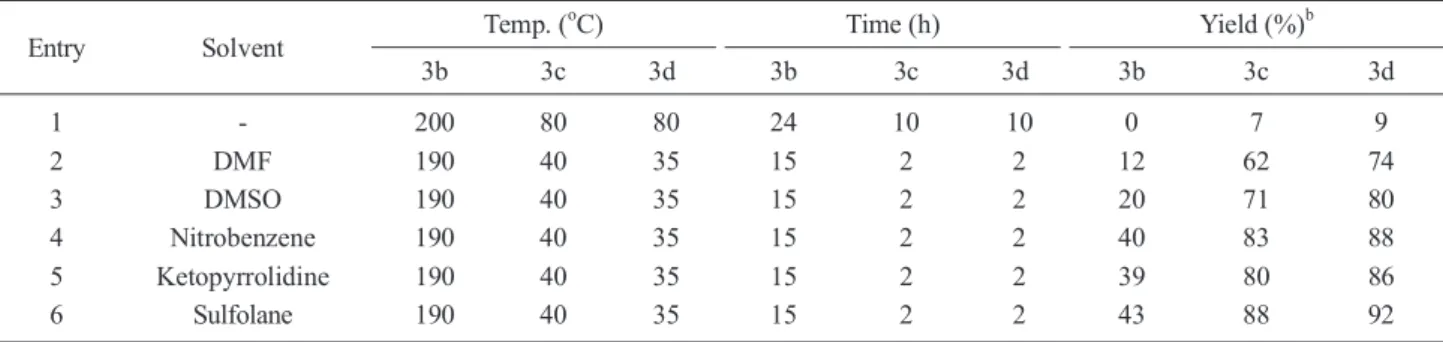
tial. The phase transfer catalysts such as TEMAC, TOMAC, BTEAC, cetyltrimethylammonium bromide (CTAB), tetra- phenylphosphonium bromide (TPPB) were screened in the reaction, we found that the best phase transfer catalyst is TPPB (Figure 3). It is noteworthy that the exchange reaction taking place between KBr or KI and 2-amino-6-chloro- purine in the presence of TPPB is very rapid, being usually completed within 2 h in a high yield 88% or 92% under relatively milder conditions (Table 2, entry 6), which means that the TPPB phase transfer catalysis is also adapt to the chlorine-exchange bromination or iodination. Besides the phase transfer catalysis, we also found that appropriate sol- vents are essential for the reaction because of the solid state of the substrate (3a), which has been evidenced by our ex- periments. No reaction occurred in the absence of whatsoever solvent for chlorine-exchange fluorination even under more drastic conditions, and the yields of 3c and 3d were only 7% and 9%, respectively (Table 2, entry 1). The influences of different types of solvents on the chlorine-exchange halogenations are shown in Table 2. From the different solvents screened (DMF, DMSO, nitrobenzene, ketopy- rrolidine, and Sulfolane) we found the best solvents to be
sulfolane for the reactions (Table 2, entries 2-6), and their yields (3b, 3c and 3d) were decreased respectively in the order: Sulfolane > Nitrobenzene > Ketopyrrolidine > DMSO
> DMF.
Preparation of 2-halogenopurines (2-2a-d, 4-2a-d, 5a-d) In the process of diazotization, we found that CuX has great influences on the reaction, and in this reaciton, the role of CuX is as an catalyst to convert diazonium ion to ArX.
To optimize the reaction conditions, we studied the condensa- tion of 2-amino-6-substituted purines (1, 3a, 4-1) with hydro- chloric acid and CuCl at first, and the influences of amount of CuCl on the diazotization are shown in Figure 4. It is obvious that the reaction proceeded very slowly, and all the yields were less than 10% in absence of CuCl, and we also found that the increase in the amount of CuCl (i.e. the mole ratio of CuCl to the substrate (1 or 3a or 4-1) increased) could enhance the reaction and the yields reached maximum at 1.1 of the ratio. It was found that the yields were not significantly affected by further adding amount of CuCl, and 1.1 equiv. of CuCl was sufficient. With these results in hand, we subjected guanine (1), 2-amino-6-methoxylpurine
Table 4. Fungicidal activity of the title compounds Compound
Diameter of inhibition zone Bacillus
subtillis
Aspergillus niger
Cardida tropicals
1 1.5 3.5 2.3
2‐2a 0.3 2.5 2.0
2‐2b 1.0 3.2 2.2
2‐2c 1.2 3.0 2.3
2‐2d 0.7 2.8 1.7
3a 1.4 2.5 1.5
3b 0.3 2.4 1.1
3c 0.6 2.0 1.3
3d 0.7 1.7 1.0
4‐2a 1.0 0 1.6
4‐2b 1.2 3.5 2.0
4‐2c 1.5 3.0 2.0
4‐2d 0.7 3.0 2.0
5a 0.6 0 2.0
5b 1.2 3.5 2.0
5c 1.3 3.0 1.1
5d 1.8 2.8 1.5
(4-1), and 2-amino-6-chloropurine (3a) to the optimized con- ditions, they were efficiently converted to the corresponding 2-halogenopurines (2-2b-d, 4-2b-d, 5b-d), and the results were summarized in Table 3.
Fungicidal activity
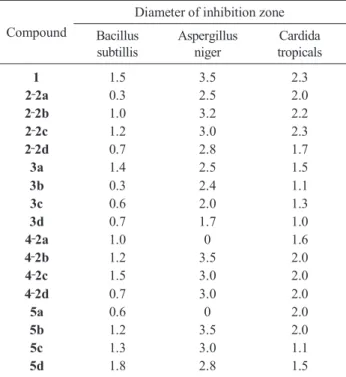
Halogenopurines synthesized were screened for their anti- fungal activities against three species of fungi, namely baci- llus subtillis, aspergillus niger and cardida tropicals using the disc diffusion method.45,46 The tested compounds were dissolved in 1% NaOH solution (which has no inhibitory activity) to get concentrations of 1 mg/mL solution. The guanine (1) was used as standard antifungal reference. The inhibition zones of microbial growth surrounding the filter paper disc (2.5 mm) were measured in millimeters at the end of an incubation period at 30 oC for 3 days. Inhibition of the organisms was evidenced by a clear zone surrounding each disk (Table 4).
All the tested compounds showed variable activities to- ward the three species of fungi, some of them comparable to standard guanine. The results of the antifungal screening showed that compounds 2-2a, 2-2d, 3b, 3c, 3d, 4-2d and 5a displayed good activity against bacillus subtillis, the com- pounds 3d, 4-2a and 5a displayed good activity against as- pergillus niger, and compounds 3b, 3d and 5c showed good activity against cardida tropicals, the compound 3d showed fairly good activity against the three fungal strains, while the
remaining compounds exhibited moderate activity. The low- est activity were observed by compounds 2-2b, 2-2c, 4-2c and 4-2b, which displayed almost the same activity as 1 against the three fungal strains (Table 4).
CONCLUSION
In conclusion, we have developed an efficient synthetic pathway for the preparation of halogenopurines starting from commercially available guanine. The desired products have been obtained in satisfactory yields under mild reaction conditions after simple work-up. One of the important as- pects in our paper was that the PEG-2000 catalyzed chlorina- tion of 2,9-diacetylguanine was carried out successfully, the yield for 3a under PEG-2000 phase transfer catalysis could be remarkably improved to 84% which presented a striking contrast to other reported procedures whose yields for 3 were usually 60 ~ 75%.47-49 Another noticeable point was that 2-amino-6-halogenopurines (3b-d) have been effi- ciently obtained through chlorine/halogen exchange reac- tions between KX and 3a by TPPB phase transfer catalysis, the yields under such conditions could be remarkably im- proved by 10 ~ 20% contrast to the reported procedures.9-21 Further, we have described a facile and convenient procedure for the preparation of 2-halogenopurines (2-2a-d, 4-2a-d, 5a-d) from 2-amino-6-substituted purines (1, 3a, 4-1) via a diazotization catalyzed by their corresponding CuX, and some biologically new compounds 2-2a, 2-2c, 2-2d, 4-2c, 4-2d, 5b, 5c and 5d have been discovered.
EXPERIMENTAL General
All the chemicals and reagents were of analytical grade and used as obtained. 1H NMR spectra were recorded on a Bruker 400-MHz spectrometer using DMSO-d6 as the sol- vent with tetramethylsilane (TMS) as an internal standard.
High performance liquid chromatography (HPLC) experi- ments were performed on a liquid chromatograph (Dionex Softron GmbH, USA), consisting of a pump (P680) and ultra- violet-visible light detector (UVD) system (170U). The ex- periments were performed on Diacovery C18 column, ø 4.6 × 250 mm. Melting points were recorded on Digital Melting Point Apparatus WRS-1B and are uncorrected. Mass spectra were measured on an HP1100LC (Agilent Techno- logies, USA). Infrared spectra were recorded on FT-IR Bru- ker Vector 22 spectrophotometer using KBr wafer technique.
Elemental analysis were performed on a Vario EL III in- strument (Elmentar Anlalysensy Teme GmbH, Germany).
Preparation of 2,9-diacetylguanine (2-1): A mixture of guanine (1, 2.5 g, 16.5 mmol) and acetic anhydride (30 mL) in acetic acid (60 mL) was stirred in 250 mL round flask at 135 oC for 7.5 h. After completion of the reaction, as indicated by HPLC, the solvent and the superfluous acetic anhydride were evaporated under vacuum and the crude product was recrystallized from distilled water afforded a white powder (2-1, 3.7 g, yield 95%). m.p. 251 - 256 oC. IR (KBr) 3200, 1680, 1530 cm-1. 1H NMR (DMSO-d6) δ 2.16-2.50 (m, 6H, CH3), 8.11 (s, 1H, CH), 8.15 (s, 1H, NH), 11.56 (s, 1H, OH).
MS (70 eV) m/z 234.09 (M-); MS m/z (%) 234.09 (M-, 20), 192.12 (100), 150.08 (23). Analysis Calcd for C9H9N5O3: C, 45.93; H, 3.87; N, 29.76; O, 20.37. Found: C, 45.96; H, 3.86; N, 29.78; O, 20.41.
Preparation of 2-amino-6-chloropurine (3a): A mixture of 2,9-diacetylguanine (2, 2.35 g, 10 mmol), PEG-2000 (4 g, 2 mmol) and ClCH2CH2Cl (10 mL) was stirred in 100 mL round flask. Then POCl3 (5.4 g, 35 mmol) was added drop- wise while the mixture was heated at 80 oC. The reaction was completed in 6 h, and then cooled to room temperature, the precipitate was filtered off. The solvent was removed and the residue was recrystallized from DMSO afforded a white powder (3a, 1.42 g, yield 84%). m.p. 298-302 oC. IR (KBr) 1636, 1292, 822, 630 cm-1. 1H NMR (DMSO-d6) δ 6.75-6.79 (m, 3H, NH2 and NH), 8.01 (m, 1H, CH). MS (70 eV) m/z 169.13 (M-); MS m/z (%) 169.13 (M-), 151.20, 135.13, 116.84. Analysis Calcd for C5H4ClN5: C, 35.37; H, 2.34; Cl, 20.93; N, 41.29. Found: C, 35.41; H, 2.38; Cl, 20.91; N, 41.30.
Preparation of 2-amino-6-methoxylpurine (4-1): A mix- ture of 2-amino-6-chloropurine (3a, 1.7 g, 10 mmol), DMSO (15 mL), and CH3ONa (50 mmol) was stirred in 250 mL round flask at 70 oC for 6.5 h. After the reaction, the solvent was removed under vacuum, the residue was dissolved in water (30 mL), then added toluene (20 mL ) to the mixture and filtered, the water layer was neutralized with conc.
HCl. The solid obtained was filtered, washed several times with water to give a white solid (4-1, 1.5 g, yield 91%). 1H NMR (DMSO-d6) δ 3.98 (s, 3H, OCH3), 6.81 (s, 1H, CH), 8.13 (s, 3H, NH2 and NH). MS (70 eV) m/z 166.02 (M+); MS m/z (%) 166.02 (M+, 35), 149.01 (100), 134.02 (17). Analysis Calcd for C6H7N5O: C, 43.64; H, 4.27; N, 42.39; O, 9.67.
Found: C, 43.63; H, 4.27; N, 42.41; O, 9.69.
General procedure for synthesis of compounds 3b-d: All the three-necked flasks were loaded with 2-amino-6-chloro- purine (3a, 1.7 g, 10 mmol), KX (50 mmol), TPPB (0.21 g, 0.5 mmol), and sulfolane (30 mL). The reaction mixture was stirred at an appropriate temperature for an appropriate time, and then cooled to room temperature, the precipitate
was filtered off, the solvent was removed and the residue was washed several times with water to give a white powder.
The yield and spectral data of the compounds are given below.
2-amino-6-fluoropurine (3b): The product was obtained with 43% yield. 1H NMR (DMSO-d6) δ 7.76 (s, 3H, NH2
and NH), 8.15 (s, 1H, CH). MS (70 eV) m/z 153.06 (M);
MS m/z (%) 153.06 (M), 137.07, 133.12. Analysis Calcd for C5H4FN5: C, 39.19; H, 2.62; F, 12.43; N, 45.76. Found:
C, 39.22; H, 2.63; F, 12.41; N, 45.74.
2-amino-6-bromopurine (3c): The product was obtained with 88% yield. 1H NMR (DMSO-d6) δ 5.75 (m, 3H, NH2
and NH), 8.03 (m, 1H, CH). MS (70 eV) m/z 213.15 (M-);
MS m/z (%) 213.15 (M-), 134.14. Analysis Calcd for C5H4BrN5: C, 28.03; H, 1.86; Br, 37.35; N, 32.71. Found:
C, 28.06; H, 1.88; Br, 37.33; N, 32.72.
2-amino-6-iodopurine (3d): The product was obtained with 92% yield. 1H NMR (DMSO-d6) δ 3.81 (s, 3H, NH2
and NH), 8.33 (s, 1H, CH). MS (70 eV) m/z 261.15 (M);
MS m/z (%) 261.15 (M), 217.32, 171.61. Analysis Calcd for C5H4IN5: C, 22.97; H, 1.54; I, 48.63; N, 26.87. Found: C, 23.01; H, 1.54; I, 48.62; N, 26.83.
General procedure for synthesis of compounds 2-2a-d, 4-2a-d and 5a-d: All the three-necked flasks were loaded with 2-amino-6-substituted purine (1 or 3a or 4-1; 10 mmol), aqueous acid (40 mL), and CuX (11 mmol). The mixture was stirred at room temperature for 30 min. After cooling down to -5 oC, the solution of sodium nitrite (0.76 g, 11 mmol) in H2O (2 mL) was added dropwise slowly, and an evolution of nitrogen gas was observed immediately, then the reaction mixture was stirred at -10 ~ 5 oC for 2 h, urea (0.3 g, 5 mmol) was then added to decompose the excess sodium nitrite. After which, the reaction mixture was stirred at -10 ~ 5oC for an- other 5 h. Then 50%NaOHsolution was added to regulate pH value of 3 ~ 4, the solid so formed was filtered, and then was dissolved completely with NaOHsolution (15%, 20 mL) and separated by silica-gel column chromatography using dichloromethane-methanol (9/1) as eluent. The solution ob- tained was neutralized with conc. HCl. The solid was separat- ed out and filtered to give the corresponding product. The yield and spectral data of each compound is given below.
2-chloro-6-hydroxylpurine (2-2a): The product was ob- tained with 53% yield. m.p. 182 - 184 oC. 1H NMR (DMSO- d6) δ 7.99 (s, 1H, CH), 10.90 (s, 1H, NH), 8.15 (s, 1H, OH).
MS (70 eV) m/z 171.30 (M+); MS m/z (%) 171.30 (M+,100), 169.33 (22), 157.39 (36), 141.58 (40). Analysis Calcd for C5H3ClN4O: C, 35.18; H, 1.77; Cl, 20.79; N, 32.83; O, 9.37.
Found: C, 35.21; H, 1.77; Cl, 20.79; N, 32.85; O, 9.38.
2-fluoro-6-hydroxylpurine (2-2b): The product was ob-
tained with 77% yield. m.p. 175 - 176 oC. 1H NMR (DMSO- d6) δ 7.99 (s, 1H, CH), 10.11 (s, 1H, NH), 10.25 (s, 1H, OH). MS (70 eV) m/z 154.99 (M+); MS m/z (%) 154.99 (M+,50), 134.98 (100). Analysis Calcd for C5H3FN4O: C, 38.98; H, 1.96; F, 12.35; N, 36.34; O, 10.36. Found: C, 38.97; H, 1.96; F, 12.33; N, 36.36; O, 10.38.
2-bromo-6-hydroxylpurine (2-2c): The product was ob- tained with 67% yield. m.p. 214 - 216 oC. 1H NMR (DMSO- d6) δ 7.23 (s, 1H, CH), 10.91 (s, 1H, NH), 11.60 (s, 1H, OH). MS (70 eV) m/z 217.01 (M+); MS m/z (%) 217.01 (M+, 39), 139.66 (100). Analysis Calcd For C5H3BrN4O: C, 27.89;
H, 1.41; Br, 37.17; N, 26.09; O, 7.41. Found: C, 27.93; H, 1.41; Br, 37.16; N, 26.06; O, 7.44.
2-iodo-6-hydroxylpurine (2-2d): The product was ob- tained with 57% yield. m.p. 224 - 227 oC. 1H NMR (DMSO- d6) δ 6.98 (s, 1H, CH), 10.63 (s, 1H, NH), 11.37 (s, 1H, OH).
MS (70 eV) m/z 260.89 (M-); MS m/z (%) 260.89 (M-,100), 234.44 (21), 157.21 (28), 146.92 (13). Analysis Calcd for C5H3IN4O: C, 22.89; H, 1.17; I, 48.46; N, 21.37; O, 6.09.
Found: C, 22.92; H, 1.15; I, 48.44; N, 21.38; O, 6.11.
2-chloro-6-chloropurine (4-2a): The product was obtained with 47% yield. m.p. 182 - 183 oC. 1H NMR (DMSO-d6) δ 8.43 (s, 1H, CH), 11.99 (s, 1H, NH). MS (70 eV) m/z 187.11 (M-); MS m/z (%) 187.11 (M-,72), 151.55 (100), 149.59 (83), 114.93 (34), 89.29 (79). Analysis Calcd for C5H2Cl2N4: C, 31.74; H, 1.08; Cl, 37.53; N, 29.62. Found: C, 31.77; H, 1.07; Cl, 37.52; N, 29.64.
2-fluoro-6-chloropurine (4-2b): The product was ob- tained with 91% yield. m.p. 162 - 163 oC. 1H NMR (DMSO- d6) δ 8.65 (s, 1H, CH), 11.97 (s, 1H, NH). MS (70 eV) m/z 171.03 (M-); MS m/z (%) 171.03 (M-,88), 134.95 (100), 90.08 (80). Analysis Calcd for C5H2ClFN4: C, 34.76; H, 1.17;
Cl, 20.53; F, 11.02; N, 32.48. Found: C, 34.80; H, 1.17; Cl, 20.55; F, 11.01; N, 32.47.
2-bromo-6-chloropurine (4-2c): The product was obtained with 54% yield. m.p. 175 - 177 oC. 1H NMR (DMSO-d6) δ 8.43 (s, 1H, CH), 11.99 (s, 1H, NH). MS (70 eV) m/z 232.86 (M-); MS m/z (%) 232.86 (M-,25), 214.94 (20), 194.16 (100), 169.29 (30), 166.56 (38). Analysis Calcd for C5H2ClBrN4: C, 25.69; H, 0.84; Br, 34.25; Cl, 15.18; N, 23.97. Found: C, 25.72; H, 0.86; Br, 34.23; Cl, 15.19; N, 24.00.
2-iodo-6-chloropurine (4-2d): The product was obtained with 68% yield. m.p. 218 - 220 oC. 1H NMR (DMSO-d6) δ 8.32 (s, 1H, CH), 11.98 (s, 1H, NH). MS (70 eV) m/z 278.92 (M-); MS m/z (%) 278.92 (M-,100), 243.21 (56), 152.11 (28).
Analysis Calcd for C5H2ClIN4: C, 21.37; H, 0.71; Cl, 12.63;
I, 45.27; N, 19.98. Found: C, 21.41; H, 0.72; Cl, 12.64; I, 45.25; N, 19.98.
2-chloro-6-methoxylpurine (5a): The product was ob-
tained with 61% yield. m.p. 197 - 199 oC. 1H NMR (DMSO- d6) δ 3.97 (s, 3H, OCH3), 7.55 (s, 1H, CH), 11.97 (s, 1H, NH).
MS (70 eV) m/z 206.95 (M+); MS m/z (%) 206.95 (M+,38), 193.08 (30), 175.24 (100). Analysis Calcd for C6H5ClN4O:
C, 39.02; H, 2.71; Cl, 19.23; N, 30.34; O, 8.68. Found: C, 39.04; H, 2.73; Cl, 19.21; N, 30.35; O, 8.67.
2-fluoro-6-methoxylpurine (5b): The product was ob- tained with 64% yield. m.p. 180 - 182 oC. 1H NMR (DMSO- d6) δ 3.96 (s, 3H, OCH3), 7.23 (s, 1H, CH), 12.00 (s, 1H, NH).
MS (70 eV) m/z 169.01 (M+); MS m/z (%) 169.01 (M+,58), 149.05 (100), 121.04 (16). Analysis Calcd for C6H5FN4O:
C, 42.81; H, 2.97; F, 11.34; N, 33.30; O, 9.53. Found: C, 42.86; H, 3.00; F, 11.30; N, 33.32; O, 9.52.
2-bromo-6-methoxylpurine (5c): The product was ob- tained with 71% yield. m.p. 195 - 199 oC. 1H NMR (DMSO- d6) δ 3.98 (s, 3H, OCH3), 7.41 (s, 1H, CH), 11.99 (s, 1H, NH). MS (70 eV) m/z 230.03 (M+); MS m/z (%) 230.03 (M+,45), 198.14 (100). Analysis Calcd for C6H5BrN4O: C, 31.43; H, 2.19; Br, 34.91; N, 24.43; O, 6.97. Found: C, 31.46;
H, 2.20; Br, 34.89; N, 24.46; O, 6.99.
2-iodo-6-methoxylpurine (5d): The product was obtained with 49% yield. m.p. 233 - 238 oC. 1H NMR (DMSO-d6) δ 3.97 (s, 3H, OCH3), 7.11 (s, 1H, CH), 12.51 (s, 1H, NH). MS (70 eV) m/z (M-); MS m/z (%) 274.96 (M-,67), 243.02 (100), 147.87 (45). Analysis Calcd for C6H5IN4O: C, 26.07; H, 1.83; I, 45.99; N, 20.31; O, 5.79. Found: C, 26.11; H, 1.83;
I, 45.97; N, 20.30; O, 5.80.
Acknowledgments. We thank the National Basic Research Program (973 Program) of China and Ministry of Education of the Republic of China for support of this research.
REFERENCES
1. Liu, P. F.; Burdzy, A.; Sowers, L. C. Chem. Res. Toxicol. 2002, 15, 1001.
2. Dolan, M. E.; Pegg, A. E. Clin Cancer Res. 1997, 3, 837.
3. Pang, R. F.; Zhang, C. L.; Yuan, D. K.; Yang, M. Bioorg. Med.
Chem. 2008, 16, 8178.
4. Yoshihito, U.; Yoichiro, K.; Shusaku, O.; Norihisa, I.; Masa- yuki, N.; Yukio, K. Bioconjugate Chem. 2003, 14, 690.
5. Svjetlana, P.; Drazenka, S.; Tatjana, G.; Draginja, M. S.; Ante, N.; Mira, G.; Kresimir, P.; Jan, B.; Erik, D. C.; Gerd, F.; Leo- nardo, S.; Mladen, M.; Silvana, R. M. J. Med. Chem. 2003, 46, 5763.
6. Paula, F.; Zlatko, J.; Susumu, S.; Morris, J. R. J. Org. Chem.
2002, 67, 6788.
7. Bowles, W. A.; Schneider, F. H.; Lewis, L. R.; Robins, R. K.
J. Med. Chem. 1963, 6, 471.
8. Kozai, S.; Maruyama, T. Chem. Pharm. Bull. 1999, 47, 574.
9. Dermeik, S.; Sasson. Y. J. Org. Chem. 1989, 54, 4827.
10. Bildinov, I.; Podsevalov, P. U.S. Patent 5824827, 1998.
11. Lacour, M. A.; Zablocka, M.; Duhayon, C.; Majoral, J. P.;
Taillefer, M.Adv. Synth. Catal. 2008, 350, 2677.
12. Thomas, G. R.; Duward, F. S. Organometallics 1984, 3, 305.
13. Kovacs, I.; Pearson, C.; Shaver, A. J. Organomet. Chem. 1999, 584, 347.
14. Bailey, W. F.; Patricia, J. J.; Nurmi1, T. T.; Wang, W. Tetra- hedron Lett. 1986, 27, 1861.
15. Clark, J. W.; Pectenwald, C. E. C.A. Patent 733489, 1966.
16. Alonso, C.; Morato, A.; Medina, F.; Cesteros, Y.; Salagre, P.;
Sueiras, J. E. Appl. Catal. B: Environ. 2003, 40, 259.
17. Xing, L. Q.; Qian, L.; Bi, Q. Y.; He, J.; Wang, Y. J.; Zhou, L.
Y.; Chen, K. F.; Lu, J. Q.; Luo, M. F. Acta Phys. Chim. Sin.
2009, 25, 1928.
18. Boyer, B.; Keramane, E. M.; Arpin, S.; Montero, J. L.; Roque, J. P. Tetrahedron 1999, 55, 1971.
19. Zhang, J.; Morton, H. E.; Ji, J. G. Tetrahedron Lett. 2006, 47, 8733.
20. Halpern, M.; Zahalka, H. A.; Sasson, Y.; Rabinovitz, M. J. Org.
Chem. 1985, 50, 5088.
21. Takagi, K.; Hayama, N.; Okamoto, T. Chem. Lett. 1978, 191.
22. Montgomery, J. A.; Hewson, K. J. Am. Chem. Soc. 1960, 82, 463.
23. Willianm, D. C.A. Patent 626965, 1961.
24. Sedova, V. F.; Mustafina, T. Y.; Krivopalov, V. P.; Mamaev, V. P. Chem. Heterocycl. Compd. 1983, 19, 91.
25. Ayman, M. S. Y.; Rasha, A. M. F.; Mohamed, M. Y. J. Korean Chem. Soc. 2001, 45, 448.
26. Volkert, W. A.; Hoffman, T. J. Chem. Rev. 1999, 99, 2269.
27. Zarei, A.; Hajipour, A. R.; Khazdooz, L.; Mirjalili, B. F.; Cher- mahini, A. N. Dyes and Pigments 2009, 81, 240.
28. Friedman, L.; Chlebowsky, J. J. Org. Chem. 1968, 33, 1636.
29. Smith, W. B.; Ho, O. C. J. Org. Chem. 1990, 55, 2543.
30. Langfeld, H.; Haarburger, K. F. U.S. Patent 5606034, 1997.
31. Krasnokutskaya, E. A.; Semenischeva, N. I.; Filimonov, V. D.;
Knochel, P. Synthesis 2007, 81.
32. Peter, W.; Volker, P. U.S. Patent 6120561, 2000.
33. Filimonov, V. D.; Semenischeva, N. I.; Krasnokutskaya, E. A.;
Tretyakov, A. N.; Hwang, H.Y.; Chi, K. W. Synthesis 2008, 185.
34. Nakazumi, H.; Szele, I.; Yoshida, K.; Zollinger, H. Helv. Chim.
Acta 1983, 66, 1721.
35. Fukuhara, T.; Yoneda, N.; Sawada, T.; Suzuki, A. Synth. Com- mun. 1987, 17, 685.
36. Lee, J. G.; Cha, H. T. Tetrahedron Lett. 1992, 33, 3167.
37. Francom, P.; Robins, M. J. J. Org. Chem. 2003, 68, 666.
38. Martin, J. O. Acc. Chem. Res. 2004, 37, 506.
39. Maruoka, K. Org. Process Res. Dev. 2008, 12, 679.
40. Yang, H. M.; Huang, C. C. Ind. Eng. Chem. Res. 2007, 46, 7915.
41. Stark, C. M.; Liotta, C. L. Phase Transfer Catalysis Principles and Techniques; Academic Press: New York, 1978.
42. Jones, A. R. Quaternary Ammonium Salts: Their Use in Phase Transfer Catalysis (Best Synthetic Methods), Elsevier, 2001.
43. Hamilton, G. L.; Kanai, T.; Toste, F. D. J. Am. Chem. Soc. 2008, 130, 14984.
44. Kimura, Y.; Yu, L. J.; Hirano, Y.; Suzuki, H.; Wang, Z. Y. J.
Biol. Chem. 2009, 284, 93.
45. Singh, A.; Latita, R.; Dhakarey, R.; Saxena, G. J. Indian Chem.
Soc. 1996, 73, 339.
46. Moosdeen, F.; Williams, J. D.; Secker, A. J. Antimicrob. Che- mother. 1988, 21, 439.
47. Reiner, R.; Rainer, S. U.S. Patent 5663338, 1997.
48. Francis, J. M.; John, W. C. G.C. Patent 0000093, 2005.
49. Chen, W. H.; Liu, Q. Y.; Ding, J. M.; Tong, L.; Ren, C. B.;
Zhang, T. C.N. Patent 101139348, 2008.