Printed in the Republic of Korea
- -
마이크로파를 이용한 강한 항균제인 새로운 N1-치환된 5-Cyano-pyrimidine 유도체의 합성
Yogesh Pore*, Gaurav Patil, Ijaj Tamboli, Vaibhav Chavan, Kirti Kamble, Shital Nikam, and Bhanudas Kuchekar
Department of Pharmaceutical Chemistry, Government College of Pharmacy, Vidyanagar, Karad, Maharashtra, India, 415 124.
(2007. 4 . 9 접수)
Microwave Assisted Synthesis of New N1-Substituted 5-Cyano-pyrimidine Derivatives as Potent Antimicrobial Agents
Yogesh Pore*, Gaurav Patil, Ijaj Tamboli, Vaibhav Chavan, Kirti Kamble, Shital Nikam, and Bhanudas Kuchekar
Department of Pharmaceutical Chemistry, Government College of Pharmacy, Vidyanagar, Karad, Maharashtra, India, 415 124.
(Received April 9, 2007)
요 약. 이 연구의 목적은 N1과 6번 자리에 다른 치환기를 가진 5-cyano가 치환된 pyrimidine 아날로그의 새로운 시리즈의 합성과 그것들의 항균성과 항진균성의 활성도에 대해 평가하기 위해서이다. 이 화합물은 MORE technique 를 이용한 potassium carbonate 의 존재하에서 ethylcyanoacetate, 치환된 thioureas, 적당한 알데히드의 제 3차 축합으로 합성 되어졌다. 항균성과 항진균성의 활성도는 25 mg의 농도에서 cup-plate 방법으로 측정되었다. 억제구역은 mm로 측정 되어졌다. 모든 화합물은 좋은 항균성과 항진균성을 보여주었다. P1과 P5는 S.aureus과 E.coli에 대해 최대 활성도 를 보여주었고, P6은 모든 종류의 미생물에 대해 좋은 활성도를 보여주었다. P8 화합물은 C. albicans 에 대해 좋은 효 과가 있음을 알아냈다. Norfloxacin와 griseofulvin는 합성된 화합물의 활성도와 비교되는 기준물질로 사용되었다. 6번 자리에 p-hydroxy와 p-methoxy로 치환된 phenyl moiety를 가진 gram-양성 미생물에 대해 강력했고, 6번 자리에 이것 들이 없는 phenyl moiety 를 가진 아날로그는 gram-음성 활성도를 가졌다,6번 자리에 p-dimethylamino로 치환된 phenyl moiety를 가진 화합물은 적당한 활성을 보여준다.. 게다가 N1자리에서 단지 fluorine을 포함한 아날로그는 상당 한 항진균성을 가졌음을 밝혀냈다. N1자리에서 aryl moiety 의 전자 끌게 치환과 마찬가지로 전자 주게 치환은 화합물 의 결정된 능력에 중요한 역할을 함을 제시한다.
주제어: 티오우라실, 항균 활성도, 마이크로파, 합성
ABSTRACT. The purpose of the study was to synthesize new series of 5-cyano substituted pyrimidine analogues with different substitutions at N1 and 6 positions and to evaluate them for antibacterial and antifungal activities. The desired compounds were synthesized by tertiary condensation of ethylcyanoacetate, substituted thioureas and suitable aldehyde in presence of potassium carbonate using MORE technique. The antibacterial and antifungal activities were evaluated by cup plate method in the concentration of 25 µg. The zone of inhibition was measured in mm. All the compounds have shown significant antibacterial and antifungal activities. The maximum activity was shown by P1 and P5 against S.aureus and E.coli respectively, while P6 has shown significant activity against all types of microorganisms. The compound P8 has been found to be significantly effective against C. albicans. Norfloxacin and griseofulvin were used as standards to compare the activites of synthesized compounds. It is concluded that analogues containing p-hydroxy, p-methoxy sub- stituted phenyl moiety at 6 position have been found to be more potent against gram-positive microorganisms, while ana-
logues lacking these substituents on phenyl moiety possessed gram-negative activity. The compounds having p- dimethylamino substituent on phenyl moiety at 6 positions have shown moderate activity. Further, only fluorine con- taining analogue at N1 position was found to possess appreciable antifungal activity. This suggests that electron donating substituent on aryl moiety as well as electron withdrawing substituent at N1 plays important role in determining potency of the compounds.
Keywords: Thiouracil, Antimicrobial Activity, Microwave, Synthesis
INTRODUCTION
Uracil derivatives play an important role in the field of medicine, as antiretroviral, agents 1,2,3. They have also been reported as potent enzyme inhibi- tors 4,5,6. In last few years uracil derivatives substi- tuted either at the C-5 or C-6 position have emerged in chemotherapy as several pyrimidine derivatives have been found to possess antileishmanial and antimicrobial activity.7,8 In case of pyrimidine nucleus structure activity relationship studies have shown that C-6 position is important determinant for the activity. The most general route for the syn- thesis of pyrimidines is a reagent containing N-C-N and C-C-C skeleton. The N-C-N skeleton contain- ing reagents are urea, thiourea or guanidine whereas C-C-C skeleton can be obtained from 1,3-dike- tones, diesters and dinitriles.8 A facile synthesis of 2-thiocytosines has been reported using piperidine in place of potassium carbonate.9 Pyrimidines have been also synthesized by regiospecific cyclization of 1,3-dicarbonitriles,10 from ketene dithioacetals11 and from alkyl N-cyanoimidates or cyanoaceta- mides.12 However these classical methods resulted in poor yield of pyrimidine compounds. Therefore, in order to obtain new potent therapeutic agents, various 5-cyano, 6-substituted (alkyl/aryl) pyrimidine deriva- tives were synthesized using one- pot reaction of aryl substituted thiourea, aldehyde and ethylcyanoacetate
utilizing microwave irradiation to get various N1- substituted and 6-aryl/substituted aryl pyrimidines in better yield. These compounds were evaluated for their antibacterial and antifungal activities.
RESULTS Chemistry
Pyrimidines have been synthesized by micro- wave irradiation and found to give higher yields of compounds13. The synthesis of substituted 5-cyano, 2-thiouracil derivatives (P1-P10) was accomplished by reacting various aldehydes with equimolar amount of appropriate substituted thioureas, ethylcyanoace- tate and potassium carbonate in small amount of ethanol utilizing microwave irradiation (Scheme 1).
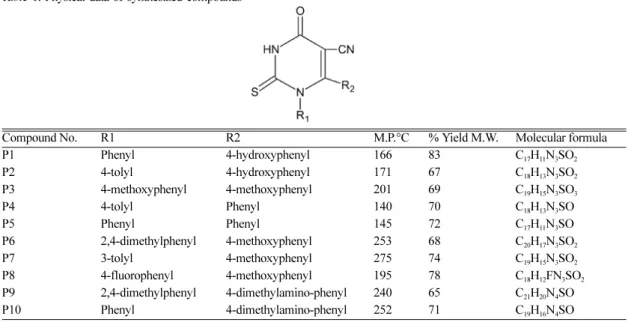
Unlike the conventional methods9-12 where the reac- tion time required was 5-7 hrs and with yields of 26-75%, microwave-assisted reactions were very facile (4-8 min. with few minutes of interval) and provided very good yields (65-83%). The purity of the compounds was checked by TLC and elemen- tal analysis. Melting points and % yields of synthe- sized compounds are reported in Table 1. Both analytical and spectral data of all the synthesized compounds were in full agreement with the pro- posed structures.
Antibacterial and antifungal activities The synthesized compounds were evaluated for
Scheme 1.
their antibacterial and antifungal activities by cup- plate method against S. aureus, B. subtilis, E. coli, P. aeruginosa, and C. albicans in the concentration of 25 μg. The activites were compared with stan- dard antibiotics; norfloxacin and griseofulvin. The synthesized compounds exhibited zone of inhibition of 09-22 mm in diameter whereas standard norflox- acin and griseofulvin exhibited zone of 25-28 mm in diameter. All the compounds have shown signif- icant antibacterial and antifungal activities. The maximum activity was shown by P1 and P5 against S.aureus and E. coli respectively, while P6 has shown significant activity against all types of
microorganisms. The compound P8 has been found to be significantly effective against C. albicans. All other compounds have shown moderate antimicro- bial activities. The results of antimicrobial activi- ties are expressed in Table 2.
DISCUSSION
In the present investigation new series of 5-cyano, N1 substituted pyrimidine analogues were synthe- sized by microwave irradiation technique. Unlike the conventional methods where more reaction time is required, with yields of 26-75%, microwave- Table 1. Physical data of synthesized compounds
Compound No. R1 R2 M.P.°C % Yield M.W. Molecular formula
P1 Phenyl 4-hydroxyphenyl 166 83 C17H11N3SO2
P2 4-tolyl 4-hydroxyphenyl 171 67 C18H13N3SO2
P3 4-methoxyphenyl 4-methoxyphenyl 201 69 C19H15N3SO3
P4 4-tolyl Phenyl 140 70 C18H13N3SO
P5 Phenyl Phenyl 145 72 C17H11N3SO
P6 2,4-dimethylphenyl 4-methoxyphenyl 253 68 C20H17N3SO2
P7 3-tolyl 4-methoxyphenyl 275 74 C19H15N3SO2
P8 4-fluorophenyl 4-methoxyphenyl 195 78 C18H12FN3SO2
P9 2,4-dimethylphenyl 4-dimethylamino-phenyl 240 65 C21H20N4SO
P10 Phenyl 4-dimethylamino-phenyl 252 71 C19H16N4SO
Table 2. Antibacterial and antifungal activities
Compound No. S. aureus B. subtilis E. coli P. aeruginosa C. albicans.
P1 +++ + + + +
P2 ++ + ++ ++ ++
P3 ++ + ++ + +
P4 ++ ++ ++ ++ +
P5 ++ ++ ++++ + +
P6 ++ ++ +++ ++ +
P7 + ++ ++ ++ ++
P8 ++ + ++ + +++
P9 ++ - + + ++
P10 ++ - ++ ++ ++
Standard ++++ ++++ ++++ ++++ ++++
Control - - - - -
Zone of inhibition: + = 5-10 mm, ++ = 11-15 mm, +++ = 16-20 mm, ++++ = More than 20 mm.
assisted reactions resulted in higher yields (65-83%) of products. These synthesized compounds were also screened for antibacterial and antifungal activi- ties. Present findings revealed that analogues con- taining p-hydroxy, p-methoxy substituted phenyl moiety at 6 position have been found to be more potent against gram-positive microorganisms, while analogues lacking these substituents on phenyl moi- ety possessed gram-negative activity. The com- pounds having p-dimethylamino substituent on phenyl moiety at 6 positions have shown moderate activity. Further, only fluorine containing analogue at N1 position was found to possess appreciable antifungal activity. The compound P7 has shown least activity among all the synthesized compounds indicating that meta methyl group in phenyl moiety at N1 position is not well tolerated. Further, as the bulkiness on phenyl moiety at N1 increases, antimi- crobial activity decreases. This suggests that elec- tron donating substituent on aryl moiety as well as electron withdrawing substituent at N1 plays impor- tant role in determining potency of the compounds.
The compounds P1, P5 and P6 have shown good antibacterial activities against S.aureus and E.coli whereas compound P8 has shown excellent antifun- gal activity against C.albicans. It is concluded that N1 and C-6 position are important determinants for the activity. Also electron-withdrawing substituent at C-5 position in pyrimidine increases the acidic dissociation constant of nucleus and enhances the receptor binding. Further studies are needed to explore the differences in the efficacy and safety of synthesized compounds.
EXPERIMENTAL Materials
The melting points were determined in open cap- illary tubes and are uncorrected. The purity of com- pounds was checked by TLC on silica gel G plates using acetonitrile: chloroform (60:40) as mobile phase. IR spectra were recorded on Digilab FT-IR spectrophotometer. 1HNMR and 13CNMR spectra were recorded in DMSO (d6) and CDCI3 on Varian Mercury YH-300 NMR spectrophotometer. Micro-
wave assisted reactions were carried out in a Cata- lysts Microwave synthesizer.
Methods
Synthesis of aryl-substituted thioureas These were obtained by reacting the various sub- stituted aromatic amines with ammonium thiocyan- ate in presence of conc. HCL. The compounds were recrystallized from hot water or ethanol and used for synthesis of pyrimidine derivatives.14
Synthesis of N1- substituted, 5-cyano, 6-aryl- substituted thiouracil derivatives (P1-P10)
The titled compounds were synthesized using one- pot reaction of aryl-substituted thiourea (0.01 mol), aldehyde (0.01 mol), ethylcyanoacetate (0.01 mol) and potassium carbonate in small amount of etha- nol to obtain various N1 substituted pyrimidines.
Six different aryl substituted thioureas like phenyl thiourea, p-tolyl thiourea, m-tolyl thiourea, p-anisi- dine thiourea, 2,4-xylidyl thiourea, p-fluoro phenyl thiourea and four aldehydes like benzaldehyde, 4-hydroxy benzaldehyde, p-methoxybenzaldehyde and p-dimethylaminobenzaldehyde were used to obtain ten different 2-thio, 4-one derivatives. The desired compounds were synthesized by the ter- tiary condensation of ethylcyanoacetate, aryl substi- tuted thiourea and suitable aldehyde in presence of potassium carbonate and ethanol using MORE (Microwave organic reaction enhancement) technique.
The reaction mixture was subjected to microwave pulse for 120 s (240 w), 60 s (350 w) and 60 s (450 w).
Between each irradiation an interval of 3-10 min- utes was kept. After the completion of reaction, the precipitate obtained was dried, which was potas- sium salt of nucleobase. The salt was dissolved in warm water and the solution was acidified by ace- tic acid to precipitate pure nucleobase. The crude product was recrystallised from acetic acid. All the compounds were obtained in good yield.
P1: 5-Cyano-1-phenyl-6-(4-hydroxyphenyl)-2-thiouracil I.R.: ν cm-1 3363 (N-H), 2210 (C≡N), 1622 (C=O), 1305 (C=S), 3150 (O-H), 1HNMR: δ (ppm): 8.17 (s, 1H, NH), 7.24-7.95 (m, 9H, ArH), 4.33-4.40 (s, 1H, OH), 13CNMR: 72.67 (C=C), 115.81-134.02 (11C), 158.10 (phenyl C5), 115.85 (C≡N), 167.09
(-CONH-), 171.79 (C=C), 174.03 (-CSNH-), Anal:
Found: C, 63.52; H, 3.39; N, 13.05; S, 9.93. Calcd for C17H11N3SO2: C, 63.54; H, 3.45; N, 13.08; O, 9.96; S, 9.98%.
P2: 5-Cyano-1-(4-methyl-phenyl)-6-(4-hydrox- yphenyl)-2-thiouracil
I.R.: ν cm-1 3010 (C-H), 3288(N-H), 2260 (C≡N), 1610 (C=O), 1320 (C=S), 1HNMR: δ (ppm): 8.19 (s, 1H, NH), 7.38-7.90 (m, 8H, ArH), 4.31-4.37 (s, 1H, OH), 2.354 (s, 3H, CH3), 13CNMR: 24.35 (CH3), 72.67 (C=C), 115.82-128.31 (10C), 133.81 (N-phe- nyl C4), 157.55 (phenyl C4), 115.75 (C≡N), 167.21 (-CONH-), 172.10 (C=C), 174.12 (-CSNH-), Anal:
Found: C, 64.41; H, 3.84; N, 12.51; S, 9.52. Calcd for C18H13N3SO2:C, 64.46; H, 3.91; N, 12.53; O, 9.54; S, 9.56%.
P3: 5-Cyano-1,6 bis-(4-methoxy-phenyl)-2-thiouracil I.R.: ν cm-1 3005 (C-H), 3102 (N-H), 2250 (C≡N), 1590 (C=O), 1280 (C=S), 3175 (O-H), 1275 (O-CH3),
1HNMR: δ (ppm): 8.12 (s, 1H, NH), 7.31-7.97 (m, 8H, ArH), 3.78-3.91 (s, 6H, OCH3), 13CNMR: 55.85 (OCH3), 72.61 (C=C), 114.11-127.41 (10C), 159.80 (phenyl C4), 156.64 (N-phenyl C4), 115.75 (C≡N), 167.21 (-CONH-), 171.68 (C=C), 173.93 (-CSNH-), Anal: Found: C, 62.43; H, 4.08; N, 11.46; S, 8.73.
Calcd for C19H15N3SO3: C, 62.45; H, 4.14; N, 11.50;
O, 13.14; S, 8.78%.
P4: 5-Cyano-1-(4-methyl-phenyl)-6-phenyl-2-thiouracil I.R.: ν cm-1 2995 (C-H), 3270 (N-H), 2240 (C≡N), 1620 (C=O), 1200 (C=S), 1HNMR: δ (ppm): 8.00-8.84 (s, 1H, NH), 7.18-7.98 (m, 9H, ArH), 2.35-2.60 (d, 3H, CH3), 13CNMR: 24.25 (CH3), 72.81 (C=C), 126.51- 134.35 (11C), 134.42 (N-phenyl C4), 115.72 (C≡N), 167.15 (-CONH-), 171.95 (C=C), 173.98 (-CSNH-), Anal: Found: C, 67.69; H, 4.05; N, 13.13; S, 10.01.
Calcd for C18H13N3SO: C, 67.69; H, 4.10; N, 13.16;
O, 5.01; S, 10.04%.
P5: 5-Cyano-1,6-diphenyl-2-thiouracil
I.R.: ν cm-1 3005 (C-H), 3280 (N-H), 2270 (C≡N), 1610 (C=O), 1265 (C=S), 1HNMR: d (ppm): δ 9.28(s, 1H, NH), δ 7.17-7.40 (m, 10H, ArH), 13CNMR: 72.68 (C=C), 126.33-133.90 (12C), 115.95 (C≡N), 167.12 (-CONH-), 171.67 (C=C), 174.23 (-CSNH-), Anal:
Found: C, 66.85; H, 3.55; N, 13.75; S, 10.47. Calcd for C17H11N3SO: C, 66.87; H, 3.63; N, 13.76; O,
5.24; S, 10.50%.
P6: 5-Cyano-1-(2,4-dimethyl-phenyl)-6-(4-methoxy- phenyl)-2-thiouracil
I.R.: ν cm-1 3010 (C-H), 3261 (N-H), 2245 (C≡N), 1605 (C=O), 1275 (C=S), 1175 (O-CH3), 1HNMR:
δ (ppm): 8.13-8.15 (d, 1H, NH), 7.32-7.98 (m, 7H, ArH), 2.16-2.17 (s, 6H, CH3), 3.88 (s, 3H, OCH3),
13CNMR: 16.45 (CH3), 24.55 (CH3), 55.81 (OCH3), 72.69 (C=C), 114.29-133.68 (9C), 134.23 (N-phe- nyl C4), 139.21 (N-phenyl C2), 160.10 (phenyl C4), 115.78 (C≡N), 167.59 (-CONH-), 171.99 (C=C), 174.33 (-CSNH-), Anal: Found: C, 66.09; H, 4.65;
N, 11.53; S, 8.79. Calcd for C20H17N3SO2: C, 66.10;
H, 4.71; N, 11.56; O, 8.80; S, 8.82 %.
P7: 5-Cyano-1-(3-methyl-phenyl)-6-(4-methoxy- phenyl)-2-thiouracil
I.R.: ν cm-1 3000 (C-H), 3280 (N-H), 2205 (C≡N), 1605 (C=O), 1250 (C=S), 1170 (O-CH3), 1HNMR:
δ (ppm): 8.13 (s, 1H, NH), 7.30-7.98 (m, 8H, ArH), 3.88 (s, 3H, OCH3), 2.17 (s, 3H, CH3), 13CNMR:
24.13 (CH3), 55.95 (OCH3), 72.67 (C=C), 114.29- 134.08 (10C), 138.66 (N-phenyl C3), 159.79 (phe- nyl C4), 115.71 (C≡N), 167.12 (-CONH-), 172.01 (C=C), 173.96 (-CSNH-), Anal: Found: C, 65.29;
H, 4.27; N, 12.01; S, 9.13. Calcd for C19H15N3SO2: C, 65.31; H, 4.33; N, 12.03; O, 9.16; S, 9.18%.
P8: 5-Cyano-1-(4-fluoro-phenyl)-6-(4-methoxy- phenyl)-2-thiouracil
I.R.: ν cm-1 2995 (C-H), 3280 (N-H), 2240 (C≡N), 1590 (C=O), 1262 (C=S), 1280 (O-CH3), 1HNMR:
δ (ppm): 8.13-8.15 (s, 1H, NH), 7.33-7.98 (m, 8H, ArH), 3.85-3.90 (s, 3H, OCH3), 13CNMR: 55.88 (OCH3), 72.55 (C=C), 114.32-129.56 (10C), 159.10 (N-phenyl C4), 159.79 (phenyl C4), 115.68 (C≡N), 167.22 (-CONH-), 171.57 (C=C), 174.13 (-CSNH-), Anal: Found: C, 61.33; H, 3.36; N, 11.90; S, 9.06.
Calcd for C18H12FN3SO2: C, 61.18; H, 3.42; F, 5.38;
N, 11.89; O, 9.06; S, 9.07%.
P9: 5-Cyano-1-(2,4-dimethyl-phenyl)-6-(4-dim- ethylamino-phenyl)-2-thiouracil
I.R.: ν cm-1 3002 (C-H), 3300 (N-H), 2245 (C≡N), 1590 (C=O), 1250 (C=S), 1HNMR: δ (ppm): 8.02 (s, 1H, NH), 7.36-7.90 (m, 7H, ArH), 2.25-2.30 (d, 12H, CH3), 13CNMR: 16.35 (CH3), 24.65 (CH3), 40.23 (-N(CH3)2), 72.78 (C=C), 114.12-133.98 (9C), 134.43
(N-phenyl C4), 139.15 (N-phenyl C2), 148.78 (phe- nyl C4), 115.68 (C≡N), 167.12 (-CONH-), 171.57 (C=C), 174.11 (-CSNH-), Anal: Found: C, 67.01;
H, 5.28; N, 14.86; S, 8.49. Calcd for C21H20N4SO:
C, 67.00; H, 5.35; N, 14.88; O, 4.25; S, 8.52%.
P10: 5-Cyano-1-phenyl-6-(4-dimethylamino-phenyl)- 2-thiouracil
I.R.: ν cm-1 3012 (C-H), 3275 (N-H), 2260 (C≡N), 1595 (C=O), 1270 (C=S), 1HNMR: δ (ppm): 8.03 (s, 1H, NH), 7.34-7.91 (m, 9H, ArH), 3.10-3.79 (s, 6H, CH3), 13CNMR: 40.31 (-N(CH3)2), 72.87 (C=C), 114.22-133.95 (11C), 148.78 (phenyl C4), 115.60 (C≡N), 167.02 (-CONH-), 171.79 (C=C), 174.13 (-CSNH-), Anal: Found: C, 65.48; H, 4.56; N, 16.03; S, 9.16.
Calcd for C19H16N4SO: C, 65.50; H, 4.63; N, 16.08;
O, 4.59; S, 9.20%.
Antimicrobial activity
All synthesized compounds were screened for antibacterial activity by cup- plate method against gram-positive species S. aureus and B. subtilis and gram-negative species E. coli and P.aeruginosa in the concentration of 25 μg. These compounds were also screened for antifungal activity against fungi C.
albicans in the same concentration. The activities were compared with standard antibiotics; norfloxa- cin and grisievofulvin. All the synthesized compounds were dissolved in dimethyl sulphoxide, which was used as a control. The plates were incubated at 37oC for 24 hours and the zone of inhibition was mea- sured in mm.
Acknowledgement. The authors are thankful to Nulife Pharmaceuticals Ltd., Pimpri, Pune and Pune
University, Pune, Maharashtra, India for spectros- copy facilities.
REFERENCES
1. Aduma, P. P.; Connelly M. C.; Srinivas R. V.; Fridland A. Mol. Pharmacol. 1995, 47, 816.
2. Andrei, G.; Snoeck R.; Schols D.; Goubau P.; Desmyter J.; Clercq E. De. Eur. J. Clin. Microbiol. Infect. Dis.
1991, 10, 1026.
3. El-Essawy, F. A.; El-Brollosy, N. R.; Pedersen E. B. J.
Heterocycl. Chem. 2003, 40, 213.
4. Clercq, E. De.; Sakuma, T.; Baba, M.; Pauwells, R.;
Balzarini, J. Antivir. Res. 1987, 8, 261.
5. Eger, K.; Klunder, E.; Schmidt, M. J. Med. Chem. 1994, 37, 3057.
6. Balzarini, J.; Pannecouque, C.; Clercq, E. De.; Aquaro, S.; Perno, C.F.; Egberink, H.; Hol, A. Antimicrob. Agents Chemother. 2002, 46, 2185.
7. Vishnu, J. R.; Goel, A.; Nath, M.; Srivastava, P. Bioorg.
Med. Chem. Lett. 1994, 4, 2653.
8. Padhy, A. K.; Bardhan, M.; Panda, C.S. Indian J. Chem.
2003, 42B, 910.
9. Abdou, I. M.; Strekowski, L. Tetrahedron. 2000, 56, 8631.
10. Perez, M. A.; Soto J. L. Synth. Commun. 1981, 12, 955.
11. Lorente, A.; Vaquerizo, L.; Martin, A.; Gomez-Sal, P.
Heterocycles. 1995, 41, 71.
12. Perez, M. A.; Soto J. L.; Carrillo, J. R. Synth. Commun.
1983, 5, 402.
13. Kidwai, M.; Rastogi, S.; Saxena, S. Bull. Korean Chem.
Soc. 2003, 24, 1575.
14. Joshua, C. P.; Rajasekharan, K. N. Chemistry and Indus- try. 1974, 21, 750.