http://dx.doi.org/10.9721/KJFST.2016.48.3.296
296
Research Note
©The Korean Society of Food Science and Technology
Effect of Temperature on the Extraction of
β-Glucan from Different Jeju Barley Varieties
Hyo Jin Kim and Hyun Jung Kim*
Department of Food Bioengineering, Jeju National University
Abstract The effect of different temperatures (45, 55, 65, and 75oC) on the extraction of β-glucan and the properties of
extracted β-glucan were investigated with four different varieties of barley. Jeju naked barley, blue barley, beer barley, and
black barley contained 6.85, 5.13, 3.58, and 4.16% of β-glucan, respectively. β-Glucan in barley was extracted in the range
of 64.88 to 93.84% depending on the extraction temperature and barley variety. The β-glucans in Jeju naked barley, Jeju
blue barley, and black barley were optimally extracted at 65oC for 3 h and Jeju beer barley at 75°C. The extracted
β-glucan resolubilized to 43.48-81.73% and the ratio of β(1→3) to β(1→4) linkage was in the range of 1:3.8-5.8. These results suggest that purification and properties of β-glucan depend not only on the water extraction temperature, but also on the barley variety.
Keywords: barley, β-glucan, resolubility, β(1→3):β(1→4) linkage, water extraction
Introduction
Barley has mainly been used for malting and feed purpose and offers a natural fiber in food products (1). Barley is a rich source for carbohydrates like starch, cellulose, and β-glucan (2). Barley β-glucan, a relatively minor fraction (4-7%) in total carbohydrate, has unique properties with both nutritional and technological significance because of their high molecular weight and water solubility (3). β-Glucans are composed of glucoses with β(1→3) and β(1→4) mixed linkage in ratio of about 2.3-3.0 to 1.0 (4). β-Glucans from different types of cereals showed the similar molecular structure but exhibited variation in the ratios of β(1→4) to β(1→3) linkages and molecular weights (5). With the structural characteristics, β-glucan can impart high in viscosity to aqueous solution (6) and nutritional effects (7). The health benefits of β-glucans include the increase in fecal bulk, the ability of relieve constipation, the reduction of plasma cholesterol, and the control of postprandial serum glucose level in humans (3,4).
About 75% of β-glucans are found in the barley endosperm cell wall and distributed uniformly throughout the endosperm (8). The β-glucans in the endosperm cell wall may be covalently bonded to protein forming large molecules (9). The extraction and purification of β-glucans in barley can be affected by flour particle size, temperature, pH, and ionic strength (10). The extraction method mostly used is involved in following steps: 1)
inactivation of endogenous enzyme, 2) extraction with water or alkali solutions, 3) removal of contaminating protein and starch using hydrolytic enzyme and/or selective adsorption, and 4) precipitation of β-glucans from the purified solutions with alcohol and freeze drying or alternatively drum or spray drying of the extracts (11,12). As the steps for extraction were added, the purification of glucans were improved (10,11). Mostly, β-glucan purification was dependent on temperature of solvent and duration of extraction (12). In this study, the objective was to investigate the effect of temperature on the extraction of β-glucan in different varieties of barley grown in Jeju along with the physicochemical properties of the extracted β-glucans.
Materials and Methods
MaterialsFour different varieties of barley were selected for this study. Naked barley (Erie36ho), blue barley (Iksan479ho), and beer barley (Iksan173ho) grown in Jeju were obtained from a local market (Jeju, Korea). Black barley (Iksan100ho) grown in Goesan (Chungbuk, Korea) was purchased in a local market (Jeju, Korea). Dehulled barley grains were ground into flour with a mill (MF10, Ika-Werke GMBH & Co., Staufen, Germany) through a 100 mesh screen.
Chemical composition of barley flours
Chemical composition of barley flours were determined by AOAC method and AACC method (13,14). Moisture content of barley flours was measured with a moisture analyzer (MX-50, AND Co., Ltd., Tokyo, Japan) at 105oC. Crude protein, fat, and
ash were determined by Kjeldahl method, Soxhlet extractor, and ashing incineration, respectively. Contents of β-glucan, starch, and total dietary fiber were analyzed by following AACC method 32-23.01 and 76.13, and AOAC method 991.43 using *Corresponding author: Hyun Jung Kim, Department of Food
Bioengineering, Jeju National University, 102 JeJudaehakno, Jeju 63243, Korea
Tel: +82-64-754-3614 Fax: +82-64-755-3601 Email: [email protected]
Received April 8, 2016; revised May 10, 2016; accepted May 11, 2016
assay kits (Megazyme International Co., Wicklow, Ireland). Viscosity of barley suspension
The viscosity of barley suspension was determined by modification of the procedure of Jeong et al. (15). Barley flour suspension was prepared by 1:8, barley flour to water ratio and the viscosity was determined by a viscosity analyzer (DV-I, Brookfield Co., Middleboro, MA, USA). A stirring speed was 100 rpm, spindle No. 2 was used at room temperature (22oC), and No. 4 (black
barley, Jeju beer barley), No. 5 (Jeju naked barley), and No. 6 (blue barley) were used at 75oC for heating.
Extraction of β-glucan
β-Glucan was extracted from barley using the procedure of Kim and White (16) with modifications. Barley flour (15 g) was suspended in 150 mL of 82% ethanol and refluxed to remove fat and inactive endogenous enzyme at 80oC for 3 h. Barley
suspension was then centrifuged at 3,100×g for 20 min to remove supernatant. Precipitate was washed with 50 mL of 95% ethanol, centrifuged at 3,100×g for 15 min twice, and dried at 40oC for
overnight. β-Glucan was extracted from the refluxed and dried flour (about 12 g) by using 120 mL distilled water at 45 and 55oC, and using 240 mL distilled water at 65 and 75oC for 3 h
to optimize extraction temperature. After extraction, suspension was centrifuged at 3,100×g for 20 min and the process was repeated for two more time. The supernatant was treated with 0.2 mL α-amylase (Sigma-Aldrich, St. Louis, MO, USA) and 36-40 mg calcium chloride (Sigma-Aldrich) in a shaking water bath (JSSB-30T, JS Research Inc., Gongju, Korea) at 90oC for 2 h and
centrifuged at 3,100×g for 20 min. The supernatant was then reacted with 15 mg pancreatin (Sigma-Aldrich) and 0.2 mL 10% sodium azide (Sigma-Aldrich) at 40oC for 3 h. Reactant was
added with 2-fold 60% ethanol and stayed overnight at 4oC
and centrifuged at 3,100×g for 20 min. The precipitate was freeze dried. Total β-glucan contents of freeze-dried β-glucan were measured for the calculation of extraction yield.
Resolubility of β-glucans extracted from barley
Resolubility of the extracted β-glucan in water was measured to analyze the physical properties of β-glucan using the method of Lee et al. (17) with modifications. The β-glucan dispersion in water (1%, w/v) was agitated at 50oC for 12 h and centrifuged
at 12,000×g for 10 min. Precipitate was dried and calculated as the percentage (%)=(weight of β-glucan dissolved in the supernatant/ initial weight of β-glucan in the dispersion)×100.
Ratio of β(1→3) to β(1→4) linkages in extracted β-glucans Ratio of β(1→3) to β(1→4) linkages was determined to compare the structure of extracted β-glucan (18). Content of binding β(1→3) glucoses was determined as following: β-glucan (2 mg) was added to 1 mL sodium phosphate buffer (20 mM, pH 6.5) with 4U lichenase (Megazyme International Co.) which divided the β(1→4) linkage of 3-O-substituted glucose residues in β-glucan at 40oC for 22 h. Reactant was added to 5 mL sodium
acetate buffer (200 mM, pH 4.0) and centrifuged at 2,000×g for
10 min. After obtained 0.1 mL supernatant, content of total glucose was determined as follows: β-glucan (2 mg) was added to 1 mL sodium phosphate buffer (20 mM, pH 6.5) with 4U lichenase (Megazyme International Co.) and incubated at 40oC for 22 h.
Reactant was treated with β-glucosidase (0.2U, Megazyme International Co.) at 50oC for 10 min. After the obtained 0.1
mL suspension, glucose content was determined. The β(1→4) linked glucoses was calculated by subtracting β(1→3) linked glucoses from total glucoses and ratio of β(1→3) to β(1→4) linkages was calculated as the amounts of β(1→4) linked glucose/ β(1→3) linked glucose.
Statistical analysis
All analyses were done in triplicate. Data were analyzed by the analysis of variance (ANOVA), followed by the Duncan’s multiple range test (p<0.05) using statistical software SPSS (Statistics Package for the Social Science, Ver. 18.0, SPSS Inc., Chicago, IL, USA).
Results and Discussion
Chemical composition and viscosity of barley flourChemical composition including crude protein, fat, ash, starch, total dietary fiber, and β-glucan contents of four different varieties of barley are shown in Table 1. Protein concentrations of black barley and Jeju naked barley were greater than those of Jeju blue and beer barley (p<0.05) but these values were within the range of common barley reported as 4-9% (9). Fat and ash contents of the four different barley varieties were not different from each other. Starch contents of four different barley varieties ranged from 72.86 to 77.44%. According to Lee (19), total dietary fiber content of naked barley was 9-10% which were similar result with the current study. Total dietary fiber content of Jeju naked barley contained great amount as 10.55%. Other three varieties of barley contained 5.69, 7.41, and 7.53% of total dietary fiber. Significant differences were observed in the total β-glucan content among four varieties of barley. Jeju naked barley contained 6.85% β-glucan, which is greater than black barley and Jeju blue and beer barley. The concentration of β-glucan was positively related to the amounts of total dietary fiber. Jeju beer barley typically used for beer brewing was the lowest content of β-glucan as 3.58%. The barley for beer brewing is genetically modified to reduce the content of β-glucan which causes a problem like cloudiness of beer (20). MacGregor and Fincher (21) reported a 4.0-7.0% of β-glucan in barley. And Batty (22) reported the chemical composition of barley like protein 12.7%, fat 2.5%, ash 1.8%, starch 74%, total dietary fiber 8.7%, and β-glucan 4.5% which were similar result with this study.
Viscosity is one of the most important physical characteristics of food components affecting their functionality in the food system (23). The viscosity of barley suspension was measured at room temperature and heating temperature and those are in Table 1. The viscosity of Jeju naked, Jeju blue barley, Jeju beer barley, and black barley were 39.70, 33.00, 22.62, and 21.10 cp at
room temperature, respectively. The viscosity of Jeju naked barley, which β-glucan was the highest as 6.85%, was the highest. Aastrup (24) reported that viscosity was highly correlated with the extractable β-glucan contents. The highest concentrations of total dietary fiber and β-glucan in Jeju naked barley appeared the highest viscosity at room temperature. In addition, viscosity of Jeju naked, Jeju blue, Jeju beer barley, and black barley suspensions increased after heating 75oC. Viscosity of barley
suspension increased with heating temperature and this was possibly related to starch gelatinization (25). According to Izydorczyk et al. (23) reported, a β-glucan degrading enzyme, like lichenase and β-glucanase, caused an immediate decline in viscosity before α-amylase and protease worked. β-Glucan degradation directly affected the viscosity of barley suspension.
Effect of temperature on β-glucan extraction
To obtain highly purified β-glucan, barley was extracted with water at 45, 55, 65, and 75oC and the concentration of
β-glucan ranged from 64.88 to 93.84% after extraction (Fig. 1). As the extraction temperature increased from 45 to 65oC, yields
of purified glucans were increased. Especially, the yield of β-glucan extracted from Jeju naked barley was 93.84% when
extracted at 65oC and Jeju beer barley extracted highly with
91.15% of β-glucan when extracted at 75oC. These results
indicated that concentration of purified β-glucans depended on variety of barley and extraction temperature. Wood et al. (25) reported a similar increase in extraction yield from oat flour with temperature when the starch gelatinization commenced above 63oC and they concluded that the optimum extraction temperature
to avoid contamination with starch was 45oC. However, McCleary
(26) showed that sequential water extraction at 40, 65, and 95oC increased the extraction rate of barley β-glucans to 90%
and minimized the contamination from starch. Also, Saulnier et al. (27) used a hot water extraction procedure in the presence of thermostable α-amylase to remove starch. In this study, β-glucan of Jeju naked barley was properly separated from gelatinized starch which was effectively removed by α-amylase and centrifuge process so that obtaining highly purified β-glucan.
Resolubility and ratio of β(1→3) to β(1→4) linkages in β-glucan extract
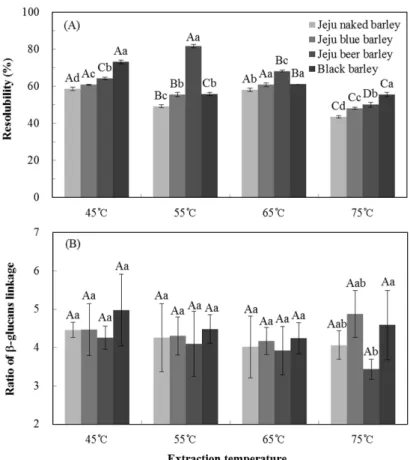
Resolubility of the extracted β-glucan is shown in Fig. 2(A). Resolubility of the β-glucans extracted from Jeju naked and blue barley at 45 and 65oC were the greatest. Resolubility of
Table 1. Chemical composition1) and viscosity of barley flours
Barley Protein (%) Fat (%) Ash (%) Starch (%) Total dietary fiber (%) β-glucan(%) Viscosity (cp) at room temperature Viscosity (cp) at heating Jeju naked barley 12.81±0.09a 2), 3) 2.43±0.16a 1.14±0.09ab 77.44±1.62a 10.55±1.21a 6.85±0.40a 39.70±0.71a 00433.00±12.73b
Jeju blue barley 07.70±0.07d 2.45±0.17a 1.29±0.21ab 72.86±3.18a 07.53±2.09b 5.13±0.37b 33.00±0.28b 1116.00±8.49a
Jeju beer barley 09.10±0.08c 2.46±0.06a 1.05±0.12b 73.73±0.96a 05.69±0.59b 3.58±0.38c 22.62±0.28c 0085.50±1.84c
Black barley 12.00±0.09b 2.11±0.21b 1.34±0.09a 73.53±2.76a 07.41±0.84b 4.16±0.25c 21.10±0.42d 0075.00±0.28c
1)All chemical contents were calculated as dry weight basis, %. 2)Each value is mean±standard deviation.
3)Means with the different letter in a column indicate significant difference (p<0.05) by Duncan’s multiple range test.
Fig. 1. β-Glucan concentration after extraction of different barley varieties at 45, 55, 65, and 75oC. Data are expressed as mean ± standard deviation. Means with different capital letters on the bars indicate significant difference (p<0.05) within the same barley variety and means with small letters indicate significant difference (p<0.05) within the same extraction temperature by Duncan’s multiple range test.
Jeju beer barley β-glucan extracted at 65oC was the highest as
81.73%. Resolubility of β-glucan extracted from black barley at 45oC was 73.14%. When extracted at high temperature, the
resolubility of β-glucan was getting low. The β-glucan with high molecular weight had a low diffusion rate in solution (28) so the β-glucan with high resolubility possibly contained low molecular weight β-glucan. Resolubility was also influenced by the ratio of β(1→3): β(1→4) linkages (5). Since the β(1→3) linkage broke up the regularity of the β(1→4) linkage in β-glucan molecules, the molecule could be more soluble and flexible to be high resolubility.
The ratio of β(1→3) and β(1→4) linkages in β-glucan is an important factor in determining the physical properties, such as solubility, viscosity and gel formation (8). The ratio of β(1→3) to β(1→4) linkages in β-glucan extracts is shown in Fig. 2(B) and ranged from 3.44 to 4.98. Izydorczyk et al. (6) reported that the ratio of β(1→3) to β(1→4) linkages of β-glucan in plants was usually 1:2.3-3.0 which were much lower than those ratio in this study. The report of Phillip and Stone (29) indicated that the more β-glucan purified, the more ratio of β(1→3): β(1→4) linkages increased. The β-glucan concentrations after extraction from barley in our study were greater than those shown in the report of Izydorczyk et al. (6). Thus, the extraction procedure in this study was optimized to purify β-glucan highly.
Conclusions
Chemical compositions including β-glucan concentration were dependent on barley varieties grown in Jeju. Viscosity of barley suspension was increased with β-glucan content and increased after heating. Barley β-glucans differently extracted at 45, 55, 65, and 75oC contained 64.88 to 93.84% of β-glucan after extraction.
The optimum temperature for the β-glucan extraction from Jeju naked barley, Jeju blue barley, and black barley was 65oC and
Jeju beer barley was 75oC. Resolubility of extracted β-glucan
was dependent on barley varieties and extraction temperature. Ratio of β(1→3) to β(1→4) linkages ranged from 3.44 to 4.98 which were high as indicating highly purified. These results indicate that the purification and physicochemical properties of β-glucan were dependent on the varieties of barley and the extraction temperature of water. It is possible to produce highly purified and uniform β-glucan which can impact nutritional and textural properties of food developed with barley.
Acknowledgment
This research was supported by the 2015 scientific promotion program funded by Jeju National University.
Fig. 2. Resolubility (A) and ratio of β-(1→3) to β-(1→4) linkages (B) of extracted β-glucan from different barley varieties at 45, 55, 65, and 75oC. Data are expressed as mean ± standard deviation. Means with different capital letters on the bars indicate significant difference (p<0.05) within the same barley variety and means with small letters indicate significant difference (p<0.05) within the same extraction temperature by Duncan’s multiple range test.
References
1. Jadhav SJ, Lutz SE, Ghorpade VM, Salunkhe DK. Barley: Chem-istry and value-added processing. Crit. Rev. Food Sci. 38: 123-171 (1998)
2. McClear BV, Holmes MG. Enzymatic quantification of (1-3),(1-4) β-D-glucan in barley and malt. J. I. Brewing 91: 285-295 (1985) 3. Wood PJ. Cereal β-glucans in diet and health. J. Cereal Sci. 46:
230-238 (2007)
4. Stone BA, Clarke AE. (1→3, 1→4)-β-Glucan in higher plants. pp. 431-489. In: Chemistry and Biology of (1→3)-β-Glucans. Stone BA, Clarke AE (eds). La Trobe University Press, Victoria, Australia (1992)
5. Autio K. Functional aspects of cereal cell wall polysaccharides. pp. 227-264. In: Carbohydrate in Food. Eliasson AC (ed). Marcel Dekker, New York, NY, USA (1996)
6. Izydorczyk MS, Biliaderist CG, Macri LJ, Macgregor AW. Frac-tionation of oat (1→3),(1→4)-β-D-glucans and characteristics of the fractions. J. Cereal Sci. 27: 321-325 (1998)
7. Wood PJ, Weisz J, Blackwell BA. Molecular characterization of cereal β-D-glucans. Structural analysis of oat β-D-glucan and rapid structural evaluation of β-D-glucans from different sources by high performance liquid chromatography of oligosaccharides released by lichenase. Cereal Chem. 68: 31-39 (1991)
8. Miller SS, Fulcher RG. Distribution of (1→3)(1→4)-β-D-glucan in kernels of oat and barley using microspectrofluorometry. Cereal Chem. 71: 64-68 (1994)
9. Baik BK, Steven EU. Barley for food: Characteristics, improve-ment, and renewed interest. J. Cereal Sci. 45: 233-242 (2008) 10. Wood PJ, Siddiqui IR, Paton D. Extraction of high viscosity
gums from oat. Cereal Chem. 55: 1038-1049 (1978)
11. Charles SB, Louise JC. The potential use of cereal (1 →3,1→4)-β-D-glucans as functional food ingredient. J. Cereal Sci. 42: 1-13 (2005)
12. Izysorczyk MS, Storsley J, Labossiere D, MacGregor AW, Ross-nagel BG. Variation in total and soluble β-glucan content in hul-less barley: Effects of thermal, physical, and enzymatic treatment. J. Agr. Food Chem. 48: 982-989 (2000)
13. AOAC. Official methods of analysis of AOAC Intl. 16th ed. Method 991.43. Association of Official Analytical Chemists, Arlington, VA, USA (1995)
14. AACC International. Approved Method of the AACC, 10th ed. Method 21-23.01, 76.13. Association of Cereal Chemists, St. Paul, MN, USA (2000)
15. Jeong HS, Kang TS, Park HJ, Jung IS, Lee HY Characteristics of viscosity and components of soluble extract in oats. Food Eng. Prog. 8: 40-46 (2004)
16. Kim HJ, White PJ. In vitro bile-acid binding and fermentation of high, medium, and low molecular weight β-glucan. J. Agr. Food Chem. 58: 628-634 (2010)
17. Lee SH, Jang GY, Kim HY, Woo KS, Hwang IG, Kim KJ, Lee MJ, Kim TJ, Lee J.S, Jeong HS. Physicochemical properties of barley β-glucan with different heating temperatures. Korean J. Soc. Food Sci. Nutr. 41: 1764-1770 (2012)
18. Woodward JR, Fincher GB, Stone BA. Water-soluble (1→3), (1→4)-β-D-glucans from barley (Hordeum vulgare) endosperm. II. Fine structure. Carbohyd. Polym. 3: 207-225 (1980)
19. Lee WJ. Changes in dietary fiber content of barley during peal-ing and cookpeal-ing. Korean J. Food Sci. Technol. 24:180-182 (1992) 20. Bamforth CW. Barley β-glucans. Their role in malting and
brew-ing. Brew. Dig. 57: 22-27 (1982)
21. MacGregor AW, Fincher GB. Carbohydrates of the barley grain. pp. 73-130. In: Barely Chemistry and Technology. MacGregor AW, Bathy RS (eds). American Association of Cereal Chemists, St Paul, MN, USA (1993)
22. Batty RS. Physicochemical properties of roller-milled barley bran and flour. Cereal Chem. 70: 397-402 (1993)
23. Izysorczyk MS, Storsley J, Labossiere D, MacGregor AW, Ross-nagel BG. Variation in total and soluble β-glucan content in hul-less barley: effects of thermal, physical, and enzymatic treatment. J. Agr. Chem. 48: 982-989 (2000)
24. Aastrup S. The relationship between the viscosity of an acid flour extract of barley and its β-glucan content. Carlsberg Res. Com-mon. 44: 289-304 (1979)
25. Wood PJ, Siddiqui IR, Paton D. Extraction of high-viscosity gums from oat. Cereal Chem. 55: 1038-1049 (1978)
26. McCleary BV. Purification of (1→3)(1→4)-β-D-glucan from bar-ley flour. pp. 511-514. In: Methods in Enzymology. Wood WA, Kellogg ST (eds). Academic Press, San Diego, CA, USA (1988) 27. Saulnier L, Gevaudan S, Thibault JF. Extraction and partial
char-acterization of β-glucan from the endosperms of two barley culti-vars. J. Cereal Sci. 19: 171-178 (1994)
28. Buliga GS, Brant DA, Fincher GB. The sequence statistics and solution conformation of a barley (1→3, 1→4)-β-glucan. Carbo-hyd. Res. 157: 139-156 (1986)
29. Phillip DR, Stone BA. Water-soluble (1→3),(1→4) β-glucans from barley (Hordeum vulgare) endosperm. IV. Comparison of 40 and 65oC soluble fractions. Carbohydr. Polym. 8: 85-97 (1988)