introduction
Knee motion arc is widely used as an outcome measure after total knee arthroplasty (TKA) and is a major component of vari-
ous scoring systems1,2). Currently, much effort is being expended to allow for greater flexion and high-flexion activities that are frequently required in certain religions and traditional Asian lifestyle3-6). However, concern has been expressed regarding the longevity of TKA due to the high-flexion activities enabled by in- creases in maximum flexion; these activities can increase stresses on the articulating surfaces and implant-bone interfaces7-11). Fur- thermore, it is debatable as to whether increased flexion provides real benefit12-16).
It appears reasonable that greater flexion after TKA improves clinical outcome13,16,17). However, several studies have reported only weak or modest correlations between the degree of maxi- mum flexion and functional outcomes in patients with TKA3,18). One possible explanation for this is passive maximum flexion without weight bearing does not accurately represent the amount of knee motion arc required for functional activities under weight
Active Flexion in Weight Bearing Better Correlates with Functional Outcomes of Total Knee Arthroplasty than Passive Flexion
Young Dong Song, MD
1,*, Nimash Jain, MS
2,*, Yeon Gwi Kang, MS
2, Tae Yune Kim, MD
2, and Tae Kyun Kim, MD, PhD
21Department of Orthopaedic Surgery, Center for Joint Surgery, National Medical Center, Seoul; 2Department of Orthopaedic Surgery, Joint Reconstruction Center, Seoul National University Bundang Hospital, Seongnam, Korea
purpose: Correlations between maximum flexion and functional outcomes in total knee arthroplasty (TKA) patients are reportedly weak. We investigated whether there are differences between passive maximum flexion in nonweight bearing and other types of maximum flexion and whether the type of maximum flexion correlates with functional outcomes.
materials and methods: A total of 210 patients (359 knees) underwent preoperative evaluation and postoperative follow-up evaluations (6, 12, and 24 months) for the assessment of clinical outcomes including maximum knee flexion. Maximum flexion was measured under five conditions: passive nonweight bearing, passive weight bearing, active nonweight bearing, and active weight bearing with or without arm support. Data were analyzed for relationships between passive maximum flexion in nonweight bearing by Pearson correlation analyses, and a variance comparison between measurement techniques via paired t test.
results: We observed substantial differences between passive maximum flexion in nonweight bearing and the other four maximum flexion types.
At all time points, passive maximum flexion in nonweight bearing correlated poorly with active maximum flexion in weight bearing with or without arm support. Active maximum flexion in weight bearing better correlated with functional outcomes than the other maximum flexion types.
conclusions: Our study suggests active maximum flexion in weight bearing should be reported together with passive maximum flexion in nonweight bearing in research on the knee motion arc after TKA.
Keywords: Knee, arthroplasty, active flexion, outcome pISSN 2234-0726 · eISSN 2234-2451
Knee Surgery & Related Research
Received April 8, 2015; Revised (1st) August 25, 2015;
(2nd) December 15, 2015; Accepted January 5, 2016 Correspondence to: Tae Kyun Kim, MD, PhD
Department of Orthopaedic Surgery, Joint Reconstruction Center, Seoul National University Bundang Hospital, 82 Gumi-ro 173beon-gil, Bundang-gu, Seongnam 13620, Korea
Tel: +82-31-787-7196, Fax: +82-31-787-4056 E-mail: [email protected]
*The first two authors contributed equally to this study.
118
This is an Open Access article distributed under the terms of the Creative Commons Attribution Non-Commercial License (http://creativecommons.org/licenses/by-nc/4.0/) which permits unrestricted non-commercial use, distribution, and reproduction in any medium, provided the original work is properly cited.
Copyright © 2016 KOREAN KNEE SOCIETY www.jksrr.org
bearing conditions with muscle function. For example, it has been reported that maximum flexion in weight bearing is smaller than that in nonweight bearing19).
We, therefore, investigated 1) whether substantial differences exist between passive maximum flexion in nonweight bearing and other types of maximum flexion (active nonweight bearing [ANWB], passive weight bearing [PWB], and active weight bear- ing with arm support [AWB-a] or active weight bearing without arm support [AWB-b]) and 2) whether any of the maximum flexion types better correlates with functional outcomes and pa- tient satisfaction.
materials and methods
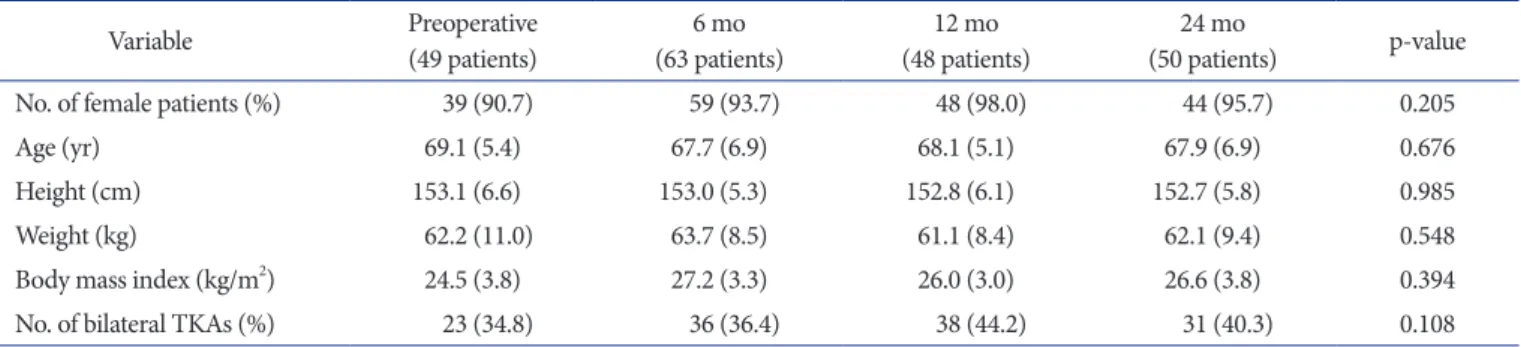
We prospectively recruited 219 patients (373 knees) who visited the operating surgeon’s outpatient clinic to form four cohorts representing the patient groups at four different time points (preoperative and postoperative 6, 12, and 24 months) from No- vember 2003 to July 2006. We included patients with primary os- teoarthritis and excluded those with postoperative complications that might affect outcome and those with systemic comorbidities that prevented patients from experiencing the maximum benefits of TKA. Fourteen knees in nine patients were excluded for the following reasons: a diagnosis other than primary osteoarthritis (6 knees) and serious medical problems unrelated to surgery, such as a cerebrovascular accident, Parkinson’s disease (7 knees), and periprosthetic infection (1 knee). Consequently, we included 359 knees of 210 patients: 86 knees of 49 patients before TKA;
99 knees of 63 patients 6 months postoperatively; 86 knees of 48 patients 12 months postoperatively; and 88 knees of 50 patients 24 months postoperatively. Outcomes with respect not to the unit of patients but to the unit of knees were analyzed in each analyti- cal trial. No demographic differences were evident among knees grouped by time points before or after surgery (Table 1). Clini-
cal information was prospectively collected using predesigned datasheets and maintained in a database by a single investigator (TKK). This information included demographic data, preopera- tive clinical status, and postoperative outcomes evaluated at 6, 12, and 24 months postoperatively. This study received Institutional Review Board approval, and all patients provided informed con- sent.
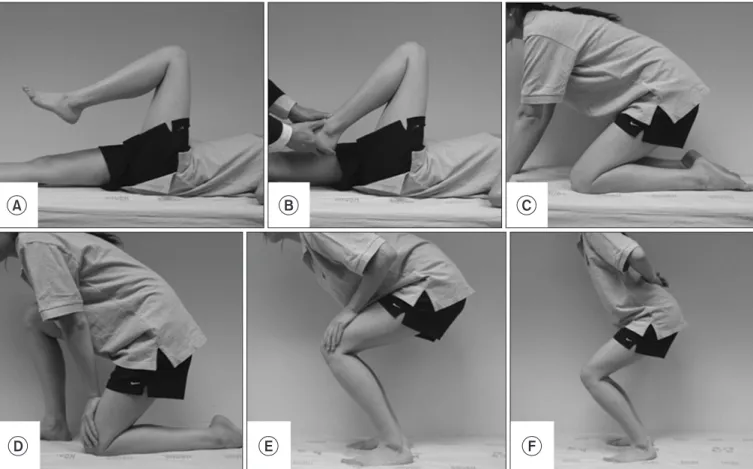
Preoperative clinical status and postoperative outcomes were evaluated using knee motion arc (flexion contracture and maxi- mum flexion), American Knee Society (AKS) knee and function scores including patient category2), the patellofemoral scoring system proposed by Feller et al.20), the Western Ontario and McMaster Universities Arthritis Index (WOMAC) scales21), Short-Form 36 (SF-36) scores22), and patient satisfaction. Patient satisfaction was evaluated using the grading system developed by the British Orthopaedic Association23-25), which involves four satisfaction levels: enthusiastic, satisfied, not committed, and disappointed. A single investigator (TKK) evaluated patient sat- isfaction using a questionnaire for all patients during follow-up visits. A single investigator (TKK) measured five types of maxi- mum flexion: 1) ANWB, 2) passive nonweight bearing (PNWB), 3) PWB, 4) AWB-a, and 5) AWB-b (Fig. 1). Active maximum flexion in nonweight bearing was measured to the nearest 5o us- ing a goniometer with the patient placed in supine position while actively bending knees (Fig. 1A). Passive maximum flexion in nonweight bearing was measured when an investigator applied a bending force without causing pain (Fig. 1B). Passive maximum flexion in weight bearing was measured while the patient kneeled on the affected knee (Fig. 1C). When a patient could not kneel on both knees, he/she kneeled only on the involved knee (Fig. 1D).
Active maximum flexion in weight bearing with arm support was measured while squatting with arm support on knees (Fig. 1E).
Active maximum flexion in weight bearing without arm support was measured while squatting with the arms free (Fig. 1F). For all
Table 1. Comparison of Demographic Data and Clinical Status at Different Time Points before and after Surgery
Variable Preoperative
(49 patients) 6 mo
(63 patients) 12 mo
(48 patients) 24 mo
(50 patients) p-value
No. of female patients (%) 39 (90.7) 59 (93.7) 48 (98.0) 44 (95.7) 0.205
Age (yr) 69.1 (5.4) 67.7 (6.9) 68.1 (5.1) 67.9 (6.9) 0.676
Height (cm) 153.1 (6.6) 153.0 (5.3) 152.8 (6.1) 152.7 (5.8) 0.985
Weight (kg) 62.2 (11.0) 63.7 (8.5) 61.1 (8.4) 62.1 (9.4) 0.548
Body mass index (kg/m2) 24.5 (3.8) 27.2 (3.3) 26.0 (3.0) 26.6 (3.8) 0.394
No. of bilateral TKAs (%) 23 (34.8) 36 (36.4) 38 (44.2) 31 (40.3) 0.108
Values are presented as mean (standard deviation) unless otherwise indicated.
TKA: total knee arthroplasty.
measurements, the center of the goniometer was kept on the knee joint axis with the distal arm pointing to the lateral malleolus and the proximal arm pointing to the greater trochanter.
All surgeries were performed by a single surgeon (TKK). Two hundred ninety-eight TKAs were performed as bilateral pro- cedures and the other sixty-one as unilateral procedures. One hundred ninety-four knees were implanted with a fixed-bearing posteriorly stabilized prosthesis (Genesis II; Smith & Nephew, Memphis, TN, USA) and 165 knees with a mobile-bearing pos- teriorly stabilized prosthesis (e.motion-PS; B. Braun-Aesculap, Tuttlingen, Germany). No differences (p=0.115) were found between patients evaluated at 6, 12, and 24 months postopera- tively in terms of implant type proportions. In all cases, a medial parapatellar arthrotomy approach was used, patellae were resur- faced, and implant fixations were carried out with cement. All patients underwent the same postoperative rehabilitation proto- col. Patients learned how to perform quadriceps strengthening
exercises and how to use a walking aid at a physiotherapy unit preoperatively. Patients were encouraged to perform quadriceps- strengthening exercises once they had returned to the ward on the operation day. One day after surgery, patients were allowed to walk to the toilet using a walking aid and received a 50-minute continuous passive motion (CPM) session with a range of mo- tion (ROM) of 0o to 30o. CPM sessions continued for 2 weeks postoperatively and ROMs were gradually increased as tolerated.
On the second postoperative day, patients began to dangle legs and perform active ROM exercises. From the 3rd to the 14th postoperative day, patients underwent a daily physiotherapy ses- sion at our rehabilitation center.
Statistical analysis was performed using SPSS ver. 12.0 (SPSS Inc., Chicago, IL, USA). Temporal patterns of the five types of maximum flexion were compared. The Kolmogorov-Smirnov test was used to confirm that the data of the 5 types of flexion were normally distributed. Differences between adjacent time A
D
B C
F E
Fig. 1. Photographs showing how the five types of maximum flexion were measured. (A) Active maximum flexion in nonweight bearing was mea- sured with the patient placed in supine while actively bending the knee. (B) Passive maximum flexion in nonweight bearing was measured while an investigator applied a bending force without causing pain. (C) Passive maximum flexion in weight bearing was measured with the patient kneeling on the affected knee. (D) When the patient could not kneel on both knees, he/she kneeled only on the involved knee. (E) Active maximum flexion in weight bearing with arm support was measured while squatting with arm support on knees. (F) Active maximum flexion in weight bearing without arm support was measured while squatting with the arms free.
points (preoperative vs. 6 months; 6 months vs. 12 months; and 12 months vs. 24 months) were determined by analysis of vari- ance with the post hoc analyses. Maximum flexion differences by the types were determined using the paired t-test. Partial correla- tion analysis adjusted for confounding factors (age, gender, body mass index, bilaterality, type of implant, and patient category as determined by the AKS) was performed to assess the relationship.
Relationships between passive maximum flexion in nonweight bearing and other maximum flexion types were evaluated by Pearson correlation analyses. To determine whether our sample size had sufficient power to detect significant correlations, a pri- ori power analysis was performed using a two-sided hypothesis test and an alpha level of 0.05. We regarded a correlation coeffi- cient of greater than 0.3 as being clinically important. Eighty-five cases were required to detect a clinically important correlation with the power of 80%. The levels of correlation detectable given
our sample size of 86, 99, 86, and 88 knees were 81%, 86%, 81%, and 82%, respectively, which indicated the study had sufficient power to detect clinically important correlations.
results
Substantial differences existed between passive maximum flex- ion in nonweight bearing and the other four flexion types (Fig. 2).
Passive maximum flexion in nonweight bearing was greatest fol- lowed by PWB or ANWB, AWB-a, and AWB-b at all time points (Fig. 2). Temporal patterns of maximum flexion also differed for the five maximum flexion types (Fig. 2). Passive maximum flex- ion in nonweight bearing after surgery peaked at 12 months. Pas- sive maximum flexion in weight bearing decreased after surgery, and no differences were observed among the three postoperative time points (p>0.05). Active maximum flexion in nonweight bearing decreased after surgery and showed similar levels at 6 and 12 months postoperatively but then reduced further at 24 months. In contrast, active flexion in weight bearing with or without arm support increased after surgery and maintained similar levels at the three different time points. In term of over- all correlation, passive maximum flexion in nonweight bearing weakly correlated with active maximum flexion in weight bearing with (r=0.41, p=0.001) or without (r=0.38, p=0.002) arm support but strongly correlated with ANWB (r=0.93, p<0.001) and PWB (r=0.86, p<0.001) (Table 2).
Active weight bearing types of maximum flexion better cor- related with functional outcomes than the other flexion types.
Furthermore, correlation patterns between maximum flexion and clinical outcome scales differed by maximum flexion type and the time after surgery (Tables 2–6). Preoperatively, active weight bearing with or without arm support correlated with AKS function score, chair rising and stair climbing scores of the patel- lofemoral scoring system, and the role physical and vitality scales of the SF-36 (Table 3). It was notable that the anterior knee pain
PNWB 80
Flexion type 160
150 140 130 120 110 100 90
Flexion(degree)
PWB ANWB AWB-a AWB-b
Preoperative 6 mo 1 yr 2 yr a) b)
a) a)
a) a)
a)
Fig. 2. Bar graph showing the temporal patterns of the five types of max- imum flexion. Statistical significance of the differences from the previous adjacent time point is shown with two footnotes. PNWB: passive non- weight bearing, PWB: passive weight bearing, ANWB: active nonweight bearing, AWB-a: active weight bearing with arm support, AWB-b: active weight bearing without arm support. a)p<0.01, b)p<0.05.
Table 2. Correlations between the Passive Nonweight Bearing Flexion and Other Four Types of Flexion
Time point PWB ANWB AWB-a AWB-b
Preoperative (n=86) 0.86 (<0.001) 0.93 (<0.001) 0.41 (0.001) 0.38 (0.002)
6 mo (n=99) 0.83 (<0.001) 0.93 (<0.001) 0.27 (0.007) 0.37 (<0.001)
1 yr (n=86) 0.78 (<0.001) 0.91 (<0.001) 0.28 (0.008) 0.37 (<0.001)
2 yr (n=88) 0.77 (<0.001) 0.91 (<0.001) 0.56 (0.008) 0.67 (<0.001)
Overall 0.84 (<0.001) 0.93 (<0.001) 0.17 (0.002) 0.23 (<0.001)
Values are presented as Pearson correlation coefficients (p-value).
PWB: passive weight bearing, ANWB: active nonweight bearing, AWB-a: active weight bearing with arm support, AWB-b: active weight bearing without arm support.
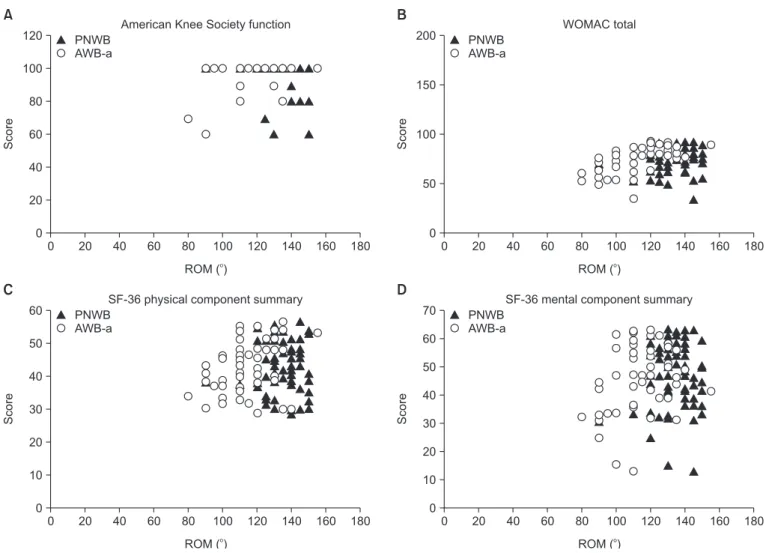
scale of the patellofemoral scoring system showed an inverse cor- relation with all types of maximum flexion, indicating that the higher the maximum flexion was, the more severe the anterior knee pain. At 6 months postoperatively, the AKS and WOMAC scales did not correlate with any of the five types of maximum flexion (Table 4). At 12 months postoperatively, active weight bearing maximum flexion with or without arm support positively correlated with many of the outcome scales, whereas passive flex- ion types and active flexion in nonweight bearing showed only weak correlations with some of the outcome scales (Table 5, Fig.
3). Only active maximum flexion in weight bearing with or with- out arm support positively correlated with patient satisfaction. At 24 months postoperatively, no correlation was evident between active maximum flexion in weight bearing without arm support;
however, AWB-a positively correlated with anterior knee pain by
all three WOMAC scales (Table 6).
discussion
Although much effort is being expended to obtain greater flexion to allow higher-flexion activities, it remains debatable as to whether increased flexion provides real benefit12-16). Previ- ous studies have reported that correlations between the degree of maximum flexion and functional outcomes are only weak or modest3,18). One possible explanation for this lack of correlation between the degree of maximum flexion and functional out- comes is that passive maximum flexion in nonweight bearing, which is typically used to evaluate knee motion arc, fails to rep- resent the amount of knee motion arc required for functional ac- tivities. In the present study, we investigated whether substantial Table 3. Comparison of the Correlations between the Five Different Types of Maximum Flexion and Clinical Outcome Scales in 86 Knees before Surgery
Outcome scale PNWB PWB ANWB AWB-a AWB-b
American Knee Society
Pain score 0.11 (0.363) 0.13 (0.305) 0.17 (0.173) 0.16 (0.193) 0.14 (0.255)
Knee score 0.26 (0.039) 0.18 (0.169) 0.33 (0.007) 0.10 (0.434) 0.08 (0.502)
Function score −0.10 (0.410) −0.02 (0.866) −0.03 (0.825) 0.25 (0.041) 0.30 (0.016)
Patellofemoral scoring system
Anterior knee pain −0.43 (0.000) −0.37 (0.003) −0.44 (0.000) −0.29 (0.019) −0.29 (0.017)
Chair rising 0.10 (0.408) 0.06 (0.647) 0.09 (0.458) 0.29 (0.019) 0.24 (0.055)
Stair climbing 0.11 (0.365) 0.17 (0.182) 0.18 (0.151) 0.48 (0.000) 0.49 (0.000)
WOMACa)
Pain score 0.02 (0.901) 0.10 (0.421) −0.01 (0.964) 0.07 (0.556) 0.08 (0.546)
Stiffness score 0.01 (0.929) 0.10 (0.456) −0.03 (0.813) 0.10 (0.419) 0.08 (0.546)
Function score 0.11 (0.396) 0.11 (0.381) 0.12 (0.323) 0.06 (0.624) 0.03 (0.806)
Short-Form 36
Physical functioning 0.10 (0.441) 0.07 (0.600) 0.05 (0.696) 0.15 (0.239) 0.13 (0.317)
Role physical −0.00 (0.989) 0.15 (0.241) −0.00 (0.992) 0.23 (0.064) 0.23 (0.070)
Bodily pain −0.22 (0.071) −0.16 (0.201) −0.25 (0.045) −0.02 (0.849) −0.04 (0.746)
General health 0.17 (0.172) 0.03 (0.827) 0.12 (0.349) 0.10 (0.440) 0.08 (0.549)
Vitality −0.04 (0.746) 0.08 (0.548) −0.04 (0.726) 0.21 (0.086) 0.25 (0.047)
Social functioning −0.10 (0.440) 0.00 (0.991) −0.13 (0.319) 0.11 (0.386) 0.10 (0.444)
Role emotional −0.04 (0.728) 0.05 (0.676) −0.07 (0.578) 0.09 (0.456) 0.08 (0.523)
Mental health −0.06 (0.635) 0.12 (0.369) −0.10 (0.422) 0.09 (0.471) 0.09 (0.490)
Physical component summary 0.06 (0.616) −0.01 (0.946) 0.04 (0.751) 0.19 (0.135) 0.17 (0.174) Mental component summary −0.09 (0.496) 0.08 (0.552) −0.12 (0.353) 0.11 (0.367) 0.11 (0.375) Values are presented as correlation coefficients (p-value).
PNWB: passive nonweight bearing, PWB: passive weight bearing, ANWB: active nonweight bearing, AWB-a: active weight bearing with arm support, AWB-b: active weight bearing without arm support, WOMAC: Western Ontario and McMaster Universities Arthritis Index.
a)To facilitate comparisons, correlation analyses were performed using standardized WOMAC scores (worst score=0, best score=100).
differences exist between passive maximum flexion in nonweight bearing and the four other flexion types and identified the maxi- mum flexion type that best correlates with functional outcomes, including patient satisfaction.
Knee motion arc, a major component of many scoring sys- tems1,2), is typically measured in passive maximum flexion in nonweight bearing3,14,18,26-28), but other types of maximum flexion measured in an active mode or in a weight bearing condition are also used19,29-31). Our study demonstrates substantial differences exist between passive maximum flexion in nonweight bearing and the other four flexion types. Active maximum flexions in weight bearing with or without arm support were smaller than passive or active maximum flexions in nonweight bearing. Our
study concurs with the findings of a fluoroscopy-based study19), which reported active flexion in weight bearing was smaller than passive flexion during nonweight bearing in normal subjects (135o vs. 139o) and TKA patients (127o vs. 113o). Furthermore, despite the greater PNWB flexion in the current study compared to the previous study (135o vs. 127o, respectively), the patients in both studies had similar degrees of active flexion in weight bearing (114o or 111o vs. 113o, respectively). Our study also demonstrates the five maximum flexion types had different temporal patterns.
For example, active maximum flexion in weight bearing with or without arm support increased after surgery and remained at a constant level throughout the postoperative period, whereas the passive and ANWB types decreased after surgery, improved Table 4. Comparison of the Correlations between the Five Different Types of Maximum Flexion and Clinical Outcome Scales in 99 Knees at 6 Months after Surgery
Outcome scale PNWB PWB ANWB AWB-a AWB-b
American Knee Society
Pain score −0.11 (0.266) −0.05 (0.607) −0.09 (0.376) 0.14 (0.183) 0.03 (0.739)
Knee score −0.04 (0.694) −0.04 (0.706) 0.02 (0.883) 0.16 (0.122) 0.16 (0.121)
Function score −0.08 (0.416) 0.02 (0.844) −0.08 (0.410) 0.06 (0.543) 0.11 (0.285)
Patellofemoral scoring system
Anterior knee pain 0.06 (0.550) 0.07 (0.493) 0.09 (0.392) 0.08 (0.434) 0.10 (0.307)
Chair rising −0.06 (0.532) −0.02 (0.864) −0.05 (0.604) 0.06 (0.556) 0.01 (0.897)
Stair climbing −0.13 (0.193) −0.05 (0.657) −0.15 (0.132) 0.18 (0.080) 0.16 (0.123)
WOMACa)
Pain score −0.10 (0.362) −0.10 (0.318) −0.13 (0.201) −0.05 (0.622) −0.05 (0.637)
Stiffness score −0.02 (0.780) −0.04 (0.704) −0.08 (0.472) 0.13 (0.228) 0.14 (0.181)
Function score −0.08 (0.438) −0.10 (0.340) −0.15 (0.141) 0.00 (0.973) 0.04 (0.722)
Short-Form 36
Physical functioning −0.15 (0.140) −0.16 (0.115) −0.21 (0.038) −0.16 (0.113) −0.11 (0.294)
Role physical −0.17 (0.097) −0.18 (0.084) −0.25 (0.015) −0.10 (0.318) −0.15 (0.139)
Bodily pain −0.20 (0.055) −0.23 (0.026) −0.27 (0.007) −0.09 (0.412) −0.12 (0.240)
General health −0.02 (0.852) 0.01 (0.891) 0.01 (0.911) −0.96 (0.353) −0.15 (0.144)
Vitality −0.26 (0.010) −0.25 (0.014) −0.32 (0.002) −0.11 ((0.279) −0.29 (0.004)
Social functioning −0.08 (0.468) −0.11 (0.302) −0.15 (0.154) −0.11 (0.275) −0.09 (0.376)
Role emotional −0.04 (0.715) −0.01 (0.911) −0.13 (0.229) −0.17 (0.103) −0.15 (0.146)
Mental health −0.12 (0.230) −0.10 (0.340) −0.13 (0.226) 0.03 (0.799) −0.06 (0.598)
Physical component summary −0.21 (0.045) −0.25 (0.018) −0.28 (0.007) −0.14 (0.194) −0.15 (0.143) Mental component summary −0.13 (0.220) −0.10 (0.324) −0.18 (0.086) −0.06 (0.583) −0.10 (0.348)
Patient satisfaction 0.18 (0.074) 0.15 (0.147) 0.13 (0.205) −0.20 (0.050) −0.11 (0.281)
Values are presented as correlation coefficients (p-value).
PNWB: passive nonweight bearing, PWB: passive weight bearing, ANWB: active nonweight bearing, AWB-a: active weight bearing with arm support, AWB-b: active weight bearing without arm support, WOMAC: Western Ontario and McMaster Universities Arthritis Index.
a)To facilitate comparisons, correlation analyses were performed using standardized WOMAC scores (worst score=0, best score=100).
between 6 and 12 months, and then decreased. In addition, cor- relation strengths between PNWB and active weight bearing types were weak except at 24 months after surgery. Our findings suggest each maximum flexion type represents a different func- tional aspect of the knee motion arc and adequate comparisons between studies require detailed information on the measuring methods used.
We found active maximum flexion in weight bearing better cor- related with functional outcomes than the other maximum flex- ions. Furthermore, correlation patterns depended on maximum flexion types and the time after surgery. Previous studies have reported weak or modest correlations between passive maximum flexion in nonweight bearing and functional outcomes3,18,29). On
the other hand, we found active maximum flexion in weight bearing correlated better than the other maximum flexion types with functional outcome scales at all time points, particularly at 12 months after surgery, which suggests active maximum flexion in weight bearing is a better measure of knee function than pas- sive maximum flexion in nonweight bearing. Active flexion in weight bearing types were positively correlated with functional outcomes at almost all time points whereas the other flexion types were inversely correlated, which suggests patients with greater passive maximum flexion in nonweight bearing have poorer functional outcomes. It is not clear why active maximum flexion in weight bearing types better correlate with the func- tional outcomes than the other types. We speculate that active Table 5. Comparison of the Correlations between the Five Different Types of Maximum Flexion and Clinical Outcome Scales in 86 Knees at 12 Months after Surgery
Outcome scale PNWB PWB ANWB AWB-a AWB-b
American Knee Society
Pain score 0.16 (0.149) 0.12 (0.290) 0.23 (0.044) 0.40 (0.000) 0.37 (0.000)
Knee score 0.28 (0.010) 0.23 (0.039) 0.31 (0.004) 0.36 (0.001) 0.35 (0.001)
Function score −0.18 (0.098) −0.18 (0.099) −0.03 (0.787) 0.28 (0.008) 0.32 (0.003)
Patellofemoral scoring system
Anterior knee pain 0.15 (0.176) 0.12 (0.299) 0.18 (0.108) 0.41 (0.000) 0.42 (0.000)
Chair rising −0.05 (0.643) 0.13 (0.254) −0.07 (0.512) 0.15 (0.167) 0.09 (0.423)
Stair climbing −0.24 (0.026) −0.10 (0.362) −0.14 (0.198) 0.16 (0.138) 0.18 (0.108)
WOMACa)
Pain 0.24 (0.029) −0.20 (0.072) 0.23 (0.036) 0.41 (0.000) 0.49 (0.000)
Stiffness 0.00 (0.990) 0.09 (0.415) −0.02 (0.835) 0.27 (0.013) 0.26 (0.019)
Function 0.13 (0.237) 0.18 (0.112) 0.12 (0.280) 0.51 (0.000) 0.52 (0.000)
Short-Form 36
Physical functioning −0.06 (0.596) −0.03 (0.795) −0.05 (0.642) 0.40 (0.000) 0.36 (0.001)
Role physical 0.09 (0.435) 0.03 (0.784) 0.05 (0.627) 0.45 (0.000) 0.48 (0.000)
Bodily pain 0.08 (0.467) 0.03 (0.811) 0.09 (0.441) 0.33 (0.002) 0.35 (0.001)
General health −0.08 (0.479) −0.20 (0.075) 0.01 (0.934) 0.06 (0.578) 0.05 (0.657)
Vitality −0.15 (0.188) −0.16 (0.154) −0.11 (0.337) 0.16 (0.143) 0.14 (0.210)
Social functioning 0.07 (0.520) 0.04 (0.750) 0.03 (0.770) 0.33 (0.002) 0.32 (0.003)
Role emotional 0.07 (0.514) 0.07 (0.554) 0.08 (0.445) 0.37 (0.000) 0.44 (0.000)
Mental health −0.06 (0.608) −0.02 (0.869) −0.03 (0.815) 0.06 (0.593) 0.08 (0.477)
Physical component summary 0.02 (0.845) 0.07 (0.537) 0.02 (0.843) 0.41 (0.000) 0.38 (0.000) Mental component summary −0.01 (0.935) 0.00 (0.972) 0.01 (0.905) 0.20 (0.066) 0.24 (0.029)
Patient satisfaction 0.12 (0.274) 0.12 (0.278) 0.15 (0.164) 0.31 (0.003) 0.36 (0.001)
Values are presented as correlation coefficients (p-value).
PNWB: passive nonweight bearing, PWB: passive weight bearing, ANWB: active nonweight bearing, AWB-a: active weight bearing with arm support, AWB-b: active weight bearing without arm support, WOMAC: Western Ontario and McMaster Universities Arthritis Index.
a)To facilitate comparisons, correlation analyses were performed using standardized WOMAC scores (worst score=0, best score=100).
flexion types in weight bearing reflect the functional motion arc under the weight bearing conditions with muscle function more efficiently than other types. Another possible explanation would be that greater passive or active flexions in nonweight bearing are associated with unequally larger flexion gaps which might in- capacitate the normal functions of the prostheses. Furthermore, our findings of lacking or inverse correlations between passive flexion and functional outcomes might concur with those of a previous study which concluded knees with maximum flexions ranging from 128o to 132o had better functional outcomes in terms of AKS pain, knee, and function scores than knees with maximum flexions of greater than 132o16). Moreover, our finding that despite substantial passive maximum flexion in nonweight
bearing, active maximum flexion in weight bearing remained at low levels may explain why TKA patients experience substantial residual functional deficits6,32). On the other hand, the presence of considerable differences between passive flexion in nonweight bearing degrees and other types and flexion and the finding of better correlation of active flexion in weight bearing degrees with functional outcomes indicate that active flexion in weight bearing degrees should be reported along with passive flexion in nonweight bearing degrees. Our literature review of studies re- porting motion arc as a major outcome variable found that many studies still included only passive flexion in nonweight bearing degrees33-44).
Several limitations to our study should be noted. First, we in- Table 6. Comparison of the Correlations between the Five Different Types of Maximum Flexion and Clinical Outcome Scales in 88 Knees at 24 Months after Surgery
Outcome scale PNWB PWB ANWB AWB-a AWB-b
American Knee Society
Pain score −0.11 (0.347) −0.03 (0.790) −0.22 (0.062) 0.10 (0.397) 0.07 (0.569)
Knee score 0.06 (0.640) 0.12 (0.350) −0.10 (0.433) 0.15 (0.233) 0.16 (0.192)
Function score −0.08 (0.512) −0.22 (0.076) −0.10 (0.396) −0.18 (0.139) −0.19 (0.117)
Patellofemoral scoring system
Anterior knee pain −0.12 (0.340) 0.06 (0.635) 0.01 (0.923) 0.20 (0.097) 0.08 (0.501)
Chair rising −0.25 (0.030) −0.13 (0.277) −0.25 (0.031) −0.06 (0.601) −0.10 (0.411)
Stair climbing −0.09 (0.476) −0.17 (0.171) −0.12 (0.34) −0.17 (0.159) −0.19 (0.112)
WOMACa)
Pain score −0.19 (0.125) 0.02 (0.876) −0.18 (0.152) 0.26 (0.033) 0.15 (0.227)
Stiffness score 0.13 (0.300) 0.21 (0.108) 0.09 (0.451) 0.24 (0.048) 0.23 (0.067)
Function score −0.12 (0.335) 0.02 (0.886) −0.12 (0.325) 0.30 (0.015) 0.17 (0.182)
Short-Form 36
Physical functioning −0.33 (0.007) −0.19 (0.142) −0.47 (0.000) −0.01 (0.907) 0.11 (0.363)
Role physical −0.22 (0.078) −0.13 (0.30) −0.24 (0.051) 0.05 (0.707) 0.03 (0.782)
Bodily pain −0.30 (0.015) −0.22 (0.083) −0.39 (0.001) −0.03 (0.836) −0.11 (0.375)
General health 0.11 (0.376) 0.05 (0.691) 0.09 (0.453) 0.16 (0.212) 0.23 (0.059)
Vitality 0.04 (0.761) −0.02 (0.882) −0.10 (0.412) 0.17 (0.159) 0.10 (0.439)
Social functioning −0.24 (0.052) −0.23 (0.077) −0.25 (0.038) −0.12 (0.325) −0.18 (0.157)
Role emotional −0.06 (0.632) −0.04 (0.746) −0.10 (0.412) 0.14 (0.270) 0.05 (0.667)
Mental health −0.23 (0.062) −0.04 (0.783) −0.19 (0.127) 0.02 (0.902) −0.09 (0.459)
Physical component summary −0.31 (0.012) −0.24 (0.059) −0.45 (0.000) 0.00 (0.980) −0.04 (0.741) Mental component summary −0.07 (0.598) −0.02 (0.886) −0.06 (0.622) 0.10 (0.424) −0.01 (0.963)
Patient satisfaction 0.06 ((0.617) 0.01 (0.935) −0.03 (0.777) 0.13 (0.269) 0.05 (0.654)
Values are presented as correlation coefficients (p-value).
PNWB: passive nonweight bearing, PWB: passive weight bearing, ANWB: active nonweight bearing, AWB-a: active weight bearing with arm support, AWB-b: active weight bearing without arm support, WOMAC: Western Ontario and McMaster Universities Arthritis Index.
a)To facilitate comparisons, correlation analyses were performed using standardized WOMAC scores (worst score=0, best score=100).
0 0
ROM ( )o 120
100
80
60
40
20
Score
20 40 60 180
A
80 100 120 140 160 American Knee Society function
0 0
ROM ( )o 200
150
100
50
Score
20 40 60 180
B
80 100 120 140 160 WOMAC total
0 0
ROM ( )o 60
50
40
30
20
10
Score
20 40 60 180
C
80 100 120 140 160 SF-36 physical component summary
0 0
ROM ( )o 70
60 50 40 30 20 10
Score
20 40 60 180
D
80 100 120 140 160 SF-36 mental component summary PNWB
AWB-a
PNWB AWB-a
PNWB AWB-a PNWB
AWB-a
Fig. 3. American Knee Society function score (A), Western Ontario and McMaster Universities Arthritis Index (WOMAC) total score (B), Short Form-36 (SF-36) physical component summary (C), and SF-36 mental component summary (D) were compared between the passive nonweight bearing (PNWB) and the active weight bearing with arm support (AWB-a). ROM: range of motion.
cluded four different groups of patients that visited an outpatient clinic; an ideal study design would have involved a single cohort of patients, because this would have excluded confounding fac- tors arising from differences among study populations. However, it was not practically possible to recruit patients who were pre- pared to undergo the same maneuvers at each follow-up visit, and we were concerned over the possibility of compromised consistency of flexion measurements if they were performed throughout a 2 year period. We did not apply any selection cri- teria to form the cohorts except the defined inclusion criteria, which would exclude any selection bias, and there were no signif- icant differences in patient factors between the four groups (Table 1). We could see no reasons not to believe the four cohorts being representative of patient groups at the four time points. Second, the majority of our patients were elderly women, and thus, our findings are not easily extrapolated to other study populations
with different ages and gender compositions. However, the study populations were recruited without any selection bias, and the gender ratio of our cohort was similar to those of typical Korean TKA series14,18,45). Third, this study involved manual measure- ments of flexion degrees using a goniometer, which is subject to certain inaccuracy46). Previous studies documented that the measurements of flexion degrees using a clinical goniometer has satisfactory inter- and intra-observer reliabilities (intraclass cor- relation coefficient; range, 0.98 to 0.99)47), but the accuracy with references of standard radiographic flexion assessment could vary with the investigator (difference between radiographic as- sessment and manual measurement with a goniometer, range, 1.7o to 14.7o)46,48). However, the other more sophisticated methods de- scribed5) would not be available for regular follow-up visits, and the majority of clinical studies reporting motion arc have used a clinical goniometer3,12-16,18,25,26,29,49-54). In our study, only the single
investigator (TKK) with 6-year experience in measuring flexion with a goniometer performed the measurement under the direct supervision by the operating surgeon (TKK), which would assure satisfactory accuracies and reliabilities.
conclusions
Our study demonstrates substantial differences exist between passive maximum flexion in nonweight bearing and the other flexion types examined, particularly with active maximum flex- ion in weight bearing, which better correlated with functional outcomes. We, therefore, suggest active maximum flexion in weight bearing should be reported with passive maximum flex- ion in nonweight bearing in future research intended to increase knee motion arc after TKA.
conflict of interest
No potential conflict of interest relevant to this article was re- ported.
references
1. Alicea J. Scoring systems and their validation for the arthritic knee. In: Insall JN, Scott WN, eds. Surgery of the Knee. 3rd ed. Philadelphia, PA: Churchill Livingstone; 2001. p1507-15.
2. Insall JN, Dorr LD, Scott RD, Scott WN. Rationale of the Knee Society clinical rating system. Clin Orthop Relat Res.
1989;(248):13-4.
3. Miner AL, Lingard EA, Wright EA, Sledge CB, Katz JN;
Kinemax Outcomes Group. Knee range of motion after total knee arthroplasty: how important is this as an outcome mea- sure? J Arthroplasty. 2003;18:286-94.
4. Mulholland SJ, Wyss UP. Activities of daily living in non- Western cultures: range of motion requirements for hip and knee joint implants. Int J Rehabil Res. 2001;24:191-8.
5. Rowe PJ, Myles CM, Walker C, Nutton R. Knee joint kine- matics in gait and other functional activities measured using flexible electrogoniometry: how much knee motion is suf- ficient for normal daily life? Gait Posture. 2000;12:143-55.
6. Weiss JM, Noble PC, Conditt MA, Kohl HW, Roberts S, Cook KF, Gordon MJ, Mathis KB. What functional activities are important to patients with knee replacements? Clin Or- thop Relat Res. 2002;(404):172-88.
7. Kanekasu K, Banks SA, Honjo S, Nakata O, Kato H. Fluoro- scopic analysis of knee arthroplasty kinematics during deep
flexion kneeling. J Arthroplasty. 2004;19:998-1003.
8. Lee SY, Matsui N, Kurosaka M, Komistek RD, Mahfouz M, Dennis DA, Yoshiya S. A posterior-stabilized total knee ar- throplasty shows condylar lift-off during deep knee bends.
Clin Orthop Relat Res. 2005;(435):181-4.
9. Nagura T, Dyrby CO, Alexander EJ, Andriacchi TP. Me- chanical loads at the knee joint during deep flexion. J Or- thop Res. 2002;20:881-6.
10. Thambyah A, Goh JC, De SD. Contact stresses in the knee joint in deep flexion. Med Eng Phys. 2005;27:329-35.
11. Morra EA, Greenwald AS. Polymer insert stress in total knee designs during high-flexion activities: a finite element study.
J Bone Joint Surg Am. 2005;87 Suppl 2:120-4.
12. Bin SI, Nam TS. Early results of high-flex total knee arthro- plasty: comparison study at 1 year after surgery. Knee Surg Sports Traumatol Arthrosc. 2007;15:350-5.
13. Huang HT, Su JY, Wang GJ. The early results of high-flex total knee arthroplasty: a minimum of 2 years of follow-up. J Arthroplasty. 2005;20:674-9.
14. Kim YH, Sohn KS, Kim JS. Range of motion of standard and high-flexion posterior stabilized total knee prostheses: a pro- spective, randomized study. J Bone Joint Surg Am. 2005;87:
1470-5.
15. Seon JK, Song EK, Lee JY. Comparison of range of motion of high-flexion prosthesis and mobile-bearing prosthesis in total knee arthroplasty. Orthopedics. 2005;28(10 Suppl):
s1247-50.
16. Ritter MA, Lutgring JD, Davis KE, Berend ME. The effect of postoperative range of motion on functional activities after posterior cruciate-retaining total knee arthroplasty. J Bone Joint Surg Am. 2008;90:777-84.
17. Li G, Schule SL, Zayontz SJ, Maloney WJ, Rubash HE. Im- proving flexion in total knee arthroplasty. In: Callaghan JJ, Rosenberg AG, Rubash HE, Simonian PT, Wickiewicz TL, eds. The adult knee. 1st ed. Philadelphia, PA: Lippincott Wil- liams and Wilkins; 2003. p 1233-44.
18. Park KK, Chang CB, Kang YG, Seong SC, Kim TK. Correla- tion of maximum flexion with clinical outcome after total knee replacement in Asian patients. J Bone Joint Surg Br.
2007;89:604-8.
19. Dennis DA, Komistek RD, Stiehl JB, Walker SA, Dennis KN.
Range of motion after total knee arthroplasty: the effect of implant design and weight-bearing conditions. J Arthro- plasty. 1998;13:748-52.
20. Feller JA, Bartlett RJ, Lang DM. Patellar resurfacing versus retention in total knee arthroplasty. J Bone Joint Surg Br.
1996;78:226-8.
21. Bellamy N, Buchanan WW, Goldsmith CH, Campbell J, Stitt LW. Validation study of WOMAC: a health status instrument for measuring clinically important patient relevant outcomes to antirheumatic drug therapy in patients with osteoarthritis of the hip or knee. J Rheumatol. 1988;15:1833-40.
22. Ware JE Jr, Sherbourne CD. The MOS 36-item short-form health survey (SF-36): I. Conceptual framework and item selection. Med Care. 1992;30:473-83.
23. A knee function assessment chart. From the British Ortho- paedic Association Research Sub-Committee. J Bone Joint Surg Br. 1978;60:308-9.
24. Waters TS, Bentley G. Patellar resurfacing in total knee ar- throplasty: a prospective, randomized study. J Bone Joint Surg Am. 2003;85:212-7.
25. Kim TK, Cho HJ, Kang YG, Kim SJ, Chang CB. Improved early clinical outcomes of RP/PS mobile-bearing total knee arthroplasties. Clin Orthop Relat Res. 2009;467:2901-10.
26. Ritter MA, Harty LD, Davis KE, Meding JB, Berend ME.
Predicting range of motion after total knee arthroplasty.
Clustering, log-linear regression, and regression tree analy- sis. J Bone Joint Surg Am. 2003;85:1278-85.
27. McAllister CM, Stepanian JD. The impact of minimally invasive surgical techniques on early range of motion after primary total knee arthroplasty. J Arthroplasty. 2008;23:10- 8.
28. Mockford BJ, Thompson NW, Humphreys P, Beverland DE.
Does a standard outpatient physiotherapy regime improve the range of knee motion after primary total knee arthro- plasty? J Arthroplasty. 2008;23:1110-4.
29. Meneghini RM, Pierson JL, Bagsby D, Ziemba-Davis M, Berend ME, Ritter MA. Is there a functional benefit to ob- taining high flexion after total knee arthroplasty? J Arthro- plasty. 2007;22(6 Suppl 2):43-6.
30. Banks S, Bellemans J, Nozaki H, Whiteside LA, Harman M, Hodge WA. Knee motions during maximum flexion in fixed and mobile-bearing arthroplasties. Clin Orthop Relat Res.
2003;(410):131-8.
31. Bellemans J, Banks S, Victor J, Vandenneucker H, Moemans A. Fluoroscopic analysis of the kinematics of deep flexion in total knee arthroplasty: influence of posterior condylar off- set. J Bone Joint Surg Br. 2002;84:50-3.
32. Noble PC, Gordon MJ, Weiss JM, Reddix RN, Conditt MA, Mathis KB. Does total knee replacement restore normal knee function? Clin Orthop Relat Res. 2005;(431):157-65.
33. Mencière ML, Epinette JA, Gabrion A, Arnalsteen D, Mertl
P. Does high flexion after total knee replacement really im- prove our patients’ quality of life at a short-term follow-up? : a comparative case-control study with hyperflex PFC Sigma versus a Triathlon knee series. Int Orthop. 2014;38:2079-86.
34. Nakamura S, Ito H, Kobayashi M, Nakamura K, Toyoji U, Komistek RD, Nakamura T. Are the long term results of a high-flex total knee replacement affected by the range of flexion? Int Orthop. 2014;38:761-6.
35. Han HS, Kang SB. Brief followup report: Does high-flexion total knee arthroplasty allow deep flexion safely in Asian pa- tients? Clin Orthop Relat Res. 2013;471:1492-7.
36. Lee BS, Chung JW, Kim JM, Kim KA, Bin SI. High-flexion prosthesis improves function of TKA in Asian patients with- out decreasing early survivorship. Clin Orthop Relat Res.
2013;471:1504-11.
37. Seon JK, Yim JH, Seo HY, Song EK. No better flexion or function of high-flexion designs in Asian patients with TKA.
Clin Orthop Relat Res. 2013;471:1498-503.
38. Kim TW, Park SH, Suh JT. Comparison of mobile-bearing and fixed-bearing designs in high flexion total knee arthro- plasty: using a navigation system. Knee Surg Relat Res. 2012;
24:25-33.
39. Nutton RW, Wade FA, Coutts FJ, van der Linden ML. Does a mobile-bearing, high-flexion design increase knee flexion after total knee replacement? J Bone Joint Surg Br. 2012;94:
1051-7.
40. Yagishita K, Muneta T, Ju YJ, Morito T, Yamazaki J, Sekiya I.
High-flex posterior cruciate-retaining vs posterior cruciate- substituting designs in simultaneous bilateral total knee ar- throplasty: a prospective, randomized study. J Arthroplasty.
2012;27:368-74.
41. Cho SD, Youm YS, Park KB. Three- to six-year follow-up results after high-flexion total knee arthroplasty: can we al- low passive deep knee bending? Knee Surg Sports Traumatol Arthrosc. 2011;19:899-903.
42. Endres S. High-flexion versus conventional total knee ar- throplasty: a 5-year study. J Orthop Surg (Hong Kong). 2011;
19:226-9.
43. Moon YW, Seo JG, Chang MJ, Yang JH, Jang SW. Minimum five-year follow-up results of single-radius, high-flex posteri- or-stabilized TKA. Orthopedics. 2010;33.
44. Huddleston JI, Scarborough DM, Goldvasser D, Freiberg AA, Malchau H. 2009 Marshall Urist Young Investigator Award: how often do patients with high-flex total knee ar- throplasty use high flexion? Clin Orthop Relat Res. 2009;
467:1898-906.
45. Kim TK, Chang CB, Kang YG, Kim SJ, Seong SC. Causes and predictors of patient’s dissatisfaction after uncompli- cated total knee arthroplasty. J Arthroplasty. 2009;24:263-71.
46. Lavernia C, D’Apuzzo M, Rossi MD, Lee D. Accuracy of knee range of motion assessment after total knee arthro- plasty. J Arthroplasty. 2008;23(6 Suppl 1):85-91.
47. Gogia PP, Braatz JH, Rose SJ, Norton BJ. Reliability and va- lidity of goniometric measurements at the knee. Phys Ther.
1987;67:192-5.
48. Edwards JZ, Greene KA, Davis RS, Kovacik MW, Noe DA, Askew MJ. Measuring flexion in knee arthroplasty patients. J Arthroplasty. 2004;19:369-72.
49. Akagi M, Nakamura T, Matsusue Y, Ueo T, Nishijyo K, Ohnishi E. The Bisurface total knee replacement: a unique design for flexion. Four-to-nine-year follow-up study. J Bone Joint Surg Am. 2000;82:1626-33.
50. Kim TH, Lee DH, Bin SI. The NexGen LPS-flex to the knee
prosthesis at a minimum of three years. J Bone Joint Surg Br.
2008;90:1304-10.
51. Kim TK, Kwon SK, Kang YG, Chang CB, Seong SC. Func- tional disabilities and satisfaction after total knee arthroplas- ty in female Asian patients. J Arthroplasty. 2010;25:458-64.
52. Kim YH, Choi Y, Kwon OR, Kim JS. Functional outcome and range of motion of high-flexion posterior cruciate- retaining and high-flexion posterior cruciate-substituting to- tal knee prostheses: a prospective, randomized study. J Bone Joint Surg Am. 2009;91:753-60.
53. Klein GR, Restrepo C, Hozack WJ. The effect of knee com- ponent design changes on range of motion evaluation in vivo by a computerized navigation system. J Arthroplasty.
2006;21:623-7.
54. Schurman DJ, Rojer DE. Total knee arthroplasty: range of motion across five systems. Clin Orthop Relat Res. 2005;
(430):132-7.