II. With Consideration of Water Quality
LEE, Sunhoon··MACHIDA, Isao*··IMOTO, Yukari Graduate School of Science and Technology, Chiba University
Japan Science and Technology Corporation*
(Manuscript received 9 June 2003; accepted 4 July 2003)
상관우물들이 분포하는 화산섬 집수역에 대한 지하수 양수능의 평가 II. 水質을 고려한 경우
善勳·町田 功*·井本 由香利
千 大學自然科學硏究科, 日本科學技術振興事業團*
(2003년 6월 9일 접수, 2003년 7월 4일 승인)
요 약
非汚染部分에로의 汚染物質의 擴散을 防止하기위한 楊水方法이 하나의 立方程式으로 구해
졌다. 式에 있어서 基本槪念은 오염부분과 비오염부분의 사이에 주변보다 높은 수위를 가지 는 高水位부분을 형성하는 것이며, 이 부분의 형성은 障害우물의 유효이용으로 이루어졌다.
양수된 지하수의 水質은 우물 5와 6의 水位에 따라서 결정되었다. 우물 5와 6의 수위변화에 따른 楊水速度와 수질의 결정은 用水의 需要 및 함유된 오염물질의 除去능력과 그에 따른 費用 을 고려함에 의해서 주어질 수 있다.
본 연구의 결과는 旣知의 汚染源으로부터의 오염물질의 확산을 방지하는 것 뿐만아니라, 용 수공급을 위한 계획의 수립에도 이용될 수 있을 것이다.
주요어 : withdrawal, uncontaminated part, contaminated part, ridge part, simultaneous equation, and barrier well
Corresponding Author: Sunhoon Lee, Lab. of Landscape Engineering, Faculty of Horticulture, Chiba University, 648, Matsudo, Matsudo-shi, Chiba, 271-851, Japan Tel & Fax: 81-47-308-8911 E-mail: [email protected]
I. Introduction
In the cases that use groundwater as the main source for water use as in Miyake Island, its water quality is a most important interest. In ‘the evaluation of groundwater pumping capacity at a catchment area with interrelated wells in volcanic islands: (I) without consideration of water quali- ty’ (this will be referred to as ‘the previous paper’ hereinafter), we described the efficiency of simultaneous withdrawal in preventing the intru- sion of a highly contaminated groundwater from Tairo Pond into the inner part of study area. It was brought about by the occurrence of the ridge part of equipotential lines between the align- ments of wells no. 1 to 4 and wells no. 5 and 6.
In the cases of individual withdrawals, irrespec- tive of pumping times and location, the ground- water adjacent to Tairo Pond intruded into the inner part of study area at high rates.
The problems related with the spread of conta- minated groundwater have been mainly
described by the convection-dispersion model that contains convection and diffusion-dispersion or hydrodynamic dispersion terms (Bear, 1972;
Bresler, et al.,1982; and Jury, et al., 1991). The application of this model requires that the flow rate in convection term is a known value or is independently predicted from well-controlled experiments or observations. Also, the hydrody- namic dispersion coefficient in hydrodynamic dispersion term is originated from diffusion phe- nomena and the scatter of microscopic flow rates due to the difference in the magnitudes of pores, but in this model it is obtained as the value for fitting some differences between time distribu- tions of the solutes acquired from experiment and transported by averaged flow rate (Dai, et al., 2002). Therefore, not only the amounts of solutes in the withdrawn groundwater for a long dura- tion is nearly equal to that in the convection-dis- persion model, but also the spatial distribution of solutes should have not any serious differences from that of groundwater resulted by averaged
Abstract
The withdrawal method for protecting the uncontaminated part from the spread of contaminants was suggested by a simultaneous equation. The formulation of them is based upon the build up of the ridge part between the contaminated and uncontaminated parts that resulted from the efficient use of barrier wells. The quality in the withdrawn groundwater depends upon the heads at wells no. 5 and 6. The determination of pumping rates and qualities with changing the heads at wells no. 5 and 6 should be given by considering the demand for water use and the capacity and cost for removing the contained contaminants.
The results of this study should be used in taking a plan for supplying water use as well as preventing the spread of contaminants from some known contaminated sources.
Key words : withdrawal, uncontaminated part, contaminated part, ridge part, simultaneous equation, and barrier well
flow rates.
The qualities of withdrawn groundwater from wells distributed in this study area show consid- erable differences regardless of the short distances between the wells (Figure 2). The causes should be in the complicated hydro-geological formations formed by frequent volcanic eruptions and the behavior of groundwater on the artificial and nat- ural impacts such as withdrawals, precipitation, evapotranspiration, etc. Under these conditions, the acquirement of the groundwater with the desirable quality and the prevention of contami- nants spread due to withdrawal are very difficult.
The purposes of this paper are to evaluate the groundwater pumping capacity with considera- tion of water quality and suggest the withdrawal method for protecting the spread of contaminants due to withdrawal at a catchment area contain- ing interrelated wells in Miyake Island, a young volcanic island, with very complicated hydro- geological formations. The parameters needed for accomplishing them were obtained from numeri- cal simulations. Also, the derivation of a simulta- neous equation from the parameters was carried out by statistical procedure.
II. Study Area
The placement of wells and Tairo Pond was shown in Figure 1. While the distances between wells in the alignment of wells no. 1 to 4 and that of wells no. 5 and 6 are very short, the dis- tance between the two alignments are relatively long. Figure 2 shows the changes of electric con- ductivities at wells no. 1 - 6 and Tairo Pond from November 29, 1995 to November 30, 2002. After the volcanic eruption in 2000, the electric conduc-
tivities of well no. 5 and 6 and Tairo Pond were largely increased. The electric conductivities mea- sured on November 30, 2002 were very higher at wells no. 5 and 6 and Tairo Pond than at wells no. 1 to 4 (Table 1). It is confirmed that the area around wells no. 5 and 6 is seriously contaminat- ed. As a reference, the electric conductivity of tap water in Tokyo, Japan is about 40 mS/m (Tokyo Metropolitan Government, 2002). The hydraulic conductivities measured by pumping tests from Figure 1. Placement of wells and Tairo Pond. The division of
contaminated, ridge, and uncontaminated parts was given by considering the hydraulic and electric conductivities and at wells (Table 1) and the distributions of equipotential lines obtained from simultaneous withdrawals in the previous paper.
Figure 2. Changes of electric conductivities at well no 1 to 6 and Tairo Pond during November 29, 1995 to November 30, 2002. The latest volcanic eruption was at June 2000.
April to October 2002, also, were much larger at wells no. 5 and 6 than at wells no. 1 to 4. This condition is desirable for protecting the intrusion of contaminants from wells no. 5 and 6 into wells no. 1 to 4. On the other hand, remediation should be more difficult at wells no. 1 to 4 than at wells no. 5 and 6. Considering the distribu- tions of equipotential lines obtained from simul- taneous withdrawals in the previous paper with the above facts, we divided study area into the three parts of contaminated, ridge, and unconta- minated parts as shown in Figure 1. The details about the locations of study area can be acquired from the previous paper.
III. Methods
It was described in the previous paper that the spread of contaminants from the contaminated into the uncontaminated through the ridge parts could be accomplished by simultaneous with- drawals. The build up of the ridge part that has higher head than the contaminated and unconta- minated parts, particularly the former, was the cause. From the distribution of equipotential lines obtained by simultaneous withdrawals with the
simultaneous duration maximum pumping rates at all wells, Pall= SMP, it was clearly shown that the most contaminated water of Tairo Pond intrudes to ridge part at high rate [Figure 4(a)].
The situation is undesirable because of resulting in some increases of the electric conductivities at wells no. 5 and 6. Setting the heads of wells no. 5 and 6 at the same could be a solution for this problem. For using as the source of water use, furthermore, it is required to acquire the ground- water with a high quality by withdrawals. This can be worked out by increasing the ratios of the pumping rates at wells no. 1 to 4 or decreasing them at wells no. 5 and 6 to the sum of pumping rates at all wells. Thus, the requirements for pre- venting the spread of contaminants and acquiring the groundwater with a high quality for water use due to withdrawals are summarized as the followings: (a) simultaneous withdrawal at all wells; (b) the higher heads at ridge part than at contaminated part; (c) setting the heads of wells no. 5 and 6 at the same; and (d) increasing the ratios of the pumping rates at wells no. 1 to 4 or decreasing them at wells no. 5 and 6 to the sum of pumping rates at all wells.
In order to set up the expressions that satisfy Table 1. The Groundwater and pumping limited heads and the hydraulic and electric conductivities at wells.
these requirements, we obtained various parame- ters through simultaneous withdrawals condi- tions using numerical simulations under several different. The details about numerical simulation were described in the previous paper. The condi- tions added to simultaneous withdrawals were given by changing the pumping rates at wells no. 5 and 6 from zero to SMP and the pumping rates at wells no. 1 to 4 according to them at wells no 5 and 6 always were SMP, in which SMP means the pumping rate that is required for the initial head at each well to simultaneously reach at its pumping limited head during con- stant pumping time by simultaneous with- drawals. The pumping time used in this study was 288 hours. The parameters obtained from simultaneous withdrawals are Dh5, Dh6, Psum, P1, P2, P3, P4, P5, and P6, in which Dhn is the absolute value of the different between initial head, hi, and the changed head, h, due to with- drawal at well no. n, |hi- h|, Pnis the pumping rate at well no. n, and Psum is the sum of the pumping rates at all well.
From the relations between these parameters, eight approximate expressions for controlling the pumping rates and heads at wells were derived by the multiple regressions (Guttman, 1965) with three variables. Using these approximate equa- tions, the SMP’s at wells no. 1 to 4 and the pumping rates at wells no. 5 and 6 under several heads or pumping rates at wells no. 5 and 6 can be obtained. In order to verify the reliability of approximate equations, they were applied into numerical simulation again and the heads at all wells calculated as the results were compared with the known heads at wells no. 5 and 6 and the pumping limited heads at wells no. 1 to 4
through examining the variations between them.
Also, the conditions to form the ridge part were estimated from the changes of heads with pump- ing times at wells no. 1 to 6 and the distributions of equipotential lines obtained from simultaneous withdrawal under various conditions. Finally, using the pumping rates at all wells under vari- ous conditions and the electric conductivities in Table 1, the expected electric conductivities in withdrawn groundwater were obtained.
IV. Results and Discussion
1. Derivation of the approximate
equation for controlling the pumping rates and heads at wells
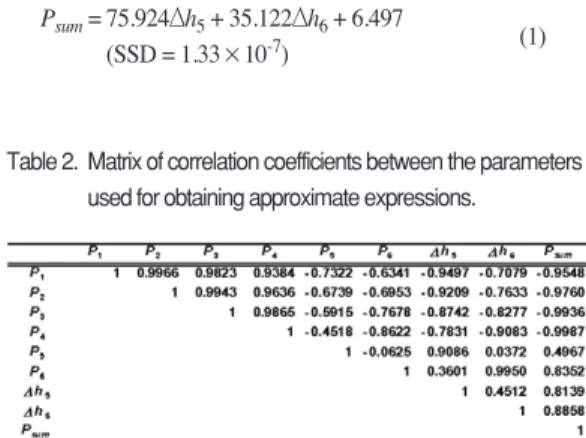
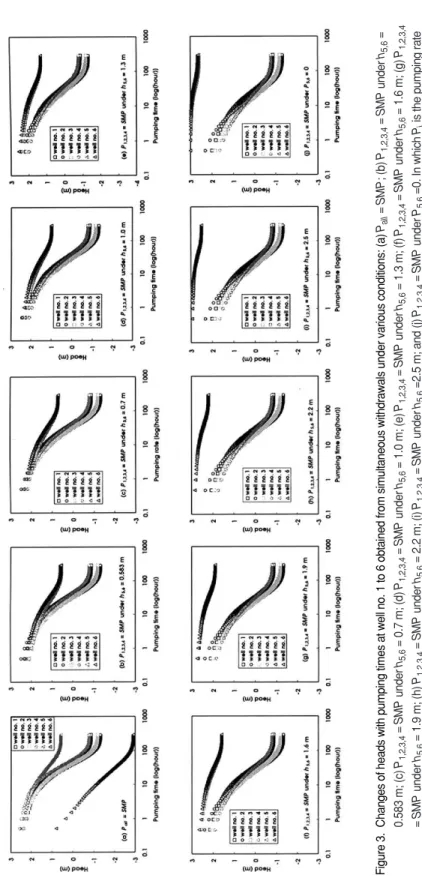
The expressions to satisfy the four require- ments were derived from the parameters obtained by simultaneous withdrawals using the numerical simulation under several different con- ditions. Table 2 shows the parameters and the correlations between them in matrix form. By considering the correlations and four require- ments, approximate equations were given as the followings using the multiple regressions with three variables.
Psum= 75.924Dh5+ 35.122Dh6+ 6.497
(SSD = 1.33×10⁻⁷) (1)
Table 2. Matrix of correlation coefficients between the parameters used for obtaining approximate expressions.
P1= - 0.024P5- 0.013P6+ 17.958
(SSD = 1.12×10⁻⁸) (2)
P2= - 0.010P5- 0.007P6+ 8.931
(SSD = 1.87×10⁻⁸) (3)
P3= - 0.022P5- 0.018P6+ 16.732
(SSD = 3.73×10⁻⁸) (4)
P4= - 0.010P5- 0.011P6+ 6.022
(SSD = 3.84×10⁻⁹) (5)
P5= 1.270Psum- 59.483Dh6- 42.312
(SSD = 1.17×10⁻⁷) (6)
P6= - 0.983P5+ 1.052Psum- 52.209
(SSD = 2.52×10⁻⁸) (7)
where SSD is the sum of the variances between the original values that were used to derive Eqs.
(1) to (7) and the estimated values due to the equations. The very small values of SSD in Eqs.
(1) to (7) were enough to confirm their accuracy.
They must be solved as a simultaneous equation in applying for practical uses.
2. Verification of approximate equation
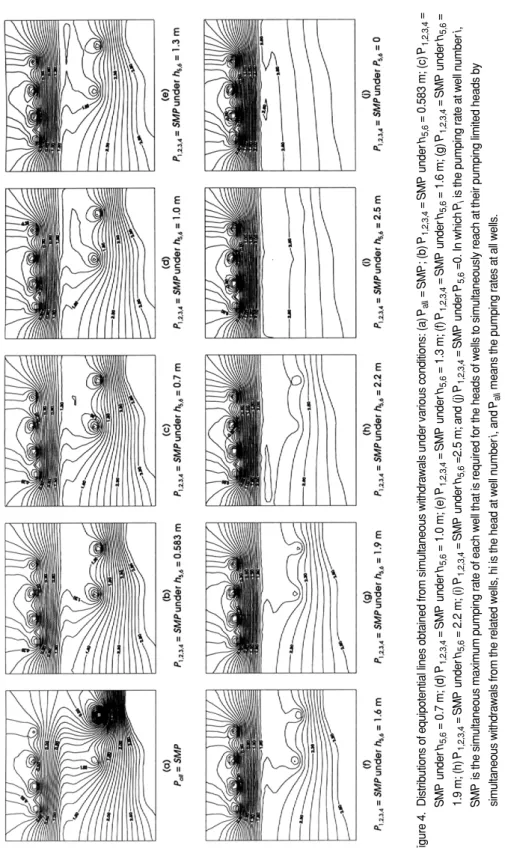
By substituting several values of h5and h6into eqs. (1) to (7), the sets of pumping rates, Pn(n = 1 to 6), according to the values of h5and h6were obtained. The simultaneous withdrawals with these sets of Pnresulted in the changes of heads with pumping times at well no. 1 to 6 as shown in Figure 3. In order to verify the reliability of approximate equations for practical uses, the h5 and h6 that were substituted into eqs. (1) to (7) and the pumping limited heads at wells no. 1 to 4 in Table 1 were compared with the estimated heads at all wells due to simultaneous with- drawals. The variances between them were less than 10-7.
The limits of heads at well no. 5 and 6 used
for obtaining eqs. (1) to (7) were:
0.583 m < h5< 2.590 m (8)
-2.908 m < h6< 2.654 m (9)
While the lower limits in eqs. (8) and (9), 0.583 m and -2.908 m, mean the pumping limited heads at wells no. 5 and 6, the upper limits, 2.590 m and 2.654 m, indicate the heads at wells no. 5 and 6 obtained by the simultaneous withdrawals with P1 to 4 = SMP and P5 and 6 = 0 [Figure 3(j)].
Therefore, the use of eqs. (1) to (7) should admit the exact estimation of P1to 6 correspond- ing to various h5and h6within the ranges of eqs.
(8) and (9).
3. Examination for the build up of ridge parts
The distributions of equipotential lines were obtained from the simultaneous withdrawals under various conditions (Figure 4). We exam- ined whether the ridge parts are formed between contaminated and uncontaminated parts and how their positions did change with conditions.
The conditions added to simultaneous with- drawals were: (a) Pall= SMP; (b) P1,2,3,4 = SMP under h5,6= 0.583 m; (c) P1,2,3,4= SMP under h5,6
= 0.7 m; (d) P1,2,3,4= SMP under h5,6= 1.0 m; (e) P1,2,3,4= SMP under h5,6= 1.3 m; (f) P1,2,3,4 = SMP under h5,6= 1.6 m; (g) P1,2,3,4 = SMP under h5,6= 1.9 m; (h) P1,2,3,4= SMP under h5,6= 2.2 m;
(i) P1,2,3,4= SMP under h5,6=2.5 m; and (j) P1,2,3,4
= SMP under P5,6=0.
All cases without Figure 4(j) indicated the occurrence of the ridge parts that have higher heads than the contaminated and uncontaminat-
Figure 3. Changes of heads with pumping times at well no. 1 to 6 obtained from simultaneous withdrawals under various conditions: (a) Pall= SMP; (b) P1,2,3,4= SMPunder h5,6= 0.583 m; (c) P1,2,3,4= SMPunder h5,6= 0.7 m; (d) P1,2,3,4= SMPunder h5,6= 1.0 m; (e) P1,2,3,4= SMPunder h5,6= 1.3 m; (f) P1,2,3,4= SMPunder h5,6= 1.6 m; (g) P1,2,3,4 = SMPunder h5,6= 1.9 m; (h) P1,2,3,4= SMPunder h5,6= 2.2 m; (i) P1,2,3,4= SMPunder h5,6=2.5 m; and (j) P1,2,3,4= SMPunder P5,6=0. In which Piis the pumping rate at well number i, SMPis the simultaneous maximum pumping rate of each well that is required for the heads of wells to simultaneously reach at their pumping limited heads by simultaneous withdrawals from the related wells, hiis the head at well number i, and Pallmeans the pumping rates at all wells.
Figure 4. Distributions of equipotential lines obtained from simultaneous withdrawals under various conditions: (a) Pall= SMP; (b) P1,2,3,4= SMP under h5,6= 0.583 m; (c) P1,2,3,4= SMP under h5,6= 0.7 m; (d) P1,2,3,4= SMP under h5,6= 1.0 m; (e) P1,2,3,4= SMP under h5,6= 1.3 m; (f) P1,2,3,4= SMP under h5,6= 1.6 m; (g) P1,2,3,4= SMP under h5,6= 1.9 m; (h) P1,2,3,4= SMP under h5,6= 2.2 m; (i) P1,2,3,4= SMP under h5,6=2.5 m; and (j) P1,2,3,4= SMP under P5,6=0. In which Piis the pumping rate at well number i, SMPis the simultaneous maximum pumping rate of each well that is required for the heads of wells to simultaneously reach at their pumping limited heads by simultaneous withdrawals from the related wells, hi is the head at well number i, and Pallmeans the pumping rates at all wells.
ed parts between them. In the case of Figure 4(j), the changes of heads showed a monotonous decrease from Tairo Pond to the alignment of wells no. 1 to 4. This means that the simultane- ous withdrawal with condition (j), P1,2,3,4 = SMP under P5,6=0, transports the highly contaminated water of Tairo Pond and wells no. 5 and 6 into the alignment of wells no. 1 to 4. On the other hand, the case of Figure 4(i) produced the broad ridge part between the contaminated and uncont- aminated parts, even though the pumping rates at wells no. 5 and 6 were slightly higher than zero. Therefore, to adopt the h5< 2.590 m and h6
< 2.654 m in eqs. (8) and (9) as the upper limits of eqs. (1) to (7) is considered to be adequate.
The case of Figure 4(a) clearly indicated the build up of the ridge part between the contami- nated and uncontaminated parts, but the intru- sion at high rate of the highly concentrated water from Tairo Pond into the ridge part, also, was occurred by the large pumping rate at well no. 6, P6 = SMP. This was resulted from much lower pumping limited head at well no. 6 than that at well no. 5. Thus, the requirement (c), setting the heads of wells no. 5 and 6 at the same, should play the efficient role for preventing the intrusion at high rate of the highly concentrated water from Tairo Pond. In the case of the simultaneous withdrawal with condition (b), P1,2,3,4 = SMP under h5,6 = 0.583 m [Figure 4(b)], the intrusion rate from Tairo Pond to the ridge part was large- ly decreased. In order to satisfy the requirement (c), the amendment of the lower and upper limits in eq. (9) is required and the eqs. (8) and (9) are rewritten as:
0.583 m < h5= h6< 2.590 m (10)
Therefore, the use of the eqs. (1) to (7) with eq.
(10) will be expected to be able to serve the exact pumping rates at all wells enough to satisfy the requirements (a) to (c), namely, not only largely decrease the intrusion at high rate of the highly concentrated water of Tairo Pond and wells no. 5 and 6 into the ridge part but also interrupt com- pletely the spread of them into the inner part of study area.
4. Method for acquirement of the water use with high quality
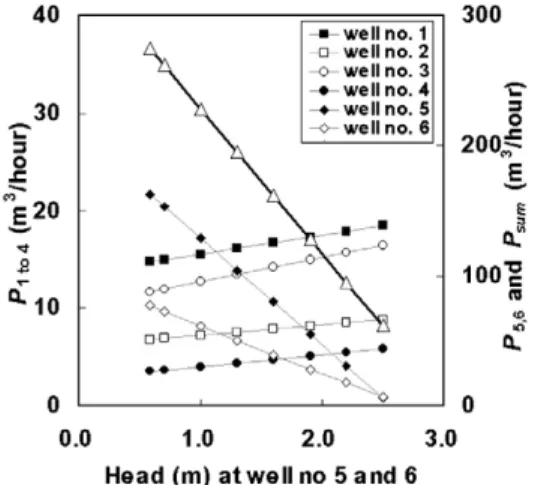
By the use of the eqs. (1) to (7) with eq. (10), the changes of the pumping rates at well no. 1 to 6 and of their sums with various heads wells no.
5 and 6 were obtained as shown in Figure 5. The first (left) and second (right) ordinates indicate the pumping rates at wells no. 1 to 4, P1 to 4, and them at wells no. 5 and 6, P5,6, and their sums, Psum, respectively.
In all cases, the pumping rates, Pn(n = 1 to 6) and Psum, have the linear changes with the heads at wells no. 5 and 6, h5,6. In details, while P1 to 4 were increased with h5,6, P5,6 and Psum were decreased. This means that the withdrawn areas at well no. 1 to 4 were expanded with increasing h5,6, but them at wells no. 5 and 6 were reduced.
Thus, it is inferred that the ridge part was gradu- ally moved into the contaminated part with increasing h5,6.
The ratios of P1 to 6to Psum are given in the second ordinate (right) of Figure 6. The rations of P1 to 4 and P5,6were arithmetically increased and decreased with increasing h5,6, respectively. The electric conductivities of Psum [the first ordinate (left) of Figure 6] were estimated as the sums of
the products of the ratios of P1 to 6 to Psum and the electric conductivities at wells in Table 1.
They were arithmetically decreased with the increasing h5,6 as in the case of the ratios of P5,6 to Psum. Thus, it is clarified that the trend of arithmetical decrease in the electric conductivities of Psum with the increases of h5,6 was mainly resulted from the decrease of P5 to 6rather than the increase of P1 to 4.
In order to acquire the withdrawn groundwa- ter, water use, with high quality, namely, to satis- fy the requirement (d), therefore, it is required to set the heads at wells no. 5 and 6 as close to the upper limit of eq. (10), 2.590 m, as possible.
Because this also means the large decrease of Psum, the determination of pumping rates and qualities with changing the heads at well no. 5 and 6 should be given by considering the demand for water use and the capacity and cost for removing the contained contaminants.
V. Conclusion
We evaluated the groundwater pumping capacity with consideration of water quality and suggested the withdrawal method for preventing the spread of contaminants due to withdrawal at a catchment area containing interrelated wells in Miyake Island, a young volcanic island, with very complicated hydro-geological formations.
The four requirements for solving the problems were given as: (a) simultaneous withdrawal at all wells; (b) the higher heads at the ridge part than at the contaminated part; (c) setting the heads of well no. 5 and 6 at the same; and (d) increasing the ratios of the pumping rates at well no. 1 to 4 or decreasing them at well no. 5 and 6 to the sum of pumping rates at all wells.
The withdrawal method for protecting the Figure 5. Changes of the pumping rates at well no. 1 to 6 and
of their sums with various heads well no. 5 and 6. The first and second ordinates indicate the pumping rates at well no. 1 to 4, P1 to 4, and the pumping rates at well no. 5 and 6, P5,6, and their sums, Psum, respectively.
Figure 6. Changes of the electric conductivity of the sum of pumping rates at all wells, Psum, (first ordinate) and the ratios of the pumping rates at wells, Pi, to Psum (second ordinate) with various heads of well no. 5 and 6. Here the subscript of P, i is well number.
uncontaminated part from the spread of contami- nants was suggested by the eqs. (1) to (7) with eq.(10) that satisfies the requirements (a) to (c).
The formulation of them is based upon the build up of the ridge part between the contaminated and uncontaminated parts that resulted from the efficient use of barrier wells.
In order to acquire the withdrawn groundwa- ter with a high quality, namely, satisfy the requirement (d), it is required to set the heads at well no. 5 and 6 as close to the upper limit of eq.
(10), 2.590 m, as possible. The determination of pumping rates and qualities with changing the heads at well no. 5 and 6 should be given by considering the demand for water use and the capacity and cost for removing the contained contaminants.
The results of this study can be used in taking a plan for supplying water use as well as pre- venting the spread of contaminants from some known contaminated sources.
References
Bear, J., 1972, Dynamics of fluids in porous media,
American Elsevier Publishing Company, Inc.
New York.
Bresler, E, B. L. McNeal, and D. L. Carter, 1982, Saline and sodic soils, Advanced series in agricultural sciences 10. Springer-Verlag Berlin Heidelberg.
Dai, W., S. Lee, and Y. Amemiya, 2002, Determination of the convective and diffusive fluxes from the transient profiles of solute and solvent under evaporation experiment, Korean Society Enviromental Impact Assessment, 11(3), 173- 187.
Guttman, I. and S. S., 1965, Introductory engineering statistics, John Wiley & Sons, Inc. New York.
Istok, j., 1989, Groundwater modeling by the finite element method, American Geophysical Union, Water Resources Monograph 13.
Jury, W. A., W. R. Gardner, and W. H. Gardner, 1991, Soil physics. 5th edition, John Wiley & Sons, Inc. New York.
Tokyo Metropolitan Government, 2002, Water Supply in Tokyo, The Bureau of Waterworks Japanese.
최종원고채택 03. 07. 08