Print ISSN: 2288-4637 / Online ISSN 2288-4645 doi:10.13106/jafeb.2021.vol8.no5.1031
The Influence of Organizational Culture on Employees’
Satisfaction and Commitment in SMEs: A Case Study in Vietnam
Thuy Dung PHAM THI
1, Anh Tin NGO
2, Nam Tien DUONG
3, Van Kien PHAM
4Received: January 30, 2021 Revised: April 05, 2021 Accepted: April 15, 2021
Abstract
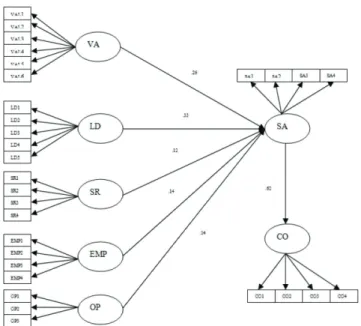
The purpose of this study is to evaluate the impact of organizational culture on job satisfaction and organizational commitment among employees in small and medium-sized enterprises in Ho Chi Minh City, Vietnam. The study hypothesized that organizational culture has a significant influence on employees’ satisfaction and that satisfaction also significantly impactsorganizational commitment among employees. The data are collected from a sample of 240 office employees. Structural Equation Modeling is used to determine the influence of organizational culture dimensions,including open working environment, salary, and rewards, empowerment, management style, corporate values, on employees’ satisfaction and organizational commitment. The findings showed that the five dimensions of organizational culture positively impact employees’ satisfaction and that job satisfaction significantly influences organizational commitment. Thus, job satisfaction serves as the bridge between organizational culture and commitment. The current study contributes to providing a practical insight into the relationships between organizational culture, employees’ job satisfaction, and organizational commitment. Based on that, managers can develop suitable personnel policies for their organizations to simultaneously enhance employees’ performance and satisfaction, which makes them stay with the company.
Keywords: Organizational Culture, Satisfaction, Commitment, SMEs, Working Environment JEL Classification Code: D23,O15, M12, M14
is becoming increasingly popular, especially a workplace where commitment is not high(Genevičiūtė-Janonienė &
Endriulaitienė, 2014). According to a survey by JobStreet.
com - job advertising network currently present in Malaysia, Singapore, the Philippines, Indonesia, Japan, and Vietnam, in early 2016, over 75% of 350 enterprises rated Quarter 1 and Quarter 2 to be the period of frequent fluctuation in human resources. Therefore, the managers are aware that the increase in the number of employees leaving the company has a significant impact on their business. This situation causes an increase in recruitment costs, training costs, pressure, and workload, leading to an imbalance in human resources in each department, which negatively influences labor productivity, and affects the reputation and position of the business in the market (Andrew, 2017; Mastrangelo et al., 2017).
Today, companies have to spend much money on recruiting and training their new employees from time to time, while they have to face a situation where hundreds of employees resign after a short time. This has caused many difficulties and losses for businesses, especially small and medium-sized enterprises (SMEs). Thus, enterprises
1
First Author. Ph.D. Candidate, Lecturer, Faculty of Commerce, Van Lang University, Ho Chi Minh City, Vietnam.
Email: [email protected]; [email protected]
2
Department of Science and Technology, Can Tho City, Vietnam.
Email: [email protected]
3
Lecturer, Faculty of Commerce, Van Lang University, Ho Chi Minh City, Vietnam.
Email: [email protected]; [email protected]
4
Corresponding Author. Assistant Professor, Ho Chi Minh City University of Economics and Finance, Ho Chi Minh City, Vietnam [Postal Address: 141–145 Dien Bien Phu, Ward 15, Binh Thanh District, Ho Chi Minh City, Vietnam] Email: [email protected]
© Copyright: The Author(s)
This is an Open Access article distributed under the terms of the Creative Commons Attribution Non-Commercial License (https://creativecommons.org/licenses/by-nc/4.0/) which permits unrestricted non-commercial use, distribution, and reproduction in any medium, provided the original work is properly cited.