Print ISSN: 2288-4637 / Online ISSN 2288-4645 doi:10.13106/jafeb.2020.vol7.no12.147
ERP-Based Accounting Information System Implementation in Organization: A Study in Riau, Indonesia
Emrinaldi NUR D.P.
1, Muhammad IRFAN
2Received: September 01, 2020 Revised: October 26, 2020 Accepted: November 05, 2020
Abstract
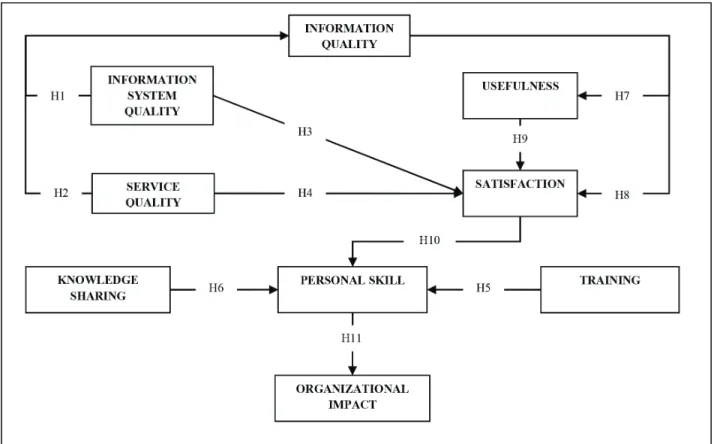
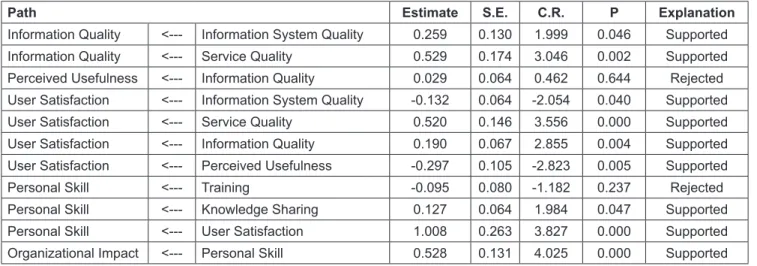
In the accounting information system implementation, the users should consider the benefits and advantages of the system. This paper examines the effect of the Enterprise Resources Planning based (ERP-based) accounting information system implementation on user impact and organizational impact. The population in this study is companies listed on the Indonesian Stock Exchange, especially companies based in Riau, Indonesia. These companies currently use the ERP-based accounting information system. Research samples are employees who use the ERP-based accounting information system. For data analysis, we use structural equation modeling (SEM). Based on data analysis, high-quality information system implementation generate high-quality information that can give satisfaction to the user. Moreover, the information system is related to user skill, satisfaction, and knowledge sharing which improve personal skills; enhanced personal skill contributes to organizational performance. On the other hand, there is no effect of training on personal skills and there is no effect of information quality on perceived usefulness. This research gives implication to the organization for implementing a high-quality ERP-based accounting information system that positively impacts organizational performance. Future research is expected to examine information system implementation in different research objects and conditions.
Keywords: ERP-Based Accounting Information System, Organizational Impact, User Impact JEL Classification Code: M15, M41, O33
between 1986 and 2007. The information system consists of 4 eras of development, which are the pre-mechanical era, mechanical era, electromagnetic era, and electronic era (Cash et al., 1992).
Hall (2010) explains that information system implemen- tation failure is a result of conflict between organizational culture and information system implementation objectives.
Information system improvement should decrease any errors and provides rapid work set to generate relevant and accurate information. Susanto (2013) also explains the information system is a tool to support daily activities, decision-making, and organization management to achieve business goals.
The information system needs support from hardware, software, and human resources system. Susanto (2013) suggests that the role and participation of system users determine the development of information system methods and technology. User role is important to make information system effective and efficient. Information system quality also gives a significant impact on use and user satisfaction (DeLone & McLean, 2003). Information system quality can be seen by how fast the system (in this case, it refers to an ERP-based accounting information system) can process the accounting data into useful information (DeLone &
1. Introduction
Organizations have to make an effective strategy to achieve their goals, such as an information system implementation strategy. An information system is needed to support strategic and operational activities (Hutahaean, 2014) as well as daily decision-making (Susanto, 2013).
The information system keeps growing in years. Hilbert and Lopez (2011) identify the exponential pace of technological change. Machines’ application-specific capacity to compute information per capita roughly doubled every 14 months
1
First Author and Corresponding Author. Lecturer, Department of Accounting, Faculty of Economics and Business, University of Riau, Indonesia [Postal Address: Kampus Bina Widya KM. 12,5, Simpang Baru, Kec. Tampan, Kota Pekanbaru, Riau 28293, Indonesia]
Email: [email protected]
2
Faculty of Economics and Business, University of Riau, Indonesia.
Email: [email protected]
© Copyright: The Author(s)
This is an Open Access article distributed under the terms of the Creative Commons Attribution Non-Commercial License (https://creativecommons.org/licenses/by-nc/4.0/) which permits unrestricted non-commercial use, distribution, and reproduction in any medium, provided the original work is properly cited.