pISSN 1738-6640 eISSN 2234-4020 http://dx.doi.org/10.6114/jkood.2017.30.2.001
Original Article / 원저
탈모증의 한약제제 치료효과에 대한 체계적 문헌 고찰
류덕현·노석선
대전대학교 한의과대학 안이비인후피부과학교실
A Systematic Review of Clinical Researches of Korean Medicine for Alopecia
Deok-Hyun Ryu·Seok-Sun Roh
Dept. of Oriental Medical Ophthalmology & Otolaryngology & Dermatology, College of Oriental Medicine, Dae-jeon University
Abstract
Objectives : This review aims to evaluate a risk of bias by risk of bias tool and RoBANS(Risk of Bias Assessment tool for Non-randomized Study) tool for clinical trial papers proving treatment effect of Korean medicines to alopecia and provides the newest reason of effectiveness of herbs to alopecia.
Methods : Data were collected through electronic database including NDSL, KISS, KMBASE, Koreantk, OASIS, KoreaMed, KISTI, Pubmed, Cochrane CENTRAL and CINAHL. Two experts in Oriental Medicine assessed risk of bias of randomized controlled trials by Cochrane group's Risk of Bias tool and non-randomized controlled trials by RoBANS tool after searching, reviewing and selecting papers.
Results : Total number of selected trials is 20 including 4 randomized controlled trial, 13 non-randomized controlled trials and 3 case reports. This study evaluate the risk of bias of 17 papers including 4 randomized controlled trials and 13 non-randomized controlled trials except 3 case reports by risk of bias tool and RoBANS tool. All papers of randomized controlled trials are evaluated unclear for random sequence generation and allocation concealment as there are no word on them. And all papers of non-randomized controlled trials are evaluated unclear for blinding of outcome assessments and relatively low for others.
Conclusions : Korean medicine intervention can be an effective for treatment in alopecia. It was evaluated by hair density, thickness and expert panel assessment of photographs and all results are statistically significant. But enhancing levels of evidence, we must try to reduce bias in researches and report a safety, protocol and IRB.
Key words : Alopecia; Korean medicine; RoB; RoBANS; Systematic review
ⓒ 2017 the Society of Korean Medicine Ophthalmology & Otolaryngology & Dermatology
This is an Open Access journal distributed under the terms of the Creative Commons Attribution Non-Commercial License (http://creativecommons.org/license/by-nc/3.0/) which permits unrestricted non-commercial use, distribution, and reproduction in any medium, provided the original work is properly cited.
Ⅰ. 서 론
탈모는 유전적 요인, 내분비 이상, 약물, 정신적 스 트레스, 잘못된 생활습관 등이 원인이 되어 모발이 정 상적으로 존재해야 할 부위에 모발이 없는 상태로 1 일 성장기 모발에서 성모가 150개 이상 탈락되는 것 을 말한다1). 통계청 자료2)에 따르면 2014년도 질병소 분류별 다빈도 상병 급여현황에서 남자는 195위, 여 자는 249위를 차지할 만큼 흔한 질환이며, 탈모로 고 민하는 20세 이상 성인의 수가 350만 명 정도로 탈모 는 더 이상 남성만의 질환이 아니라 여성 탈모환자도 점차 증가하는 추세에 있다3).
탈모증의 기존 치료 방법으로는 Minoxidil과 Finasteride가 대표적인데 Minoxidil은 고혈압 치료제 로 약물 복용 후 부작용으로 머리, 팔, 다리 등에 털 이 자라는 것이 관찰되어 발모제로 개발된 것으로 각 질형성세포의 생존과 모낭의 성장기를 연장시켜 모발 이 굵고 길게 자랄 수 있게 하는 효과가 있다. 그리고 Finasteride는 5α-reductase를 차단시켜 테스토스테 론이 DHT로 변화되는 것을 억제하는 기전으로 탈모 치료에 이용된다4). 그러나 Minoxidil은 두피소양증, 홍반, 각질 등의 접촉피부염, 다모증의 부작용이 있고 Finasteride는 성기능 감소의 부작용이 보고되어 있어
5,6) 탈모를 방지하고 모발 성장에 효과가 있는 한의학 적 치료 방법을 개발하는 것은 중요한 의미가 있다.
그 중에서도 Minoxidil과 Finasteride의 부작용을 극 복하기 위해 탈모증에 효과가 있는 생약제제들을 찾 는 연구가 국내에서 매우 활발히 진행되고 있는데, 만 형자, 천궁, 백지, 측백엽, 상백피, 홍삼, 인삼, 고삼, 단삼 등 다양한 종류의 추출물들이 이용되고 있으며, 해외에서도 탈모증에 효과가 있으면서 부작용이 적은
천연물 연구에 많은 투자를 하고 있다7).
이러한 연구가 실제 치료로 이어지기 위해서는 임상 연구가 선행되어야 하며, 이러한 임상연구는 근거중심의 학적 측면에서 타당성과 공정성을 인정받아야 한다. 현 재 한의학계에서도 근거중심의학의 일환으로 여러 질환 에서 침, 한약의 효과에 대한 체계적 문헌고찰이 이루어 지고 있다8-11). 체계적 문헌 고찰이란 현존하는 방대한 정보들 중에서 질문에 적합한 연구를 파악하여 검색함과 동시에 그 질적 수준에 대한 비평하고 통합된 결론을 제 공하는 정확하고 객관적인 방법이다12). 체계적 문헌 고 찰 과정 중 비뚤림 위험 평가는 문헌의 질을 평가하는 것인데, 비뚤림이란 체계적인 오류로 결과나 추정에 있 어 참값으로부터 벗어나는 것을 말하며, 연구에서 중재 효과를 과소추정하거나 혹은 과다추정하게 하는 요소가 될 수 있기 때문에 중요하다13).
따라서 본 논문에서는 탈모증 환자에서 한약제제의 치료효과를 입증한 임상연구 논문에 대하여 Risk of Bias(RoB)와 Risk of Bias Assessment tool for Non-randomized Study(RoBANS) 도구를 이용한 비 뚤림 위험을 평가하고 체계적 문헌고찰을 통하여 탈 모의 한약제제 치료의 효과성에 대해 최신의 근거를 제공하고자 한다.
Ⅱ. 연구대상 및 방법
1. 연구대상
본 연구에서는 2000년 이후부터 2015년 10월까지 국내외의 탈모증에 대한 한약제제 임상연구 논문을 대상으로 조사하였다.
2. 자료수집
자료 수집은 국내, 국외의 전자 데이터베이스 검색 을 통해 수행되었으며, 국내 데이터베이스는 과학기 술정보통합서비스 (http://www.ndsl.kr), 한국학술정 보(http://kiss.kstudy.com), 한국의학논문데이터베이
Corresponding author : Seok-sun Roh, Dept. of Ophthalmology, Otolaryngology and Dermatology of Korean Medicine, Daejeon University, 22-5, Daeheung-dong, Jung-gu, Daejeon, Korea (Tel : 042)229-6815, Fax : 042-254-3403, E-mail : [email protected])
Recieved 2017/3/10 Revised 2017/5/8 Accepted 2017/5/15
스 (http://kmbase.medric.or.kr), 한국전통지식포탈 (http://www.koreantk.com), 한국전통포탈 Oasis (http://oasis.kiom.re.kr), KoreaMed (http://www.
koreamed.org), 과학기술학회마을 (http://society.
kisti.re.kr)이 있으며, 국외 데이터베이스는 Cochrane CENTRAL (http://www.thecochranelibrary.com), Pubmed (http://www.ncbi.nlm.nih.gov/pubmed), CINAHL (http://search.ebscohost.com/login.asp?
profile=ehost&defaultdb=rzh)를 이용하였다.
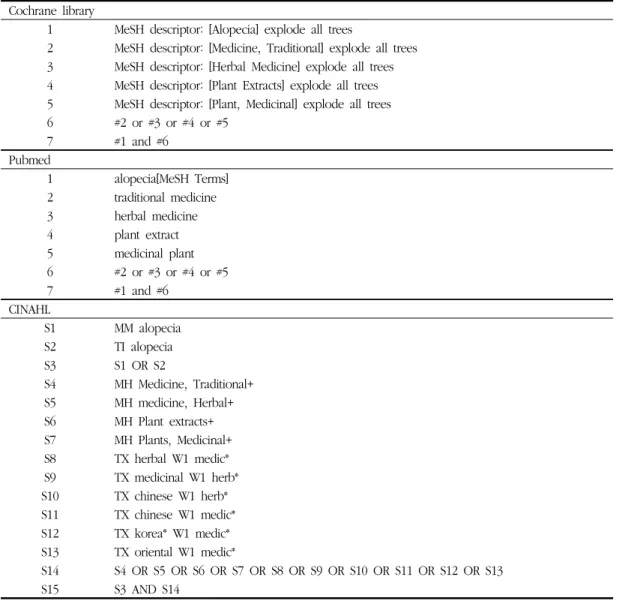
Table 1. Search Formula Cochrane library
1 MeSH descriptor: [Alopecia] explode all trees
2 MeSH descriptor: [Medicine, Traditional] explode all trees 3 MeSH descriptor: [Herbal Medicine] explode all trees 4 MeSH descriptor: [Plant Extracts] explode all trees 5 MeSH descriptor: [Plant, Medicinal] explode all trees 6 #2 or #3 or #4 or #5
7 #1 and #6
Pubmed
1 alopecia[MeSH Terms]
2 traditional medicine
3 herbal medicine
4 plant extract
5 medicinal plant
6 #2 or #3 or #4 or #5
7 #1 and #6
CINAHL
S1 MM alopecia
S2 TI alopecia
S3 S1 OR S2
S4 MH Medicine, Traditional+
S5 MH medicine, Herbal+
S6 MH Plant extracts+
S7 MH Plants, Medicinal+
S8 TX herbal W1 medic*
S9 TX medicinal W1 herb*
S10 TX chinese W1 herb*
S11 TX chinese W1 medic*
S12 TX korea* W1 medic*
S13 TX oriental W1 medic*
S14 S4 OR S5 OR S6 OR S7 OR S8 OR S9 OR S10 OR S11 OR S12 OR S13
S15 S3 AND S14
3. 검색어
국내 데이터베이스에서는 “탈모”, “Alopecia”를 사 용하였고, 국외 데이터베이스는 검색식을 이용하여 검색하였다. 검색식은 Table 1과 같다.
4. 자료 선택
두 명의 연구자에 의해 논문 제목과 초록을 확인하 여 1차 선택하고, 전문을 확보하여 2차 선택 하였으며
전 과정은 각각 독립적으로 수행되었다. 두 연구자간 합의를 통하여 최종 평가에 포함될 문헌을 선택했는 데, 연구자가 합의를 이루지 못할 경우 제3자가 개입 하여 다수결로 결정하였다.
포함 기준은 탈모증에 대한 연구이며 단일 추출물 과 복합제를 포함한 한약제제를 투여한 임상연구로 하였고, 배제 기준은 사람을 대상으로 하지 않은 in vivo, in vitro 연구, 원저가 아닌 연구, 초록만 발표 된 연구, 한국어나 영어로 출판되지 않은 연구로 하였 으며, 최종적으로 각각의 개별 연구를 적합도 검증을 거친 문헌분류 도구인 DAMI(Study Design Algorithm for Medical literature of Intervention)를 이용하여 연구 설계별로 분류하였다.
5. 비뚤림 위험 평가 도구
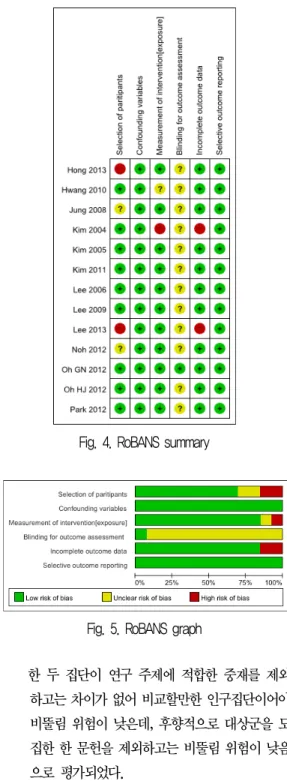
무작위배정 비교임상시험의 비뚤림 위험 평가는 Cochrane group의 Risk of Bias 도구를 사용하였고, 비무작위배정 비교임상시험, 전후연구, 코호트 연구를 포함한 비무작위 연구의 비뚤림 위험 평가는 Risk of Bias Assessment tool for Non-randomized Study (RoBANS)를 사용하였다.
Ⅲ. 결 과
총 637건의 논문이 검색되었다. 검색된 결과 중에 탈모증에 대한 연구가 아닌 것, 한약제제에 대한 연구 가 아닌 것, 사람을 대상으로 하지 않은 in vivo, in vitro 연구, 원저가 아닌 연구, 초록만 발표된 연구, 한국어나 영어로 출판되지 않은 연구를 제외하고 총 20건의 논문이 최종적으로 선정되었다. 이 중 무작위 연구가 4건, 비무작위 연구가 13건, 증례보고 3건 이 었는데 증례보고 논문 3건을 제외한 17건의 논문에 대해 체계적 문헌 고찰을 시행하였다(Fig. 1).
Fig. 1. Flow diagram of the study
1. 문헌의 일반적인 특성
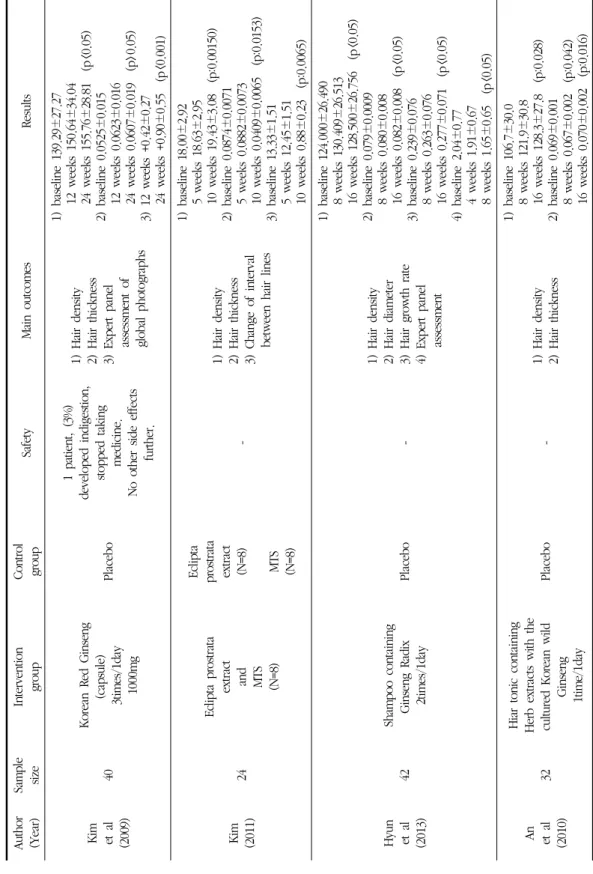
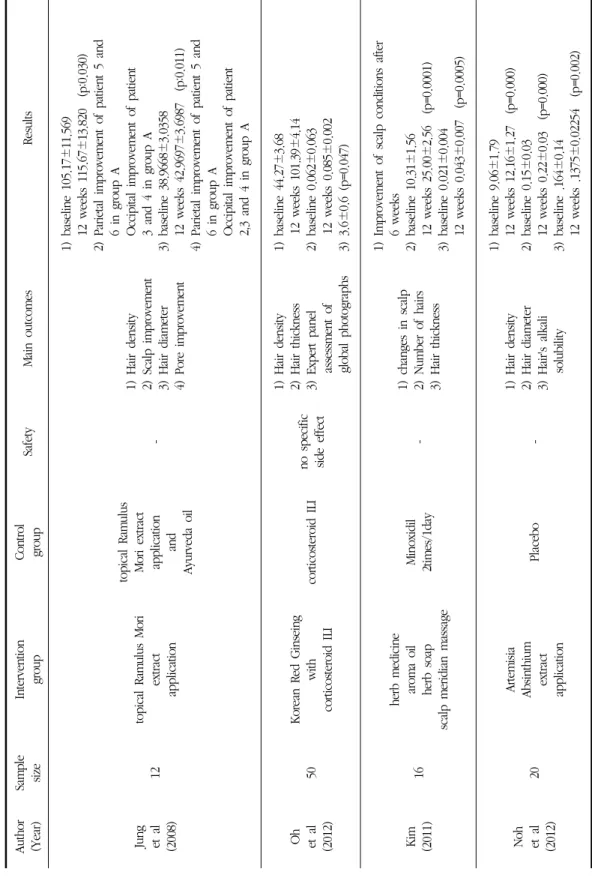
최종 대상 논문은 17편 이었으며 연구특성 결과는 Table 2, Table 3, Table 4와 같다.
연구 디자인별로 분류해 보면 무작위배정비교임상 시험 4건, 비무작위배정비교임상시험 4건, 전후연구 9 건이 있었으며, 환자 대상군 별로 보면 환자 수는 6명 에서 1050명까지 다양하였고, 남녀 비율은 같거나 남 자가 많은 편이었다.
연구에 사용된 한약제제의 제형은 내복이 7건
14,19-21,23,29,30), 외용이 10건15-18,22,24-28)이었고, 그 종류 를 보면 단일 약제로는 홍삼 3건, 한련초, 산삼, 상지, 쑥, 생모근, 측백엽 등 9건이 있었고 나머지는 복합제 제로 구성되어 있었다. 김의 논문20)에서는 상백피, 고 삼, 구기자, 흑지마, 한련초, 숙지황, 측백엽, 하수오, 당귀, 감초를 배합하여 제조한 천연물 추출액과 한련 초, 살구씨, 숙지황으로 제조한 환을 이용하여 연구를 하였고, 오 등의 논문23)에서는 측백엽과 적하수오를 포함한 8종 식물 추출물과 단백질 2종, 비타민 4
Table 2. Characteristics of Randomized Controlled Studies Author (Year)Sample sizeIntervention groupControl groupSafetyMain outcomesResults Kim et al (2009)40 Korean Red Ginseng (capsule) 3times/1day 1000mg
Placebo
1 patient, (3%) developed indigestion, stopped taking medicine. No other side effects further.
1) Hair density 2) Hair thickness 3) Expert panel assessment of global photographs
1) baseline 139.29±27.27 12 weeks 150.64±34.04 24 weeks 155.76±28.81 (p<0.05) 2) baseline 0.0525±0.015 12 weeks 0.0623±0.016 24 weeks 0.0607±0.019 (p>0.05) 3) 12 weeks +0.42±0.27 24 weeks +0.90±0.55 (p<0.001) Kim (2011)24
Eclipta prostrata extract and MTS (N=8)
Eclipta prostrata extract (N=8) MTS (N=8)
-
1) Hair density 2) Hair thickness 3) Change of interval between hair lines
1) baseline 18.00±2.92 5 weeks 18.63±2.95 10 weeks 19.43±3.08 (p:0.00150) 2) baseline 0.0874±0.0071 5 weeks 0.0882±0.0073 10 weeks 0.0409±0.0065 (p:0.0153) 3) baseline 13.33±1.51 5 weeks 12.45±1.51 10 weeks 0.88±0.23 (p:0.0065) Hyun et al (2013)42Shampoo containing Ginseng Radix 2times/1dayPlacebo-
1) Hair density 2) Hair diameter 3) Hair growth rate 4) Expert panel assessment
1) baseline 124.000±26.490 8 weeks 130.409±26.513 16 weeks 128.500±26.756 (p<0.05) 2) baseline 0.079±0.0009 8 weeks 0.080±0.008 16 weeks 0.082±0.008 (p<0.05) 3) baseline 0.239±0.076 8 weeks 0.263±0.076 16 weeks 0.277±0.071 (p<0.05) 4) baseline 2.04±0.77 4 weeks 1.91±0.67 8 weeks 1.65±0.65 (p<0.05) An et al (2010)32
Hiar tonic containing Herb extracts with the cultured Korean wild Ginseng 1time/1day Placebo-1) Hair density 2) Hair thickness 1) baseline 106.7±30.0 8 weeks 121.9±30.8 16 weeks 128.3±27.8 (p:0.028) 2) baseline 0.069±0.001 8 weeks 0.067±0.002 (p:0.042) 16 weeks 0.070±0.002 (p:0.016)
Table 3. Characteristics of Case Control Study Author (Year)Sample sizeIntervention groupControl groupSafetyMain outcomesResults Jung et al (2008)12topical Ramulus Mori extract application topical Ramulus Mori extract application and Ayurveda oil
-
1) Hair density 2) Scalp improvement 3) Hair diameter 4) Pore improvement
1) baseline 105.17±11.569 12 weeks 115.67±13.820 (p:0.030) 2) Parietal improvement of patient 5 and 6 in group A Occipital improvement of patient 3 and 4 in group A 3) baseline 38.9668±3.0358 12 weeks 42.9697±3.6987 (p:0.011) 4) Parietal improvement of patient 5 and 6 in group A Occipital improvement of patient 2,3 and 4 in group A Oh et al (2012)50Korean Red Ginseing with corticosteroid ILIcorticosteroid ILIno specific side effect
1) Hair density 2) Hair thickness 3) Expert panel assessment of global photographs
1) baseline 44.27±3.68 12 weeks 101.39±4.14 2) baseline 0.062±0.063 12 weeks 0.085±0.002 3) 3.6±0.6 (p=0.047) Kim (2011)16
herb medicine aroma oil herb soap scalp meridian massage Minoxidil 2times/1day-1) changes in scalp 2) Number of hairs 3) Hair thickness
1) Improvement of scalp conditions after 6 weeks 2) baseline 10.31±1.56 12 weeks 25.00±2.56 (p=0.0001) 3) baseline 0.021±0.004 12 weeks 0.043±0.007 (p=0.0005) Noh et al (2012)20
Artemisia Absinthium extract application
Placebo-
1) Hair density 2) Hair diameter 3) Hair's alkali solubility 1) baseline 9.06±1.79 12 weeks 12.16±1.27 (p=0.000) 2) baseline 0.15±0.03 12 weeks 0.22±0.03 (p=0.000) 3) baseline .164±0.14 12 weeks .1375±0.02254 (p=0.002)
Table 4. Characteristics of Before-and-after Study Author (Year)Sample sizeConditionInterventionSafetyMain outcomesResults Kim et al (2015)20Patients having sysptoms of nonscarring alopecia Sangmogen soap containing herbs 5 patients feel stiff hairs 1 patient feels tighten scalp 1) Hair number 2) Hair follicle number 3) Changes of terminal hair rate and vellus hair rate 4) Depilation rate 5) Irritating reaction
1) F=29.868, p<0.001 2) F=24.823, p<0.001 3) Number of terminal hairs : F=17.110, p<0.001 Proportion of terminal hairs : baseline 0.764 12 weeks 0.779 4) F=5.878, p<0.01 5) F=10.938, p<0.001 Oh et al (2012)20The twenties - fifties appealing subjective symptoms of alopecia
medical plant extracts complex No serious side effects except slight gastrointestinal disturbance in 1-2 patients.
1) Improvement of Hair Loss Symptoms by the subjective Self-Assessment 2) Hair loss counts 3) Hair thickness
1) Patients answer that it is improved than baseline whether self-consciousness of alopecia, increase in hair density of parietal region, and hair danage are improved or not. 2) baseline 102.65±41.36 3months 70.35±34.36 (p<0.05) 3) baseline 59.07±10.19 3 months 66.08±9.00 (p<0.001) Park et al (2012)11
28-51 years old man and women having symptoms of alopecia Leaves extracts of Thuja orientalis L.- 1) Hair growth 2) Scalp and hair improvement 3) Amount of hair
1) baseline –2.40±0.30 6 months 2.10±0.30 2)The number ofhairsisincreasedand root of hairs become thick, 3) All patients are improved. Lee et al (2009)21
20-55 years old man having alopecia diagnosis by medical specialist external application with traditional oriental hair care products -1) Hair density 2) Hair thickness 3) Comparative analysis 1) baseline-12weeks : -6.26 (p<0.0001) 2) baseline-12weeks : -0.080 (p=0.0024) 3) keratin, itching, sebum, scurf : p<0.0001
Kim et al (2004)6 Man and women having symptoms of alopecia in different surroundings and working conditions
Herb medicine and spray containing herb extractant No specific side effects 1) Hair condition 2) Hair thickness 3) The shape of hair root 4) Falling out hair 5) Change of number of total hair
1) Hairs are grown up generally. 2) Hairs become thick generally. 3)There are casesofchange withhealty clubbed hair root or nothing. 4) It is decreased generally but increased to some patients who are unhealthy or overwork. 5) Generally increased Hwang et al (2010)20Alopecia patients
Sophorae Radix, Panax ginseng, Salvia miltiorrhiza BUNGE water extracts
-
1) Hair loss counts 2) Hair thickness 3) Increase of hair 4) Hair density
1) 105→78 in number (90% improvement) 2) 0.035mm→0.069mm (85% improvement) 3) 5→20 in 5×4mm square (85% improvement) 4) 17->23 in 5×4mm square (75% improvement) Lee et al (2006)82Men of androgenic alopecia
oriental medicine including acupuncture and herb
-
1) Self assessment 2) Investigator assessment 3) Global photograph assessment
1) 45.2%(Q1),59.8%(Q2),58.5%(Q3),68.3%(Q4), 34.2%(Q5),42.7%(Q6),45.1%(Q7) 2) 53.7% positive effects 3) 48.4% positive effects Hong et al (2013)30Alopecia patients except alopecia universalis
Gagamchenghyou ng-tang- 1) Heat score 2) Scalp score 3) Hair density 4) Scalp problem
1) 5.35±2.82→4.21±2.29 (p=0.082) 2) 4.5±1.25→1.6±1.10 (p<0.001) 3) 1.43±0.27→1.61±0.24 (p<0.001) 4) Improved scalp symptoms are heat, flare, serious oilness and sweat in order of many. Lee et al (2013)153Alopecia patients except alopecia universalisKorean medicine-
1) Parietal fever 2) Scalp and hair symptoms 3) Photograph 1) Whether or not improvement of sebum after 1 month treatment is significant differences. (p<0.001) 2) Decreasing of scalp symptoms(p=0.005) and hair loss(p=0.001) were significant. 3) Increasement of hair (p<0.001)
종, Biotin, 미네랄을 함유하는 복합 처방 정제로 연 구를 진행하였다. 이 등의 논문25)에서 사용한 샴푸와 헤어토닉은 생지황, 하수오, 산약 3가지 재료를 이용 하여 만든 제품이고, 김 등의 논문26)에서는 측백엽, 상엽, 죽엽, 백과엽, 송엽, 감초, 인삼, 백두옹, 지부 자, 목단피, 구기자, 숙지황, 복령, 산수유, 흑두, 흑지 마, 하고초, 오가피, 택사, 흰돌버섯, 포공영, 곤포, 백 자인을 배합하여 탈모 방지 및 발모 촉진에 관해 연 구하였다. 또한 황 등의 논문27)에서는 고삼, 인삼, 단 삼 혼합물을 혼합하여 ‘모내기’라고 명명한 후 동물과 사람에서 모발의 성장과 분포에 미치는 영향을 연구 하였고, 이 등의 논문28)에서는 남성의 안드로겐성 탈 모증에 자하거, 홍화 등으로 만든 약침을 두유, 상성, 전정, 백회, 승광, 사신총 등의 혈위에 0.05㎖ 이하로 자입하여 한의학적 치료 효과를 연구하였다. 홍 등의 논문29)에서는 가감청영탕을 처방하였는데 그 구성은 생지황, 천화분, 죽엽, 대청엽, 치자, 현삼, 시호, 연 교, 대황으로 이루어져 있으며, 마지막으로 이 등의 논문30)에서는 후천적 열성 탈모에 대한 연구를 하였 는데 처방 구성은 밝히지 않고 ‘한약’이라고만 표기하 였다.
2. 비뚤림 위험 평가
1) 무작위 연구의 비뚤림 위험
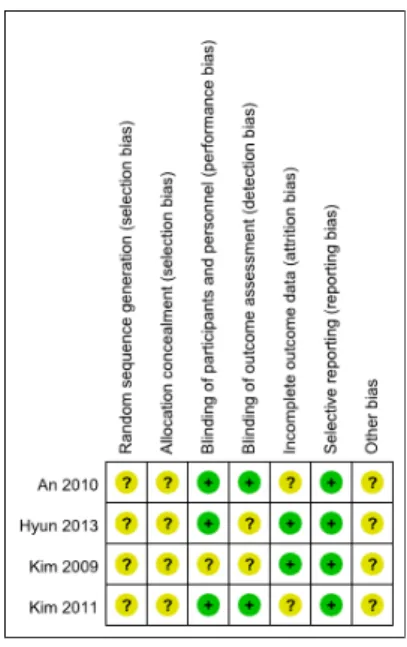
4편의 무작위배정 비교임상시험의 비뚤림 위험 평 가 결과를 그래프로 나타내었다(Fig. 2, 3).
① ‘무작위 배정순서 생성’ 항목은 대상군이 동전, 주사위 던지기, 난수표, 컴퓨터 등의 적절한 무 작위 배정순서 생성을 통해 모든 군이 동일한 중재를 받아야 비뚤림 위험이 낮음으로 평가할 수 있다. 그러나 대부분 무작위로 배정하였다고 만 밝히고 순서 생성 방법에 대한 구체적인 언 급이 없으므로 불확실로 평가되었다.
② ‘배정순서 은폐’ 항목은 무작위 배정순서 생성이 잘 이루어졌다고 해도 배정순서 은폐가 이루어
Fig. 2. Risk of bias summary
Fig. 3. Risk of bias graph
지지 않으면 그 순서를 예측할 수 있어 비뚤림 위험이 커지므로 매우 중요한 요소이다. 그러나 모든 문헌에서 해당 결과를 다루지 않고 있으므 로 불확실로 평가되었다.
③ ‘연구 참여자, 연구자에 대한 눈가림’ 항목은 참 여자나 연구자에 대한 눈가림이 제대로 시행되 지 않으면 비교군의 기대 부족, 중재군간 다른 행동 등의 차이로 연구 결과에 영향을 줄 수 있 으므로 참여자와 연구자에 대한 이중 눈가림이 적절하게 시행되었거나, 눈가림이 연구 결과에 영향을 미치지 않을 때 비뚤림 위험이 낮음으로 평가할 수 있다. 한 문헌에서 해당 결과를 다루 지 않은 것 외에는 연구원들 전원이 모르는 상 태에서 혹은 이중맹검으로 시행되었다고 나와