원발성 월경곤란증에 대한 침구치료 관련 무작위배정 임상시험의 체계적 고찰:
한국 문헌을 중심으로김정완1, 박봉기2, 전종익1, 임윤경1,*
1대전대학교 한의과대학 경락경혈학교실
2대전대학교 대전한방병원 내과면역학교실
[Abstract]
Acupuncture and Moxibustion for Primary Dysmenorrhea in Korean Literatures: A Systematic Review of Randomized Controlled Trials
Jung Wan Kim1, Bong Ki Park2, Jong Ik Jeon1 and Yun Kyoung Yim1,*
1Department of Meridian & Acupoint, College of Korean Medicine, Daejeon University
2Department of Internal Immune Center, Daejeon Korean Medicine Hospital, Daejeon University
Objectives : Primary dysmenorrhea is one of the most common female gynecological diseases.
Acupuncture and moxibustion therapy have been used to treat dysmenorrhea in Korea. The aim of this review was to examine the effectiveness of acupuncture and moxibustion therapy for primary dysmenorrhea as described in studies in Korea.
Methods : A total of 8 databases were searched, with the search concluding February 15, 2015.
These were the Oriental Medicine Advanced Searching Integrated System, DBpia, Korean Studies Information Service System, National Digital Science Library, Korean Traditional Knowledge Portal, Research Information Sharing Service, and Pubmed. Randomized controlled Trails(RCTs) comparing acupuncture or moxibustion therapy with non acupoints stimulation or medication were selected. Data abstraction and assessment of methodology was conducted by authors and disagreements were resolved by discussion.
Results : 7 trials were included in this review, with a total of 308 participants. 4 trials reported on acupuncture, 1 trial reported on acupress by magnet, 1 trial reported on pharmacopuncture, and the other trial reported on moxibustion. Quality of methodology was low. 2 trials showed that experimental therapy was effective for pain relief compared to the controlled group.
However, 5 trials did not show a significant difference in pain relief.
Conclusions : Acupuncture and moxibustion therapy may reduce period pain, however, it is needed for well designed RCTs in Korea.
Key words :
Primary dysmenorrhea;
Acupuncture;
Moxibustion;
Korean medicine;
Traditional east Asia medicine
Received : 2015. 04. 03.
Revised : 2015. 05. 26.
Accepted : 2015. 06. 02.
On-line : 2015. 06. 20.
✱ Corresponding author : Department of Meridian & Acupoint, College of Korean Medicine, Daejeon University. 62, Daehak-ro, Dong-gu, Daejeon, 300-716, Republic of Korea
Tel : +82-42-280-2610 E-mai l: [email protected]
This is an Open-Access article distributed under the terms of the Creative Commons Attribution Non-Commercial License (http://creativecommons.org/licenses/by-nc/3.0) which permits unrestricted non-commercial use, distribution, and reproduction in any medium, provided the original work is properly cited.
The Acupuncture is the Journal of Korean Acupuncture & Moxibustion Medicine Society. (http://www.TheAcupuncture.org) Copyright © 2014 KAMMS. Korean Acupuncture & Moxibustion Medicine Society. All rights reserved.
Ⅰ. 서 론
원발성 월경곤란증이란 골반의 병리적 병변 없이 월경 시 발생하는 하복부에서 허리나 허벅지 전면부로 방사되는 경 련성 통증을 의미하며, 한의학에서는 痛經, 經行腹痛, 經期 腹痛에 해당한다1).
월경 곤란증의 증상은 하복부의 통증과 함께 오심, 구 토, 설사, 두통, 피로, 초초함과 어지러움 등을 특징으로 한다. 원발성 월경곤란증은 가장 흔한 여성 생식기 질환 중 하나로 약 47~88 %의 여성이 월경곤란증을 호소하며, 그들 중 약 10 %는 일상생활이 곤란할 정도의 고통을 호소 한다2,3).
원발성 월경곤란증은 학업 혹은 업무 수행에 영향을 미칠 뿐만 아니라 삶의 질을 낮추는 원인이 되기에 사회ㆍ경제적 으로 큰 문제가 된다4).
월경곤란증은 보통 첫 생리가 시작되고 6~12개월 사이 에 발생하며, 점차 증가하다 사춘기를 지나면서 감소하는 데, 증상의 지속시간은 보통 48~72시간이다5). 병리학적 으로 자궁내막의 증가된 prostaglandin(PG)에 의해 자궁 의 긴장과 수축력이 증가하고 이로 인해 자궁의 혈액 흐름 을 감소시켜 월경곤란증을 유발한다6). 그밖에 oxytocin, vasopressin도 원발성 월경곤란증과 관련이 있을 것으로 보고 있다7). 통상적으로 월경곤란증 치료에는 non- steroidal anti-inflammatory drugs(NSAIDs)나 PG 길 항제 등이 사용된다8,9). 하지만 상기 약물의 지속적인 사 용은 위염, 간이나 신장 기능 이상 등의 여러 부작용을 유 발한다6).
침과 뜸을 응용한 치료법은 수천 년 전부터 한의학에서 사용된 주요한 치료법으로 원발성 월경곤란증에도 사용되 어왔다. 최근에는 월경곤란증에 대해 침구치료 관련 무작 위배정 임상시험(randomized clinical trails, RCTs)이 다수 시행되었고, 이들 RCTs에 대한 체계적 고찰(sys- tematic reviews, SRs)과 메타분석도 여러 편 수행되었 다6,7,10-13).
하지만 기존의 체계적 고찰 연구 대부분은 한국의 검색엔 진을 이용하여 논문 검색이 이루어지지 않았고, 한국 검색 엔진을 이용한 체계적 고찰 연구도 침에 대한 RCTs로 한정 하였다. 따라서 본 연구는 한국에서 시행된 원발성 월경곤 란증의 침구치료 관련 무작위배정 임상시험에 대하여 체계 적으로 고찰하여 향후 침구치료의 임상 근거로 삼을 수 있 게 하였다.
Ⅱ. 방 법
1. 선정기준
원발성 월경곤란증 환자를 대상으로 한 연구를 포함하였 으며, 속발성으로 발생한 월경곤란증은 배제하였다. 침구치 료의 범위는 한의과대학의 침구학 교과서에 수록된 치료 방 법으로 정하였으며, 침, 뜸, 수지침, 이침, 자석 등의 기타 방법을 이용한 경혈 자극이 이에 포함된다. 대상연구는 무 작위배정이 이루어진 대조군이 있는 임상시험을 대상으로 하였고, 유사 무작위배정(quasi-randomized)이 이루어진 임상시험이나 대조군이 없는 임상 연구는 배제하였다. 대조 군은 통상적으로 시행되는 한의학적 치료를 사용한 경우와 중재 방법이 없거나 위약(placebo)인 경우 모두 포함하였 다. 평가 항목에 관련하여 visual analogue scale(VAS)나 numerical rating scale(NRS), questionnaire를 이용하여 통증을 평가하거나, 그 밖에 menstrual symptom severity list(MSSL), cox menstrual symptom scale(CMSS)과 같 은 월경곤란증과 관련된 증상을 평가하는 임상 연구를 대상 으로 하였다.
2. 자료 검색
2015년 2월 15일까지 Oriental Medicine Advanced Searching Integrated System(OASIS), DBpia, Korean Studies Information Service System(KISS), National Digital Science Library(NDSL), 한국전통지식포탈, Re- search Information Sharing Service(RISS)를 통하여 ‘월 경곤란증 or 월경통 or 생리통 or 통경 or dysmenorrhea’
로 검색하였다. 추가로 해외 저널에 출판된 한국문헌 검색 을 위하여 Pubmed에서 ‘dysmenorrhea and(acupuncture or moxibustion or moxa or acupress or traditional Korean medicine or oriental medicine or traditional Chinese medicine) and (randomized controlled trial* or controlled clinical trial* or randomized* or randomly* or placebo or clinical trial* or controlled trial*)’로 검색 하였고 연구 시행 연도나 언어에는 제한을 두지 않았다.
3. 자료 추출과 질적 평가
대상연구에서 관련 정보를 추출하는 과정은 사전에 미리 결정된 항목별로 정보를 추출하였다. RCTs의 질적 평가는
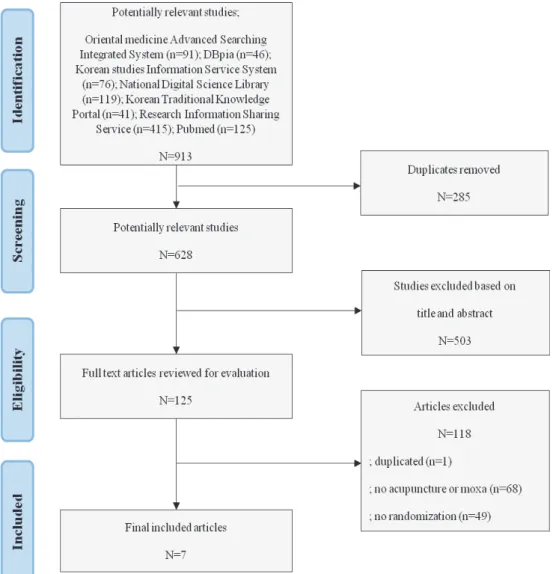
Fig. 1. Flowchart of study selection Cochrane handbook 5.1.0의 risk of bias에 따라 평가하
였다14). 정보추출 및 연구방법의 질적 평가과정에서 저자들 사이에 의견이 일치하지 않을 때는 교신저자의 중재 아래 저자들의 합의에 의해 결론을 도출하였다.
Ⅲ. 결 과
1. 연구 검색 및 선택
논문 검색을 통하여 913편의 연구를 검색하였고, 이들 중 중복된 285편의 연구를 제외한 628편의 연구 제목과 초록 을 바탕으로 503편의 연구를 배제하였다. 남은 125편의 논 문 전문을 읽고 침구치료와 관련이 없는 68편의 연구와 무
작위배정이 이루어지지 않은 49편의 연구, 그리고 제목이 다르지만 연구 내용이 같은 중복 연구 1편을 제외하였다.
그 결과 총 7편의 연구가 본 고찰 대상연구로 선정하였다 (Fig. 1)15-21).
2. 대상연구 특성
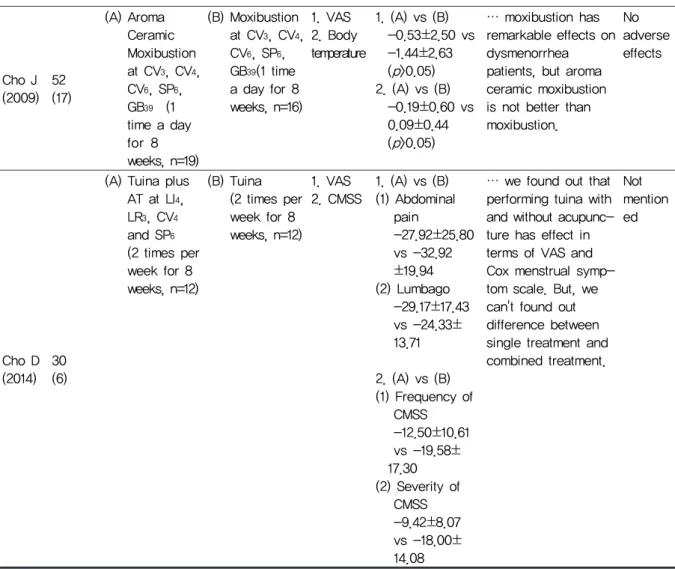
Table 1은 대상연구들의 주요 특징과 연구결과를 보여준 다. 대상연구의 참여자 수는 총 308명으로 범위는 30명에 서 56명이었고, 5편의 연구에서 탈락자에 대해서 언급하였 다. 치료기간은 3시간에서 3번 생리 주기까지 다양하였고, 치료방법은 호침치료의 효과를 비교한 연구가 4편, 아로마 세라믹 뜸과 죽력뜸 효과를 비교한 연구가 1편, 자하거약침 의 효과에 대한 연구가 1편, 자석을 이용한 경혈 자극에 대
First author (year)
Sample size (drop
out)
Treatment method
Main
outcomes Main results Author’s conclusion Adverse effects Interventions
(regimen, number)
Control (regimen,
number)
Jang H (2006)
44 (4)
(A) Acupoint stimulation by magnet at SP6, CV3, BL23(3 hours, n=22)
(B) Acupoint stimulation by non magnet (3 hours, n=18)
1. GRS 2. ALPRS
1. (A) vs (B) 5.04 vs 7.44 (p<0.05) 2. (A) vs (B) 5.13 vs 8.94 (p<0.05)
… the magnetic field therapy on acupunc- ture has an effect on the pain alleviation of dysmenorrhea of femaile high school students…
Not mention ed
Cho J (2007)
30 (20)
(A) GBH plus AT at CV3, CV4, CV6, SP6, GB39 (3 time/ week for 8 weeks, n=6)
(B) GBH (8 weeks, n=4)
VAS (A) vs (B)
80.50±18.15 vs 55.00±36.97 (p>0.05)
… this study shows that GBH has re- markable effects on dysmenorrhea pa- tients. Obviously futher researches concerning all these area still necessary.
No adverse effects
Lee I (2007) 49
(A) AT at GB41, SI3, SI2, BL66, SP6 (2 times in first menstrual cycle and 3 times in second men- strual cycle, n=23)
(B) Sharm AT at LU10, PC5, GB40, ST40
(2 times in first men- strual cycle and 3 times in second menstrual cycle, n=26)
1. MMP 2. MSSL
1. (A) vs (B) 3.260 vs 2.977 (p>0.05) 2. (A) vs (B) 27.609 vs 22.750 (p>0.05)
… it was verified that acupuncture treat- ment was effective in decreasing the symp- tom of dysmenorrhea.
Not mention ed
Kim S (2008)
56 (7)
(A) Hominis plancenta pharmacopu ncture at CV4, SP6, ST36, SP9 (2 times in first men- strual cycle;
3 times in second men- strual cycle, n=25)
(B) Normal saline at CV4, SP6, ST36, SP9 (2 times in first men- strual cycle and 3 times in sencond menstrual cycle, n=24)
1. MMP 2. MSSL
1. (A) vs (B) 4.570±2.704 vs 5.195±2.476 (p>0.05) 2. (A) vs (B) 30.480±20.650 vs 32.875±
17.593(p>0.05)
… the Hominis plan- centa pharmaco- puncture treatment and the normal saline treatment were ef- fective in decreasing the symptom of dysmenorrhea.
Not mention ed
Youn H (2008) 47
(A) AT at GB41, SI3, SI2, BL66, SP6, CV6
(2 times in first menstrual cycle; 3 times in second and third menstrual cycle, n=25)
(B) Sharm AT (2 times in first men- strual cycle; 3 times in second and third men- strual cycle, n=22)
1. MMP 2. MSSL
1. MMP, MSSL a statistically significant difference was not shown in the acupunc- ture group compare to control group.
… it was verified that acupuncture treat- ment was effective in decreasing the symp- tom of primary dysmenorrhea.
Not mention ed Table 1. Characteristics of Included Trials on Acupoint Stimulation for Primary Dysmenorrhea
First author(year)
Random sequence generation
Allocation
concealment Blinding Incomplete outcome data
Selective reporting
Other bias
Jang H(2006) L(pitching pennies) U U H U U
Cho J(2007) U U H H U U
Lee I(2007) L(random table) U H(single blind) U U U
Kim S(2008) L(random code) U U H U U
Youn H(2008) L(random table) U U U U U
Cho J(2009) U U U H U U
Cho D(2014) U U H H U U
L : low risk of bias. H : high risk of bias. U : unclear risk of bias.
Table 2. Assessment of Methodological Quality Cho J
(2009) 52 (17)
(A) Aroma Ceramic Moxibustion at CV3, CV4, CV6, SP6, GB39 (1 time a day for 8 weeks, n=19)
(B) Moxibustion at CV3, CV4, CV6, SP6, GB39(1 time a day for 8 weeks, n=16)
1. VAS 2. Body temperature
1. (A) vs (B) -0.53±2.50 vs -1.44±2.63 (p>0.05) 2. (A) vs (B) -0.19±0.60 vs 0.09±0.44 (p>0.05)
… moxibustion has remarkable effects on dysmenorrhea patients, but aroma ceramic moxibustion is not better than moxibustion.
No adverse effects
Cho D (2014)
30 (6)
(A) Tuina plus AT at LI4, LR3, CV4
and SP6
(2 times per week for 8 weeks, n=12)
(B) Tuina (2 times per week for 8 weeks, n=12)
1. VAS 2. CMSS
1. (A) vs (B) (1) Abdominal pain
-27.92±25.80 vs -32.92 ±19.94 (2) Lumbago -29.17±17.43 vs -24.33±
13.71
2. (A) vs (B) (1) Frequency of CMSS -12.50±10.61 vs -19.58±
17.30 (2) Severity of CMSS -9.42±8.07 vs -18.00±
14.08
… we found out that performing tuina with and without acupunc- ture has effect in terms of VAS and Cox menstrual symp- tom scale. But, we can't found out difference between single treatment and combined treatment.
Not mention ed
GBH : Geijibokryunghwan. AT : acupuncture therapy. GRS : graphic rating scale. ALPRS : adjective labor pain rating scale.
VAS : Visual analogue scale. MMP : measure of mestrual pain. MSSL : menstrual symptom severity list.
CMSS : Cox menstrual symptom scale.
한 연구가 1편이었다. 대조군으로는 무처치가 2편, sham acupuncture가 2편, 기타 치료군과 비슷한 요법을 사용한 사례(ex. 생리식염수, 자력이 없는 자석, 죽력뜸)가 3편이 었다. 2편의 연구에서 부작용에 대해 혈액 검사에서 aspar-
tate aminotransferase(AST), alanine aminotrans- ferase(ALT), blood urea nitrogen(BUN), creatinine에 이상이 없음을 보고하였고, 나머지 연구에서는 부작용과 관 련된 언급이 없었다.
3. 연구 방법의 질 평가
무작위배정 방법에 대하여 언급한 연구는 난수표를 이용 한 연구 3편, 동전던지기를 이용한 연구 1편 등 총 4편이었 다(Table 2). 할당 은닉에 대한 언급은 모든 연구에서 없었 다. Blinding에 관련해서 모든 연구가 double blinding에 대한 언급이 없었으며, 한 편의 연구에서만 single blinding에 대한 기술이 있었다. 불충분한 결과자료에 관련 해서 중도 탈락자가 나온 연구는 모두 5편으로 중도탈락률 은 9~67 %였다(Table 1). 5편의 연구 모두 intention-to- treat(ITT) 분석이 이루어지지 않았고, 탈락자에 대한 언급 이 없는 2편의 연구도 정확히 비뚤림이 있는지 판단을 내리 기 어려웠다. 7편의 연구 모두 프로토콜이 따로 존재하지 않았으며, 그 외의 비뚤림 여부도 판단하기 어려웠다(Table 2).
4. 치료효과
계지복령환과 침치료를 시행한 군과 계지복령환만 투약한 군을 비교한 연구에서는 두 군 모두 전후 비교에서 유의한 통 증 감소가 있었지만, 두 군 사이에 유의한 차이는 없었다.
월경치료를 위한 혈 자리(소장정격ㆍ삼음교)에 침구치료 를 시행한 군과 월경과 관련 없는 혈자리(어제ㆍ간사ㆍ구허ㆍ 풍륭)에 침구치료를 시행한 군을 비교한 연구와 소장정격ㆍ 삼음교ㆍ삼음교ㆍ행간에 침구치료를 시행한 군과 혈 자리 와 婦人科 치료에 사용하지 않는 혈 자리(양지ㆍ어제ㆍ풍륭ㆍ 구허ㆍ신궐)에서 0.5寸에서 1寸 벗어난 지점에 침구치료를 시행한 군을 비교한 연구에서는 통계적으로 통증개선에 유 의한 차이가 없었다.
자하거 약침치료를 한 군과 생리식염수를 주사한 군을 비 교한 연구에서는 두 군 모두 전후 비교에서 유의한 통증감소 가 있었지만, 두 군 사이에 유의한 차이를 보여주지 못했다.
추나치료와 침치료를 동시에 시행한 군과 추나치료만 시 행한 군을 비교한 연구에서는 두 군 모두 통증 등 월경곤란 증의 증상감소에 유의한 효과를 보여줬으나, 두 군 간의 유 의한 차이는 없었다.
자석을 이용한 경혈자극군과 가짜 자석을 이용한 경혈자 극군을 비교한 연구에서는 자석 자극을 시행한 군이 대조군 에 비해서 유의한 통증개선 효과가 나타났다.
아로마 세라믹 뜸을 시행한 군과 일반 죽염뜸을 시행한 군을 비교한 연구에서는 아로마 세라믹 뜸을 시행한 군이 대조군에 비해서 유의한 통증개선 효과와 국부체온개선 효 과가 나타났다.
Ⅳ. 고찰 및 결론
본 연구는 한국에서 시행된 침구치료를 이용한 원발성 월 경곤란증에 대한 무작위배정 임상시험에 대한 고찰로서 현 재 임상시험의 현황을 파악하고 침구치료의 임상적 효과에 대한 평가와 향후 이와 관련된 임상시험을 시행할 때 근거 자료로 활용하기 위하여 수행되었다.
본 연구에서는 913편의 연구를 검색하여 그 중 조건을 만 족하는 총 7편의 연구에 대하여 고찰하였다. 연구방법의 질 과 관련하여서 대체로 연구방법에 대한 기술이 부족하였다.
무작위배정에 대한 구체적 서술이 기술되어 있는 논문은 4편 이었으며, 할당은닉에 대하여 기술한 연구는 없었다. 또 이 중맹검과 관련하여 언급한 연구도 없었다. 대조군을 무처치 군으로 둔 두 개의 연구를 제외하고, 5편의 연구는 침치료 와 실험군 연구와 비슷한 치료를 시행하여 이중맹검이 가능 하다고 사료되지만 단일맹검을 시행한 하나의 연구를 제외 한 나머지 4편의 연구는 이에 대한 언급이 없었다. 그밖에 탈락자가 나온 5편의 연구는 as treated analysis를 시행하 였다. 일반적으로 무작위배정 임상시험은 높은 근거가 있는 것으로 알려져 있지만, 연구방법이 제대로 시행되지 않으면 여러 비뚤림이 발생하여 연구결과에 영향을 미치기 때문에 방법론적으로 잘 설계된 임상시험을 수행하는 것도 중요하 다22). 물론, 무작위배정에 대한 방법과 할당은닉, 이중맹검 에 대한 기술이 없어도 실제 시행되었을 가능성이 있지만, 방법적으로 잘 설계하고 수행하는 것과 별개로 동시에 정확 히 기술하는 것이 중요하다고 할 수 있다.
본 고찰에 선정된 7편의 연구 중에서 침구치료가 대조군 에 비해 유의한 효과를 보여주는 연구는 세라믹 뜸과 자석 을 이용한 경혈자극 2편이었다. 나머지 5편의 연구는 전후 비교에서 유의한 개선 효과를 보여주었고, 대조군보다는 개 선된 결과를 보여주지만, 통계적인 유의성을 보여주지는 못 하였다(p>0.05). 실험군이 대조군에 통계적 유의성을 보여 주지 못한 연구의 경우는 시험군과 동일한 경혈에 자극을 준 경우도 있었기 때문에 단순히 침구치료가 효과가 없음이 라고 보기는 힘들다. 또한 통계적 유의성은 보다 많은 대상 자가 있을 때 유의성을 보여 줄 수 있기에 향후 관련 연구를 할 때 이러한 부분을 고려할 필요가 있다고 생각된다.
7편의 대상연구가 연구방법의 질이 낮아서, 현재의 연구 결과만으로 침구치료가 어떠한 임상적 효과가 있는지 판단 하기는 어렵다. 또한, 본 고찰에서 대상연구의 치료방법이 서로 일치하지 않고 치료결과도 불충분한 연구가 있어서 추 가로 메타분석을 시행하기 어려웠다. 본 고찰과 비교하여 Cochrane library에서 수행한 원발성 월경곤란증을 대상으
로 침치료를 시행한 RCT에 대한 체계적 고찰연구에서는 통 증과 증상의 개선을 보여주었고6), 원발성 월경곤란증을 대 상으로 침치료를 시행한 RCT에 대하여 체계적으로 고찰한 또 다른 2편의 해외 연구에서도 통증과 증상의 개선을 보여
주었다7,13). 원발성 월경곤란증을 대상으로 삼음교 혈에 침
치료를 시행한 RCT에 대한 1편의 해외 체계적 고찰 연구에 서는 삼음교 혈위가 통증개선에 효과가 있을 것으로 보이지 만, 다른 월경과 관련 없는 혈 자리와의 효과 차이는 없는 것으로 생각된다고 하였다11). 향후에는 기존 한국의 RCT 연구의 연구방법의 질에 대한 문제점과 해외의 관련 연구들 을 고려하여 잘 설계된 무작위배정 임상시험이 필요하리라 사료된다.
Ⅴ. References
1. Dawood MY. Primary dysmenorrhea: advances in pathogenesis and management. Obstet Gynecol.
2006 ; 108(2) : 428-41.
2. Polat A, Celik H, Gurates B et al. Prevalence of primary dysmenorrhea in young adult female university students. Arch Gynecol Obstet. 2009 ; 279(4) : 527-32.
3. Zukri SM, Naing L, Hamah TNT, Hussain NHN.
Primary dysmenorrhea among medical and dental university students in Kelantan: prevalence and association. Int Med J. 2009 ; 16(2) : 93-9.
4. Fedele L, Parazzini F, Bianchi S, Arcaini L, Candiani GB. Stage and localization of pelvic endometriosis and pain. Fertil Steril. 1990 ; 53(1) : 155-8.
5. Banikarim C, Chacko MR, Kelder SH. Prevalence and impact of dysmenorrhea on hispanic female adolescents. Arch Pediatr Adolesc Med. 2000 ; 154 (12) : 1226-9.
6. Smith CA, Zhu X, He L, Song J. Acupuncture for primary dysmenorrhoea. Cochrane Database Syst Rev. 2011 ; 19(1) : CD007854.
7. Chung YC, Chen HH, Yeh ML. Acupoint sti- mulation intervention for people with primary dysmenorrhea: systematic review and meta- analysis of randomized trials. Complement Ther Med. 2012 ; 20(5) : 353-63.
8. Chantler I, Mitchell D, Fuller A. The effect of three cyclooxygenase inhibitors on intensity of primary dysmenorrhea pain. Clin J Pain. 2008 ; 24(1) : 39-44.
9. Harel Z. Dysmenorrhea in adolescents and young adults: from pathophysiology to pharmacological treatments and management strategies. Expert Opin Pharmacother. 2008 ; 9(15) : 2661-72.
10. Xu T, Hui L, Juan YL, Min SG, Hua WT. Effects of moxibustion or acupoint therapy for the treatment of primary dysmenorrhea: a meta-analysis. Altern Ther Health Med. 2014 ; 20(4) : 33-42.
11. Chen MN, Chien LW, Liu CF. Acupuncture or acupressure at the Sanyinjiao(SP6) acupoint for the treatment of primary dysmenorrhea: a meta- analysis. Evid Based Complement Alternat Med.
2013 ; 2013 : 493038.
12. Yang H, Liu CZ, Chen X et al. Systematic review of clinical trials of acupuncture-related therapies for primary dysmenorrhea. Acta Obstet Gynecol Scand. 2008 ; 87(11) : 1114-22.
13. Cho SH, Hwang EW. Acupuncture for primary dysmenorrhoea: a systematic review. BJOG. 2010 ; 117(5) : 509-21.
14. Higgins JPT, Sterne JAC. Chapter 8: assessing risk of bias in included studies. The Cochrane Collaboration 2011. Available from: http://www.
cochrane-handbook.org
15. Youn HM, Kim CH, Park JH et al. Effect of acupuncture treatment on the primary dysmenor- rhea(a study on single blind, sham acupuncture, randomized, controlled clinical trial). The Acu- puncture. 2008 ; 25(3) : 139-62.
16. Cho DI, Ryu SJ, Nam EY et al. The comparative study on the effects of chuna and combined with acupuncture in patients with dysmenorrhea. J Oriental Rehabil Med. 2014 ; 24(3) : 157-64.
17. Kim SM, Jang SH, Kim CH et al. Effect of hominis placenta pharmacopuncture on the dysmenorrhea (a pilot study, single blind, randomized, con- trolled clinical trial). J Korean Pharmacopuncture Institute. 2008 ; 11(3) : 123-31.
18. Cho JH. A pilot study of the difference between Gyejibongnyeong-hwan and Gyejibongnyeong-
hwan combined acupuncture therapy on the pri- mary dysmenorrhea. J Oriental Obstet Gynecol.
2007 ; 20(1) : 161-8.
19. Lee IS, You HM, Jung KK et al. Effect of Sa-am acupuncture treatment on the dysmenorrhea(pillot study, single blind, randomized, sham acupunc- ture, controlled clinical trial. The Acupuncture.
2007 ; 24(3) : 63-79.
20. Cho JH, Kim HS, Choi DY, Lee JD. A clinical study on the effect of aroma ceramic moxibustion
for primary dysmenorrhea. J Oriental Obstet Gynecol. 2009 ; 22(1) : 172-81.
21. Jang HJ. Effect of magnetic field therapy applied to acupuncture point on dysmenorrhea experi- enced by high school girls [dissertation]. Daegu : Keimyung Univ. 2006. Korean.
22. Schulz KF, Grimes DA. The lancet handbook of essential concepts in clinical research. Phil- adelphia : Elsevier. 2006 : 1-12.