대자석의 중의 신경정신과 임상연구 현황
정진형, 최윤희, 김태헌, 김보경
동의대학교 한방병원 신경정신과
Research Trends of Traditional Chinese Medicine Containing Haematitum in the Neuropsychiatric Clinical Scene
Jin-Hyeong Jung, Yun-Hee Choi, Tae-Heon Kim, Bo-Kyung Kim
Department of Neuropsychiatry, Dong-Eui Oriental Medicine Hospital, Dong-Eui University
Received: November 28, 2014 Revised: December 11, 2014 Accepted: December 11, 2014
Objectives: This study was intended to review the research trends of treating neuropsychiatric diseases and symptoms with Traditional Chinese Medicine containing Haematitum.
Methods: Articles were obtained through the CNKI (China National Knowledge Infrastructure) by searching with ‘Haematitum' as the main key word, and supportive words related with neuro- psychiatric diseases and symptoms were selected. There were 61 articles related to clinical fields, which were then classified according to study design.
Results: The 61 articles were categorized into the following types of study design: 3 randomized con- trolled trials, 1 quasi-randomized trial, 3 simple-designed clinical trials, and 54 case studies.
Decoctions containing Haematitum were used to treat diseases and symptoms such as vertigo, head- ache, stroke, epilepsy, neurosis, globus hystericus, fishbilepoisoning, insomnia, mania, post-traumatic brain syndrome, and kinesia. All articles reported a good rate of effectiveness. There was no poor re- sponsiveness regarding the effects of Haematitum in 9 studies, but it was not mentioned in the other 52 studies. Decoctions self-prepared by the authors were used in 28 studies. Modified Seonbokdeja-tang, modified Banhabeakchulcheonma-tang, modified Ondam-tang were used in that order of frequency. The daily dosage of Haematitum provided was 0.2∼6 g in powder, and 9∼60 g in decoction.
Conclusions: Decoctions containing Haematitum are used restrictively in the neuropsychiatric clinical scene. While there were no reports of poor responsiveness of the effects of Haematitum, more research is needed to confirm its clinical stability.
Key Words: Haematitum, Neuropsychiatry, Traditional Chinese Medicine.
Correspondence to Bo-Kyung Kim Department of Oriental Neuropsychiatry, Dong-Eui Oriental Medical Hospital in Dong-Eui University, Yangjung-dong, Busan, Korea.
Tel: +82-51-850-8808 Fax: +82-51-867-5162 E-mail: [email protected]
Copyright © 2014 by The Korean Society of Oriental Neuropsychiatry. All rights reserved.
CC
This is an open access article distributed under the terms of the Creative Commons Attribution Non-Commercial License (http://creativecommons.org/licenses/by-nc/3.0) which
permits unrestricted non-commercial use, distribution, and reproduction in any medium, provided the original work is properly cited.
I. 서론
대자석(代赭石)은 자석(赭石) 또는 적토(赤土)로 불리며, 산화물류 광물 적철석이다. 이 광물은 주로 삼산화이철수화 물(Fe
2
O3
ㆍnH2
O)을 함유한다. 성상은 크기가 고르지 않은 불규칙하게 납작한 덩어리 모양이며, 어두운 갈색 내지는 회흑색이다. 바깥면에는 작은 젖꼭지 모양의 돌기가 나온 것과 들어간 것이 있고, 적갈색의 가루가 붙어 있으며, 금속 성의 광택이 난다. 질은 단단하고 무거우며 부서지지 않고, 깨진 면은 물결모양으로 휘어진 층문이 있다. 경도는 5.5∼6.0, 비중은 5.0∼5.3이다
1)
.대자석은 고한(苦寒)한 성질을 가지며 평간잠양(平肝潛 陽) 강역지혈(降逆止血)한 효능이 있어 간양상항(肝陽上亢) 으로 인한 두운목현(頭暈目眩), 이명(耳鳴) 등을 치료하고, 열격번위(噎膈翻胃) 및 상한한하(傷寒汗下) 후 심하비편(心 下痞鞭), 애기부제(呃氣不除)를 치료하며, 중추신경을 진정 시키는 효과가 있다
2)
.대자석은 문헌에 빈출하는 약제는 아니나, 청대(淸代) 말 기의 의가인 장석순(張錫純)의 저서인 의학충중참서록(醫學 衷中參書錄)엔 대자석을 적옥(赤沃), 하혈부지(下血不止), 구토(嘔吐), 해천(咳喘), 토뉵(吐衄), 격식(膈食), 두동(頭疼), 전광(癲狂), 간풍(癎風), 내풍(內風)등에 사용한 의안을 남겼 으며
3)
, 특히 내중풍증(內中風證(類中風))과 간경전광문(癎 痙癲狂門)에서 진간식풍탕(鎭肝熄風湯)에 대자석을 주약(主 藥)으로 하여 치료하는4)
등 대자석을 운용한 많은 처방을 남겼다.이에 저자는 대자석의 평간잠양(平肝潛陽)과 중추신경 진정효과에 주목하여 중의 논문 검색 사이트에서 대자석이 함유된 처방이 중의 신경정신과 영역에서 사용되는 현황 및 연구 동향을 조사하여 다소의 지견을 얻었기에 이에 보고하 는 바이다.
II. 연구방법 및 결과
1. 연구방법
중의 논문 검색사이트인 중국지식기초시설공정(中國知 識基礎施設工程, http://www.cnki.net)에서 대자석이 의 미있게 포함된 처방 중 신경정신과 질환에 사용된 모든 임 상논문을 검색하였다. 2014년 8월 8일 이전에 발표된 모든
논문들을 대상으로 하였고, 검색범위를 '医药卫生科技'로 한정하였으며, 표준검색에서 기본 검색어를 '代赭石' 으로 설정하고 신경정신과와 관련된 검색어들을 보조검색어로 함께 검색하였다. 신경정신과와 관련된 간체 검색어를 설정하 기 위해 한의신경정신과학 교과서
5)
에 나오는 질병 및 증후에 대응되는 용어를 중국어 용어사전 사이트(www.iciba.com)에 서 찾고 검색어가 중복이 되지 않게 설정하였다. 질병명과 관련해서는 ‘谵妄’ ‘神志’ ‘震颤’ ‘极度兴奋’ ‘认知’ ‘迪勒瑞 姆’ ‘爱是一种病’ ‘狄格勒姆’ ‘失智’ ‘痴呆’ ‘遗忘’ ‘精神’ ‘神 经’ ‘心理’ ‘物质戒断’ ‘中毒’ ‘滥用’ ‘物质的瘾性’ ‘物质 酒 精’ ‘安非他明’ ‘咖啡因’ ‘大麻’ ‘可卡因’ ‘致幻剂’ ‘致幻剂’‘尼古丁’ ‘阿片’ ‘苯环己哌啶’ ‘镇静’ ‘催眠’ ‘焦虑’ ‘统合失 调’ ‘妄想’ ‘情感’ ‘忧郁’ ‘萧条’ ‘抑郁’ ‘双相’ ‘躁郁’ ‘狂躁’
‘狂热’ ‘癫狂’ ‘躁狂’ ‘心境’ ‘情绪’ ‘惊恐’ ‘恐怖’ ‘恐惧’ ‘畏 惧’ ‘强迫’ ‘应激’ ‘躯体’ ‘转化’ ‘转换’ ‘疑病’ ‘多虑’ ‘体象’
‘疼痛’ ‘疲乏’ ‘疲劳’ ‘性障碍’ ‘人为’ ‘虚构’ ‘自为’ ‘人格’
‘性欲’ ‘性功能’ ‘性别认同疾患’ ‘进食障碍’ ‘厌食’ ‘易饿症’
‘贪食’ ‘暴食’ ‘过胖’ ‘肥胖’ ‘睡眠’ ‘性欲’ ‘冲动控制’ ‘适应 品行’ ‘性格’ ‘痫证’의 단어를 선정하였으며, 증후명과 관련 해서는 ‘气证’ ‘七气’ ‘梅核气’ ‘中气’ ‘上气’ ‘下气’ ‘短气’
‘少气’ ‘气痛’ ‘气逆’ ‘脱营’ ‘失精’ ‘血证’ ‘痰飮’ ‘火病’ ‘惊 悸’ ‘怔忡’ ‘不眠’ ‘梦’ ‘郁证’ ‘头痛’ ‘眩晕’ ‘癫癎’ ‘昏厥’
‘酒伤’ ‘振颤’ ‘虚劳’ ‘中风’ ‘心身证’의 단어를 선정하였다.
이 과정을 통해 총 787편의 논문을 검색하였으며. 그 중 1 차로 중복 검색된 논문, 원문 열람이 불가한 논문, 문헌연구, 본 주제와 무관한 임상연구를 배제하여 209편의 논문을 선 별하였으며, 2차로 신경정신과질환을 다루지 않거나(33편) 연구대상에 대자석이 부분적으로 처방된(6편) 논문 및 10례 이하 소수증례보고(109편)를 배제하여 총 61편의 논문을 선별하였다(Fig. 1).
2. 논문의 경향성
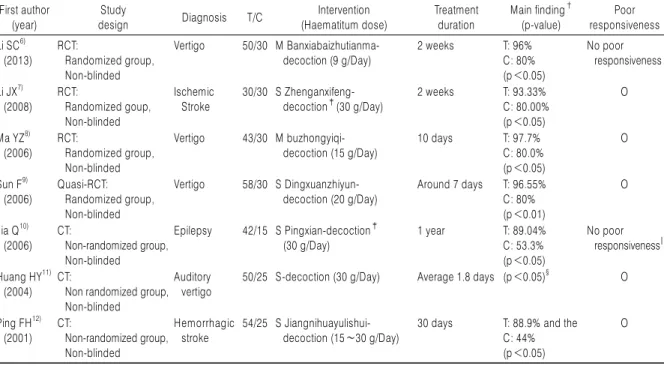
최종연구대상에 선정된 총 61편의 논문 중 임상연구는 7 편이며, 10례 이상 증례연구는 54편이었다. 임상연구를 연구 방법에 따라 나누어보면, 무작위 대조군 연구(Randomized Controlled Trial, RCT) 3편
6-8)
, 유사 무작위 연구(Quasi- randomised trial) 1편9)
, 대조군을 무작위로 설정하지 않은 임상연구 3편10-12)
이며, 이들 모두 이중맹검방식을 사용하 지 않았다.Table 1. List of Clinical Trials Treating with Herb Decoction that Contains Haematitum First author
(year)
Study
design Diagnosis T/C Intervention
(Haematitum dose)
Treatment duration
Main finding
†(p-value)
Poor responsiveness Li SC
6)(2013) RCT:
Randomized group, Non-blinded
Vertigo 50/30 M Banxiabaizhutianma- decoction (9 g/Day)
2 weeks T: 96%
C: 80%
(p<0.05)
No poor responsiveness Li JX
7)(2008) RCT:
Randomized goup, Non-blinded
Ischemic Stroke
30/30 S Zhenganxifeng- decoction
‡(30 g/Day)
2 weeks T: 93.33%
C: 80.00%
(p<0.05)
O
Ma YZ
8)(2006)
RCT:
Randomized group, Non-blinded
Vertigo 43/30 M buzhongyiqi- decoction (15 g/Day)
10 days T: 97.7%
C: 80.0%
(p<0.05)
O
Sun F
9)(2006)
Quasi-RCT:
Randomized group, Non-blinded
Vertigo 58/30 S Dingxuanzhiyun- decoction (20 g/Day)
Around 7 days T: 96.55%
C: 80%
(p<0.01)
O
Jia Q
10)(2006)
CT:
Non-randomized group, Non-blinded
Epilepsy 42/15 S Pingxian-decoction
‡(30 g/Day)
1 year T: 89.04%
C: 53.3%
(p<0.05)
No poor responsiveness
‖Huang HY
11)(2004) CT:
Non randomized group, Non-blinded
Auditory vertigo
50/25 S-decoction (30 g/Day) Average 1.8 days (p<0.05)
§O
Ping FH
12)(2001)
CT:
Non-randomized group, Non-blinded
Hemorrhagic stroke
54/25 S Jiangnihuayulishui- decoction (15∼30 g/Day)
30 days T: 88.9% and the C: 44%
(p<0.05)
O
O: Omission, S: Self-prepared, T: Treatment group, C: Control group, M: Modified, RCT: Randomized Controlled Trial, CT: Clinical Trial.
†
All clinical trial reproted that there were statistically significant difference of therapeutic effects between the treatment group and the control group. So we make table with both group's total effective ratio and p-value,
‡Both group treated with western medine treatment,
§Both group's total effective ratio is 100%, so author compared with both group in treatment term,
‖Control group reported nausea and weight loss in 5 cases and report disorientation and memory loss, motor retardation in 2 cases.
Fig. 1. Flow diagram preferred reporting items for review.
3. 임상연구
총 7편의 임상연구 중, 현훈 4편
6,8,9,11)
, 뇌졸중 2편7,12)
, 간질 1편10)
에 대자석이 포함된 처방을 사용하였다. 치료기 간은 질환군에 따라 편차가 있었으며, 1일부터 1년 사이로 보고하였다. 연구결과, 모든 논문에서 치료군과 대조군의 치료율 차이가 통계적으로 유의성이 있다고 하였으며, 2편의
논문
6,10)
에서는 치료군의 불량반응은 없었고, 그 중 1편10)
에선 대조군의 불량반응이 있었다고 보고하였다. 나머지 5편 의 논문에서는 불량반응에 대해 명시하지 않았다(Table 1).
4. 증례연구
총 54편의 증례연구 중 현훈은 28편
13,15,16,18-22,24,25,28, 30-32,34,36-40,44,46,47,53,56,61,62,66)
, 두통은 8편
23,26,41,48,54,57,60,64)
, 간질
45,50,58)
, 신경증14,33,49)
, 매핵기27,42,65)
, 뇌졸중35,51,63)
은 각 3편, 뇌진탕 후 증후군52,59)
은 2편, 멀미17)
, 불면29)
, 어담 중독43)
, 전광55)
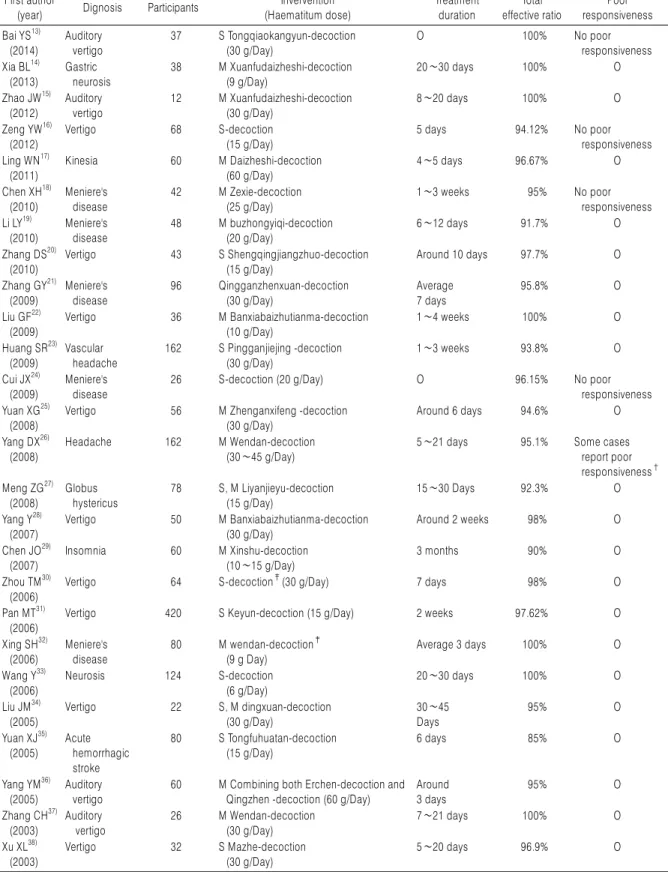
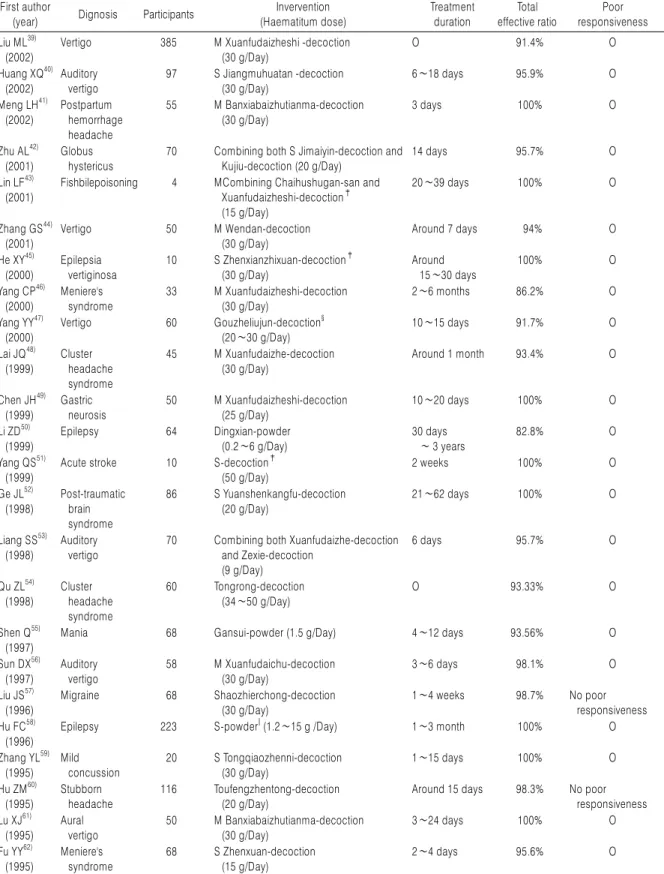
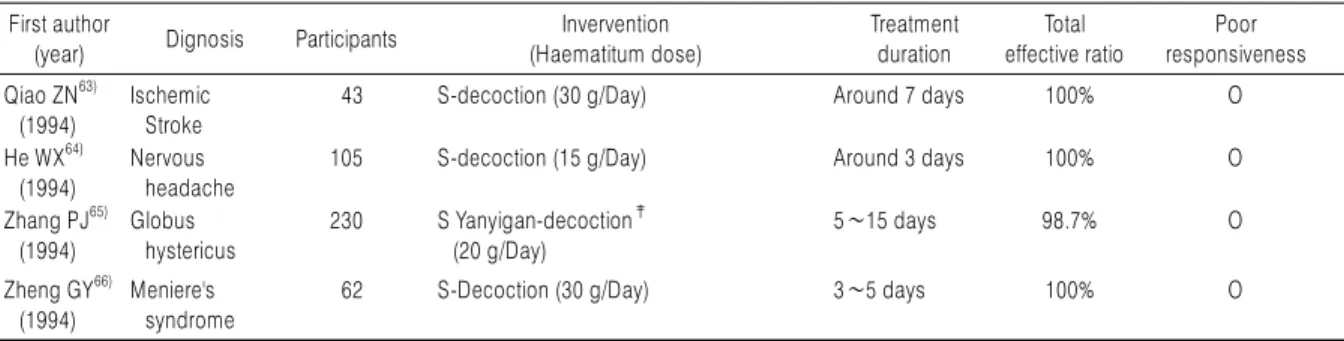
은 각 1편씩을 대자석이 포함된 처방으로 치 료하였다. 치료기간은 질환에 따라 3일부터 2년 사이로 보 고하였으며, 4편의 논문13,24,39,54)
에서는 치료기간을 정확히 명시하지 않았다. 총유효율은 82∼100%로 모두 높은 치 료효과를 보고하였으며, 1편
26)
에서는 배변량증가를 보고 하였으나 이는 대자석의 불량반응이 아니라고 하였으며, 6편13,16,18,24,57,60)
에서는 불량반응은 없다고 보고하였다. 나 머지 47편의 논문에서는 불량반응에 대해서 명시하지 않았 다(Table 2).
Table 2. List of Case Study Treating with Herb Decoction that Contains Haematitum First author
(year) Dignosis Participants Invervention
(Haematitum dose)
Treatment duration
Total effective ratio
Poor responsiveness Bai YS
13)(2014) Auditory
vertigo 37 S Tongqiaokangyun-decoction
(30 g/Day) O 100% No poor
responsiveness Xia BL
14)(2013)
Gastric neurosis
38 M Xuanfudaizheshi-decoction (9 g/Day)
20∼30 days 100% O
Zhao JW
15)(2012)
Auditory vertigo
12 M Xuanfudaizheshi-decoction (30 g/Day)
8∼20 days 100% O
Zeng YW
16)(2012)
Vertigo 68 S-decoction
(15 g/Day)
5 days 94.12% No poor
responsiveness Ling WN
17)(2011)
Kinesia 60 M Daizheshi-decoction
(60 g/Day)
4∼5 days 96.67% O
Chen XH
18)(2010)
Meniere's disease
42 M Zexie-decoction (25 g/Day)
1∼3 weeks 95% No poor
responsiveness Li LY
19)(2010)
Meniere's disease
48 M buzhongyiqi-decoction (20 g/Day)
6∼12 days 91.7% O
Zhang DS
20)(2010)
Vertigo 43 S Shengqingjiangzhuo-decoction (15 g/Day)
Around 10 days 97.7% O
Zhang GY
21)(2009)
Meniere's disease
96 Qingganzhenxuan-decoction (30 g/Day)
Average 7 days
95.8% O
Liu GF
22)(2009)
Vertigo 36 M Banxiabaizhutianma-decoction (10 g/Day)
1∼4 weeks 100% O
Huang SR
23)(2009)
Vascular headache
162 S Pingganjiejing -decoction (30 g/Day)
1∼3 weeks 93.8% O
Cui JX
24)(2009)
Meniere's disease
26 S-decoction (20 g/Day) O 96.15% No poor
responsiveness Yuan XG
25)(2008)
Vertigo 56 M Zhenganxifeng -decoction
(30 g/Day)
Around 6 days 94.6% O
Yang DX
26)(2008)
Headache 162 M Wendan-decoction
(30∼45 g/Day)
5∼21 days 95.1% Some cases
report poor responsiveness
†Meng ZG
27)(2008)
Globus hystericus
78 S, M Liyanjieyu-decoction (15 g/Day)
15∼30 Days 92.3% O
Yang Y
28)(2007)
Vertigo 50 M Banxiabaizhutianma-decoction (30 g/Day)
Around 2 weeks 98% O
Chen JO
29)(2007)
Insomnia 60 M Xinshu-decoction
(10∼15 g/Day)
3 months 90% O
Zhou TM
30)(2006)
Vertigo 64 S-decoction
‡(30 g/Day) 7 days 98% O
Pan MT
31)(2006)
Vertigo 420 S Keyun-decoction (15 g/Day) 2 weeks 97.62% O
Xing SH
32)(2006)
Meniere's disease
80 M wendan-decoction
‡(9 g Day)
Average 3 days 100% O
Wang Y
33)(2006)
Neurosis 124 S-decoction
(6 g/Day)
20∼30 days 100% O
Liu JM
34)(2005)
Vertigo 22 S, M dingxuan-decoction
(30 g/Day)
30∼45 Days
95% O
Yuan XJ
35)(2005)
Acute hemorrhagic stroke
80 S Tongfuhuatan-decoction (15 g/Day)
6 days 85% O
Yang YM
36)(2005) Auditory
vertigo 60 M Combining both Erchen-decoction and Qingzhen -decoction (60 g/Day) Around
3 days 95% O
Zhang CH
37)(2003)
Auditory vertigo
26 M Wendan-decoction (30 g/Day)
7∼21 days 100% O
Xu XL
38)(2003)
Vertigo 32 S Mazhe-decoction
(30 g/Day)
5∼20 days 96.9% O
Table 2. Continued 1 First author
(year) Dignosis Participants Invervention
(Haematitum dose)
Treatment duration
Total effective ratio
Poor responsiveness Liu ML
39)(2002) Vertigo 385 M Xuanfudaizheshi -decoction
(30 g/Day) O 91.4% O
Huang XQ
40)(2002)
Auditory vertigo
97 S Jiangmuhuatan -decoction (30 g/Day)
6∼18 days 95.9% O
Meng LH
41)(2002)
Postpartum hemorrhage headache
55 M Banxiabaizhutianma-decoction (30 g/Day)
3 days 100% O
Zhu AL
42)(2001)
Globus hystericus
70 Combining both S Jimaiyin-decoction and Kujiu-decoction (20 g/Day)
14 days 95.7% O
Lin LF
43)(2001)
Fishbilepoisoning 4 MCombining Chaihushugan-san and Xuanfudaizheshi-decoction
‡(15 g/Day)
20∼39 days 100% O
Zhang GS
44)(2001)
Vertigo 50 M Wendan-decoction
(30 g/Day)
Around 7 days 94% O
He XY
45)(2000)
Epilepsia vertiginosa
10 S Zhenxianzhixuan-decoction
‡(30 g/Day)
Around 15∼30 days
100% O
Yang CP
46)(2000)
Meniere's syndrome
33 M Xuanfudaizheshi-decoction (30 g/Day)
2∼6 months 86.2% O
Yang YY
47)(2000)
Vertigo 60 Gouzheliujun-decoction
§(20∼30 g/Day)
10∼15 days 91.7% O
Lai JQ
48)(1999)
Cluster headache syndrome
45 M Xuanfudaizhe-decoction (30 g/Day)
Around 1 month 93.4% O
Chen JH
49)(1999)
Gastric neurosis
50 M Xuanfudaizheshi-decoction (25 g/Day)
10∼20 days 100% O
Li ZD
50)(1999)
Epilepsy 64 Dingxian-powder
(0.2∼6 g/Day)
30 days
∼ 3 years
82.8% O
Yang QS
51)(1999)
Acute stroke 10 S-decoction
‡(50 g/Day)
2 weeks 100% O
Ge JL
52)(1998)
Post-traumatic brain syndrome
86 S Yuanshenkangfu-decoction (20 g/Day)
21∼62 days 100% O
Liang SS
53)(1998)
Auditory vertigo
70 Combining both Xuanfudaizhe-decoction and Zexie-decoction
(9 g/Day)
6 days 95.7% O
Qu ZL
54)(1998)
Cluster headache syndrome
60 Tongrong-decoction (34∼50 g/Day)
O 93.33% O
Shen Q
55)(1997)
Mania 68 Gansui-powder (1.5 g/Day) 4∼12 days 93.56% O
Sun DX
56)(1997)
Auditory vertigo
58 M Xuanfudaichu-decoction (30 g/Day)
3∼6 days 98.1% O
Liu JS
57)(1996)
Migraine 68 Shaozhierchong-decoction (30 g/Day)
1∼4 weeks 98.7% No poor
responsiveness Hu FC
58)(1996)
Epilepsy 223 S-powder
‖(1.2∼15 g /Day) 1∼3 month 100% O
Zhang YL
59)(1995)
Mild concussion
20 S Tongqiaozhenni-decoction (30 g/Day)
1∼15 days 100% O
Hu ZM
60)(1995)
Stubborn headache
116 Toufengzhentong-decoction (20 g/Day)
Around 15 days 98.3% No poor responsiveness Lu XJ
61)(1995)
Aural vertigo
50 M Banxiabaizhutianma-decoction (30 g/Day)
3∼24 days 100% O
Fu YY
62)(1995)
Meniere's syndrome
68 S Zhenxuan-decoction (15 g/Day)
2∼4 days 95.6% O
Table 2. Continued 2 First author
(year) Dignosis Participants Invervention
(Haematitum dose)
Treatment duration
Total effective ratio
Poor responsiveness Qiao ZN
63)(1994) Ischemic
Stroke 43 S-decoction (30 g/Day) Around 7 days 100% O
He WX
64)(1994)
Nervous headache
105 S-decoction (15 g/Day) Around 3 days 100% O
Zhang PJ
65)(1994)
Globus hystericus
230 S Yanyigan-decoction
‡(20 g/Day)
5∼15 days 98.7% O
Zheng GY
66)(1994)
Meniere's syndrome
62 S-Decoction (30 g/Day) 3∼5 days 100% O
O: Omission, S: Self-prepared, M: Modified.
†
In these cases, they recognized as Pulvis Ostreae's side effect,
‡In this study, they treated with western medicine treatment,
§In this study, they treated with acupuncture,
‖
In this styudy, they treated with catgut implantation at acupuncture point.
5. 빈용처방 및 대자석 함유량
총 61편의 연구 중 사용된 처방의 제형을 살펴보면 산제
(3편)
50,55,58)
와 탕제(58편)가 사용되었으며, 빈용 된 처방을살펴보면 28편
7,9-13,16,20,21,24,27,30,31,33-35,38,40,45,51,52,58,59,62-66)
은 저자의 창방을 사용하였고, 8편
14,15,19,39,46,48,49,56)
은 선 복대자탕가미(modified Xuanfudaizheshi-decoction)를,5편
6,22,28,41,61)
은 반하백출천마탕가미(modified Banxia-baizhutianma-decoction)를, 4편
26,32,37,44)
은 온담탕가미 (modified Wendan-decoction)를 사용하였으며, 진간식풍 탕가미(modified Zhenganxifeng-decoction)7)
, 대자석탕 가미(modified Daizheshi-decoction)17)
, 택사탕가미 (modified Zexie-decoction)18)
, 보중익기탕가미(modified Buzhongyiqi-decoction)8)
는 각각 한 편씩 사용되었다. 그 외 12편은 출처를 밝히지 않은 처방 및 합방을 사용하였다.연구 대상자가 일일복용한 대자석량을 살펴보면 산제(3
편)
50,55,58)
에서는 0.2∼6 g을 복용하였고, 탕제(58편)에서는6∼60 g을 복용하였다.
III. 고찰
대자석은 산화물류의 광물 적철광의 광석을 채취한 것이 며 주요성분은 삼산화철이다. 그 외에 인체에 필수적인 10 여 종의 미량원소가 함유되어 있다. 이들 미량원소들의 협 동작용으로 인체 내 철흡수를 촉진하며, 장관을 흥분시켜 장윤동을 촉진함으로 소화 흡수를 촉진하며, 중추신경계를 진정하여 구토를 진정시키고 그 외 최면 진통 지해의 작용
이 있다고 알려져 있다.
67)
송대(宋代)의 증류본초(證類本草)에 인용된 부분을 살펴 보면, 신농본초경(神農本草經)에서 대자석은 고감한(苦甘 寒)한 성질을 가지며, 귀주(鬼疰), 적풍(賊風), 고독(蠱毒), 살정물악귀(殺精物惡鬼), 복중독사기(腹中毒邪氣), 여자적 옥류하(女子赤沃漏下)하는 것을 주관한다고 기술하였으며, 명의별록(名醫別錄)에서는 대하백병(帶下百病), 난산(難産), 포의불출(胞衣不出) 타대(墮胎)를 주관하며, 혈기를 기르고 (養血氣), 오장혈맥중의 열로 인한 혈비(血痺), 혈어(血瘀) 성인과 소아의 경기(大小人驚氣), 배로 들어갔을 때의 음위 불기(入腹陰痿不起)를 제거 한다고 기술하였다
68)
. 이후 근 대 이전의 타 문헌들에서 대자석이 언급되기는 하나 대개 신농본초경과 명의별록의 내용 및 상한론의 선복화대자탕 (Xuanfudaizheshi-decoction)에 대한 해설에 국한되어, 연 구가 활발하게 진행되지 않은 것을 알 수 있다69)
.장석순(張錫純, 1860∼1933)은 중서회통학파의 대표적 인 중의사로, 필요시 광물성 약재와 동물성 약재를 대량으 로 사용했으며, 광물성약재를 기미론 뿐만 아니라 화학적으 로도 해석하려 시도하였다
70)
. 그는 광물성 약재 중에서도 대자석과 석고를 많이 사용하였으며, 대자석에 대해서는‘색이 붉고 성질은 미량하여, 능히 생혈(生血)하면서도 량혈 (凉血)을 겸하면서도, 그 질이 무겁게 떨어진다. 또한 역기 (逆氣)를 잘 진정하여, 담연을 끌어내리고 구토를 멎게 하고 마르고 결한 것을 통하며, 복용할 때 온전하게 하는 뛰어난 효능이 있다.’등 본인의 저서인 의학충중참서록에 많은 부 분을 할애하여 언급한 부분이 확인된다
3)
.현재 중의에선 대자석을 장석순의 해석에 입각하여 임상
에서 사용하고 있는 경향이 두드러지며, 대자석의 약리성분 이 두개내 혈류공급을 개선하며 두개내 소모되는 산소량을 줄이고 두개내압을 줄일 수 있다고 하여, 신경정신과 질환 에 임상운용 할 것을 제안하는 문헌도 확인이 된다
71)
. 따라 서 실제 대자석을 의미있게 사용한 임상연구의 현황을 살펴, 대자석을 임상에서 사용할 때 참고할 수 있도록 하는 것은 의미가 있다고 할 수 있겠다.본 연구는 중국지식기초시설공정(CNKI)을 통해 총 61편 의 논문을 검색한 후 진행되었다. 61편 논문의 경향성을 살 펴보면, 임상연구는 7편, 증례연구는 54편이었다. 임상연구 7편의 연구설계를 살펴보면, 무작위 대조군 연구는 3편이었 으며 나머지는 4편은 유사 무작위 연구(1편), 대조군을 무작 위로 설정하지 않은 임상연구(3편)이였으며, 모두 이중맹검 방식을 사용하지 않았다. 설계가 치밀한 무작위 대조군 연 구가 증례연구에 비해 부족한 것을 알 수 있다.
임상현장에서 다룬 질환 및 증후를 살펴본다면, 현훈 4 편, 뇌졸중 2편, 간질 1편은 임상연구에서, 현훈 28편 두통 8편, 간질, 신경증, 매핵기, 뇌졸중 각 3편, 뇌진탕 후 증후 군 2편, 멀미, 불면, 어담중독, 전광은 각 1편씩 증례연구에서 대자석이 포함된 처방으로 치료하였다. 중의 신경정신과 임 상현장에서 대자석이 주로 현훈과 두통에 집중되어 사용되 며, 기타 질환 및 증후에는 제한적으로 사용됨을 알 수 있다.
대자석을 운용하는 방제에 대해서 살펴본다면, 연구자가 대자석의 중의학적 효능에 근거하거나 저자의 경험에 의한 창 방이 28편으로 가장 많은 비중을 차지하고 있었다. 그리고 선 복대자탕가미(modified Xuanfudaizheshi-decoction) 8편, 반하백출천마탕가미(modified Banxiabaizhutianma-de- coction) 5편, 온담탕가미(modified Wendan-decoction) 4편, 진간식풍탕가미(modified Zhenganxifeng-decoc- tion), 대자석탕가미(modified Daizheshi-decoction), 택 사탕가미(modified Zexie-decoction), 보중익기탕가미 (modified Buzhongyiqi-decoction)는 각 1편으로 사용되 었다. 12편의 논문에서는 처방의 기원을 밝히지 않은 처방 을 사용하였다. 기존 문헌들에서 대자석을 배오한 처방이 많지 않기 때문에 창방을 사용하거나 기존에 있는 처방에 대자석을 가미하여 연구를 하였음을 추론할 수 있고, 이들 처방 사용 시 모두 총유효율 85%이상으로 보고하여 유의미 한 효과를 입증하였다는 것을 알 수 있다. 다만, 모든 논문에 서 연구방법을 설계할 때, 환자 증상에 따라 약제를 가미하
였다고 보고하여 연구의 객관성이 떨어지는 면도 있음을 알 수 있다.
대자석의 독성에 관해서 살펴본다면, 박과 서의 문헌연구
72)
에서 대자석을 전제(煎劑)로 사용할 때는 10∼30 g을 사용 하며 환(丸)이나 산(散)에 넣는 경우에는 매회 1∼3 g을 사 용한다고 하며, 중독 시 나타나는 부작용이나 중독증상은 소화기증상, 혈액의 조성변화, 신경계증상, 심혈관계증상, 비뇨계통증상이 있으며 그 외 비소중독이 있을 수 있다고 하였다. 중충참서록에서는 생대자석을 최대 120 g을 사용 한 처방이 수록되어 있고, 이에 대한 근거로 장석순은 생대 자석은 장위를 상하지 않기 때문이라 대용량을 써도 무방하 다고 기술하였으며73)
, 이에 대한 불량반응은 언급하지 않았 다. 본 연구에 의하면 일일 복용하는 대자석량은 산제에서 는 0.2∼6 g, 탕제에서는 9∼60 g이었으며 이에 대한 불량 반응은 없었다. 처방 사용기간과 약물에 대한 반응에 대해 서 고찰하려 했으나, 불량반응이 없었으며, 질환에 따라 치 료기간의 편차가 커서 유의한 결론을 얻을 수 없었다. 대자 석을 임상현장에서 사용하였을 때 권고량 이상을 사용하더 라도 불량반응은 없다고 볼 수 있으나, 부작용을 명시하지 않은 논문이 52편에 달하여 대자석의 임상운용 적정량에 대 한 추가 연구가 필요하다고 사료된다.IV. 결론
중국 논문 검색사이트인 CNKI에서 대자석이 함유된 처 방이 신경정신과 질환에 사용된 임상연구동향을 조사 연구 한 결과 다음과 같은 결론을 얻었다.
1. 최종 선정된 논문 61편의 논문을 임상연구방법에 따라 나누어보면 통제임상시험은 7편, 증례연구는 54편이었다.
2. 7편의 통제임상시험논문 중 3편은 무작위연구, 3편은 무작위가 아닌 일반연구, 1편은 유사무작위연구였으며, 질 환별로는 4편은 현훈, 2편은 뇌졸중, 1편은 간질을 대자석 이 포함된 처방으로 연구하였다. 논문 모두 치료군이 대조 군보다 치료효과가 뛰어나다고 보고하였다.
3. 54편의 증례연구 중 28편에서 현훈, 8편에서 두통, 간 질, 신경증, 매핵기, 뇌졸중은 각 3편 씩, 뇌진탕 후 증후군 은 각 2편씩, 멀미, 불면, 어담중독, 전광은 각 1편 씩 대자 석이 포함된 탕약으로 치료하였다. 논문 모두에서 총유효율 은 85%이상으로, 유효한 효과를 보고하였다.
4. 총 61편의 논문 중 28편에서 저자의 창방을 사용하였 으며, 그 외 빈용한 처방은 선복대자탕가미(modified Xuanfudaizheshi-decoction), 반하백출천마탕가미(modified Banxiabaizhutianma-decoction), 온담탕가미(modified Wendan-decoction) 순이었다.
5. 본 연구에 확인된 처방들의 대자석의 일일복용량은 산 제에서는 0.2∼6 g, 탕제에서는 9∼60 g이었으며, 이에 대 한 불량반응의 보고는 없었으나, 불량반응을 명시하지 않은 논문이 52편이었다.
REFERENCES
1. The Korean Food and Drug. The Korean Herbal Pharmacopoeia.〔cited 2014 Oct 17〕2014;17 Nov.
Available from: http://www.mfds.go.kr/index.do?mid=
1013&seq=8446&cmd=v
2. Lee JS, et al. Dong Eui Medicinal Mineralogy. 1st ed.
Seoul:Eui Seong Dang. 2005:249-52.
3. Zhang XC. Rixue Zhongzhong Canxilu Yifang Jiedu (Zhongyao Jiedu). Hebei: Hebei Science & Technology Publishing House. 2007:42-54.
4. Zhang XC. Rixue Zhongzhong Canxilu Yifang Jiedu (Jing Hua Ben). Hebei: Hebei Science & Technology Publishing House. 2007:590-98.
5. Jung DG, et al. Neuropsychiatry of Korean medicine. 1st ed. Paju:Jip Moon Dang. 2007:189-626.
6. Li SC. The Banxiabaizhutianma Soup Combined with Western Medicine Treatment of Vertigo Randomized Controlled. Journal of Practical Traditional Chinese Internal Medicine. 2013;27(2):94-5.
7. Li JX. Treating 30 Cases of Ischemic Stroke with Self-pre- pared Zhenganxifeng-decoction. Shaanxi Journal of Traditional Chinese Medicine. 2008;29(2):168-9.
8. Ma YZ, Zuo QX. Treating 43 Cases of Vertigo with Jiang- zhuoshengqing-decoction. Traditional Chinese Medicinal Research. 2006;19(11):34-35.
9. Sun F. Treating 58 Cases of Vertigo with Self-prepared Dingxuanzhiyun-decoction. China's Naturopathy. 2006;
14(7):40-1.
10. Jia Q, Zhang XJ. Treating 42 Cases of Epilepic Syndrome with Calm Epilepsy decoction. Shaanxi Journal of Traditional Chinese Medicine. 2006;27(5):563-4.
11. Huang HY. Treating 50 Cases of Auditory Vertigo with Promote the Circulation of Water and Calm the Liver Method. Jilin Journal of Traditional Chinese Medicine.
2004;24(10):24.
12. Ping FG, Zhang ZJ. Combined Methods of Traditional Chinese and Western Medicine Treatment 54 Cases of Hemorrhagic Stroke. Shaanxi Journal of Traditional
Chinese Medicine. 2001;22(2):79.
13. Bai YS. Treating 37 Cases of Auditory Vertigo Tongqiao- kangyun-decoction. China's Naturopathy. 2014;22(2):43.
14. Xia BL. Treating Gastric Neurosis with Xuanfudaizheshi- decoction. Nei Mongol Journal of Traditional Chinese Medicine. 2013;32(9):17-8.
15. Zhao JW, Du SQ, Hou CF. Treating 12 Cases of Auditory Vertigo with Xuanfudaizheshi-decoction. Chinese Medicine Modern Distance Education of China. 2012;10(8):79.
16. Zeng YW. Treating 68 Cases of Vertigo with Resolving Phlegm and Reduce Fluid Stagnation Method. Jiangxi Journal of Traditional Chinese Medicine. 2012;43(4):38 17. Ling WN. Treating 60 Cases of Kinesia with Modified
Daizheshi-decoction. Chinese Journal of Ethnomedicine and Ethnopharmacy. 2011;20(11):79.
18. Chen XH. Efficacy Observation of Treating Meniere's Disease 42 Cases with Modified Zexie-decoction.
Aerospace Medicine. 2010;21(10):1904.
19. Li LY. Treating 48 Cases of Meniere's Deisease with Xuanfuhuadaizheshi-decoction. China Practical Medicine.
2010;5(30):144-5.
20. Zheng DS. Treating 43 Cases of Vertigo with Self-pre- pared Shengqingjiangzhuo-decoction. Yunnan Journal of Traditional Chinese Medicine and Materia Medica.
2010;31(1):48.
21. Zheng GY, Zhang HQ, Zhang ZF. Treating 96 Cases of Meniere's Disease with Qingganzhenxuan-decoction.
Hebei Journal of Traditional Chinese Medicine.
2009;31(11):1647.
22. Liu GF. Treating 36 Cases of Vertigo with Traditional Chinese Medicine Method. Journal of Liaoning University of Traditional Chinese Medicine. 2009;11(8):133.
23. Huang SR. Treating 162 Cases of Vascular Headache with Pingganjiejing-decoction. Journal of Practical Traditional Chinese Medicine. 2009;25(8):530.
24. Cui JX. Treating 26 Cases of Meniere's Disease with Eliminating Phlegm Dissolving Stasis Method. Hebei Journal of Traditional Chinese Medicine. 2009;31(4):571.
25. Yuan XG. Treating 56 Cases of deficiency of Liver-yin and Kidney-in Type Vertigo with Modified Zhenganxifeng- decoction. Chinese Community Doctors. 2008;24(21):44.
26. Yang DX. Treating 162 Cases of Headache with Liushizhengan-decoction. Gansu Journal of Traditional Chinese Medicine. 2008;21(11):23.
27. Meng ZG. Treating 78 Cases of Globus Hystericus with Liyanjieyu-decoction. Guangming Journal of Chinese Medicine. 2008;23(5):622.
28. Yang Y, Wu Y. Treating 50 Cases of Vertigo with Modified Banxiabaizhutianma-decoction. Yunnan Journal of Tradi- tional Chinese Medicine and Materia Medica. 2007;
28(7):24.
29. Chen JO, Wu CT. Treating 60 Cases of Insomnia with Xinshu-decoction. Shaanxi Journal of Traditional Chinese Medicine. 2007;28(4):448-9.
30. Zhou TM, Zhou SM, He Z. Clinical Observation of 64 Cases Vertigo with Combined Methods of Traditional Chinese and Western Medicine Treatment. Clinical Medicine. 2006;26(10):75-6.
31. Pan MT. Treating of Auditory Vertigo with Keyun-decoction.
Hubei Journal of Traditional Chinese Medicine. 2006;
28(8):42.
32. Xing SH, Jiang HP, Cai DH. Treating 80 Cases of Meniere's Disease with Combined Methods of Traditional Chinese and Western Medicine Treatment. Liaoning Journal of Traditional Chinese Medicine. 2006;33(6):718.
33. Wang Y, Zhou ZH. Treating 124 Cases of Neurosis with Regulating Qi and Removing Stasis Decoction. China’s Naturopathy. 2006;14(4):38-9.
34. Liu JM, Wang CL. 22 Cases of Treating Vertigo with Combination of Chinese Medicine and Western Medicine. Journal of Henan University of Chinese Medicine. 2005;20(4):56.
35. Yuan XJ, Wei B. Treating 80 Cases of Acute Hemorrhagic Stroke with Tongfuhuatan-decoction. China’s Naturo- pathy. 2005;13(7):37.
36. Yang YM. Summary of Treating 60 Cases Auditory Vertigo with Traditional Chinese medicine Treatment. Journal of Yangtze University. 2005;18(1):65.
37. Zhang CH. Treating 26 Cases of Auditory Vertigo with Modified Wenden-decoction. Journal of Emergency in Traditional Chinese Medicine. 2003;12(4):317.
38. Xu XL. Clinical Observation of Treating 32 Cases Vertigo with Mazhe-decoction Jiangxi Journal of Traditional Chinese Medicine. 2003;34(1):22.
39. Liu ML, Liu CS. Treating 35 Cases of Vertigo with Xuanfudaizheshi-decoction. Chinese Journal of Informa- tion on Traditional Chinese Medicine. 2002;9(8):49.
40. Huang XQ. Treating 97 Cases of Auditory Vertigo with Jiangmuhuatan-decoction. Hubei Journal of Traditional Chinese Medicine. 2002;24(7):30.
41. Meng LH, Si JJ. Treating 55 Cases of Postpartum Hemorrhage Headache with Modified Banxiabaizhutianma- decoction. Journal of Emergency in Traditional Chinese Medicine. 2002;11(5):336.
42. Zhu AL. Treating 70 Cases of Globus Hystericus with Jimaiyin Combined Kujiu-decoction. Journal of Practical Traditional Chinese Medicine. 2001;17(12).
43. Lin LF. Treating 4 Cases of Fishbilepoisoning with Combined Methods of Traditional Chinese and Western Medicine Treatment. Journal of Practical Traditional Chinese Internal Medicine. 2001;15(3):26.
44. Zhang GS. Treating 50 Cases of Vertigo with Modified Wenden-decoction. Journal of Emergency in Traditional Chinese Medicine. 2001;10(5):304.
45. He XY. Treating 10 Cases of Epilepsia Vertiginosa with Self-prepared Zhenxianzhixuan-decoction. Traditional Chinese Medicinal Research. 2000;13(4):47.
46. Yang CP, Niu MM, Zhang XY, Song H. Clinical Research of
Meniere's Syndrome with Xuanyuting NO.1. China’s Naturopathy. 2000;8(3):36-7.
47. Yang YY, Yang Y. Treating 60 Cases of Vertigo with Gouzheliujun-decoction. Hebei Journal of Traditional Chinese Medicine. 2000;22(3):181.
48. Lai JQ. Treating 45 Cases of Cluster Headache Syndrome with Modified Xuanfudaizhe-decoction. Hunan Journal of Traditional Chinese Medicine. 1999;15(5):26.
49. Chen JH, Chen ZR. Treating 50 Cases of Gastric Neurosis with Xuanfudaizheshi-decoction. China’s Naturopathy.
1999;7(5):29.
50. Li ZD. Treating 64 Cases of Epilepsy with Dingxian- powder. China’s Naturopathy. 1999;7(4):31.
51. Yang QS. Treating 10 Cases of Acute Stroke with Combined Methods of Traditional Chinese and Western Medicine Treatment Aiming at 'Calming Wind, Activating Blood, Transforming Stasis Method'. Chinese Journal of Integrated Traditional and Western Medicine in Intensive and Critical Care. 1999;6(1):41.
52. Ge JL, Yuan J, Pu W. Treating 86 Cases of Post-traumatic Brain Syndrome with Yuanshenkangfu-decoction. Journal of Hebei Traditional Chinese Medicine and Pharma- cology. 1998;13(3):10-1.
53. Liang SS. Treating 70 Cases of Auditory Vertigo with Guangxi Journal of Traditional Chinese Medicine. 1998;
21(6):21, 23.
54. Qu ZL, Che ZQ, Wang FR. Treating Cluster Headache Syndrome with Tongrong-decoction. Shandong Journal of Traditional Chinese Medicine. 1998;17(6):259.
55. Shen Q, Chen J. Treating 68 Cases of Mania with Mainly Gansui-powder. Jilin Journal of Traditional Chinese Medicine. 1997;17(1):12.
56. Sun DX. Treating 58 Cases of Auditory Vertigo with Xuanfudaizhe-decoction. Shaanxi Journal of Traditional Chinese Medicine. 1997;18(1):12.
57. Liu JS, Liu SE. Efficacy Observation of Treating 68 Cases Migraine with Shaozhiechong-decoction. Shanxi Journal of Traditional Chinese Medicine. 1996;12(3):16-7.
58. Hu FC. Treating 223 Cases of Epilepsy with Catgut Implantation at Acupuncture Point and Traditional Chinese Medicine. Guangming Journal of Chinese Medicine. 1996;11(2):51-2.
59. Zhang YL. Treating 20 Cases of Mild Concussion with Self-prepared Tongqiaozhenni-decoction. Shanxi Journal of Traditional Chinese Medicine. 1995;16(9):411.
60. Hu ZM. Treating 116 Cases of Stubborn Headache with Toufengzhentong-decoction. Shanxi Journal of Traditio- nal Chinese Medicine. 1995;16(9):410-1.
61. Liu XJ, Lu CZ, Zhou QF. Treating 50 Cases of Aural Vertigo with Modified Banxiabaizhutianma-decoction. Journal of Medical Forum. 1995;3(6):44.
62. Fu YY. Treating 68 Cases of Meniere's Syndrome with Self-prepared Zhenxuan-decoction. Guangxi Journal of Traditional Chinese Medicine. 1995;18(2):8.
63. Qiao ZN. Treating 43 Cases of Ischemic Stroke with Combined Methods of Traditional Chinese and Western Medicine Treatment. Shanxi Journal of Traditional Chinese Medicine. 1994;15(4):173.
64. He WX. Treating 105 Cases of Nervous Headache with Headache Prescription. Shanxi Journal of Traditional Chinese Medicine. 1994;15(9):418.
65. Zhang PJ. Treating 230 Cases of Globus Hystericus with Combined Methods of Traditional Chinese and Western Medicine Treatment. Shanxi Journal of Traditional Chinese Medicine. 1994;15(6):246.
66. Zheng GY, Liu WY. Treating 62 Cases of Meniere's Syndrome with Empirical Prescription. Modern Journal of Integrated Traditional Chinese and Western Medicine.
1994;3(3):37.
67. Kang LW, Xiong NY, Han QY. Review of Haematitum's Chemical Analysis and Clinical Application. Global Traditional Chinese Medicine. 2009;2(6):451-3.
68. Tang SW. Chongxiu Zhenghe Jingshi Zhenglei Beiyong Bencao. Facsimile edition. Beijing:People’s Medical Publishing House. 1957;128-9.
69. Kim CM, Shin MK, Ahn DG. Lee KS. Dictionary Traditional Drugs. Seoul:Jung Dam Publishing House. 1999; 982-5.
Originally published as Dictionary Traditional Drugs.
Shanghai Scientific and Technical Publishers. 1977.
70. Ma HJ, Jeong CH. A Study on Jangseoksun's Use of Herb Remedies. Journal of Korean Medical Classics.
2010;23(3):81-101.
71. Qiu FH, Lin QQ. Review of Haematitum Compatibility in Intracranial Disease. Clinical Journal of Traditional Chinese Medicine. 2014;26(1):54.
72. Park JH, Seo BI. A Philological Study On Poisoning of Haematitum. The Journal of Jeahan Oriental Medical Academy. 2012;10(1):27-32.
73. Analysis of Dr. Zhang Xi Chun's Experience in Using Haematitum. Gansu Medical Journal. 2013;32(12):942-4.