• 검색 결과가 없습니다.

A feasibility of coagulation as post-treatment of the anaerobic fluidized bed reactor (AFBR) treating domestic wastewater

N/A
N/A
Protected

Academic year: 2021

Share "A feasibility of coagulation as post-treatment of the anaerobic fluidized bed reactor (AFBR) treating domestic wastewater"

Copied!
12
0
0

로드 중.... (전체 텍스트 보기)

전체 글

(1)

1. Introduction

Recently, anaerobic wastewater treat- ments are attracting global attention, as it consume less energy and produce less bio- solid than aerobic systems. Anaerobic sys- tem also produces methane as renewable energy, which might be enough to supply

electricity to operate wastewater treat- ment system (McCarty and Smith. 1986;

Yoo et al. 2012; Kim et al. 2011). One of the problems with an anaerobic treatment is that anaerobic microbes have low growth rate and thus require long solid retention time (SRT). Anaerobic fluidized bed reactor (AFBR) has been suggested to overcome this problem as it can maintain high biomass at short hydraulic retention time (HRT) be- cause fluidized media in the reactor pro-

•Received 07 July 2014, revised 07 December 2014, accepted 10 December 2014.

* Corresponding author: Tel : +00-00-00-0000 Fax : +00-00-00-0000 E-mail : [email protected]

Abstract : This study examined a feasibility of coagulation as post-treatment to remove sulfide and phosphorus for the effluent of anaerobic fluidized bed reactor (AFBR) treating domestic wastewater. Removal efficiencies of sulfide, phosphorus and COD by coagulation were not affected by pH in the range of 5.9 to 7.2. Alkalinity requirement could be estimated by the amount of Fe

3+

to form Fe(OH)

3(S)

and to remove sulfide and phosphorus. At coagulant aid dosage of 2 mg/L, anionic polymer showed best results regarding size and settleability of flocs.

Sulfide removal for the AFBR effluent at the Fe

3+

/S

2-

ratio of 0.64, close to the theoretical value of 0.67 found with a synthetic wastewater, was only 75.2%. One of the reasons for this high Fe

3+

/S

2-

ratio requirement is that the AFBR effluent contains sulfide, phosphorus, hydroxide and bicarbonate which can react with Fe

3+

competitively. Concentrations of sulfide and phosphorous reduced to below 0.1 and 0.5 mg/L, respectively, at the Fe

3+

/S

2-

ratio of 2.0. Average effluent COD of 80 mg/L, mostly soluble COD, was obtained at the dosage 50 mg Fe

3+

/L (Fe

3+

/S

2-

ratio of 2.0) with corresponding COD removal of 55%. For better re- moval of COD, soluble COD removal at the AFBR should be enhanced. Coagulation with Fe

3+

removed sulfide, phosphorus and COD simultaneously in the AFBR effluent, and thus could be an alternative process for the conventional wastewater treatment processes where relatively high quality effluent is not required.

Key words : Anaerobic treatment, Fluidized reactor, Coagulation, Sulfide, Phosphorus

A feasibility of coagulation as post-treatment of the anaerobic fluidized bed reactor (AFBR) treating domestic wastewater

도시하수 처리 혐기성 유동상 반응조의 후속공정으로서 화학응집의 가능성 평가
Seung yong Yang·Jae ho Bae *

양승용·배재호

*

Department of Environmental Engineering, Inha University

인하대학교 환경공학과

(2)

vides support for biofilm growth for high mass transfer of substrate and to maintain the biomass (De Oliveira et al. 2010; Shin et al. 2011; Shin et al. 2014; Diamadopou- los et al. 2007; Smith et al. 2013).

Another problem with anaerobic treat- ment system is that it alone cannot sat- isfy the high quality discharge standard requirements (Diamadopoulos et al. 2007;

Gomec et al. 2010; Chan et al. 2009). An- aerobic fluidized membrane bioreactor (AFMBR) as post-treatment of AFBR show a high organic removal efficiency that is comparable to aerobic process (Shin et al.

2014). However, the AnMBR requires high capital and operating costs associated with the installation and maintenance of mem- branes (Gabelman et al. 1999; Berube et al.

2006; Liao et al. 2006). Sulfide remaining in the AFMBR effluent need to be removed as it creates problems such as bad smell and pipe corrosion. Phosphorus removal is also generally required to discharge the final effluent.

Sulfide and phosphorus can be con- verted into insoluble materials by react- ing with metal salts, and thus removed by precipitation (Gutierrez et al 2010; Nielsen et al. 2005). Sulfide is produced by sulfate reducing bacteria (SRB) under anaerobic condition. Generally, sulfide is removed with Fe

3+

ion. The reaction of hydrogen sulfide with ferric ion is given in eq (1) to (3) (Ge et al. 2012; Nielsen and Keiding.

1998; Nielsen et al. 2005).

2Fe

3+

+ HS

-

→ 2Fe

2+

+ S

o

↓ + H

+

(1) Fe

2+

+ HS

-

→ FeS↓ + H

+

(2) 2Fe

3+

+ 3HS

-

→ 2FeS↓ + S

o

↓ + 3H

+

(3)

According to eq (1), ferric ion first oxi- dize sulfide into elemental sulfur. Then, the produced ferrous ion reacts with sul- fide to produce FeS precipitate. Therefore one third of sulfide is removed by sulfur and two third is removed by FeS as sum- mery in eq (3). Eq (3) indicate the theo- retical Fe

3+

/S

2-

ratio is 2/3 or 0.67, and alkalinity consumption is 1.5 mol HCO

3-

/ S

2-

removed

Phosphorus can cause eutrophication that lead to ecocide, so recovery or re- moval of phosphorus is necessary for an- aerobic treated effluent. If Fe

3+

is used as coagulants, it can remove the phosphate simultaneously in anaerobic treated efflu- ent. The reaction of phosphate and fer- ric has shown in following equation (4) (Zhang et al. 2010).

Fe

3+

+ PO

43-

+ 2H

2

O →FePO

4

·2H

2

O↓ (4) Soluble phosphate is changed to insol- uble phosphate by reacting with ferric ion and then settled.

As coagulant removes sulfide, phospho-

rus and organic matter simultaneously, it

may be a suitable post-treatment of the

AFBR effluent. However, there is a lack of

study about coagulation as post-treatment

of the anaerobic treatment. This study

was conducted to determine the Fe

3+

/S

2-

ratio to remove the sulfide and phosphorus

in AFBR effluent. Also, removals of COD,

sulfide and phosphorus for the AFBR ef-

fluent were evaluated under the optimum

conditions found to test a feasibility of co-

agulation as a post-treatment of anaero-

bic treatment.

(3)

2. Material and Methods 2.1 Preparation of wastewater

Theoretical coagulant ratio for removal of sulfide was estimated by using synthet- ic wastewater. Synthetic wastewater was prepared by diluting 100 g Na

2

S·9H

2

O/L stock solution. Sulfide concentrations of 10.74 and 8.08 mg/L were tested at initial pH values of 10.82 and 10.61 at experiment 1 and 2, respectively.

A pilot-scale AFBR at Bucheon waste- water treatment plant, Korea, has beed used to treat 2 mm screened primary ef- fluent. Coagulation was applied for this AFBR effluent. The AFBR containing GAC as fluidizing media, was fed with a settled domestic wastewater at a rate of 12 m

3

/d, and corresponding hydraulic retention time (HRT) was 2.0 h. Detailed description of the AFBR operation is described else- where (Shin et al, 2014).

Collected AFBR effluents were sealed to maintain anaerobic condition, and coagu- lation experiments were conducted within 1 h of sampling. All analysis was conduct- ed within 2 h of experiment to prevent

composition changes with time. To check the COD removal efficiency of the AFBR followed by coagulation process, AFBR in- fluent taken two hour prior to the effluent sampling time to consider the HRT of the AFBR.

2.2 Coagulation procedure

Coagulation was conducted with the following procedure. First, the pilot-scale 2 L of the AFBR effluents kept under an- aerobic condition was filled in jars. After adding various amounts of NaOH to pro- vide alkalinity, coagulants were injected to the jar with rapid mixing for 2 min at 180 rpm. Next, slow mixing was applied for 20 min at 50 rpm, and then settling time of 20 min. Supernatant samples were taken at 7 cm (50% of height) from the bottom of the jar. Ferric chloride was chosen as coagulants. Stock solutions of 10000 mg Fe

3+

/L were made by using FeCl

3

.6H

2

O.

To determine the optimum pH for coag- ulation, pH of the samples were adjusted to 7, 8, 9 and 10 using 1N NaOH before the coagulant addition without the coagu- lation aids. To test the optimum type of coagulant aids, 2 mg/L of different type of coagulation aids, cationic (SWC-910, Songwoopolymer), anionic (SWA-210, Songwoopolymer) and nonionic polymers (Bestfloc, Kolon Life Science), were added 10 min after slow mixing started. Optimum dosage of coagulant was evaluated by in- creasing the dosage of coagulant (Fe

3+

/S

2-

ratio) at optimum pH and coagulant aids dosage.

After coagulation, the supernatant was

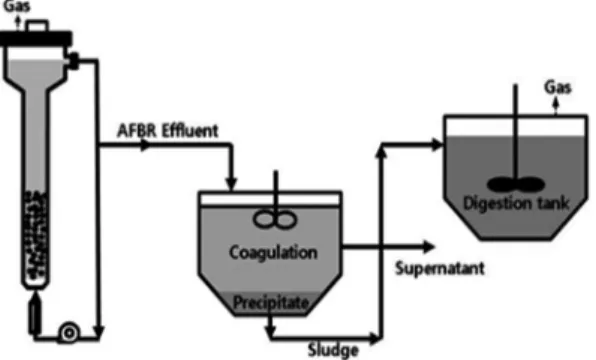
Fig. 1. AFBR followed by coagulation process.

(4)

analyzed to evaluate the optimum condi- tions. Evaluations were made based on the removal of COD, total phosphorus (T-P), final pH, alkalinity and sulfide. Total ni- trogen (T-N) and 5-day biochemical oxy- gen demand (BOD

5

) and were also analyzed for evaluation of pollutant removal by a process consisted of AFBR followed by co- agulation.

2.3 Analytical procedure

COD, BOD

5

, T-P, sulfide, and alkalinity were determined according to the Standard Methods (APHA, 1998). To eliminate the effect of hydrogen sulfide and dissolved methane on COD measurement, AFBR ef- fluent samples were purged with air for 10 min except the AFBR effluent subject to coagulation. Soluble COD (SCOD) was determined by filtering through 1.2 μm GF/C filters. T-P was detected by UV-VIS (SHINCO S-3100). Sulfide concentration was measured immediately by electrode method with electrode equipment (Orion 9616 BNWP) and ISE meter (Orion 4-star Benchtop, USA). Alkalinity was measured by the titration method using an end point pH of 4.5. pH was measured with a pH meter (Orion 3-star Benchtop, USA). T-N was measured by HACH DR/2500.

3. Results and Discussion

3.1 Removal of sulfide for synthetic wastewater Experiments with synthetic wastewater was conducted to determine the optimal dosage of coagulant for sulfide removal at the fixed sulfide concentration of 10.74

and 8.08 mg/L with corresponding initial pH values of 10.8 and 10.6, respectively, and the results are shown in Fig. 2. The- oretical molar ratio of ferric ion to sul- fide has been reported as 0.67 by Ge et al.

(2012). The removal efficiency of sulfide increased proportionally by increasing the dosage at the Fe

3+

/S

2-

ratio below 0.67. At the Fe

3+

/S

2-

ratio of 0.67, sulfide removal was almost complete. Removal efficiency is higher about 10% to 25% than predicted by eq. (3). Although the reason for this high removal is not clear, the same phe- nomena was also reported by Firer et al (2008).

3.2 Coagulation using AFBR effluent.

3.2.1 Effect of pH on sulfide, phosphorus and COD removal

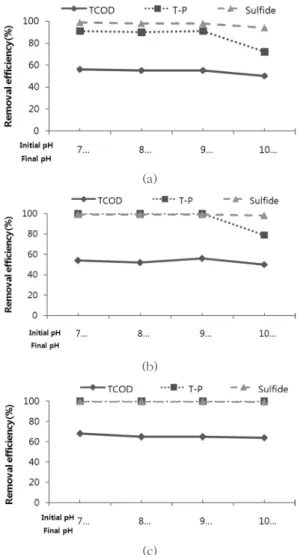
To evaluate the effect of pH on sulfide, phosphorus and COD removal, experi- ments were conducted at different initial pH levels, 7, 8, 9 and 10, at fixed dos- ages of coagulant (30, 50, 90 mg Fe

3+

/L).

The final pH values were lower than initial values as Fe

3+

consumed OH

-

ion in solu- tion, and were 5.9, 6.4, 7.2 and 9.3 at 30 mg Fe

3+

/L, respectively. In general, COD,

Fig. 2. Sulfide removal for synthetic wastewater at various co-

agulant dosages.

(5)

phosphorus and sulfide removals were not dependent on final pH as illustrated in Fig.

3. However, phosphorus removal efficien- cy was decreased significantly about 18%

to 21% above final pH 9, when coagulant dosage was 30 and 50 mg Fe

3+

/L, respec- tively.

The optimum pH for coagulation is near pH 7. To keep the final pH near 7 of AFBR effluent, alkalinity should be added as ferric ion precipitate as Fe(OH)

3

. Require- ment alkalinity is calculated by the fol-

lowing equation (6).

(6) NaOH (mole) = 3[Total Fe

3+

- (A/2+B)]

A : Moles of ferric ion consumed for sulfide removal. According to eq. (3), one mole of ferric ion used for sulfide removal produces 1.5 moles of H

+

.

B : Moles of ferric ion consumed for phosphorus removal. According to eq. (4), ferric ion used for phosphorous removal is independent of alkalinity.

When calculating the requirement of al- kalinity, Fe

3+

consumption used to remove sulfide in AFBR effluent was not small enough to ignore. Therefore, Fe

3+

con- sumption for the removal of sulfide and phosphorus have to be considered to esti- mate the alkalinity addition.

3.2.2 Selection of coagulant aids

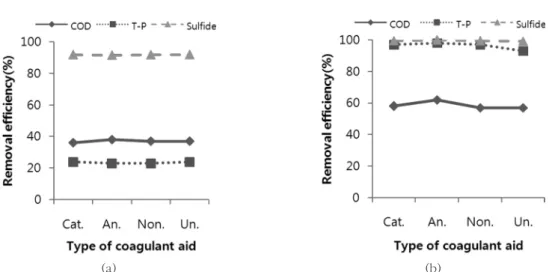
Three types of coagulant aids, cationic, anionic and nonionic, were tested at fixed dosage of 2 mg/L at optimized pH con- dition, and results are illustrated in Fig.

4. Removal efficiency of COD, sulfide and phosphorus at various dosages (30 and 50 mg Fe

3+

/L) were not greatly affected by the type of coagulant aids. However, size and settleability of floc were affected by coagulants aids. Anionic polymer showed good floc settleability with big floc forma- tion. With cationic polymer aid, most flocs were floating even though big sized flocs were formed. With non-ionic polymer aids or without coagulants aid, small flocs with bad settleability were formed. Therefore, anionic polymer has been chosen as the optimum coagulant aids.

Fig. 3. COD, sulfide and T-P removals at various final pH values (a) 30 mg Fe

3+

/L, (b) 50 mg Fe

3+

/L, (C) 90 mg Fe

3+

/L.

(a)

(b)

(c)

(6)

3.2.3 Removal of sulfide and phosphorus at various coagulant dosages

Sulfide and phosphorus removals for the pilot-scale AFBR effluents were eval- uated at various coagulant dosages, and are illustrated in Fig. 5. Unlike synthetic wastewater, sulfide removal at the Fe

3+

/ S

2-

ratio of 0.64 (16 mg Fe

3+

/L), close to the theoretical value of 0.67, was only 75.2%. At Fe

3+

/S

2-

ratio of 1.2 (30 mg Fe

3+

/L) which is approximately 2 times of theoretical ratio, sulfide removal ef- ficiency was increased to 96.4%. One of the reasons for this high Fe

3+

/S

2-

ratio re- quirement for the AFBR effluent is that the AFBR effluent contains sulfide, phos- phorus and alkalinity (hydroxide, bicar- bonate) which can react with Fe

3+

.

During production of methane under anaerobic condition, bicarbonate was pro- duced by eq (7) (McCarty and Smith. 1986;

Mohammad et al. 1995).

CH

3

COO

-

+ H

2

O → HCO

3-

+ CH

4

(7)

When coagulant was injected in waste- water, ferric ion first oxidize sulfide into elemental sulfur and change to ferrous ion according to eq (1). If ferrous iron is present in a solution containing bicarbon- ate, FeCO

3

was formed by the following eq (8) as suggested by Dold et al. (2010) and Davydov et al. (1998).

Fe

2+

+ HCO

3-

→ FeCO

3(s)

+ H

+

(8) Actually sulfide, phosphate and alka- linity were competitively reacted with Fe

3+

and produce the FeS, Fe(OH)

3

, FePO

3

and FeCO

3

, respectively. Additionally Fe(OH)

3

react with H

2

S to form the FeS and S

o

,

Fig. 4. COD, sulfide and T-P removals with different type of coagulant aids (a) 30 mg Fe

3+

/L+2 mg/L coagulation aid, (b) 50 mg Fe

3+

/ L+2 mg/L coagulation aid.

(a) (b)

Fig. 5. Sulfide and phosphorus removal efficiencies for the AFBR

effluent at various coagulant dosages.

(7)

whereas FeCO

3

does not react with oth- er material (Firer et al. 2008). Therefore, required dosage to remove the sulfide for AFBR effluent was different with theo- retical ratio.

This precipitated materials (FeS, S

o

and FePO

4

) can be recovered as sulfur and phosphorus are resources with declining quality and accessibility. As both elements are major plant nutrient, these precipi- tated materials could be used as fertilizer (Zhao and Sengupta. 1998; Wooding et al.

2000).

Phosphorus removal efficiency was 14%

at the Fe

3+

/S

2-

ratio of 0.64. When almost all sulfide was removed at the Fe

3+

/S

2-

ra- tio of 2.0, phosphorus removal increased significantly to 83%. At the Fe

3+

/ S

2-

ratio of 2.0, or 50 mg/L of Fe

3+

/L, sulfide and phosphorous concentrations were below 0.1 and 0.5 mg/L, respectively. Phospho- rus was almost removed up to 99% (0.01 mg/L) at the Fe

3+

/S

2-

ratio of 2.80. This indicates that the removal of phosphorus rather than sulfide is an operating param- eter in determining the coagulant dosage.

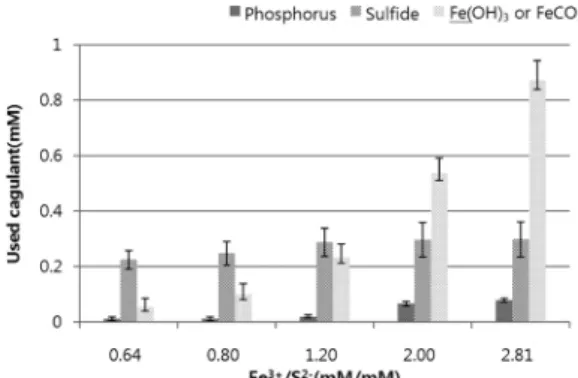
The amount of Fe

3+

consumption for dif- ferent reaction was calculated, and illus-

trated in Fig. 6. Most of Fe

3+

was used for the removal of sulfide at the Fe

3+

/S

2-

ratio of 0.64, while there was least consump- tion of Fe

3+

to remove the phosphorus. Up to the Fe

3+

/S

2-

ratio of 1.20, Fe

3+

ratio to remove sulfide increased almost linearly.

When completely sulfide was removed at the Fe

3+

/S

2-

ratio of 2.0 (50 mg Fe

3+

/L), the ratio of Fe

3+

to remove phosphorus was greatly increased.

When 17 ~ 24 mg/L of Fe

3+

was ap- plied to anaerobic reactor as pretreatment, some organic and phosphorus removal was observed (Aiyuk et al. 2004; Kalogo and Verstraete. 2000; Sarparastzadeh et al.

2007). As sulfide is produced after an- aerobic treatment, additional dosage of coagulant is required to remove the pro- duced sulfide. Our results indicate that the Fe

3+

/S

2-

ratio higher than theoretical value is necessary to remove both sulfide and phosphate below 0.1 and 0.5 mg/L, re- spectively. As this was enough to remove sulfide and phosphorus simultaneously, coagulation with Fe

3+

as post-treatment is suitable option without additional process to remove the sulfide and phosphorus.

Fig. 6. Amount of Fe

3+

used for different reactions involved.

(8)

3.2.4 Removal efficiency of COD at various dosages

COD removal by coagulation of AFBR effluent is shown at Fig. 7. TCOD removal efficiency increased from 25% to 59% as the Fe

3+

/S

2-

ratio increased 0.64 to 2.8. TCOD decreased from 185 to under 80 mg/L at Fe

3+

/S

2-

ratio of 2.8. Particulate chemical oxygen demand (PCOD) removal efficiency was 99% and decreased below 9 mg/L at Fe

3+

/ S

2-

ratio of 2.8. At Fe

3+

/ S

2-

ratio of 2.0, a clear solid-liquid separation was observed with naked eyes. However SCOD removal efficiency by coagulation was not good. SCOD decreased to 67 mg/L at Fe

3+

/ S

2-

ratio above 2.0, indicating less than 28% removal efficiency by coagulation.

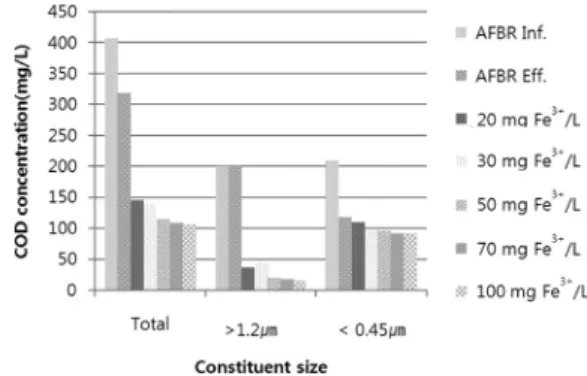
To investigate the COD constituent size of AFBR influent, effluent and superna- tant, additional experiment was conduct- ed. Fig. 8 illustrates the changes in COD function measured with different filter size over a wide range of coagulant dos- ages. TCOD and SCOD removal efficiency of the AFBR were 22% and 44%, respec- tively, whereas PCOD concentration was not removed at all. Thus the main func- tions of the AFBR are to remove soluble

material.

COD ratio of AFBR influent with bigger size (≻1.2 μm) was 49%, and that for size

≺0.45 μm was 51%. At 20 mg Fe

3+

/L, PCOD (COD with particles bigger than 1.2 μm) removal efficiency was 82%, while SCOD (≺1.2 μm) removal was about 21%. At the dosage 100 mg Fe

3+

/L, PCOD was further reduced to 93%, whereas SCOD removal was not increased further, and was 24%.

Coagulation is not suitable to remove sol- uble material. After coagulation and Fe

3+

dosage above 50 mg/L, 80% of TCOD was composed of SCOD. Therefore to increase COD removal efficiency of overall system, it is important to improve SCOD removal of AFBR.

3.3 Treatment of domestic wastewater by the AFBR-coagulation process

Changes of sulfide, phosphorus, BOD

5

and T-N with various dosages of coagu- lants for the treatment of the AFBR efflu- ent are summarized in Table 1. Results in Table 1 obtained in winter slightly differ- ent from the data described in Section 3.1 and 3.2 obtained in previous seasons as

Fig. 7. COD removal for the AFBR effluent at various coagulant dosages.

Fig. 8. COD mass distributions by particle size at various co-

agulant dosages.

(9)

the characteristics of the influent waste- water changed. In the AFBR, 16.07 mg/L of sulfide was produced. Sulfide removal efficiency by coagulation was 99% at ra- tio of 0.71 (20 mg Fe

3+

/L) and was com- plete above that ratio. T-P concentration of AFBR influent was 3.7 mg/L. T-P re- moval efficiency by the AFBR was 10%, and subsequent coagulation at the ratio of 0.71 removed additional 6%. Phospho- rus removal was complete at the ratio of 1.78. Coagulant dosage of 50 mg Fe

3+

/L was enough for simultaneous removal of sulfide and phosphorus.

Although TCOD removal by the AFBR was 29%, only 6% PCOD was removed in the AFBR whereas SCOD was removed up to 49%. TCOD removal efficiency in- creased as coagulant dosage increased.

TCOD concentration was reduced below 80 mg/L and 70 mg/L at Fe

3+

/ S

2-

ratios of 1.78 and 3.57, respectively. Corresponding removal efficiencies were 66% and 69%,

respectively. The AFBR effluent PCOD of 145 mg/L was reduced to 9 mg/L as Fe

3+

/ S

2-

ratio was increased. PCOD removal ef- ficiency was 88% at ratio 1.78, and slight additional PCOD removal was found be- yond this ratio. As found in the previous experiment, a clear solid-liquid separa- tion was observed with naked eyes at Fe

3+

/ S

2-

ratio of 1.78.

SCOD concentration was reduced from 88 to 61 mg/L at ratio of 1.78, and reduced slightly even at the ratio of 5.35. This is because coagulation is effective for col- loidal or big size organic material rather than soluble material. Therefore, to in- crease COD removal efficiency of overall system, it is important to improve SCOD removal by the AFBR.

TBOD

5

and SBOD5 showed similar trends to those of TCOD and SCOD. Just small amount (6 ~ 10 mg/L) of T-N was reduced during coagulation process with the re- moval of solid materials.

AFBR Inf.

AFBR Eff.

0.71

a

(20 mg Fe

3+

/L)

1.78

a

(50 mgFe

3+

/L)

2.50

a

(70 mg Fe

3+

/L)

3.57

a

(100 mgFe

3+

/L)

5.35

a

(150 mgFe

3+

/L)

TCOD (mg/L) 326±17 233±24 126±34 79±6 71±3 66±1 62±6

overall removal - 29% 61% 76% 78% 80% 81%

SCOD (mg/L) 172±25 88±12 76±14 61±9 57±8 55±12 53±9

PCOD (mg/L) 154±14 145±27 50±21 18±7 14±5 11±11 9±4

TBOD (mg/L) 193±34 130±15 68±21 45±3 40±1 36±0.6 34±4

SBOD (mg/L) 96±27 46±2 38±4 30±2 31±2 30±3 28±3

T-P (mg/L) 3.7±0.28 3.34±0.42 2.8±0.26 0 0 0 0

S

2-

(mg/L) 0 16.07±0.60 0.15±0.03 0 0 0 0

T-N (mg/L) 42±2.89 41±2.65 35±6 33±3.46 33±4.51 32±3.21 31±12.31

Initial pH 6.96±0.03 6.88±0.06 6.98±0.19 8.32

b

±0.78 9.09

b

±0.45 9.61

b

±0.34 10.33

b

±0.43 Final pH 6.96±0.03 7.01±0.1 6.95±0.11 7.02±0.07 7.08±0.04 7.03±0.10 7.01±0.04 Alk. (mg/L

CaCO

3

) 196±26 259±31 221±26 238±25 238±22 227±25 211±24

Table 1. Changes of wastewater characteristics during treatment of domestic wastewater with AFBR followed by various dosages of coagulation

a: Fe

3+

/S

2-

(mM/mM) b: pH after addition of NaOH number of data is 3

(10)

4. Conclusion

After evaluating a feasibility of coagu- lation for the removal of sulfide, phos- phorus and COD from the AFBR effluent treating domestic wastewater, following conclusions were made.

1. Experiments with synthetic wastewa- ter showed that sulfide removal was almost complete at the Fe

3+

/ S

2-

ratio of 0.67.

2. Removals efficiencies of COD, sulfide and phosphorus are not greatly af- fected by pH in the range of 5.9 to 7.2. Alkalinity requirement to keep the final pH near 7 could be estimat- ed by eq (6).

3. Although the type of coagulant aids did not affect pollutant removals, anionic polymer showed good floc settleability with big floc formation.

4. At the dosage of 50 mg/L of Fe

3+

/L with optimum pH and coagulant aids, sulfide and phosphorous con- centrations were below 0.1 and 0.5 mg/L with corresponding removals of 99.5% and 83% respectively, for the AFBR effluent treating domestic wastewater.

5. After coagulation of the AFBR ef- fluent at dosage higher than 50 mg Fe3+/L, TCOD concentration was reduced to 80 mg/L with complete particulate COD removal. However, to increase overall COD removal ef- ficiency of the system, COD removal by the AFBR should be improved.

6. Coagulation with Fe

3+

removed sul- fide, phosphorus and COD simulta-

neously in the AFBR effluent, and thus could be an alternative pro- cess for the conventional wastewater treatment processes where relatively high quality effluent is not required.

요약문

본 연구는 도시하수를 처리하는 혐기성 유동 상 반응조(AFBR)의 유출수 내에 존재하는 황화 물, 인을 제거하기 위한 후속 공정으로서 화학 응집의 가능성을 평가하였다. pH 범위 5.9에서 7.2까지는 화학응집을 통한 황화물, 인 및 COD 의 제거율에 큰 영향을 주지 않았다. 알칼리도 의 요구량은 Fe(OH)

3

를 형성 및 황화물과 인 을 제거하기 위한 Fe

3+

의 양을 통해 추정한다.

응집보조제 농도 2 mg/L에서 음이온성 폴리머 는 플록의 크기와 침전성 면에서 가장 좋은 결 과를 보였다.

AFBR 유출수의 황화물을 제거하기 위해 투 입한 응집제 주입비(Fe

3+

/S

2-

)는 0.64로 인공폐 수 실험을 통해 확인한 이론적인 응집제 주입 비 0.67에 가까우나 황화물 제거율은 75.2%에 그쳤다. 이렇게 높은 응집제 주입비를 요구하는 이유는 인공폐수와는 다르게 AFBR 유출수에는 황화물, 인, 수산화이온, 중탄산염이 존재하고 Fe

3+

와 경쟁적으로 반응하기 때문이다. 응집제 주입비 2.0에서 황화물과 인의 농도는 각각 0.1, 0.5 mg/L 이하로 감소했다. 응집제 주입량 50 mg Fe

3+

/L에서 평균적인 유출수의 COD 농도 는 80 mg/L로 대부분 용존성 COD로 구성되어 있고 제거율은 55%이다.

더 높은 COD 제거율을 얻기 위해서는 AFBR 에서의 용존성 COD 제거율을 강화해야 한다.

Fe

3+

를 이용한 화학응집은 AFBR 유출수 내의

황화물, 인 및 COD를 동시에 제거할 수 있고,

이는 상대적으로 높은 처리수 수질을 요구하지

않는 나라의 기존 하수처리 공정을 대체할 수 있

을 것이다.

(11)

Acknowledgments

This work is financially supported partly by Korea Ministry of Science, ICT and Fu- ture Planning (Grant number 48912-01)

References

APHA. (1998). In: Clesceri, L.S., Greenberge, A.E., Eaton, A.D. (Eds.), Standard Meth- ods for Examination of Water and Waste- water, 20th ed. American Public Health Association, Washington, DC.

Aiyuk, S., Amoako, J., Raskin, L., Haandel, A.V. and Verstraete, W. (2004). Removal of Carbon and Nutrients from Domestic Wastewater Using a Low Investment, In- tegrated Treatment Concept, Water Re- search, 38, pp. 3031-3042.

Berube , P.R., Hall, E.R. and Sutton, P.M. (2006).

Parameters Governing Permeate Flux in an Anaerobic Membrane Bioreactor Treat- ing Low-strength Municipal Wastewaters:

A Literature Review, Water Environment Research, 78, pp. 887-896.

Chan, Y.J., Chong, M.F., Law, C.L. and Has- sell, D.G. (2009). A Review on Anaerobic- Aerobic Treatment of Industrial and Mu- nicipal Wastewater, Chemical Engineering Journal and the Biochemical Engineering Journal, 155 , pp. 1-18.

Davydo v, A., Chuang, K.T. and Sanger, A.R.

(1998). Mechanism of H

2

S Oxidation by Ferric Oxide and Hydroxide Surfaces, Journal of Physical Chemistry B, 102, pp.

45-52.

De Oliv eira, L.L., Costa, R.B., Okada, D.Y., Vich, D.V., Duarte, I.C.S., Silva, E.L. and Va- resche, M.B.A. (2010). Anaerobic Degra- dation of Linear Alkylbenzene Sulfonate (LAS) in Fluidized Bed Reactor by Micro- bial Consortia in Different Support Ma- terials, Bioresource Technology, 101, pp.

5112–5122.

Diamad opoulos, E., Megalou, K., Gerogiou, M.

and Gizgis, N. (2007). Coagulation and Precipitation as Post-treatment of An-

aerobically Treated Primary Municipal Wastewater, Water Environment Re- search, 79, pp. 131-139.

Dold, B . (2010). Basic Concepts in Environmen- tal Geochemistry of Sulfidic Mine-Waste Management, Waste Management, Ku- mar, E. S. (Ed.), ISBN: 978-953-7619- 84-8, InTech, Available from:http://

www.intechopen.com/books/waste-man- agement/basic-concepts-in-environ- mental-geochemistry-ofsulfidic-mine- waste-management

Firer, D., Friedler, E. and Lahav, O. (2008).

Control of Sulfide in Sewer Systems by Dosage of Iron Salts : Comparison Between Theoretical and Experimental Results, and Practical Implications, Science of the Total Environment, 392, pp. 145-156.

Gabelm an, A. and Hwang, S.T. (1999). Hollow Fiber Membrane Contactors, Journal of Membrane Science, 159, pp. 61-106.

Gomec , C.Y. (2010). High-rate Anaerobic Treat- ment of Domestic Wastewater at Ambi- ent Operating Temperatures: a Review on Benefits and Drawbacks, Journal of En- vironmental Science and Health, Part A:

Toxic/Hazardous Substances & Environ- mental Engineering, 45, pp. 1169-1184..

Gutierr ez, O., Park, D., Sharma, K.R. and Yuan, Z. (2010). Iron Salts Dosage for Sul- fide Control in Sewers Induces Chemical Phosphorus Removal during Wastewa- ter Treatment, Water Research, 44, pp.

3467-3475.

Ge, H. , Zhang, L., Batstone, D.J., Keller, J. and Yuan, Z. (2012). Impact of Iron Salt Dos- age to Sewers on Downstream Anaero- bic Sludge Digesters: Sulfide Control and Methane Production, Journal of Environ- mental Engineering, 139, pp. 594-601.

Kalogo , Y. and Verstraete, W. (2000). Techni- cal Feasibility of the Treatment of Domes- tic Wastewater by a CEPS-UASB System, Environmental Technology, 21, pp. 55-65.

Kim, J ., Kim, K., Ye, H., Lee, E., Shin, C., Mc-

Carty P.L. and Bae, J. (2011). Anaerobic

Fluidized Bed Membrane Bioreactor for

(12)

Wastewater Treatment, Environmental Science & Technology, 45, pp. 576-581.

Liao, B . Q., Kraemer, J. T. and Bagley, D. M.

(2006). Anaerobic Membrane Bioreactors:

Applications and Research Directions, Critical Reviews in Environmental Science

& Technology, 36 , pp. 489–530.

McCart y, P.L. and Smith, D.P. (1986). Anaero- bic Wastewater Treatment Fourth of a Six-part Series on Wastewater Treatment Process, Environmental Science & Tech- nology, 20, pp. 1200-1206.

Moham mad, R.H.P., Sanjoy, K.B., and Mingbo, Q. (1995). Effects of Nitrophenols on Ac- etate Utilizing Methanogenic Systems, Water Research, 29, pp. 391-399.

Nielsen , A.H., Lens, P., Vollertsen, J. and Hvitved-Jacobsen, T. (2005). Sulfide- iron Interactions in Domestic Wastewater from a Gravity Sewer, Water Research, 39, pp. 2747-2755.

Nielsen , P.H. and Keiding, K. (1998). Disintegra- tion of Activated Sludge Flocs in Presence of Sulfide, Water Research, 32, pp. 313- 320.

Sarpar astzadeh, H., Saeedi, M., Naeimpoor, F.

and Aminzadeh, B. (2007). Pretreatment of Municipal Wastewater by Enhanced Chemical Coagulation, Public Health In- ternational Journal of Environmental Re- search and Public Health, 1, pp. 104-113.

Shin, C ., Lee, E., McCarty, P.L. and Bae J. (2011).

Effects of Influent DO/COD Ratio on the Performance of an Anaerobic Fluidized Bed Reactor Fed Low-strength Synthetic Wastewater, Bioresource Technology, 102, pp. 9860-9865.

Shin, C ., Kim, J., McCarty, P.L. and Bae, J.

(2014). Pilot-scale Temperate-climate Treatment of Domestic Wastewater with a Staged Anaerobic Fluidized Membrane Bioreactor(SAF-MBR), Bioresource Tech- nology, 159, pp. 95–103.

Smith, A.L., Skerlos, S.J. and Raskin, L. (2013).

Psychrophilic Anaerobic Membrane Biore- actor Treatment of Domestic Wastewater, Water Research, 47, pp. 1655-1665.

Woodin g, A.R., Kavale, S., MacRitchie, F., Stod- dard, F.L. and Wallac, A. (2000). Effects of Nitrogen and Sulfur Fertilizer on Pro- tein Composition, Mixing Requirements, and Dough Strength of Four wheat Cul- tivars, Cereal chemistry, 77, pp. 798-807.

Yoo, R ., Kim, J., McCarty P.L. and Bae, J. (2012).

Anaerobic Treatment of Municipal Waste- water with a Staged Anaerobic Fluidized Membrane Bioreactor (SAF-MBR) System, Bioresource Technology, 120, pp. 133-139.

Zhang, T., Ding, L., Ren, H., Guo, Z. and Tan, J.

(2010). Thermodynamic Modeling of Fer- ric Phosphate Precipitation for Phospho- rus Removal and Recovery from Waste- water, Journal of Hazardous materials, 176, pp. 444-450.

Zhao, D. and Sengupta, A.K. (1998). Ultimate

Removal of Phosphate from Wastewater

Using a New Class of Polymeric ion Ex-

changers, Water Research, 32, pp. 1613-

1625

수치

Fig. 1. AFBR followed by coagulation process.
Fig. 2.  Sulfide removal for synthetic wastewater at various co- co-agulant dosages.
Fig. 3.  COD, sulfide and T-P removals at various final pH values  (a) 30 mg Fe 3+ /L, (b) 50 mg Fe 3+ /L, (C) 90 mg Fe 3+ /L.
Fig. 4.  COD, sulfide and T-P removals with different type of coagulant aids (a) 30 mg Fe 3+ /L+2 mg/L coagulation aid, (b) 50 mg Fe 3+ / L+2 mg/L coagulation aid.
+4

참조

관련 문서

In this study, we developed a noble biotransformation reactor for α-ketoglutarate production using enzyme aggregated nanofiber reactor, micro reactor, monolith

The purpose of this case study was to find comparison of sports related physical fitness and anaerobic power changes of college hockey players and

Change into Anaerobic energization is coincide with government policy Treatment Technology of Organic Waste

(2011) Anaerobic fluidized bed membrane bioreactor

This study aims to analyze the process and the features of corporate e-Learning as a form of informal learning. For this purpose, the concept of

The aim of this study was to investigate the removal of phosphorus in combined sewer overflow(CSO) using rapid coagulation system(plug flow reactor +

Biological treatment of wastewater is an economical green technology, however, the effluent water quality of a biological wastewater treatment facility is

This study examined the changes of kinetic expression factors of movement through art historical approach and as a result of analyzing internal and external