500
and Safety
Available online at http://www.foodhygiene.or.kr
https://doi.org/10.13103/JFHS.2017.32.6. 500
재배농법에 따른 국내산 배추의 위해미생물 및 중금속 오염평가
오소영·남기웅1·윤덕훈*
국립한경대학교 국제농업기술정보연구소, 1국립한경대학교 원예생명과학과
Analysis of Pathogenic Microorganism’s Contamination and Heavy Metals on Kimchi Cabbage by Cultivation Methods in Korea
Soh-Young Oh, Ki-Woong Nam1, and Deok-Hoon Yoon*
Research Institute of International Agriculture, Technology and Information,
Hankyong National University, Anseong, Korea
1
Department of Horticultural Life Science, Hankyong National University, Anseong, Korea (Received September 15, 2017/Revised October 7, 2017/Accepted October 23, 2017)
ABSTRACT - Kimchi cabbage is one of the four major vegetable crops in Korea. The total annual production of kimchi cabbage, the main material of kimchi, was 20,559 tons in 2015. Kimchi cabbage is one of the majer crops pro- duced by farmers which accounts for about 80% of the total leaf vegetable production in Korea. As the consumption of environmental-friendly agricultural products increases, food safety is one of the major public health concerns. We analyzed the biological hazards of kimchi cabbage produced by two types of cultivation methos such as organic farm- ing and conventional farming using various culture media and microscopy. A total of 432 samples were analysed for presence of sanitary indicator microorganisms (aerobic plate count, coliform count, yeast & mold) and food-borne pathogens (Staphylococcus aureus, environmental Listeria, Bacillus cereus). The population of sanitary indicating microorganisms and food borne pathogens was under 5 Log CFU/g in all tested samples. The results of total microor- ganism numbers of leaf surface showed a positive correlation to those of soil samples. Additionally, we examined chemical factors such as pesticide residues and heavy metals in soil samples. All tested samples did not shown con- tamination levels higher than the standard limit.
Key words : Organic, Kimchi cabbage, Sanitary indicator microorganisms, Food-borne pathogens
배추는 한국인의 식생활에 빠질 수 없는 김치의 주원료 로 매우 중요한 채소 중 하나이다. 또한 최근 소비자들은 생활수준 향상과 건강한 삶에 관심이 높아지면서 농산물 선택에 있어 유기농, 기능성 농산물을 선호하는 추세에 있 다. 이에 따라 최소가공 농산물의 소비증가, 국제 유통의 증가 등의 요인에 의해 생과일과 채소섭취에 따른 인체 감염발생이 증가하고 있다
1). 유기농업은 화학 비료를 사 용하지 않는 대신 여러 친환경자재뿐만 아니라 유해미생 물의 증식이 우려되는 가축분뇨 기반의 퇴비를 사용하고
있으며
2,3,4), 화학적방제제나 화학비료를 사용하지 않으므
로 유해미생물의 증식이 우려되어 미생물 안전성에 문제 가 부각되고 있다. 실제로 유기농산물을 원인으로 사람에 게 다양한 질환이 유발되거나 사망에 이르는 사례가 보고
되고 있다
5,6). 단순히 물 세척만으로는 잎채소 중의 미생 물을 완벽히 제거하기는 어려우며
7), 생식용 채소와 관련 된 식중독 사고는 농산물로 인한 식중독의 많은 부분을 차지하고 있다
8). 미국에서는 토마토에 오염된 Salmonella 식중독 사건이 발생하였으며
9), Listeria 에 오염된 멜론을 먹고 감염되어 16명이 사망하였다
10). 딸기에 Escherichia coli O157:H7 이 오염되어 질환 및 사망사고가 발생 하였 으며
11), 새싹채소, 당근, 방울토마토, 호박 등의 과채류에 서 Listeria monocytogenes와 Aeromonas spp.의 검출이 보 고되었다
12). 독일에서는 유기농 채소를 섭취하고 Entero- hemorhagic Escherichia coli 에 약 3,000명이 감염되어 46 명이 사망하였으며
13), 2005 년 스페인산 양상추에서 Salmonella Typhimurium 이 검출되었으며 원인은 하수를 관 계수로 이용했기 때문이었다
12). 국내에서는 즉석섭취, 편 의식품에 대해 대장균, 살모넬라, 장염비브리오는 음성, Staphylococcus aureus 은 1 g당 100 CFU/g 이하, Bacillus cereus 는 1 g당 1,000 CFU/g 이하, 세균수는 1 g당 100,000
*Correspondence to: Deok-Hoon Yoon, Hankyong National Univer- sity #327, Jungang-ro, Anseong-si, Gyeonggi-do 17579, Korea Tel: 82-31-678-4643, Fax: 82-31-678-4644
E-mail: [email protected]
CFU/g 이하로 규정하고 있다
14). 일반적으로 신선채소류의 총균수는 10
4~10
6CFU/g 이며, 품질저하에 관계되는 미생 물은 10
3CFU/g, 부패균인 Fluorescent pseudomonas 등은 10
1~10
3CFU/g 수준으로 존재한다
15). 또한 국내산 유기농 채소의 23.2%에서 대장균이 검출되었고, Enterobacter, Klebsiella 및 Citrobacter 등의 장내세균도 발견되었다
16). 병원성 미생물은 농산물 표면에서 생존 및 증식이 가능하 기 때문에 관리가 필요함을 시사하며, 미국 FDA에서는 채 소 생산에 있어서 미생물 오염도를 최소화하기 위하여 The Guide to Minimize Microbial Food Safety Hazards for Fresh Fruits and Vegetables 지침서를 따르도록 하고 있다
17). 또한 2011 년에 식품안전을 강화하기 위하여 식품안전현대화법 (FSMA, Food Safety Modernization Act) 을 제정하고, 성 공적인 실행을 위한 방안 중 하나로 농산물 안전기준 (Produce Safety) 을 마련하였다
11). 농산물 안전기준은 미생 물오염 5대 경로인 농업용수, 가축분뇨를 이용한 생물학 적 토양 개량제, 작업자의 건강과 개인위생, 농기구 및 농 기계, 가축과 야생동물을 과학적으로 관리하도록 설정한 기준이다
11). 이에 따라 국내에서도 농산물의 안전성을 확 보하는 제도인 농산물우수관리제도(GAP, Good Agricultural Practice) 의 도입 및 확장을 권장하고 있으며
18), 신선 채소 에 의한 식중독 사고예방 및 농산물안전성 향상을 위한 위생관리지침의 마련이 필요하다.
다양한 방법으로 제조되는 퇴비 등을 사용하는 유기농 법은 관행농법에 비하여 유해미생물의 오염도가 높을 것 이라는 인식이 크다. 따라서 본 연구는 국내 엽채류 중 소 비량이 가장 많은 배추를 대상으로 유기농가와 관행농가 에서 계절별로 채취하여 위생지표세균 및 유해미생물의 오염도를 측정하여 비교하였으며, 또한 퇴비 사용에 따른 토양과 식물체내의 중금속 오염을 비교함으로써 유기농산 물의 건전성과 미생물 위해평가의 기초자료로 활용하고자 수행하였다.
Materials and Methods
시료채집
국내 유기농 배추의 유해미생물 오염도 조사를 위해 2015 년부터 2016년까지 강원도 소재의 유기농가 중 가축 분뇨 기반의 자가제조퇴비를 사용하는 3개 농가(Organic) 와 관행농가 3개 농가(Conventional)에서 배추와 토양을 3 반복으로 2주 간격(총 24회)으로 총 432점의 시료를 채집 하였다. 채집된 시료는 냉장박스에 보관하여 실험실로 운 반 후 12시간 이내에 분석하였다. 배추는 착즙하여 얻은 용액을 단계별로 희석하여 분석에 사용하였다. 토양은 10 g 을 90 mL의 멸균수로 희석 후 단계별로 희석하여 분석에 사용하였다. 각 농가별로 시료당 3반복으로 분석하였다.
중금속 분석을 위한 시료는 토양과 배추를 각각 반복
당 1 kg을 채집하였으며 전문 분석기관에 의뢰하였다.
위생지표세균조사
Total aerobic bacteria, coliforms, yeast and mold, en- vironmental listeria 등 위생지표세균을 분석하였다. Total aerobic bacteria 는 3M petrifilmTM aerobic count plate (3M, Oakdale, MN, USA) 에 시료 1 mL를 분주하여 35
oC 에서 48시간 배양 후, 형성된 붉은색 집락(colony)을 계수 하였다. Coliforms는 3M petrifilmTM coliform count plate (3M, Oakdale, MN, USA) 에 1 mL를 분주하여 35
oC 에서 24 시간 배양 후, 기포를 가진 붉은색 colony를 계수하였다.
Yeast 와 mold는 3M petrifilmTM yeast와 mold (3M, Oakdale, MN, USA) 에 시료 희석액 1 mL를 분주하여 25
oC 에서 48 시간 배양 후, 파란색의 colony를 계수하였다. 또한, En- vironmental Listeria 는 3M petrifilmTM Environmental Listeria (3M, Oakdale, MN, USA) 에 시료 1 mL를 분주하 여 35
oC 에서 48시간 배양 후, 자주색의 colony를 계수하였다.
유해미생물 오염도 조사
조사대상 유해미생물은 식중독 유발가능성이 있는 Bacillus cereus 와 Staphylococcus aureus의 오염도를 정량적으로 분 석하였다. B. cereus의 오염도 조사를 위해 균질화한 희석 용액 100 µL를 3개의 Mannitol Egg Yolk Polymyxin Agar 에 각각 분주하여 도말하였다. 37
oC 배양기에서 24시간 동 안 배양한 후 분홍색 집락주위에 밝은 환(clear zone)이 나 타나는 단일 집락수를 계수하였다. S. aureus의 오염도 조 사를 위해 균질화한 희석용액을 100 µL씩 3개의 Baird- Parker Agar (BP, OXOID, UK) 에 각각 분주하여 도말한 후 37
oC 의 배양기에서 48시간 동안 배양 후 검은 집락주 위에 밝은 환(clear zone)이 나타나는 단일 집락을 계수하 였다. 최종 동정은 계수한 평판에서 전형적인 집락을 선 발하여 NA배지에 접종하고 37
oC 에서 24시간 배양한 후 VITEK (VITEK-2 compact) 을 사용하였고 대조군으로 S.
aureus 표준 균주 ATCC 25923을 사용하였다. Clostridium
spp. 는 균질화한 희석용액 100 µL를 Difco
TMDifferential
Reinforced Clostridial Agar (Difco, Franklin Lakes, NJ,
USA) 에 분주하여 도말한 후 37
oC 배양기에서 72시간 동
안 배양한 후 검정색의 반점이 나타나는 단일 집락수를
계수하였다. Salmonella spp.는 Salmonella Express Plate
(SALX) Petrifilm
TM(3M, USA) 에 균질화한 희석용액 1 mL
씩 치상하여 37
oC 배양기에서 24시간 동안 배양한 후 흑
청색/검정색 균체 주변으로 푸른색 침전물이 나타나거나,
흑청색/검정색 균체에 흑적색을 중심으로 푸른색 침전물
이 나타나는 단일 집락수를 계수하였다. Listeria mono-
cytogenes 의 오염도 분석은 균질화한 희석용액 100 µL를
Oxford agar (Oxoid, UK) 배지에 분주하여 도말하여 37
oC
배양기에서 48시간 동안 배양한 후 검정색을 중심으로 회
색 균체가 나타나는 단일 집락수를 계수하였다.
중금속 오염도 조사
유기농법과 관행농법 실천에 따른 토양내 Cr
6+, Cu, Ni, Pb, Cd, As, Hg, Zn 등의 중금속 오염도를 조사하였다. 채 취한 토양은 실험실에서 풍건 후 2 mm 체를 통과한 것을 분쇄하여 중금속 분석에 이용하였다. 중금속 분석을 위하 여 시료 10 g을 125 mL 삼각플라스크에 넣어 Cd, Cu, Ni, Pb 및 Zn은 0.1 M HCl 용액 50 mL를 가하여 30
oC 에서 60 분간 진탕하고, As는 1 M HCl 용액 50 mL를 가하여 30
oC 에서 30분간 진탕한 후 여과지(No. 2)로 여과하여 여 액을 ICP (Prodigy7, Teledyne Leeman Labs, Hudson, NH, USA) 를 이용하여 측정하였다.
식물체내의 중금속 함량은 식품공전 상의 농산물 중금 속 시험법에 따랐다. 식물체 시료를 증류수로 세척한 후 가식부위를 분리하고 균질화하여 분석에 이용하였다. 카 드뮴과 납의 분석을 위한 시료의 분해는 microwave분해 법을 이용하였으며, 100 mL PTFE vessel에 시료 약 2 g을 취하고 질산 8 mL, 과산화수소수 2 mL을 넣고 microwave digester (IT/ETHOS Touch Control, Milestone, Vergamo, Italy) 를 사용하여 1,000 W로 15분 동안 150
oC 까지 온도 상승 후 추가로 15분 동안 200
oC 까지 온도를 상승시키는 조건으로 분해하였다. 분해된 시험용액은 질산을 모두 휘 발시키고 0.5% 질산으로 20배가 되게 희석하여 여과한 후 시험용액을 ICP (Prodigy7, Teledyne Leeman Labs, Hud- son, NH, USA) 를 이용하여 측정하였다.
통계분석
분석된 중금속과 미생물 군집은 SAS 프로그램 9.1.3 버 젼을 사용하여 5% 수준에서 Duncan's multiple range test 검정을 하였다.
Results and Discussion
재배농법별 배추의 위생지표세균 비교
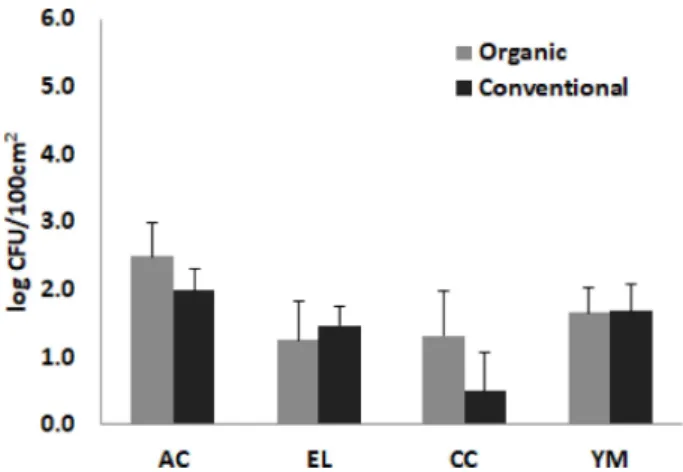
배추 생산단계의 위생지표세균의 밀도를 유기농 배추와 관행배추에서 분석하였다(Fig. 1). 관행 배추(Conventional) 에서는 모든 위생지표 세균이 검출된 반면, 자가제조퇴비 유기농 배추(Organic)에서는 환경리스테리아(EL, Environ- mental Listeria) 와 대장균군(CC, Coliforms)이 검출되지 않 았다. 재배농법과 상관없이 배추 잎표면에서의 위생지표 균은 일반호기성세균(AC, total aerobic bacteria)은 2.2 Log CFU/100 cm
2, 효모 및 곰팡이(YM, yeast and mold)는 1.7 Log CFU/100 cm
2, 환경리스테리아(EL, Environmental Listeria) 는 1.4 Log CFU/100 cm
2, 대장균군(CC, Coliforms) 은 1.0 Log CFU/100 cm
2순으로 검출되었다. 일반적으로 발견되는 총 미생물수는 3.0~9.0 Log CFU/g로 알려져 있
으며
19), 식품에 총균수가 7.0~8.0 Log CFU/g이 존재할 경 우 병원성이 없는 세균이라 할지라도 면역기능이 약한 사 람에게는 식중독을 일으킬 가능성이 있다고 하였는데
20), Fig. 1. Comparison of the numbers of sanitary indicating bacteria on kimchi cabbage leaf surface according to the type of cultivation method. Organic: Farm uses only self-made compost, Conven- tional: General farm uses chemical fertilizer. AC: Total Aerobic Bacteria, EL: Environmental Listeria, CC: Coliforms, YM: Yeast
& Molds.
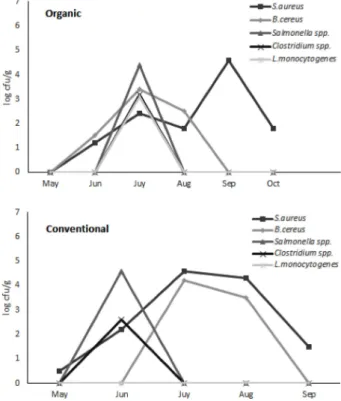
Fig. 2. Change of sanitary indicating bacteria numbers on kimchi cabbage leaf surface according to the type of cultivation method.
Organic: Farm use several environment friendly agricultural materials, Conventional: General farm uses chemical fertilizer. AC:
total aerobic bacteria, EL: Environmental Listeria, CC: Coliforms,
YM: yeast and mold.
본 연구결과에서는 모두 2.2 Log CFU/g 이하로 재배농법 과 상관없이 안전한 수준이었다.
유기농배추와 관행배추의 생육기간 중 위생지표세균의 밀도를 시기별로 조사한 결과는 Fig. 2와 같다. 유기농 배 추의 경우 정식 후 작물의 생장 및 기온이 상승함에 따라 모든 균이 상승하다가 수확 및 온도가 낮아짐에 따라 전 반적으로 균밀도가 낮아지는 경향을 나타내었다. 관행배 추의 경우는 대장균군(CC)을 제외한 일반호기성균(AC), 환경리스테리아(EL), 효모와 곰팡이(YM)은 2.0~3.0 Log CFU/g 의 수준으로 수확기까지 유지되었다. WHO (World Health Organization) 의 총호기성 세균수에 대한 오염 한도 치인 10
7CFU/g 기준
21)을 적용하였을 때, 모든 농가에서 기준치 이하인 것으로 나타났다.
재배농법별 배추의 유해미생물 비교
식중독균인 S. aureus는 하나 이상의 독소를 형성해서 식중독을 일으키는 독소형 식중독으로서, 신선채소의 17.7~24.0% 에서 검출된다고 보고
7)되어 있으며, 한국에서 생산된 상추 중 37%에서 S. aureus가 검출되었다고 보고
22)되어 있다. 배추의 재배농법별 식중독 유발가능성이 있는 유해미생물을 비교·분석하였다(Fig. 3). 자가제조퇴비를 사용한 배추(Organic)의 경우 모든 유해미생물의 검출량이 0.8 Log CFU/g 이하로 매우 낮은 수준이었고, 관행 배추 의 경우 모든 유해미생물의 검출량이 1.3~2.6 Log CFU/g 으로 비슷한 수준이었다. 독소형 식중독균인 S. aureus와 B. cereus 의 경우 재배농법에 상관없이 독소를 생성하기 위한 최저 수준인 5.0 Log CFU/g보다 낮았으므로 안전한 수준이었다.
배추의 재배기간 동안 배추잎 표면의 유해미생물 분포 를 조사한 결과(Fig. 4), 재배농법과 상관없이 S. aureus와 B. cereus 는 정식 후 서서히 증가하여 수확기까지 약 2.0~4.0 Log CFU/g 의 수준으로 유지되었다. 그러나 Salmonella spp., Clostridium spp., Listeria monocytogenes 는 6~7월에 급격히
증가하였다가 감소하여 2.0 Log CFU/g 미만의 수준이었다.
최근 유기농산물에서의 미생물적 안전성이 크게 대두되 었으나
23), 본 연구 결과 관행 배추와 유기농 배추의 위생 지표세균 및 유해미생물 검출량은 모두 위해 수준 이하였 으며, 통계적 유의차가 없으므로 재배방법에 의한 미생물 학적 안전성 차이는 없는 것으로 사료된다. 이는 미국의 미네소타지역의 유기농가와 관행농가로부터 2,029개의 농 산물 샘플을 조사한 결과 모든 유형의 농가에서 생산된 엽채류와 상추, 배추에서 높은 수준의 대장균이 검출되었 으나, 관행농가와 유기농가 사이에 유의미한 차이는 없으 며, 농장의 대장균 오염여부가 농산물의 미생물 품질에 영 향을 끼칠 가능성이 높다
24)는 보고와 유사하였다. 또한 조 사 지점에서 유해균의 분포는 재배방법의 차이보다는 각 농가별 관리 수준과 밀접한 관계가 있었으며 이는 이전 연구의 결과
25)와 동일한 결과였다.
배추 재배농법별 토양의 위생지표세균 및 유해미생물 변화 배추 재배기간 중 토양내 위생지표세균의 밀도를 분석 하였다(Fig 5). 유기농배추 토양의 경우 호기성세균(AC)은 약 5.5 Log CFU/g의 수준으로 재배기간 중 변함이 없었으 며, 환경리스테리아(EL)와 효모 및 곰팡이(YM)는 약 3.0 Log CFU/g 으로 유지되다가 9월 이후 감소하였다. 대장균 군(CC)은 6월까지 검출되지 않다가 7월 이후 2.5 Log CFU/
Fig. 3. Comparison of the number of toxin-producing bacteria on kimchi cabbage leaf surface according to the type of cultivation method. Organic: Farm use only self-made compost, Conven- tional: General farm to the chemical control.
Fig. 4. Change of toxin-producing pathogens from kimchi cab- bage leaf surface according to the type of cultivation method.
Organic: Farm use only self-made compost, Conventional: Gen-
eral farm to the chemical control.
g 수준으로 검출되다가 9월 이후 다시 감소하였다. 관행 배추 토양의 위생지표세균을 조사한 결과 일반호기성세균 (AC) 의 경우 약 5.7 Log CFU/g, 환경리스테리아(EL)와 효 모 및 곰팡이(YM)는 약 3.0 Log CFU/g 의 수준으로 변함 없이 검출되었다. 대장균군(CC)은 7월 이후 약 3.0 Log CFU/
g 수준으로 검출되다가 9월 이후 다시 감소하였다. 토양내 위생지표균의 밀도 및 변화의 양상은 재배농법간 차이가 없었다.
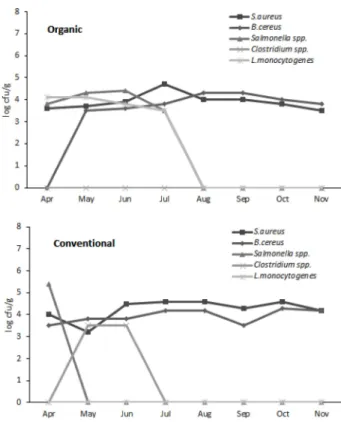
배추재배토양내 유해미생물의 분포를 주기적으로 분석 하였다(Fig. 6). 유기재배 토양의 경우 S. aureus와 B. cereus 는 생육기간동안 약 4.0 Log CFU/g으로 일정한 수준을 유 지하였으며, 유기 및 관행토양의 차이는 없었다. 유기배추 토양에서 Clostridium spp.은 검출되지 않았으며, 4월~7월 까지 Salmonella spp.와 Listeria monocytogenes가 약 4.0 Log CFU/g 수준으로 검출되었으며 이후 검출되지 않았다.
관행배추 토양에서는 4월에 5.4 Log CFU/g 의 Clostridium spp. 가 검출되었으나 이후 검출되지 않았으며, 5월~6월에 Clostridium spp. 가 검출되었으나 7월 이후 검출되지 않았 다. L. monocytogenes는 조사기간 동안 검출되지 않았다.
배추재배 토양의 유해미생물의 오염도는 발병량 이하로
낮은 수준이었다.
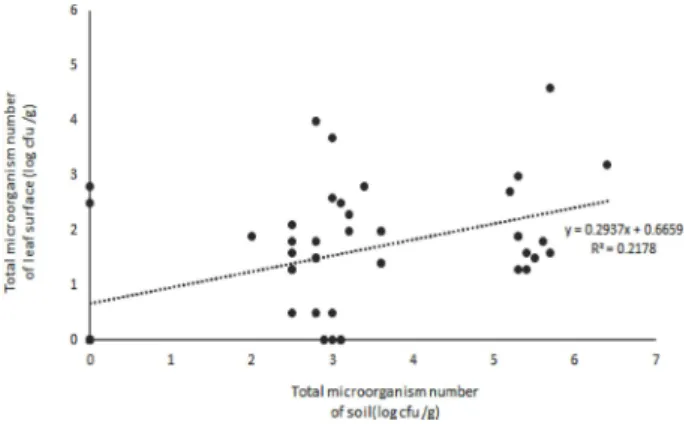
배추 생산시 토양과 식물체간 미생물 오염도 상관 배추의 미생물 밀도를 조사한 결과 재배 관리방법에 따 른 차이가 없었으므로 토양의 오염도와 배추의 유해미생 물 발생량간의 상관관계를 분석하였다(Fig. 7). 그 결과 토 양의 미생물 오염도가 높아질수록 엽채류의 미생물 오염 도도 높아지는 정의 상관관계가 있었다. 본 연구결과 배 추에서 유해미생물의 검출량은 식품에서의 허용한계치 이 하였으며, 일반농산물과 유기농산물의 차이는 없었다. 또 한 섭취 전 세척, 가공하는 과정에서 제거될 것으로 기대 되는 바 안전하다고 판단되었다. 그러나 토양의 위해균밀 도와 생산물의 오염도가 정의 상관관계가 있었으므로 생 산환경의 개선으로 위해미생물의 오염을 차단 및 오염율 을 더욱 저하시킬 수 있을 것이다.
배추 재배농법별 토양과 식물체의 중금속 함량 비교 잘 부숙된 발효퇴비의 사용시 토양내 중금속 함량을 경 감시키는데 효과가 인정된다는 보고
26)가 있다. 배추재배 토양 및 배추의 중금속함량을 분석하였다(Table 1). 모든 배추재배 토양에서 조사대상 중금속이 검출되지 않거나 기준치 이하로 검출되었는데, 유기농배추 토양에서의 중 금속 함량이 관행배추 토양보다 전체적으로 낮은 수치를 나타내었다. 유기농이나 관행의 배추 잎에서 관리대상 중 Fig. 5. Change of the numbers of sanitary indicating bacteria from
soil of kimchi cabbage farm according to the type of cultivation method. Organic: Farm use several environment friendly agricul- tural materials, Conventional: General farm to the chemical con- trol. AC: Total Aerobic Bacteria, EL: Environmental Listeria, CC: Coliforms, YM: Yeast & Molds.
Fig. 6. Change of the food poisoning bacteria numbers on soil
from organic and conventional farm growing kimchi cabbage.
금속인 카드뮴(Cd) 및 납(Pb)은 검출되지 않았다. Go 등
27)은 국내 유통 채소류의 납의 평균 함량은 0.001~0.026 mg/
kg, 카드뮴은 0.001~0.018 mg/kg 이라고 보고하였는데, 본 연구에서는 재배농법과 상관없이 모두 검출되지 않았다.
Acknowledgement
본 연구는 농촌진흥청 공동연구사업(과제번호: PJ010820) 의 지원에 의해 이루어진 것입니다.
국문요약
본 연구는 자가제조퇴비를 사용하는 유기농가와 관행농 가로 구분하여 생산되는 배추와 토양의 위생지표세균
(Aerobic plate count, coliform count, yeast & mold) 과 식 중독발병 가능성이 있는 유해미생물(Staphylococcus aureus, Environmental listeria, Bacillus cereus) 의 밀도를 분석하였 다. 그 결과, 토양과 식물체 모두 식품에서 위해균 허용한 계치인 5.0 Log CFU/g 이하로 검출되었다. 또한 토양에서 위해균 검출량과 식물체 표면의 위해균 검출량간의 상관 관계를 분석한 결과 정의 상관관계에 있었다. 또한 토양 과 식물의 중금속 오염도를 조사한 결과 검출되지 않거나 허용한계치 이하로 검출되었다.
References
1. Beuchat L.R.: Ecological factors influencing survival and growth of human pathogens on raw fruits and vegetables.
Microbes and Infection, 4, 413-423 (2002).
2. Erenstein O.: Crop residue mulching in tropical and semi- tropical countries: an evaluation of residue availability and other technological implications. Soil Till. Res., 67, 115-133 (2002).
3. Lai R.: Tillage and agricultural sustainability. Soil Till. Res., 20, 133-146 (1991).
4. Lee Y.H.: Evaluation of no-tillage rice cover crop cropping systems for organic farming. Korean J. Soil Sci. Fert., 43, 200-208 (2010).
5. Lammerding A.M.: An overview of microbial food safety risk assessment. J. Food Protect., 60, 1420-1425 (1997).
6. Stephenson J.: New approaches for detecting and curtailing foodborne microbial infections. J. Am. Med. Assoc., 277, 1337-1339 (1997).
7. Beuchat L.R., Harris L.R., Linda J., Ward T.E., Kajs T.M.:
Development of a proposed standard method for assessing the efficacy of fresh produce sanitizer. J. Food Protect., 64, 1103-1109 (2001).
8. Beuchat L.R.: Pathogenic microorganisms associated with fresh produce. J. Food Prot., 59, 204-216 (1996).
9. CDC. Centers for Disease Control and Prevention. The United States annual listing of foodborne disease outbreaks.
Available from: http://www.cdc.gov/foodborne outbreaks/
outbreak data.htm. Accessed Aug. 1 (2008).
10. Lomonaco S., Verghese B., Gerner-Smidt P., Tarr C., Glad- ney L., Joseph L., Katz L., Turnsek M., Frace M., Chen Y., Brown E., Meinersmann R., Berrang M., Knabel S.: Novel epidemic clones of Listeria monocytogenes, United States.
Emerg. Infect. Dis., 19, 147-150 (2013).
11. FDA. Fresh strawberries from washington county farm implicated in E. coli O157 outbreak in NW Oregon. Avail- able from: http://www.fda.gov/Safety/Recalls/ucm267667.
htm. Accessed Aug. 16 (2011).
12. Heaton J.C., Jones K.: Microbial contamination of fruit and vegetables and the behaviour of enteropathogens in the phyl- losphere: A review. J. Appl. Microbiol., 104, 613-626 (2008).
13. Frank C., Werber D., Cramer J.P., Askar M., Faber M., Heiden M., Bernard H., Fruth A., Prager R., Spode A., Wadl Fig. 7. Correlation between microorganism number on leaf sur-
face and microorganism number on soil. The coefficient between the microorganism number on leaf surface and microorganism number on harvest tools occurrence was calculated as 0.22.
Table 1. Concentrations of heavy metals detected in soil and plant body of kimchi cabbage from organic and conventional farming systems
Sample Heavy metal Results (mg/kg) Standard
z(mg/kg) Organic Conventional
Soil
Cd 0.4 ND 4.0
Cr6+ 0.7 0.4 5.0
Cu 2.8 12.8 150.0
Ni 1.8 5.3 100.0
Pb 6.4 8.1 200.0
Zn 50.2 82.3 300.0
As ND ND 25.4
Hg ND ND 4.0
Plant body Cd ND ND 0.2
Pb ND ND 0.3
z)
standard derived from www.law.go.kr.
y)