208
Copyright © 2016 The Korean Society of Fisheries and Aquatic Science pISSN:0374-8111, eISSN:2287-8815
서 론
가자미목
(Pleuronectiformes)
참서대과(Cynoglossidae)
어류 는열대및아열대해역에서식하는저서성어류로전세계적으 로3
속127
종(Menon, 1977; Munroe, 1998; Nelson, 2006),
국 내에는3
속8
종이보고되어있다(Kim and Choi, 1994; Kim et al., 2005).
참서대과어류는몸이매우측편되어있으며,
눈은 몸의왼쪽으로돌아가있고등지느러미및뒷지느러미가꼬리 지느러미와연결되어있는것이특징이다(Menon, 1977; Nel- son, 2006).
본과는2
아과로구분되는데,
주둥이가갈고리형으 로휘어진입이주둥이아래에있고유안측에측선이존재하면 참서대아과(Cynoglossinae),
주둥이가 갈고리형이아니고직 선형입이주둥이앞에있으며유안측에측선이없으면보섭 서대아과(Symphurinae)
로 구분된다(Chyung, 1977; Menon, 1977; Nelson, 2006).
국내에서는 용서대Cynoglossus ab- breviatus (Gray, 1835),
물서대Cynoglossus gracilis Günther,
1873b
및박대Cynoglossus semilaevis Günther, 1873a 3
종 이Jordan and Metz (1913)
에의해처음보고된이후보섭서대Symphurus orientalis (Bleeker, 1879),
흑대기Paraplagusia ja- ponica (Temminck and Schlegel, 1846),
참서대Cynoglossus joyneri Günther, 1878,
개서대Cynoglossus robustus Günther, 1873b,
칠서대Cynoglossus interruptus Günther, 1880
가추가 로보고되었다(Mori, 1928; Mori and Uchida, 1934; Uchida and Yabe, 1939; Mori, 1952).
하지만Yokogawa et al. (2008)
은국내에보고된칠서대의표본에C. interruptus
와함께Cyno- glossus ochiaii Yokogawa, Endo and Sakaji, 2008
가포함된 가능성을언급하며확인이필요하다고하였고, Yamada et al.
(2009)
은Yokogawa et al. (2008)
의결과를근거로칠서대의학 명을C. ochiaii
로제시하였다.
이와함께Lee et al. (2013)
은보 섭서대의 국내분포에의문을제기하였는데,
특히보섭서대는 형태기재없이목록으로처음우리나라에보고되었으며(Mori,
1928),
분류학적재검토연구에서도표본을확인하지못하였다형태 및 분자분석에 의한 한국산 참서대과 어류(가자미목) 2종의 재동정
권혁준 ∙ 김진구
1*
국립해양생물자원관, 1부경대학교 자원생물학과
Re-identification of Two Tonguefishes (Pleuronectiformes) from Korea using Morphological and Molecular Analyses
Hyuck Joon Kwun and Jin-Koo Kim1*
National Marine Biodiversity Institute of Korea, Seocheon 33662, Korea
1Department of Marine Biology, Pukyong National University, Busan 48547, Korea
The re-identification of two Korean tonguefishes, Cynoglossus interruptus and Symphurus orientalis , was carried out using eight specimens collected from Korean waters in 2007 and 2013. C. interruptus is characterized by having a single row of scales between rows connected to the supraorbital line and the middle lateral line, 107–113 dorsal fin rays, 86–89 anal fin rays, and 53–55 vertebrae. S. orientalis is characterized by having a 1-2-2-2-2 ID pattern, 97–100 dorsal fin rays, 83–89 anal fin rays, and 52–55 vertebrae. Molecular analysis using mitochondrial DNA Cytochrome Oxidase subunit I sequences showed that specimens of the two species corresponded well to Japanese C. interruptus and Taiwanese S. orientalis , respectively. Therefore, although several reports have raised questions regarding the distribution of C. interruptus and S. orientalis in Korean waters, morphological and molecular data confirm that these two species are indeed distributed in these waters.
Keywords: Cynoglossus interruptus , Symphurus orientalis , Re-identification, Korea, Morphological and molecular analyses
This is an Open Access article distributed under the terms of the Creative Commons Attribution Non-Commercial Licens (http://creativecommons.org/licenses/by-nc/3.0/) which permits unrestricted non-commercial use, distribution, and reproduction in any medium, provided the original work is properly cited.
http://dx.doi.org/10.5657/KFAS.2016.0208 Korean J Fish Aquat Sci 49(2) 208-213, April 2016
Received 22 December 2015; Revised 4 March 2016; Accepted 21 March 2016
*Corresponding author: Tel: +82. 51. 629. 5927 Fax: +82. 51. 629. 5931 E-mail address: [email protected]
(Kim and Choi, 1994).
또한칠서대도목록으로만처음보고되 었으며(Mori, 1952),
표본에근거한기재와사진이있음에도불 구하고(Kim and Choi, 1994; Kim et al., 2005)
종의특징이명확하지않아정확한종확인이필요한실정이다
(Yokogawa et
al., 2008).
따라서본연구는국내에서처음으로형태및분자분석을통 해보섭서대와칠서대를재동정하여한국해역에분포하는것을 확인하였고상세히재기재하였다
.
재료 및 방법
칠서대
4
개체는2012
년10
월경상남도창원연안에서채집 되었으며,
보섭서대4
개체는2007
년4
월과2013
년3
월제주 및전라남도신안연안에서채집되었다(Fig. 1).
계수및계측은Hubbs and Lagler (2004)
과Munroe (1992)
를따라버니어캘리퍼스를이용하여
0.1 mm
단위까지측정하였다.
지느러미줄기수및척추골수는
Soft X-ray (Hitex HA-100, Japan; SOFT- EX M150, Japan)
를이용하여계수하였다.
등쪽담기골끝부분 이신경극사이에삽입된형태(Interdigitation pattern of dorsal- fin pterygiophores and neural spines: ID)
는Munroe (1992)
를따라확인하였다.
본연구에사용된표본은부경대학교(Pu- kyong National University, Korea: PKU)
에등록및보관하였 다.
분자분석을위한DNA
추출과중합효소연쇄반응은Kwun and Kim (2013)
을 따라 수행하였으며,
미토콘드리아DNA Cytochrome Oxidase Subunit I (COI)
영역을증폭하기위해VF2 (5`-TCAACCAACCACAAAGACATTGGCAC-3`)
와FR1d (5`-CACCTCAGGGTGTCCGAARAAYCARAA-3`) Primer
를이용하였다(Ward et al., 2005; Ivanova et al., 2007).
염기서열은
DDBJ/EMBL/GenBank database
에 등록하였다(accession numbers: KU234514–KU234519).
염기서열 정 리는BioEdit version 7 (Hall, 1999)
의ClustalW (Thompson et al., 1994)
를이용하였으며,
비교어종으로는참서대과에속 한C. abbreviatus (GQ380410), C. interruptus (JF952714), C.
joyneri (GU479053), C. robustus (HM180553), C. semilaevis (FJ797309), P. japonica (JQ639066), S. orientalis (JN678778)
를선택하였다.
유전적거리는MEGA6 (Tamura et al., 2013)
의Kimura 2-parameter
모델을이용하여계산하였다. Neigh- bor joining (NJ) tree
는MEGA6 (Tamura et al., 2013)
를이용 하여작성하였으며, bootstrap
은10,000
번수행하였다.
결과 및 고찰
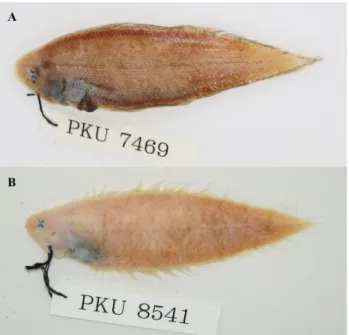
Cynoglossus interruptus Günther, 1880 (
국명:
칠서대) (Fig. 2A)
Cynoglossus interruptus Günther, 1880: 70 (type locality:
Yokohama, Japan; Syntype: BMNH 1879.5.14.92); Kim and Choi, 1994: 805 (Busan, Yeosu); Kim et al., 2005: 488 (south- ern sea of Korea); Yamada and Yagishita, 2013: 1694 (Japan, Taiwan, East China Sea).
Fig. 1. Collecting sites of Cynoglossus interruptus (●) and Sym-
phurus orientalis (■). Fig. 2. (A) Cynoglossus interruptus, PKU 7469, 108.2 mm SL; (B) Symphurus orientalis, PKU 8541, 99.6 mm SL.
Areliscus interruptus: Mori, 1952: 184 (Busan); Chyung, 1977: 581(Busan).
Cynoglossus ochiaii (not of Yokogawa, Endo and Sakaji):
Yamada et al., 2009: 645 (in part; southern sea of Korea).
표본
: PKU 7469-7472, 4
개체,
체장96.1-122.1 mm,
경상남 도창원, 2012
년10
월12
일.
기재
:
몸은타원형으로약간길고심하게측편되어있다.
주둥 이는갈고리모양으로앞쪽부분은약간뾰족하다.
유안측콧구 멍은1
쌍으로전비공은관형,
후비공은구형이다.
입은작고주 둥이아래에있으며,
촉모(fringes)
가없다.
무안측에는가늘고 작은원뿔니가2-3
열있으며,
유안측에는이빨이없다.
눈은작 고양안간격은매우좁다.
등지느러미기점은주둥이앞쪽부분 에서시작한다.
뒷지느러미기점은배지느러미뒤에서시작하 며,
배지느러미와막으로연결되어있다.
꼬리지느러미는약간 뾰족하며,
등지느러미및뒷지느러미뒷부분과부드럽게연결 되어있다.
가슴지느러미는없다.
유안측에는2
개의측선이있 으며중앙측선은꼬리지느러미앞까지발달되어있고,
등쪽측 선은불완전하게발달되어있다.
머리에는다방향으로분지된 측선이발달되어있다.
안상선(supraorbital line)
과중앙측선 사이에는1
열의비늘열이있다.
유안측과무안측모두머리와 몸은작은빗비늘로덮여있다.
체색
:
유안측머리와몸은갈색이며,
무안측은전체적으로흰 색에등쪽과배쪽은황색을띠고반점이없다.
등지느러미와뒷 지느러미는반투명한갈색이며깨알같은점이있다.
분포
:
우리나라부산,
여수,
창원(Kim and Choi, 1994; Kim et al., 2005;
본연구),
대만(Shen, 2001),
일본(Yamada and Ya-
gishita, 2013),
중국(Menon, 1977).
분자분석
:
참서대과어류2
종6
개체로부터얻은미토콘드리 아DNA COI
영역603 bp (base pair)
를이용하여분석한결과,
칠서대4
개체는일본산C. interruptus
와유전거리가0.3-1.2%
로최소였으며
,
같은개서대속에포함된4
종(
개서대,
박대,
용서 대,
참서대)
과는22.2-25.9%
로큰차이를나타내었다.
또한다 른속인흑대기속의흑대기및보섭서대속의보섭서대와도각 각24.1-24.9%
및32.1-32.7%
로큰차이를나타내었다.
미토콘 드리아DNA COI
영역을이용한neighbor-joining
분석에서칠 서대4
개체는C. interruptus
와유집되었으며,
같은개서대속4
종,
흑대기속의흑대기및보섭서대속의보섭서대와는잘분리 되었다(Fig. 3).
부기
:
한국연안에서 채집된칠서대4
개체는C. interruptus
의원기재(Günther, 1880)
및모식표본의형태적특징(
등지느 러미줄기106
개,
척추골52
개,
유안측측선2
개)
과거의일치 하였으며, Kim and Choi (1994)
및Yokogawa et al. (2008)
의 표본과도잘일치하였다(Table 1).
칠서대는Mori (1952)
에의 해처음우리나라에보고되었으며, Areliscus interruptus
로기 록되었다.
이후Kim and Choi (1994)
는Menon (1977)
의연 구에근거하여Cynoglossus
속으로변경하였다. Yokogawa et al. (2008)
은C. interruptus
와매우유사한Cynoglossus ochiaii
를 신종으로보고하면서국내에보고된칠서대에는C. inter- ruptus
와함께C. ochiaii
가섞여있는것으로생각하였으며C.
ochiaii
의국내분포확인이필요하다고언급하였다.
왜냐하면C. interruptus
와C. ochiaii
는중앙측선과안상선사이의비늘 열(C. interruptus
는1
열vs. C. ochiaii
는없음)
및유안측측선Cynoglossus interruptus (PKU 7470) Cynoglossus interruptus (PKU 7472) Cynoglossus interruptus (PKU 7469) Cynoglossus interruptus (PKU 7471)
Cynoglossus interruptus (JF952714) Cynoglossus robustus(HM180553) Paraplagusia japonica (JQ639066) Cynoglossus joyneri (GU479053)
Cynoglossus abbreviatus(GQ380410) Cynoglossus semilaevis(FJ797309)
Symphurus orientalis (JN678778) Symphurus orientalis (PKU 916)
Symphurus orientalis (PKU 8541) 100
99 75 70
100 77
0.05
Fig. 3. Neighbor-joining tree of the mitochondrial DNA for Cynoglossus interruptus, Symphurus orientalis, and comparative Cynoglossidae species. Numbers at branches indicate bootstrap probabilities in 10,000 bootstrap replications. Bar indicates genetic distance of 0.05.
수
(2
개vs. 3
개)
로구분하였는데(Yokogawa et al., 2008), Kim and Choi (1994)
는한국산칠서대의측선수를2-3
개로제시하 였기때문이다.
이후Yamada et al. (2009)
은Yokogawa et al.
(2008)
을따라우리나라남해에분포하는칠서대의측선수를3
개로표현하고학명을
C. ochiaii
로제시하였다.
하지만본연구 결과,
우리나라에서채집된개체는중앙측선과안상선사이에1
개의비늘열이존재및유안측에2
개측선이관찰되었다.
또한 분자분석결과에서도일본산C. interruptus
와98.8-99.7%
로잘 일치하여우리나라에보고된칠서대는C. ochiaii
가아니라C.
interruptus
가확실하다는것을명확히밝혔다.
Symphurus orientalis (Bleeker 1879) (
국명:
보섭서대) (Fig. 2B)
Aphoristia orientalis Bleeker, 1879: 31 (type locality: Japan;
Neotype: BSKU 44238).
Symphurus orientalis: Mori, 1928: 8 (listed; Korea); Mori and Uchida, 1934: 33 (Busan); Mori, 1952: 183 (Busan);
Chyung, 1977: 582 (Busan); Son, 1980: 409 (eastern sea of
Korea); Kim and Choi, 1994: 810 (eastern sea of Korea); Kim et al., 2005: 490 (Busan); Lee et al., 2013: 383 (Taiwan, Japan, East and South China Sea); Yamada and Yagishita, 2013: 1698 (Japan, East China Sea).
Symphurus novemfasciatus Shen and Lin, 1984: 8 (type lo- cality: Dong-Gang, Taiwan; Holotype: NTUM 04586).
표본
: PKU 916-918, 3
개체,
체장95.2-112.4 mm:
제주도제 주, 2007
년4
월24
일; PKU 8541, 1
개체,
체장99.6 mm,
전라남 도신안, 2013
년3
월15
일.
기재
:
몸은타원형으로약간길고심하게측편되어있다.
주둥 이는갈고리모양이아니며앞쪽부분은약간뾰족하다.
유안측 콧구멍은1
쌍으로전비공은관형,
후비공은구형이다.
입은작 고주둥이앞쪽에있으며,
촉모(fringes)
가없다.
무안측에는작 은원뿔니가3-4
열로있으며,
유안측에도가늘고작은원뿔니 가1
열로있다.
눈은작고양안간격은매우좁다.
등지느러미기 점은눈위에서시작한다.
뒷지느러미기점은배지느러미뒤에 서시작하며,
배지느러미와분리되어있다.
꼬리지느러미는약 간뾰족하며,
등지느러미및뒷지느러미뒷부분과부드럽게연 결되어있다.
유안측몸에는측선이없다.
유안측과무안측모두 Table 1. Meristic and morphometric characters of two cynoglossid fishesCynoglossus interruptus Symphurus orientalis
Present study Günther (1880) Kim and Choi (1994) Yokogawa et al.
(2008) Present study Lee et al. (2013)3
Number of specimens 4 1 19 56 4 94
Standard length (mm) 96.1-122.1 152.41 119.3-156.6 63.0-153.0 95.2-112.4 54.7-109.0 Counts
Dorsal fin rays 107-113 106 106-113 105-114 97-100 96-101
Anal fin rays 86-89 - 84-89 81-91 83-89 82-89
Pelvic fin rays 4 - 4 4 - 4
Caudal fin rays 9-10 - 9-10 9-10 12 11-12
Lateral line scales - 78 64-74 60-75 - 87-99
Vertebrae 53-55 522 50-53 51-55 52-55 52-55
Measurements (In % of SL)
Head length 19.7-21.1 - 19.1-21.6 17.3-22.1 17.1-19.6 17.4-21.6
Body depth 27.3-29.0 - 26.6-31.4 23.7-30.4 25.6-28.2 24.2-28.8
Preanal length 25.0-27.1 - - - 23.8-28.5 21.0-25.6
(In % of HL)
Snout length 30.0-36.5 - 33.3-40.4 25.7-40.0 21.6-29.4 17.2-22.1
Interorbital width 0.0-2.0 - - - 3.0-3.5 -
Eye diameter 12.3-15.1 - 9.3-13.4 11.6-20.5 6.6-14.1 9.7-12.6
Pelvic fin length 22.3-30.5 - - - 31.5-44.1 -
1Translated original description data from inch into millimeter. 2Counted from radiograph of syntype provided by Natural History Museum homepage. 3Including Symphurus orientalis neotype and S. novemfasciatus holotype.
빗비늘로덮여있다
.
등쪽담기골의삽입형태는1-2-2-2-2
이다.
체색:
유안측머리와몸은밝은갈색에다수의불명확한어두 운갈색무늬가있으며,
무안측은전체적으로흰색에반점이없 다.
등지느러미와뒷지느러미는반투명한옅은갈색이며반점 이없다.
분포
:
우리나라제주도,
신안(Kim et al., 2005,
본연구),
대 만(Shen, 2001; Lee et al., 2013),
일본(Yamada and Yagishita, 2013).
분자분석
:
참서대과어류2
종6
개체로부터얻은미토콘드리 아DNA COI
영역603 bp (base pair)
를이용하여분석한결과,
보섭서대2
개체는대만산S. orientalis
와유전거리가0.2-0.3%
로최소였으며
,
다른속인개서대속5
종(
개서대,
박대,
용서대,
참서대,
칠서대)
및흑대기속의흑대기와는각각30.6-35.9%
및31.1-31.4%
로큰차이를나타내었다.
미토콘드리아DNA COI
영역을이용한neighbor-joining
분석에서보섭서대2
개체는S.
orientalis
와유집되었으며,
개서대속5
종및흑대기속의흑대기 와잘분리되었다(Fig. 3).
부기
:
한국연안에서채집된보섭서대4
개체는S. orientalis
모 식표본의형태적특징(
등지느러미줄기98
개,
뒷지느러미줄 기87
개,
꼬리지느러미줄기12
개,
척추골54
개, ID 1-2-2-2-2)
과잘일치하였다(Lee et al., 2013; Table 1).
보섭서대는Mori (1928)
에 의해 처음 우리나라에 보고되었으며, Symphurus orientalis
로기록되었다.
본종은Mori (1928)
가보고한이후 우리나라어류목록에기록되어왔지만채집된기록이없으며(Kim and Choi, 1994),
최근에는Lee et al. (2013)
이S. orien-
talis
의재기재를수행하면서우리나라분포에대한의문을제기하였다
.
특히,
우리나라에보고된S. orientalis
의기재(Kim and Choi, 1994; Kim et al., 2005)
는2
종이상이포함된Ochiai (1959)
의기재를인용한것이며, Kim et al. (2005)
이제시한사 진역시S. orientalis
가아니라고언급하였다(Lee et al., 2013).
하지만본연구에서는형태및분자분석을통해우리나라에서 채집된종이
S. orientalis
인것을확인할수있었다.
보섭서대속 어류의경우,
등쪽담기골끝부분이신경극사이에삽입된형 태를분류형질로이용하는데(Munroe, 1992, 1998; Munroe et al., 2011),
우리나라에서채집된개체는ID 1-2-2-2-2
를나타내 어Lee et al. (2013)
이제시한S. orientalis
의삽입형태(
대부분ID 1-2-2-2-2)
와일치하였다.
이와함께분자분석결과에서도Lee et al. (2013)
이제시한S. orientalis
와99.7-99.8%
로잘일 치하여우리나라해역에S. orientalis
가분포하는것이명확히 확인되었다.
다만, Son (1980)
은보섭서대가우리나라동해에 분포한다고보고하였지만표본이확인되지않아추후지속적인 모니터링을통한표본확보및분포확인이필요하다.
사 사
이논문은
2016
년국립해양생물자원관재원으로지원을받아수행된연구임
(
관리번호2016M00200).
References
Bleeker P. 1879. Énumerátion des espèces de poissons actuel- lement connues du Japon et description de trois espèces inédites. Verhandelingen der Koninklijke Akademie van Wetenschappen, Afdeeling Natuurkunde 18, 1-33.
Chapleau F. 1988. Comparative osteology and intergeneric re- lationships of the tongue soles (Pisces; Pleuronectiformes;
Cynoglossidae). Can J Zool 66, 1214-1232. http://dx.doi.
org/10.1139/z88-177
Chyung MK. 1977. The Fishes of Korea. Ilji Publishing, Seoul, Korea.
Gray JE. 1835. Illustrations of Indian Zoology; Chiefly Selected from the Collection of Major-General Hardwicke, F.R.S.
Treutel, Würtz, Treuttel, Jun. and Richter, London.
Günther A. 1873a. On a collection of fishes from Chefoo, north China. Ann Mag Nat Hist Ser 4 12, 377-380. http://dx.doi.
org/10.1080/00222937308680784
Günther A. 1873b. Report on a collection of fishes from Chi- na. Ann Mag Nat Hist Ser 4 12, 239-250. http://dx.doi.
org/10.1080/00222937308680749
Günther A. 1878. Notes on a collection of Japanese sea- fishes. Ann Mag Nat Hist Ser 5 1, 485-487. http://dx.doi.
org/10.1080/00222937808682368
Günther A. 1880. Report on the shore fishes procured during the voyage of H.M.S. Challenger in the years 1873-1876.
Zoology 1, 1-82.
Hall TA. 1999. BioEdit: a user-friendly biological sequence alignment editor and analysis program for Windows 95/98/
NT. Nucl Acids Symp Ser 41, 95-98.
Hubbs CL. and Lagler KF. 2004. Fishes of the Great Lakes Re- gion. Revised ed. Michigan Univ. Press, Ann Arbor, USA.
Ivanova NV, Zemlak TS, Hanner RH and Hebert PDN. 2007.
Universal primer cocktails for fish DNA barcoding. Mol Ecol Notes 7, 544-548. http://dx.doi.org/10.1111/j.1471- 8286.2007.01748.x
Jordan DS and Metz CW. 1913. A catalog of the fishes known from the waters of Korea. Mem Carnegie Mus 6, 1-65.
http://dx.doi.org/10.5962/bhl.title.42936
Kim IS and Choi Y. 1994. A taxonomic revision of the fam- ily Cynoglossidae (Pisces, Pleuronectiformes) from Korea.
Bull Korean Fish Soc 27, 803-813.
Kim IS, Choi Y, Lee CL, Lee YJ, Kim BJ and Kim JH. 2005. Il- lustrated Book of Korean fishes. Kyohak Publishing, Seoul, Korea.
Kwun HJ and Kim JK. 2013. Molecular phylogeny and new classification of the genera Eulophias and Zoarchias (Pi- sces, Zoarcoidei). Mol Phylogenet Evol 69, 787-795. http://
dx.doi.org/10.1016/j.ympev.2013.06.025
Lee MY, Munroe T and Shao KT. 2013. Symphurus orientalis (Bleeker) redefined based on morphological and molecular characters (Pleuronectiformes: Cynoglossidae). Zootaxa
3620, 379-403. http://dx.doi.org/10.11646/zootaxa.3620.3.3 Menon AGK. 1977. A systematic monograph of the tongue
soles of the genus Cynoglossus Hamilton-Buchanan (Pisces:
Cynoglossidae). Smithson Contr Zool 238, 1-129. http://
dx.doi.org/10.5479/si.00810282.238
Mori T. 1928. A catalogue of the fishes of Korea. J Pan-Pacific Res Inst 3, 3-8.
Mori T. 1952. Check list of the fishes of Korea. Mem Hyogo Univ Agric 1, 1-228.
Mori T and Uchida K. 1934. A revised catalogue of the fishes of Korea. J Chosen Nat Hist Soc 19, 1-23.
Munroe TA. 1992. Interdigitation pattern of dorsal-fin pterygi- ophores and neural spines, an important diagnostic character for symphurine tonguefishes (Symphurus: Cynoglossidae:
Pleuronectiformes). Bull Mar Sci 50, 357-403.
Munroe TA. 1998. Systematics and ecology of tonguefishes of the genus Symphurus (Cynogossidae: Pleuronectiformes) from the western Atlantic Ocean. Fish Bull 96, 1-182.
Munroe TA, Tyler J and Tunnicliffe V. 2011. Description and biological observation on a new species of deepwater sym- phurine tonguefish (Pleuronectiformes: Cynoglossidae:
Symphurus) collected at Volcano 19, Tonga Arc, West Pa- cific Ocean. Zootaxa 3061, 53-66.
Nelson JS. 2006. Fishes of the World. 4th ed. John Wiley and Sons Inc., Hoboken, New Jersey, USA.
Ochiai A. 1959. Morphology, Taxonomy and Ecology of the Soles of Japan. Laboratory of fisheries, Faculty of Science, Kyoto University, Kyoto, Japan.
Shen SC. 2001. Family Cynoglossidae. In: Fishes of Taiwan.
Revised ed. Shen SC, ed. National Taiwan University Press, Taipei, Taiwan, 578-581.
Shen SC and Lin WW. 1984. Some new records of fishes from Taiwan with descriptions of three new species. Taiwan Mus Spec Publ Ser 4, 1-25.
Son YH. 1980. The Fishes of East Sea of Chosen. Science Press, Pyeongyang, DPK.
Tamura K, Stecher G, Peterson D, Filipski A and Kumar S.
2013. MEGA6: Molecular evolutionary genetics analysis version 6.0. Mol Biol Evol 30, 2725-2729. http://dx.doi.
org/10.1093/molbev/mst197
Temminck CJ and Schlegel H. 1846. Pisces, Part 10-14. In:
Fauna Japonica, sive descriptio animalium quae in itinere per Japoniam suscepto annis 1823-30 collegit, notis obser- vationibus et adumbrationibus illustravit P. F. de Siebold, 173-269.
Thompson JD, Higgins DG and Gibson TJ. 1994. CLUSTAL W:
improving the sensitivity of progressive multiple sequence alignment through sequence weighting, position-specific gap penalties and weight matrix choice. Nucl Acids Res 22, 4673-4680. http://dx.doi.org/10.1093/nar/22.22.4673 Uchida KS and Yabe H. 1939. The fish fauna of Saisyu-to
(Quelpart Island) and its adjacent waters. J Chosen Nat Hist
Soc 25, 3-16.
Ward RD, Zemlac TS, Innes BH, Last PR and Hebert PDN.
2005. DNA barcoding Australia’s fish species. Philos Trans R Soc Lond B Biol Sci 360, 1847-1857. http://dx.doi.
org/10.1098/rstb.2005.1716
Yamada U, Tokimura K, Hoshino K, Deng S, Zheng Y, Li S, Kim YS and Kim JK. 2009. Names and Illustrations of Fish- es from the East China Sea and the Yellow Sea, -Japanese • Chinese • Korean-. Overseas Fishery Cooperation of Japan, Tokyo, Japan.
Yamada U and Yagishita N. 2013. Cynoglossidae. In: Fishes of Japan with Pictorial Keys to the Species. 3rd ed. Nakabo T, ed. Tokai University Press, Tokyo, Japan, 1693-1698.
Yokogawa K, Endo H and Sakaji H. 2008. Cynoglossus ochiaii, a new tongue sole from Japan (Pleuronectiformes: Cyno- glossidae). Bull Natl Mus Nat Sci Ser A Suppl 2, 115-127.