서 론
대주둥치과(Macroramphosidae) 어류는 큰가시고기목(Gas
tero steriformes) 또는 실고기목(Syngnathiformes)에 속하는 어 류로 전 세계적으로 3속 8종(Nelson et al., 2016), 일본에 1속 2 종 M. sagifue Jordan and Starks 1902, M. japonicus(Günther, 1861)(Senou, 2013), 대만에 1속 1종 M. scolopax(Linnaeus, 1758)(Shao et al., 2008), 한국에 1속 1종 M. scolopax(MABIK, 2018)이 보고되어 있다. 대주둥치과 어류는 측편된 몸, 높은 체 고, 전방으로 길게 뻗은 주둥이, 제1등지느러미 제2극조가 매우 긴 특징을 가지며(Nelson et al., 2016), 서부 대서양, 인도양, 태
평양의 온대 해역에 걸쳐 광범위하게 분포한다(Ehrich, 1976;
Bilecenoglu, 2006; Senou, 2013).
대주둥치속 어류에 대한 분류학적 연구는 어류학자들 간에 오 랜 기간 논쟁의 대상이 되어 왔다. Mohr(1937)은 체색, 등지느 러미 극조 길이를 기준으로 북서대서양에 서식하는 대주둥치과 어류를 2종, 즉 등지느러미 극조가 긴 M. scolopax 등지느러미 극조가 짧은 M. gracilis(Lowe, 1839)으로 분류하였으며, 북서 태평양에 보고된 M. sagifue와 M. japonicus를 각각 M. scolopax 와 M. gracilis의 동종이명으로 간주하였다. 이후 Okada and Suzuki(1951)는 등지느러미 극조 길이에서 중간 형태가 출현하 는 것을 근거로 M. sagifue, M. gracilis, M. japonicus를 모두 M.
scolopax의 단일종으로 동종이명 처리하였다. Erich(1976)도 대 주둥치속 어류의 등지느러미 극조 길이가 성장에 따라 바뀌는 것을 근거로 M. scolopax 한 종만을 인정하였다.
—199 — http://www.fishkorea.or.kr
저자 직위: 손민수(대학원생), 김진구(교수)
* Corresponding author: JinKoo Kim Tel: 82516295927, Fax: 82516295931, Email: [email protected] 부경대학교 자원생물학과
Discordance between Morphological and Molecular Variations of the Genus Macroramphosus(Macro
ramphosidae) from Korea by Min-Soo Sohn and Jin-Koo Kim* (Department of Marine Biology, Pukyong National University, Busan 48513, Republic of Korea)
ABSTRACT In order to clarify the taxonomic status of the Korean Macroramphosus species, which were previously confused, we investigated morphological and molecular variations of Macroramphosus(18 individuals) from Korea, and Macroramphosus(35 individuals) from Japan and Taiwan, and compared with those of M. scolopax from type locality(Mediterranean Sea). Although the Korean and Japanese specimens of Macroramphosus were clearly divided into two types in the first dorsal spine length(22.8~32.1% in A-type vs. 15.6~21.4% in B-type), distance between the first dorsal fin and second dorsal fin(6.4~9.7% vs. 8.6~13.3%), and body depth(20.0~28.0% vs. 17.3~
22.6%), no genetic differences among all individuals of longspine snipefish between them were found at the specific level [d=0.0~3.3% in control region(CR); 0.0~1.3% in cytochrome b(cyt b); 0.0~0.5%
in cytochrome c oxidase subunit I(COI)]. Whereas, they were well distinguished in genetics(9.9~11.5%
in CR; 3.8~4.6% in cytb; 1.2~3.6% in COI) from those of M. scolopax in Mediterranean Sea. It needs the scientific name of the longspine snipefish(M. scolopax) in Korea be changed as M. japonicus(and/
or M. sagifue). However, our results could not find evidence of consistency between morphological and mitochondrial DNA variations which suggests that their differentiation event may occur fairly recently. Further studies using more sensitive markers such as microsatellite are needed to clarify the degree of gene flow between the two types.
Key words: Longspine snipefish, M. japonicus, M. sagifue, M. scolopax, morphology, genetics, variations
반면, Clarke(1984)은 M. scolopax에 플랑크톤 섭식자와 저서 섭식자의 2개 생태형이 존재하고, 플랑크톤 섭식자가 저서 섭식 자보다 짧은 등지느러미 극조와 낮은 체고를 가진다고 보고하였 다. 이후 Miyazaki et al.(2004)은 Clarke(1984)와 비슷하게 유 어의 형태에서 두 형태형이 잘 구분되어 이를 근거로 북서태평 양 대주둥치에 형태 및 생태적으로 구분되는 2종(M. scolopax, M. gracilis) 이 존재할 것으로 주장하였다.
과거 연구들이 형태와 생태학적 관점에서 이루어진 반면 Robalo et al.(2009)은 분자 연구를 통해 두 형태형은 단순한 종 내 변이일 것으로 결론 내렸다. 또한 Noguchi et al.(2014)은 분 자 변이 연구에서 M. scolopax와 M. gracilis의 등지느러미 극 조 길이의 차이는 식성 및 서식지 차이에서 비롯된 것으로 간주 하였다. 그럼에도 불구하고, 일본에서는 여전히 대주둥치속에 2 종, M. sagifue 및 M. japonicus의 존재를 인정하고 있다(Senou, 2013). 따라서 북서태평양에 서식하는 대주둥치속 어류에 대한 보다 심도깊은 연구가 필요한 실정이다.
한편, 한국의 대주둥치속 어류에는 제1등지느러미 2번째 극 조 길이에 의거 M. sagifue(대주둥치)와 M. japonicus(붕대물 치) 2종이 보고된 바 있으나(Chyung, 1977), 이후 Youn(2002) 이 Linberg and Legeza(1959)를 따라 두 종을 M. scolopax로 변경하였고, 오늘날까지 인용되고 있다(Kim et al., 2005; NIBR, 2011; MABIK, 2018; Kim et al., 2019). 따라서, 여전히 분류학 적으로 혼란스러운 북서태평양에 서식하는 대주둥치속 어류를 실제 표본을 근거로 다양한 분석 기법을 이용한 종합적인 연구 가 수행될 필요가 있다.
미토콘드리아 DNA(mtDNA)는 비교적 빠른 진화속도와, 모 계유전의 특징을 가지고 있어 종의 차이를 식별하는 데 유용 한 방법으로 간주되어 왔다(Brown et al., 1979). MtDNA의 여 러 영역 중에서도 종식별 영역인 cytochrome c oxidase subunit I(COI) 또는 cytochrome b(cytb) 영역과, 비암호화 영역인 control region(CR) 영역이 지금까지 광범위하게 사용되어 왔다 (Wang et al., 2014; Zheng et al., 2015). 본 연구에서는 처음으 로 한국에 서식하는 대주둥치속 어류를 대상으로 mtDNA 세 영 역의 염기서열을 동시에 분석하고, 나아가 일본산 대주둥치속 2 종(M. sagifue, M. japonicus)과 NCBI에 등록된 북서대서양 및 지중해산 대주둥치(M. scolopax)의 염기서열을 비교하여, 처음 으로 한국에 서식하는 대주둥치속 어류의 정확한 분류학적 위치 를 구명하고자 한다.
재료 및 방법
1. 채집 및 형태 분석
본 연구에 사용된 대주둥치속 어류는 2012년 10월부터 2018 년 9월까지 한국의 남해 및 제주도에서 채집된 18개체를 대상
으로 하였다. 표본은 채집 후 10% 포르말린에 고정하고 수세 후 70% 에탄올로 교체하여 보관하였다. 형태 분류는 극조가 길게 신장되어, 제2등지느러미 후단을 넘는 Atype과 극조가 제2등지 느러미 선단부를 지나지 못하는 Btype으로 구분하였다(Fig. 1).
계측형질은 Bilecenoglu(2006)과 Senou(2013)을 따라 등지느 러미 극조의 길이를 포함한 총 22개의 형질을 계측하였고, 계측 형질의 명칭은 Bilecenoglu(2006)을 따랐다. 버니어캘리퍼스를 이용하여 0.01mm 단위까지 측정하였으며, 측정값은 체장과 두 장에 대한 백분율(%)로 환산하여 나타내었다. 비교 목적으로 일 본 국립자연사박물관(NMNS)에서 M. sagifue, 표본 29개체, 조 직 2개체, M. japonicus, 표본 6개체, 조직 2개체를 각각 대여받 아 비교 분석에 이용하였다.
2. 분자 분석
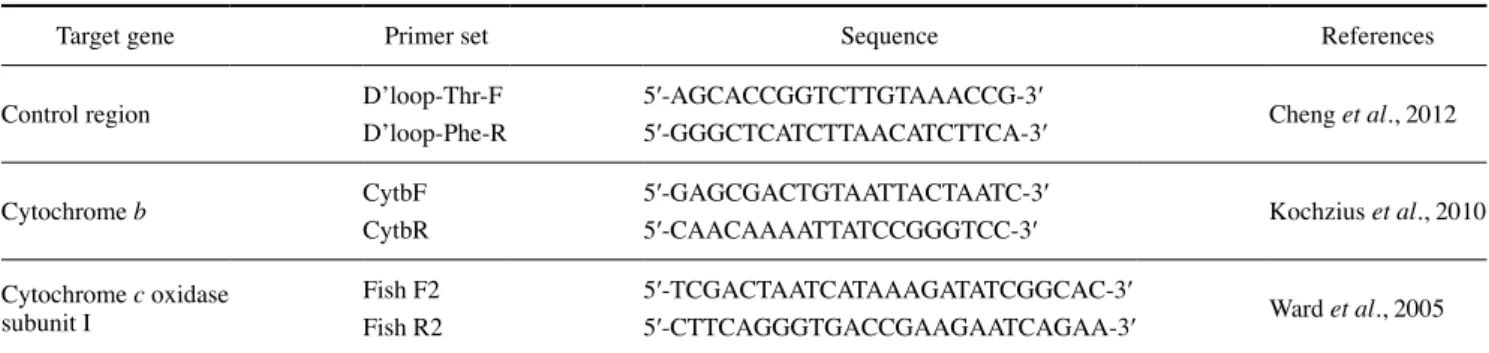
총 DNA는 10% Chelex 100 Resin(BioRad, USA)을 이용 하여 어체의 체측 근육에서 추출하였다. 중합효소연쇄반응은 미 토콘드리아 DNA control region(CR), cytochrome b(cytb), cytochrome c oxidase subunit I(COI)을 대상으로 진행했으며, 사용한 universal primer은 Table 1과 같다. 10X buffer 2μL, 2.5 mM dNTP 1.6μL, forward primer 1μL, reverse primer 1μL, TaKaRa EXTaq polymerase 0.1μL(TaKaRa Bio Inc., Japan) 을 넣은 혼합물에 총 DNA 2μL을 첨가한 후, 3차증류수를 넣어 total volume을 20μL로 맞추었다. 이 혼합물을 열반응기(Bio
RAD, USA)에 넣고 다음 조건에서 중합효소연쇄반응을 수행하 였다: 95℃에서 5분간 초기 변성; 다음의 조건(95℃에서 1분간 변성, 54℃에서 1분간 어닐링, 72℃에서 1분간 신장)에서 35회 반복; 72℃에서 5분간 최종 신장, 염기서열은 ABI 3730xl DNA Analyzer(Applied biosystem Inc., USA)에서 ABI PRISM BigDye Terminator v3.1 Ready Reaction Cycle Sequencing Kit (Applied BiosystermS Inc., USA)를 이용하여 얻었다. 염기서열 은 BioEdit version 7(Hall, 1999)의 cluster W(Tompson et al., 1994)를 이용하여 정렬하였다. 유전거리는 MEGA X(Kumar et al., 2018) Kimura2parameter 모델(Kimura, 1980)을 이용하여 계산하였으며, 계통도는 근린결합법(Neighbor joining method) 을 사용하여 구하였다. 또한, MrModeltest 2.3(Nylander, 2004) 을 이용하여 각 염기서열에 적합한 진화모델을 구한 후 최대 우도법(Maximum likelihood method)으로 계통도를 작성하였 다. COI은 HYK+G 모델(Tavare, 1986), cytb는 GTR+I 모델 (Tavare, 1986), CR은 HKY+I 모델(Tavare, 1986)이 적합한 것 으로 나타났다. 모든 부트스트랩은 1,000번 수행하였다. 모식산 지인 지중해 및 대서양에 서식하는 M. scolopax와 비교를 위해 National center for biotechnology information(NCBI)에서 CR (FJ457759457763), cytb(FN688351688358), COI(이탈리아:
KJ709552709556; 북서대서양: KF930099930100; 포르투갈:
JQ775064775067, JQ774658) 염기서열을 이용하였다. 또한, 대 만산 대주둥치 Btype은 대만의 중앙연구원(Academia Sinica, ASIZP)에서 관련 정보(사진, DNA 염기서열 등)를 수집하여 함 께 비교하였다.
3. 관찰 표본
1) 한국산 대주둥치 A-type
PKU 7879(어체 및 근육표본), 1개체, 남해(34°20′11.9″N 128°03′24.3″E), 2012년 10월 20일, 저층 트롤; PKU 79207923 (어체 및 근육표본), 4개체, 남해(34°01′25.3″N 127°09′11.8″E),
2012년 10월 21일, 저층 트롤; PKU 13599(어체 및 근육 표본), 1개체, 2016년 채집 정보 미상 저층 트롤; PKU 16411(어체 및 근육표본), 1개체, 제주시 한림읍(33°26′42.7″N 126°12′05.7″E), 2018년 10월 27일, 안강망; PKU 5940759418(어체 및 근육표 본), 7개체, 제주시(33°41′24.24″N 127°52′45.29″E), 2016년 10 월 12일, 저층 트롤; PKU 5954759548(어체 및 근육표본), 1개 체, 제주시(33°46′39.91″N 129°45′9.99″E), 2016년 10월 12일, 저층 트롤; MABIKPI00049039(어체 및 근육표본) 1개체, 여수 (34°61′99.75″N 127°83′31.42″E), 2018년 9월 17일, 외끌이 대 형저인망.
Fig. 1. Photos of Macroramphosus in Korea.(Above) Atype(considered as M. sagifue of Senou, 2013), PKU 59409, 94mm SL;(Below) Btype (considered as M. japonicus of Senou, 2013), MABIK P00049040, 117mm SL.
Table 1. Primers information used to amplify three mitochondrial regions in present study
Target gene Primer set Sequence References
Control region D’loopThrF 5′AGCACCGGTCTTGTAAACCG3′
Cheng et al., 2012 D’loopPheR 5′GGGCTCATCTTAACATCTTCA3′
Cytochrome b CytbF 5′GAGCGACTGTAATTACTAATC3′ Kochzius et al., 2010
CytbR 5′CAACAAAATTATCCGGGTCC3′
Cytochrome c oxidase
subunit I Fish F2 5′TCGACTAATCATAAAGATATCGGCAC3′
Ward et al., 2005
Fish R2 5′CTTCAGGGTGACCGAAGAATCAGAA3′
2) 한국산 대주둥치 B-type
PKU 8600(어체 및 근육표본), 1개체, 남해 미조항 (34°42′35.0″N 128°02′49.3″E), 2013년 4월 18일, 선망;
PKU 14054(어체 및 근육표본), 1개체, 부산시(35°02′23.4″N 129°03′08.2″E), 2017년 05월 26일, 선망; MABIKPI00049 040(어체 및 근육 표본), 1개체, 제주(33°43′81.77″N 126°22′
60.93″E) 2018년 9월 19일, 저인망.
3) 일본산 대주둥치 M. sagifue
NSMTP 102719(근육표본), 1개체, Fukusima Pref(36°59.76′
N 141°17.4′E), 2006년 8월 26일, otter trawl; NSMTP 103048 (근육표본), 1개체, Minamiise town, Mie Pref, 2010년 6월 10일;
NSMTP 107513107515(어체표본), 3개체, East China Sea, Nagasaki Pref(31°34.8′N 27°50.8′E), 2011년 4월 22일;
NSMTP 112121112122,112125(어체표본), 12개체, East China Sea, Kyushu(31°45.07′N 127°45.792′E), 2011년 8월 30 일, otter trawl; NSMTP 108300,108252(어체표본), 2개체, East China Sea, Kyushu(31°43.3′N 127°50′E), 2011년 8월 22일;
NSMTP 112123112124(어체표본), 10개체, East China Sea, Kyushu(31°45.81′N 127°44.582′E), 2012년 4월 24일, otter trawl.
4) 일본산 대주둥치 M. japonicus
NSMTP 118398(어체표본), 1개체, Kuroshio Town, Kochi Pref, 2014년 2월 17일; NSMTP 78225(어체표본) 4개체, Suruga bay, Shizuoka Pref, 1986년 4월 1일, trawl; NSMTP 90913(어체 및 근육표본), 1개체, Tosa bay, Shikoku; NSMTP 101610(근육표본), 1개체, Tosa bay, Kochi Pref, 2010년 3월 8 일.
5) 대만산 대주둥치 B-type
ASIZP0800690800072, 3개체, Daxi, Yilan, Taiwan, 2004년 7월 19일, 저층트롤.
결 과
1. 분자 분석
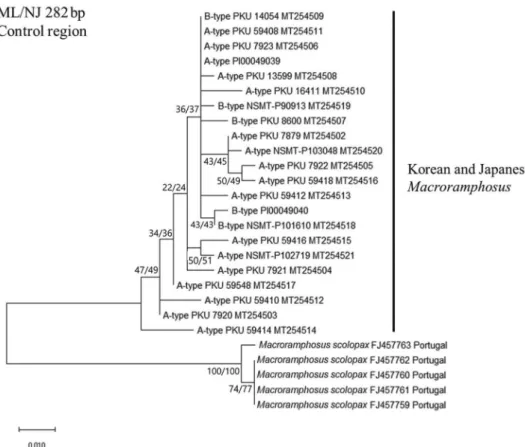
한국산 대주둥치 Atype, Btype을 일본에서 대여한 대주둥 치 M. sagifue, M. japonicus의 염기서열과 비교한 결과, CR(282 bp)에서 유전거리 0.0~3.3%로 거의 차이가 없으나, 북서대서양 M. scolopax와는 유전거리 9.9~11.5%로 현저한 차이를 보였다 (Fig. 2). 또한 cyt b(404bp)에서는 한국 및 일본산 대주둥치 두
Fig. 2. ML/NJ tree based on mtDNA CR sequences showing the relationship between Atype(considered as M. sagifue of Senou, 2013), Btype (considered as M. japonicus of Senou, 2013) and M. scolopax.
형태형 사이의 유전거리는 0.0~1.3%로 차이가 없으나, 북서대 서양 M. scolopax와는 3.8~4.6%로 명확히 구분되었다(Fig. 3).
COI(508bp)에서는 한국 및 일본산 대주둥치 두 type 사이의 유 전거리는 0.0~0.5%로 차이가 없으나, 북서대서양 및 지중해에 서식하는 M. scolopax와는 1.2~3.6%로 잘 구분되었다(Fig. 4).
이처럼 한국산 대주둥치 두 type(Atype, Btype)은 CR, cyt b, COI 영역에서 유전적 차이를 확인할 수 없었으나, 이와는 달리 북서대서양에 서식하는 M. scolopax와는 명확히 구분되었다.
2. 형태 분석
한국산 대주둥치의 Atype, Btype과 일본에서 대여한 M.
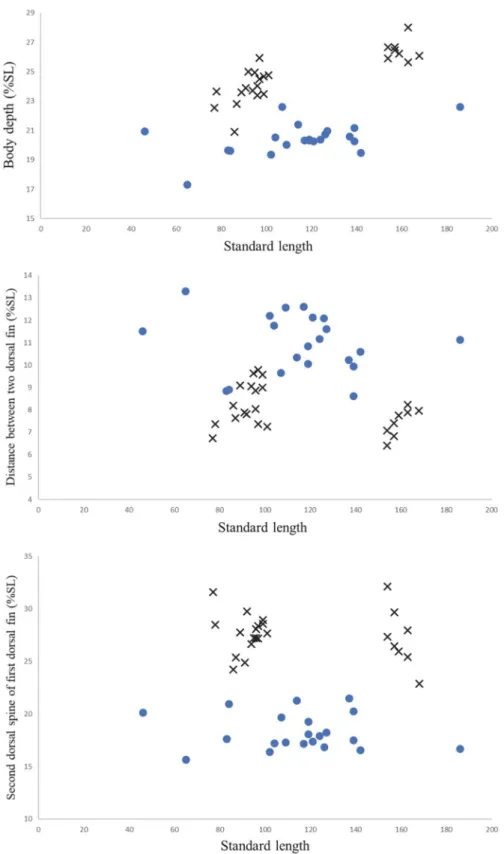
sagifue, M. japonicus의 22개의 계측형질 분석 결과, 두 type 은 제1등지느러미 극조의 길이(Atype은 22.8~32.1%, Btype 은 15.6~21.4%), 제1등지느러미와 제2등지느러미 사이 길 이(Atype은 6.4~9.7%, Btype은 8.6~13.3%), 체고(Atype 은 20.0~28.0%, Btype은 17.3~22.6%)에서 잘 구별되었으나 (Table 2, Fig. 5), 계수형질에서는 두 type이 중복된 계수범위를 나타내었다(Table 3).
고 찰
대주둥치속 어류는 제1등지느러미 제2극조의 길이와 형태에 따라 대서양에는 M. scolopax 및 M. gracilis 두 종이(Carneiro et al., 2019) 일본에는 M. sagifue, M. japonicus 두 종이(Senou, 2013), 우리나라에도 과거 M. sagifue, M. japonicus의 두 종 이 인정받았으나(Chyung, 1954, 1961, 1977) 최근 M. scolopax 한 종만이 인정받고 있다(Yoon, 2002; NIBR, 2011; MABIK, 2018). 그러나 대주둥치속의 극조의 형태 및 길이에 따라 종 을 분류하는 데 있어 학자들 간에 이견이 많아(Miyazaki et al., 2004; Noguchi et al., 2014; Senou, 2013), 본 연구를 통해 한국 산 대주둥치속의 학명을 재조명하고자 하였다.
계측형질에서 한국 및 일본산 대주둥치속 어류는 제1등지 느러미 제2극조가 긴 Atype과 짧은 Btype으로 구분되었다 (Fig. 5). 한국에 서식하는 대주둥치속 어류 두 type의 계측형질 을 대서양에 서식하는 M. scolopax, M. gracilis 및 일본에 서식 하는 M. sagifue, M. japonicus와 비교하였을 때, Atype은 M.
scolopax, M. sagifue, Btype은 M. gracilis, M. japonicus와 잘 일치하는 경향을 보였다(Table 2). 한편, 두 type의 계수형질은 Fig. 3. ML/NJ tree based on mtDNA cyt b sequences showing the relationship between Atype(considered as M. sagifue of Senou, 2013), Btype (considered as M. japonicus of Senou, 2013) and M. scolopax.
유의미한 차이를 확인할 수 없었으며, 나아가 지중해에 서식하 는 M. scolopax 및 M. gracilis와 태평양에서 보고된 M. sagifue 및 M. japonicus의 원기재와 비교하였을 때 대부분 중복되었다 (Table 3). 일반적으로 종을 분류하는 데 있어 계수형질이 중요 하게 적용되지만, 대주둥치속 어류는 종에 관계없이 중복된 범 위를 보여 분류형질로 사용하기 어려웠다.
대서양에 서식하는 대주둥치속 어류에는 등지느러미 극조 가 길고, 뒤에 소극이 존재하는 M. scolopax와 등지느러미 극조 가 짧고 소극이 존재하지 않는 M. gracilis 두 종이 알려져 있다 (Bilecenoglu, 2006; Carneiro et al., 2019). 북서태평양에 서식 하는 대주둥치속 어류 또한 등지느러미 극조의 길이 및 형태로 M. sagifue, M. japonicus로 구분된다(Senou, 2013). 본 연구에 서 나타난 대주둥치 극조의 두 type(Atype, Btype)은 분포지 역에서 멀리 떨어진 지역임에도 불구하고 북서태평양과 대서 양에서 모두 보고된 바 있으며(Miyazaki et al., 2004; Robalo et al., 2009), 이와 관련으로 Clark(1984)와 Miyazaki et al.(2004) 은 등지느러미 극조가 길고, 체고가 높은 형태를 바닥에서 저 서동물을 섭이하는데 적응된 형태, 등지느러미 극조가 짧고, 체
고가 낮은 형태를 중층에서 플랑크톤을 섭이하는 데 적응된 형 태로 간주하였다. 또한 Kuranga and Sasaki(2000)는 두 대양 의 대주둥치속 어류가 자어의 꼬리지느러미 길이(일본산은 척 색장 2.48mm에서 전장의 44.4%, 지중해산은 척색장 2.68mm 에서 전장의 33.6%) 및 체측 표면의 극의 발달시기에서 차이 가 있음을 보고하였다. 즉, 일본에 서식하는 대주둥치속 어류는 M. scolopax(모식산지: 지중해)와 별종임을 암시한다. 분포 지 역에서 멀리 떨어진 지역임에도 불구하고 두 종간 유사한 계수 범위와 외부형태를 보이는 것은 그들 사이의 비슷한 먹이 선택 에서 비롯된 진화의 결과로 사료된다(Matthiessen et al., 2003;
Miyazaki et al., 2004).
한국산 대주둥치속 두 type을 지중해산 M. scolopax와 염기 서열을 비교한 결과, COI에서 1.2~3.6%, cyt b에서 3.8~4.6%, CR에서 9.9~11.5%의 차이로 확인되었다. Robalo et al.(2009) 은 북대서양 및 지중해에 서식하는 두 종(M. scolopax, M.
gracilis)의 mtDNA CR과 nDNA S7 영역의 염기서열을 분석 한 결과, 형태와 상관없이 두 종이 모두 유집되는 결과를 나타 내었다. Robalo et al.(2009)과 유사하게, 일본산 대주둥치속 어 Fig. 4. ML/NJ tree based on mtDNA COI sequences showing the relationship between Atype(considered as M. sagifue of Senou, 2013), Btype (considered as M. japonicus of Senou, 2013) and M. scolopax, M. gracilis.
류에서는 유전적으로 구분되지 않았으나, 두 대양 사이에는 의 미 있는 유전적 차이가 보고된 바 있다(Noguchi et al., 2014).
이후 Noguchi et al.(2016)은 유전적 차이와 함께 형태적 차이 를 보고하면서, 두 대양의 대주둥치속 어류는 명확히 구분되어 야 한다고 주장하였고, 이에 따라 Senou(2013)는 유전적인 차 이는 없지만, 명확한 형태적 및 생태적으로 구별되는 두 종으 로 인정하였다. 따라서 본 연구결과, 두 type 간 mtDNA 염기
서열에서 의미있는 차이는 발견하지 못했으나, 형태 및 생태에 서 구분되고(Miyazaki et al., 2004; Noguchi et al., 2014; 본 연 구), 나아가 지중해산 M. scolopax와 형태(Kuranga and Sasaki, 2000; Noguchi et al., 2016) 및 유전(Noguchi et al., 2014; 본 연구)에서 구분되는 점에 근거하여, 한국산 대주둥치의 학명을 Yoon(2002)이 제시한 M. scolopax에서 M. japonicus(및/또는 M. sagifue)로 변경함이 타당해 보인다. 최근 mtDNA에서 정확
Number of specimens 15 14 3 17 9 16
Standard length(mm) 91.0~101.0 77.0~168.0 51.0~117.0 83.0~186.0 56.0~106.0 43.0~106.0 In % of standard length
Head length 45.1~46.9 44.1~49.6 42.8~45.6 44.4~48.0 44.8~49.1 42.2~50.2
Snout length 29.1~31.4 29.0~33.6 27.8~30.6 29.7~33.3 28.0~34.6 27.7~34.5
Postopercular body length 51.3~54.1 50.5~58.3 53.5~54.4 51.4~55.7 50.6~58.0 50.1~56.2
Body depth 23.3~25.9 20.0~28.0 17.3~20.9 19.3~22.6 21.7~26.9 18.5~22.1
Second dorsal spine of the first dorsal fin 24.8~29.7 22.8~32.1 15.6~20.1 16.4~21.4 21.4~32.1 13.1~23.7 Length before dorsal spine 68.6~72.2 66.9~73.5 62.5~67.6 66.0~69.8 21.9~29.4 16.4~24.2 Length after dorsal spine 26.5~29.4 24.~31.5 31.5~33.7 29.1~33.0 22.0~29.2 25.7~37.3
Preanus length 73.3~76.4 73.3~77.3 71.2~74.0 72.7~78.0 - -
Preanal fin length 75.5~79.1 76.8~80.4 75.3~78.0 74.6~80.2 - -
Pectoral fin length 11.7~15.4 12.0~15.2 11.9~12.8 11.6~14.7 - -
Pectoral fin base length 3.3~3.7 3.0~3.9 3.1~4.3 3.3~4.1 - -
Pelvic fin length 5.2~7.9 3.4~6.5 4.5~7.0 4.1~6.4 - -
Caudal peduncle depth 3.2~3.9 3.1~4.2 3.5~3.6 3.2~4.0 - -
Caudal peduncle length 7.9~9.5 6.3~8.0 8.0~9.8 6.3~9.0 - -
Distance between two dorsal fin 7.2~9.7 6.4~9.1 11.5~13.3 8.6~12.2 - -
Eye diameter 7.8~8.8 6.4~9.0 6.4~8.3 5.8~7.6 - -
First dorsal fin base length 6.8~8.1 5.6~7.5 5.1~6.6 5.5~7.8 - -
Second dorsal fin base length 5.5~7.5 4.7~6.6 4.1~5.7 3.9~6.2 - -
In % of head length
Eye diameter 17.0~19.5 13.3~19.0 14.4~18.1 12.6~16.5 16.7~21.4 14.5~18.0
Snout length 64.2~67.9 62.6~70.3 62.7~68.4 65.9~73.6 62.5~70.3 61.8~68.8
Postocular head length 16.0~18.3 14.6~18.4 18.4~21.3 16.8~21.7 14.2~17.3 14.7~21.9 In % of distance between the two dorsal fins
Eye diameter 82.8~110.7 82.4~132.6 51.3~72.0 54.8~87.7 165.3~249.1 58.2~99.1
In % of postocular head length
Eye diameter 93.7~107.7 88.7~112.7 78.6~85.0 67.4~92.2 103.1~135.5 79.1~99.5
In % of postopercular body length
Length of dorsal spine 46.0~55.8 44.5~61.8 29.2~37.6 30.0~39.6 39.7~59.1 26.1~42.7
Body depth 44.1~48.5 41.0~53.3 32.3~39.1 35.8~43.8 42.5~50.9 33.3~43.7
In % of length before the dorsal spine
Body depth 33.2~36.9 30.0~40.0 27.6~30.9 28.3~33.8 86.3~103.6 78.7~118.1
In % of length after the dorsal spine
Body depth 79.9~90.0 76.9~112.0 51.3~66.2 58.6~72.0 76.1~118.7 52.0~85.2
한 종의 식별이 불가능한 경우, AFLP, microsatellite와 같은 방 법을 사용하여 종을 식별한 연구결과가 있다(Kai et al., 2002;
Kai and Nakabo, 2008; Hsu and Lin, 2008; Muto et al., 2011,
2019). 따라서 대주둥치속에서 나타나는 유의한 형태적, 생태 적 두 type 간 유전적 교류의 정도를 파악하기 위해서는 보다 민감한 마커를 사용한 후속연구가 필요할 것이다.
Fig. 5. Percentage(% SL) of three morphometric characters with growth, showing clear separation between typeA(cross) and typeB(circle).
요 약
본 연구는 예전부터 혼란스러웠던 한국산 대주둥치속, Macro
ramphosus 어류의 분류학적 위치를 명확히 하기 위해, 한국산 18개체를 일본/대만산 35개체 및 지중해산 M. scolopax와 형태 및 분자 변이를 비교 분석하였다. 한국, 일본 및 대만산 대주둥 치속 어류는 제1등지느러미 극조 길이(Atype은 22.8~32.1%, Btype은 15.6~21.4%), 제1등지느러미와 제2등지느러미 사 이 길이(Atype은 6.4~9.7%, Btype은 8.6~13.3%), 체고 (Atype은 20.0~28.0%, Btype은 17.3~22.6%)에서 두 type 으로 명확히 구분되었으나, 유전적으로는 구분되지 않았다(CR 에서 0.0~3.3%, cyt b에서 0.0~1.3%, COI에서 0.0~0.5%). 한 편, 한국산 대주둥치는 지중해산 M. scolopax와 유전적으로 명 확히 구분되어(CR에서 9.9~11.5%, cyt b에서 3.8~4.6%, COI 에서 1.2~3.6%), 최근 사용하고 있는 학명 M. scolopax를 M.
japonicus(및/또는 M. sagifue)로 변경해야 할 것이다. 그러나, 본 연구에서 두 type 간 형태변이와 분자변이 간 일치성을 찾지 못했으며, 이는 아마도 그들간에 분화가 상당히 최근에 일어났 음을 시사한다. 두 type 간 유전자 교류 정도를 파악하려면 향후 microsatellite와 같은 보다 민감한 마커를 이용한 후속 연구가 필요할 것이다.
사 사
이 논문은 2019학년도 부경대학교 연구[II] 교원 지원사업에 의하여 연구되었습니다. 또한 이 논문의 완성도를 높여 주신 심 사위원께 감사드립니다.
REFERENCES
Bilecenoglu, M. 2006. Status of the genus Macroramphosus(Syn
gnathiformes: Centriscidae) in the eastern Mediterranean Sea. Zootaxa, 1273: 5564.
Brown, W.M., M. George and A.C. Wilson. 1979. Rapid evolution of animal mitochondrial DNA. Proc. Natl. Acad. Sci., U.S.A., 76: 19671971. https://doi.org/10.1073/pnas.76.4.1967.
Carneiro, M., R. Martins, F. Reiner and I. Bastista. 2019. Ichthyo
fauna of Portugal: Taxonomic diversity, common and sci
entific names of marine fishes. Vol. I. I.P.M.A., I.P., Lisbon, Portugal, 376pp.
Cheng, Y.Z., T.J. Xu, X.X. Jin, D. Tang, T. Wei, Y.Y. Sun and R.X. Wang. 2012. Universal primers for amplification of the complete mitochondrial control region in marine fish species. Mol. Biol., 46: 727730. https://doi.org/10.1134/
S0026893312040024.
Chyung, M.K. 1954. Korean fishes. Ministry of Trade, Seoul, Korea, p. 207.
Chyung, M.K. 1961. Illustrated encyclopedia the fauna of Korea(2) fishes. The ministry of Education, Seoul, Korea, pp. 298-299.
Chyung, M.K. 1977. The fishes of Korea. Iljisa, Seoul, Korea, pp.
269270.
Clarke, T.A. 1984. Diet and morphological variation in snipefishes, presently recognized as Macrorhamphosus scolopax, from southeast Australia: evidence for two sexually dimorphic species. Copeia, 1984: 595608. https://doi.org/10.2307/
1445140.
Ehrich, S. 1976. On the taxonomy, ecology and growth of Macroram
phosus scolopax(Linnaeus, 1758)(Pisces, Syngnathiformes) from the subtropical northeast Atlantic. Ber. Dt. Wiss. Kommn.
Meeresforsch., 24: 251266.
Hall, T.A. 1999. BioEdit: a userfriendly biological sequence align
Number of specimens 15 3 4 2 1 -
Standard length(mm) 91.0~101.0 51.0~117.0 - - - -
Character
Total vertebrae 22~24 23~24 - - - -
Total gill raker 15~20 18~23 - - - -
1st dorsal spine Ⅳ~Ⅴ Ⅳ~Ⅴ Ⅴ Ⅳ~Ⅴ Ⅴ Ⅳ~Ⅴ
2nd dorsal ray 10~12 8~12 12 11 12 11
Pectoral fin 14~17 13~16 - 16 14 15
Anal fin 17~19 17~18 18 or 19 18~19 18 17
Pelvic fin Ⅰ,4 Ⅰ,4 - 5 - Ⅰ,4
ment editor and analysis program for Windows 95/98/NT.
Nucleic. Acids. Symp. Ser., 41: 9598.
Hsu, T.H and K.H. Lin. 2008. Genetic relationship among four sub
species of cherry salmon(Oncorhynchus masou) inferred using AFLP. Mol. Phylogenet. Evol., 48: 776781.
Kai, Y. and T. Nakabo. 2008. Taxonomic review of the Sebastes inermis species complex(Scorpaeniformes: Scorpaenidae).
Ichthyol. Res., 55: 238259. https://doi.org/10.1007/s10228
00700297.
Kai, Y., K. Nakayama and T. Nakabo. 2002. Genetic differences among three colour morphotypes of black rockfish, Sebastes inermis, inferred from mtDNA and AFLP analysis. Mol.
Ecol., 11: 25912598. https://doi.org/10.1046/j.1365294X.
2002.01628.x.
Kim, I.S., Y. Choi, C.L. Lee, Y.J. Lee, B.J. Kim and J.H. Kim. 2005.
Illustrated book of Korean fishes. Kyohak Publishing Co.
Ltd., Seoul, Korea, 615pp.
Kim, J.K., J.H. Ryu, H.J. Kwon, H.S. Ji, J.H. Park, S.H. Myoung, Y.S.
Song, S.J. Lee, H.J. YU, S.E. Bae, S.H. Jang and W.J. Lee.
2019. Distribution map of sea fishes in Korean Peninsula.
Maple design, Busan, Korea, 541pp.
Kimura, M. 1980. A simple method for estimating evolutionary rates of base substitutions through comparative studies of nucleo
tide sequences. J. Mol. Evol., 16: 111120.
Kochzius, M., C. Seidel, A. Antoniou, S.K. Botla, D. Campo, A. Cariani and G. Hreggvidsson. 2010. Identifying fishes through DNA barcodes and microarrays. PLoS One, 5: e12620. https://doi.
org/10.1371/journal.pone.0012620.
Kumar, S., G. Stecher, M. Li, C. Knyaz and K. Tamura. 2018.
MEGA X: Molecular evolutionary genetics analysis across computing platforms. Mol. Biol. Evol., 35: 15471549.
https://doi.org/10.1093/molbev/msy096.
Kuranaga, I. and K. Sasaki. 2000. Larval development in a snipefish (Macroramphosus scoplopax) from Japan with notes on east
ern Pacific and Mediterranean Macroramphosus larvae(Gas
terosteiformes, Macroramphosidae). Ichthyol. Res., 47: 101
106.
Lindberg, G.U. and M.I. Legeza. 1959. Fishes of the Sea of Japan and the adjacent areas of the Sea of Okhotsk and the Yellow Sea, part 2, Teleostomi, xii. Israel Program for Scientific Translations, Jerusalem.
MABIK(Marine Biodiversity Institute of Korea). 2018. National list of marine species. Namu Press, Seocheon, Korea, p. 33.
Matthiessen, B., H.O. Fock and H. von. Westernhagen. 2003. Evi
dence for two sympatric species of snipefishes Macroram
phosus spp.(Syngnathiformes, Centriscidae) on Great Meteor Seamount. Helgol. Mar. Res., 57: 63. https://doi.org/10.1007/
s101520020133z.
Miyazaki, E., K. Sasaki, T. Mitani, M. Ishida and S. Uehara. 2004.
The occurrence of two species of Macroramphosus(Gaster
osteiformes: Macroramphosidae) in Japan: morphological and ecological observations on larvae, juveniles, and adults.
Ichthyol. Res., 51: 256262. https://doi.org/10.1007/s10228
00402275.
Mohr, E. 1937. Revision der Centriscidae(Acanthopterygii, Cen
trisciformes). Dana Rep., 13: 169.
Muto, N., Y. Kai and T. Nakabo. 2011. Genetic and morphological differences between Sebastes vulpes and S. zonatus(Teleostei:
Scorpaeniformes: Scorpaenidae). Fish. Bull., 109: 429439.
Muto, N., Y. Kai and T. Nakabo. 2019. Taxonomic review of the Sebastes vulpes complex(Scorpaenoidei: Sebastidae). Ich
thyol. Res., 66: 929. https://doi.org/10.1007/s10228018
06418.
Nelson, J.S., T.C. Grande and M.V.H. Wilson. 2016. Fishes of the world, 5th ed. John Wiley & Sons Inc., New Jersey, U.S.A., 410pp.
NIBR(National Institute of Biological Resources). 2011. National list of species of Korea(Vertebrates). NIBR, Incheon, Korea, p. 69.
Noguchi, T., K. Sakuma, T. Kitahashi, H. Itoh, Y. Kano, G. Shinoha
ra and S. Kojima. 2014. No genetic deviation between two morphotypes of the snipefishes(Macroramphosidae: Macro
ramphosus) in Japanese waters. Ichthyol. Res., 62: 368373.
https://doi.org/10.1007/s1022801404436.
Noguchi, T., T. Kitahashi, G. Shinohara, J. Hashimoto and S. Kojima.
2016. Morphological differences among snipefishes(Macro
ramphosidae: Macroramphosus) from the Pacific and Atlantic oceans. Plankton Benthos Res., 11: 147150. https://doi.org/
10.3800/pbr.11.147.
Okada, Y. and K. Suzuki. 1951. A review on the Macrorhamphosus fishes of Japan. Rep. Fac. Fish. Pref. Univ. Mie, 1: 7-11.
Robalo, J.I., C. Sousa-Santos, H. Cabral, R. Castilho and V.C.
Almada. 2009. Genetic evidence fails to discriminate betw
een Macro ramphosus gracilis Lowe 1839 and Macro
ramphosus scolopax(Linnaeus 1758) in Portuguese waters.
Mar. Biol., 156: 17331737. https://doi.org/10.1007/s00227
0091197y.
Senou, H. 2013. Macroramphosidae. In: Nakabo, T.(ed.), Fishes of Japan with pictorial keys to the species, 3rd ed. Tokai Univ.
Press, Kanagawa, Japan, p. 611.
Shao, K.T., H.C. Ho, P.L. Lin, P.F. Lee, M.Y. Lee, C.Y. Tsai, Y.C.
Liao and Y.C. Lin. 2008. A checklist of the fishes of southern Taiwan, northern South China Sea. Raffles. Bull. Zool., 19:
233271.
Tavare, S. 1986. Some probabilistic and statistical problems in the analysis of DNA sequences. Lectures Math. Life Sci., 17:
5786.
Tompson, J.D., D.G. Higgins and T.J. Gibson. 1994. CLUSTAL W:
Improving the sensitivity of progressive multiple sequence weighthing, position-specific gap penalties, and weight ma
trix choice. Nucleic Acids Res., 22: 46734680.
Wang, J., P. Sun and F. Yin. 2014. Low mtDNA Cytb diversity and shallow population structure of Eleutheronema tetra
dactylum in the East China Sea and the South China Sea.
Biochem. Syst. Ecol., 55: 268274. https://doi.org/10.1016/
j.bse.2014.03.026.