DOI : http://dx.doi.org/10.5394/KINPR.2014.38.2.177
Assessing Critical Factors of Brand Equity for Container Liner Shipping Companies using Analytic Hierarchy Process
Hyun Mi Jang*․†Sang Youl Kim․Ho Park**
* Department of International Logistics, Dongseo University, Busan San 69-1, Republic. of Korea
†, ** Graduate School of International Studies, Pusan National University, Busan 609-735, Republic. of Korea
Abstract: Recently, brand equity is paid much attention in various industries. However, container liner shipping companies are still unfamiliar with this concept, and also the brand equity model has not been tested yet in shipping context. This study, therefore, aims to measure the relative importance of brand equity factors of container liner shipping companies by employing AHP (Analytic Hierarchy Process). This study concludes that perceived quality, in particular cost-related service quality, is the most influential factor of brand equity, while weak support is found for brand association. In addition to this, group comparisons were conducted between shipping companies, freight forwarders and academics. The results will be useful as they firstly define brand equity and its role in shipping context, highlighting the significance of brand management to container liner shipping firms. This evaluation is not an end in itself, but will eventually be utilised as a tool to build competitive advantage which cannot be easily imitated by competitors.
Key words : brand, brand equity, brand awareness, brand association, brand loyalty, perceived quality, container liner shipping company, AHP
* [email protected], 051)320-2635
† Corresponding author : [email protected], 051)510-2597
** [email protected], 051)510-2597
Note) This paper was presented on the subject of “Brand Equity for Container Liner Shipping Companies” in 2013 International Conference of Asian Shipping and Logistics-ICASL, Japan, August 30-31.
1. Introduction
With the trend toward digital globalisation and commoditisation of products and services, brands have become increasingly significant, regardless of business type and industry. According to the American Marketing Association(AMA), brand can be defined as “name, term, sign, symbol, or design or a combination of them, intended to identify the goods and services of one seller or group of sellers and to differentiate them from those of the competitor”. That is, a brand refers to the recognition or an image that a product has managed with its share of customers. In other words, brands have been utilised for many years in order to identify and differentiate goods and services from those of the competitors. In addition, a brand can be used to build competitive advantages and financial gains for the organisation. Therefore, brand management becomes one of the top management priorities for global companies.
Brand has begun to be appreciated as an intangible asset which is called brand equity(Keller, 2002). Brand equity has been defined as “a set of assets (and liabilities) linked to a
brand’s name and symbol that adds to (or subtracts from) the value provided by a product or service to a firm and/or that firm’s customers”(Aaker, 1991, p. 15). Brand equity can improve value for companies in two ways; not only directly from increasing sales volumes and profitability by utilising resources and capabilities, but also indirectly by lowering costs such as human resources. In particular, it plays a critical role in agreements and mergers and acquisitions, focusing on the economic value of the transaction at the expense of losing control over the brand.
Although brand equity is explored in various industries and contexts related to countries(e.g., Supphellen and Nygaardsvik, 2002), cities(e.g., Trumen et al., 2007), harbors(e.g., Kim at al., 2002; Ishida and Fukushige, 2010) and airports(e.g., Cheng and Tseng, 2010: Chung et al., 2013), the existing literature in container shipping context is sparse. Before suggesting a successful branding strategy and the ways for controlling their own brand strategically, it is essential for shipping firms to evaluate their current brand equity precisely. This is due to the fact that accurate evaluation will lead to excellent management. In this regard, the purpose of this study is to measure the relative
weights and priorities consisting of brand equity factors in the container shipping context using the analytic hierarchy process(AHP). This approach adopted in this research will be helpful as it provides insight for marketing strategies, and also highlights the research areas which can support managerial decision making.
This study proceeds with a review of the shipping industry in Section 2, and brand equity focusing on the customer-based approach in Section 3. In Section 4, details of the research methodology are provided. Following an analysis of the results in Section 5, conclusions and implications are drawn in regards to this study in Section 6.
2. Background
The container shipping industry is contributing, in a large extent, to the world economy. However, the critical role of the container shipping industry has not been well publicised over the last few decades. Rather, this industry is often recognised as a ‘hard’ and at worst, dirty and labor-intensive sector. According to the survey by Lee(2012), it was found that public perception on the overall image and economic role of the shipping industry is relatively positive, while perception on multifaceted aspects is both positive and negative. In addition, the perceived attractiveness of the occupation and employment related to this industry has shown to be low. The issue of public awareness undermines the importance of this industry, and may be more of a hindrance to the advance of this industry.
As most service activities for the transport of cargo are on a business-to-business basis, advertising to improve a company's image or reputation has not been regarded as a priority. On the other hand, a company's ability to offer low-cost services has been regarded as the order winner.
Thus, there are a few studies on the brand issue in maritime transport context. For example, Ding et al.(2011) evaluated brand equity for the global shipping carrier-based logistics service providers(GSLPs) from Taiwan shippers' perspective by using a fuzzy multiple criteria decision-making(MCDM) model. In this study, brand equity is composed of five components: brand loyalty, brand association, brand fame, customer value and market evaluation. Among them, customer value was revealed to be the most critical element for brand equity. Interestingly, the brand equity of a subsidiary firm of a global ocean
carrier whose head office is located in Northwest Europe has been proved to be the highest, followed by one in East Asia and another in Northeast Asia. According to report conducted by Korea Institute for Industrial Economics &
Trade and Policies(2002), Hyundai Merchant Maine was ranked 19th as a representative brand of South Korea.
In addition to the changing business environment emphasising quality services of shipping companies, shippers regard the brand name of their carriers as an important factor in the transport their cargo. To cope with this change and improve public understanding of the shipping industry, twenty-four global container shipping companies conducted a public relations campaign by establishing The Container Shipping Information Service (CSIS) in 2008. In particular, Maersk has utilised social media networks including Facebook, Twitter, Youtube and Linkedin as a communication tool in an effort to remain closely connected with all stakeholders from around the world. Through these networks, Maersk has provided not only their company’s information, but has also provided interesting photos and videos of one of their vessels, documenting the journey of a Nakuru giraffe from Auckland to Melbourne. They have also provided a documentary on the building process of Maersk Line’s 18,000 TEU Triple-E Vessel as illustrated in Figure 1.
They have developed the website ‘Worldslargestship.com’ to improve its image as well as to promote itself more effectively.
Fig. 1 Example Photos Provided by Maersk Source: http://twitter.com/MaerskLine, www.worldslargestship.com
As ocean carriers are increasingly pressured by their shippers to become involved in the CSR field, most activities to improve publicity are through advertisements created by their own corporate social responsibility or by the firm's image itself(Monthly Maritime Korea, 2013).
However, according to Fafalious et al.(2006), only subsidiaries of international conglomerates or firms managed by owners interested in socially responsible business have implemented CSR. In addition, dividing the CSR concept into three dimensions including “community
involvement and environment”, “disclosure”, and “employee and consumer interests”, Lu et al.(2009) demonstrated that each factor contributed positively to both financial and non-financial performance.
Although container liner shipping is a B2B industry, promotion should also target the public by showing how vital the shipping industry is to people’s daily life in the contemporary world. The approaches of Lee(2012) could possibly be used for improving the public understanding of the shipping industry. These approaches consist of: 1) The text contact method, such as B2B advertising, advertisements of the shipping industry using the Internet and SNS, and PR hosted by government; 2) The goods and services contact method by developing a brand image for shipping services, considering B2C services and employing nation image for the shipping industry; and 3) The organisation contact approach by developing shipping focused on culture and tourism, developing education programmes and building a memorial hall dedicated to the shipping industry. Above all, the brand image for container shipping companies from the goods and services contact methods are closely related to the major issue of this paper, brand equity, in shipping context. In the next section, brand-related literatures will be studied in detail.
3. Customer-based Brand Equity
From the early 1990s, the concept of brand equity has been widely discussed as a crucial area for marketing management. After brand equity has been initially defined as “the added value with which a given brand endows a product”(Farquhar, 1989, p. 24), a diverse amount of definitions now exist such as “the differential effect that brand knowledge has on consumer response to the marketing of that brand”(Keller, 1993, p. 2); “a differentiated, clear image that goes beyond simple product preference” (Barwise 1993, p.100); “the enhancement in the perceived utility and desirability a brand name confers on a product (Lassar et al., 1995, p. 13); “the incremental price that a customer will pay for a brand versus the price for a comparable product or service without a brand name on it”(Keegan et al., 1995, p. 324). Accordingly, brand equity can be regarded as the output which results from the marketing activities in the form of ‘the added value’ to a product or a service. Robust brand equity is advantageous, allowing companies to charge premiums, to increase customer demand, to extend a brand easily, to
gain greater margins and become less vulnerable to competition(Guzmán, 2005, p. 13). Customers can also receive benefits from high brand equity since it improves customer confidence in decision making and self-esteem, supports identical repurchasing as well as improves information processing procedures by reducing time and energy when purchasing(Tuominen, 1999, p. 74).
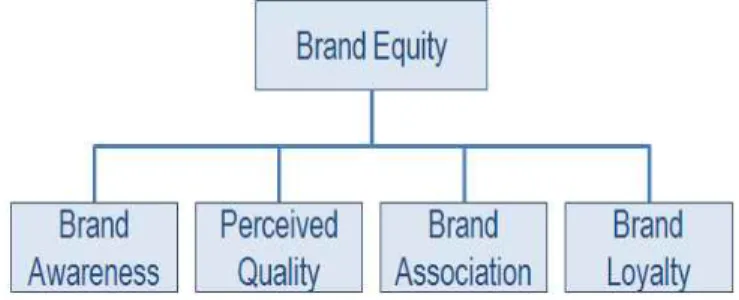
Three distinct ways have been suggested by Keller(1993) to appreciate brand equity: 1) The financial approach, 2) The customer-based approach, and 3) The combined approach. Among the three approches, this research has adopted the customer-based point of view. This perspective agrees with Keller’s description for brand equity, that brand equity is created by how consumers, as individuals, think, feel and act regarding a specific brand. The rationale behind this presumes that customers can, over time, develop a stronger or weaker attachment to a certain brand and base judgement on value from their past experience of the brand(Munteaun and Florea, 2012). By understanding customers’ perceptions and behaviours, marketing productivity of container liner shipping companies are anticipated to improve. Moreover, this perspective gives an opportunity to examine brand equity theories, such as Aaker’s(1991, 1996) and Keller’s(1993) models. Arguing that customer-based brand equity arises from brand awareness and brand image, Keller(2003) established the Customer- Based Brand Equity(CBBE) model to assist in building and conrolling brand. In particular, Aaker(1991, 1996) proposed a brand equity model consisting of four dimensions as seen in Figure 2. This model has been widely employed and also verified in various research contexts(e.g., Motameni and Shahrokhi, 1998; Pappu et al., 2005; Yoo and Donthu, 2001).
Fig. 2 Brand Equity Model Source: Aaker (1991, 1996)
These four dimensions have been examined as causal relationships in various studies empirically(e.g., Atilgan et al., 2005; Chen and Tseng, 2010; Davis et al., 2008; Kim and Kim, 2004). For example, Kim and Kim (2004) have
proved that brand awareness has the least significant effect on brand equity, while being the strongest factor on firms' revenues in B2C context. Daviset al. (2008) has demonstrated the existence of brand equity in B2B service and its differentiating role on logistics service providers.
4. Research Methodology
The brand equity model is still considered to be in a premature and exploratory stage in the container shipping context because few studies related to this issue have been found in preceding literature. Accordingly, interviews with experts and academics were conducted following literature reviews and mainly includes Aaker(1996), Chen and Tseng(2010), Chung et al.(2012), Ding et al.(2011), Jang and Kim(2012), Keller(1993), Korea Institute for Industrial Policy Studies(2002), Pappu et al.(2005), Stank et al.(2003), as well as Yoo and Donthu(2001), in order to identify key factors of the brand equity model and establish its hierarchical structure using the AHP approach. The principal logic of AHP is to deconstruct the complex problems into sub-level components and also synthesis the relations of the components through their paired comparison of them(Cheng and Li, 2001).
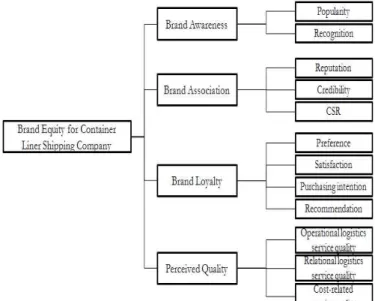
According to the study by Aaker(1996), the model consists of four constructs: Brand Awareness, Brand Association, Brand Loyalty and Perceived Quality. The study has been widely verified and adopted in diverse contexts, though some changes to the criteria have been made(see Figure 3). Brand Awareness indicates “the ability of a potential buyer to recognise or recall that a brand is a member of a certain product category”(Aaker, 1991, p. 61). This is composed of brand recognition and recall with more emphasis on the recognition as product decisions are made in the store(Keller, 1993, p. 3). Brand Association means “any mental linkage to the brand”(Tuominen, 1999, p. 83) and consists of reputation, credibility and CSR. In addition, Brand Loyalty is “a favourable attitude toward a brand resulting in consistent purchase of the brand over time” (Tuominen, 1999, p. 79) and conceptualised as consisting of preference, satisfaction, purchasing intention and recommendation. Perceived Quality consisting of operational and relational logistics service quality and cost-related service quality indicates
“the consumer's subjective evaluation of the product”(Zeithaml, 1988, p. 3).
Fig. 3 Decision Hierarchical Structure of This Research
Under the structure developed in this study, a nine-point pair-wise comparative questionnaire was designed and administered by email and face-to-face to academics, researchers and practitioners whom are involved in the container shipping industry in South Korea. Purposive sampling was selected as the preferred procedure for obtaining information needed to understand the factors that influence brand management decision-making. This technique has been mentioned as being practical for investigating specific topics rather than general ones.
Despite follow-up calls made to improve participation, only 23 questionnaires were completed. The number of questionnaires gathered in this study has been considered acceptable since a small sample size is not a big concern when analysing the data using AHP(Sambasivan and Fei, 2008).
5. Analysis of the Results
5.1 Respondents Profile
In total, 18 from the 23 questionnaires distributed were used for the analysis. Five of the questionnaires of which the consistency ratios (CR) were greater than 0.2 were excluded. The participants' working experience in the shipping industry is averaged to be over 12 years.
Specifically, 7 from shipping firms, 4 from freight forwarding firms and 7 from academics in Korea were involved; each group with the average working experience of 13.6 years, 10.7 years and 11.8 years.
Though the findings cannot be generalised due to the
small sample size, a systematic approach which applies AHP can give a rational answer to what can be considered the highest concern for building brand equity other than a subjective selection process. The results generated from all participants, whom have been experienced in the shipping industry for over ten years, are also valuable enough to give critical information for understanding brand management. In addition, different groups participating in this study are able to provide diverse perspectives on brand issues.
5.2 Priority Weights
The consistency ratios for all the factors, one of the significant considerations in multiple pair-wise comparisons in AHP, are within the acceptable threshold value of 0.2(Saaty, 2001). The priority weights of the critical factors demonstrate their relative importance for building brand equity for container liner shipping companies. According to the normalised priority weights at level one, Perceived Quality is revealed to be the most significant factor with a priority weight of 0.365, while Brand Association is the least significant (priority weight = 0.106) as seen in Figure 4.
Fig. 4 Relative Importance of Brand Equity Factors
The relative importance of the sub-attributes under each factor with priority weights are given in Figure 5. Under Brand Awareness, the order of importance of sub-attributes is as follows: Recognition (0.594) and Popularity (0.406).
Under Brand Association, the order of importance of sub-attributes is as follows: Credibility (0.405), CSR (0.322) and Reputation (0.273). Under Brand Loyalty, the order of importance of sub-attributes is as follows: Satisfaction (0.296), Preference (0.269), Purchasing Intention (0.226) and Recommendation (0.210). Under Perceived Quality, the order of importance of sub-attributes is as follows: Cost-related Service Quality (0.446), Operational Logistics Service Quality (0.333) and Relational Logistics Service Quality (0.222).
Fig. 5 Results of Sub-attributes of Each Factor
Based on Figure 6 illustrating the global priority weights for each of the factors, it can be said that the five most important sub-attributes relative to brand equity are as follows: Cost-related Service Quality (0.149), Operational Logistics Service Quality (0.116), Recognition (0.110), Relational Logistics Service Quality (0.100) and Popularity (0.098). On the other hand, CSR (0.030) is revealed to be the least critical.
Fig. 6 Overall Results of All Sub-attributes
5.3 Comparison of Factors between Groups
Pair-wise comparisons in each respondent group were further conducted to obtain and compare the relative importance of each factor. For shipping companies and academics, Perceived Quality had the highest weight,
followed by Brand Awareness and Brand Loyalty, although the weight is slightly different between them as seen in Figure 7.
Fig. 7 Comparison Result of Brand Equity Factors
Brand Association had relative weights of 0.112 (shipping companies) and 0.089 (academics), which were relatively unimportant. Similar to shipping companies and academics, freight forwarders also considered Perceived Quality (0.517) as the most critical factor when establishing brand equity.
However, they regarded Brand Loyalty (0.277) and Brand Association (0.128) as the next significant factors, while Brand Awareness (0.079) was selected as the least crucial factor.
Moreover, Figure 8 shows the comparison of the global priority weights among the three groups.
Fig. 8 Overall Comparison Results of All Sub-attributes
As illustrated in the figure, differences were found in the ranking of those factors: For shipping companies, Cost-related Service Quality, Popularity and Preference; for freight forwarders, Relational Logistics Service Quality, Operational Logistics Service Quality and Recommendation;
and for academics, Recognition, Operational Logistics Service Quality and Cost-related Service Quality were the top brand equity sub-attributes.
6. Conclusion and Implications
As low brand image of the container shipping companies appears to be one of the major difficulties towards the advance of the container shipping business, it is a crucial time for container shipping companies to strategically manage their brand equity for continued and prosperous development. To facilitate an appropriate brand management, understanding brand equity is of major importance for brand managers. Therefore, this study has been carried out to fill the research gaps discovered in the container shipping context where brand management is still in an early stage. Although in an exploratory and premature stage, the analysis results are insightful enough to highlight the growing importance of brand equity issues in the shipping industry.
From the priority weights obtained at levels one and two, it can be concluded that the most important of the critical factors is Perceived Quality. Although this result is contradictory to other previous studies conducted in the air transport context or other industries (i.e., the beverage industry), it is not surprising that this research has been conducted while the shipping industry still places much emphasis on Service Quality as a factor for being selected as a main carrier for their shippers. Specifically, all three sub-attributes under Perceived Quality need to be well managed, while Cost-related Service Quality is most significant for creating brand equity. That is, the ability of container shipping companies to flexibly adjust cost in global competition plays a vital role for creating brand equity.
However, to promote high brand equity, there should be an effort for developing Brand Loyalty and Brand Awareness considering their priority weights. In particular, Recognition and Popularity under Brand Awareness, and Preference and Satisfaction under Brand Loyalty should be regarded as the essential factors. In addition, perceptual gaps of relative importance of brand equity between shipping companies, academics and freight forwarders have been discovered and identified, which calls for future research on the issue.
This study provides several practical and theoretical implications. From a theoretical perspective, by validating
Aaker's model with AHP, this study offers a foundation for future branding research in the container liner shipping industry. Virtually all container liner shipping companies have the ability to utilise the findings in order to define and differentiate their own brand strategically. Equally, brand equity can be used effectively for selecting strategic alliances or M&A partners. High brand equity of ocean carriers can increase the shipment value for shippers in the near future.
To overcome the generalisation problem of this study, further research is needed to include other dimensions in the brand equity model using larger samples. Different statistical methods including structural equation model can be applied to develop more valid measurement instruments.
References
[1] Aaker, D. A. (1991), Managing Brand Equity.
Capitalising on the Value of a Brand Name, Free Press: New York.
[2] Aaker, D. A.(1996), “Measuring Brand Equity across Products and Markets”, California Management Review, Vol. 38, No. 3, pp. 102-120.
[3] Atilgan, E., Aksoy, S. and Akinci, S.(2005),
“Determinants of the Brand Equity: A Verification Approach in the Beverage Industry in Turkey”, Marketing Intelligence & Planning, Vol. 23, No. 3, pp.
237-248.
[4] Barwise, P.(1993), “Brand Equity: Snark of Boojum?”, International Journal of Research in Marketing, Vol. 1, pp. 93-104.
[5] Chen, C. -F. and Tseng, W. -S. (2010), “Exploring Customer-based Airline Brand Equity: Evidence from Taiwan”, Transportation Journal, Vol. 49, No. 1, pp.
24-34.
[6] Cheng, E. W. L. and Li, H.(2001), “Analytic Hierarchy Process: An Approach to Determine Measures for Business Performance”, Measuring Business Excellence, Vol. 5, No. 3, pp. 30-37.
[7] Chung, T. W., Jang, H. M. and Han, J. K.(2013),
“Financial-based Brand Value of Incheon International Airport”, The Asian Journal of Shipping and Logistics, Vol. 29, No. 2, pp. 267-286.
[8] Davis, D. F., Golicic, S. L. and Marquardt, A. J.(2008),
“Branding a B2B Service: Does a Brand Differentiate a Logistics Service Provider?”, Industrial Marketing
Management, Vol. 37, pp. 218-227.
[9] Ding, J. -F., Lee, K. -L. and Lin, S. -C.(2011), “An Empirical Study on Assessing Brand Equity for Global Shipping Carrier-based Logistics Service Providers”, African Journal of Business Management, Vol. 5, No.
16, pp. 6756-6763.
[10] Fafaliou, I., Lekakou, M. and Theotokas, I.(2006), “Is the European Shipping Industry Aware of Corporate Social Responsibility? The Case of the Greek-owned Short Sea Shipping Companies”, Marine Policy, Vol.
30, pp. 412-419.
[11] Farquhar, P. H.(1989), “Managing Brand Equity”, Marketing Research, Vol. 1, No. 3, pp. 24-33.
[12] Guzmán, F. (2005), A Brand Building Literature Review. Excerpt from PhD Thesis Brand Building Towards Social Values: Associating to Public Goods.
ESADE.
[13] Ishida, T. and Fukushige, M.(2010), “The Effects of Fishery Harbor-based Brands on the Brand Equity of Shore Fish: An Empirical Study of Branded Mackerel in Japan”, Food Policy, Vol. 35, No. 5, pp. 488-495.
[14] Jang, H. M. and Kim, S. Y.(2012), “Customer Loyalty and Logistics Service Performance in Maritime Transport”, Journal of Korean Navigation and Port Research, Vol. 36, No. 9, pp. 753-761.
[15] Keegan, W., Moriarty, S. and Duncan, T. (1995), Marketing, Prentice Hall: Englewood Cliffs.
[16] Keller, K. L.(1993), “Conceptualising, Measuring, and Managing Customer-Based Brand Equity”, Journal of Marketing, Vol. 57, No. 1, pp. 1-22.
[17] Keller, K. L. (2002), Branding and Brand Equity, Bart Weitz, Robin Wensley, eds. Handbook of Marketing.
Sage Publication: London, UK, pp. 151-178.
[18] Keller, K. L. (2003), Strategic Brand Management:
Building, Measuring, and Managing Brand Equity, Pearson Education Limited: Harlow.
[19] Kim, G. S., Chung, T. W. and Kwak, K. S.(2002), “A Study on the Brand Equity of Port using Conjoint Analysis”, Journal of Korean Navigation and Port Research, Vol. 26, No. 2, pp. 45-51.
[20] Kim, W. G. and Kim, H. -B.(2004), “Measuring Customer-based Restaurant Brand Equity”, Cornell Hotel and Restaurant Administration Quarterly, Vol.
45, No. 2, pp. 115-131.
[21] Korea Institute for Industrial Economics & Trade and Policies (2002), Report on Evaluation of Brand Value.
[22] Lassar, W., Mittal, B. and Sharma, A.(1995),
“Measuring Customer-based Brand Equity”, Journal
of Consumer Marketing, Vol. 12, No. 4, pp. 11-19.
[23] Lee, D. H.(2012), “Survey on Multifaceted Role of Shipping Industry and Measures to Improve Public Perception”, Journal of Korea Port Economic Association, Vol. 28, No. 3, pp. 127-150.
[24] Lu, C. S., Lin, C. -C. and Tu, C. -J.(2009), “Corporate Social Responsibility and Organisational Performance in Container Shipping”, International Journal of Logistics Research and Applications: A Leading Journal of Supply Chain Management, Vol. 12, No. 2, pp. 119-132.
[25] Monthly Maritime Korea (2013), How do Shipping Companies Communicate With World?
[26] Motameni and Shahrokhi(1998), “Brand Euqity Valuation: A Global Perspective”, Journal of Product and Management, Vol. 7, No. 4, pp. 275-290.
[27] Pappu, R., Quester, P. G. and Cooksey, R. W.(2005),
“Consumer-based Brand Equity: Improving the Measurement - Empirical Evidence”, Journal of Product & Brand Management, Vol. 14, No. 3, pp.
143-154.
[28] Stank, T. P., Goldsby, T. J., Vickery, S. K. and Savitskie, K.(2003), “Logistics Service Performance:
Estimating Its Influence on Market Share”, Journal of Business Logistics, Vol. 24, No. 1, pp. 27-55.
[29] Supphellen, M. and Nygaardsvik, I.(2002), Testing Country Brand Slogans: Conceptual Development and Empirical Illustration of a Simple Normative Model, The Journal of Brand Management, Vol. 9, No. 4, pp.
385-395.
[30] Saaty, T. L.(2001), Decision Making for Leaders : The Analytic Hierarchy Process for Decisions in a Complex World, RWS Publications.
[31] Trueman, M., Klemm, M. and Giroud, A.(2004), “Can a City Communicate? Bradford as a Corporate Brand”, Corporate Communications: An International Journal, Vol. 9, No. 4, pp. 317-330.
[32] Tuominen, P.(1999), “Managing Brand Equity”, The Finnish Journal of Business Economics, Vol. 1, pp.
65-100.
[33] Yoo, B. and Donthu, N.(2001), “Developing and Validating a Multidimensional Consumer-based Brand Equity Scale”, Journal of Business Research, Vol. 52, pp. 1-14.
[34] Zeithaml, V. A.(1988), “Consumer Perceptions of Price, Quality, and Value: A Means-end Model and Synthesis of Evidence”, Journal of Marketing, Vol. 52, No. 3, pp.
2-22.
Received 20 November 2013 Revised 3 March 2014 Accepted 31 March 2014