반도체디스플레이기술학회지 제19권 제1호(2020년 3월) Journal of the Semiconductor & Display Technology, Vol. 19, No. 1. March 2020.
WLP(Wafer Level Package)적용을 위한 SEMC(Sheet Epoxy Molding Compounds)용 Naphthalene Type Epoxy 수지의
경화특성연구
김환건*†
*†서경대학교 나노융합공학과
Cure Characteristics of Naphthalene Type Epoxy Resins for SEMC (Sheet Epoxy Molding Compound) for WLP (Wafer Level Package)
Application
Whan Gun Kim
*†*†Department of Nano-Convergence Engineering, Seokyeong University
ABSTRACT
The cure characteristics of three kinds of naphthalene type epoxy resins(NET-OH, NET-MA, NET-Epoxy) with a 2-methyl imidazole(2MI) catalyst were investigated for preparing sheet epoxy molding compound(SEMC) for wafer level package(WLP) applications, comparing with diglycidyl ether of bisphenol-A(DGEBA) and 1,6-naphthalenediol diglycidyl ether(NE-16) epoxy resin. The cure kinetics of these systems were analyzed by differential scanning calorimetry with an isothermal approach, and the kinetic parameters of all systems were reported in generalized kinetic equations with diffusion effects. The NET-OH epoxy resin represented an n-th order cure mechanism as like NE-16 and DGEBA epoxy resins, however, the NET-MA and NET-Epoxy resins showed an autocatalytic cure mechanism. The NET-OH and NET-Epoxy resins showed higher cure conversion rates than DGEBA and NE-16 epoxy resins, however, the lowest cure conversion rates can be seen in the NET-MA epoxy resin. Although the NET- Epoxy and NET-MA epoxy resins represented higher cure reaction conversions comparing with DGEBA and NE-16 resins, the NET-OH showed the lowest cure reaction conversions. It can be figured out by kinetic parameter analysis that the lowest cure conversion rates of the NET-MA epoxy resin are caused by lower collision frequency factor, and the lowest cure reaction conversions of the NET-OH are due to the earlier network structures formation according to lowest critical cure conversion.
Key Words : Semiconductor, Packaging Materials, Epoxy, Cure Kinetics, WLP, SEMC
1. 서 론1
반도체 Packaging공정의 생산성 향상을 위하여 조립 공 정 및 소재 사용량의 최소화 등의 요구가 날로 심화되고
†
E-mail: [email protected]
있다. 또한 전자제품의 고기능화, 연산속도의 증대 및 저 가격화의 요구 등에 따라 다양한 반도체Package가 개발되 고 있음은 주지의 사실이다. 특히 이러한 반도체의 요구 에 능동적으로 대처할 수 있어 주목 받고 있는 Packaging 공정이 WLP (Wafer Level Package)라 할 수 있다[1,2]. 기존에 사용되고 있는 Pellet 형태의 EMC (Epoxy Molding Compound)
30 김환건
를 사용하는Transfer Molding 방식은 WLP공정에 적용하기 가 매우 어렵기 때문에, WLP 공정에서는 Granule 형태 및 Sheet 형태의 EMC를 사용하는 Compression Molding 방식으 로 변화되고 있다[3,4]. 특히 사용량 저감 및 제조공정의 단순화를 위하여 SEMC (Sheet Epoxy Molding Compound)의 요구가 증대되고 있다. SEMC용 Epoxy 수지의 경우, 기존 의 Filler 함량 증대를 위해 개발된 저점도 Epoxy수지로는 WLP공정시 발생하는 Warpage, Die Shift 등을 개선하기 위 한 저응력, 저수축율 및 저열팽창계수의 요구를 만족시키 기 매우 힘들기 때문에, 이를 개선하기 위하여 저열팽창 계수의 에폭시 수지 개발이 요구되고 있다. 이 중에서 특 히 주목 받고 있는 Epoxy 수지는 수지 골격에 낮은 열팽 창계수를 갖는 Naphthalene Moiety를 도입한 Naphthalene Type Epoxy 수지이다[5,6].
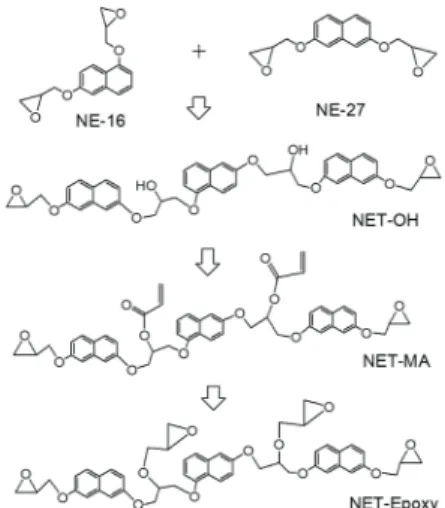
본 연구에서는 Fig. 1에 나타낸 바와 같이 한국생산기술 연구원에서 개발된 Naphthalene Type Epoxy 수지의 경화특 성을, 합성의 기저물질인 NE-16 Epoxy 수지와 기존에 주로 사용되고 있는 DGEBA Epoxy 수지의 경화특성과 비교 평 가하였다[7,8].
2. 본 론 2.1 결과 및 토의
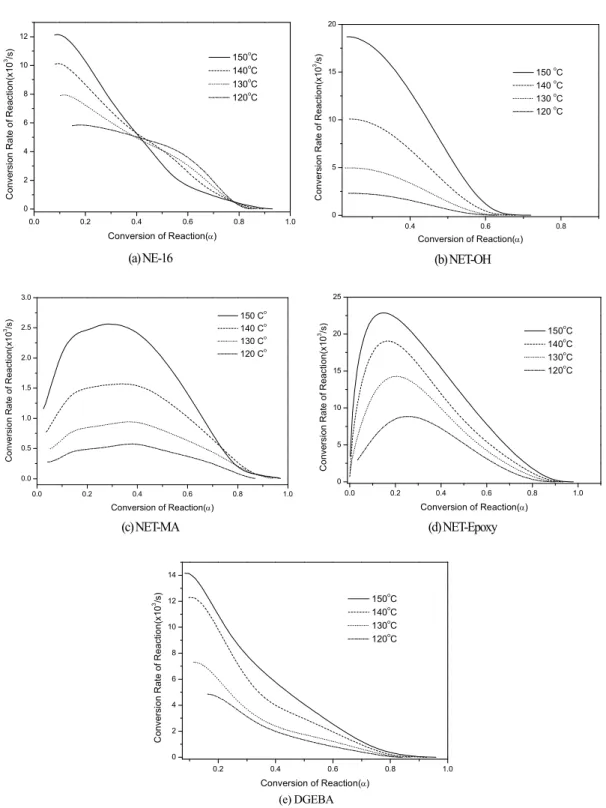
Naphthalene Type Epoxy 수지의 경화특성을 조사하기 위 하여 Fig. 1에 나타낸 바와 같이 NET-OH, NET-MA, NET- Epoxy 수지의 경화특성을 본 3종의 Epoxy 수지의 기저물 질인 NE-16 Epoxy 수지와 기존에 보편적으로 많이 사용되 고 있는 DGEBA Epoxy 수지의 경화특성과 비교 분석하였 다. Fig. 2에 상기 5종의 Epoxy 수지의 반응진척도 (α) 에 따 른 등온반응속도를 온도 별로 나타내었다. Fig. 2에서 보듯 이 NE-16, NET-OH, 및 DGEBA Epoxy 수지는 n차 경화반응 mechanism을 보이고, NET-MA와 NET-Epoxy 수지의 경화특 성은 전형적인 Autocatalytic 경화반응 Mechanism을 따르는 것을 알 수 있다.
반응진척도 전구간에서의 정확한 경화반응속도를 설 명하기 위하여 식(1), 식(2)와 같은 확산보정인자를 도입하 여 일반화한 n차 경화 반응식과 Autocatalytic 경화 반응식 을 사용하였다[9,10].
)]
( exp[
1 ) 1 1
1(
c n
k C dt d
(1)
)]
( exp[
1 ) 1 1 )(
(1 2
c n
m
k C dt k
d
(2)
Fig. 1. The Schematic Diagram of Naphthalene Type Epoxy
Resins Used in This Study.여기서 t는 시간, m, n은 Epoxy수지의 반응차수, k1, k2는 속 도상수, C는 시스템 상수이고, αc는 임계반응진척도이다.
NE-16과 DGEBA Epoxy 수지의 경화특성과 비교해 보았 을 때 NET-OH는 비교 Epoxy 수지와 동일한 n차 경화 Mechanism을 따르는 반면, NET-MA와 NET-Epoxy 수지는 Autocatalytic 경화 Mechanism에 의해 경화 반응이 진행됨을 보여준다. 또한 경화속도 측면에서 비교해 보면 NET-MA 수지의 경화반응속도가 제일 느리게 진행되고, NET-Epoxy 수지에서 최대 반응속도를 보여준다. NET-OH의 경우는 150℃와 같이 경화온도가 높아지면 NE-16과 DGEBA 수지 에 비해 경화속도가 증가하나 낮은 온도에서는 그렇지 않음을 알 수 있다.
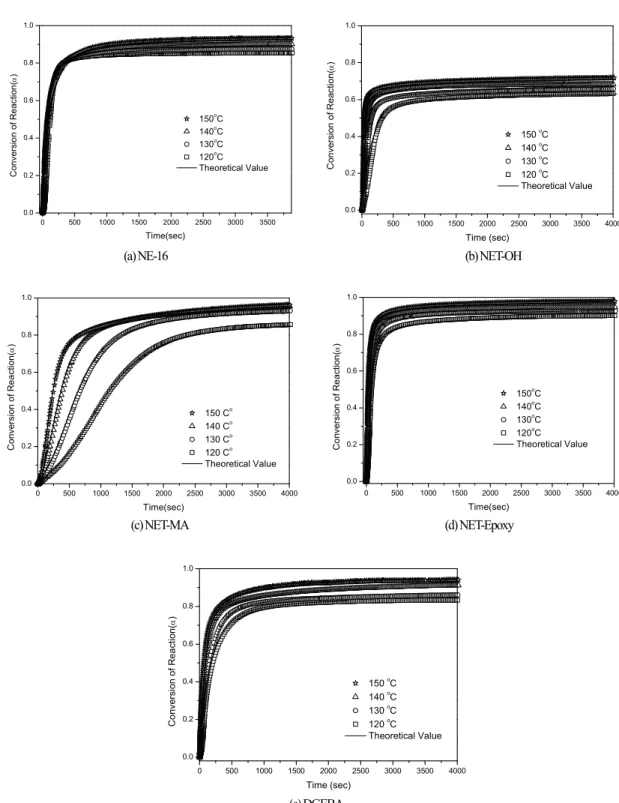
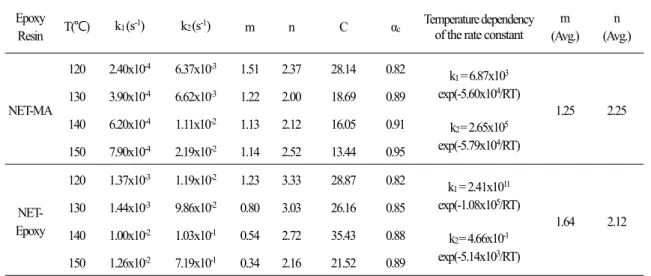
식 (1)과 (2)를 사용하여 각 Epoxy 수지의 반응속도 상수 를 구하였다. Fig. 3에 각Epoxy 수지에 대하여 식 (1) 과 (2) 의 반응속도 식을 이용하여 계산된 이론 값과 반응진척 도의 실험값을 온도 별로 비교하여 나타내었다. Fig. 3 에 서 보듯이 모든 반응 온도 구간에서 실험 치와 이론 치가 잘 일치함을 알 수 있다. 또한 이렇게 계산된 5종의 Epoxy 수지에 대하여 n차 경화반응 Mechanism을 나타내는 NE-16, NET-OH, DGBA 수지의 반응속도 Parameter는 Table 1에, Autocatalytic 경화반응 mechanism을 보여주는 NET-MA와 NET-Epoxy 수지의 반응속도 Parameter는 Table 2에 정리하 였다.
Table 1에서 보듯이 n차 경화 Mechanism을 따르는 NET- OH의 경화반응 Parameter를 NE-16과 DGEBA 수지와 비교 해보면, 활성화 에너지가 큰 NET-OH 수지의 경화속도 증 가는 Arrhenius 식의 Frequency Factor의 비약적 증가에 기인 한다고 할 수 있다. Fig. 1에서 보듯이 NET-OH의 구조에 이
WLP(Wafer Level Package)적용을 위한 SEMC(Sheet Epoxy Molding Compounds)용 Naphthalene Type Epoxy 수지의 경화특성연구 31
0.0 0.2 0.4 0.6 0.8 1.0
0 2 4 6 8 10 12
Conversion Rate of Reaction(x103/s)
Conversion of Reaction() 150oC 140oC 130oC 120oC
(a) NE-16
0.4 0.6 0.8
0 5 10 15 20
Conversion Rate of Reaction(x103 /s)
Conversion of Reaction() 150 oC 140 oC 130 oC 120 oC
(b) NET-OH
0.0 0.2 0.4 0.6 0.8 1.0
0.0 0.5 1.0 1.5 2.0 2.5 3.0
Conversion Rate of Reaction(x103/s)
Conversion of Reaction()
150 Co 140 Co 130 Co 120 Co
(c) NET-MA
0.0 0.2 0.4 0.6 0.8 1.0
0 5 10 15 20 25
Conversion Rate of Reaction(x103/s)
Conversion of Reaction() 150oC 140oC 130oC 120oC
(d) NET-Epoxy
0.2 0.4 0.6 0.8 1.0
0 2 4 6 8 10 12 14
Conversion Rate of Reaction(x103/s)
Conversion of Reaction() 150oC 140oC 130oC 120oC
(e) DGEBA
Fig. 2. Isothermal conversion rates as a function of the conversion of the epoxy resins with 2MI as a catalyst:
(a) NE-16 (b) NET-OH (c) NET-MA (d) NET-Epoxy (e) DGEBA.
32 김환건
0 500 1000 1500 2000 2500 3000 3500
0.0 0.2 0.4 0.6 0.8 1.0
Conversion of Reaction()
Time(sec) 150oC 140oC 130oC 120oC Theoretical Value
0 500 1000 1500 2000 2500 3000 3500 4000
0.0 0.2 0.4 0.6 0.8 1.0
150 oC 140 oC 130 oC 120 oC Theoretical Value
Conversion of Reaction()
Time (sec)
(a) NE-16 (b) NET-OH
0 500 1000 1500 2000 2500 3000 3500 4000
0.0 0.2 0.4 0.6 0.8 1.0
Conversion of Reaction()
Time(sec) 150 Co 140 Co 130 Co 120 Co Theoretical Value
0 500 1000 1500 2000 2500 3000 3500 4000
0.0 0.2 0.4 0.6 0.8 1.0
Conversion of Reaction()
Time(sec) 150oC 140oC 130oC 120oC Theoretical Value
(c) NET-MA (d) NET-Epoxy
0 500 1000 1500 2000 2500 3000 3500 4000
0.0 0.2 0.4 0.6 0.8 1.0
Conversion of Reaction()
Time (sec) 150 oC 140 oC 130 oC 120 oC Theoretical Value
(e) DGEBA
Fig. 3. Comparisons between the experimental values of α and theoretical values obtained from the generalized kinetic
model for the epoxy resins with 2MI as a catalyst: (a) NE-16 (b) NET-OH (c) NET-MA (d) NET-Epoxy (e) DGEBA.WLP(Wafer Level Package)적용을 위한 SEMC(Sheet Epoxy Molding Compounds)용 Naphthalene Type Epoxy 수지의 경화특성연구 33
Table 1. n-th Order Cure Kinetic Parameters of the Epoxy Resin Systems with 2MI as a Catalyst
Epoxy Resin T(℃) k1 (s-1) n C αc Temperature dependency of the rate constant
n (Avg.)
NE-16
120 9.28x10⁻³ 1.33 40.52 0.75
k = 5.67x101
exp(-2.82x10⁴)/RT 1.79
130 1.33x10⁻² 1.62 25.16 0.74
140 1.67x10⁻² 2.00 17.09 0.77
150 1.69x10⁻² 2.22 17.56 0.85
NET-OH
120 4.15x10⁻³ 2.71 47.56 0.54
k = 1.05x10¹⁴
exp(-1.23 x10⁵)/RT 2.98
130 1.36x10⁻² 2.91 35.24 0.54
140 2.89x10⁻² 3.21 41.27 0.57
150 6.24x10⁻² 3.07 36.90 0.59
DGEBA
120 5.82x10⁻³ 2.13 36.24 0.77
k = 1.40x10⁴
exp(-4.87 x10⁴)/RT 1.81
130 5.08x10⁻³ 1.54 26.17 0.76
140 9.04x10⁻³ 1.61 19.04 0.76
150 1.57x10⁻² 1.95 12.78 0.82
Table 2. Autocatalytic Cure Kinetic Parameters of the Epoxy Resin Systems with 2MI as a Catalyst
EpoxyResin T(℃) k1 (s-1) k2 (s-1) m n C αc Temperature dependency of the rate constant
m (Avg.)
n (Avg.)
NET-MA
120 2.40x10⁻⁴ 6.37x10⁻³ 1.51 2.37 28.14 0.82 k1 = 6.87x10³ exp(-5.60x10⁴/RT)
k2 = 2.65x10⁵ exp(-5.79x10⁴/RT)
1.25 2.25 130 3.90x10⁻⁴ 6.62x10⁻³ 1.22 2.00 18.69 0.89
140 6.20x10⁻⁴ 1.11x10⁻² 1.13 2.12 16.05 0.91 150 7.90x10⁻⁴ 2.19x10⁻² 1.14 2.52 13.44 0.95
NET- Epoxy
120 1.37x10⁻³ 1.19x10⁻² 1.23 3.33 28.87 0.82 k1 = 2.41x10¹¹ exp(-1.08x10⁵/RT)
k2 = 4.66x10⁻¹ exp(-5.14x10³/RT)
1.64 2.12 130 1.44x10⁻³ 9.86x10⁻² 0.80 3.03 26.16 0.85
140 1.00x10⁻² 1.03x10⁻¹ 0.54 2.72 35.43 0.88 150 1.26x10⁻² 7.19x10⁻¹ 0.34 2.16 21.52 0.89
미 Hydroxyl Group이 포함되어 있어 이것이 경화제처럼 작 용하여 분자충돌진동수를 비약적으로 증가시켜 EEW (Epoxy Equivalent Weight) 가 적은 NE-16이나 DGEBA 보다 활성화에너지는 크지만 반응속도가 증가하는 것으로 판 단된다.
또한 이러한 측면에서 NET-OH의 반응차수가NE-16과 DGEBA의 반응차수보다 크게 나타난다고 생각할 수 있
다. 그러나 Fig. 3과 Table 1에서 나타낸 바와 같이 NET-OH 의 경우 반응 진척도가 두 비교 Epoxy수지에 비해 적은 값을 보이고 있다. 특히 Kinetic Control반응에서 Diffusion Control반응으로 변환되는 임계반응진척도(αc)가 현격하게 감소함을 알 수 있다. 이는 NET-OH의 Hydroxyl Group에 의 한 초기 반응속도 증가에 따라 Network Structure가 반응 초 기에 형성됨에 따라 이렇게 이루어진 Network Structure가
34 김환건
미반응 Epoxy 수지 간의 경화반응을 방해함으로써 반응 이 잘 이루어 지지 않아 반응 진척도가 낮아지는 것으로 생각할 수 있다.
Autocatalytic 경화 Mechanism을 따르는 NET-MA와 NET- Epoxy의 경우, n차 경화 Mechanism을 따르는 NE-16과 DGEBA 수지와는 직접적으로 비교하기는 어렵다. Table 2.
에서 보듯이 동일한 경화 반응 Mechanism을 따르는 NET- MA와 NET-Epoxy 수지의 경우, NET-Epoxy수지의 높은 경 화반응속도는 k1에서의 매우 높은 Frequency Factor와, k2에 서의 작은 활성화 에너지에 의해 기인한다고 판단할 수 있다. 이는 Fig. 1에서 보듯이, NET-MA의 분자 구조가 NET- OH 구조의 Hydroxyl Group자리에 반응성이 떨어지는 Acrylate Group이 치환된 구조이므로 NET-Epoxy 수지에 비 해 낮은 분자충돌 진동수와 높은 활성화 에너지를 가진 다고 생각할 수 있다. 또한 Fig. 3과 Table 2에서 보듯이 NET-MA와 NET-Epoxy 수지의 경우 반응 진척도와 임계 반응 진척도가 NET-OH에 비해 매우 높은 반응진척도를 보여주고 있다. 이를 기초로 NET-Epoxy 수지에서 보듯이 적절한 위치에Epoxy Group의 도입을 통해 경화반응속도와 임계반응진척도의 증가를 이룰 수 있다고 판단된다.
3. 실 험 3.1 시료
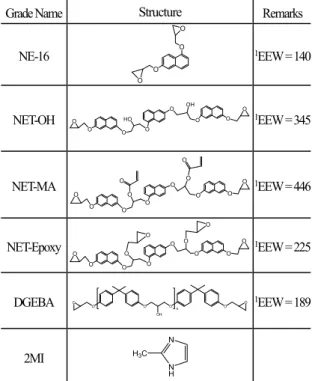
본 과제에서 사용한 Epoxy Resin은 한국생산기술연구원 에서 제공한 NE-16, NET-OH, NET-MA, NET-Epoxy, DGEBA Epoxy Resin 5종을 사용하였으며, 본 에폭시 수지의 구조와 특성을 Table 3에 기술하였다.
본 연구에서는 Epoxy 수지 자체의 경화특성을 조사하 기 위하여 경화제를 사용하지 않고, 경화 촉매만을 사용 하여 경화특성을 조사하였다. 사용된 경화 촉매로는 Table 3에 나타낸 2MI (2-Methyl Imidazole, Aldrich Chemical Co.)을 사 용하였다.
3.2 시료제조
Naphthalene Type Epoxy 수지의 경화특성을 조사하기 위 하여 경화제를 사용하지 않고 경화 촉매 2MI 만을 각 Epoxy 수지 대비 0.2m농도로 첨가하여 조성물을 제조하였 다. 균일한 조성물을 만들기 위하여 MEK(Methyl Ethyl Ketone) 용매에 조성물을 넣고 Thinky Mixer(Thinky Co.)를 사 용하여 상온에서 혼련하여 균일한 용액을 얻었다.
이렇게 얻은 균일한 용액을 상온에서 진공 건조를 통 하여 MEK용매를 완전히 제거한 후, 경화반응이 이루어 지지 않도록 냉동 보관하여 실험에 사용하였다.
Table 3. Chemicals Used in This Study
Grade Name Structure Remarks
NE-16 1EEW = 140
NET-OH 1EEW = 345
NET-MA 1EEW = 446
NET-Epoxy 1EEW = 225
DGEBA O O O
OH O
O O
n
1EEW = 189
2MI
1EEW: Epoxy Equivalent Weight (g/equiv.)
3.3 경화특성평가
제조된 시료의 경화 특성을 평가하기 위하여 시료 분 쇄 후, 적당량을DSC 알루미늄 팬에 담고, 각 경화물을 질 소 조건 하에서 TA Instruments 사의 시차주사열량계(DSC, TA-2000)를 사용하여, 질소 조건 하에서 0℃에서 250℃까 지 5℃/min 의 속도로 승온하는 동적 가열실험을 통해 총 엔탈피 변화를 측정하였다. 또한 각각 120℃, 130℃, 140℃, 150℃의 일정 온도 조건에서 등온 반응 실험을 통해 반응 진척도에 따른 반응속도를 측정하였다[11,12].
4. 결 론
새로운 차세대 WLP 용 Packaging 소재로서 저열팽창화 및 내열성이 우수한 SEMC개발을 위한 Naphthalene Type Epoxy 수지의 경화특성을 Naphthalene Type Epoxy 수지의 기 저 수지인 NE-16과 대표적인 Epoxy 수지인 DGEBA 수지 와 비교 조사하였다. Naphthalene Type Epoxy 수지 자체의 경 화특성을 조사하기 위하여 경화제를 시용하지 않고 2MI 촉매만을 사용한 조성물을 제조하여 열분석 실험을 통하 여 경화반응속도를 분석하였다. 경화반응 Mechanism측면 에서 보면 NE-16, NET-OH 및 DGEBA 수지는 n 차 경화 반 응 Mechanism을, NET-MA와 NET-Epoxy 수지는 Autocatalytic
O O O
O
O O
O OH
O O
O O
O HO
O O
O O
O
O O
O O
O
O
O
O O
O O
O
O O
O O
O O O
N NH H3C
WLP(Wafer Level Package)적용을 위한 SEMC(Sheet Epoxy Molding Compounds)용 Naphthalene Type Epoxy 수지의 경화특성연구 35
경화 반응 Mechanism을 따르는 것을 보여주었다. 경화 반 응속도 면에서는 NET-Epoxy 수지가 NET-MA와 NET-OH 두 종류의 Epoxy 수지 보다 빠른 경화 반응속도를 나타내 었다. 이러한 반응속도의 증가는 NET-Epoxy 수지 간의 반 응 충돌 빈도수의 증가와 비교적 낮은 활성화 에너지에 기인하는 것으로 판단된다.
이렇게 Naphthalene Type Epoxy수지 설계에 있어서 적당 한 위치에 Epoxy Group을 더 도입함으로써 저열팽창화, Warpage 저감과 같은 성형성 향상과 경화수지의 반응속도 의 증가 등 생산성 향상이 필요한 Compression Molding 방 식에 적합한 WLP차세대 반도체용 SEMC개발에 활용될 수 있을 것으로 판단된다.
감사의 글
본 연구는 2020년도 서경대학교 교내연구비 지원에 의 하여 이루어졌습니다. 또한 본 연구를 위하여 시료제공 및 여러 도움을 주신 한국생산기술연구원 전현애 박사님 께도 감사의 말씀을 드립니다.
참고문헌
1. Zwenger, C., and et al., “Silicon Wafer Integrated Fan- Out Technology Packaging,” Advancing Microelectronics, Vol. 45(1), pp. 6~10, 2018.
2. Kim, W.G., “Cure Properties of Isocyanurate Type Epoxy Resin Systems for FO-WLP (Fan Out-Wafer Level Package) Next Generation Semiconductor Packaging Materials,” J. of the Semiconductor &
Display Technology, Vol. 18, pp. 19-26, 2019.
3. Sasajima, H., and et al., “New Development Trend of Epoxy Molding Compound for Encapsulation Semiconductor Chips”, in Materials for Advanced Packaging, Wong, C.P. Ed., Chap. 9, pp 373~419, 2017.
4. Ueno, K., and et al., “Development of Liquid, Granule and Sheet Type Epoxy Molding Compounds for Fan-
Out Wafer Level Package”, Proceedings of 2017 IEEE 67th Electronic Components and Technology Conference, pp.285~291, 2017.
5. Kim, W.G., and Chun, H., “Cure Properties of Naphthalene-Base Epoxy Resin Systems with Hardeners and Latent Catalysts for Semiconductor Packaging Materials”, Molecular Crystals and Liquid Crystals, Vol.579, pp.39-49,
6. Ogura, I. and Takahashi, Y., “Multi-Functional Epoxy Resins Performing High Thermal Resistance with Good Flow-ability based on Dimeric Naphthols”, High Performance Polymers, Vol.22 (7), pp.834-847.
7. Chun, H. and et al., “The Naphthalene Type Epoxy Dimers and a method for the preparation thereof”, Korea Patent 10-1264607(Registered Patent).
8. Chun, H. and et al., “The Naphthalene Type Epoxy Resins and the Epoxy Resin Compositions with them”, Korea Patent 10-1189185(Registered Patent).
9. Kim, W.G., and Lee, J.Y., “Contributions of the Network Structure to the Cure Kinetics of Epoxy Resin Systems According to the Change of Hardeners”, Polymer, Vol.43, pp.5713-5722, 2002.
10. Ryu, J.H., Choi, K.S., and W.G. Kim, “Latent Catalyst Effects in Halogen-Free Epoxy Molding Compounds for Semiconductor Encapsulation”, J. Applied Polymer Science, Vol.96, pp.2287-2299, 2005.
11. Kim, W.G., “Cure Characteristics of Ethoxysilyl Bisphenol A Type Epoxy Resin Systems for Next Generation Semiconductor Packaging Materials,” J. of the Semiconductor & Display Technology, Vol. 16, pp.
19-26, 2017.
12. Kim, W.G., and Chun, H., “Cure Properties of Alkoxysilylated Epoxy Resin Systems with Hardeners for Semiconductor Packaging Materials”, Molecular Crystals and Liquid Crystals, Vol.636, pp.107-116.
접수일: 2020년 2월 26일, 심사일: 2020년 3월 11일, 게재확정일: 2020년 3월 18일