Effect of Temperature on the Quality and Storability of Cherry Tomato during Commercial Handling Condition
Mohammad Zahirul Islam1, Young-Sik Kim2, and Ho-Min Kang1*
1Dept. of Horticulture, Kangwon Nat’l. Univ., Chuncheon 200-701, Korea
2Dept. of Plant & Food Science, Sangmyung University, Cheonan 330-720, Korea
Abstract. This study was carried out in order to investigate the effect of temperature of treatment and stor- age on the longevity of ‘Unicorn’ tomatoes of light red maturity stage during commercial handling condi- tions encountered while exporting over long distances. Tomato stored at 5oC and 11oC temperature with 85% relative humidity by pre-treating handling temperature that was using from field to before shipment as a winter temperature 5oC, spring temperature 11oC and summer temperature 25oC for 3 days. On the final storage day, 25oC/11oC (treated/stored) tomatoes showed the highest respiration and ethylene production rate; whereas the lowest respiration and ethylene production rate was found for 5oC/5oC treated and stored tomatoes. Tomatoes treated and stored at 5oC/5oC showed higher marketability, without evidence of fungal rot, decay or spots for 23 days. The fresh weight loss under all treatment conditions increased gradually dur- ing 5oC and 11oC storage temperatures. The higher firmness and soluble solids were determined from 5oC/
5oC and 5oC/11oC treated and stored tomatoes repectively, than from others tomatoes on the final day of storage. In addition, 5oC/5oC tomatoes showed higher vitamin C contents than tomatoes stored at other tem- peratures, on the final day of storage. As the ripening and storage period progressed, the titratable acidity increased, but declined (P < 0.05) thereafter, due to over ripe tomatoes under all treatment conditions. These results show that 5oC/5oC treated and stored light red maturity stages of ‘Unicorn’ tomatoes are optimum to export because they show the highest storability and marketability. Moreover, the marketability of light red maturity stage of ‘Unicorn’ tomato maintained for 2 weeks in 25oC/11oC treated and stored temperature that might be the export temperature from Korea to Japan in summer season. This research result could be use- ful in helping tomato growers and exporters to get optimum market value by satisfying the buyer and con- sumer with a fresher product.
Key words : handling condition, tomato export, tomato quality, tomato storability
Introduction
The shelf life of tomatoes is very short under ambient conditions due to a high perishability. After harvesting tomatoes, quality deterioration begins by emitting gas- eous compounds (carbon dioxide & ethylene), reducing physical properties (visual quality, weight and firmness), and chemical properties (vitamin C, soluble solids, titrat- able acidity). It mainly happens through inadequate stor- age facilities, and due to enzymatic activities. As a result, growers and/or exporters, wholesaler, retailer as well as nations incur heavy losses in revenue. Temperature is an important factor tomato to maintain postharvest quality
and storability. At lower temperatures ripening is slowed;
at temperatures over 27oC, bacterial growth and rotting may be accelerated, and above 30oC ripening may be inhibited (Kader, 2002). Polderdijk et al. (1993) showed that a temperature of 12oC is considered to be safe for storage for tomatoes. Znidarcic and Pozrl (2006) reported that tomatoes can be stored at ambient temperatures for periods of up to 7 days. However, longer period ripe tomatoes can be stored at a temperature of 10~15oC and 85~95% relative humidity (Castro et al., 2005).
Roberts et al. (2002) reported that during typical com- mercial handling, commodities are often shipped in mixed loads, meaning that shipping temperatures may be 5oC or lower, well below recommended temperatures for many crops, including tomatoes. Storage and ripening recom- mendations for tomatoes are well known, but quality
*Corresponding author: [email protected]
*Received May 1, 2012; Revised May 25, 2012;
*Accepted June 7, 2012
problems associated with poor temperature management continue to occur during distribution (Cantwell et al., 2009). At the market interface, only produce that corre- sponds to the expectations of the consumer is acceptable (Tzortzakis et al., 2007). Consumers increasingly desire high quality (visual and nutritional) tomatoes for a longer market period, within convenient prices in both domestic as well as export markets. It is important to understand the growers and/or exporters, wholesaler, retailer as well as consumer’s desire for quality throughout the commer- cial handling period. So, researchers should establish an optimum condition to reduce water loss, delay softening and extend shelf life, so as to not only prevent posthar- vest losses, but also generate additional revenue. The study was carried out to investigate the effect of temper- ature on the quality and storability of light red maturity stage of ‘Unicorn’ tomatoes during commercial handling when exporting over long distances.
Materials and Methods
Hydroponics grown light red maturity stage of fresh consumed tomatoes (Lycopersicon esculentum Mill. cv
‘Unicorn’) were harvested, washed and rinsed in chlori- nated water (0.015% NaOCl), and stored at 5oC and 11oC with 85% relative humidity by pre-treating handling tem- perature that was using from field to before shipment as a winter temperature 5oC, spring temperature 11oC and summer temperature 25oC for 3 days.
Carbon dioxide concentration was measured by PBI Dan sensor (Check Mate 9900) and ethylene concentra- tion was measured by GC (2010 Shimadzu) equipped with a wax column and a flame ionization detector (FID).
The detector and injector operate at 127oC, oven was 50oC, and carrier gas (N2) flow rate was 0.67 mL/s (Park et al., 2000). Two fruit per replicate of light red maturity stage were placed into a sealed 125 mL plastic container for 6 h. A 1 mL sample of the head space was withdrawn using a syringe, to measure the ethylene concentration.
The percentage of marketability was subjectively assessed on fruits based on visual quality determinants likes mould growth, decay, shriveling, smoothness, shininess and homogeneity. Marketability was observed on a scale of 1 to 100 (01~39 = very bad, 40~59 = bad, 60~79 = good (marketable), 80~99 = very good, and 100 = excellent)
during 5oC and 11oC storage. Five panel members were employed to assess the marketability of the tomatoes.
The fresh weight loss of tomatoes during the storage period was measured by subtracting sample weights from their previous recorded weights, and presented as % of weight loss. Firmness was measured using a Rheo meter (Sun Scientific Co. Ltd., Japan) with a maximum force of 10 kg and a 6 mm diameter round stainless steel probe with a flat end. During measurement, tomatoes were placed on a plastic ring to keep upright. Penetrating force (N) through the skin of the tomatoes flesh and deforma- tion (mm) values were recorded. Vitamin C was mea- sured by RQflex plus (Merck, Germany) with mg/100 g FW (Arvanitoyannis et al., 2005). Soluble solids was measured by Refractometer (Atago U.S.A. Inc., U.S.A.) and results were read directly in oBrix. The titratable acidity was measured by DL 22 Food & Beverage Ana- lyzer (Metter Toledo Ltd., Korea), and results were reported as mg/g citric acid.
1. Statistical analysis
Graphs were produced using SigmaPlot 10 (Systat Software, Inc., USA) and statistic analyses were per- formed by SPSS V.18 (SPSS Inc., Chicago, USA). Sig- nificant differences between mean values were determined using the Duncan’s Multiple Range Test (P = 0.05) fol- lowing one-way ANOVA.
Results and Discussion
During postharvest handling temperatures (5oC, 11oC, and 25oC) treated period (0~3 days), the respiration rate was significantly decreased (P < 0.05). As the storage period (4~28 days) progressed, respiration rates were increased until the 23rd day, and significantly decreased (P < 0.05) thereafter. The highest to lowest respiration rates were produced by 25oC/11oC and 5oC/5oC tomatoes during storage period, respectively. As temperature as well as respiration rate increase, the fruit quality decreases. Respiration rate is one of the most important indicators of senescence in tomatoes, as are weight loss, pigment content, firmness and ethylene production (Meir et al., 1992). Hardenburg et al. (1986) reported that the respiration rate of mature green tomatoes increased by 100% when stored at 25 to 27oC compared to storage at
0oC. As assessing respiration rates during storage is ben- eficial to maintain quality (Wareham and Persaud, 1999), 5oC/5oC tomato treatment, and storage is appropriate because of lower respiration rates.
The ethylene production rate (8.28µLC2H4/kg/h) of initial day was in agreement with Kader (2002) that tomatoes produce 1.0~10.0µLC2H4/kg/h at 20oC. Burg (2004) reported that the optimal temperature for ethylene production by tomatoes tissue is 27oC. Higher tempera- tures produce higher ethylene production rates than lower temperatures. Until the 13th day the ethylene production rate was significantly decreased (P < 0.05) at different treatment and storage temperatures, and thereafter ethyl- ene production rates increased and quality decreased.
Due to concerns that naturally produced ethylene from the fruit delays ripening (Krishnamoorthy, 1982), 5oC/
5oC tomato treatment, and storage is appropriate because of lower ethylene production rates.
It may be possible to extend tomato storability by low- ering the respiration and ethylene production rates after harvesting, by taking appropriate action at the store house, during transportation, in port, at distribution period, in super market/outlet, in wholesale/retail shop and in the refrigerator. Our results agreed with those of Workneh and Osthoff (2010), in that ethylene was found to increase significantly with an increase in respiration rates in cli- macteric fruit, increasing the ripening process. In addi- tion, our results also agreed with Krishnamoorthy (1982), that a rise in respiration rate is accompanied by increased ethylene production.
As storage period progressed, the fresh weight loss was significantly increased. Not only did different tem-
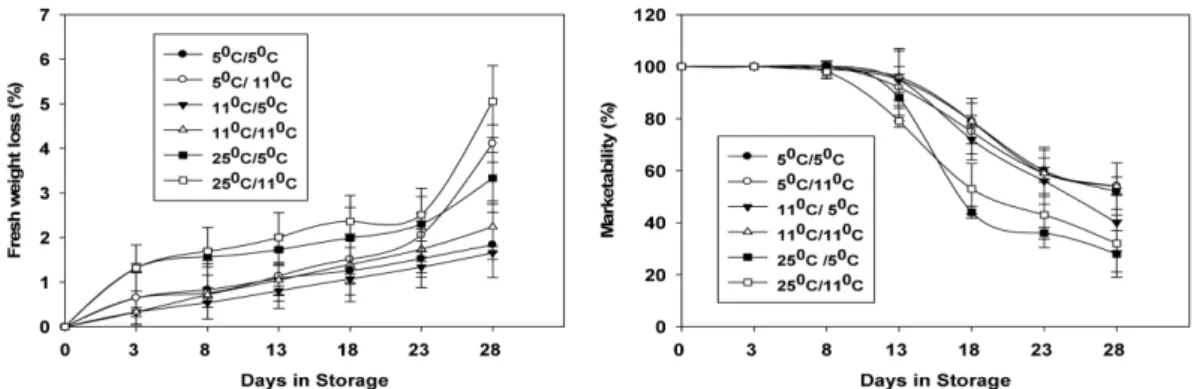
peratures show different fresh weight losses, but results were almost linear (Fig. 2, left). 25oC/11oC treated and stored tomatoes showed higher fresh weight loss than other lower temperatures. Until the final storage day, our result did not exceed the maximum permissible weight loss 7% (Kays and Paull, 2004). During the storage period at 5oC/5oC, 5oC/11oC and 11oC/5oC, 11oC/11oC, the fresh weight loss did not influence the fruit appear- ance due to controlled humidity. It has been found that storage duration, storage temperature and treatment have significant effects on weight loss (Javanmardi and Kubota, 2006) because higher temperatures and longer storage times showed higher transpiration than lower tempera- tures and shorter times.
The marketability of light red maturity stage of ‘Uni- corn’ tomatoes, were maintained for 2 weeks under 25oC/11oC conditions, which might be the export tem- perature from Korea to Japan during the summer season.
In contrast, 5oC/5oC, 5oC/11oC, 11oC/5oC, 11oC/11oC tomatoes remained marketable for 3 weeks. All toma- toes had 100% marketability until the 8th day except for 5oC/5oC, 11oC/11oC and 25oC/11oC tomatoes, which showed 1~2% reduction. In light red tomatoes, 5oC/5oC treated tomatoes showed the highest marketability (60%) on the 23rd day. Cantwell et al. (2009) reported that at 5oC and 10oC, near ripe grape tomatoes remained of mar- ketable quality for 18 and 12 days, respectively. Our results agreed with those of Roberts et al. (2002) in that no decay occurred from any treatments during ripening and storage for several days beyond the light red (red- ripe) maturity stage. In addition, there was no visible evi- dence of chilling injury (uneven color development) due
Fig. 1. The respiration rate and ethylene production rate of ‘Unicorn’ tomato at different treated (5oC, 11oC and 25oC for 0~3 days) and storage temperature (5oC and 11oC for 4~28 days). Vertical bars represent ± SD of means (n = 5).
to treatment and storage at low temperatures for the light red maturity stage.
Firmness is an important aspect of fresh tomato quality and it decreases over time (Islam et al., 2011). It is pri- marily dependant on the storage temperature. As firm- ness is closely associated with the ripeness stage of the tomato (Kader, 1986), as ripeness and storage progressed, firmness significantly decreased (P < 0.05). High temper- ature treated tomatoes showed lower firmness, whereas low temperature treated tomatoes showed higher firm- ness. During 18 days of storage, the tomatoes of lowest firmness were those treated at 5oC/5oC, decreasing by almost 29% over the next 28. Moreover, the firmness of tomatoes treated at 25oC/11oC decreased by around 40%, and 28 days later, by around 43%. Our results agreed with Roberts et al. (2002) in that higher storage temper- atures caused more rapid senescence. However, on the
23rd day our results showed the minimum acceptable firmness (16.82 N) was determined for 5oC/5oC toma- toes. If the firmness value of tomatoes is below this min- imum acceptable value, they are very difficult to market.
During the postharvest handling temperature treatment period (0~3 days) the vitamin C content significantly decreased (P < 0.05) under all treatment conditions. For higher temperature treated tomatoes, the vitamin C losses were higher than for lower temperature treated tomatoes.
As storage period and ripening progressed, vitamin C increased and significantly decreased (P < 0.05) thereaf- ter under all treatment conditions. Our results agreed with those of Dalal et al. (1965) that an increase in ascorbic acid content took place with ripening, with either a con- tinuing rise or a slight fall during the final stages of rip- ening. On the final day of storage, 5oC/5oC tomatoes showed higher vitamin C than other tomatoes. As vita- Fig. 2. The Fresh weight loss (%) and marketability (%) of Unicorn tomato at different treated (5oC, 11oC and 25oC for 0~3 days) and storage temperature (5oC and 11oC for 4~28 days). Marketability was scored on the scale of 1 to 100 (01~39 = very bad, 40~59 = bad, 60~79 = good, marketable, 80~99 = very good, and 100 = excellent) during storage period. Vertical bars represent ± SD of means (n = 5).
Fig. 3. The firmness and vitamin C of ‘Unicorn’ tomato at different treated (5oC, 11oC and 25oC for 0~3 days) and storage temperature (5oC and 11oC for 4~28 days). Vertical bars represent ± SD of means (n = 5).
min C losses are accelerated at higher temperatures (Lee and Kader, 2000) 11oC/11oC tomatoes showed about 22% more loss than 5oC/5oC tomatoes on the 28th day.
During the treated period (0~3 days) all tomatoes showed a sharp reduction in soluble solids, but it did not show any differentiation between higher and lower tem- perature effects. It was found that as the ripening and storage period progressed, soluble solids increased over a certain period, and decreased significantly (P < 0.05) after- wards for all tomatoes except 25oC/5oC and 11oC/5oC.
However, 25oC/5oC and 11oC/5oC tomatoes, soluble sol- ids significantly increased during the storage period. The highest soluble solids were observed in 5oC/11oC toma- toes followed by 5oC/5oC, 25oC/5oC, 11oC/5oC, 25oC/
11oC, and 11oC/11oC, respectively, on the final day of storage. Our results are in agreement with those of Jav- anmardi and Kubota (2006) in that no significant changes in soluble solids for both room (25oC) and low (5oC) temperature treated tomatoes occurred up to the 3rd day.
A previous report had indicated that total sugar levels showed a general increase, followed by stability, or a slight decrease during ripening (Baldwin et al., 1991), though our different temperatures showed a similar effect during the postharvest ripening and storage period.
Table 1. The soluble solids (oBrix) of different treated (5oC, 11oC and 25oC for 0~3 days) and storage temperatures (5oC and 11oC for 4~28 days) of ‘Unicorn’ tomato.
Treatment Initial 3 day 8 day 13 day 18 day 23 day 28 day
5oC/5oC z6.80az 5.75a z6.15ab 6.93c 7.07d 7.03b z6.93cd 05oC/11oC 6.80a 5.75a 6.28b 6.90c 7.15d 7.13b 7.00d
11oC/5oC0 6.80a 5.90a 6.00a 6.48a 6.52a 6.70a 6.80c
11oC/11oC 6.80a 5.90a 6.46c 6.68b z6.80bc 6.57a 6.30a
25oC/5oC0 6.80a 5.70a 6.08a z6.60ab z6.63ab 6.65a z6.85cd
25oC/11oC 6.80a 5.70a 6.30b z6.60ab 6.85c 6.60a 6.33b
ZMean separation within columns by Duncan’s multiple range test at P < 0.05.
Table 2. The titratable acidity (mg/g citric acid) of different treated (5oC, 11oC and 25oC for 0~3 days) and storage tempera- tures (5oC and 11oC for 4~28 days) of ‘Unicorn’ tomato.
Treatment Initial 3 day 8 day 13 day 18 day 23 day 28 day
5oC/5oC z0.38az 0.32a 0.40c 0.42b 0.42a 0.54c 0.38b
05oC/11oC 0.38a 0.32a z0.38bc 0.43b 0.45a z0.53bc z0.33ab
11oC/5oC0 0.38a 0.30a 0.30a z0.37ab 0.44a 0.41a z0.36ab
11oC/11oC 0.38a 0.30a 0.33a z0.38ab 0.42a zz0.50abc z0.31ab
25oC/5oC0 0.38a 0.30a z0.34ab 0.43b 0.48a z0.53bc 0.33a
25oC/11oC 0.38a 0.30a 0.32a 0.36a 0.47a z0.43ab z0.36ab
ZMean separation within columns by Duncan’s multiple range test at P < 0.05.
During the treated period (0~3 days), 5oC treated tomatoes showed a higher citric acid content than others, and significantly decreased (P < 0.05) under all treatment conditions. The highest and lowest acidity value was recorded in 5oC/5oC and 11oC/11oC tomatoes, respec- tively, on the final storage day. Moreover, 11oC/11oC tomatoes showed about 18% more loss in titratable acid- ity than 5oC/5oC tomatoes on the 28th day. During the storage period (4~28 days) under all treatment condi- tions, titratable acidity increased gradually over a certain period, and declined (P < 0.05) thereafter. So, our result agreed with those of Castro et al. (2005) which reported titratable acidity of tomatoes during ripening and storage to slightly increase, and decrease afterwards. The titrat- able acidity content of 5oC/11oC, and 25oC/5oC tomatoes were fairly constant at 28th day. As sourness highly cor- related with titratable acidity (Stevens et al., 1979), the lower titratable acidity content showed higher sweetness than higher titratable acidity contents.
During the treated period (0~3 days), 11oC treated tomatoes showed higher sugar/acid ratio. The sugar/acid ratio was higher due to increased sugar and decreased acid contents during the treatment and storage period. On the final day of storage, 5oC/11oC tomatoes showed higher
sugar/acid ratios whereas 25oC/11oC tomatoes showed lower (P <0 .05) sugar/acid ratios. As storage time and rip- ening progressed, sugar/acid ratios generally increased.
However, our result agreed with those of Mohammed et al. (1999) in that there was a general increase in the sugar/acid ratio in each group, as storage time advanced.
Before exporting tomatoes, growers and/or exporters must confirm the appropriate handling temperature for optimum longevity. If there is a loss in quality, market- ability will decrease. It is recommended that after har- vesting until before exporting, the tomatoes growers and/
or exporters can keep their tomatoes under appropriate temperatures for long distance exports. The light red maturity stage of ‘Unicorn’ tomato at 5oC treated at the store house, during transport, and at sea/air port, and 5oC storage temperatures from the port onwards are appro- priate for long distance export because of the higher storability and marketability. Therefore, the findings of this work should be useful in helping to tomatoes grow- ers and/or exporters to export their tomatoes different countries by using appropriate temperatures.
Acknowledgment
This study was supported by Korea Institute of Plan- ning and Evaluation for Technology in Food, Agriculture, Forestry and Fisheries, Ministry for Food, Agriculture, Forestry and Fisheries, Republic of Korea.
Literature Cited
1. Baldwin, E.A., M.O. Nisperos-Carriedo, and M.G.
Moshonas. 1991. Quantitative analysis of flavor and other volatiles and for certain constituents of twoto-
Table 3. The sugar/acid ratio of different treated (5oC, 11oC and 25oC for 0~3 days) and storage temperatures (5oC and 11oC for 4~28 days) of ‘Unicorn’ tomato.
Treatment Initial 3 day 8 day 13 day 18 day 23 day 28 day
5oC/5oC z17.89az 17.97a 15.38a 16.50c 16.83f 13.02b 18.24b 05oC/11oC 17.89a 17.97a 16.53b 16.05b 15.89d 13.45d 21.21f 11oC/5oC0 17.89a 19.67c 20.00f 17.51d 14.82c 16.34f 18.89c 11oC/11oC 17.89a 19.67c 19.58d 17.58e 16.19e 13.14c 20.32d 25oC/5oC0 17.89a 19.00b 17.88c 15.35a 13.81a 12.55a 20.76e 25oC/11oC 17.89a 19.00b 19.69e 18.33e 14.57b 15.35e 17.58a
ZMean separation within columns by Duncan’s multiple range test at P < 0.05.
mato cultivars during ripening. J. Amer. Soc. Hort.
Sci. 116(2):265-269.
2. Burg, S.P. 2004. Postharvest Physiology and Hypobaric Storage of Fresh Produce. CABI Publishing, Walling- ford, UK. B.
3. Castro, L.R., C. Vigneault, M.T. Charles, and L.A.B.
Cortez. 2005. Effect of cooling delay and cold-chain breakage on ‘Santa Clara’ tomato. J. Food Agr. Envir.
3:49-54.
4. Cantwell, M., X. Nie, and G. Hong. 2009. Impact of Storage Conditions on Grape Tomato Quality. 6th ISHS Postharvest Symposium. Antalya, Turkey. April 8-12.
5. Dalal, K.B., D.K. Salunkhe, A.A. Boe, and L.E. Olson.
1965. Certain physiological and biochemical changes in the developing tomato fruit. J. Food Sci. 30:504- 508.
6. Hardenburg, R.E., A.E. Warada, and C.V. Wang. 1986.
The Commercial Storage of Fruits, Vegetables, and Florist and Nursery Stocks, Agriculture Handbook No 66, USDA, Washington. D.C.
7. Islam, M.Z., Y.S. Kim, and H.-M. Kang. 2011. Effect of breathable film for modified atmosphere packaging material on the quality and storability of tomato in long distance export condition. Journal of Bio-Envi- ronment Control, 20(3):221-226.
8. Javanmardi, J. and C. Kubota. 2006. Variation of lyco- pene, antioxidant activity, total soluble solids and weight loss of tomato during postharvest storage. Post- harvest Biology and Technology 41:151-155.
9. Kader, A.A. 1986. Effects of postharvest handling pro- cedures on tomato quality. Acta Horticulturae 190:
209-221.
10. Kader, A.A. 2002. Postharvest Technology of Horti- cultural Crops. Publication 3311, USA.
11. Kays J. Stanley and Paull E. Robert. 2004. Postharvest Biology. Exon Press, Athens, A.
12. Krishnamoorthy, H.N. 1982. Plant Growth Substances (Including Applications in Agriculture). McGraw-Hill Education, New Ed edition, New Delhi.
13. Lee, S.K. and A.A. Kader. 2000. Preharvest and post-
harvest factors influencing vitamin C content of horti- cultural crops. Postharvest Biology and Technology 20:207-220.
14. Meir, S., L. Rubin, G. Zauberman, and Y. Fuchs. 1992.
Changes in fluorescent lipid peroxidation products of room-ripened ans vine-ripened tomato fruits in rela- tion to other ripening parameters. Postharvest Biol.
Technol. 2(2):125-135.
15. Mohammed, M., L.A. Wilson, and P.L. Gomes. 1999.
Postharvest sensory and physiochemical attributes of processing and non-processing tomato cultivar. J. Food Qual 22:167-182.
16. Polderdijk, J.J., L.M.M. Tijskens, J.E. Robbers, and H.C.P.M. Van der Valk. 1993. Predictive model of keeping quality of tomatoes. Postharvest Biology and Technology 2:179-185.
17. Roberts, K.P., S.A. Sargent, and A.J. Fox. 2002.
Effects of storage temperature on ripening and posthar- vest quality of grape and mini-pear tomatoes. Proc.
Fla. State Hort. Soc. 115:80-84.
18. Stevens, M.A., A.A. Kader, and M. Albright. 1979.
Potential for increasing tomato flavor via increasing sugar and acid content. J. Amer. Soc. Hort. Sci.
104(1):40-42.
19. Tzortzakis, N., A. Borland, I. Singleton, and J. Bar- nes. 2007. Impact of atmospheric ozone-enrichment on quality-related attributes of tomato fruit. Postharvest Biology and Technology 45:317-325.
20. Wareham, P.D. and K.C. Persaud. 1999. On-line anal- ysis of sample atmospheres using membrane inlet mass spectrometry as a method of monitoring vegeta- ble respiration rate. Anal. Chim. Acta 394:43-54.
21. Workneh, T.S. and G. Osthoff. 2010. A review on inte- grated agro-technology of vegetables. Review, Afri- can Journal of Biotechnology 9(54):9307-9327.
22. Znidarcic, D. and T. Pozrl. 2006. Comparative study of quality changes in tomato cv. ‘Malike’ (Lycopersicon esculentum Mill.) whilst stored at different tempera- tures. Acta agriculturae Slovenica, 87 - 2, September 2006 str. 235-243.
유통중 온도관리가 방울토마토의 품질과 저장성에 미치는 영향
이스람 모하메드 조히를1·김영식2·강호민1*
1강원대학교 원예학과, 2상명대학교 식물식품 공학과
적 요. 본 연구는 방울토마토 장거리 수출을 위한 적정 유통저장 조건을 확립하기 위하여, 온도관리가 방울토마토의 품질과 저장성에 미치는 영향에 따른 외관상 품질변화와 저장성에 미치는 영향에 대해 알 아보고자 연구를 진행하였다. 소과종인 ‘유니콘’ 품종을 대상으로, 저장 전 3일간 각각 5, 11, 25oC에서 저장한 후, 각각 5oC와 11oC에서 25일간 저장하였다. 저장온도는 봄, 여름, 겨울철 외부 평균온도에 준 하여 설정하였다. 저장 최종일에 25oC/11oC(저장 전 온도/저장온도) 처리구에서 높은 호흡률과 에틸렌 발 생량을 나타냈고, 5oC/5oC 처리구에서 가장 낮은 호흡률과 에틸렌 발생량을 나타냈다. 5oC/5oC 처리구가 가장 높은 시장성을 나타냈고, 저장 23일간 외관상 품질의 부패 현상은 나타나지 않았다. 생체중 감소율 은 저장 전 5oC와 11oC에서 저장된 처리구에서 대체적으로 느리게 증가하였다. 저장 최종일에 5oC/5oC 처리구와 5oC/11oC 처리구가 다른 처리구보다 높은 경도와 당도를 나타냈으며, 또한 5oC/5oC 처리구는 다른 처리구에 비해 높은 비타민 C 농도를 나타냈다. 저장 중 과숙 되어짐에 모든 처리구에서 titratable
acidity가 대체적으로 증가하였으나, 과숙이 어느 정도 진행된 후에는 오히려 감소하는 경향이 보였다. 이
상의 결과로, 5oC 3일 저장 후, 5oC로 25일 저장하는 것이 바람직하며, 담적색기의 과실을 저장 유통하 는 것이 저장성과 시장성에 적합한 것으로 판단된다. 또한 여름철 25oC 이상의 고온에서 저장 하였음에 도 11oC에서 저장하여 2주간의 저장이 가능하여, 여름철 일본 수출조건으로 적용 가능하다. 이와 같은 조건 조건의 유통조건이 이뤄진다면, 안정적인 시장경제와 소비자들에게 보다 신선한 품질의 방울토마토 를 공급하는 데에 효과적일 것으로 생각된다.
주제어 : 처리조건, 토마토 수출, 토마토 품질, 토마토 저장성