Optimization of a Medium for the Production of Cellulase by Bacillus subtilis NC1 Using Response Surface Methodology
Hee-Jong Yang
1, Chang-Su Park
2, Ho-Yeon Yang
3, Su-Ji Jeong
1, Seong-Yeop Jeong
1, Do-Youn Jeong
1, Dae-Ook Kang
4, Ja-Young Moon
4and Nack-Shick Choi
3,4*
1Microbial Institute for Fermentation Industry (MIFI), Sunchang 595-804, Korea
2Department of Food Science and Technology, Catholic University of Daegu, Hayang 712-702, Korea
3RealBioTech Co., Ltd., Gongju-si, Chungnam 314-853, Korea
4Department of Biochemistry and Health Science, Changwon National University, Changwon 641-773, Korea Received June 15, 2015 /Revised June 18, 2015 /Accepted June 18, 2015
Previously, cellulase and xylanase producing microorganism, Bacillus subtilis NC1, was isolated from soil. Based on the 16S rRNA gene sequence and API 50 CHL test the strain was identified as Bacillus subtilis, and named as B. subtilis NC1. We cloned and sequenced the genes for cellulase and xylanase.
Plus, the deduced amino acid sequences from the genes of cellulase and xylanase were determined and were also identified as glycosyl hydrolases family (GH) 5 and 30, respectively. In this study to optimize the medium parameters for cellulase production by B. subtilis NC1 the RSM (response sur- face methodology) based on CCD (central composite design) model was performed. Three factors, tryptone, yeast extract, and NaCl, for N or C source were investigated. The cellulase activity was measured with a carboxylmethyl cellulose (CMC) plate and the 3,5-dinitrosalicylic acid (DNS) methods.
The coefficient of determination (R
2) for the model was 0.960, and the probability value (p=0.0001) of the regression model was highly significant. Based on the RSM, the optimum conditions for cellulase production by B. subtilis NC1 were predicted to be tryptone of 2.5%, yeast extract of 0.5%, and NaCl of 1.0%. Through the model verification, cellulase activity of Bacillus subtilis NC1 increased from 0.5 to 0.62 U/ml (24%) compared to the original medium.
Key words :
Bacillus subtilis, cellulose, optimization, response surface methodology
*Corresponding author
*Tel : +82-41-881-3171-4, Fax : +82-41-881-3170
*E-mail : [email protected]
This is an Open-Access article distributed under the terms of the Creative Commons Attribution Non-Commercial License (http://creativecommons.org/licenses/by-nc/3.0) which permits unrestricted non-commercial use, distribution, and reproduction in any medium, provided the original work is properly cited.
Journal of Life Science 2015 Vol. 25. No. 6. 680~685 DOI : http://dx.doi.org/10.5352/JLS.2015.25.6.680
서 론
Cellulose는 지구상에 풍부하게 존재하는 biomass 자원으 로서 산업적으로 유용한 물질로 전환 하기 위한 연구가 지속 적으로 수행되어 왔다[7, 11, 16, 18]. 최근에는 cellulose로부터 기능성 올리고 당과 같은 기능성 물질의 생산뿐만 아니라 차 세대 대체 에너지로서 많은 각광을 받고 있는 바이오 에탄올 을 생산하기 위한 원료로서 활용하기 위한 연구가 높은 관심 속에서 수행되고 있다[2, 13, 17]. 이러한 관점에서 cellulose의 유용한 활용을 위해서는 먼저 구성 단당인 glucose로 분해가 선행되어야 하는데 지구 환경오염의 문제가 현대 사회에 심각 하게 대두되면서 화학적인 분해 방법을 대신하여 환경적으로 온화한 미생물 유래의 효소를 이용한 생물학적 방법이 많은 주목을 받게 되었다[4, 8]. Cellulose는 식물세포벽의 주성분으
로서 d-glucose가 β-1,4결합으로 연결되어 있는 d-glucose 중 합체로서 endo-β-1,4-cellulase (EC 3.2.1.4), exo-β-1,4-cellulase (EC 3.2.1.91) 그리고 β-1,4-glucosidase (EC 3.2.1.21)의 협동적 인 상승작용에 의하여 구성 단당인 d-glucose로 분해가 이루 어진다[1, 3, 15]. 이러한 관점에서, cellulose의 활용을 위해서 는 이들 중합체를 분해하는 미생물 유래 효소 자원의 발굴은 무엇보다도 중요한 연구 중의 하나라고 할 수 있으며, 향후, 효소 자원의 산업적 활용을 위하여 효소 대량 생산 및 효소의 개량을 위한 효소 유전자의 확보 또한 효소 자원의 발굴과 함께 반드시 병행 되어야 할 중요한 연구 분야라고 할 수 있다.
유용 미생물을 산업적으로 적용하고자 할 경우 미생물의
종류와 미생물로부터 생성되는 영양물질 및 배양조건의 조절
이 매우 중요하며, 배양 조건 조절의 방법 중 배지의 선정은
균체의 증식 및 유용물질 회수의 용이성과 경제성 등 다양한
변화의 조건을 고려해야 한다[6]. 탄소원과 질소원의 최적화에
서 고전적 방법으로 다른 변수는 일정 농도로 고정하고, 하나
의 변수의 농도 변화를 이용하여 측정하는 방법이 대부분이었
으나, 이 경우 많은 시간이 소비되며, 다양한 변수와의 상호
작용을 파악하기 어려우며, 많은 비용을 초래하는 단점을 지
니고 있다[6]. 최근에는 이러한 단점을 보완한 통계학적 방법
을 응용한 반응표면분석법(response surface methodology,
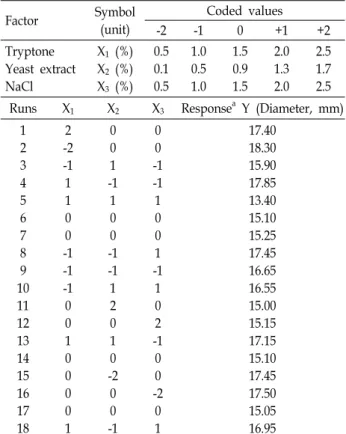
Table 1. Range of different variables for the central composite design and results for cellulase activity using factors
Factor Symbol
(unit)
Coded values
-2 -1 0 +1 +2
Tryptone Yeast extract NaCl
X1 (%) X2 (%) X3 (%)
0.5 0.1 0.5
1.0 0.5 1.0
1.5 0.9 1.5
2.0 1.3 2.0
2.5 1.7 2.5 Runs X1 X2 X3 Responsea Y (Diameter, mm)
1 2 3 4 5 6 7 8 9 10 11 12 13 14 15 16 17 18
2 -2 -1 1 1 0 0 -1 -1 -1 0 0 1 0 0 0 0 1
0 0 1 -1 1 0 0 -1 -1 1 2 0 1 0 -2 0 0 -1
0 0 -1 -1 1 0 0 1 -1 1 0 2 -1 0 0 -2 0 1
17.40 18.30 15.90 17.85 13.40 15.10 15.25 17.45 16.65 16.55 15.00 15.15 17.15 15.10 17.45 17.50 15.05 16.95 The experiments were carried out in triplicate.
aResponse was cellulase activity of Bacillus subtilis NC-1.
RSM)이 다양하게 사용되고 있다. 반응표면분석법은 여러 개 의 인자가 상호작용을 하는 경우, 예를 들면 복합배지의 경우 C, N, P의 공급원이 여러 개로 복합적으로 작용할 때, 원인보 다는 최적화를 통해 얻고자 하는 결과에 근거하여 최적점을 찾는 통계학적 방법의 하나이다[12]. 반응표면 분석법과 같은 통계학적 방법을 응용한 배양 조건의 최적화는 얻고자 하는 실험 결과를 위한 최적 배지 조성 확립과 배지 성분 간의 상호 관계를 확인하는데도 유용한 방법이며[5], 이를 통해 기존의 복잡한 공정을 간소화하는 효과를 얻을 수 있고, 최적화를 수 행하는데 따르는 비용을 절감하는 장점이 있어 생물공학에서 최적 조건을 확립하는 연구에 다양하게 응용되어 사용되고 있다.
본 연구자는 이전에 토양으로부터 CM-cellulose와 Beech- wood xylan에 대하여 각각 높은 효소 활성을 보이는 cellulase 와 xylanase 생산 균주 B. subtilis NC1에 대해 보고한 바 있으 며[10], 본 연구에서는 RSM을 이용하여 B. subtilis NC1유래의 cellulase 효소 대량생산을 위한 발효 최적 조건을 확립하였다.
재료 및 방법
Cellulase 생산 균주 및 배양
본 실험에 사용된 균주는 이전에 전국의 다양한 장소에서 채취한 토양 시료로부터 trypan blue [0.02% (w/v), Sigma, St. Louis, MO, U.S.A] 염색 시약과 기질로서 1%의 CM-cellu- lose와 Beechwood xylan을 첨가한 고체 배지 Luria-Burtani (LB) (Difco, Sparks, MD, U.S.A.)를 이용하여 분리한 cellulose 및 xylanase 생성 균주 Bacillus subtilis NC1를 사용하였다[10].
LB배지에 균주를 접종하여 37°C에서 200 rpm으로 48시간 동 안 진탕 배양 후 원심분리(8,000 rpm, 15 min)에 의해 회수한 배양 상층액을 cellulase 효소 활성을 측정하기 위한 효소액으 로 사용하였다.
효소활성 측정
Cellulase 효소 활성의 정성 분석은 carboxylmethyl cellu- lose (CMC, Sigma, St. Louis, MO, U.S.A)을 기질로 선택하여 1% CMC를 함유한 CMC agar 배지를 제조하여 측정하였다.
효소 분비능 측정 배지에 각 균주의 배양 상등액을 0.45 μm membrane filter (Sartorius, Frankfurt, Germany)로 제균 한 후 100 μl씩을 직경 8 mm의 준비한 well에 분주하여 25°C에서 24시간 동안 반응시킨 후 cellulase 분비능을 투명환의 직경으 로 조사하였다[14].
또한, 환원당 측정법을 이용하여 효소 활성을 측정하였다.
1% CMC를 50 mM acetic acid 완충용액(pH 5.0)에서 용해한 용액을 cellulase 효소 활성 측정을 위한 기질로 사용하였다.
효소와 기질의 반응은 효소액 200 μl에 기질 200 μl를 첨가하여 50°C에서 10분간 반응하였으며, 반응 후 효소 분해 활성으로
인해 생성된 환원 말단은 Miller에 의해 소개된 3,5-dinitrosali- cylic acid (DNS) 시약(Sigma, St. Louis, MO, U.S.A)을 이용하 여 다음과 같이 측정하였다[9]. 반응 시간 종료 후 효소 반응을 정지시키기 위하여 900 μl 의 DNS 시약을 첨가 후 100°C의 열탕 속에서 10분간 처리하였다. 그리고, 처리가 끝난 시료를 상온에서 20분간 방치 한 후 원심분리(10,000 rpm, 10 min)에 의해 상층을 회수한 후 540 nm에서 반응 상층액의 흡광도를 측정하였다. 본 연구에서 효소 활성의 1 unit은 1분간에 1 μ mol의 d-glucose를 생산하는 효소량으로 정의하였다.
실험계획 및 통계 분석
배지성분의 최적 농도를 결정하기 위하여 배지 성분 각각의
농도 변화가 cellulase 활성에 미치는 영향을 발효공정 및 생산
공정의 최적화를 실시하는데 가장 영향력이 있는 반응표면분
석법(response surface methodology, RSM)을 이용하여 통계
학적 최적화를 수행하였다. 실험계획은 cellulase 활성의 증진
을 위하여 배지성분의 최적 농도를 결정하기 위해 중심합성계
획법(central composite design, CCD)을 적용하였으며, 실험
의 계획, 데이터 분석 및 통계 분석은 Design Expert 9.0
(Version 9.0.3.1, Stat-Ease Inc., Minneapolis, USA) program
을 사용하였다. 배지 조성 성분의 최적 농도 결정을 위하여
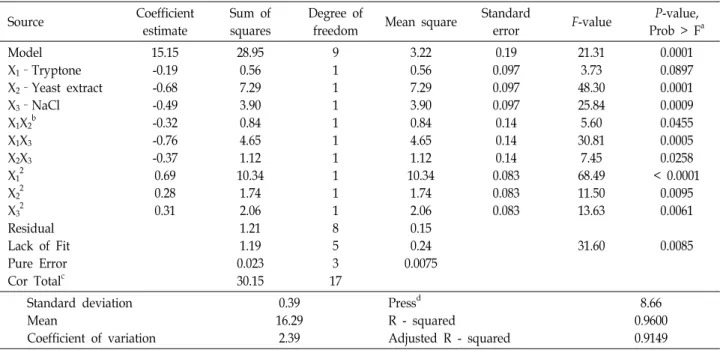
Table 2. Analysis of variance (ANOVA) of central composite design for improving cellulase activity of Bacillus subtilis NC-1
Source Coefficient
estimate
Sum of squares
Degree of
freedom Mean square Standard
error F-value P-value,
Prob > Fa Model
X1–Tryptone X2–Yeast extract X3–NaCl X1X2b
X1X3
X2X3
X12
X22
X32
Residual Lack of Fit Pure Error Cor Totalc
15.15 -0.19 -0.68 -0.49 -0.32 -0.76 -0.37 0.69 0.28 0.31
28.95 0.56 7.29 3.90 0.84 4.65 1.12 10.34
1.74 2.06 1.21 1.19 0.023 30.15
9 1 1 1 1 1 1 1 1 1 8 5 3 17
3.22 0.56 7.29 3.90 0.84 4.65 1.12 10.34
1.74 2.06 0.15 0.24 0.0075
0.19 0.097 0.097 0.097 0.14 0.14 0.14 0.083 0.083 0.083
21.31 3.73 48.30 25.84 5.60 30.81
7.45 68.49 11.50 13.63 31.60
0.0001 0.0897 0.0001 0.0009 0.0455 0.0005 0.0258
< 0.0001 0.0095 0.0061 0.0085
Standard deviation Mean
Coefficient of variation
0.39 16.29
2.39
Pressd R - squared
Adjusted R - squared
8.66 0.9600 0.9149 Response model was suggested quadratic model through the lack of fit tests.
aP-value, probability distribution value. P-value less than 0.05 indicate that the term is significant.
bX1X2, X1X3, X2X3 represent the interaction effect of variables X1, X2, and X3. X12
, X22
, and X32
are the squared effects of the variables.
cCor Total, Sum of squares total corrected for the mean.
dPress, The predicted residual sum of squares for the model.
Table 1과 같이 독립변수(X
i)로는 tryptone (X
1), yeast extract (X
2), 그리고 NaCl (X
3)으로 예비 실험을 통해 중심점을 설정하 였고, 이를 바탕으로 범위를 설정하여 각각을 -2, -1, 0, 1, 2의 5개 수준으로 부호화하였다. 독립변수에 영향을 받는 종속변 수(Y)로는 cellulase 활성을 3회 반복 측정하여 평균값을 회귀 분석에 사용하였으며, 중심점 3회를 포함한 18개의 실험구를 실시하였다. 회귀분석에 의한 모델식은 아래와 같다.
여기에서 β
0은 절편, β
X는 회계계수이고, 회귀분석에 의한 모델식의 예측은 Design Expert 9.0 (Version 9.0.3.1, Stat-Ease Inc., Minneapolis, USA)을 이용하여 분석하였고, 회귀분석 결 과를 바탕으로 임계점 분석 및 cellulase 활성을 위한 각 배지 성분의 최적 농도를 결정하였으며, ANOVA 분석을 통해 실험 모델의 유의성을 검토하였다.
결과 및 고찰
Cellulase 생산 균주
본 연구자는 이전에 토양으로부터 cellulase와 xylanase를 생산하는 균주를 단리하였다. 선발 단리된 균주는 16S rRNA 유전자 분석(Gene Bank Accession number, AB701293)과 API 50 kit를 이용하여 탄소원으로 당이나 당 유도체의 이용성을
분석을 통해 Bacillus subtilis NC1 로 명명하였다[10]. 또한, 본 균주 유래의 cellulase와 xylanase의 활성에 대한 조건 및 기질 특이성을 검토하였으며 두 효소 유전자 cellulase와 xylanase 를 cloning 한 후 효소 유전자의 염기배열 및 단백질의 아미노 산 서열을 규명하였다.
반응표면 분석법을 이용한 배양 조건 최적화
B. subtilis NC1로부터 cellulase 활성 증가를 위한 배지 성분 의 농도 최적화를 위하여 반응표면분석법을 실시하였다. 독립 변수는 선행연구를 기반으로 하여 tryptone (X
1), yeast extract (X
2), 그리고NaCl (X
3)를 3가지 요인 변수로 설정하고 5개 수준 의 실험계획을 수립하여 cellulase 활성를 측정하였다. 각각의 독립변수에 대한 종속변수(Y, celllulase 활성)의 반응값은 Table 1과 같으며, 반응값에 대한 모델식의 예측은 Design ex- pert 프로그램을 사용하여 분석하였고, cellulase 활성에 대한 회귀방정석은 아래와 같다.
반응값에 대하여 분산분석을 실시한 결과 결정계수(R-
Predicted vs. Actual
13 14 15 16 17 18 19
13 14 15 16 17 18 19
Predicted
Actual
Fig. 1. Comparison between the experimental values and the predicted values of the response surface methodology model.
-1 -0.5 0 0.5 1
-1 -0.5 0 0.5 1
B: Yeast extract (%)
15
15.5
16.5 16 16.5
4
-1 -0.5 0 0.5 1
-1 -0.5 0 0.5 1
C: NaCl (%) 15
15.5
16
16 16
16.5 17 4
-1 -0.5 0 0.5 1
-1 -0.5 0 0.5 1
C: NaCl (%)
14.5
15
15.5 16
4
A: Tryptone (%) A: Tryptone (%) B: Yeast extract (%)
A B C
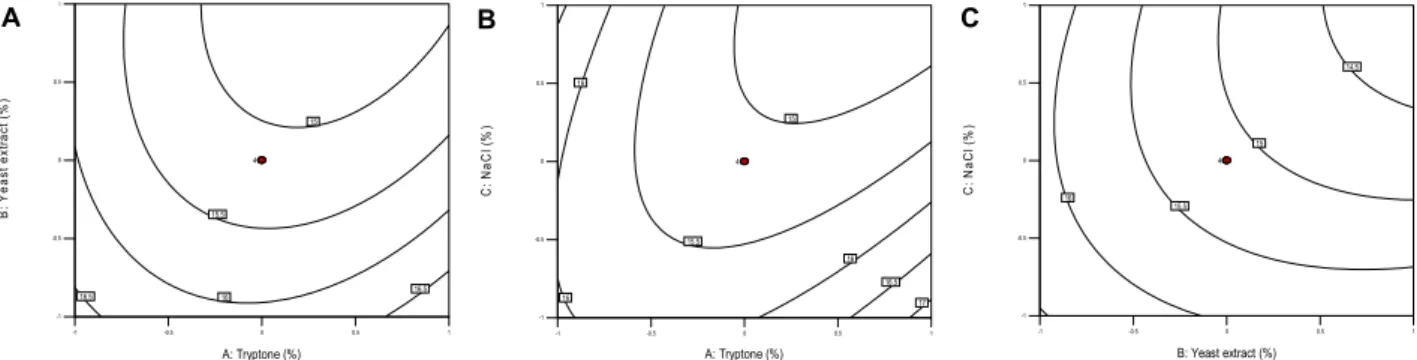
Fig. 2. Contour plots of maximal cellulase activity showing the interactions between tryptone, yeast extract and NaCl. (A) Contour plot showing the effect of tryptone (X1) and yeast extrac t(X2) on cellulase activity (Y, response value) (B) Contour plot showing the effect of tryptone (X1) and NaCl (X3) on cellulase activity (Y, response value) (C) Contour plot showing the effect of yeast extract (X2) and NaCl (X3) on cellulase activity (Y, response value).
-1 -0.5 0 0.5 1
-1 -0.5
0 0.5
1 13
14 15 16 17 18 19
Cellulase activity (mm)
B: Yeast extract (%) C: NaCl (%)
-1 -0.5 0 0.5 1
-1 -0.5
0 0.5
1 13
14 15 16 17 18 19
Cellulase activity (mm)
A: Tryptone (%) C: NaCl (%)
-1 -0.5 0 0.5 1
-1 -0.5
0 0.5
1 13
14 15 16 17 18 19
Cellulase activity (mm)
A: Tryptone (%) B: Yeast extract (%)
A B C
Fig. 3. Three-dimensional response surface of maximal cellulase activity showing the interactions between tryptone, yeast extract and NaCl. (A) Response surface plot showing the effect of tryptone (X1) and yeast extract (X2) on cellulase activity (Y, response value) (B) Response surface plot showing the effect of tryptone (X1) and NaCl (X3) on cellulase activity (Y, response value) (C) Response surface plot showing the effect of yeast extract (X2) and NaCl (X3) on cellulase activity (Y, response value).
square)는 0.96으로 1에 가깝다고 할 수 있으므로 매우 높은 유의성을 지님을 확인하였으며, 전체 모델에 대한 유의확률이 0.0001로 0.05보다 낮아 가정된 실험 모형이 자료에 적합함을
확인하였다. 또한 변동계수(CV, Coefficient of variation)는 2.39로 매우 낮은 수치를 나타내어 cellulase 활성에 변수들의 독립적인 영향뿐만 아니라 변수들 간의 상호작용이 매우 높게 작용하고 있음을 확인하였다(Table 2).
또한 반응표면분석법을 통해 예측된 결과값과 실험값이 어
느 정도 유의성을 보이는지를 나타내는 plot를 Fig. 1에 나타내
었으며 두 값의 차이는 매우 유사하여 실험계획을 통한 반응
값과 실제 실험 결과값이 유사함을 확인할 수 있다. Fig. 2는
각 변수가 cellulase 활성에 미치는 영향을 하나의 독립 변수를
최적점에 고정하여 등고선을 이용하여 확인하였다. Fig. 3은
각 변수가 미치는 영향을 쉽게 확인하기 위하여 3개의 변수
중 하나의 독립변수를 최적점에 고정한 후 나머지 2개의 변수
를 이용하여 3차원의 형태로 교호작용을 확인한 결과이다. 최
종적으로 중심합성계획법을 통하여 B. subtilis NC1의 cellu-
lase 활성에 가장 영향을 주는 독립변수의 농도를 예측할 수
있었으며, 실험 범위 내에서 tryptone는 첨가량이 증가할수록
활성이 증가하는 경향을 보인 반면, yeast extract와 NaCl의
경우 첨가량이 증가에 따라 감소하는 경향을 보였다. 중심합
성 계획법을 통하여 최대 cellulase 활성은 18.1246±0.388513
Fig. 4. Comparison of LB (basal) and optimal culture conditions after incubation for 48 hr. The experiments were carried out in triplicate (p<0.05).
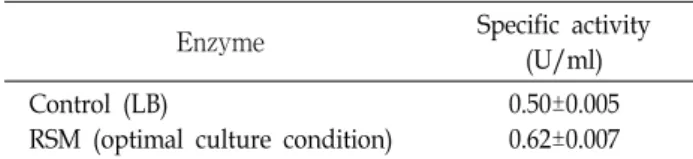
Table 3. Comparison of cellulose activity of LB (basal) and opti- mal culture conditions after incubation for 48hr
Enzyme Specific activity
(U/ml) Control (LB)
RSM (optimal culture condition)
0.50±0.005 0.62±0.007 Data represent the means of three experiments with standard deviation.
mm로 예측되었고, 이때의 각 변수의 농도는 tryptone 2.5%, yeast extract 0.5%, 그리고 NaCl 1.0%이었다.
실험모델의 검증
반응표면분석법을 통하여 얻어진 최적화 배지에서의 B.
subtilis NC1의 cellulase 활성을 검증하기 위하여 예측된 최적 활성 배지에 B. subtilis NC1을 1% 접종하여 48시간 배양한 후 cellulase 활성을 측정하였다. 대조구로는 기본 LB 액체 배 지를 사용하였다. 최적화를 통한 배지에서 배양한 결과 B. sub- tilis NC1의 cellulase 활성은 18.2±0.389 mm로 중심합성계획 법을 통하여 예측된 18.1246±0.388513 mm와 거의 유사한 결 과를 나타내었으며 실험계획법을 통한 실험모델의 예측값이 신뢰할 수 있음을 확인하였다. 또한, 최적화를 실시하기 이전 인 대조구의 cellulase 활성 15.05±0.214 mm와 비교하면 20.43% 활성이 향상되었다(Fig. 4). 또한, 1% CMC 기질을 이 용한 환원당 활성측정법을 통해 비교해 보았을 때 대조구 (0.5U/ml) 대비 최적화된 배지에서의 효소활성은 0.62 U/ml 로 약 24% 활성이 향상되었다(Table 3).
감사의 글
이 논문은 2013년도 정부(교육부)의 재원으로 한국연구재 단의 지원을 받아 수행된 기초연구사업(No. 2013R1A1A2062475) 과 2013~2014년도 창원대학교 연구비에 의하여 연구되었음
References
1. Beguin, P. and Aubert, J. 1994. The biological degradation of cellulose. FEMS Microbiol. Rev. 13, 25-58.
2. de Almeida, M. N., Guimarães, V. M., Bischoff, K. M., Falkoski, D. L., Pereira, O. L., Gonçalves, D. S. and de Rezende, S. T. 2011. Cellulases and hemicellulases from en- dophytic Acremonium species and its application on sugar- cane bagasse hydrolysis. Appl. Biochem. Biotechnol. 165, 594- 610.
3. Díaz, I., Donoso-Bravo, A. and Fdz-Polanco, M. 2011. Effect of microaerobic conditions on the degradation kinetics of cellulose. Bioresour. Technol. 102, 10139-10142.
4. Hideno, A., Inoue, H., Tsukahara, K., Yano, S., Fang, X., Endo, T. and Sawayama, S. 2010. Production and character- ization of cellulases and hemicellulases by Acremonium cellu- lolyticus using rice straw subjected to various pretreatments as the carbon source. Enzyme Microb. Technol. 48, 162-168.
5. Jeong, Y. S., Kim, J. W., Lee, E. S., Gil, N. Y., Kim, S. S.
and Hong, S. T. 2014. Optimization of alkali extraction for preparing oat protein concentrates from oat groat by re- sponse surface methodology. J. Kor. Soc. Food Sci. Nutr. 43, 1462-1466.
6. Joshi, S., Yadav, S., Nerurkar, A. and Desai, A. J. 2007.
Statistical optimization of medium components for the pro- duction of biosurfactant by Bacillus licheniformis K51. J.
Microbiol. Biotechnol. 17, 313-319.
7. Kataria, R., and Ghosh, S. 2011. Saccharification of Kans grass using enzyme mixture from Trichoderma reesei for bio- ethanol production. Bioresour. Technol. 102, 9970-9975.
8. Metz, B., Seidl-Seiboth, V., Haarmann, T., Kopchinskiy, A., Lorenz, P., Seiboth, B. and Kubicek, C. P. 2011. Expression of biomass-degrading enzymes is a major event during coni- dium development in Trichoderma reesei. Eukaryot. Cell. 10, 1527-1535.
9. Miller, G. L. 1959. Use of dinitrosalicylic acid reagent for determination of reducing. Anal. Chem. 31, 426-428.
10. Park, C. S., Kang D. O. and Choi, N. S. 2013.
Characterization of cellulase and xylanase from Bacillus sub- tilis NC1 isolated from environmental soil and determi- nation of their genes. J. Life Sci. 22, 912-919.
11. Peng, L. and Gutterson, N. 2011. Energy crop and bio- technology for biofuel production. J. Intergr. Plant Biol. 53, 253-256.
12. Qasim, K. B., Vikram, S. and Rani, G. 2003. Statistical media optimization and alkaline protease production from Bacillus mojavensis in a bioreactor. Process Biochem. 39, 203-209.
13. Silva, G. G., Couturier, M., Berrin, J. G., Buléon, A. and Rouau, X. 2012. Effects of grinding processes on enzymatic degradation of wheat straw. Bioresour. Technol. 103, 192-200.
14. Teather, R. and Wood, P. J. 1982. Use of congo fed poly- saccharide interactions in enumeration and characterization of cellulolytic bacteria from the bovine rumen. Appl. Environ.
Microbiol. 43, 777-780.
15. Tomme, P., Warren, A. J. and Gilkes, N. R. 1995. Cellulose hydrolysis by bacteria a Fungi. Adv. Microbial. Physiol. 37,
초록:반응 표면 분석법을 사용한
Bacillus subtilisNC1 유래 cellulase 생산 배지 최적화 양희종
1․박창수
2․양호연
3․정수지
1․정성엽
1․정도연
1․강대욱
4․문자영
4․최낙식
3,4*
(1
(재)발효미생물산업진흥원,
2대구가톨릭대학교 식품가공학전공,
3㈜리얼바이오텍,
4창원대학교 보건의학과
)이전에 토양으로부터 cellulase와 xylanase 생산 균주로 단리하였다. 단리한 균주 유래의 16S rRNA 유전자 및 API 50 kit를 분석한 결과 Bacillus subtilis와 약 99.5%의 높은 상동성을 보였기에 본 균주를 B. subtilis NC1으로 명명하였다. Bacillus subtilis NC1 균주 유래 cellulase와 xylanase 유전자를 cloning 하여 유전자 배열을 규명하였 다. 또한, 두 효소의 아미노산 배열을 이용하여 상동성을 검토한 결과 cellulase는 Glycoside hydrolase family (GH) 5 그리고 xylanase는 GH30에 속하는 효소임을 밝혔다. 본 연구에서는 B. subtilis NC1 의 cellulase 생산을 위한 배지성분의 최적 농도를 결정하기 위해 중심합성계획법(central composite design, CCD)을 기반으로 한 반 응표면 분석법(Response Surface Methodology) 을 수행하였다. 세가지 독립변수로는 tryptone, yeast extract, 그 리고 NaCl이 조사되었다. 반응값에 대하여 분산분석을 실시한 결과 결정계수(R
2)는 0.96이었으며 전체 모델에 대 한 유의확률이 0.0001로 매우 높은 유의성을 지님을 확인하였다. 반응표면분석법을 통하여 얻어진 B. subtilis NC1 의 cellulase 활성을 위한 최적화 배지의 각 변수 농도는 tryptone 2.5%, yeast extract 0.5%, 그리고 NaCl 1.0%로 예측 되었다. 최적화 배지에서의 B. subtilis NC1의 cellulase 활성을 검증한 최적화를 실시하기 이전인 대조구의 cellulase 활성 0.5U/ml와 비교하면 24% 활성이 향상된 0.62U/ml의 높은 활성을 보였다.
1-81.
16. Xie, G. and Peng, L. 2011. Genetic engineering of energy crops: a strategy for biofuel production in China. J. Intergr.
Plant Biol. 53, 143-150.
17. Yu, L., Chen, Z. X., Tong, X., Li, K. and Li, W. W. 2012.
Anaerobic degradation of microcrystalline cellulose: Kinet-
ics and micro-scale structure evolution. Chemosphere. 86, 348- 353.
18. Zhang, Y., Han, B. and Ezeji, T. C. 2012. Biotransformation of furfural and 5-hydroxymethyl furfural (HMF) by Clostridium acetobutylicum ATCC 824 during butanol fermentation. N. Biotechnol. 29, 345-351.