• 검색 결과가 없습니다.

Isolation of Temperature-sensitive Mutant Escherichia coli YrdC Involved in Universal t<sup>6</sup> A tRNA Synthesis

N/A
N/A
Protected

Academic year: 2021

Share "Isolation of Temperature-sensitive Mutant Escherichia coli YrdC Involved in Universal t<sup>6</sup> A tRNA Synthesis"

Copied!
8
0
0

로드 중.... (전체 텍스트 보기)

전체 글

(1)

Isolation of Temperature-sensitive Mutant Escherichia coli YrdC Involved in Universal t 6 A tRNA Synthesis

Jihwan Hwang*

Department of Microbiology, Pusan National University, Busan 46241, Korea

Received November 21, 2017 /Revised February 3, 2018 /Accepted February 7, 2018

The YrdC superfamily is a group of proteins that are highly conserved in almost all organisms se- quenced so far. YrdC in Escherichia coli was suggested to be involved in ribosome biogenesis, trans- lation termination, cold adaptation, and threonylcarbamoyl adenosine formation in tRNA. In this study, to unambiguously demonstrate that yrdC is essential in E. coli, we constructed two yrdC mutant strains of E. coli and examined their phenotypes. In the temperature-sensitive yrdC mutant strain, cell growth stopped almost immediately under nonpermissive conditions and it appeared to accumulate 16S ribosomal RNA precursors without significant accumulation of 30S ribosomal subunits. We also cloned yeast and human homologs and demonstrated that they complement the E. coli yrdC-deletion strain. By mutational study, we demonstrated that the concave surface in the middle of the YrdC pro- tein plays an important role in E. coli, yeast, and human versions. By comparison of two yrdC-deletion strains, we also unambiguously demonstrated that yrdC is essential for viability in E. coli and that the functions of its yeast and human homologs overlap with that of E. coli YrdC.

Key words : ATPase, Escherichia coli, threonylcarbamoyl adenosine, tRNA, YrdC

*Corresponding author

*Tel : +82-51-510-2194, Fax : +82-51-514-1778

*E-mail : [email protected]

This is an Open-Access article distributed under the terms of the Creative Commons Attribution Non-Commercial License (http://creativecommons.org/licenses/by-nc/3.0) which permits unrestricted non-commercial use, distribution, and reproduction in any medium, provided the original work is properly cited.

Journal of Life Science

2018 Vol. 28. No. 2. 257~264 DOI : https://doi.org/10.5352/JLS.2018.28.2.257

Introduction

The YrdC protein belongs to the superfamily of YrdC/

YciO/Sua5 proteins, and it is ubiquitously found in both prokaryotes and eukaryotes [28]. The function of YrdC has been implicated in the formation of threonylcarbamoyl ad- enosine (t

6

A) in tRNA [7, 13, 29]. However, its exact role in the process of tRNA modification has not been de- termined yet; nevertheless, its structural study indicated that Escherichia coli YrdC has double-stranded RNA-binding ac- tivity and its concave surface clustered with positive electro- static potential appears to be critical for its dsRNA associa- tion [2, 9, 19, 28]. Another structural determination of Sulfolobus tokodaii Sua5 also revealed that it possesses nucleo- tide-binding activity in the concave area [19].

Previously, a genetic study showed that the prfA1 allele encodes temperature-sensitive polypeptide Release Factor 1 and is associated with the enhanced translational misreading of UAG and UAA [26]. The temperature-sensitive phenotype

of prfA1 was also reported to be suppressed by deletion of the first 12 nucleotides of the yrdC open reading frame in E. coli [17]. Kaczanowska et al. suggested that the sup- pression by ΔyrdC12 (12 nucleotides deletion) is associated with impaired 30S ribosome biogenesis and showed margin- al accumulation of 16S rRNA precursors without notable ac- cumulation of 30S ribosomal subunits. Serial deletions of rRNA genes also suppressed the prfA1 phenotype, implying that YrdC is a novel ribosome maturation factor. Moreover, the defective precursors of 16S rRNA in prfA1 ΔyrdC12 (12 nucleotides deletion) cell lysates were fully processed to be- come normal 16S rRNA when purified YrdC proteins were added exogenously [18].

For yeast YrdC homolog, the sua5-1 allele in Saccharomyces cerevisiae was identified as a suppressor of cyc1-1019 mutant encoding an aberrant upstream AUG initiation codon fol- lowed by a stop codon, UAA. It was suggested that the sua5-1 mutant is involved in translation, re-initiation, and/or mRNA stability. Sua5 null mutant exhibited a growth defect in minimal medium and a deficit in cytochrome a,a3 [11, 12].

Recently, Yacoubi et al. showed that the deletion of sua5

in yeast led to the disappearance of t

6

A at position 37 of

tRNA, which in turn was recovered by the exogenous ex-

pression of E. coli YrdC [8]. Unlike in yeast, however, the

modification defect associated with the deletion of yrdC in

E. coli remains unknown [8], even though E. coli YrdC binds

- Note -

(2)

Table 1. Bacterial strains and plasmids used in this study

Strains Genotypes References

BW25113 BY

lacI

q

rrnB

T14

ΔlacZ

WJ16

hsdR514 ΔaraBAD

AH33

ΔrhaBAD

LD78

yrdC::kan, pIEYrdC in BW25113

[6]

This study Plasmids

pIE pBAD33 pIEYrdC pBADYrdC pBADYrdCts pBADYrdC

Y25C

pBADYrdC

F95L

pBADYrdC

T27L

pBADYrdC

K50I

pBADYrdC

L58A

pBADYrdC

R117A

pBADYrdC

L127A

pBADSua5 pBADSua5

T70L

pBADSua5

K93I

pBADSua5

L101A

pBADSua5

S107F

pBADSua5

R174A

pBADSua5

L184A

pBADhYrdC pBADhYrdC

T87L

pBADhYrdC

K110I

pBADhYrdC

L118A

pBADhYrdC

R173A

pBADhYrdC

L183A

lpp

p

lac

po

, Amp

r

, ori

ts

P

BAD

, Cm

r

yrdC

+

, pIE yrdC

+

, pBAD33

yrdC (Y25C, F95L), pBAD33 yrdC (Y25C), pBAD33 yrdC (F95L), pBAD33 yrdC (T27L), pBAD33 yrdC (K50I), pBAD33 yrdC (L58A), pBAD33 yrdC (R117A), pBAD33 yrdC (L127A), pBAD33 sua5

+

, pBAD33 sua5 (T70L), pBAD33 sua5 (K93I), pBAD33 sua5 (L101A), pBAD33 sua5 (S107F), pBAD33 sua5 (R174A), pBAD33 sua5 (L184A), pBAD33 hyrdC

+

, pBAD33 hyrdC (T87L), pBAD33 hyrdC (K110I), pBAD33 hyrdC (L118A), pBAD33 hyrdC (R173A), pBAD33 hyrdC (L183A), pBAD33

[15]

[10]

[1]

This study This study This study This study This study This study This study This study This study This study This study This study This study This study This study This study This study This study This study This study This study This study preferentially to partially modified tRNA

thr

. Nevertheless, it

has been demonstrated that t

6

A is synthesized in vitro by the functional combination of YrdC, YgjD, YjeE, and YeaZ of E. coli [7]. Intriguingly, Meng et al. demonstrated that Sua5 binds to the core telomeric single-stranded DNA se- quences in yeast and positively regulates telomere length through an association with telomere-binding proteins or te- lomeric DNA [22, 23]. They also demonstrated that muta- tions in the positively charged concave surface disrupt the telomeric DNA binding.

Unlike E. coli YrdC and yeast Sua5 proteins, ischemia/re- perfusion-induced mouse YrdC (mYrdC/mIRIP, ischemia/

reperfusion condition-induced protein), which associates with the membrane transporter regulator RS1 protein of mouse and human YrdC (hYrdC/hIRIP), was shown to in- teract with retinoblastoma-binding protein, RBBP10 [3, 16].

However, the functional association of human or mouse YrdC protein with tRNA modification or telomere DNA reg- ulation is currently elusive. Thus, the defined role of YrdC

is still controversial due to its divergent functional character- izations in different species, and as mentioned earlier, the tRNA modification defect was not observed by the deletion of yrdC in E. coli [8].

In this study, to demonstrate the essentiality of YrdC in E. coli and the functional complementation of eukaryotic ho- mologs in the deletion of yrdC, we constructed yrdC-deletion and temperature-sensitive yrdC mutant strains and inves- tigated their phenotypes. We also demonstrated that using the yrdC-deletion strain, the function of eukaryotic and bac- terial homologs is likely conserved.

Materials and Methods

Growth conditions

Wild-type and yrdC-deletion strains were grown in Luria

–Bertani (LB) medium. Table 1 summarizes the strains and

plasmids used in this study. LB medium without arabinose,

unless indicated otherwise, was routinely used for cell

(3)

growth, and antibiotics were used at concentrations of 50, 35, and 50 mg/ml for ampicillin, kanamycin, and chlor- amphenicol, respectively. Arabinose was added at a final concentration of 0.4% (w/v). Culture turbidity was meas- ured at 600 nm.

Cloning and site-directed mutagenesis of yrdC Primers were used to amplify the coding sequence of the wild-type yrdC from E. coli, human, and yeast. The polymer- ase chain reaction (PCR) products were digested with NdeI-HindIII; the digested DNA fragments were ligated into the NdeI-HindIII site of pBAD33 (an arabinose-inducible plasmid, Cm

r

) [10]. The final clones are listed in Table 1.

Site-directed mutagenesis was carried out by PCR and con- firmed by sequencing analysis.

Construction of yrdC-deletion strain

Primers containing up- and downstream flanking se- quences of yrdC were used to amplify the kanamycin cas- sette of pKD13 by PCR [6]. The strain BW25113 harboring pKD46 [γ β exo (λ Red recombinase), bla, ori

ts

] [6] and a helper plasmid pBADYrdC (yrdC

+

, pBAD33) was subjected to PCR- amplified linear DNA transformation, and the trans- formants resistant to chloramphenicol and kanamycin at 30°C were isolated. The gene disruption was verified by PCR. The resultant strain was used to prepare for P1 trans- duction [24]. The P1 lysate was transduced to the strain BW25113 harboring pIEYrdC, which is a helper plasmid con- taining yrdC, a temperature-sensitive replication origin, and an ampicillin- resistant gene [1]. The transductant resistant to ampicillin and kanamycin at 30°C was tested for temper- ature sensitivity to 42°C, yielding strain BY (yrdC-deletion strain). The deletion of yrdC in the BY strain was confirmed again by PCR.

Random mutagenesis and screening the temperature- sensitive mutants

Error-prone Taq polymerase was used for random muta- genesis of yrdC with dITP, as described by Lerner et al. [20]

and Spee et al. [27]. The PCR products corresponding to the mutagenized open reading frame of yrdC were digested with NdeI-HindIII; the digested fragments were ligated into the NdeI-HindIII site of pBAD33; the ligation mixture was trans- formed into the BY cells. The clones were screened for tem- perature sensitivity at 42°C. The selected clones were re- transformed into the BY cells and the temperature-sensitive

phenotype of the transformants was confirmed. The plas- mids consistently showing a growth defect at 42°C were sequenced.

Isolation of polysomes and sucrose density gradient sedimentation

Polysomes were prepared and resolved as described pre- viously [15]. E. coli strains were grown at either 30°C or 42°C in 100 ml of LB medium to log phase. Upon reaching an appropriate culture density, polysomes were trapped by the addition of chloramphenicol to the culture at a final concen- tration of 0.1 mg/ml. After an additional 4 min of in- cubation, cells were harvested by centrifugation. The cell pellet was resuspended in 1 ml of buffer BP [20 mM Tris–

HCl (pH 7.5), 10 mM MgCl

2

, 100 mM NH

4

Cl, and 5 mM β-mercaptoethanol]. Polysomes were resolved by applying 0.5 ml of the cell lysate to a 5%-40% linear sucrose density gradient (10 ml) in buffer BP with subsequent ultracen- trifugation at 4°C in a Beckman SW41-Ti rotor for 2.5 hr at 150,000× g. The profile of polysomes was detected at 254 nm.

Results and Discussion

YrdC is essential in E. coli

Previously, it was suggested that YrdC may play a critical role in 30S ribosome biogenesis [5, 17], and a yeast homolog Sua5 was shown to be essential for normal cell growth [21].

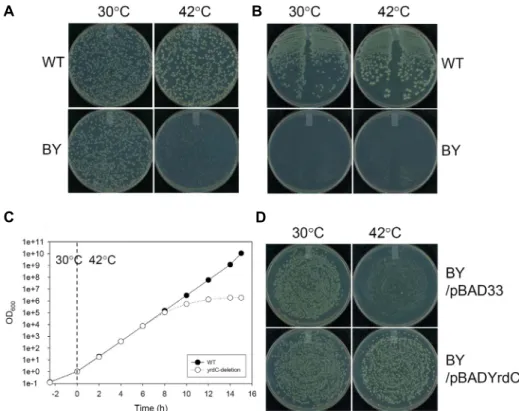
Peculiarly, however, a combination of prfA1 and ΔyrdC12 (first 12 nucleotides deleted) in E. coli was not detrimental [17], suggesting that the product of yrdC is not necessary in this specific genetic background. To unambiguously dem- onstrate that YrdC is pivotal for cell growth in E. coli, we attempted to delete the whole open reading frame of yrdC in wild-type E. coli. Wild-type cells were transformed with a helper plasmid, pIEYrdC, which contains a temper- ature-sensitive replication origin and an ampicillin-resistance gene. Subsequently, a kanamycin resistance cassette replaced the locus of yrdC in a cell harboring pIEYrdC. This condi- tional deletion of yrdC (strain BY) was confirmed by PCR using the transformants formed at 30°C on LB plates con- taining ampicillin and kanamycin. As shown in Fig. 1A, both wild-type and BY cells formed colonies at 30°C; however, BY cells formed smaller colonies on LB plates at 42°C.

Subsequent streaking of these cells was found to be ampi-

cillin-sensitive (data not shown) and did not lead to the col-

ony formation even on LB plates without ampicillin at not

(4)

A B

C D

Fig. 1. YrdC is essential in Escherichia coli. (A) The wild-type and BY cells were grown overnight and plated on LB plates. For BY cells at 30°C, the plate contained ampicillin and kanamycin. Then, plates were incubated at 30°C or 42°C. (B) The respective cells from plates incubated at 42°C in (A) were restreaked on LB plates and incubated at 30°C or 42°C. (C) The wild-type and BY cells were grown at 30°C in LB for the wild-type strain or in LB medium containing ampicillin and kanamycin for the BY cells. Portions of both cultures were centrifuged to remove antibiotics and resuspended in prewarmed LB medium.

The cultures were shifted to 42°C at the time indicated by a vertical line. During incubation at 42°C, the cultures were repeatedly diluted (1:20) into a freshly prewarmed medium. Closed circles, wild type; open circles, BY cells. (D) The BY cells were transformed with pBAD33 or pBADYrdC, and the transformants were incubated at 30°C and 42°C. For 30°C, the plates contained ampicillin and chloramphenicol, whereas for 42°C, they contained chloramphenicol, but not arabinose.

only 42°C but also 30°C (Fig. 1B). These results indicate that cells in these small colonies lost the helper plasmid, and that the deletion of yrdC in E. coli is detrimental to cell viability.

This phenotype was further confirmed by measuring the generation time of BY cells grown in a liquid medium at a nonpermissive temperature, 42°C. The growth rate of BY cells decreased at 8 hr after an increase of temperature to 42°C, which corresponds to approximately 15 generations (Fig. 1C). Note that the helper plasmid in the BY strain was derived from a low-copy-number plasmid, pEL3 (~5 cop- ies/chromosome at 30°C), whose replication is inhibited at 42°C [1, 4, 14]. Next, to verify the essentiality of yrdC and exclude the polar effect of gene deletion, the BY strain was transformed with pBAD33 or pBADYrdC. Cells transformed with empty vector pBAD33 formed small colonies, as con- sistently observed in Fig. 1A, and transformants of pBADYrdC recovered the normal growth at 42°C on LB plates even without an inducer, suggesting the essentiality

of YrdC (Fig. 1D).

Both mouse and yeast YrdC homologs were proposed to be present at low abundance, suggesting that their ex- pression in each organism is tightly regulated [16, 25]. This may be related to our observations shown in Fig. 1. The overexpression of YrdC from a helper plasmid enables cells to divide up to ~15 generations under nonpermissive con- ditions, resulting in the small colony formation on the first plating. Thus, it is tempting to speculate that E. coli YrdC is also a protein present in low abundance.

Isolation of temperature-sensitive YrdC

The BY cells exhibited an unexpected prolonged growth

even under nonpermissive conditions (Fig. 1A, Fig. 1C), and

the expression of YrdC from pBADYrdC in the absence of

an inducer resulted in colony formation (Fig. 1D). Thus, it

is likely that minimal plasmid-borne expression of YrdC is

sufficient for viability. To circumvent this problem and to

(5)

A

B

C

30°C (36 hr) 42°C (16 hr)

Fig. 2. Screening of temperature-sensitive YrdC protein and its phenotype. (A) Random mutagenesis of yrdC was car- ried out using dITP and MnCl

2

, and temperature-sensitive YrdC was isolated as described in Materials and Me- thods. BY cells harboring pBAD33, pBADYrdC, pBADYrdCts, pBADYrdC

Y25C

, or pBADYrdC

F95L

were streaked on LB or M9 plates supplemented with casamino acids. Both plates contained chloramphenicol and were incubated either at 30°C for 36 hr or at 42°C for 16 hr. (B) Temper- ature-sensitive phenotype of YrdCts-expressing cells. The ΔyrdC cells transformed with pBADYrdC, pBADYrdCts, or pBADYrdC

Y25C

were cultured in an LB medium con- taining chloramphenicol at 30°C, and further incubation was carried out as described in Fig. 1C. (C) Total RNAs of BY cells expressing wild-type or YrdCts. Aliquots of the cell culture in (B) were taken at 0, 2, 4, and 6 hr after an increase in temperature and were used to extract total RNAs. Here, 1.5 μg of total RNA for each sample was applied on a 3.5% polyacrylamide gel. Arrows in- dicate 23S, 17S, and 16S rRNA from the top.

demonstrate the immediate lethal phenotype of yrdC dele- tion, yrdC was randomly mutagenized as described in Mate- rials and Methods section to obtain a temperature-sensitive YrdC. The mutagenized yrdC fragments were ligated into pBAD33, and the ligation mixture was transformed into the BY cells. The clones were screened for a growth phenotype at 30°C and lethality at 42°C. The screening results revealed that the temperature-sensitive mutant YrdC expressed by the clone pBADYrdCts contains two substitutions at Tyr25 and Phe95 to Cys and Leu, respectively. These two mutations were separated by site-directed mutagenesis, yielding pBADYrdC

Y25C

and pBADYrdC

F95L

, and were further exam- ined to determine the residue responsible for the temper- ature sensitivity. BY cells were transformed with respective plasmids, and cells on the LB+Cm plate were first incubated at 42°C to remove the helper plasmid, pIEYrdC. The absence of the helper plasmid was subsequently confirmed by fur- ther incubation on LB plates containing ampicillin (data not shown). The colonies formed at 42°C were subsequently re- streaked on the LB+Cm plates or M9+Cm minimal medium plates supplemented with 0.4% glucose, and the plates were incubated at 30°C or 42°C. As shown in Fig. 4A, either muta- tion could support the normal cell growth at 30°C; however, transformants of pBADYrdC

Y25C

appeared to form smaller colonies at 42°C than those of pBADYrdC

F95L

. These results suggest that a combination of both Y25C and F95L mutations in YrdC caused the temperature sensitivity of growth. Next, we confirmed the temperature sensitivity by measuring the growth of cells harboring pBADYrdC, pBADYrdCts, or pBADYrdC

Y25C

. These cells were grown first in LB medium containing chloramphenicol at 30°C for 2 hr; then, the cul- tures were transferred to 42°C for further incubation. The isogenic wild-type strain ΔyrdC/pBADYrdC grew exponen- tially in a serially diluted culture after an increase in temper- ature. By contrast, the growth rate of ΔyrdC/pBADYrdCts cells was more severely reduced at 42°C than that of ΔyrdC/

pBADYrdC

Y25C

cells (Fig. 2B). Using ΔyrdC cells harboring pBADYrdC or pBADYrdCts, we analyzed the polysome pro- file to detect the abnormality of ribosome biogenesis. Isolation of polysomes and sucrose density gradient sedimentation were performed as described in Materials and Methods. No significant accumulation of ribosomal subunits was ob- served from the ΔyrdC/pBADYrdCts cells cultured at a non- permissive temperature (data not shown). Similarly, we did not observe the abnormal polysome profile of the BY cells grown at 42°C (data not shown). However, when we exam-

ined the total RNAs from ΔyrdC/pBADYrdCts cells grown

at 42°C, the accumulation of 16S rRNA precursors was mar-

ginally detected at 2-6 hr after the increase in temperature,

even without notable accumulation of 30S subunits (Fig. 2C).

(6)

A

B

Fig. 3. Complementation of the BY strain by human and yeast YrdC homologs. (A) The BY cells were transformed with the plasmids as indicated in (B) and incubated first at 30°C on LB plates containing ampicillin and chloram- phenicol. Then, each transformant was restreaked and incubated at 42°C on LB plates containing chlorampheni- col in the presence or absence of 0.4% arabinose. (B) The colonies formed at 42°C from (A) were restreaked on the same plates at 42°C as in (A), followed by second incubation at 42°C.

Consistent with this, the deletion of yrdC (12 nucleotides de- letion) in the prfA1 genetic background did not cause sub- stantial accumulation of 30S; nevertheless, rRNA processing was impaired, leading to the accumulation of 17S rRNA [17].

Furthermore, yeast Sua5 plays roles in translation initiation and 40S ribosome assembly [12, 21, 25]. However, we could not detect the direct interaction between the 30S ribosome subunit and YrdC (data not shown). Nevertheless, our re- sults suggest that YrdCts cause improper processing of 16S rRNA, implying a ribosome biogenesis factor. However, we do not rule out the possibility that defective tRNA mod- ification in yrdC null indirectly causes abnormal rRNA bio- synthesis [8, 13, 30].

Eukaryotic homologs of YrdC complement E. coli yrdC-deletion strain

Not only do human (aa residues 63-209) and yeast (aa residues 53-222) YrdC domains share a sequence homology of 44% and 47% with E. coli YrdC, respectively, but the struc- tures of E. coli YrdC and Sua5 proteins are also super- imposable with a positively charged concave area and ATP-binding domain [19, 28]. Therefore, to investigate whether the expression of human and yeast YrdC homologs in E. coli complements the BY cells, we cloned human yrdC and yeast sua5 in pBAD33, yielding pBADhYrdC and pBADSua5. The plasmids pBAD33, pBADYrdC, pBADhYrdC, and pBADSua5 were transformed into the BY cells, and the transformed cells were first plated on LB plates containing ampicillin and chloramphenicol at 30°C. Colonies from con- ditions of 30°C were further streaked on LB plates contain- ing chloramphenicol in the presence or absence of 0.4% ara- binose, and the plates were then incubated at 42°C overnight (Fig. 3A). Colonies were then picked and restreaked on the same plates. Next, the plates were incubated at 42°C. As shown in Fig. 3B, in the absence of arabinose, only cells har- boring pBADYrdC formed colonies at 42°C; however, ΔyrdC cells were able to form colonies when human and yeast pro- teins were overexpressed in the presence of 0.4% arabinose.

As mentioned previously, defective t

6

A modification in yeast sua5 mutant was reversed by the expression of E. coli YrdC;

thus, our results suggest that the function of E. coli, human, and yeast YrdC proteins is conserved and that they are mu- tually functional in each organism.

Mutational analyses of E. coli, yeast, and human YrdC proteins

Previously, it was shown that a double mutant [T87L

(corresponding to T27 in E. coli YrdC) and K110I (K50 in

E. coli YrdC)] of human YrdC exhibited a dominant-negative

phenotype by enhancing MPP

+

transport activity [16]. In

yeast Sua5, S107F mutation in the YrdC domain was shown

to eliminate its function [21]. More recently, Sulfolobus toko-

daii Sua5 protein was proposed to bind nucleotide, AMP (or

ATP) [19], and the highly conserved residues Leu58, Arg117,

and Leu127 (numbering in E. coli YrdC) were proposed to

be involved in nucleotide binding. Interestingly, all of these

residues are located in the concave area and have been im-

plicated in double-stranded RNA binding. Hence, we at-

tempted to analyze these residues described earlier to de-

termine their functional importance in YrdC homologs. For

this purpose, we performed site-directed mutagenesis using

pBADYrdC, pBADSua5, and pBADhYrdC. Each mutation

was verified by sequencing. Plasmids were first transformed

into the BY cells, and the complementation experiment was

performed as shown in Fig. 3. In the absence of arabinose,

the E. coli YrdC protein carrying L58A or L127A mutation

was able to support cell growth, whereas the YrdC protein

carrying T27L, K50I, or R117A mutation failed to do so. Note

that in the presence of 0.4% arabinose, proteins carrying the

mutation T27L or K50I complemented the yrdC-deletion

cells, suggesting that these mutant proteins are partially

(7)

A

B

C

Fig. 4. The mutational analyses of human, yeast, and Escherichia coli YrdC proteins. Five mutant clones for E. coli YrdC, six for yeast Sua5, and five for human YrdC (hYrdC) were constructed via site-directed PCR mutagenesis. The resulting plasmids were transformed into the BY cells, and the complementation experiment was carried out as described in Fig. 3. The plates shown here are from the second incubation at 42°C. The LB plates contained ei- ther chloramphenicol or chloramphenicol and 0.4%

arabinose. (A) YrdC and its mutants; (B) Sua5 and its mutants; and (C) hYrdC and its mutants.

functional (Fig. 4A). Corresponding mutations were in- troduced in yeast and human YrdC homologs, and the plas- mids carrying the resulting constructs were transformed into the BY cells. As shown in Fig. 3B and Fig. 3C, none of the human and yeast mutants except yeast Sua5

L101A

could com- plement the ΔyrdC cells, suggesting that the concave surface of the YrdC protein composed of highly conserved residues is critical for its RNA association and/or ATP binding.

In summary, our study suggested that the YrdC homologs play a conserved role in ribosome biogenesis and/or tRNA modification. In addition, it suggested that the temper- ature-sensitive mutant YrdC isolated in this study may pro- vide a platform to investigate the biosynthetic process of t

6

A tRNA modification by E. coli YrdC, which has not been eluci- dated yet, probably due to the unclear phenotype associated with the deletion of yrdC.

Acknowledgments

This work was supported by a Two-Year Research Grant of Pusan National University. We would like to thank Dr.

Michael Hampsey for providing the yeast sua5 clone.

References

1. Armstrong, K. A., Acosta, R., Ledner, E., Machida, Y., Pancotto, M., McCormick, M., Ohtsubo, H. and Ohtsubo, E. 1984. A 37×10

3

molecular weight plasmid-encoded pro- tein is required for replication and copy number control in the plasmid pSC101 and its temperature-sensitive derivative pHS1. J. Mol. Biol. 175, 331-348.

2. Carmel, D., Dahlstrom, K. M., Holmstrom, M., Allahver- diyeva, Y., Battchikova, N., Aro, E. M., Salminen, T. A. and Mulo, P. 2013. Structural model, physiology and regulation of Slr0006 in Synechocystis PCC 6803. Arch. Microbiol. 195, 727-736.

3. Chen, J., Ji, C., Gu, S., Zhao, E., Dai, J., Huang, L., Qian, J., Ying, K., Xie, Y. and Mao, Y. 2003. Isolation and identi- fication of a novel cDNA that encodes human yrdC protein.

J. Hum. Genet. 48, 164-169.

4. Cohen, S. N. and Chang, A. C. 1977. Revised interpretation of the origin of the pSC101 plasmid. J. Bacteriol. 132, 734-737.

5. Comartin, D. J. and Brown, E. D. 2006. Non-ribosomal fac- tors in ribosome subunit assembly are emerging targets for new antibacterial drugs. Curr. Opin. Pharmacol. 6, 453-458.

6. Datsenko, K. A. and Wanner, B. L. 2000. One-step in- activation of chromosomal genes in Escherichia coli K-12 us- ing PCR products. Proc. Natl. Acad. Sci. USA. 97, 6640-6645.

7. Deutsch, C., El Yacoubi, B., de Crecy-Lagard, V. and Iwata- Reuyl, D. 2012. Biosynthesis of threonylcarbamoyl ad- enosine (t6A), a universal tRNA nucleoside. J. Biol. Chem.

287, 13666-13673.

8. El Yacoubi, B., Lyons, B., Cruz, Y., Reddy, R., Nordin, B., Agnelli, F., Williamson, J. R., Schimmel, P., Swairjo, M. A.

and de Crecy-Lagard, V. 2009. The universal YrdC/Sua5 family is required for the formation of threonylcarbamoyla- denosine in tRNA. Nucleic Acids Res. 37, 2894-2909.

9. Fu, T. M., Liu, X., Li, L. and Su, X. D. 2010. The structure of the hypothetical protein smu.1377c from Streptococcus mu- tans suggests a role in tRNA modification. Acta Crystallogr.

Sect. F Struct. Biol. Cryst. Commun. 66, 771-775.

10. Guzman, L. M., Belin, D., Carson, M. J. and Beckwith, J. 1995.

Tight regulation, modulation, and high-level expression by vectors containing the arabinose PBAD promoter. J.

Bacteriol. 177, 4121-4130.

11. Hampsey, M., Na, J. and Pinto, I. 1991. Isolation and charac- terization of the Sua5 gene, which affects AUG initiation codon selection in Saccharomyces cerevisiae. FASEB J. 5, A808- A808.

12. Hampsey, M., Na, J. G., Pinto, I., Ware, D. E. and Berroteran, R. W. 1991. Extragenic suppressors of a translation initiation defect in the cyc1 gene of Saccharomyces cerevisiae. Biochimie 73, 1445-1455.

13. Harris, K. A., Jones, V., Bilbille, Y., Swairjo, M. A. and Agris,

P. F. 2011. YrdC exhibits properties expected of a subunit

for a tRNA threonylcarbamoyl transferase. RNA 17, 1678-

1687.

(8)

초록:대장균에서 t

6

A tRNA의 생합성에 관여하는 필수 단백질 YrdC의 온도 민감형 돌연변이 분리

황지환*

(부산대학교 미생물학과)

YrdC 수퍼 패밀리는 지금까지 유전 서열이 알려진 거의 모든 생명체에서 매우 잘 보존 된 단백질 중 하나이다.

Escherichia coli의 YrdC는 리보솜 생합성, 번역 종결, 저온 적응, tRNA에서 threonylcarbamoyl adenosine의 형성에 관여하는 것으로 제안되었다. 이 연구에서, yrdC 유전자가 대장균에서 필수적이라는 것을 명확하게 증명하기 위해, 대장균에서 두 개의 yrdC 결손 돌연변이 균주를 만들고 그 표현형을 조사하였다. 특히 온도에 민감한 yrdC 돌연변 이 균주는 42°C 온도 조건 하에서 거의 즉시 세포 성장을 멈추었으며 30S 리보솜 단위체의 상당한 축적없이 16S rRNA 전구체를 축적하는 것으로 나타났다. 또한 효모와 인간의 yrdC 유전자를 클로닝하여 이들이 대장균 yrdC 결손 균주의 성장억제를 회복 할 수 있다는 것을 입증하였다. 이밖에도 여러 돌연변이 연구에 의해, 우리는 YrdC 단백질의 중간에 위치한 오목한 표면이 대장균, 효모 및 인간의 YrdC 단백질에서 중요한 역할을 한다는 것을 보여 주었다. 따라서, 두 개의 yrdC 결손 균주를 비교하여, yrdC 유전자가 대장균에서 생존력에 필수적이며, 효모 및 인간 동족체의 기능이 대장균 YrdC의 기능과 중복된다는 것을 규명하였고, 이 균주를 이용하여 아직까지 밝혀지지 않은 대장균 YrdC 단백질이 tRNA 형성에 관여한다는 것을 증명할 수 있는 토대를 제공한다는데 의의가 있다.

14. Hasunuma, K. and Sekiguchi, M. 1979. Effect of DNA muta- tions on the replication of plasmid pSC101 in Escherichia coli K-12. J. Bacteriol. 137, 1095-1099.

15. Hwang, J. and Inouye, M. 2006. The tandem GTPase, Der, is essential for the biogenesis of 50S ribosomal subunits in Escherichia coli. Mol. Microbiol. 61, 1660-1672.

16. Jiang, W., Prokopenko, O., Wong, L., Inouye, M. and Mir- ochnitchenko, O. 2005. IRIP, a new ischemia/reperfusion-in- ducible protein that participates in the regulation of trans- porter activity. Mol. Cell Biol. 25, 6496-6508.

17. Kaczanowska, M. and Ryden-Aulin, M. 2004. Temperature sensitivity caused by mutant release factor 1 is suppressed by mutations that affect 16S rRNA maturation. J. Bacteriol.

186, 3046-3055.

18. Kaczanowska, M. and Ryden-Aulin, M. 2005. The YrdC pro- tein-a putative ribosome maturation factor. Biochim. Biophys.

Acta 1727, 87-96.

19. Kuratani, M., Kasai, T., Akasaka, R., Higashijima, K., Terada, T., Kigawa, T., Shinkai, A., Bessho, Y. and Yokoyama, S.

2011. Crystal structure of Sulfolobus tokodaii Sua5 complexed with L-threonine and AMPPNP. Proteins 79, 2065-2075.

20. Lerner, C. G., Kobayashi, T. and Inouye, M. 1990. Isolation of subtilisin pro-sequence mutations that affect formation of active protease by localized random polymerase chain reaction mutagenesis. J. Biol. Chem. 265, 20085-20086.

21. Lin, C. A., Ellis, S. R. and True, H. L. 2010. The Sua5 protein is essential for normal translational regulation in yeast. Mol.

Cell Biol. 30, 354-363.

22. Meng, F. L., Chen, X. F., Hu, Y., Tang, H. B., Dang, W. and Zhou, J. Q. 2010. Sua5p is required for telomere recombina- tion in Saccharomyces cerevisiae. Cell Res. 20, 495-498.

23. Meng, F. L., Hu, Y., Shen, N., Tong, X. J., Wang, J., Ding, J. and Zhou, J. Q. 2009. Sua5p a single-stranded telomeric

DNA-binding protein facilitates telomere replication. EMBO J. 28, 1466-1478.

24. Miller, J. H. 1992. A short course in bacterial genetics : a laboratory manual and handbook for Escherichia coli and re- lated bacteria. Cold Spring Harbor Laboratory Press, Plainview, N.Y.

25. Na, J. G., Pinto, I. and Hampsey, M. 1992. Isolation and characterization of SUA5, a novel gene required for normal growth in Saccharomyces cerevisiae. Genetics 131, 791-801.

26. Ryden, S. M. and Isaksson, L. A. 1984. A temperature-sensi- tive mutant of Escherichia coli that shows enhanced misread- ing of UAG/A and increased efficiency for some tRNA non- sense suppressors. Mol. Gen. Genet. 193, 38-45.

27. Spee, J. H., de Vos, W. M. and Kuipers, O. P. 1993. Efficient random mutagenesis method with adjustable mutation fre- quency by use of PCR and dITP. Nucleic Acids Res. 21, 777- 778.

28. Teplova, M., Tereshko, V., Sanishvili, R., Joachimiak, A., Bushueva, T., Anderson, W. F. and Egli, M. 2000. The struc- ture of the yrdC gene product from Escherichia coli reveals a new fold and suggests a role in RNA binding. Protein Sci.

9, 2557-2566.

29. Wan, L. C., Mao, D. Y., Neculai, D., Strecker, J., Chiovitti, D., Kurinov, I., Poda, G., Thevakumaran, N., Yuan, F., Szilard, R. K., Lissina, E., Nislow, C., Caudy, A. A., Durocher, D. and Sicheri, F. 2013. Reconstitution and charac- terization of eukaryotic N6-threonylcarbamoylation of tRNA using a minimal enzyme system. Nucleic Acids Res. 41, 6332- 6346.

30. Zhang, W., Collinet, B., Perrochia, L., Durand, D. and van

Tilbeurgh, H. 2015. The ATP-mediated formation of the

YgjD-YeaZ-YjeE complex is required for the biosynthesis of

tRNA t6A in Escherichia coli. Nucleic Acids Res. 43, 1804-1817.

수치

Table  1.  Bacterial  strains  and  plasmids  used  in  this  study
Fig.  1.  YrdC  is  essential  in  Escherichia  coli.  (A)  The  wild-type  and  BY  cells  were  grown  overnight  and  plated  on  LB  plates
Fig.  2.  Screening  of  temperature-sensitive  YrdC  protein  and  its  phenotype.  (A)  Random  mutagenesis  of  yrdC  was   car-ried  out  using  dITP  and  MnCl 2 ,  and  temperature-sensitive  YrdC  was  isolated  as  described  in  Materials  and   M
Fig.  3.  Complementation  of  the  BY  strain  by  human  and  yeast  YrdC  homologs
+2

참조

관련 문서

 Thus, boiling occurs at a given pressure acting on the fluid by raising the temperature, or at a given fluid temperature by lowering the pressure.. Cavitation phenomena in

1 John Owen, Justification by Faith Alone, in The Works of John Owen, ed. John Bolt, trans. Scott Clark, &#34;Do This and Live: Christ's Active Obedience as the

Relationship of temperature at the mature stage, Atmospheric pressure distribution, airflow, convective cells.. The vertical distribution analyzed by K-LAPS at

First, there was no significant difference as a result of analyzing the differences in psychological capital, achievement goal orientation, and game roots

Comparison of the monthly average difference between surface temperature and sea surface temperature at Chilbaldo on foggy(f_avg) and no foggy(nf_avg) day cases from

The results show that the green seed extracts are only shown as antioxidants, but the others are shown as a prooxidants against DNA damage and Escherichia coli

The used output data are minimum DNBR values in a reactor core in a lot of operating conditions and the input data are reactor power, core inlet

Snow accumulation in January and the mean snowfall at each station in Jeollanam-do region from 1991 to 2008 · ·