Culture Conditions for In Vitro Maturation of Abattoir Derived Oocytes of Native Zebu Cows of Bangladesh
SM Niyaz Morshed, Mohammad Musharraf Uddin Bhuiyan†, Mohammad Moshiur Rahman, Joydev Kumer Singha and Nasrin Sultana Juyena
Department of Surgery and Obstetrics, Faculty of Veterinary Science, Bangladesh Agricultural University, Mymensingh 2202, Bangladesh
ABSTRACT
The objectives of the study were to determine an effective culture dish, culture duration and protein supplementation in medium for in vitro maturation (IVM) of oocytes of native zebu cows in Bangladesh. The ovaries of cows were collected from local slaughterhouse followed by aspiration of follicular fluid. The cumulus-oocyte-complexes (COCs) with more than 3 compact cumulus cell layers were cultured in tissue culture medium (TCM) 199 for maturation.
The maturation of oocytes was determined by observing polar body under microscope. To determine an effective culture dish, 130 COCs derived from 48 ovaries in a well of 4-well dish and 102 COCs derived from 36 ovaries in drops covered with mineral oil within 35 mm petri dish were cultured for 24 hours. The rate of maturation of oocytes did not vary between 4-well dish (51.3 ± 15.0 %) and drops in petri dish (52.4 ± 11.6 %). To determine the effective culture duration, 185 COCs derived from 62 ovaries were cultured in drops for 18, 21, 24 and 27 hours.
The rate of maturation of occytes ranged from 51.9 ± 9.4 % (18 hours) to 59.0 ± 17.1 % (27 hours) and the difference in maturation rate among different culture durations was not significant (P>0.05). To determine an effective protein supplementation, 63 oocytes from 19 ovaries were cultured separately in TCM 199 supplemented with either fetal bovine serum (FBS) or bovine serum albumin (BSA). The rate of maturation was significantly (P<0.01) higher in medium supplemented with FBS (55.63 ± 16.19 %) than that of BSA (14.82 ± 9.36 %). In conclusion, COCs of native zebu cows can be cultured for IVM either in 4-well culture dish or droplets in petri dish for 18 to 27 hours in medium supplemented with FBS.
(Key words : in vitro maturation, oocytes, culture conditions, zebu cows)
* The research work was funded by Bangladesh Agricultural University Research System and Ministry of Education, Government of the Peoples’ Republic of Bangladesh.
† Correspondence : [email protected]
INTRODUCTION
Tropically adapted nondescript zebu (Bos indicus) cows of Bangladesh are low yielding ones with comparison to exotic (Bos traurus) cows although the latter is poorly adapted in tropical environmental condition like Bangladesh. Therefore, it is essential to upgrade the locally adapted zebu cows for increasing milk production. Keeping this in mind, the Depart- ment of Livestock Services of Bangladesh introduced artificial insemination (AI) using semen of exotic breeds for cross breeding native cows since 1958 (Ahmed and Islam, 1987).
However, indiscriminate use of semen from exotic breeds without adapting any breeding policy in Bangladesh resulted in many crossbred cows with unknown genetics. It has been demonstrated that cows resulting from crossbreeding (F1 gene-
ration) possess both adaptation and production potential inclu- ding expressing heterosis (Cunningham and Syrstad, 1987).
However, it has also been demonstrated for years that daughters of F1 cows and subsequent generations are not productive or not adaptive or both under tropical conditions (Syrstad, 1989).
This indicates that the subsequent generations originated from F1 cross breeds will make little contribution to the increased demand of milk production in tropical country like Bangladesh.
This emphasizes the rapid generation of F1 crossbred population of cows for maximum milk production in Bangladesh.
Rapid generation of F1 offspring can be done by applying assisted reproductive technologies (ARTs) such as multiple ovulation and embryo transfer (MOET) and in vitro fertilization (IVF) of IVM oocytes followed by embryo transfer (ET) in zebu cows. Applying IVM-IVF-ET is more advantageous than
in vitro. However, limited studies have been done on IVM of oocytes of zebu cows in Bangladesh (Goswami, 2002; Rahman, 2003; Das et al., 2006; Islam et al., 2007; Talukder et al., 2008). Moreover, the IVM rate of oocytes may be influenced by the dish of oocyte culture, duration of IVM culture (Dode and Adona, 2001) and types of protein supplementation in culture media (Rose et al., 1992; Kobayashi et al., 1994; Holm et al., 1999; Alm et al., 2008). Therefore, the present study was conducted to determine an efficient culture dish, culture duration and protein supplementation in medium for IVM of oocytes of native zebu cows in Bangladesh.
MATERIALS AND METHODS
The study was carried out at the laboratory of Community- based Dairy Veterinary Foundation (CDVF), Department of Surgery and Obstetrics, Bangladesh Agricultural University, Mymensingh during the period from June to October, 2013.
1. Chemicals and Media
All the chemicals, reagents and media constituents were purchased from Sigma-Aldrich Chemicals, St Louis, USA.
Media and reagents were prepared using standard protocol following aseptic technique. The final media for washing and maturation culture were filtered using 0.22 µm pore size filter (Durapure® membrane filter, Carrigtwohill, Ireland).
2. Collection of Ovary
The ovaries of native zebu cows were collected from local slaughterhouse and carried to the laboratory in a thermo flask containing warm normal saline (37℃, 0.9% sodium chloride solution, w/v) within 2 hours of slaughtering.
3. Collection of Oocytes
In the laboratory, the ovaries were rinsed 3 times in normal saline at 37℃. The follicular fluid from 2 to 8 mm diameter follicles was aspirated using an 18 gauge needle (TERUMO®, Beijing, China) fitted with a 10 ml disposable plastic syringe
with more than 3 compact cumulus cell layers were selected under a stereo microscope (Leica Microsystems, MZ6, Wetzlar, Germany).
5. Culture of Oocytes for Maturation
TCM-199 (With Earle’s salts, L-glutamine and sodium bicar- bonate) was the basic media for oocyte maturation. Bicarbonate buffered TCM 199 supplemented with 0.011 mg/ml sodium pyruvate, 5 mg/ml FSH, 1 mg/ml estradiol and 0.01 ml/ml peni- cillin-streptomycin solution was used for maturation. Moreover, as protein supplement, the culture medium was supplemented either with 10% FBS (v/v) or 5 mg/ml BSA according to the experimental design. The COCs were washed 3 times in washing TCM 199 followed by washing once in culture media before being cultured. The COCs were cultured in incubator at 39℃ in presence of 5% CO2 in a humidified air following the method described elsewhere (Bhuiyan et al., 2004). According to the experimental design, COCs were cultured either in 4- well dish (Nunclon, Rosklide, The Netherlands) or in droplets in 35 mm petri dish (Greiner bio-one, Frickenhausen, Germany).
Thirty to forty COCs were cultured in 500 µl media in single well of a 4-well dish (Fig. 1A) and 8∼12 COCs were cultured in mineral oil covered 50 µl droplets of media in a 35 mm petri dish (Fig. 1B). The duration of culture varied from 18 to 27 hours according to experimental design.
6. Evaluation of Oocytes for Maturation
The wells of 4-well dish and droplets of petri dish were examined under the stereo microscope for cumulus expansion after maturation culture. The maturation of oocytes was deter- mined by observing extrusion of first polar body within denuded oocytes under inverted microscope (Fig. 1C). The COCs were denuded by vortexing for 2 minutes in presence of 3% sodium citrate (w/v) in HEPES buffered TCM 199 followed by pipetting with mouth controlled pipette.
7. Experimental Design and Statistical Analysis
In Experiment 1, COCs were cultured either in well of 4-
(A) (B) (C)
Fig. 1. (A) A 4-well dish used for IVM of occytes (arrow indicates culture media in a well), (B) A petri dish used for IVM of oocytes (arrow indicates droplet of culture media) and (C) denuded oocytes after maturation culture (arrow indicates extruded polar body in periviteline space of a mature oocyte).
well dish or droplets in 35 mm petri dish for 24 hours for determination of an effective culture dish for IVM. In Expe- riment 2, COCs were cultured in droplets in 35 mm petri dish for 18, 21, 24 and 27 hours for determination of optimum duration of culture for IVM. In Experiment 3, COCs were cultured in droplets in 35 mm petri dish for 24 hours in media supplemented with either FBS or BSA for determination of an effective protein supplementation in culture media. Each expe- riment was repeated at least 3 times across the days.
The data were entered in Microsoft Excel spread sheet and descriptive statistics was performed. The maturation rates were expressed as mean ± SD and the difference between groups was determined by Chi-square test. The difference between groups was considered significant when the P value was <0.05.
All the analysis was performed using SPSS software.
RESULTS
The follicles from 165 ovaries were aspirated and 480 oocy- tes were retrieved. The mean number of oocytes retrieved from each ovary was 3.0 ± 0.2. The rate of overall maturation was 53.8 ± 2.7%. The matured oocytes showed a clear expansion of cumulus cells and extrusion of the first polar body.
1. Experiment 1 : Determination of an Effective Culture Dish The IVM rate with respect to two types of culture dishes is presented in Table 1. The rate of maturation of oocytes was 51.3 ± 15.0% when COCs were cultured in 4-well dish and the maturation rate was 52.4 ± 1.6% when the COCs were cultured in droplets in petri dish. However, the difference in maturation rate did not vary between 2 types of culture dishes.
Table 1. Effect of culture dish on IVM rate of oocytes of local zebu cows
Type of culture dish
No. of oocytes examined
No. of replicates
Rate of maturation (%) Culture in well
of 4-well dish 96 4 51.3 ± 15.0%
Culture in drops
within petri dish 45 3 52.4 ± 11.6%
Percentage values are mean ± S.D. The percentage values within same column did not differ significantly from each other (P>0.05).
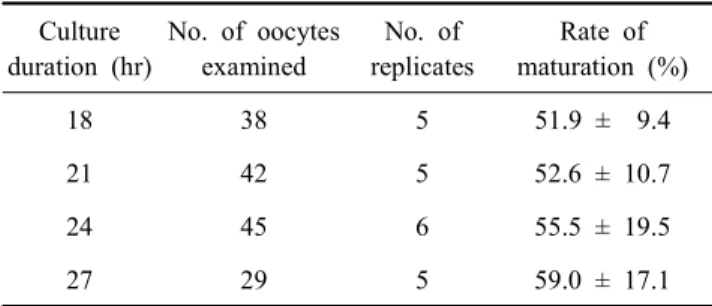
2. Experiment 2: Determination of Effective Culture Duration The IVM rate of oocytes of local zebu cows with respect to culture duration is presented in Table 2. The rate of matura- tion of oocytes was the lowest (51.9 ± 9.4%) when the COCs were cultured for 18 hours and the maturation rate was the highest (59.0 ± 17.1%) when the COCs were cultured for 27 hours. However, the difference in maturation rate of oocytes did not vary significantly among different duration of culture period.
3. Experiment 3: Determination of an Effective Protein Supplementation The IVM rate of oocytes of zebu cows with respect to protein supplementation in culture media is presented in Table 3. The rate of maturation of oocytes was higher when the medium was supplemented with FBS (55.63 ± 16.19 %) than that of media supplemented with BSA (14.82 ± 9.36 %). The difference in rate of maturation between 2 types of protein supplementation was statistically significant (P<0.05).
21 42 5 52.6 ± 10.7
24 45 6 55.5 ± 19.5
27 29 5 59.0 ± 17.1
Percentage values are mean ± S.D. The percentage values within same column did not differ significantly from each other (P>0.05).
Table 3. Effect of protein supplementation in culture medium on IVM rate of oocytes of local zebu cows
Types of protein supplementation
No. of oocytes examined
No. of replicates
Rate of maturation
(%) Fetal bovine
serum (FBS) 27 3 55.6 ± 16.2a
Bovine serum
albumin (BSA) 27 3 14.8 ± 9.3b
Percentage values are mean ± S.D.
a,b The values with superscripts within same column differed significantly from each other (P<0.01).
DISCUSSION
The first step towards in vitro production of embryo is oocytes maturation. In this study, attempts were taken to optimize the culture conditions for immature oocytes from slaughter house ovaries of zebu cows. In this study, the follicles from 165 ovaries were aspirated and 480 oocytes were retrieved where mean number of oocytes retrieved from each ovary was 3.0. However, number of retrieved oocytes per ovary was higher than that of present study in earlier inves- tigations (Goswami 2002; Das et al., 2006; Talukder et al., 2008). The reason for variations in oocyte retrieval rate among studies may be due to variation in skillness of follicle aspirators.
Moreover, seasons of oocytes retrieval and cyclic status of cows may influence the oocyte retrieval from ovaries (Dode and Adona, 2001). Additionally, an increase in FSH level in blood may influence the number of oocytes retrieved (Fortune,
et al., 2006; Talukder et al., 2008) and Brazil (Dode and Adona, 2001) in earlier studies. Moreover, grades of oocytes may influence the in vitro maturation rates of oocytes as va- riation in rate of maturation in vitro was demonstrated between good and poor grade oocytes (Goswami 2002). However, all retrieved oocytes were cultured for maturation irrespective of grading which may contribute for obtaining lower maturation rate in the present study than earlier studies.
In the present study, the culture dish did not affect the in vitro maturation rate of oocytes as indicated by absence of any significant difference in maturation rate between oocytes cul- tured in drops of petri dish or well of 4-well dish. However, no previous investigation on effect of culture dish is evident on zebu cows elsewhere. In the present study, droplet of culture media was covered by mineral oil which could affect maturation of occytes in vitro. Because, used oestradiol in culture media may be absorbed by mineral oil resulting in reduced rate of maturation in vitro (Armstrong et al., 1996).
In the present study, the culture duration did not affect the in vitro maturation rate of oocytes as indicated by absence of any significant difference in maturation rate among oocytes cultured for different durations. Semple et al. (1993) reported that bovine oocytes achieved developmental competency within 14 hours of commencing maturation in vitro and checked ma- turation at 18 hours of duration. Contrasting to the present finding, Dode and Adona (2001) reported significantly higher rate of maturation in 24 hours culture duration than that of 18 and 21 hours counterparts in zebu cows of Brazil. The reason for variation in maturation rates between studies may be due to variation in laboratory procedures and medium.
When timing of nuclear events during maturation in vitro was evaluated, the germinal vesicle (GV) was evident from 0 to 6.6 hours, GVBD occurred at 6.6∼8.0 hours, chromatin condensation at 8∼10.3 hours, metaphase I at 10.3∼15.4 hours, anaphase I at 15.4∼16.6 hours, telophase I at 16.6∼18.0 hours and metaphase II at 18.0∼24.0 hours (Sirard, 1989). Enright et al. (2000) investigated the effect of duration of maturation and concluded that maturation should be carried out for 24
hours. Moreover, partially denuded oocytes, totally denuded oocytes and oocytes with expanded cumulus cells at the star- ting of maturation culture progressed to metaphase II faster than compact cumulus-oocyte-complexes which may influence the rate of maturation (Spiropoulos and Long, 1989). However, in the present study, no grouping of occytes was done before maturation of occytes with respect to presence or absence of cumulus cells. Further, Enright et al. (2000) investigated the effect of duration of maturation culture (16∼32 hours) on the developmental competence of the oocyte. For optimal quality, it was concluded that maturation should be carried out for 24 hours (Enright et al., 2000). By consideration of these facts, in the subsequent experiment, 24 hours duration was used for maturation culture of oocytes.
In the present study, protein supplementation in culture me- dium influenced the in vitro maturation rate of oocytes as indicated by presence of significant difference in maturation rate between oocytes cultured in medium supplemented with serum (FBS) or BSA. As protein supplementation in culture medium for in vitro maturation of oocytes, usually foetal bovine serum (FBS) or foetal calf serum (FCS) or oestrus cow serum (OCS) or BSA is used. Accordingly, Holm et al. (1999) stated that BSA is essential during in vitro maturation of bovine oo- cytes. Moreover, BSA was used with culture media as a source of protein by Rose and Bavister (1992). However, Sanbuissho and Threlfall (1988) found that FCS was superior to BSA as a protein supplement in maturation medium. The higher rate of maturation in FBS than BSA supplemented medium may be due to stimulation of oocytes maturation by different hormones present in serum. However, serum may act as a source of disease transmission in culture medium. Nevertheless, it has been documented that BSA may probably be chemically impure and contaminated with some low molecular weight compound (Kane, 1987). On the other hand, FBS has also been demon- strated as important protein supplement in oocytes maturation medium (Kobayeshi et al., 1994). Alm et al. (2008) used 20%
FBS in maturation medium and Das et al. (2006) used 15%
FBS in maturation medium. However in the present study, 10% FBS was used in maturation medium for supplementation as protein source which was similar to other studies (Bhuiyan et al., 2004; Talukder et al., 2008).
In conclusions, both culture in droplets and 4-well dish are equally effective for in vitro maturation of oocytes of zebu cows. The COCs of zebu cows may be cultured for 18 to 27
hours for in vitro maturation without compromising the rate of maturation. Culture medium for in vitro maturation of zebu cows should be supplemented with FBS as protein source.
Further studies are needed with more number of oocytes to confirm the finding as few numbers of oocytes were used in this study.
REFERENCES
Ahmed ZU and Islam TS. 1987. Cattle breeding program through artificial insemination in Bangladesh. A report from Central Cattle Breeding Station, Savar, Dhaka. De- partment of Livestock Services, Bangladesh.
Alm H, Torner H, Kanitz W and Roschlau K. 2008. Influence of oocyte recovery method, in vitro fertilization method and serum source on embryonic development of in vitro matured bovine oocytes. Arch. Teirz. (Germany) 51:224-234.
Armstrong DT, Xia P, De Gannes G, Tekpetey FR and Khamsi F. 1996. Differential effects of insulin-like growth factor-1 and follicle stimulating hormone on proliferation and diffe- rentiation of bovine cumulus cells and granulosa cells. Biol.
Reprod. 54:331-338.
Bhuiyan MMU, Cho JK, Jang G, Park ES, Kang SK, Lee BC and Hwang WS. 2004. Effect of protein supplementation in potassium simplex optimization medium on preimplantation development of bovine non-transgenic and transgenic cloned embryos. Theriogenology 62:1403-1416.
Cunningham and Syrstad. 1987. Crossbreeding Bos indicus and Bos taurus for milk production in the tropics. FAO Animal Production and Health Paper. pp. 68.
Das ZC, Siddiqui MAR, Bhattacharjee J, Bhuiyan MMU and Shamsuddin M. 2006. In vitro fertilization using zebu and crossbred bull semen. Bangladesh Society for Veterinary Education and Research (BSVER) Publication 31:31 (Abs- tract).
Dode MAN and Adona PR. 2001. Developmental capacity of Bos indicus oocytes after inhibition of meiotic resuption by 6-dimethylaminopurine. Anim. Reprod. Sci. 65:171-180.
Enright BP, Lonergan P, Ward FA, Fair T and Boland MP.
2000. Effect of duration of maturation, duration of gamete co-incubation and sperm concentration on cleavage and blastocyst development from cattle oocytes. Theriogenology 53:419 (Abstract).
Fortune JE. 1994. Ovarian follicular growth and development
Holm P, Booth PJ, Schmidt MH, Greve T and Callesen H.
1999. High bovine blastocyst development in a static in vitro production system using SOFaa medium supplemented with sodium citrate and myo-inositol with or without se- rumproteins. Theriogenology 52:683-700.
Islam MF, Bhuiyan MMU, Banu TA, Bhattacharjee J and Sham- suddin M. 2007. In vitro maturation and fertilization of oocytes in zebu cattle. Bang. Vet. J. 41:58-76.
Kane MT. 1987. Culture media and culture of early embryos.
Theriogenology 27:49-57.
Kobayashi K, Yamashita S and Hoshi H. 1994. Influence of epidermal growth factor and transforming growth factor-α on in vitro maturation of cumulus cell-enclosed bovine oocytes in a defined medium. J. Reprod. Fertil. 100:439-446.
Rahman GM. 2003. In vitro production of bovine embryo. MS Thesis, Department of Animal Breeding and Genetics, Ban- gladesh Agricultural University, Mymensingh.
Rose TA and Bavister BD. 1992. Effect of oocyte maturation medium on in vitro development of in vitro fertilized
development of bovine oocytes into blastocysts. Therioge- nology 39:307 (Abstract).
Sirard MA. 1989. Practical aspects of in vitro fertilization in cattle. J. Reprod. Fertil. 38:127-134.
Spiropoulos J and Long SE. 1989. Female meiosis in dairy cattle. J. Reprod. Fertil. 3:48 (Abstract).
Syrstad O. 1989. Dairy cattle crossbreeding in the tropics: per- formance of secondary crossbred populations. Livest. Prod.
Sci. 23:97-106.
Talukder AK, Shamsuddin M, Rahman MB, Bari FY and Pa- rish JJ. 2008. Normal and abnormal in vitro fertilization of zebu cattle oocytes. J. Emb. Trans. 24:89-95.
Zeitoun MM, Rodriguez-Martinez H and Randel RD. 1996.
Effects of season on ovarian follicular dynamics in Brahman cows. Theriogenology 45:1577-1581.
Received August 5, 2014, Revised September 20, 2014, Accepted September 23, 2014