Comparison of Culture Media for In Vitro Maturation of Oocytes of Indigenous Zebu Cows in Bangladesh
Joydev Kumar Singha1,2, Mohammad Musharraf Uddin Bhuiyan1,†, Mohammad Moshiur Rahman1 and Farida Yeasmin Bari1
1Dept. of Surgery and Obstetrics, Faculty of Veterinary Science, Bangladesh Agricultural University, Mymensingh, Bangladesh
2Dept. of Livestock Services, Upazilla Livestock Officer, Dhaka, Bangladesh
ABSTRACT
The objectives of the present study were to select an effective basic medium including its hormone and protein supplementation for IVM of oocytes of indigenous zebu cows. The ovaries of cows were collected from slaughter house and the follicular fluid was aspirated from 2 to 8 mm diameter follicles. The COCs with more than 3 cumulus cell layers and homogenous cytoplasm were selected for maturation. The oocytes were matured in media for 24 hrs at 39℃ with 5% CO2 in humidified air. The maturation of oocytes was evaluated by examining the presence of first polar body under microscope. An efficient basic medium was determined after culturing COCs in either TCM 199 or SOF medium in Experiment 1. An efficient hormone supplementation was determined after culturing COCs in either FSH or gonadotrophin supplemented TCM 199 in Experiment 2. An efficient protein supplementation was determined after culturing COCs in either FBS or Oestrous cow serum (OCS) supplemented TCM 199 in Experiment 3. The oocyte recovery rate per ovary was 3.35. The overall rate of IVM was 74.6%. The maturation rate was 75.5±3.9 and 62.2±20.2% in TCM and SOF medium, respectively (P>0.05). The maturation rate of oocytes was significantly higher (76.6±13.2%) in FSH supplemented medium than gonadotrphin supplemented counterpart (69.7±10.8%) (P<0.05). The maturation rates of oocytes were 81.7±12.9 and 85.7±12.7% in medium supplemented with FBS and OCS, respectively (P>0.05). In conclusions, both TCM 199 and SOF supplemented with either FBS or OCS, and FSH may be used as medium for IVM of indigenous zebu oocytes in Bangladesh.
(Key words: culture media, indigenous, IVM, oocytes, zebu cows)
Financial Support: National Agricultural Technology Project (NATP), Department of Livestock Services (DLS) and Ministry of Education, People’s Republic of Bangladesh.
†Correspondence : [email protected]
INTRODUCTION
The indigenous zebu (Bos indicus) cattle of Bangladesh are lower yielding than the exotic (Bos taurus) cattle although the indigenous cattle are highly adapted to tropical environment and resistant to maximum diseases. There are mark deficit of milk and meat production in Bangladesh. Therefore, it is essential to upgrade the locally adapted indigenous zebu cattle for increasing milk and meat production. In Bangladesh, up- gradation of indigenous zebu cows by artificial insemination using semen of exotic breed has been in practice for more than 4 decades (Ahmed and Islam, 1987). However, the progress of genetic up-gradation is slower than expectation. Therefore, it is essential for application of other assisted reproductive tech- nologies (ARTs) for rapid production of crossbred cow to meet
up the requirement of milk and meat.
Rapid generation of F1 offspring can be done by applying ARTs such as multiple ovulation and embryo transfer (MOET) and in vitro embryo production (IVEP) followed by embryo transfer (ET) in zebu cows. The IVEP and ET is more suitable than MOET as IVEP can use slaughterhouse derived oocytes for generation of F1 crossbred embryos. By this time, the IVEP and ET techniques have already been established with satis- factory results in many animals and humans in most of the country in the world. However, this IVEP-ET technique has not yet been established in this country.
In vitro maturation (IVM) of oocytes is the first and most important step for any IVEP-ET programme in cattle. However, although several preliminary studies have been conducted on IVM of oocytes of zebu cows in Bangladesh (Goswami, 2002,
Rahman, 2003; Das et al., 2006; Islam et al., 2007; Talukder et al., 2008; Morshed et al., 2014) still the IVM rate needs to be improved. The maturation medium and supplementation of protein and hormones in it may play an important role for IVM rate and subsequent development after in vitro fertilization (IVF) (Bavister et al., 1992). Therefore, the present study was conducted to improve the IVM rate of indigenous zebu cows oocytes in Bangladesh.
MATERIALS AND METHODS
The study was carried out at the Community based Dairy Veterinary Foundation (CDVF) Laboratory, Department of Surgery and Obstetrics, Bangladesh Agricultural University, Mymensingh during the period from January to June, 2014.
1. Chemicals and Media
All the media constituents, reagents and chemicals were purchased from Sigma-Aldrich Inc., St Louis, USA. Media and reagents were prepared using standard protocol and under aseptic condition. All media were filtered using 0.22 µm pore size filter (Durapure® membrane filter, Carrigtwohill, Ireland) and culture medium was routinely equilibrated in incubator (VS-9000C, Vision Scientific Co. Ltd. South Korea) at 39℃ with 5% CO2 in humidified air for at least 2 hrs before use.
2. Collection of Ovaries
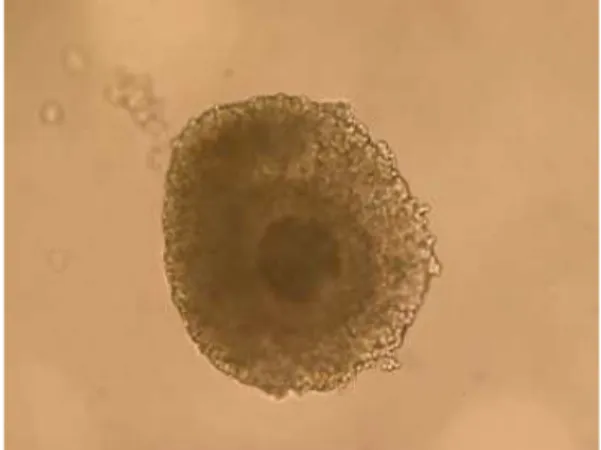
The ovaries of indigenous zebu cows were collected from local slaughter house after slaughtering within 2 hrs (Fig. 1) and carried to the laboratory in a thermo flask containing warm normal saline (37℃, 0.9% sodium chloride solution, w/v).
Fig. 1. An immature cumulus oocyte complex (COC) (10× objective).
3. Collection of Oocytes
In the laboratory, the ovaries were washed three times with warm (37℃) normal saline. The follicular fluid of 2 to 8 mm diameter follicles was aspirated using an 18 gauge needle (TERUMO®, Beijing, China) fitted with a 10 ml disposable plastic syringe (JMI Syringes and Medical Devices Ltd®, Chau- ddagram, Comilla, Bangladesh).
4. Selection of Occytes for Culture
The aspirated follicular fluid was transferred in a 60 mm petridish (Greiner bio-one, Frickenhausen, Germany) and left for 5 minutes for sedimentation. The retrieved follicular aspi- rate was diluted with HEPES-buffered tissue culture medium (TCM) 199 supplemented with bovine serum albumin (BSA) (washing medium) (Appendix 1). Oocytes (Fig. 1) were selected under a stereo-microscope (LABOMED, USA). The cumulus- oocyte-complexes (COCs) with more than 3 compact cumulus cell layers and homogenous ooplasm (Fig. 1) were selected for maturation. The COCs were washed three times in washing medium followed by once washing in maturation medium.
5. Culture of Oocytes for Maturation
Four 50 µl drops of maturation medium were prepared in 35 mm petridish (FALCON, Becton Dickinson Labware, USA) and covered with embryo tested mineral oil. For in vitro matu- ration, 7∼10 COCs were cultured in each drop of medium in incubator at 39℃ with 5% CO2 in humidified air for 24 hrs.
6. Evaluation of Oocytes for Maturation
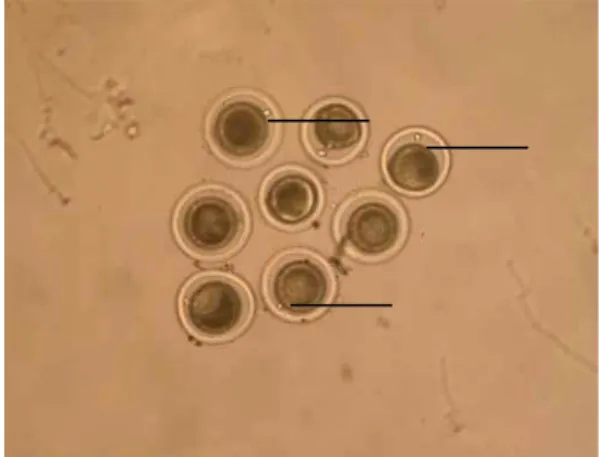
The culture drops were examined under the stereo micro- scope for cumulus expansion after 24 hrs of culture in the maturation media. Presumptive maturation was confirmed by the degree of cumulus expansion (Fig. 2). To examine the presence of first polar body extrusion, the COCs were denuded by using denuding agent (3% sodium citrate, w/v in HEPES buffered TCM 199 medium) and pipetting. After pipetting, the denuded oocytes were kept in 10 µl drops of HEPES buffered TCM 199 and examined for presence of polar body under inverted microscope (Leica DM IRE2, Germany) with the help of a mouth controlled pipette (Fig. 3).
7. Experimental Design
1) Experiment 1
Fig. 2. An expanded COCs (10× objective).
Fig. 3. Mature oocytes with polar body. Black arrow indicates polar body (10× objective).
To determine an effective basal maturation medium, the COCs were cultured either in TCM 199 (TCM, Earle’s salts with sodium bicarbonate) (Appendix 2) or Synthetic oviductal fluid medium (SOF) (GIBCO, Invitrogen Corporation 3) su- pplemented with 10% fetal bovine serum (FBS), 5 µg/ml follicle stimulating hormone (FSH) and 1 µg/ml oestradiol (OE2).
Each experiment was repeated for 5 times across the days.
2) Experiment 2
To determine an effective hormone supplementation in ma- turation medium, the oocytes were cultured in TCM 199 supplemented with either 5 µg/ml FSH or 10 IU/ml gonado- trophin, 10% FBS and 1 µg/ml OE2. Each experiment was repeated for 5 times across the days.
3) Experiment 3
To determine an effective protein supplementation in matu-
ration medium, the COCs were cultured in TCM 199 supple- mented with either 10% FBS or 10% OCS, 5 µg/ml FSH and 1 µg/ml OE2. Each experiment was repeated for 6 times across the days.
8. Method of Oestrus Cow Serum (OCS) Preparation
Forty ml blood was collected from oestrus cow in a 50 ml sterilized plastic syringe containing no anticoagulant. Then the tube was kept in refrigerator at 4℃ in an upright position for 60 minutes to allow clotting. After clotting the tube was tilted and serum was collected in two 10 ml sterilized plastic tube.
Then the serum containing tubes were centrifuged 15 minutes at 2,000 RPM for sedimentation of insoluble matter. After centrifugation the serum was inspected for turbidity. Then the serum was inactivated by heat in water bath at 56℃ for 30 minutes. After heat inactivation the serum was cooled in re- frigerator at 4℃, and then the serum was aliquot of 500 µl in cryovials and store at —20℃ for further use.
9. Statistical Analysis
The data were recorded in Microsoft Excel spread sheet and descriptive statistics was performed. The maturation rates were expressed as mean±S.D. and the difference between groups was determined by Student’s t-test. The difference between groups was considered significant when P-value was <0.05.
RESULTS
A total of 496 oocytes were collected from 148 ovaries and the mean number of oocytes collection from each ovary was 3.35. The overall maturation rate in the present investigation was 74.6% (206/276).
1. Experiment I: Determination of an Effective Basic Medium for Oocytes Maturation
The maturation rate of oocytes in two basic media is pre- sented in Table 1. The maturation rates of oocytes were 75.5
±3.9% and 62.2±20.2 in TCM 199 and SOF medium, respec- tively. However the maturation rate did not vary statistically between two media (P>0.05).
2. Experiment 2: Determination of an Effective Hormone Supplemen- tation for Oocytes Maturation
The maturation rate of oocytes in two hormone supple-
Table 1. Effect of basic maturation media on IVM rate of zebu oocytes
Basic media used
Number of oocytes cultured
Number of oocytes matured
Maturation rate (%)
TCM 199 53 40 75.5±3.9
SOF 45 27 62.2±20.2
Number of replicates is 5. Proportion values are mean±S.D.
The maturation rate was not significantly different from each other (P>0.05).
mented media is presented in Table 2. The maturation rate of oocytes was higher (76.6±13.2%) in FSH supplemented TCM 199 than that of gonadotrphin supplemented counterpart (69.7
±10.8%). The difference in maturation rate was statistically significant between two hormone supplementations (P<0.05).
3. Experiment 3: Determination of an Effective Protein Supplemen- tation for Oocytes Maturation
The maturation rate of oocytes in two protein supplemented media is presented in Table 3. The maturation rates of oocytes were 81.7±12.9% in medium supplemented with FBS and 85.7
±12.7 in OCS, respectively. However the maturation rate did not vary statistically between two protein supplementations (P>0.05).
DISCUSSION
The objectives of the present study were to select an effec- tive basic medium and its effective hormone and protein supplementation for IVM of oocytes of indigenous zebu cows.
In the present study, the mean number of oocytes collection from each ovary was 3.35. The present mean number of retrie- ved oocytes per ovary is higher than that of previous study
Table 2. Effect of hormone supplementation on IVM rate of zebu oocytes
Hormone supplementation
Number of oocytes cultured
Number of oocytes matured
Maturation rate (%)
FSH 49 38 76.6±13.2a
Gonadotrophin 39 27 69.7±10.8b
Number of replicates is 5. Proportion values are mean±S.D.
a,b The values with superscripts within same column was significantly different from each other (P<0.05).
Table 3. Effect of protein supplementation on IVM rate of zebu oocytes
Protein supplementation
Number of oocytes cultured
Number of oocytes matured
Maturation rate (%)
FBS 45 36 81.7±12.9
OCS 45 38 85.7±12.7
Number of replicates is 6. Proportion values are mean±S.D.
The maturation rate was not significantly different from each other (P>0.05).
(Morshed et al., 2014) and lower than that of an earlier study (Talukder et al., 2008). The reason for variations in oocyte retrieval rate among studies may be due to variation in skill of follicle aspirators. Moreover, seasons of oocytes retrieval and cyclic status of cows may influence the oocyte retrieval from ovaries (Dode and Adona, 2001). Additionally, an increase in FSH level in blood may influence the number of oocytes retrieved (Fortune, 1994). Further, nutrition and temperature may influence the gonadotrophin concentrations and affect the population of follicles and number of oocytes retrieved (Zei- toun et al., 1996).
In the present study, the rate of overall oocyte maturation was 74.5%. The present maturation rate is similar to the earlier study reported by Talukder et al. (2008) in indigenous zebu cows. However, contrasting to the present findings, lower ma- turation rate was reported by Das et al., (2006) (65.4%) and Morshed et al., (2014) (53.8%) in indigenous zebu cows. The reasons for variation in maturation rate among studies might be due to variation in basic media and percentage of serum supplementation in it used for oocyte maturation. Moreover, grades of oocytes may influence the in vitro maturation rates of oocytes as variation in rate of maturation in vitro was demonstrated between good and poor grade oocytes (Goswami, 2002). However, all retrieved oocytes were cultured for matu- ration irrespective of grading which may contribute for obtaining lower maturation rate by Morshed et al. (2014) than that of present study. In the present study, oocytes with at least 3 compact cumulus cell layers were used for maturation which might contribute to obtaining satisfactory rate of oocyte matu- ration in vitro.
For maturation of oocytes in vitro, ingredients of a culture media play an important role. Different culture media such as TCM-199 (Kharche, 2006; Amer et al., 2008), SOF (Totey et al., 1992), minimum essential medium (MEM) (Ravindranatha,
2001) and Ham's F-10 (Totey et al, 1993; Tamilman et al., 2005) have been used for IVM of mammalian oocytes else- where. Among them, TCM 199 is the most widely used culture medium for such purposes (Arunakumari et al., 2007). The beneficial effect of TCM-199 medium on IVM of animal oocytes may be attributed due to presence of some factors in its composition such as essential amino acids and glutamine that may stimulate DNA and RNA synthesis and enhance cell division (Pawshe et al., 1996; Gordon, 2003). Moreover, there is a report that TCM 199 improved the rate of IVM of oocytes better than MEM in buffaloes (Roushandeh et al, 2006). It has been known for many years that glucose and glutamine are poor energy substrates for the cumulus cell- free rodent oocytes (Downs and Verhoeven, 2003). The lower IVM rate in MEM may be explained by the fact that it contains higher glucose and glutamine than that of TCM 199. In the present investigation, the maturation rate of oocytes did not vary between oocytes cultured in either TCM 199 or SOF (P>0.05). Similar to the present study, Prasad et al. (2013) did not obtain any diffe- rence in IVM rates when maturation rate of buffalo oocytes were compared between TCM 199 and SOF. Contrasting to the present study, Totey et al. (1992) reported higher percentage of oocytes maturation in TCM than that of SOF in buffaloes.
However, when compared the rate of cleavage and blastocyst formation after IVF, there were no difference in cleavage and balstocyst formation in bovine oocytes matured either in de- fined TCM 199 or SOF (Lonergran et al., 1994). The reasons for variations in IVM rate among studies may be due to vari- ation in supplementations in basic media.
In the present study, the maturation rate of oocytes was sig- nificantly (P<0.05) higher in FSH supplemented TCM 199 than that of gonadotrphin supplemented counterpart. Contrasting to the present study, although IVM rate was not compared, the embryo development rate after IVF did not vary between bovine oocytes cultured either in FSH or gonadotrophin supplemented medium. Moreover, the IVM rate did not vary in buffalo oo- cytes matured in either FSH or PMSG supplemented medium (Hegab et al., 2009). Further, no difference in IVM rate of bovine oocytes was observed when compared between FSH and LH supplementation (Younis et al., 1989). Supplementa- tion of reproductive hormones in maturation media is essential because it improves IVM rate of mammalian oocytes. Addition of follicle stimulating hormones (FSH) (Chauhan et al., 1998), pregnant mare serum gonadotrophin (PMSG) (Roy et al., 1968),
luteinizing hormone (LH) and oestradiol (Nandi et al., 2002b) to maturation media has been made to improve the developmen- tal competence of in vitro matured oocytes. In many ma- mmalian species, gonadotrophin has been found to stimulate cumulus cells to synthesize molecules able to drive germinal vesicle breakdown (GVBD) as meiosis activating sterols (Tsafriri et al., 2005). Oestradiol has been found to improve the com- pletion of maturational changes and also to support the synthesis of presumed male pronuclear growth factor (Fukui and Ono, 1989). Moreover, FSH is essential for cumulus cell expansion and maturation of oocytes in vitro as FSH enhances the ex- pansion of cumulus cells in buffaloes (Alok et al., 2010).
Nevertheless, in addition to either FSH or gonadotrophin, oes- tradiol was always supplemented in maturation medium in the present study.
In the present study, the maturation rate of oocytes did not vary in OCS supplemented TCM 199 than that of FBS supple- mented counterpart (P>0.05). Contrasting to the present finding, Lu and Gordon (1987) reported that OCS had a significant and marked effect on oocytes maturation compared to FBS supple- mentation. Further, similar result to earlier report has been demonstrated elsewhere (Schellander et al., 1990). Serum may provide energy substrates, amino acids, growth factors and vitamins to the culture medium. The positive effect of serum on maturation rate of oocytes may be due to presence of growth factors that is manifested by improved embryo development following IVF (Eppig et al., 1992). Moreover, it is important to include serum in the IVM medium to prevent hardening of zona pellucida which could adversely affect fertilization (Downs et al., 1986). Additionally, there is a report that fetuin, a major glycoprotein constituent of fetal calf serum, can prevent har- dening of zona pellucida during IVM (Schroeder et al., 1990).
Kan and Yamane (1983) reported another beneficial action of serum due to its antioxidant properties as evidenced by reducing superoxide formation. In addition, serum added to the matura- tion medium provides a source of albumin that balances the osmolarity (Thompson, 2000).
There are different sources for supplemented sera such as FBS (Kobayeshi et al., 1994; Nandi, 1998; Mahmoud and Nawito, 2005; Das et al., 2006; Talukder et al., 2008), OCS (Schellander et al., 1990), steer serum (Roy et al., 1968; Nandi et al., 2001), and super ovulated cow serum (Boediono et al., 1994). Although, there are reports to use different sera sources for supplementation in maturation medium, comparison was
made between FBS and OCS only in the present study. Because, FBS and OCS are the most widely used protein supplementation for maturation culture of bovine oocytes in the world.
REFERENCES
Ahmed ZU and Islam TS. 1987. Cattle breeding program th- rough artificial insemination in Bangladesh. A report from Central Cattle Breeding Station, Savar, Dhaka. Department of Livestock Services, Bangladesh.
Alok P, Gupta SC and Neelam G. 2010. Effect of FSH and LH hormones on oocyte maturation of buffalo and gene expre- ssion analysis of their receptors and Cx43 in maturing oocytes. Zygote. 18:231-234.
Amer HA, Hegab AO and Zaabal SM. 2008. Effects of ovarian morphology on oocyte quantity and quality, granulose cells, in vitro maturation and steroid hormone production in bu- ffaloes. Anim. Reprod. Sci. 5:55-62.
Arunakumari G, Vagdevi R, Rao BS, Naik BR, Naidu KS, Kumar RVS and Rao VH. 2007. Effect of hormones and growth factors on in vitro development of sheep preantral follicles. Small Rumin. Res. 70:93-100.
Bavister BD, Rose-Hellekant TA and Pinyopummintr T. 1992.
Development of in vitro matured/in vitro fertilized bovine embryos into morulae and blastocysts in defined culture media. Theriogenology 37:127-146.
Boediono A, Takaji M, Saha S and Suzuki T. 1994. Influence of day-0 and day-7 super ovulated cow serum during de- velopment of bovine oocytes in vitro. Reprod. Fertil. Dev.
6:261-284.
Chauhan MS, Singla SK, Palta P, Manik RS and Madan ML.
1998. In vitro maturation and fertilization and subsequent development of buffalo (Bubalus bubalis) embryos: Effects of oocyte quality and type of serum. Reprod. Fertil. Dev.
10:173-177.
Das ZC, Siddiqui MAR, Bhattacharjee, Bhuiyan MMU and Shamsuddin M. 2006. In vitro fertilization using zebu and crossbred bull semen. Bangladesh Society for Veterinary Education and Research (BSVER) Publication 31:31. (Ab- stract)
Dode MAN and Adona PR. 2001. Developmental capacity of Bos indicus oocytes after inhivition of meiotic resumption by 6-dipethylaminopurine. Anim. Reprod. Sci. 65:171-180.
Downs SM and Verhoeven A. 2003. Glutamine and the main-
tenance of meiotic arrest in mouse oocytes: Influence of culture medium, glucose and cumulus cells. Mol. Reprod.
Dev. 66:90-97.
Downs SM, Schroeder AC and Epping JJ. 1986. Serum maintains the fertilizability of mouse oocyte in vitro by preventing hardening of zona. Gamete Res. 15:115-122.
Eppig J, Wigglesowrth JK and Brien MJO. 1992. Comparison of embryonic development competence of mouse oocytes grown with and without serum. Mol. Reprod. Dev. 32:33- 40.
Fortune JE. 1994. Ovarian follicular growth and development in mammals. Biol. Reprod. 50:225-232.
Fukui Y and Ono H. 1989. Effects of sera, hormones and gra- nulosa cells added to culture medium for in vitro maturation, fertilization, cleavage and development of bovine oocytes.
J. Reprod. Fertil. 86:501-506.
Gordon I. 2003. Laboratory Production of Cattle Embryos:
Maturing the Oocyte, 2th edition, Cambridge, MA 02138, CABI publishing.
Goswami PC. 2002. Collection and grading of bovine cumulus oocyte-complexes (COCs) from slaughterhouse ovaries in view of in vitro maturation, fertilization and culture. MS Thesis, Department of Animal Breeding and Genetics, Ban- gladesh Agricultural University, Mymensingh.
Hegab AO, Montasser AE, Hammam AM, Abu EI-Naga EMA and Zaabel SM. 2009. Improving in vitro maturation and cleavage rates of buffalo oocytes. Anim. Reprod. 6:416-421.
Islam MF, Bhuiyan MMU, Banu TA, Bhattacharjee J and Shamsuddin M 2007. In vitro maturation and fertilization of oocytes in zebu cattle. Bang. Vet. J. 41:58-76.
Kan M and Yamane I. 1983. Oxygen-dependent growth decli- ning and effect of vitamin E for human diploid fibroblasts in serum-free, BSA containing culture. Tohoku J. Exp. Med.
139:389-398.
Kharche SD, Goel AK, Jindal SK and Sinha NK. 2006. Tech- nical note: In vitro maturation of caprine oocytes in different concentration of estrous goat serum. Small. Rumin. Res.
64:186-189.
Kobayeshi K, Yamashita S and Hoshi H. 1994. Influence epi- dermal growth factor and transforming growth factor- α on in vitro maturation of cumulus cell-enclosed bovine oocytes in a defined medium. J. Reprod. Fertil. 100:439-446.
Lonergan P, Carolan C and Mermillod P. 1994. Development of bovine embryos in vitro following oocyte maturation
under defined conditions. Reprod. Nutr. Dev. 34:329-339.
Lu KH and Gordon I. 1987. Effect of serum, hormones and cumulus cells on the in vitro maturation of bovine oocytes.
Proceeding 7th Meeting of the European Embryo Transfer Association (Cambridge) 63. (Abstract)
Mahmoud K, Gh M and Nawito MF. 2005. Influence of serum source on buffalo in vitro embryonic development with re- ference to heat inactivation. Livest. Prod. Sci. 96:285-289.
Morshed NSM, Bhuiyan MMU, Rahman MM, Singh JK and Juyena NS. 2014. Culture condition for in vitro maturation of abattoir derived oocytes of native zebu cows in Ban- gladesh. J. Emb. Trans. 29:201-206.
Nandi S, Chauhan MS and Palta P. 1998. Influence of cu- mulus cells and sperm concentration on cleavage rate and subsequent embryonic development of buffalo (Bubalus bubalis) oocytes matured and fertilized in vitro. Therioge- nology 50: 1251-1262.
Nandi S, Chauhan MS and Palta P. 2001. Effect of environ- mental tem developmetal competence in vitro of buffalo temperature on quality and oocytes. Vet. Rec. 148:278-279.
Nandi S, Raghu HM, Ravindranatha BM and Chauhan MS.
2002b. Production of buffalo (Bubalus bubalis) embryos in vitro. Premises and promises. Reprod. Domestic. Anim. 37:
65-74.
Pawshe CH, Palanisamy A, Taneja M, Jain SK and Totey SM.
1996. Comparison of various maturation treatments on in vitro maturation of goat oocytes and their early embryonic development and cell numbers. Theriogenology 46:971-982.
Prasad CS, Palanisamy A, Gomathy VS, kumar SS, Thangavel A and Dhinakar RG. 2013. Effect of TCM-199 and synthetic oviductal fluid (SOF) Medium and cysteamine supplemen- tation to in vitro maturation media on maturation, cleavage rate and subsequent embryonic development of buffalo oocytes. Buffalo Bulletin 32(3):182-188.
Rahman GM. 2003. In vitro production of bovine embryo. MS Thesis, Department of Animal Breeding and Genetics, Ban- gladesh Agricultural University, Mymensingh.
Ravindranatha BM, Nandi S, Gupta PSP and Sharma PV. 2001.
Comparison of three different media on maturation of bu- ffalo oocytes in vitro. Indian J. Anim. Sci. 71:841-843.
Roushandeh AM, Mooghahi MHN, Pasbakhsh P, Abddvahabi A, Akbari M, Shokrgozar A and Sobhani A. 2006. Effect of cysteamine on the rate of in vitro maturation of oocytes in two media. Acta. Med. Iranica. 44:167-171.
Roy A, Razada BC, Tiwari RBI, Andey MDP, Yadavand PO and Sengupta BP. 1968. Effect of management on fertility of buffalo cows bred during summer. Indian J. Vet. Sci.
38:554-560.
Schellander KF, Fuhrer BG, Brackett B, Korb H and Schleger W. 1990. In vitro fertilization and cleavage of bovine oo- tes mature in medium supplemented with oestrus cow serum.
Theriogenology 33:477-485.
Schroeder A, Schultz RM, Kopf GS, Taylor ER, Becker RB and Eppig JJ. 1990. Fetuin inhibit zona pellucida hardening and conversion of ZP2=ZP2f during spontaneous mouse oocyte maturation in the absence of serum. Biol. Reprod.
43:891-897.
Talukder AK, Shamsuddin M, Rahman MB, Bari FY and Parish JJ. 2008. Normaland abnormal in vitro fertilization of zebu cattle oocytes. J. Emb. Trans. 24:89-95.
Tamilman G, Rao BS, Vegdevi R, Amarnath D, Naik BR, Mu- tharao M and Rao VH. 2005. Nuclear maturation of bovine oocytes in cultured preantral follicles. Small Rumin. Res.
60:295-305.
Thompson JG. 2000. In vitro culture and embryo metabolism of cattle and sheep embryos. Anim. Reprod. Sci. 30:273- 280.
Totey SM, Pawshe CH and Singh GP. 1993. Effects of bull and heparin and sperm concentrations on in vitro fertilization of buffalo (Bubalus bubajis) oocytes matured in vitro. The- riogenology 39:887-898.
Totey SM, Singh G, Taneja M, Pawshe CH and Talwer GP.
1992. In vitro maturation, fertilazition and development of follicular oocytes from Buffalo (Bubalus babulis). J. Reprod.
Fertil. 95:597-607.
Tsafriri A, Cao X, Ashkenazi H, Mottola S, Popliker M and Pomerantz SH. 2005. Resumption of oocyte meiosis in ma- mmals: On models, meiosis activating sterols, steroids and EGF like factors. Mol. Cell. Endocrinol. 234:37-45.
Younis AI, Brackett BG and Fayer-Hosken RA. 1989. Influence of serum and hormones on bovine oocyte maturation and fertilization in vitro. Gamete Res. 23:189-201.
Zeitoun MM, Rodriguez-Martinez H and Randel RD. 1996.
Effect of season on ovarian follicular dynamics in Brahman cows. Theriogenology 45: 1577-1581.
Received December 21, 2015, Revised December 23, 2015, Accepted December 24, 2015