*Corresponding Author : Liao Xuan([email protected]) Received September 19, 2019
Accepted November 20, 2019
Revised November 4, 2019 Published November 28, 2019
Empirical Study on the Impact of China Mobile Phone Market Origin Image on Consumers' Purchasing Intention
Ze Gao 1 , Jae-yeon Sim 2 , Xuan Liao 2*
1
Professor, College of Business Administration, Jilin Engineering Normal University,
2
Professor, Dept. of Business Management, Sehan University
중국 휴대폰 시장에서 원산지 이미지가 소비자의 구매 의도에 미치는 영향에 관한 실증 연구
고택 1 , 심재연 2 , 요선 2*
1
길림공정기술사범학원 공상관리학원 교수,
2세한대학교 경영학과 교수
Abstract With the rapid development of China's economy, the consumption concept of Chinese consumers has changed, and the purchase intention of consumers is also affected by the origin of the brand. The purpose of this study is to help local enterprises gain more competitive advantages in international marketing activities by improving the image of the country of origin. Based on the theory of clue utilization, this paper constructs a theoretical model of the effect of the image of origin on consumers' purchase intention and puts forward the basic hypothesis. The data were collected, analyzed and processed through questionnaire survey and spss23.0. The results showed that: the image of the place of origin and the perceived value had a significant impact on the purchase intention. The image of origin has significant influence on perceived value. Finally, combined with the empirical research results, relevant marketing strategies and Suggestions are provided for local enterprises. At the same time, it also provides some reference for other countries to sell in China.
Key Words : Origin, Origin image, Purchase intention, Perceived value, Information-processing theory
요 약 중국 경제가 빠른 속도로 발전함에 따라 중국 소비자들의 소비 관념에도 변화가 생겼다. 브랜드 원산지가 소비 자의 구매 의도에 영향이 미치고 있는 것이다. 본 논문은 원산지 이미지의 제고를 통하여, 기업이 글로벌 마케팅활동에 서 경쟁우위를 확보하기 위한 연구이다. 브랜드 이미지의 기초 이론을 바탕으로 원산지 이미지가 소비자의 구매 의도에 영향을 주는 새로운 모형과 연구 가설을 제기하였다. 양적 연구방법과 질적 연구방법을 혼합한 연구방법을 이용하였는 데, SPSS 23.0을 이용하여 설문지 내용의 데이터를 수집하여 분석하였다. 연구결과는 원산지의 이미지가 소비자 구매 의도에 정(+)의 영향을 미치는 것으로 나타났고, 인지 가치에서도 소비자의 구매 의도에 정(+)의 영향이 미치는 것으로 나타났다. 마지막으로 실증연구결과를 종합하여, 현지 기업에게 새로운 마케팅전략과 개선책을 제시하였고, 다국적 기 업들에게도 중국 시장에서의 판매 전략을 고려할 수 있도록 하였다.
주제어 : 원산지, 원산지 이미지, 구매 의사, 인지 가치, 정보 처리 이론
1. Introduction
Foreign brands or products produced abroad usually leave a better impression on consumers.
People usually associate it with the words of high quality, respectability, fashion and so on. It seems to be more acceptable to society and the public to use it. Although the development of economic globalization makes China increasingly important in the field of international trade, most domestic products are still in a weak position compared with similar foreign products. Schooler was the first scholar to introduce the factor of origin into the field of marketing. Through experiments, he found that consumers have prejudice in evaluating products of different origins, that is, consumers prefer products from developed countries. With the development of international trade, many scholars begin to further study and discuss the issue of origin, which has gradually become a hot topic in the field of international marketing. In China, the research on origin has just begun, and there are many gaps in the research methods and contents, which has become an opportunity for this paper.
2. Theoretical background
2.1 Image of origin
Initially, the image of origin was considered as a single dimensional concept, that is, the image of the country or region of origin. Kleppe, I.
Astrid, N. M. Iversen & I. G. Stensaker believed that the operability of a single dimension was low, so they divided it into two levels: country and product. The national level refers to the sum of all the descriptive, speculative and intelligence beliefs held by consumers on a particular country, while the product level refers to consumers' impression on a particular product or brand in that country or region[1]. S. A. Ahmed &
A. D'astous, established an evaluation system for
the image of origin and divided it into two dimensions: the overall image of the country and the overall image of products[2]. Parameswaran, Ravi & R. Mohan Pisharodi argues that in addition to the national image and product image, consumers also are under the influence of the particular product, they said on the basis of this puts forward three levels, namely the overall national level (including political and economic development level, social system, history and culture and other factors), the general product level (including the country's overall product reputation and value, etc.), specific product level (such as product marketing ability of a country related impression etc.)[3]. C. M. Allwood & J. W.
Berry expanded the concept research on the image of origin. Starting from the perspective of rationality theory, they used the grounded theory to analyze the comments on Chinese products by consumers in the United States and India and divided the image of origin into performance image and system image[4]. To sum up, the image of origin referred to in this study refers to consumers' overall cognition and impression of a specific country (or region), which not only includes the macro image of the country (or region) in terms of politics, economy, culture and other aspects, but also includes the overall product image of the country (or region).
2.2 Purchase intention
Intention refers to the high or low probability of an individual to carry out a certain behavior.
R. P. Bagozzi & R E. Burn Krant believed that purchase intention refers to the behavior tendency of an individual to act on a certain commodity or service, which can be used to predict consumer purchase behavior[5]. W. B.
Dodds, D. Grewal & K. B. Monroe believed that
purchase intention refers to the possibility of
consumers attempting to buy a certain product,
and it is the judgment made by consumers on
whether to buy a certain product or service
based on the current or imminent situation[6].
3. Research design
3.1 Model construction
The conceptual model of this study is mainly based on the following three theoretical foundations:
3.1.1 information-processing theory
information-processing theory of the core thought it refers to the consumers in the case of asymmetric information, can according to the product of the inherent clues (such as quality, size, shape, taste, etc.) and the external cues (such as country of origin, price, brand, retailers, business reputation, etc.) to evaluate the product, and then make a buying decision, because the product intrinsic clue is not so easy to get, so for most consumers, they are more used to rely on product formation of a product's overall cognitive external cues. Foreign studies believe that the image of origin as an important external clue will have an important impact on the evaluation of consumers. A. Pecotich & M. J.
Rosenthal both pointed out that consumers use the information of source country to evaluate products[7].
3.1.2 purchase intention theory based on maximum perceived value
Perceived value maximum theory is that consumers will choose the perceived value of the solution, in turn, make a purchase decision, it from the perspective of consumers, think that the higher the consumer perception of the gains, the higher of the feelings of value, with the improvement of value, purchase intention increases, namely customer perceived value, the greater the purchase intention is stronger also.
There are many studies on this aspect in the
academic circle, so the theory of purchasing intention is relatively perfect and mature based on this perspective.
3.1.3 country-of-origin effect
The origin effect is the influence or preference of consumers on the established concept of a specific country brought by the origin. The theory of origin effect holds that the information of origin can have an impact on consumers' purchase intention, and a positive and positive image of origin can improve people's positive evaluation of products. Many scholars believe that the image of origin may influence consumers' purchasing decisions. It is believed that the place of origin can affect consumers' perception of product quality, and further points out that there are differences in the overall perception of product consumers in different countries in the following research.
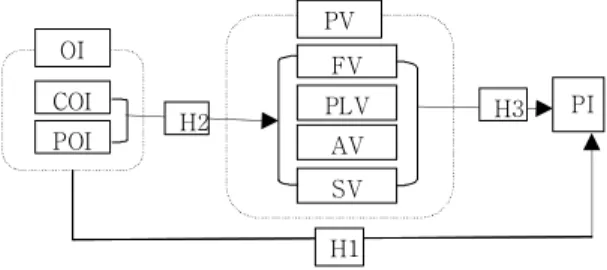
OI COI
PV FV PLV
AV SV POI
PI
H1
H2 H3
Fig. 1. Research Model
In this study, on the basis of the above three
theories, selection of origin image as the
independent variable, consumers purchase
intention as dependent variable, and the
introduction of perceived value as the
intermediate variable, build the image of the
country of origin to influence customers
purchase intention conceptual model, as shown
in Fig. 1, According to relevant theoretical
research, the image of origin(OI) is divided into
two levels. respectively, for the country (or
region) overall image(COI) and the product
overall image level(POI), The perceived value(PV)
is divided into four dimensions: functional perceived value(FV), profit-loss perceived value(PLV), affective perceived value(AV) and social perceived value(SV).
3.2 Research hypothesis presentation 3.2.1 hypothesis of origin image
The image of origin is a subjective impression formed in the mind of consumers. Previous studies by western scholars have proved that the image of origin has a certain influence on the purchase intention. R. A. Peterson & A. J. P.
Jolibert hold that if purchase intention is taken as the dependent variable, the observed value of the image effect of origin is 0.19, that is to say, the proportion of origin in all factors in the purchase process of consumers is 19%[8]. J. C.
Sweeney & G. N. Soutar.(2001) through the survey of consumers in Taipei area, confirms the image of origin impact on consumer purchase intention, the study also found that national image as a product of dispositional properties impact the consumers for the product evaluation and purchase intentions, and often highly industrialized products than emerging industrialized countries are more popular with the consumers[9]. Therefore, this study believes that when consumers have a better impression of the origin, their purchase intention is stronger.
The better consumers' impression of the origin, the greater the perceived benefit. Based on the above views and statements, this paper proposes the following hypotheses:
H1: the image of origin is positively correlated with consumers' purchase intention
H1-a: the overall national image is positively correlated with consumers' purchase intention
H1-b: the overall image of the product is positively correlated with consumers' purchase intention
H2: the image of origin is positively correlated
with the perceived value of consumers H2-a: the overall national image is positively
correlated with the perceived value of consumers
H2-b: the overall product image is positively correlated with the perceived value of consumers。
3.2.2 perceptive value hypothesis
Scholars' research on the results of perceived value mainly focuses on how it ACTS on consumers' behavioral intention. D. Maheswaran .(1994) pointed out in the research that whether consumers are willing to buy a specific product ultimately depends on the relative relationship between the price they get from the product and the price they pay for the product, namely, the perceived value[10]. J. G Klein , R. Ettenson & M.
D Morris and other scholars have shown that there is a positive correlation between perceived value and behavioral intention[11]. The following hypothesis can be drawn:
H3: perceived value is positively correlated with consumers' purchase intention H3-a: functional perceived value is positively
correlated with consumers' purchase intention
H3-b: profit-loss perceived value is positively correlated with consumers' purchase intention
H3-c: affective perceived value is positively correlated with consumers' purchase intention
H3-d: socially perceived value is positively correlated with consumers' purchase intention
4. Positive analysis 4.1 General characteristics of samples
A total of 148 men and 156 women
participated in this survey, accounting for 48.7%
and 51.3% of the total sample, respectively. From the perspective of age group, young and middle-aged people aged 21-30 and 31-50 are the majority, accounting for 44.1% and 42.1% of the total sample, respectively. From the perspective of occupation, it is mainly enterprise employees and students in school, accounting for 35.5% and 45% of the total sample, respectively.
In terms of educational background, 60.5% of the respondents have a bachelor's degree, 34.6%
have a master's degree or above, and 4.9% have a high school degree or below. From the perspective of monthly income, 3,001-5,000 yuan accounts for the largest proportion, 39.9%, followed by people under 3,000 yuan, accounting for 32.5%, and those between 5,001 yuan and 7,000 yuan account for 39.8%, while those above 7,001 yuan account for 8.9%. To sum up, the
distribution of the samples in this questionnaire survey is relatively balanced in gender, age, occupation, education background, and monthly income, with a certain emphasis. Generally speaking, it is in line with the actual situation and has certain representativeness.
4.2 Exploratory factor analysis
In this study, the determination variables were extracted on the basis of the prior study of each factor. In order to verify the rationality and credibility of extracted variables, exploratory factor analysis and trust analysis were carried out. The results of the analysis are shown in Table 1.
Exploratory factor analysis to avoid multiple commonness, use of VARIMAX, has carried on the principal component analysis, exploratory factor analysis of the first elements of origin image,
Factor Variable λ C EV VE α
OI COI
The commercial prosperity .857 0.753
3.28 46.987 0.803
High level of industrialization .866 0.798
Improvement of market economy .812 0.786
Political stability .565 0.525
Efficient government .777 0.700
High level of education .624 0.615
Strong ability of scientific research .802 0.782
POI
The visual image .777 0.732
3.15 21.97 0.792
The quality of image .791 0.729
Social image .827 0.761
KMO: 0.903 Bartlett’s test of sphericity: X
2=1355.417( ≺ ), df=66, Total variance explained:68.957
PV FV
Stable performance .781 0.699
3.98 25.892 0.864
Reliable quality .805 0.734
This mobile phone is more durable .793 0.726
PLV
Value for money .629 0.589
3.56 23.126 0.852
The price is reasonable .880 0.823
Considering the time spent, it is a good choice to buy
the phone .613 0.590
AV
Using this phone will make me feel good and relaxed .848 0.799
4.12 20.563 0.786
This phone will make me feel very comfortable .853 0.812 This mobile phone can bring me pleasant enjoyment .676 0.653
SV
Can show my unique personal style .775 0.689
3.67 12.128 0.872
Can reflect my personal image and social status .739 0.788 Can bring me more sense of identity .868 0.766
KMO: 0.887 Bartlett’s test of sphericity: X
2=1833.799( ≺ ), df=66, Total variance explained:81.709
PI
If necessary, we will purchase mobile phones from this
region .873 0.793
2.293 76.435 0.845
I am willing to pay more for the mobile phone made in
this country .886 0.812
I would like to recommend this phone to my friends and
relatives .863 0.810
KMO: 0.728 Bartlett’s test of sphericity: X
2=251.666( ≺ ), df=3,Total variance explained:81.709
Table 1. Results of exploratory factor analysis
according to the results of KMO is 0.903, higher than the standard value of 0.5, Bartlett ball test (Bartlett's test of sphericity: X
2= 1355.417 (p <.
001)), and significant results achieved. 000, suitable for factor analysis, exploratory factor analysis, country of origin image elements are divided into two basic elements of national image and product image, among them, Factor load quantity value is.565~.866(≥.4), common value is.525~.798(≥.4), characteristic value is 3.15~3,28(≥1.0), in addition, the total difference explanatory force is 68.957%, The national image is composed of 7 items, the credibility is.803, the explanatory power is 46.987%, the product image is composed of 3 items, the credibility is.792, the explanatory power is 21.97%.That is to say, it is consistent with the scale structure set in this paper, indicating that the structure validity of the image of origin is good.
Exploratory factor analysis results of the perceived value of the second factor showed that KMO was 0.887, 0.5 higher than the standard value, Bartlett's test of sphericity: X
2=1833,799(p<.001), and the significance reached.000, suitable for exploratory factor analysis, factor load was.613~
.866(≥.4), commonality value was.589~.823(≥.4), and characteristic value was 3.56~4.12(≥1.0).
Exploratory factor analysis results, perceived value is divided into functional perceived value, profit-loss perceived value, affective perceived value and social perceived value of four elements, among them, the factors of load quantity for. 613 ~ 880 (0. 4), the convergence value of. 589 ~ 812 (0 4), the characteristic value of 3.56 ~ 4.12 (1.0) or higher, in addition, the total difference shows that force is 81.709%, functional perceived value consists of three projects, the credibility is.864, the explanatory power is 25.892%, profit-loss perceived value consists of three projects, the credibility is.852,
the explanatory power is 23.126%, affective perceived value is composed of 3 items, the credibility is.786, the explanatory power is 20.563%, and social perceived value is composed
of 3 items, the credibility is.872, the explanatory power is 12.128%, which is consistent with the scale structure set in this paper, indicating that the structural validity of perceived value is good.
The results of exploratory factor analysis on the purchase intention of the third factor show that KMO is 0.728, higher than the standard value of 0.5, and the Bartlett sphericity test (Bartlett's test of sphericity: X
2=251.666(p<.001)).
According to exploratory factor analysis results, the factor load value is.863~.886(≥ 4), the common value is.793~.812(≥ 4), and the characteristic value is 2.293(≥1.0). projects, the credibility is.852,the explanatory power is 23.126%, affective perceived value is composed of 3 items, the credibility is.786, the explanatory power is 20.563%, and social perceived value is composed of 3 items, the credibility is.872, the explanatory power is 12.128%, which is consistent with the scale structure set in this paper, indicating that the structural validity of perceived value is good. The results of exploratory factor analysis on the purchase intention of the third factor show that KMO is 0.728, higher than the standard value of 0.5, and the Bartlett sphericity test (Bartlett's test of sphericity: X2 =251.666(p<.001)).
According to exploratory factor analysis results, the factor load value is.863~.886(≥ 4), the common value is.793~.812(≥ 4), and the characteristic value is 2.293(≥1.0).
4.3 Regression analysis
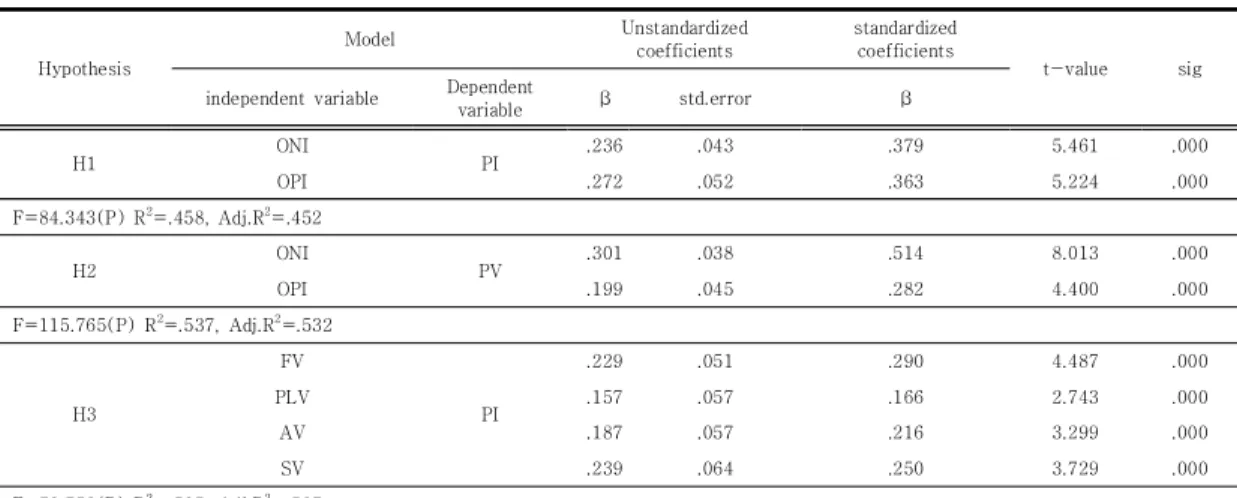
According to Table 2 display, First of all, H1
assumes the correlation analysis results of the
influence of origin image on purchase intention
show that F=84.343(p<0.001), which is statistically
significant, R2=.458, Adj.R2=.452. Among them,
national image has an effective impact on
purchase intention (β ONI → PI =.379, t=5.461,
p<.001), and product image has an effective
impact on purchase intention (β OPI → PI =.363,
t=5.224, p<.001), assuming that h1-a and hl-b are
verified. Secondly, the correlation analysis results of H2 assuming the influence of national image on perceived value show that F=115.765(p<0.001), which is statistically significant, R2=.458, Adj.R2=.452. Among them, national image has a significant impact on perceived value (β
COI → PV=.514, t=8.013, p<.001), and product image has an effective impact on perceived value (β
POI → PV=.282, t=4.400, p<.001). Hypothesis h2-a and h2-b are verified. Finally, the correlation analysis results of H3 hypothesis on the influence of perceived value on purchase intention show that F=72.753(p<0.001), which is statistically significant, R2=.595, adj.R2=.587. Functional perception has a significant impact on purchase intention (β
FV→ PI
=.290, t=4.487, p<.001), profit-loss perceived value has an effective impact on purchase intention (β
PLV → PI=.166, t=2.743, p<.001), and affective perception has a significant impact on purchase intention (β
AV → PI=.216, t=3.299, p<.001). Social perception has an effective impact on purchase intention (β
SV → PI=.250, t=3.729, p<.001). Hypothesis h3-a, h3-b, h3-c and h3-d are verified. Such results show that the stronger the image of origin is, the greater the impact on perceived value and purchase intention will be.
5. Conclusions
According to the above empirical analysis, the image of origin is positively correlated with the purchase intention of consumers, that is, the better the overall image of a country is, the stronger the purchase intention of consumers will be[12]. The better the overall image of the product, the stronger the purchase intention of consumers. There is a significant positive correlation between the image of origin and perceived value. The four factors of perceived value also show a significant positive correlation with consumers' purchase intention, among which functional and social perceived value have the greatest influence on consumers' purchase intention, while emotional perception and perceived value of profit and loss have a slightly smaller influence on consumers' purchase intention[13]. The higher the perceived value, the stronger the purchase intention; the lower the perceived value, the weaker the purchase intention. Through the above analysis, we can see that the image of origin has a great impact on consumers' purchasing intentions, so it is extremely important to establish a positive and strong image of origin[14]. So in order to improve the image of Chinese country of origin,
Hypothesis
Model Unstandardized
coefficients
standardized coefficients
t-value sig
independent variable Dependent
variable β std.error β
H1 ONI
PI .236 .043 .379 5.461 .000
OPI .272 .052 .363 5.224 .000
F=84.343(P) R
2=.458, Adj.R
2=.452
H2 ONI
PV .301 .038 .514 8.013 .000
OPI .199 .045 .282 4.400 .000
F=115.765(P) R
2=.537, Adj.R
2=.532
H3
FV
PI
.229 .051 .290 4.487 .000
PLV .157 .057 .166 2.743 .000
AV .187 .057 .216 3.299 .000
SV .239 .064 .250 3.729 .000
F=72.753(P) R
2=.595, Adj.R
2=.587
Table 2. Results of regression analysis
the enterprise should look for accurate positioning, cultivating competitive industries and establish a good state's overall image, build the international strategic alliance, avoid adverse image of origin, the creation of independent brands, to expand the brand influence, improve the quality of products, improve product overall shape, pay attention to the perceived value of promotion, enterprise in the process of operation shall follow the "country of origin image - perceived value - purchase intention" of ideas, to the customer's demands and interests as the starting point, and a deep understanding of consumer needs and desires and mining, figure out what the consumer is the most value, improve customer perceived value[15].
The innovation of this paper is to verify the existence of the image effect of origin in the Chinese market. As a hot and difficult point in the field of international marketing, the research on the image of origin is mostly concentrated in a few western developed countries, and there are few literatures on the Chinese market. Due to the difference between subjective and objective factors, Chinese consumers and western consumers have different purchasing behaviors.
This paper takes the mobile phone industry as an example to verify the existence of the factor of origin in the Chinese market. The composition of the country of origin image is discussed. Scholars have different opinions on the composition of the image of origin. This paper defines the concept of origin on the basis of previous studies, and classifies the image of origin from the two levels of country and product, forming the concept system of origin image in this paper.
In this paper, the research object is limited to the mobile phone industry, which is also a common exploration method for the research on the image of origin, that is, it is mainly aimed at tangible products such as mobile phones, computers and automobiles. In the future, the research object can be extended to intangible
service products to explore the impact of service origin image on consumers' purchase intention.
REFERENCES
[1] I. A. Kleppe, N. M. IversenI & G Stensaker(2002).
Country Images in Marketing Strategies: Conceptual Issues and An Empirical Asian Illustration Journal of Brand Management, 10(1), 61-74.
DOI:10.1057/palgrave.bm.2540102
[2] S. A. Ahmed & A. D'astous. (2009). Product-Country Images in Canada and in the People's Republic of China. Journal of International Consumer Marketing, 11(1), 5-22.
DOI:10.1300/J046v11n01_02
[3] R. Parameswaran & R. Mohan Pisharodi. (1994).
Facets of Country of Origin Image: An Empirical Assessment . Journal of Advertising, 23(1), 43-56 DOI:10.1080/00913367.1994.10673430
[4] C. M. Allwood & J. W. Berry. (2007). Origins and development of indigenous psychologies: An international analysis International Journal of Psychology, 41(4), 243-268.
DOI:10.1080/00207590544000013
[5] R. P. Bagozzi & R. E. Burn Krant. (1979). Attitude Organization and Attitude-Behavior relationship.
Journal of Personality and Social Psychology, 37(6), 913-929.
DOI: 10.1037/0022-3514.37.6.913
[6] W. B. Dodds, D. Grewal & K. B. Monroe. (1991).
Effects of Price, Brand, and Store Information on Buyers' Product Evaluations. Journal of Marketing Research, 28(3), 307-319
DOI:10.1177/002224379102800305
[7] A. Pecotich & M. J. Rosenthal. (2008). Country of Origin, Quality, Brand and Consumer Ethnocentrism.
Journal of Global Marketing, 15(2), 31-60.
DOI:10.1300/j042v15n02_03
[8] R. A. Peterson & A. J. P. Jolibert. (1995). A Meta-Analysis of Country-Of-Origin Effects Journal of International Business Studies, 26(4), 883-900.
DOI:10.1057/palgrave.jibs.8490824
[9] J. C. Sweeney & G. N. Soutar. (2001). Consumer perceived value: The development of a multiple item scale. Journal of Retailing, 77(2), 203-220.
DOI: 10.1016/S0022-4359(01)00041-0
[10] D. Maheswaran. (1994). Country-of-Origin as a Stereotype Journal of Consumer Research, 21(2), 354-365.
DOI: 10.1086/209403
[11] J. G. Klein , R. Ettenson & M. D. Morris. (1998) The
Animosity Model of Foreign Product Purchase: An
Empirical Test in the People's Republic of China.
Journal of Marketing, 62(1), 89-100.
DOI: 10.2307/1251805
[12] Y. M. Seo, L. Shuai & E. K. Kim. (2015). The Influence of National image, Brand Image and Countryof- Origin Image on Purchase attitude and Purchase Intention Journal of Digital Convergence, 13(6), 69-79.
DOI: 10.14400/JDC.2015.13.6.69
[13] S. O. Han. (2016). A Study on the Training Plans of SMEs’ Origin Management Specialist for the Improvement of FTA Utilization in the Digital Convergence Era. Journal of Digital Convergence, 14(12), 55-63.
DOI: 10.14400/JDC.2016.14.12.55
[14] Y. S. Kim & H. M. Choi. (2017). Global Service Quality of Service Centers in Automotive Brands to Improve Consumer-brand Relationship Quality. Journal of The Korea Convergence Society, 8(4), 167-182.
DOI: 10.15207/JKCS.2017.8.4.167
[15] H. K. Chin & M. J. Kim. (2017). Converged Study of Influencing Consumer Factors on Hologram Media Experience. Journal of The Korea Convergence Society, 8(1), 149-154.
DOI: 10.15207/JKCS.2017.8.1.149
고 택(Ze Gao) [정회원]
․ 2000년 6월 : 길림농업대학교 경영학 과(이학사)
․ 2007년 12월 : 길림대학교 경영학과 (경영학 석사)
․ 2018년 5월 : 세한대학교 경영학과 (경영학 박사)
․ 2004년 8월 ~ 현재 : 길림공정기술사 범학원 공상관리학원 교수
․ 관심분야 : 통계, 마케팅
․ E-Mail : [email protected]
심 재 연(Jae-yeon Sim) [정회원]
․ 1985년 2월 : 조선대학교 회계학과 (경영학사)
․ 1990년 2월 : 조선대학교 대학원 회계 학과(경영학석사)
․ 1995년 2월 : 조선대학교 대학원 경영 학과(경영학박사)
․ 1995년 3월 ~ 현재 : 세한대학교 경영 학과 교수
․ 관심분야 : 회계정보시스템, 정부회계, 인적자원관리
․ E-Mail : [email protected]
요 선(Xuan Liao) [정회원]