• 검색 결과가 없습니다.

Differences in Bird Communities Between Before and After Forest Fire in Tropical Dry Dipterocarp Forest of the Northeastern Cambodia

N/A
N/A
Protected

Academic year: 2021

Share "Differences in Bird Communities Between Before and After Forest Fire in Tropical Dry Dipterocarp Forest of the Northeastern Cambodia"

Copied!
5
0
0

로드 중.... (전체 텍스트 보기)

전체 글

(1)

563

F OREST S OCIETY

Differences in Bird Communities Between Before and After Forest Fire in Tropical Dry Dipterocarp Forest of the

Northeastern Cambodia

Shin-Jae Rhim

1

* , Seung Hun Son

1

, Eun Jae Lee

2

, Woo-Shin Lee

2

, Bunnat Pech

3

and Masphal Kry

4

1

Department of Animal Science and Technology, Chung-Ang University, Ansung 456-756, Korea

2

Department of Forest Science, Seoul National University, Seoul 151-921, Korea

3

Wildlife Conservation Society Cambodia Program, St. 21 Tonle Bassac, Phnom Penh, Cambodia

4

Wildlife Protection Office, Forestry Administration, 40 Preah Norodom Blvd, Phnom Penh, Cambodia

Abstract : This study was conducted to clarify the characteristics of bird communities between before and after forest fire in tropical deciduous Dipterocarp forest of Mondulkiri protected forest of the northeastern Cambodia from January to April 2009. The DBH distribution of trees were different in each DBH class.

Most of the trees (> 80%) were belong to < 30 cm DBH. After the forest fire, coverage of understory layers were dramatically decreased by the fire. Total 64 species of birds were recorded, and 64 and 46 species of birds were observed before and after the fire, respectively. Observed number of individuals of bee-eaters, treepies, kingfishers, lapwings, herons, junglefowl, peafowl, prinias and warblers were decreased after the fire. The decrease of those species would be related with the change of habitat condition, such as decrease of water amount and understory coverage. For the management and conservation of junglefowls, peafowls, prinias and warblers, understory vegetation should be maintained in Mondulkiri protected forest, northeastern Cambodia.

Key words : bird community, cambodia, dipterocarp forest, fire, understory coverage

Introduction

The tropical forests of southeastern Asia have abun- dance of biodiversity. But recently, there were dramati- cally decrease of forest. The direct causes of deforestation or degradation of forests were considered as improper man- agement in concession areas, illegal logging, forest fire, lack of management in protected areas and non-conces- sion area, conversion of forest land for agriculture pur- pose, and limited reforestation activities (ASEAN, 2006).

The World Bank (2003) reported that Cambodia is rich at biodiversity. Forest and wetland habitats support many species of flora and fauna. There are 15,000 different species of plants, 9% of which are endemic and at least 74 tree species of coastal wetlands. Moreover, there are more than 2,300 species of vascular plants (GEF, 1999).

The forest inventory in 1965 was more than 13 million

ha or 73.04% of the country’s total land area. But after the civil war ended, the forest cover showed gently decreased about 10%, which was from 73.04% to 62.16% in 1993 and to 61.34% in 1997 (Forestry Administration, 2004).

Better understood information on biodiversity species in Cambodia is still limited. National and international biodiversity experts therefore have been working hard and careful to discover the huge unrecorded and unknown species (Ouk, 2005). The aim of this study was to obtain the basic information of bird communities before and after the forest fire for the conservation and management of bird communities and their habitats in tropical decid- uous Dipterocarp forest of the northeastern Cambodia.

Methods

This study was conducted in tropical deciduous Diptero- carp forest in Mondulkiri protected forest of the north- eastern Cambodia from January to April 2009. Mondulkiri protected forest is located in the northeastern coner of Cambodia's Mondulkiri Province, adjacent to Rattanakiri Province and Vietnam. Mondulkiri protected forest is

*Corresponding author E-mail: [email protected]

This study was carried out with the support of “Forest Science &

Technology Projects (Project No. S210608L0101604C)” pro-

vided by Korea Forest Service.

(2)

centered at approximately 12

o

08' N, 106

o

05' E, cover- ing an area of 363,177 ha. This area is a key protected area within the eastern plains dry forest landscape and contains part of the Mekong river and major tributaries landscape, two of the five priority landscapes within the lower Mekong dry forests ecoregion (Maclnnes, 2007;

Schweithelm and Chhay, 2007).

Mondulkiri protected forest is characteristic of the dry forests in having habitat mosaics dominated by decidu- ous Dipterocarp forest, low elevation, a strong monsoonal climate, a high frequency fire regime, a considerable herbi- vore biomass, and a relatively lower human population density (Tordoff et al ., 2005). This area has a strongly seasonal climate, with a rainy season providing 90% of the annual precipitation between May and October, a cool dry season from November to February, and a hot dry season from March to April (Mondulkiri Province, 2005). Dipterocarpus tuberculatus, D. obtusifolius, Sho- rea obtusa, S. siamensis and Terminalia alata were dom- inant tree species, and Imperata cylindrica were in understory vegetation (Schweithelm and Chhay, 2007).

Fire is an important part of the ecology of the study area. Virtually all of the ground vegetation burns annu- ally when humans set fires to expedite dry resin collec- tion and hunting, making it difficult to determine what the fire regime would be in the absence of human activ- ity. Fire is used to strongly happen during dry season from February to March which burn dry forest, bamboo forest, savana grassland and sbov grass ( Imperata cylin- drica ).

Two lines were designed in study area each 2 km length and the distance between line was positioned at 2 km apart each other in order to minimize probability of double-counting individuals and ensure to keep them independent. Surveys on bird communities were con- ducted before (January 2009) and after (April 2009) for- est fire in dry season by the method technique of line count technique (Bibby et al ., 1997; Robson, 2002; Hur et al ., 2003; Tan and Poole, 2003). Bird species diversity was used in the analysis of bird communities. Bird spe- cies diversity values were calculated by the following equation (Shannon and Weaver, 1949).

H' =

where s is the number of categories and P i is the pro- portion of individuals in the i th category.

In order to describe quantitatively the habitat, vari- ables of the forest structure, such as foliage height pro- file and DBH (diameter at breast height) of trees, were recorded in areas of woodland five meters in diameter in random 20 points on the each line transect. Foliage height was classified into six vertical layers, such as less

1m from the ground, 1~2 m, 2~4 m, 4~8 m, 8~12 m, 12~16 m, 16~20 m, 20~25 m and 25~30 m. Numeric values were assigned to percentages of foliage cover, e.g. foliage cover of 0% was 0, 1~33% was 1, 34~66%

was 2, and 67~100% was 3 (Lee, 1996; Rhim et al ., 2007).

Results and Discussion

The DBH distribution of trees were different in each DBH class. Most of the trees (> 80%) were belong to <

30 cm DBH. The large trees over 30 cm of DBH were less 20% of trees in the study sites. Six percent of trees were larger than 60 cm DBH (Figure 1).

In dry season from December to March, there were fallen leaves in tropical dry Dipterocarp forest of Mon- dulkiri protected forest of the northeastern Cambodia.

Coverage of overstory layer were dramatically decreased

Pi ( – ) ln Pi × ( )

i 1=

s

Figure 1. DBH distribution of trees in tropical dry Dipterocarp

forest of the northeastern Cambodia.

Figure 2. Difference in average foliage profiles between before and after the forest fire in tropical dry Dipterocarp

forest of the northeastern Cambodia.

(3)

in early of dry season.

The average foliage profiles were different between before and after the forest fire in study area. The cov- erages were significantly differences in 0~1 m (t-test, t=

Table 1. Number of observed birds of before and after the forest fire area within both transect in tropical dry Dipterocarp

forest of the northeastern Cambodia.

Common name Scientific name Fire / No. of transect

Before After

1 2 1 2

Chinese Francolin Francolinus pintadeanus 1 1 1 2

Red Junglefowl Gallus gallus 2 2 - -

Green Peafowl Pavo muticus 2 1 - -

Grey-capped Pygmy Woodpecker Dendrocopos canicapillus 1 2 1 1

Black-headed Woodpecker Picus erythropygius 2 1 1 -

Common Flameback Dinopium javanense 1 2 2 1

Greater Flameback Chrysocolaptes lucidus 3 2 - -

Great Slaty Woodpecker Mulleripicus pulverulentus 1 2 - -

Rufous Woodpecker Celeus brachyurus 2 1 1 1

Lineated Barbet Megalaima lineata 3 1 2 1

Green-eared Barbet Megalaima faiostricta 1 2 1 1

Moustached Barbet Megalaima incognita 1 1 2 1

Coopersmith Barbet Megalaima haemacephala - 1 1 1

Oriental Pied Hornbill Anthracoceros albirostris 2 1 1 1

Great Hornbill Buceros rhinoceros 1 1 2 1

Stork-billed Kingfisher Halcyon capensis 3 2 - -

Blue-eared Kingfisher Alcedo meninting 2 1 - -

Banded Kingfisher Lacedo pulchella 2 1 - -

Black-capped Kingfisher Halcyon pileata 3 2 - -

Green Bee-eater Merops orientalis 2 1 1 1

Blue-throated Bee-eater Merops viridis 3 2 1 -

Chestnut-headed Bee-eater Merops leschenaulti - 1 - -

Indian Cuckoo Cuculus micropterus 2 1 1 1

Banded Bay Cuckoo Cacomantis sonneratii 1 1 1 2

Vernal Hanging Parrot Loriculus vernalis 4 2 3 2

Alexandrine Parakeet Psittacula eupatria 1 2 1 1

Blossom-headed Parakeet Psittacula roseata 2 6 4 3

Red-breasted Parakeet Psittacula alexandri 2 5 4 3

Common Hoopoe Upupa epops 2 2 1 3

Green Imperial Pigeon Ducula aenea 2 1 1 1

Spotted Dove Streptopelia chinensis 2 2 1 1

Red Collared Dove Streptopelia tranquebarica 3 4 2 3

Yellow-footed Green Pigeon Treron phoenicoptera 3 1 2 1

Red-wattled Lapwing Vanellus indicus 2 1 - -

Crested Serpent Eagle Spilornis cheela 1 2 1 1

Javan Pond Heron Ardeola speciosa 2 3 - -

Black-crowned Night Heron Nycticorax nycticorax 2 1 - -

Blue-winged Leafbird Chloropsis cochinchinensis 3 2 2 2

Ashy Drongo Dicrurus leucophaeus 3 4 2 2

Crown-billed Drongo Dicrurus annectans 2 1 1 -

Bronzed Drongo Dicrurus aeneus 2 - 1 1

Lesser Racket-tailed Drongo Dicrurus remifer 1 1 2 1

Red-billed Blue Magpie Urocissa erythrorhyncha 2 1 3 2

Rufous Treepie Dendrocitta vagabunda 3 1 1 1

Grey Treepie Dendrocitta formosae 1 1 - -

(4)

− 12.51, p=0.001), 1~2 m (t= 10.34, p=0.001), 2~4 m (t= 4.63, P=0.01) layers. There were not differed in coverage of the other layers in study area (Figure 2). By the forest fire, most of the understory vegetation was burned. And coverages of understory layers were dra- matically decreased in study area.

Total 64 species of birds were recorded in tropical dry

Dipterocarp forest of Mondulkiri protected forest of the northeastern Cambodia. Black-hooded Oriole was the most dominant species in study area. Also, Blossom- headed Parakeet, Sooty-headed Bulbul, Red-breasted Parakeet and Black-naped Oriole were dominant (Table 1). Also, These species were dominant bird species in Cambodia (Tan and Poole, 2003; Forestry Administra- tion and Conservation International, 2007).

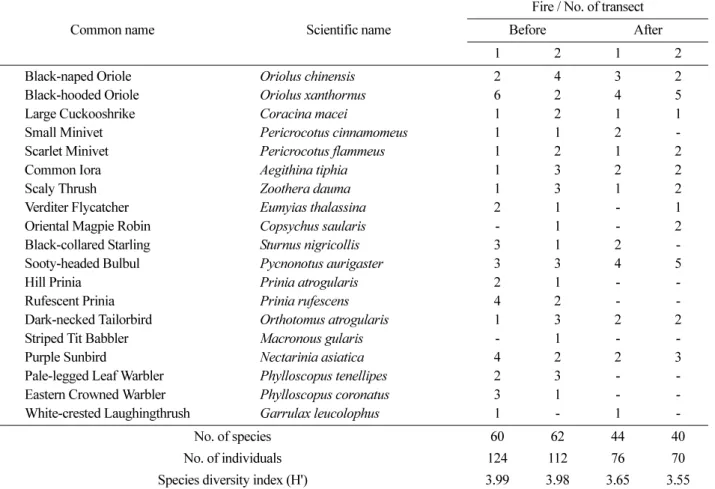
Before the forest fire, 64 species were observed and 46 species were recorded after the forest fire in both transects of study area. Observed number of individuals were 124 and 112 in each transect before the fire. After the fire, observed number of individuals were decreased as 76 and 70 in each transect. Also, bird species diver- sity (H') was decreased after the fire than before the fire.

Observed number of parrots, parakeets, barbets, horn- bills, cuckoos, orioles and minivets were not differed

between before and after the fire in study area (Table 1).

But many birds were decreased after the fire in study area. Observed number of individuals of bee-eaters and treepies were decreased after the fire compared with the numbers before the fire in both transects. Also, some species of woodpeckers were decreased after the fire.

Kingfishers, lapwings and herons were dramatically decreased after the fire. These species were water-related birds. There were streams and ponds in the study area.

And amount and level of water were decreased in dry season during December and March within Mondulkiri protected forest. After the fire, most of streams and ponds were dried out. Therefore, decrease of kingfishers, lapwings and herons would be related with decrease of water and wetlands in study area (Schweithelm and Chhay, 2007).

Red Junglefowl, Green Peafowl, prinias and warblers were also decreased after the fire. These species were found out their food, roosting site and shelter in under- story layer and ground. By the forest fire, the coverage of understory layer were dramatically decreased (Figure 2). The creased of understory vegetation would be effected to inhabitation of those birds (Walston et al ., 2000; Robson, 2002).

Table 1. Continued.

Common name Scientific name Fire / No. of transect

Before After

1 2 1 2

Black-naped Oriole Oriolus chinensis 2 4 3 2

Black-hooded Oriole Oriolus xanthornus 6 2 4 5

Large Cuckooshrike Coracina macei 1 2 1 1

Small Minivet Pericrocotus cinnamomeus 1 1 2 -

Scarlet Minivet Pericrocotus flammeus 1 2 1 2

Common Iora Aegithina tiphia 1 3 2 2

Scaly Thrush Zoothera dauma 1 3 1 2

Verditer Flycatcher Eumyias thalassina 2 1 - 1

Oriental Magpie Robin Copsychus saularis - 1 - 2

Black-collared Starling Sturnus nigricollis 3 1 2 -

Sooty-headed Bulbul Pycnonotus aurigaster 3 3 4 5

Hill Prinia Prinia atrogularis 2 1 - -

Rufescent Prinia Prinia rufescens 4 2 - -

Dark-necked Tailorbird Orthotomus atrogularis 1 3 2 2

Striped Tit Babbler Macronous gularis - 1 - -

Purple Sunbird Nectarinia asiatica 4 2 2 3

Pale-legged Leaf Warbler Phylloscopus tenellipes 2 3 - -

Eastern Crowned Warbler Phylloscopus coronatus 3 1 - -

White-crested Laughingthrush Garrulax leucolophus 1 - 1 -

No. of species 60 62 44 40

No. of individuals 124 112 76 70

Species diversity index (H') 3.99 3.98 3.65 3.55

(5)

By the forest fire, the coverage of understory vegeta- tion was dramatically changed in study area. Also, many birds were influenced by the change of habitat structure.

For the management and conservation of junglefowls, peafowls, prinias and warblers, understory vegetation should be maintained in study area. Forest fire would be needed to reconsider in Mondulkiri protected forest, northeastern Cambodia.

Literature Cited

1. ASEAN. 2006. Third ASEAN State of the Environ- ment Report 2006. Public Affairs Office, ASEAN Sec- retariat, Jakarta.

2. Bibby, C.J., Burgess, N.D. and Hill, D.A. 1997. Bird census techniques. Academic Press, London.

3. Forestry Administration of Cambodia. 2004. Cambo- dia's forest cover. Forestry Administration of Cambo- dia, Phnom Penh.

4. Forestry Administration and Conservation International.

2007. Central Cardamom Protected Forest: Annual Report.

Forestry Administration and Conservation International, Phnom Penh.

5. Global Environment Facility (GEF). 1999. Biodiversity and protected areas management project in Cambodia.

GEF, Phnom Penh.

6. Hur, W.H., Rhim, S.J. and Lee, W.S. 2003. Effects of road on bird communities in forest areas. Korean Jour- nal of Environment and Ecology 17: 1-8.

7. Lee, W.S. 1996. The relationship between breeding bird communities and forest structure at a deciduous broad- leaved forest in Hokkaido, Japan. Korean Journal of Ecology 19: 353-361.

8. Maclnnes, M. 2007. Burning issues. WWF Great Mekong- Cambodia Country Program, Phnom Penh.

9. Mondulkiri Province. 2005. Announcement of prohibi- tions and demarcation of Mondulkiri protected forest.

Mondulkiri Province, Mondulkiri.

10. Ouk, K. 2005. Local attitudes toward conservation in Seima Biodiversity Conservation Area, Modulkiri prov- ince, Eastern Cambodia. MSc thesis. Tokyo University of Agriculture and Technology, Tokyo.

11. Rhim, S.J., Lee, J.Y. and Kang, J.H. 2007. Character- istics of habitat structure and bird communities between natural deciduous forest and road area in Gwangneung, Korea. Korean Journal of Environment and Ecology 21: 47-54.

12. Robson, C. 2002. A field guide to the birds of South- East Asia. New Holland Publishers (UK) Ltd., London.

13. Schweithelm, J. and Chhay, H.K. 2007. Mondulkiri protected forest: management plan 2008-2012. Forestry Administration, Kingdom of Cambodia, Phnom Penh.

14. Shannon, C.E. and Weaver, W. 1949. The mathematical theory of communication. Univ. of Illinois press, Urbana.

15. Tan, S. and Poole, C.M. 2003. A field guide to the birds of Cambodia. Wildlife Conservation Society Phnom Penh (WCS) Cambodia Program. JSRC Printing House, Phnom Penh.

16. Tordoff, A.W., Timmins, R.J., Maxwell, A., Huy, K., Lic, V. and Khou, E.H. 2005. Biological assessment of the lower Mekong dry forest ecoregion. WWF, Amster- dam.

17. Walston, J., Davidson, P. and Men, S. 2000. A wildlife survey of southern Mondulkiri Province, Cambodia.

Wildlife Conservation Society Cambodia Program, Phnom Penh.

18. World Bank. 2003. Cambodia environment monitor.

World Bank Phnom Penh Office, Phnom Penh.

(Received June 25, 2009; Accepted September 23, 2009)

수치

Figure 2. Difference in average foliage profiles between before and after the forest fire in tropical dry  Dipterocarp
Table 1. Number of observed birds of before and after the forest fire area within both transect in tropical dry  Dipterocarp
Table 1. Continued.

참조

관련 문서

내삶을 바꾸는 숲, 숲 속의 대한민국.. KOREA FOREST

1 John Owen, Justification by Faith Alone, in The Works of John Owen, ed. John Bolt, trans. Scott Clark, &#34;Do This and Live: Christ's Active Obedience as the

key words: forest healing, forest healing factor, forest healing program, forest for healing, urban forest.. 특히 급 격한 도시화 및 산업화에 따라 여가시간

Objectives: The present study was conducted to determine the relationship between degree of work performance and job satisfaction in NICU nurses.. Methods: The subjects of

This study was to do a comparative analysis on kinematic differences and differences in muscle activity between the skilled and the unskilled in windsurfing

2) In between-group comparison before and after elastic band exercise, a significant difference was found in the percentage of body fat, fat-free

In the broad approach, a country would define a system of forest management practices (without the requirement that a specified forest management practice

The study was conducted to find out the relationship between teacher passion and intrinsic motivation and class attitude that was perceived by participants in physical