大韓獸醫學會誌 (2014) 第 54 卷 第 1 號 Korean J Vet Res(2014) 54(1) : 53~54 http://dx.doi.org/10.14405/kjvr.2014.54.1.53
53
<Short Communication>
Serum cardiac troponin I concentrations in clinically normal and Dirofilaria immitis infected Korean Jindo dogs
Soo-Hyen Hwang1, Hyung-Jin Park1, Kyoung-Won Seo1, Sang-Eun Lee2, Kun-Ho Song1,*
1Laboratory of Veterinary Internal Medicine, College of Veterinary Medicine, Chungnam National University, Daejeon 305-764, Korea
2Division of Malaria & Parasitic Diseases, Korea National Institute of Health, Korea Centers for Disease Control and Prevention, Cheongwon 363-951, Korea
(Received: November 22, 2013; Revised: January 9, 2014; Accepted: January 22, 2014)
Abstract : This study was conducted to determine the serum cardiac troponin I (cTnI) concentrations in clinically normal (uninfected) Korean Jindo dogs and those infected with Dirofilaria (D.) immitis. Forty Korean Jindo dogs (22 females, 18 males) were obtained from two kennels in the Boryeong area of Chungnam Province and the Daejeon area, Korea.
Significantly higher cTnI concentrations were observed in D. immitis-infected dogs than clinically normal dogs. cTnI testing in addition to thoracic radiography, echocardiography, and electrocardiography shows promise as an additional method for diagnosis of heartworm infection.
Keywords : cardiac troponin I, Dirofilaria immitis, Korean Jindo dog
Dirofilaria (D.) immitis resides in the pulmonary arteries, right ventricle, and right atrium of infected dogs, cats, ferrets and wild canids in temperate, tropic and subtropic zones [4].
Canine heartworm disease can be manifested by thromboem- bolism, pulmonary hypertension, right-sided congestive heart failure, and ascites. Korea is in the temperate zone and is one of the enzootic regions of D. immitis [7, 8]. The prevalence of heartworm disease in Korean dogs was estimated to be 28.3% in a survey conducted from 1994 to 1995 that used an antigen test [3]. Using a similar antigen test, a recent survey of several Korean provinces, conducted from 2001 to 2002, revealed an increase in the prevalence of heartworm infec- tion to 40.0% [7]. However, a recent report showed that numbers of cases of canine heartworm disease diagnosed from 2007 to 2008 had decreased, although the risk of expo- sure to this nematode in the breeding farms is still high [8].
Injury to the sarcomere leads to the detachment of cardiac troponin I (cTnI) from actin, and the subsequent disruption of the cell membrane allows leakage of cTnI into the general circulation [5]. A high level of cTnI in serum or plasma is considered to be a very sensitive and specific indicator of myocardial cell damage and necrosis [5]. An elevated cTnI concentration is associated with poor long-term outcomes and is an independent predictor of mortality [2]. The objec- tive of this study was to determine serum cTnI concentration in Korean Jindo dogs clinically normal and uninfected or
infected with D. immitis.
Forty Korean Jindo dogs (22 females, 18 males; weight, 17~23 kg) were obtained from 2 kennels in the Boryeong area of Chungnam Province and the Daejeon area, Korea.
The ages of the dogs ranged from 1 to 12 years (median; 4.1 years). They underwent physical examinations, and evalua- tions of serum biochemistries and cTnI concentrations. The dogs were divided into 2 groups. Twenty dogs were assigned to the clinically normal group and 20 dogs were assigned to the D. immitis-infected group. None of the D. immitis- infected dogs had laboratory abnormalities or clinical signs such as exercise intolerance, dyspnea, cough, ascites and car- diac murmurs. To these dogs were therefore classified with mild canine heartworm disease severity [5]. The dogs were fasted for 12 hours prior to blood collection. Blood samples were collected through cephalic venipuncture, and each sam- ple was allowed to clot at room temperature for 30 min, and then centrifuged at 1,500 × g for 5 min. Aliquots of serum were frozen in plastic tubes at −80oC until analysis. Twenty dogs were clinically normal and negative by ELISA kit (4Dx SNAP test; Idexx Laboratories, USA) and 20 dogs that were ELISA-positive but asymptomatic for dirofilariasis. cTnI concentrations were measured using Chemiluminescent Molecu- lar Immunoassay by Architect (Abbott Diagnostics, USA).
This study was conducted in accordance with the Guide for the Care and Use of Laboratory Animals as approved by
*Corresponding author
Tel: +82-42-821-6789, Fax: +82-42-821-6703 E-mail: [email protected]
54 Soo-Hyen Hwang, Hyung-Jin Park, Kyoung-Won Seo, Sang-Eun Lee, Kun-Ho Song
Chungnam National University (no. CNU-00316).
Mann-Whitney U test was used for nonparametric data and unpaired t-test was used to compare normally distributed data. All values were expressed as mean± standard error of the mean. A p value of < 0.05 was considered significant. All analyses were performed using PASW Statistics 18 software (SPSS, USA).
In the present study, serum cTnI was mean 0.01 ng/mL in normal dogs, which is similar to the results of Sleeper et al.
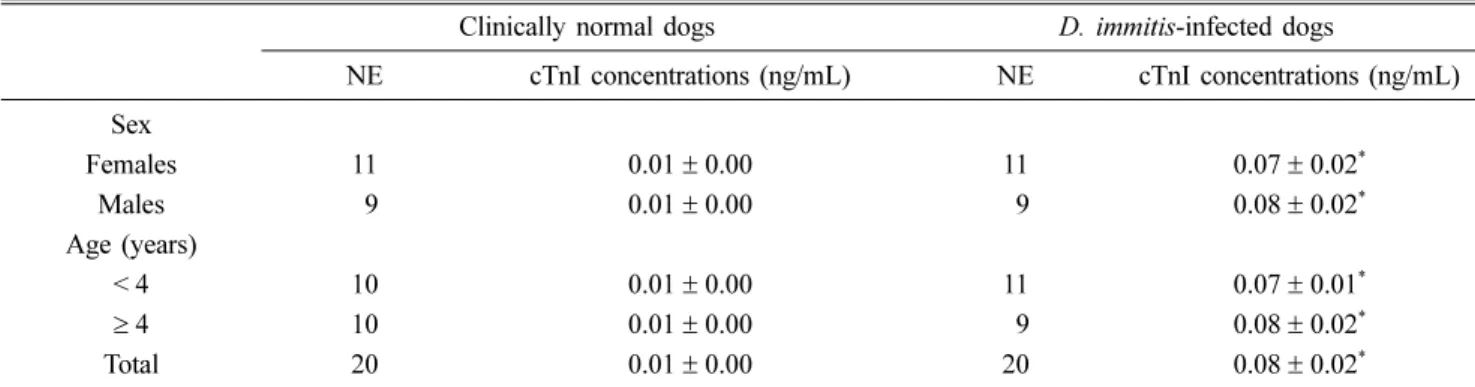
[6]. Gazyagci et al. [1] reported that there were statistically significant differences in the cTnI levels of dogs with and without dirofilariasis. The results of this study showed that the mean serum concentration of cTnI was 0.01 ng/mL in clinically normal(uninfected) dogs and 0.08 ng/mL in D.
immis-infected dogs. The higher cTnI concentration is statis- tically observed in D. immitis-infected dogs than clinically normal dogs in the present study (p < 0.05). In females and males, the higher cTnI concentration is statistically observed in D. immitis-infected dogs than clinically normal dogs (p <
0.05, respectively, Table 1). In over 4year-old and less than 4year-old dogs, the higher cTnI concentration is statistically observed in D. immitis-infected dogs than clinically normal group (p < 0.05, respectively, Table 1). Sleeper et al. [6]
reported that plasma cTnI concentrations greater than 0.07 ng/mL in the dog should be considered to be suggestive of cardiac pathology. In our study, seven of 20 (35%) in D.
immitis-infected dogs had serum cTnI concentrations greater than 0.07 ng/mL. The remaining D. immitis-infected dogs had serum cTnI concentrations less than 0.04 ng/mL. There were no significant differences in the rates of positivity between male versus female dogs and dogs aged younger than 4 years versus older than 4 years in either the unin- fected or D. immitis-infected dogs. Based on evidence from previous studies in humans and experimental animals, cTnI assays likely will be helpful in diagnosing myocarditis, myo- cardial contusion, early cardiotoxicity from chemotherapeu- tic agents such as doxorubicin, and for assessing response to therapy for congestive heart failure [6]. We believe that cTnI assays may also useful for assessing heartworm disease in dogs because pulmonary arterial disease caused by heart-
worm can cause right-sided congestive heart failure [5]. After acute damage to the myocyte, the serum cTnI concentration increases within a few hours, peaks in 12 to 24 hours, and then declines over the next few weeks [5]. In the present study, a significantly higher cTnI concentration (p < 0.05) was seen in the D. immitis-infected dogs than in the uninfected dogs. Therefore, testing for cTnI along with other evaluation test such as thoracic radiography, echocardiography, and electrocardiography is important for assessing a dog with heartworm disease, and shows promise as an additional diag- nosis method for heartworm infection. Further study is needed to investigate the relationship of serum cTnI concen- trations to the severity of naturally occurring heartworm dis- ease in dogs.
References
1. Gazyagci S, Dogru MT, Yagi BB. Cardiac troponin I levels in dogs with dirofilariosis and without dirofilariosis.
Asian J Anim Vet Adv 2011, 6, 738-743.
2. Healey JS, Davies RF, Smith SJ, Davies RA, Ooi DS.
Prognostic use of cardiac troponin T and troponin I in patients with heart failure. Can J Cardiol 2003, 19, 383- 386.
3. Lee JC, Lee CY, Shin SS, Lee CG. A survey of canine heartworm infections among German shepherds in South Korea. Korean J Parasitol 1996, 34, 225-231.
4. McCall JW, Genchi C, Kramer LH, Guerrero J, Venco L. Heartworm disease in animals and humans. Adv Parasitol 2008, 66, 193-285.
5. Nelson RW, Couto CG. Small Animal Internal Medicine.
4th ed. pp. 169-183, Mosby, St. Louis, 2009.
6. Sleeper MM, Clifford CA, Laster LL. Cardiac troponin I in normal dog and cat. J Vet Intern Med 2001, 15, 501- 503.
7. Song KH, Lee SE, Hayasaki M, Shiramizu K, Kim DH, Cho KW. Seroprevalence of canine dirofilariosis in South Korea. Vet Parasitol 2003, 114, 231-236.
8. Song KH, Park JE, Lee DH, Lee SH, Shin HJ.
Serological update and molecular characterization of Dirofilaria immitis in dogs, South Korea. Res Vet Sci 2010, 88, 467- 469.
Table 1. Cardiac troponin I concentrations in clinically normal and D. immitis-infected dogs (mean ± SE)
Clinically normal dogs D. immitis-infected dogs
NE cTnI concentrations (ng/mL) NE cTnI concentrations (ng/mL)
Sex
Females 11 0.01± 0.00 11 0.07± 0.02*
Males 99 0.01± 0.00 99 0.08± 0.02*
Age (years)
< 4 10 0.01± 0.00 11 0.07± 0.01*
≥ 4 10 0.01± 0.00 99 0.08± 0.02*
Total 20 0.01± 0.00 20 0.08± 0.02*
*Significant difference was observed between clinically normal and D. immitis-infected dogs (p < 0.05). NE: numbers of examined, cTnI:
cardiac troponin I.