2009년도 추계 학술발표회 논문집 대한방사선방어학회
- 118 -
Enhancement of Image Quality with Movable Multiple-slit System for the Cone-beam CT
Jina Chang1)․ Tae-Suk Suh1)․ Doh Yun Jang2)․ Siyong Kim3)
1) Dept. of Biomedical Engineering, Catholic University
2)Dept. of Nuclear Engineering, Hanyang University
3)Dept. of Radiation Oncology, Mayo Clinic, FL E-mail: [email protected] Key words : multiple-slit, scatter reduction, cone-beam CT
Introduction
Cone-beam CT (CBCT) has been widely used for the purpose of image-guided radiation therapy. This image-guidance is an important development for precise treatment dose delivery [1] and is being introduced for clinical applications such as adaptive radiation therapy.[2] In this study, we propose new movable multiple slit system for reduction of scattering in CBCT. The multiple slits with equi-angled intervals prevent scatter radiations in a longitudinal direction, and this whole multiple slit system moves after one gantry rotation. The projection images were reconstructed using CBCT image reconstruction method. As a preliminary study, we performed the MCNP simulation to verify an effectiveness of this system.
Materials and Methods
A. MCNPX Geometry and Simulation setup The MCNPX code was used to build a multiple slits geometry. The multiple slits are equi-angled arc to consider beam divergence. The photon energy is 40 kVp mono energy, and the source-isocenter distance is 100 cm and source-detector distance is 130 cm. The cylindrical water phantom model of 10 cm diameter includes
polyvinyl chloride (1.406 g/cm3) of 2 cm, polyurethane (0.021g/cm3) of 4 cm, and polytetrafluoroethylene (Teflon) (2.25g/cm3) of 6 cm diameter cylinder.
B. Scatter to Primary Ratio (SPR) and Scatter Reduction Factor (SRF)
Scatter to primary ratio (SPR) is defined as the ratio of scattered to primary radiation.
The SPR profile along the x-axis of the phantom at the center was calculated to evaluate the scatter reduction of the 2D radiograph at each slits width. Scatter reduction factor (SRF) is used to quantify the effect of scattered reduction directly of the multiple-slit method, and the SRF can be defined as follow:
WO MS WO
S S SRF S -
=
SWOand SMSare scattered radiation of without and with multiple-slit.
Results
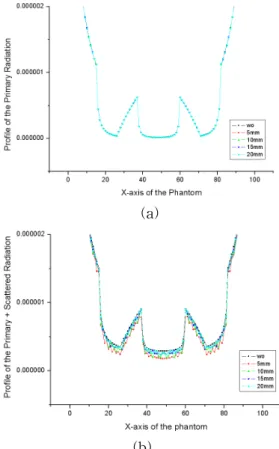
Fig. 1 shows the x-axis profiles of the phantom with/without (wo) multiple slits in the 2D projection view. Fig.1 (a) shows profiles of primary radiation, and (b) shows profiles of primary radiation and primary plus scattered radiation. As can be seen, the primary radiation is identical all the slit
2009년도 추계 학술발표회 논문집 대한방사선방어학회
- 119 - widths and without multiple slits, but the
profiles of primary plus scattered radiation were changed according to the scattered radiation of the silt widths. Fig. 2 shows the SRF, and the scatter reduction rate is 28%, 15%, 9%, 7%, when the slit widths were 5mm, 10mm, 15mm, 20mm, respectively. Fig.
3 shows the x-axis profiles of the CBCT image of the phantom with/without multiple slits. The profiles of the 10mm, 15mm, and 20mm were almost identical in the center area of the image, but the profiles changes towards the periphery area of the image similar to the 2D projection results.
(a)
(b)
Fig. 1. Profiles of (a) primary radiation, and (b) scattered plus primary radiation of the
phantom with/without multiple slits.
Conclusion
We have designed a movable multiple-slit system for scatter reduction in cone-beam CT. Preliminary study based on MCNP simulation shows an effectiveness of the
multiple-slit system reducing 28% scatter radiation in the 5mm slit width. Further study will be performed with combination of the fore slit system or grid system to improve the scatter reduction rate.
Fig. 2. Scatter reduction factor (SRF) of the phantom with/without multiple slits.
Fig. 3. X-axis profiles of the CBCT image of the phantom with/without multiple slits.
Reference
1. Y. Yang, E. Schreibmann, T. Li, C.
Wang, L. Xing, Evaluation of on-board kV cone beam CT (CBCT)-based dose calculation, Phys Med Biol, 52, 685-705(2007)
2. S. Samant, J. Xia, P. Muyan-Özçelik, J.
Owens, High performance computing for deformable image registration: Towards a new paradigm in adaptive radiotherapy, Med Phys, 35(8), 3546–3553(2008)