대한 두경부 종양 학회지 제 27 권 제 2 호 2011
Induction Chemotherapy with S-1 and Cisplatin in Patients with Locally Advanced Squamous Cell Carcinoma
of the Head and Neck : A Single Center Experience
Dok Hyun Yoon, MD
1, Yoojin Cho, MD
1, Ji Youn Kim, RN
1,
Sang Yoon Kim, MD, PhD
2, Soon Yuhl Nam, MD, PhD
2, Seung-Ho Choi, MD
2, Jong-Lyel Roh, MD
2, Sang-Wook Lee, MD, PhD
3, Jeong Hyun Lee, MD
4, Jae Seung Kim, MD, PhD
5, Kyung-Ja Cho, MD, PhD
6, Sung-Bae Kim, MD, PhD
1Department of Oncology,
1Otolaryngology,
2Radiation Oncology,
3Radiology,
4Nuclear Medicine
5and Pathology,
6Asan Medical Center, University of Ulsan College of Medicine, Seoul, Korea
국소진행성 두경부편평상피암 환자를 대상으로 한 S1과 시스플라틴 병용 유도항암화학요법에 관한 연구
울산대학교 의과대학 서울아산병원 종양내과,1 이비인후과,2
방사선종양학과,3 영상의학과,4 핵의학과,5 병리과6 윤덕현1·조유진1·김지연1·김상윤2·남순열2·최승호2 노종렬2·이상욱3·이정현4·김재승5·조경자6·김성배1
= 국 문 초 록 =
서 론
5-FU와 cisplatin 병용항암화학요법은 국소진행성 두경부편평상피암의 유도화학요법으로 널리 사용되고 있는 요법이다. 저자들은 5-FU 대신 경구제재인 S-1을 cisplatin과 병용하는 복합항암요법의 효과와 안전성에 대해 연구하였다.
대상 및 방법
저자들은 2007년 2월부터 2008년 12월까지 S1과 cisplatin의 복합유도화학요법을 시행받은 3/4기 구인두, 하 인두, 후두, 구강 편평상피세포암 환자 52명의 치료결과를 후향적으로 분석하였다. 유도항암화학요법은 제 1일에 cisplatin(75 또는 60mg/m2), 제1일부터 14일까지 S-1(40mg/m2)을 1일 2회, 21일 간격으로 투여하였고 가능한 경우에는 항암방사선동시요법 또는 수술을 뒤이어 시행하였다.
결 과
전체 52명 중 37명(71.2%)에서 부분반응을 보였으나 완전반응은 관찰되지 않았다. 2년 무진행생존율은 56.9%, 2년 전체생존율은 68.2%였다. 유도항암요법과 관련된 유해반응으로는 호중구감소증(71.2%) 및 빈혈(63.5%) 등과 같은 혈액학적 부작용이 가장 흔했다.
결 론
S-1과 cisplatin의 복합항암화학요법은 국소진행성 두경부편평상피암 환자를 대상으로 한 유도화학요법으로 적용이 가능한 것으로 판단된다.
중심 단어:두경부암ㆍS-1ㆍCisplatinㆍ유도화학요법.
Received : May 30, 2011 / Revised : September 17, 2011 / Accepted : September 19, 2011
교신저자 : 김성배, 138-736 서울 송파구 아산병원길 86 울산대학교 의과대학 서울아산병원 종양내과 전화 : (02) 3010-3217 · 전송 : (02) 3010-6961 · E-mail : [email protected]
online©MLComm
Introduction
Approximately 60% of patients with squamous cell carci- nomas of the head and neck(SCCHN) present at an advanced stage.1) Prognosis in these patients is poor, with 5-year over- all survival rates of less than 20% despite radiotherapy.2,3) Af- ter introduction of concurrent chemoradiotherapy(CCRT), this has become the standard of care for patients with locally advanced SCCHN, with a meta-analysis showing that CCRT is superior to radiotherapy alone, providing an 8% absolute survival benefit at 5 years.4,5) However, interest has increased in induction chemotherapy(ICT) as the failure pattern of pa- tients receiving CCRT has shifted from locoregional recur- rence to systemic failure. Another issue in the treatment of locally advanced SCCHN is to identify patients who would benefit from this non-surgical approach. Response to ICT has been shown to be predictive of response to subsequent radi- ation in patients with oropharyngeal and laryngeal cancer.5,6) A meta-analysis of a subgroup of five large studies showed that overall response rates to ICT with fluorouracil(5-FU) and cisplatin(PF) ranged from 56 to 93%, resulting in a 5%
survival benefit at 5 years.3-5,7,8) The PF regimen, however, re- quires continuous infusion of 5-FU, necessitating admission of patients or insertion of a central venous catheter, both of which are demanding on resources. Newer oral fluoropy- rimidines have been introduced ; these include capecitabine and S-1. S-1 is a mixture of three compounds : the 5-FU pro- drug, tegafur ; the dihydropyrimidine dehydrogenase(DPD) inhibitor, 5-chloro-2, 4-dihydroxypyridine ; and the orotate phosphoribosyl transferase inhibitor, potassium oxonate.
S-1 may be more potent than 5-FU, particularly in DPD-ex- pressing tumors including SCCHN, and showed reduced gastrointestinal toxicity.9) Patients with pre-treated SCCHN have shown a 30.4% response rate to S-1, higher than the re- sponse rate of 15% observed with continuous infusion of 5-FU.10) Thus, replacing 5-FU with S-1 may result in higher efficacy as have been shown in two recent phase II trials.6,11) Here, we tried to verify the activity and safety of a combination of S-1 and cisplatin as ICT in patients with locally advanced SCCHN in a consecutive patient series.
Design and Methods
1. Patients and diagnosis
Fifty-two patients with locally advanced SCCHN who had been treated with S-1/cisplatin(SP) were retrospectively an- alyzed. Disease location was limited to the oral cavity, oro-
pharynx, hypopharynx, and larynx. Tumor stage ranged from III to IV according to the American Joint Committee on Can- cer staging. All patients were treated at the Asan Medical Center, Seoul, Korea, between February 2007 and December 2008.
2. Treatment
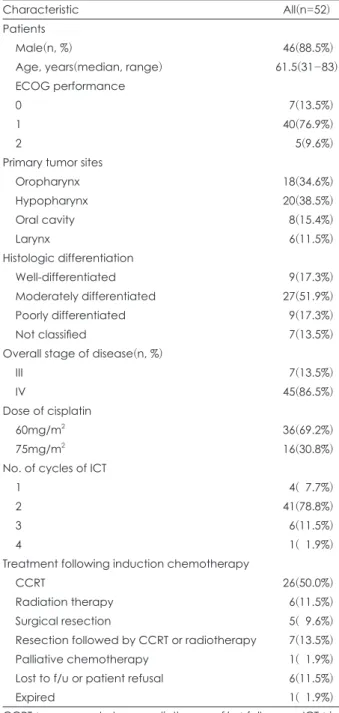
Each 21-day cycle of SP chemotherapy initially consisted of cisplatin at 75mg/m2 on day 1 and S-1(Taiho Pharmaceuti- cal Co., Tokyo, Japan) twice daily on days 1 to 14. Individual S-1 doses were dependent on patient body surface area(BSA), and were 40mg twice daily for patients with BSA<1.25m2, 50mg twice daily for patients with 1.25≤BSA<1.5m2, and 60mg twice daily for patients with BSA≧1.5m2. However, the dose of cisplatin was reduced to 60mg/m2 after treatment of 16 patients with 75mg/m2 for concerns about toxicity and poor compliance to following treatment. Thus, 36 patients were treated with 60mg/m2 of cisplatin since August 2007 (Table 1). Forty-one patients received two cycles of ICT, as planned. Seven patients received an additional one(n=6) or two cycles(n=1) because of delayed surgery/radiotherapy or patient reluctance to undergo surgery/radiotherapy. Another four patients received only one cycle of ICT ; each because of patient refusal of further chemotherapy with loss to follow- up, another loss to follow-up, early death, and early surgery at the discretion of the surgeon after one cycle of ICT without response evaluation, although this patient showed symptom- atic improvement after a single cycle of ICT, respectively.
Thus, response to ICT was evaluable in 48 patients exclud- ing these four.
Definitive local treatment after ICT was performed within 4 weeks of the end of the last ICT cycle, if possible. Twenty- six patients received definitive CCRT, six received radiother- apy alone, and 12 underwent surgical resection, followed by adjuvant radiotherapy or chemoradiotherapy in seven patients.
One patient developed distant metastases despite ICT and received additional palliative chemotherapy. Seven patients received no further treatment, because of patient refusal, loss to follow-up or death after ICT(Table 1).
Radiotherapy as a definitive or adjuvant treatment, either alone or as CCRT, was commenced within 4 weeks of the end of the last ICT cycle or surgery. Radiotherapy consisted of daily fractions of 1.8 or 2.0Gy, administered on each of five days per week, with a total dose of 60-70Gy. Patients under- going CCRT also received intravenous infusions of high-dose cisplatin(80-100mg/m2) on days 1, 22, and 43.
3. Response and toxicity criteria
Response was evaluated by computed tomography(CT) or
magnetic resonance imaging(MRI), and by laryngoscopic examination conducted by an otorhinolaryngologist, ac- cording to the Response Evaluation Criteria in Solid Tumors (RECIST).12) Responses were assessed after completion of ICT, 2-3 months after completion of CCRT, every 3 months for the first 2 years and every 6 months thereafter and when- ever clinically indicated. Toxicity in all patients who received S-1, regardless of dose, was assessed according to the National Cancer Institute Common Terminology Criteria for Adverse Events(NCI-CTCAE), version 3.0. Relative dose intensity (RDI) was defined as the ratio of the delivered dose/time to
the planned dose/time and was expressed as mean±standard error. The nontreatment-radiotherapy-day ratio(NTDR, days without radiotherapy/overall radiotherapy time), suggested by d’Ambrosio et al.13) as a measure of overall radiotherapy time, was calculated based on dose per fraction 1.8 or 2.0G, and treated as a continuous variable. Survival was computed by the Kaplan-Meier method. Progression-free survival(PFS) was calculated from the first day of ICT to the date of docu- mented progression, death from any cause, or last follow-up.
Overall survival(OS) was calculated from the first day of ICT to the date of death from any cause or last follow-up.
Results
1. Patient characteristics and treatment
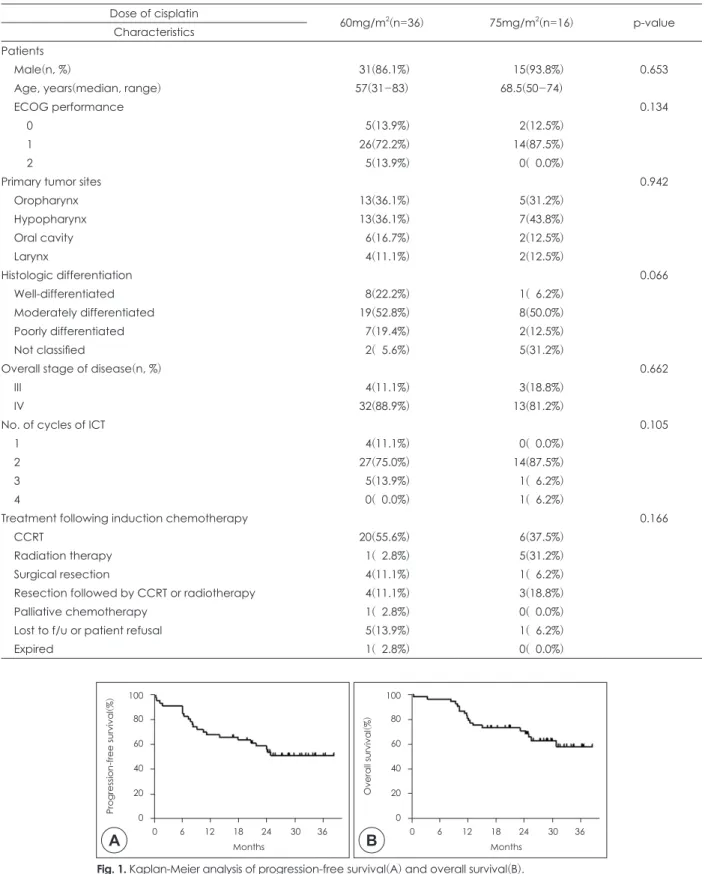
Our study population consisted of 6 women and 46 men, of median age 61.5 years(range, 31-83 years). Tumor locations included the oropharynx in 18 patients, the hypopharynx in 20, the larynx in six, and the oral cavity in eight. Seven pa- tients had stage III and 45(86.5%) had stage IV tumors(Table 1). Patients’ characteristics did not differ between two differ- ent doses of cisplatin(75mg/m2 vs. 60mg/m2)(Table 2).
2. Response to therapy
Thirty-seven patients(71.2%) showed partial response(PR) after ICT, whereas none achieved complete response(CR).
Nine patients(17.3%) showed stable disease, whereas two (3.8%) progressed after ICT. Response rates did not differ by stage(stage III vs. IV, p=0.33), histopathologic differentiation (p=0.57) or cisplatin dose(87.0% in 60 mg/m2 group vs. 77.8%
in 75mg/m2 group, p=0.605). However, response rates were significantly different according to the primary site of tumor : 63.2% in hypopharynx, 40.0% in larynx, 100.0% in oral cavity, and 94.1% in oropharynx(p=0.006).
3. Survival analysis
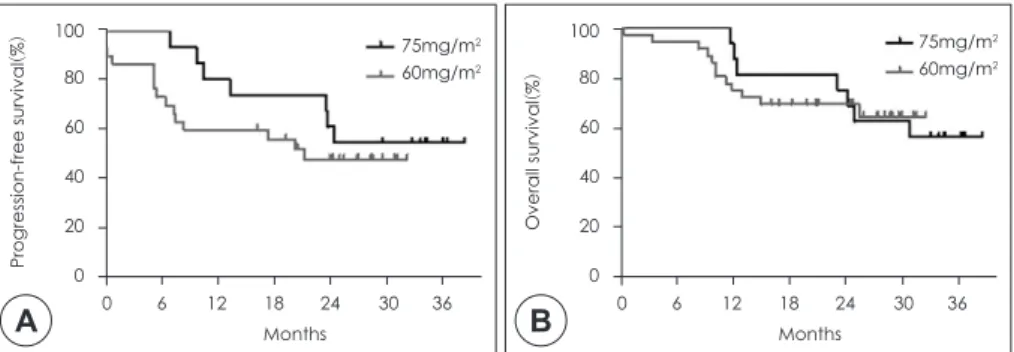
At a median follow-up time of 28.2 months(range, 16.3 to 38.6 months) in surviving patients, 19 had died. A 1-year and 2-year overall survival(OS) rate were 80.8% and 68.2%, re- spectively while a median OS was not reached, yet(Fig. 1).
Disease progressed in 20 patients and two patients died of pneumonia and cerebral infarct without evidence of progres- sion, respectively. The estimated 1-year and 2-year progres- sion-free survival(PFS) rates were 66.5% and 56.9%, respec- tively and a median PFS was not reached(Fig. 2). Two-year PFS rates were 68.8% in patients treated with 75mg/m2 cis- platin and 50.7% in patients treated with 60mg/m2 cisplatin, respectively(p=0.36, hazard ratio [HR] 0.67, 95% confidence interval [CI] 0.29-1.57). Two-year OS rates were 75.0% in
Table 1. Baseline patient characteristics
Characteristic All(n=52)
Patients
Male(n, %) 46(88.5%)
Age, years(median, range) 61.5(31-83)
ECOG performance
0 7(13.5%)
1 40(76.9%)
2 5(9.6%)
Primary tumor sites
Oropharynx 18(34.6%)
Hypopharynx 20(38.5%)
Oral cavity 8(15.4%)
Larynx 6(11.5%)
Histologic differentiation
Well-differentiated 9(17.3%)
Moderately differentiated 27(51.9%)
Poorly differentiated 9(17.3%)
Not classified 7(13.5%)
Overall stage of disease(n, %)
III 7(13.5%)
IV 45(86.5%)
Dose of cisplatin
60mg/m
236(69.2%)
75mg/m
216(30.8%)
No. of cycles of ICT
1 4(07.7%)
2 41(78.8%)
3 6(11.5%)
4 1(01.9%)
Treatment following induction chemotherapy
CCRT 26(50.0%)
Radiation therapy 6(11.5%)
Surgical resection 5(09.6%)
Resection followed by CCRT or radiotherapy 7(13.5%)
Palliative chemotherapy 1(01.9%)
Lost to f/u or patient refusal 6(11.5%)
Expired 1(01.9%)
CCRT : concurrent chemoradiotherapy, f/u : follow-up, ICT : in-
duction chemotherapy
patients treated with 75mg/m2 cisplatin and 69.4% in patients treated with 60mg/m2 cisplatin, respectively(p=0.29, hazard ratio [HR] 0.96, 95% CI 0.37-2.48). When separately analyz- ing 26 patients who received CCRT following ICT, 2-year PFS rate was 64.2% and 2-year OS rate was 80.8%, respectively
(Fig. 3).
4. Toxicity
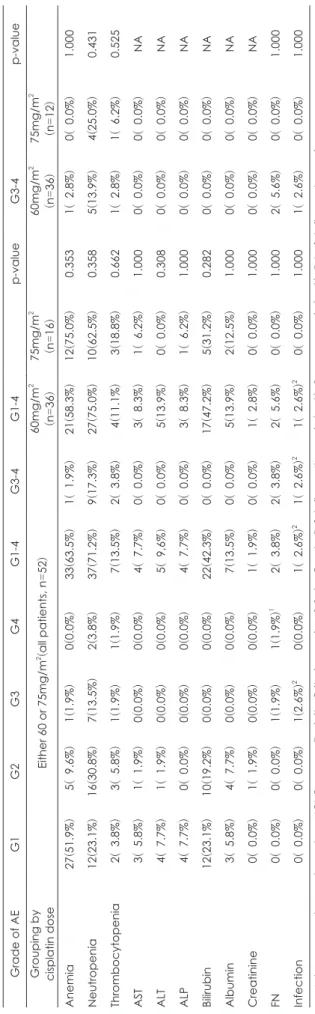
All 52 patients were assessed for toxicity. Most of the Grade 3/4 adverse events during ICT were hematological, including neutropenia(n=9), anemia(n=1) and thrombocytopenia(n=2).
Table 2. Patients’ characteristics according to cisplatin dose Dose of cisplatin
60mg/m
2(n=36) 75mg/m
2(n=16) p-value Characteristics
Patients
Male(n, %) 31(86.1%) 15(93.8%) 0.653
Age, years(median, range) 57(31-83) 68.5(50-74)
ECOG performance 0.134
0 5(13.9%) 2(12.5%)
1 26(72.2%) 14(87.5%)
2 5(13.9%) 0(00.0%)
Primary tumor sites 0.942
Oropharynx 13(36.1%) 5(31.2%)
Hypopharynx 13(36.1%) 7(43.8%)
Oral cavity 6(16.7%) 2(12.5%)
Larynx 4(11.1%) 2(12.5%)
Histologic differentiation 0.066
Well-differentiated 8(22.2%) 1(06.2%)
Moderately differentiated 19(52.8%) 8(50.0%)
Poorly differentiated 7(19.4%) 2(12.5%)
Not classified 2(05.6%) 5(31.2%)
Overall stage of disease(n, %) 0.662
III 4(11.1%) 3(18.8%)
IV 32(88.9%) 13(81.2%)
No. of cycles of ICT 0.105
1 4(11.1%) 0(00.0%)
2 27(75.0%) 14(87.5%)
3 5(13.9%) 1(06.2%)
4 0(00.0%) 1(06.2%)
Treatment following induction chemotherapy 0.166
CCRT 20(55.6%) 6(37.5%)
Radiation therapy 1(02.8%) 5(31.2%)
Surgical resection 4(11.1%) 1(06.2%)
Resection followed by CCRT or radiotherapy 4(11.1%) 3(18.8%)
Palliative chemotherapy 1(02.8%) 0(00.0%)
Lost to f/u or patient refusal 5(13.9%) 1(06.2%)
Expired 1(02.8%) 0(00.0%)
Fig. 1. Kaplan-Meier analysis of progression-free survival(A) and overall survival(B).
100 80 60 40 20 0
0 6 12 18 24 30 36 Months
Progression-free survival
(%
)
A
100 80 60 40 20 0
0 6 12 18 24 30 36 Months
Overall survival
(%
)
B
Two episodes of febrile neutropenia were noted(n=2)(Table 3). A 58-year old female patient with diabetes died of febrile neutropenia complicated by pneumonia with sepsis 2 weeks after her first cycle of ICT. ICT was delayed in six patients at discretion of attending physicians by a median of 7 days(range, 7-14 days), because of Grade 2(n=1) or Grade 3(n=2) neutro- penia, Grade 3 nausea/vomiting(n=1), Grade 2 ALT eleva- tion(n=1) and a patient’s wish to delay ICT for personal cause(n=1). These patients received the planned doses of S-1 and cisplatin without dose reduction after recovery of toxic- ities to less than Grade 1. The overall RDIs were 98.4±4.5%
for both S-1 and cisplatin. Toxicity profiles did not signifi- cantly differ by cisplatin dose(Table 3) nor does compliance for following radiotherapy as was shown by proximity in the median NTDRs(0.35 for cisplatin of 60mg/m2 and 0.39 for 75mg/m2, respectively, p=0.506).
Discussion
ICT with SP, replacing 5-FU with S-1 in PF, was shown to be effective against advanced SCCHN in a Korean phase II trial and in a Japanese phase I/II trial.6,11) In the Korean phase II trial involving 30 patients, the overall response rate was 89.7%(9 CR, 17 PR) and the 2-year estimated overall survival rate was 79.2%.11) In our present series, the overall response rate was 71.2%(no CR), and 2-year OS rate was 68.2%. These differences may at least partly be attributed to distinct patient
characteristics in that most of our patients(86.5%) had stage 4 tumors and nasopharyngeal carcinomas were excluded from this analysis ; poorly differentiated nasopharyngeal carcinoma is known to be distinct in its epidemiology, biol- ogy, clinical behavior, and treatment, and is treated as a sep- arate disease.14) Furthermore, we used two different doses of cisplatin, 60mg/m2 or 75mg/m2 on day 1. Although cisplatin of 75mg/m2 was used in the initial phase of our study like the Korean phase II trial, we reduced the dose of cisplatin in a later phase for concerns about toxicity. A phase I/II study of the same regimen for metastatic or recurrent AGC conducted in our center also employed 60mg/m2 cisplatin.15) The Japa- nese trial, involving patients with both advanced and recur- rent SCCHN, determined the maximal tolerable dose(MTD) of cisplatin in a phase I to be 70mg/m2. However, the Japanese study defined the MTD as the dose at which at least 50%
(three out of six) patients experienced DLT during the first course unlike conventional definition of MTD at which at least two of six underwent DLT. As two of six patients showed DLT at 70mg/m2 of cisplatin, the recommended dose would have been 60mg/m2 if the conventional definition of MTD is ap- plied.6,16)
Irrespective of concerns for toxicity related to high dose of cisplatin, toxicity profiles of patients treated with cisplatin of 60mg/m2 and 75mg/m2 didn’t seem to differ in this study.
Most of the grade 3/4 adverse events were hematologic toxici- ties, with neutropenia(17.3%) being the most common, simi-
Fig. 2. Kaplan-Meier analysis of progression-free survival(A) and overall survival(B) by dose of cisplatin, 60mg/m
2vs. 75mg/m
2.
10080 60 40 20 0
0 6 12 18 24 30 36 75mg/m2 60mg/m2
Months
Progression-free survival
(%
)
A
100 80 60 40 20 0
0 6 12 18 24 30 36 Months
Overall survival
(%
)
B
75mg/m2 60mg/m2
Fig. 3. Kaplan-Meier analysis of progression-free survival(A) and overall survival(B) in the patients who received concurrent chemora- diotherapy after induction chemotherapy.
100 80 60 40 20 0
0 6 12 18 24 30 36 Months
Progression-free survival
(%
)
A
100 80 60 40 20 0
0 6 12 18 24 30 36 Months
Overall survival
(%
)
B
lar to findings in the Korean phase II study(26.7%).11) Al- though no grade 4 hematologic toxicity was reported in the earlier trial, we observed three grade 4 neutropenias as well as one patient who experienced treatment-related mortality, resulting from febrile neutropenia complicated by pneumo- nia with sepsis. As most grade 3/4 toxicities occurred after completion of planned ICT, ICT was delayed in only four pa- tients, resulting in a high RDI of 98.4±4.6%. This regimen was also well tolerated in the earlier Korean phase II trial, in that the RDI was 98.5% for S-1 and 97.2% for cisplatin. In the Japanese trial, the most common grade 3 or 4 adverse event was anorexia(26.5%), followed by nausea(14.7%) and hema- tologic toxicities including neutropenia and thrombocytope- nia(11.8% for each). These findings indicate that SP as ICT would be feasible with respect to associated toxicities.
All variables related to clinical efficacy including response rate, 2-year PFS and 2-year OS rates were not significantly different between patients treated with 60 or 75mg/m2 cispl- atin, although these results do not guarantee non-inferiority of 60mg/m2 dose to 75mg/m2 as this study was not designed to compare these two different cisplatin doses. In the Japa- nese trial, the confirmed response rate was 44.4%, and the best response rate, including unconfirmed responses, was 72.2% in the subgroup of patients with advanced SCCHN(n
=18).6) In the subpopulation, the median overall survival was 16.7 months, and the 1-year OS rate was 83%. Taken to- gether of these and the Korean phase II trial, the results in- dicate that ICT of SP regimen is as effective as PF of which response rates is 56-93%, although cross-study comparisons should be interpreted with caution.3,7,8)
Although S-1 plus cisplatin regimen in three studies used the same dose of S-1, 40mg/m2 twice daily for consecutive 14 days, the dose and schedule of cisplatin varied : 60 or 75mg/
m2 on day 1 in our study, 75mg/m2 on day 1 in the Korean phase II trial and 70mg/m2 on day 8 in the Japanese phase I/
II study, respectively. Two Korean studies repeated the sched- ule every 3 weeks but the Japanese trial employed every 4 week schedule. These differences in the dose of cisplatin and schedule may at least partially explain slight difference in efficacy and toxicity. Although the interpretation of our results is limited by its retrospective nature, two different dose of cis- platin and incomplete toxicity evaluation excluding non-labo- ratory toxicities, our results further support for the use of the regimen in clinical practice in that the number of patients in- cluded in this study(n=52) is larger than the sum of patient numbers of previous two studies(n=18 and n=30, respec- tively) in the context of induction chemotherapy.
Several recent large trials have shown that induction regi-
Table 3.
G ra de s 1 - 4 dr ug -re la te d ad ve rse e ve nt s d ur in g in du ct io n ch em ot he ra py * Grade of AE G1 G2 G3 G4 G1-4 G3-4 G1-4 p-value G3-4 p-value
Grouping by cisplatin dose
Either 60 or 75mg/m
2(all patients, n
= 52 ) 60mg/m
22
75mg/m (n = 36 )
2
60mg/m (n = 16 )
2
75mg/m (n = 36 )
(n = 12 ) (51.9% Anemia 27
) 5(
09.6% ) 1( 1.9% ) 0( 0.0% ) 33 (63.5%
) 1(
01.9% ) 21
(58.3%
) 12
(75.0%
) 0.353 1(
02.8% ) 0(
00.0% ) 1.000 Neutropenia 12 (23.1%
) 16
(30.8%
) 7( 13.5% ) 2( 3.8% ) 37
(71.2%
) 9( 17.3% ) 27
(75.0%
) 10
(62.5%
) 0.358 5( 13.9% ) 4( 25.0% ) 0.431 Thrombocytopenia 2(
03.8% ) 3(
05.8% ) 1( 1.9% ) 1( 1.9% )
07( 13.5% ) 2(
03.8% )
04( 11.1% ) 3( 18.8% ) 0.662 1(
02.8% ) 1(
06.2% ) 0.525 AST 3(
05.8% ) 1(
01.9% ) 0( 0.0% ) 0( 0.0% )
04(
07.7% ) 0(
00.0% )
03(
08.3% ) 1(
06.2% ) 1.000 0(
00.0% ) 0(
00.0% ) NA ALT 4(
07.7% ) 1(
01.9% ) 0( 0.0% ) 0( 0.0% )
05(
09,6% ) 0(
00.0% )
05( 13.9% ) 0(
00.0% ) 0.308 0(
00.0% ) 0(
00.0% ) NA ALP 4(
07.7% ) 0(
00.0% ) 0( 0.0% ) 0( 0.0% )
04(
07.7% ) 0(
00.0% )
03(
08.3% ) 1(
06.2% ) 1.000 0(
00.0% ) 0(
00.0% ) NA Bilirubin 12 (23.1%
) 10
(19.2%
) 0( 0.0% ) 0( 0.0% ) 22
(42.3%
) 0(
00.0% ) 17
(47.2%
) 5( 31.2% ) 0.282 0(
00.0% ) 0(
00.0% ) NA Albumin 3(
05.8% ) 4(
07.7% ) 0( 0.0% ) 0( 0.0% )
07( 13.5% ) 0(
00.0% )
05( 13.9% ) 2( 12.5% ) 1.000 0(
00.0% ) 0(
00.0% ) NA Creatinine 0(
00.0% ) 1(
01.9% ) 0( 0.0% ) 0( 0.0% )
01(
01.9% ) 0(
00.0% )
01(
02.8% ) 0(
00.0% ) 1.000 0(
00.0% ) 0(
00.0% ) NA FN 0(
00.0% ) 0(
00.0% ) 1( 1.9% ) 1( 1.9% )
1 02(
03.8% ) 2(
03.8% )
02(
05.6% ) 0(
00.0% ) 1.000 2(
05.6% ) 0(
00.0% ) 1.000 Infection 0(
00.0% ) 0(
00.0% ) 1( 2.6% )
20( 0.0% )
01(
02.6% )
21(
02.6% )
201(
02.6% )
20(
00.0% ) 1.000 1(
02.6%
)
0(
00.0% ) 1.000 * : Adverse event score based on NCI Common Toxicity Criteria, versio
n 3.0. 1
: Grade 5, febrile neutropenia
(n = 1) , 2
: pneumonia
(n = 1) , FN
: febrile neutropenia
mens, combining a taxane with 5-FU and cisplatin, yielded very promising results, with superior response rates, signifi- cantly longer survival, and favorable safety profiles.17-19) As these triplet regimens have replaced PF as the standard in- duction regimen, the role of S-1 may expand in combination with taxane, especially in the context of sequential ICT fol- lowed by CCRT. This new treatment scheme was recently shown to be of superior efficacy compared with CCRT alone, as determined by increased time-to-treatment-failure.20) The- oretically, such sequential treatment should provide both systemic and local control of locally advanced SCCHN.
In conclusion, we have shown that the SP regimen as ICT is active and safe with a acceptable response rate and safety pro- file in patients with locally advanced SCCHN.