Abstract
Purpose - The purpose of this study is to explore, examine, and analyze Journal of Distribution Science and its articles based on five key factors of journal selection process by Thompson and to provide foundations for further knowledge creation and theory building in the areas of distribution and distribution science.
Research design, data, methodology - This study used an ex- ploratory case study method to engage article analysis and reviews of Journal of Distribution Science. Thompson’s five journal selection fac- tors were used as criteria for the journal and article analyses and review.
Results - Journal of Distribution Science is currently meeting or at least in the progress of meeting the following factors: timeliness of publication, international editorial convention, international diversity, and citation analysis. However, JDS is short of meeting the factor of editorial content. The research topics were not new, emerging, and/or distinctive, and they were not directly associated with specific region or country other than Korea.
Conclusions - The findings from this study could lead the field of distribution to reexamine the core knowledge, to reestablish the funda- mental concepts and principles, to formulate and propose academically and practically sound research methods, and to develop and focus on unique research topics in the area of distribution.
Keywords : Journal of Distribution Science, Distribution Knowledge in Korea, Traditional Market in Korea.
JEL Classifications : M30, M39, N95, R10.
1. Introduction
According to the Editorial Review that was published in the Journal of Distribution Science (JDS) in May of 2012, the Korea Distribution Science Association (KODISA) and its major research journal, JDS, have carefully and thoroughly been examining its oper-
* Corresponding Author. Assistant Professor, SUNY Empire State College, USA, Tel: +1-315-773-6139. E-mail: [email protected]
** Professor, College of Health Industry, Eulji University, Korea. Tel:
+82-10-2263-7292. E-mail: [email protected]
ations and procedures to develop a sound strategy to achieve their fu- ture goals. In general, the primary objectives of research associations and scholarly journals are to promote both industry and academia to research to publish innovative and quality papers that are clearly ap- plicable to researchers and practitioners and to add practical and aca- demic knowledge to their field or discipline. Ultimately, the final goal of any research association and journalis to become a world reputable and renowned research association and journal in its specific field.
Similarly, the apparent goals for KODISA and JDS in the future are almost identical to other research associations and journals: becoming a reputable research organization and journal in the field of dis- tribution throughout the world.
Recent efforts of KODISA and JDS to improve its reputation clearly show optimistic results. KODISA redesigned its Korean web- page to English version in July of 2011 and changed JDS’s pub- lication schedulefrom quarterly to monthly in the beginning of 2012.
The increase in the bounce rate and the number of article sub- missions by foreign scholars are the immediate and encouraging re- sults of the implementation of new strategies (Kim & Youn, 2012).
The latest strategies of KODISA and JDS are not arbitrary or illog- ical because they are coinciding with Thompson’s journal selection process for Social Sciences Citation Index (SSCI). Thompson consid- ers five key factors in its evaluation and selection process: (1) time- liness of publication, (2) international editorial conventions, (3) edito- rial content, (4) international diversity, and (5) citation analysis.
It seems that the key factor of focus for JDS after itsnew strat- egies are fully implemented and changes have takenplace is the edito- rial content. This factor, editorial content, is probably the most sig- nificant factor to be considered by the evaluating editors from Thompson because editorial content depicts new and emerging re- search topics that are relevant to social sciences research that could enhance the quality of the existing SSCI database. This study is ex- ploratory, stimulated by the recent editorial review of JDS, and is aimed at providing foundations for further knowledge creation and theory building in the area of distribution and distribution science.
2. KODISA and JDS
Since its establishment in 1999, KODISA and JDS slowly but surely worked its way to improvetheir reputation as a research associ- ation and a journal in the area of distribution and its related fields in Korea. The official members of KODISA and editorial board of JDS worked closely together for the last two years to develop and imple-
[Editorial Review]
Distribution Knowledge, Research, and Journal in Korea
1)
Dong-Ho Kim*, Myoung-Kil Youn**
ment incomparable strategies to enhance the reputation of both the journal and the association. This type of continuous improvement was necessary for KODISA and JDS to remain competitive as a reputable journal and research association in Korea, especially when the National Research Foundation of Korea planned to implement their policy of ceasing the current operation of journal accreditation in 2014. Both KODISA and JDS strongly believed that the recent efforts to enrich their journal will not only promote JDS to become a repu- table and major journal in Korea but also assistJDS to be included in the reputable database, e.g., SCOPUS and SSCI.
According to Kim et al. (2010) and Kim and Youn (2012), JDS published a total of 109 research articles, of which eight articles were written in English and only two were submitted from other countries.
However, the recent changes of the association and the journal re- sulted in the increase of the article submission number from other countries, e.g., JDS received a total of six articles from foreign schol- ars fromdifferent countries to review and evaluate for the possible publication in JDS during the first three months of 2012. Table 1 de- picts the published articles of JDS since 1999. The table indicates the lack of international diversity, though it is a significant factor for JDS to expand its research area in a global context and to target in- ternational audiences and community of researchers.
<Table 1> Publication of Journal of Distribution Science Since 1999 Articles Submitted by Year Volume &
Number
Total Number of Articles
Domestic Author(s)
Foreign Author(s)
2012 10(3) 5 5
2012 10(2) 5 4 1
2012 10(1) 5 5
2011 9(4) 9 9
2011 9(3) 9 9
2011 9(2) 13 12 1
2011 9(1) 5 5
2010 8(4) 4 4
2010 8(3) 5 5
2010 8(2) 5 5
2010 8(1) 5 4 1
2009 7(4) 5 5
2009 7(3) 5 4 1
2009 7(2) 5 5
2009 7(1) 5 5
2008 6(2) 4 5
2008 6(1) 7 5
2007 5(2) 6 6
2007 5(1) 6 6
2006 4(2) 8 8
2006 4(1) 8 8
2005 3(2) 7 7
2005 3(1) 6 6
2004 2(2) 6 6
2004 2(1) 7 7
1999 1(1) 8 8
Total 164 4
Source: Kim & Youn (2012)
The redesigning of the webpage of KODISA in July of 2011 was the ingenuous yet brilliant idea to attract international audience, in-
creasingthe article submission number from foreign scholars andpos- sible improvement of the journal impact factor in the future. In addi- tion, including many highly regarded foreign scholars as editors or members of editorial advisory board also promotedthe positive envi- ronment of international diversity. JDS also restructured its publication standards to make easier for international researchers and practitioners to submit their research papers. Table 1 depicts that JDS is currently meeting its monthly publication schedule without any problem, and the current evaluation by NRF of Korea indicates that JDS’s peer re- view process of evaluation of submitted articles are both rigorous and appropriate.
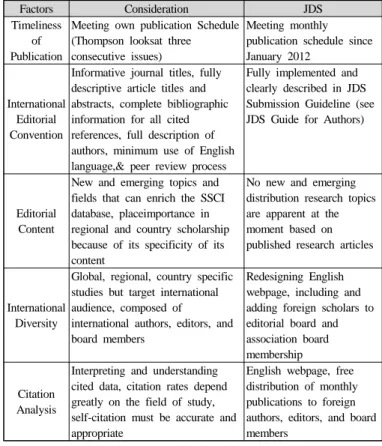
Table 2 depicts the key factors that evaluating editors from Thompson consider during the journal selection process, and the ac- tions that are taken by JDS to meet these factors.
<Table 2> SSCI Journal Selection: Key Factors
Factors Consideration JDS
Timeliness of Publication
Meeting own publication Schedule (Thompson looksat three consecutive issues)
Meeting monthly publication schedule since January 2012
International Editorial Convention
Informative journal titles, fully descriptive article titles and abstracts, complete bibliographic information for all cited references, full description of authors, minimum use of English language,& peer review process
Fully implemented and clearly described in JDS Submission Guideline (see JDS Guide for Authors)
Editorial Content
New and emerging topics and fields that can enrich the SSCI database, placeimportance in regional and country scholarship because of its specificity of its content
No new and emerging distribution research topics are apparent at the moment based on published research articles
International Diversity
Global, regional, country specific studies but target international audience, composed of
international authors, editors, and board members
Redesigning English webpage, including and adding foreign scholars to editorial board and association board membership
Citation Analysis
Interpreting and understanding cited data, citation rates depend greatly on the field of study, self-citation must be accurate and appropriate
English webpage, free distribution of monthly publications to foreign authors, editors, and board members
Source: Park& Kim (2009)
Both Table1 and 2 clearly show the tremendous efforts made by KODISA and JDS in recent years to identify and satisfy the im- portant factors that are critical to JDS during the evaluation and se- lection process for inclusion in SSCI and SCOPUS databases.
Furthermore, JDS is currently meeting or at least in progress of meet- ing the following factors: timeliness of publication, international edito- rial convention, international diversity, and citation analysis. However, new and emerging distribution research topics are not evident based on the analysis of JDS and its published articles (Kim et al., 2011).
Without having new, emerging, and/or distinctive research topics and research topics that are directly associated with specific region or country, it is extremely difficult to be included in the reputable database. For instance, Park and Kim (2009) indicated that the titles
of all Korean journals in the SSCI database were country or regional specific. Except for the Journal of Global Economic Review, the titles of the journals clearly present geographic implication: Asia-Pacific Journal of Financial Studies, Asian Journal of Women Studies, Journal of Korea Trade, Seoul Journal of Korean Studies, etc.
It is imperative for a reputable research journal to distinguish itself from other journals with research topics, areas, and methods, to be a leader and expert in their specific disciplinary field, and to con- tinually develop academically and practically sound theories and knowledge. Although there are many research journals that include the term Distribution in their titles, these journals donot distinguish themselves as unique distribution research journals with specific re- search topic and content. These types of phenomena are not unusual when the definition of Distribution remains too vague and noticeably confusedwith the definitions of closely related fields such as Supply Chain and Logistics.
3. Distribution and Knowledge
What is Distribution? In general, anyone who hears the word Distribution would probably think of something related to space or location, range, supply, classification, measurement, etc. Distribution, in business, is the process or movement of products and services from producer to final consumers. According to business dictionary (WebFinance, 2012), Distribution is the movement of goods and serv- ices from the source through a distribution channel, right up to the final customer, consumer, or user, and the movement of payment in the opposite direction, right up to the original producer or supplier.
Youn and Kim (2010) and Kim and Youn (2004) suggest that the concept of distribution is, "the economic process that facilitates the movement of goods and services from the supplier or manufacturer to the final consumer or user to promote and add value to individual and national economy". Furthermore, there are similar terms that are used to explain the process or movement of getting products and services to the customers in the field of business, such as physical distribution, logistics, supply chain management, and materials management. Table 3 depicts similar terms that are used to describe the process of getting products and services to the final consumers.
<Table 3> Distribution and Similar Terms
All of these terms and definitions are so closely related with the definition of Distribution that they could be perceived as interchange- able terms. In order to differentiate, the next question should be ex- amined and answered, "What distinguishes the term Distribution from other similar terms?" Obviously, the term Distribution is the only concept that excludes the following elements: controlling, handling, planning, and procurement. The key concept of Distribution is the
"process" and "movement" of goods and services from one source to the next source.
Figures 1 and 2 below depict the functions and processes of busi- ness logistics and integrated supply chain. The major difference be- tween logistics and supply chain is that the process of logistics be- gins at the manufacturing with raw materials, but supply chain en- compasses sourcing and procurement of raw materials. Both concepts include the movement channels, sometimes called marketing channels.
Distribution, on the other hand, does not have to include this move- ment or distribution channels to reach consumers.
Source : Coyle et al. (2003)
<Figure 1> A View of Business Logistics in a Company
Figure 3 below shows how distribution process occurs. In the con- cept of distribution, retailers, wholesalers, manufacturers, suppliers, and consumers all become distributors or distribution points, and from these points, their products and services including labor move to oth- er distribution points, e.g., manufacturers not only procure raw materi- als from suppliers but also obtainproducts and services from retailers, wholesalers, consumers, and suppliers.
Terms Definitions
Supply Chain Management
Management of material and information flow in a supply chain to provide the highest degree of customer satisfaction at the lowest possible cost and the supply chain comprises of vendors that supply raw material, producers who convert the material into products, warehouses that store, distribution centers that deliver to the retailers, and retailers who bring the product to the ultimate user
Physical Distribution
Handling, movement, and storage of goods from the point of origin to the point of consumption or use, via various channels of distribution.
Logistics
Planning, execution, and control of the procurement, movement, and stationing of personnel, material, and other resources to achieve the objectives of a campaign, plan, project, or strategy. It may be defined as the management of
inventory in motion and at rest
Materials Management
The planning and control of the functions supporting the complete cycle of materials, and the associated flow of information. These functions include identification, cataloging, standardization, need determination, scheduling, procurement, inspection, quality control, packaging, storage, inventory control, distribution, and disposal
Distribution
The movement of goods and services from the sourcethrough a distribution channel, right up to the final customer, consumer, or user, and the movement of payment in the opposite direction, right up to the original producer or supplier
<Figure 3> Distribution Chart
In addition to the movement of goods and services from different distribution points to other distribution points, the concept of dis- tribution also includes the movement of payment for selling and buy- ing products and rendering and receiving services. These concepts of distribution distinguish themselves from other similar terms that are used for moving products and services. Consequently, considering the following definition of distribution would definitely establish the dis- cipline as unique, "The process or movement of goods, services, and payment from one distribution point to one or more distribution points or the final point of distribution".
4. Distribution Research
Distribution research should be focused on exploring, examining, and solving distribution issues and problems with the scientific re- search method. The research area of distribution as Figure 3 illus- trates would constitute any issues or problems arising from the inter- actions among distributors and could be the distribution research top- ics, which means that potential disciplinary topics could include ac- counting, business, computer technology, economics, engineering, fi- nance, logistics, management, marketing, mathematics, organizational behavior, philosophy, political science, psychology, sociology, sta-
tistics, and trade. However, all these major disciplinary topics and subtopics are studied or researched by those experts and scholars in their own respective academic and practice fields, and there are many major research journals that currently exist.
In that regard, the extensive examination and exploration of tradi- tional markets in Asian countries maybe the most appropriate con- temporary research topics in the distribution field mainly because these traditional markets usually do not exist in the Western coun- tries, and the topic is associated with so many different areas of the business field that it could provide opportunities to explore and re- search in specific yet new area of knowledge. Furthermore, this unique research topic could attract many regional scholars to partic- ipate in knowledge creation and to build theories in the field of dis- tribution without competing with major journals that are closely re- lated to the field of distribution.
Although contemporary distribution issues and problems are rapidly changing and increasing in complexity, distribution researchers have not made any effort to generate or develop any distribution theoriesor research models and methods. The survey method, which apply mar- keting model to statistically analyzing the data was the majority of the research methods that were used in those published articles of JDS during 1999 to 2010 (Kim et al., 2010). This type of research practice, merely applying so called, "hard science" in distribution re- search, would eventually dislocate research from practice, and creation of practical knowledge in the distribution field will no longer exist (Tapp & Hughes, 2008).
In general, there are three approaches to research: quantitative, flexible (qualitative), and mixed (Robeson, 2002; Creswell, 2003).
Each approach applies different methodologies to carry out its specific study systematically and produces good results if researchers follow these standardscarefully and completely. Choosing appropriate research methodologies, mathematic and statistical models, or theories from other disciplines are within researchers’ discretion, and researchers in the distribution field may have to use other disciplinary theories until unified theories of distribution are available to them. However, simply mimicking other models, showing up with "hard science"that produce no practical results, and heavy reliance on one research approach, i.e., deductive, will only undermine the integrity of scholarship and pro- fessionalism (Decision Analyst, 2012).
Source : Coyle et al. (2003)
<Figure 2> Integrated Supply Chain
Wholesalers Distributor
Manufacturing Distributor
Suppliers Distributor Consumers
Distributor Retailers Distributor
5. Conclusion
The analysis of this paper contributes to future success of both KODISA and JDS and the knowledge of distribution in general terms. The examination of JDS based on five key factors of journal selection process by Thompson indicated that JDS is currently meet- ing or at least in progress of meeting the following factors: timeliness of publication, international editorial convention, international diversity, and citation analysis. However, JDS is not meeting the factor of edi- torial content: their research topics were not new, emerging, and/or distinctive topics and not directly associated with specific region or country. A brief evaluation and analysis of both previous and existing distribution research indicates that clearly defined concepts and defi- nition of distribution, application of different types of research meth- ods, and discovery of unique and new research topics are necessary elements that JDS has to improve in the future.
For instance, the suggested definition of distribution, "The process or movement of goods, services, and payment from one distribution point to one or more distribution point or the final point of dis- tribution," would more likely distinguish the distribution discipline from other similar terms or disciplines. Applying different types of research methods would prevent the research practice that are merely applying so called, "hard science" in distribution research, which would eventually dislocate research from practice, and creation of practical knowledge in the distribution field. Finally, research in tradi- tional markets in Asian countries could attract many regional scholars to participate in knowledge creation and build theories in the field of distribution without competing with major journals that are closely re- lated to the field of distribution.
Received: August 09, 2012.
Revised: September 02, 2012.
Accepted: September 24, 2012.
References
Coyle, J. J., Bardi, E. J. & Langley, C. J. (2003), The Management of Business Logistics: A Supply Chain Perspective, 7th ed., South-Western, Mason, Ohio:Mason.
Creswell, J. W. (2003), Research design: Qualitative, quantitative, and mixed methods approaches, 2nd ed., Thousand Oaks, CA:
SAGE Publications.
Decision Analyst (2012). Marketing science. Retrieved 15 May, 2012, from http://www.decisionanalyst.com/services/marketingscience.dai Kim, D. & Youn, M.K. (2012), “Present and Future of the Journal of
Distribution Science,” Journal of Distribution Science, 10(5), 9-17.
Kim, Y. M., Kim Y. E. & Youn, M.K. (2010), “Analysis of Research Trends in Journal of Distribution Science,”“ Journal of Distribution Science, 8(4), 5-15.
Kim, Y.O. & Youn, M.K. (2004), “A Study on the Conception Academic of Distribution Theory(II)”, Journal of Distribution Science, 3(1), 1-22.
Morrison, D. G. (2001), “Founding Marketing Science,” Marketing Science, 20(4), 357-359.
Park, J. & Kim, D. (2009), “Analysis of Research Trends in Journal of Korea Logistics Review,” Journal of Korea Logistics Review, 19(2), 5-26.
Robson, C. (2002), Real world research: A resource for social scien- tists and practitioner-researchers, 2nd ed., Malden, MA:
Blackwell Publishing.
Tapp, A. & Hughes, T. (2008), “Commentary: Why “Soft Science” Is the Key to Regaining Leadership in Marketing Knowledge,”
European Journal of Marketing, 42(3/4), 265-278.
Web Finance. (2012). Definition: Distribution. Retrieved 15 May, 2012, from http://www.businessdictionary.com/definition/dis- tribution.html#ixzz1xOtqhnC9
Youn, M.K. & Kim, Y.O. (2010), Principles of Distribution, Seoul, Korea: Dunam Publishing.