1. Introduction
Sports sponsorship has been used as a means to enhance the corporate image, however recently it is being used as a strategic factor in differentiated marketing communication to improve brand value and secure competitive advantage in the face of rapid market changes (Henseler et al., 2011). This is due to the message that is naturally presented in a sports environment that already positively formed, thus reducing the advertisement avoidance
* First Author, Doctoral Student, Dept of Kinesiology, Jeju National University, Korea,
Email: [email protected]
** Corresponding Author, Research Fellow (PhD), Jeju Research Institute (Public Investment Management Center), Korea, Email: [email protected]
*** Co-Author, Professor, Dept of Kinesiology, Jeju National University, Korea, Email: [email protected]
© Copyright: Korean Distribution Science Association (KODISA)
This is an Open Access article distributed under the terms of the Creative Commons Attribution Non-Commercial License (https://creativecommons.org/licenses/by-nc/4.0/) which permits unrestricted non-commercial use, distribution, and reproduction in any medium, provided the original work is properly cited.
phenomenon of consumers and the sporting events are not only quantitatively larger than other events, but also has larger ripple effects. Meenaghan and Shipley (1999) stated that both the message and media elements are not separate in the case of sponsorship, but are inextricably connected and its imagery is delivered by association with particular activities and events of sponsorship. Prior studies about sports sponsorship has shown that the sports sponsorship is valuable and sometimes powerful method to set marketing communication strategies (Javalgi et al., 1994).
It is easy to see that more corporations are increasingly relying on the virtues of sport sponsorship to advertise or promote their products and services because of the growth of the sports market. The rapid growth of the sports sponsorship market includes these conditions: decrease in advertising influence of major media, changes in social issues and personal values, increased need for two-way communication, and higher consumer capacity. Also, through sports sponsorship, the company's intended message can be effectively delivered to the targeted group and positive sentiment can be transferred to the brand, creating a brand
Print ISSN: 1738-3110 / Online ISSN 2093-7717http://dx.doi.org/10.15722/jds.17.10.201910.49
The Effects of Sports Sponsorship Recognition on Corporate Image, Purchasing Intention and Brand Identification
Seung-Hoon KANG
*, Jae-Gyun KIM
**, Myung-Hwan YANG
***Received: August 14, 2019. Revised: September 11, 2019. Accepted: October 05, 2019.
Abstract
Purpose - This study aims to verify the effect of sports sponsorship recognition on corporate image and the relationship between image and identification, corporate image and purchasing intention, brand identification and purchasing intention Research design, data, and methodology - To carry out the purpose of this study, a set of data was collected from 320 surveys and 305 of them were used. Statistic programs, SPSS 18.0 and AMOS 20.0, were used to analyze the data.
Results - It was found that emotional sports sponsorship recognition and social sponsorship sports sponsorship recognition had positive effects on corporate image and brand identification. Corporate image also had a positive effect on brand identification. Besides, it was analyzed that corporate image and brand identification had positive effects on purchasing intention.
Conclusions - The results show that sports sponsorship recognition can influence brand identification and purchasing intention, and contribute to the enhancement of corporate image. Since brand personality that matches the self-image of the targeted customer will have a more positive effect on the relationship with the consumer, marketing activities should be carried out so that the brand image can be identified with the company image of sports sponsorship activities.
Keywords: Sports Sponsorship, Corporate Image, Product Purchasing Intention, Brand Identification.
JEL Classifications: M14, M31, M36, D91.
identification effect, which can naturally lead to product purchase intention.
However, prior studies on the marketing effects of sports sponsorship have been focused on comprehensive corporate image and product purchase intention. In order to maximize the marketing effect of sports sponsorship, it is necessary to consider the effect of communication on the difference of consumer's recognition of sports sponsorship in various factors and forms, and the effect on corporate image and product purchase intention (Cho et al., 2000). It is also important to study the relevance of brand identification, which increases the brand performance (Hughes & Ahearne, 2010).
This study conducted a theoretical analysis that considers previous studies on consumers' recognition and areas of sports sponsorship, corporate image, brand identification, and product purchase intention. Based on this, the analysis on the influence of the corporate image, brand identification, and product purchase intention were found according to the recognition of sports sponsorship. This study also suggests marketing implications according to the recognition of sports sponsorship by verifying and analyzing the relationship between corporate image and brand identification, corporate image and product purchase intention, brand identification and product purchase intention.
2. Theoretical Background and Hypothesis 2.1. Sports Sponsorship Recognition
Sponsorship is the underwriting of a special event to support corporate objectives by enhancing corporate image, increasing awareness of brands, or directly stimulating sales of products and services, that can be individual or joint; the event can be a one-time affair or a continuing series of activities (Javalgi et al., 1994). As sports sponsorships emerge as new marketing tools, a variety of studies are being conducted in sports practice and academia. In particular, the influence of sports is increasing through various channels and media due to the increase of the sports population and the development of the media, and sports sponsorship is an indirect advertising medium for consumers who are exposed to the flood of information and the advertisement recognition and acceptance rate is significantly lowered. I have a new delivery power. Sports Sponsorship is more focused on the target group than traditional advertising media with the seriousness of clutter, enabling efficient communication in the communication process, and amplifying the visibility of the message to play a mediating role in targeting and differentiation.
According to previous studies of Hermann (1990), Pitts and Slattery (2004), sports sponsorship is an exchange between sponsors and sponsors. Also, they are associated with events that receive and support financial, material, and
human support from sponsors, thereby helping to achieve a variety of marketing objectives. There are a number of events and activities that companies can sponsor. The main reason for enhancing the company's image and choosing sports sponsorship as an influential medium is that the company's potential consumers sponsor the sport they prefer. This is because they can feel a sense of intimacy and homogeneity, and can create a new corporate image or establish a marketing plan through these sporting events. In addition, the company's brand equity can be maximized through positive corporate image and brand awareness, efficient access to target groups, sustained positive ties with customers and increased customer loyalty to increase sales.
Ludwig and Karabetsos (1999), Lough and Irwin (2001) also stated that another reason for the rapid growth of sports sponsorships as marketing communication tools is that sports sponsorships are relatively effective, while traditional marketing methods are less effective.
Sports sponsorship can promote products that pose risks to health so it can promote health-supporting products and the sponsorship of popular sports for young people is mostly dominated by unhealthy sponsorship, which contains predominantly gambling, alcohol and unhealthy food, relative to healthy sponsorship (Maher et al., 2006). According to Meenaghan and Shipley (1999), goodwill, which is caused by consumers as a result of corporate sponsorship involvement, differs by sponsorship category and this study examined the images transferred by two different categories of sponsorship, sports and arts.
The previous studies on the recognition of sports sponsorships looked into the types of recognition and were classified into image enhancement, promotion and event contribution (Yook, 1993; Kim, 1998; Cho et al., 2000). Lee (2003) also categorized the field of corporate behavior, social image, and corporate contribution by referring to Winter (1986).
After considering these previous studies, this study categorized the recognition of sports sponsorship into three categories and analyzed the relationship between corporate image and brand identification. First, this study focuses on the type of sports sponsorship activity recognized by consumers to strengthen corporate image as part of corporate advertising and publicity activities, and to focus on advertising effects and the effect of increasing the number of impressions of companies, brands and products, which is classified as advertising and publicity sponsorship recognition. Second, the recognition of emotional sponsorship for familiarity, trust and good reputation of corporate products. Lastly, the recognition of social contribution sponsorships that contribute to the successful hosting of sporting events and sports development.
2.2. Corporate Image
Corporate image management is becoming more important
as the gap between technology and marketing ability between companies is narrowed, which makes the homogeneity of product quality deeper and makes it difficult to differentiate between products and services. This is because modern consumers tend to choose products according to the product image, corporate image, and brand image formed in themselves rather than the primary attributes or characteristics of the product. According to Hatch and Schultz (2003), corporate image is transferred to positive image of corporate products to help them to differentiate from competitors and to induce consumers' purchase intentions and play an important role in corporate profit creation. Kim and Jeong (2017) states that the sports enthusiasts will have a positive impression of the corporate image of providing financial support to their favorite sports team and this will create trust in the company that will lead to favorable attitude and finally purchase intention of sports sponsor enterprise products (Wang et al., 2012).
Keller (2001) states that the corporate image is not a creation created by a company, but a reaction of people to the behavior of a company, and a form of a company formed in the mind as a result of consumers contacting corporate information. It can also be said to be a general concept formed by the individual's emotional perception of all factors surrounding a company, such as human factors, physical factors, behavioral factors, environmental factors, and social factors. Corporate image can be made in various kinds of shapes depending upon an individual's experience and perception on substance of the enterprise and with corporate advertising, social contribution activities also had influence upon corporate images and brand attitude (Su et al., 2014).
Therefore, through proper management of the overall factors of companies, it helps not only to design the organization's vision and to create an organizational culture, but also to differentiate them from competitors' products, leads to a favorable image of quality, and to maintain and increase market share. There is a need for efficient management of corporate images and corporate image enhancement (Bouchikhi & Kimberly, 2003; Hatch & Shultz, 2003).
The number of companies participating in sponsorship, as well as corporate expenditures for sponsoring events, is on the rise as organizations seek new ways to reach audiences and enhance their corporate image and corporate sponsorship can improve corporate image but its effects differ among companies (Javalgi et al., 1994).
Companies can raise corporate awareness and credibility by instilling more familiar and good corporate image to consumers through sports and a strong and clear corporate image has the effect of increasing the confidence in the company's products to increase the likelihood of purchase (Lee, 2002). Involvement in sports transfers the image values of being healthy, young, energetic, fast, vibrant and largely masculine while the social sponsorship causes
enables the sponsor to be seen as admirable, concerned, caring and intelligent, which are mostly the good image of sponsorship (Meenaghan & Shipley, 1999).
Corporate image captures the subjective perceptions of the company so sponsorship should, theoretically, have a direct impact on it (Javalgi et al., 1994).
Based on these preceding, the following hypothesis were set to examine the effects of sports sponsorship recognition on corporate image.
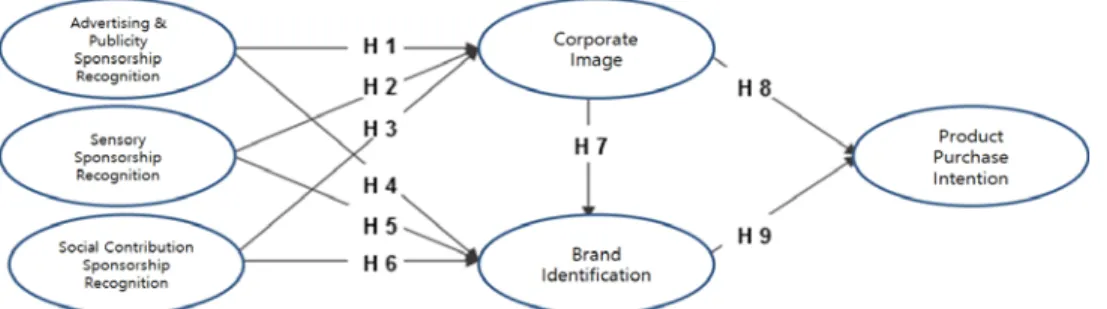
H1: Recognition of advertising and publicity sponsorship will have a positive effect on corporate image.
H2: Recognition of emotional sponsorship will have a positive effect on corporate image.
H3: Recognition of social contribution sponsorship will have a positive effect on corporate image.
2.3. Brand Identification
Identification is one of the variables that explain not only the relationship between individuals and groups, but also the psychological connections between individuals (Lantz & Loeb, 1998) and it is what the individuals feel psychological connection or emotional attachment to a particular object (Mael & Ashforth, 1992; Hogg & Terry, 2000). The basic premise of identification, therefore, is motivated to favorably evaluate oneself through psychological ties to attach or identify with a particular object (Mael & Ashforth, 1992;
Ashforth & Mael, 2000). Identification refers to categorizing themselves in terms of what individuals can share with members in the group, and has a unique point of view that distinguishes them from others. According to Ahn and Lee (2004), identification also shows how people form a sense of unity or identification with the social group or organization to which they belong, and how this identification affects their attitudes and behaviors.
The extent to which sales control systems are aligned with manufacturer goals will be moderated by the extent to which the reseller salesperson identifies with two potentially competing organizational entities: the manufacturer’s brand, which is brand identification and the reseller, which is distributor identification and this relative effort will affect the salesperson’s brand sales performance and overall sales performance (Hughes & Ahearne, 2010). In this study, the dependent variable, product purchase intention, can be led to brand performance and overall sales performance.
Brand identification coincides with the self-image of the consumer and the brand personality, and through identification, consumers feel the evaluation of the brand as if it is their own image (Park et al., 2001; Lee & Ra, 2002).
Shin et al. (2006) states that the consumers want to
express who they are through the brand, and by forming an
identification on the brand with personal characteristics that
match their own image, it leads to a strong crush on the
brand and a willingness to buy the brand continuously.
Therefore, brand identification is a variable that ultimately increases not only the consumer's personal identification with the brand but also with the company. Especially, when a brand fits well with the consumer image, it is identified with the brand and brand loyalty is high. Also, sports consumers and fans express their interests or psychological needs through sports, sports teams, and athletes. The higher the degree of brand identification, the higher the brand value.
Consumers feel the feelings of joy and love through this attitude attachment, and brand reputation and differentiation have a beneficial effect on brand identification (Keller, 2001).
Lee and Ra (2002) argued that consumers have an attachment and affinity for brands with high brand identification, and they are more likely to continue purchasing their product and show brand loyalty. Bhattacharya and Sen (2003) stated that brand identification is related to consumer behavior, so that the higher the brand identification of the corporate brand, the more likely it is to continuously purchase the products and services brands that the company sells, and show high loyalty. Seo et al. (2007) examines the relationship between corporate image, consumer and corporate brand identification, and it was verified that the corporate image effects brand identification. Lim and Koo (2012) also found that corporate image influences brand identification. Choi et al. (2017) also suggests that the character identification and emotional response to characters affected the purchase intention positively.
Based on these preceding, the following hypothesis were set to examine the effects of sports sponsorship recognition on brand identification and the relationship between corporate image and brand identification.
H4: Recognition of advertising and publicity sponsorship will have a positive effect on brand identification.
H5: Recognition of emotional sponsorship will have a positive effect on brand identification.
H6: Recognition of social contribution sponsorship will have a positive effect on brand identification.
H7: Corporate image will have a positive effect on brand identification.
2.4. Product Purchase Intention
The behavior of an individual is directly influenced by the degree of his intention to carry out the action, and the product purchase intention, which is a mediating variable between attitude and behavior, is a direct factor in determining the purchase behavior, which is a prediction of actual purchase behavior (Fishbein & Ajzen, 1980). Also the brand values perceived by consumers can be important information factors in creating positive perceptions and behaviors of these brand experiences which influences brand purchase intentions (Bae et al., 2019).
In general, consumers form expectations for product performance before purchase, so the pre-purchase intention
is influenced by pre-purchase attitudes and is shaped by pre-purchase expectations (Lee et al., 2004). Petty and Cacioppo (1981) also states that a favorable attitude toward the product attributes leads to a higher purchase intention, resulting in a higher likelihood of action. When a company with image of ethical management concerning public service activities gave consumers good images to let consumers have favorable attitude on the product of the company to improve brand images and to have consistent buying behavior of consumers (Su et al., 2014).
A strong intention to purchase does not necessarily mean that the user is likely to buy, but human behavior is controlled by consciousness and influenced by many other factors. Therefore, as a strategy that induces purchase behavior by increasing consumer's purchase intention in marketing, it should provide attractive and meaningful social identities to consumers and seek identification with companies (Ahn & Lee, 2004). The strongest corporate- consumer relationship occurs when consumers seek identification with companies that help them meet their desire to define self. Corporate-consumer identification is voluntary, active, and optional, which leads to a participation in positive business-related behavior (Dutton et al., 1994).
Bhattacharya et al. (1995) stated that the degree of identification with a company is closely related to the ongoing purchase of the product or service and that there is a positive relationship between familiarity and identification.
Ahn et al. (2004) found that consumer-company identification increases as the company's reputation, company's reliability, and company's familiarity with the consumer increases. It is also said that the trust is increased and the favorable attitude toward the enterprise product is made. Therefore, consumers who have a positive attitude toward the sponsor company are more likely to purchase the sponsor company's brand (Mazodier & Merunka, 2012). Seo et al. (2007) and Lim et al. (2012) also analyzed the relationship between brand identification and product purchase intention, which states that the higher the brand identification, the higher the product purchase intention.
Based on these preceding, the following hypothesis were set.
H8: Corporate image will have a positive effect on product purchase intention.
H9: Brand identification will have a positive effect on product purchase intention.
3. Methodology 3.1. Research Model
This study was designed to verify the effects of sports
sponsorship activities on corporate image, brand identification
and product purchase intention. In <Figure 1>, the research
model, sets sports sponsorship recognition as independent variables, corporate image and brand identification as param- eters, and product purchase intention as outcome variables.
3.2. Metrics in Variables
In this study, to verify the proposed research model, the factors and questionnaires of previous studies were referred to and modified according to the research purpose. <Table 1> shows the measurement of the research model that was used in this study.
3.3. Data Collection
Data collection was conducted by trained interviewees for 320 students, including university students, graduate students, and office workers in Jeju region. The data was collected for 1 month from November 15, 2018 to December 14, 2018 and gifts were distributed to improve the quality of the response. After discarding the uncandid data, total of 305 da- ta was used in the analysis. Statistic program SPSS 18.0 and AMOS 20 were used to carry out the study. <Table 2>
shows the demographic characteristics of the collected data.
Figure 1: Research Model
Table 1: Measurement of the Research Model
Variables Items Reference
Advertising &
Publicity Sponsorship Recognition
Participation in sports sponsorship is a corporate advertising activity.
Winter(1986), Kim and Lee(2005) Corporate sports sponsorship Helps to strengthen corporate image.
Participation in sports sponsorship has a corporate promotional effect.
Advertising effect can be obtained by participating in sports sponsorship.
Participation in sports sponsorships can increase exposure to companies and product brands.
Emotional Sponsorship Recognition
Corporate products that participate in the company's sports sponsorship are friendly.
Corporate participation in sports sponsorship gives trust.
A good reputation can be gained by participating in sports sponsorships.
Corporate participation in sports sponsorships gives the public a good image.
Social Contribution Sponsorship Recognition
Corporate participation in sports sponsorships contributes to the successful hosting of sporting events.
Corporate participation in sports sponsorships contributes to sports development.
Corporate participation in sports sponsorships affects sporting events.
Corporate Image
The company offers good quality products.
Keller(2001), Kim and Jeong(2017) The company provides a good service.
The company invests in technology development.
Brand Identification
The company's product brand fits my personality.
Lantz and Loeb(1998), Han et al.(1999), Lee and Ra(2002) The company's product brand fits my lifestyle.
The company's product brand fits my value.
The company's product brand fits my image.
Product Purchase Intention
I will consider purchasing this company's products.
Seo et al.(2007), Dees et al.(2010) I intend to continue to buy this company's products.
I am willing to buy this company's products over other competitors.
Table 2: Demographic Characteristics
Number Rate (%)
Age 20 ~ 29 215 70.5
30 ~ 39 58 19.0
Over 40 32 10.5
Gender Male 153 50.2
Female 152 49.8
Occupation
Students 191 62.6
Clerical/service industry 64 21.0
Professional (teacher, doctor, lawyer, etc.) 20 6.6
Self-employed 16 5.2
Other 14 4.6
Monthly Income
Less than ₩1,000,000/month 87 28.5
₩1,000,000 - ₩3,000,000/month 116 38.0
₩3,000,000 - ₩5,000,000/month 48 15.7
More than ₩5,000,000/month 54 17.7
Total 305 100.0
Table 3: Results of Exploratory Factor Analysis
Variables 1 2 3Component Factors4 5 6 Cronbach's Alpha
Brand Identification
.900 -.050 .429 .337 .287 .536
0.935
.881 -.095 .314 .346 .225 .464
.878 -.086 .326 .317 .273 .493
.866 -.043 .478 .338 .297 .513
.842 -.026 .530 .474 .357 .584
.832 .006 .487 .406 .321 .651
Advertising &
Publicity Sponsorship
Recognition
-.089 .868 .235 .288 .329 -.004
0.884
-.027 .858 .242 .310 .410 .123
-.080 .807 .199 .325 .520 .098
.005 .798 .307 .170 .268 -.037
-.004 .786 .137 .273 .428 .064
Corporate Image
.449 .239 .901 .349 .242 .319
0.850
.509 .302 .844 .379 .430 .376
.445 .183 .777 .409 .377 .440
.248 .175 .777 .212 .271 .407
Emotional Sponsorship Recognition
.365 .175 .234 .843 .423 .249
0.847
.400 .224 .373 .836 .517 .411
.311 .275 .415 .832 .433 .256
.268 .414 .265 .792 .419 .256
Social Sponsorship Recognition
.186 .458 .254 .391 .817 .159
0.773
.261 .456 .340 .403 .781 .334
.185 .459 .283 .477 .761 .077
.373 .109 .314 .419 .709 .419
Product Purchase Intention
.601 .008 .445 .320 .296 .917
0.880
.605 .092 .513 .370 .281 .878
.710 .018 .360 .341 .385 .824
Total dispersion(%) = 72.613%, Kaiser-Meyer-Olkin Measures of Standardization Adequacy = 0.880 Bartlett's spherical test(App. chi square = 5526.101, df = 325, p=0.000)
4. Results
4.1. Reliability and Validity
Exploratory factor analysis and reliability analysis were performed to secure the validity and reliability of the analysis tools that make up the variables used in this study. For
construct validity of measurements, exploratory factor analy- sis was conducted because the variables were composed of multiple items.
First of all, the value of more than 0.9 in KMO (Kaiser-Meyer-Olkin) value is considered very good, and 0.8
~0.89 is considered as a good value. Bartlett spherical tests
indicate that factor analysis is appropriate when the test val- ue is less than 0.5. Applied to the results of this study, KMO value was 0.886 and Batlett spherical test was found to be appropriate as p=0.000.
Next, the oblique rotation method was used, which is widely used among the rotation methods, and removed the items that were judged to impair the validity, such as be- longing to the group with factor 0.4 or more. Reliability anal- ysis was also performed after refining through exploratory factor analysis. As a result of the analysis, it was found that the reliability values of all variables were all good, and the
results are shown in <Table 3>.
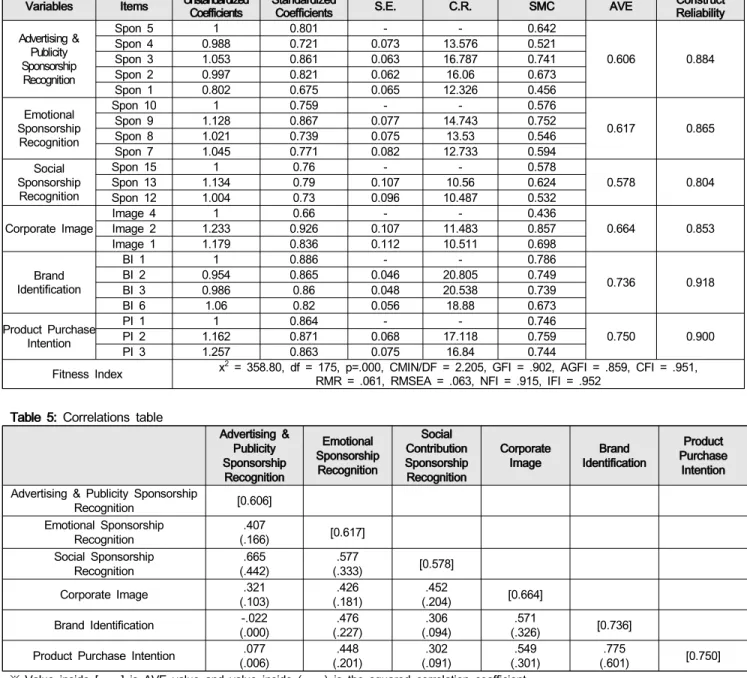
After exploratory factor analysis, confirmatory factor analysis was performed using AMOS20. Measurement tools that inhibit the validity were removed and finally most of the values were verified to be good. The results are shown in <Table 4>.
After the convergent validity test as above, the correla- tion analysis was performed to verify the discriminant val- idity between the constructs, and the discriminant validity was secured in all parts. The results are shown in
<Table 5>.
Table 4: Results of Confirmatory Factor Analysis Variables Items Unstandardized
Coefficients Standardized
Coefficients S.E. C.R. SMC AVE Construct
Reliability Advertising &
Publicity Sponsorship
Recognition
Spon 5 1 0.801 - - 0.642
0.606 0.884
Spon 4 0.988 0.721 0.073 13.576 0.521
Spon 3 1.053 0.861 0.063 16.787 0.741
Spon 2 0.997 0.821 0.062 16.06 0.673
Spon 1 0.802 0.675 0.065 12.326 0.456
Emotional Sponsorship Recognition
Spon 10 1 0.759 - - 0.576
0.617 0.865
Spon 9 1.128 0.867 0.077 14.743 0.752
Spon 8 1.021 0.739 0.075 13.53 0.546
Spon 7 1.045 0.771 0.082 12.733 0.594
Social Sponsorship
Recognition
Spon 15 1 0.76 - - 0.578
0.578 0.804
Spon 13 1.134 0.79 0.107 10.56 0.624
Spon 12 1.004 0.73 0.096 10.487 0.532
Corporate Image Image 4 1 0.66 - - 0.436
0.664 0.853
Image 2 1.233 0.926 0.107 11.483 0.857
Image 1 1.179 0.836 0.112 10.511 0.698
Brand Identification
BI 1 1 0.886 - - 0.786
0.736 0.918
BI 2 0.954 0.865 0.046 20.805 0.749
BI 3 0.986 0.86 0.048 20.538 0.739
BI 6 1.06 0.82 0.056 18.88 0.673
Product Purchase Intention
PI 1 1 0.864 - - 0.746
0.750 0.900
PI 2 1.162 0.871 0.068 17.118 0.759
PI 3 1.257 0.863 0.075 16.84 0.744
Fitness Index x2 = 358.80, df = 175, p=.000, CMIN/DF = 2.205, GFI = .902, AGFI = .859, CFI = .951, RMR = .061, RMSEA = .063, NFI = .915, IFI = .952
Table 5: Correlations table
Advertising &
Publicity Sponsorship
Recognition
Emotional Sponsorship Recognition
Social Contribution Sponsorship Recognition
Corporate
Image Brand
Identification
Product Purchase
Intention Advertising & Publicity Sponsorship
Recognition [0.606]
Emotional Sponsorship
Recognition .407
(.166) [0.617]
Social Sponsorship
Recognition .665
(.442) .577
(.333) [0.578]
Corporate Image .321
(.103) .426
(.181) .452
(.204) [0.664]
Brand Identification -.022
(.000) .476
(.227) .306
(.094) .571
(.326) [0.736]
Product Purchase Intention .077
(.006) .448
(.201) .302
(.091) .549
(.301) .775
(.601) [0.750]
※ Value inside [ ] is AVE value and value inside ( ) is the squared correlation coefficient.
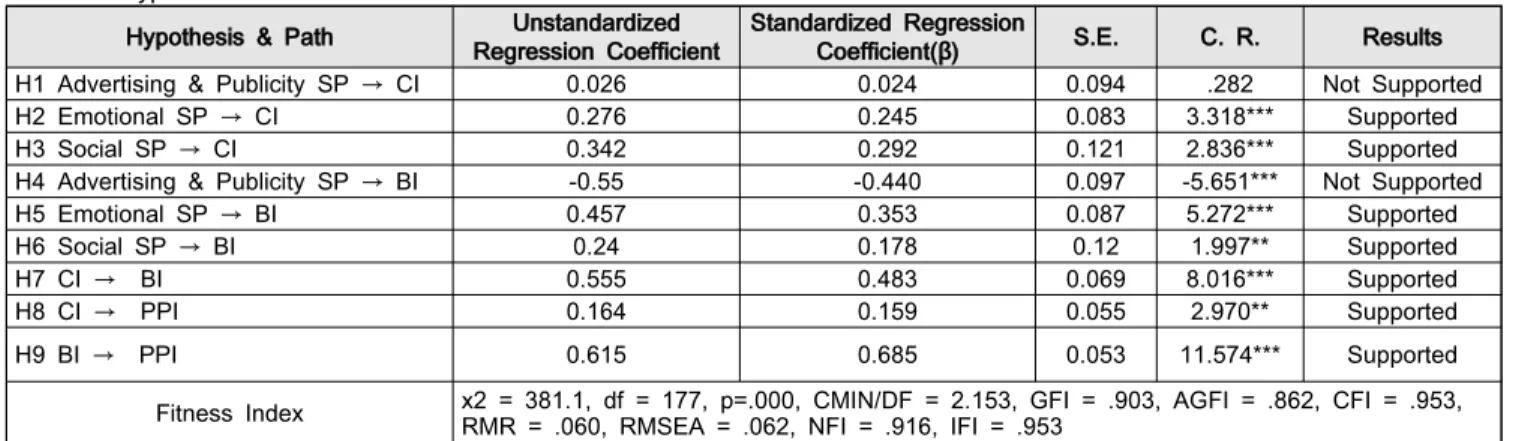
Table 6: Hypothesis Verification
Hypothesis & Path Unstandardized
Regression Coefficient Standardized Regression
Coefficient(β) S.E. C. R. Results
H1 Advertising & Publicity SP → CI 0.026 0.024 0.094 .282 Not Supported
H2 Emotional SP → CI 0.276 0.245 0.083 3.318*** Supported
H3 Social SP → CI 0.342 0.292 0.121 2.836*** Supported
H4 Advertising & Publicity SP → BI -0.55 -0.440 0.097 -5.651*** Not Supported
H5 Emotional SP → BI 0.457 0.353 0.087 5.272*** Supported
H6 Social SP → BI 0.24 0.178 0.12 1.997** Supported
H7 CI → BI 0.555 0.483 0.069 8.016*** Supported
H8 CI → PPI 0.164 0.159 0.055 2.970** Supported
H9 BI → PPI 0.615 0.685 0.053 11.574*** Supported
Fitness Index x2 = 381.1, df = 177, p=.000, CMIN/DF = 2.153, GFI = .903, AGFI = .862, CFI = .953, RMR = .060, RMSEA = .062, NFI = .916, IFI = .953
Note: * ; p < 0.1, ** ; p < 0.05, *** ; p < 0.01