- 46 -
Development of Fermented Acidic Beverage using Wild Grape Juice
Mi Lim Kim and Mi Ae Choi†
Faculty of Herbal Food Cuisine and Nutrition, Daegu Hanny University, Gyeongsan 712-715, Korea
산머루과즙을 이용한 발효산형음료 개발
김미림․최미애†
대구한의대학교 한방식품조리영양학부
Abstract
Wild grape juice was fermented by Gluconacetobacter hansenii TF-2 isolated from tea fungus, to develop a new acidic beverage (fermented wild grape beverage, WGB). Broth was prepared by fermentation of 11~17% (v/v) juice, and sweetened with sucrose (initial sucrose level: 10° Brix). Fermentation was initiated by addition of 5%
(w/v) seed gel (the pellicle of the tea fungus) which had been previously cultured in the same medium (freshjuice broth), and fermentation proceeded in the dark at 29±1℃ for about 15 days. The major acids produced were succinic acid, malic acid, and acetic acid. After 15 days of fermentation, the organic acid content (principally succinic acid) was 49.6 ppm in WGB 11 and 77.4 ppm in WGB 17. The free sugar content of WGB was 1063.6-1082.5 mg/mL, composed of unfermented fructose, glucose, and sucrose, in that order. The microbial inhibitory effects of the fermented beverage were most apparent when Gram-negative bacteria (Escherichia coli and Salmonella typhimurium) were tested; the inhibition rate was 34.46-88.00%. The new fermented beverage thus displays effective antimicrobial activity against some species of bacteria.
Key words:fermented acidic beverage, wild grape juice Gluconacetobacter hansenii, tea fungus 서 론
1)
산머루(wild grape, Vitis coignetiae)는 포도과(科) 포도속 (屬) 식물로 우리나라 고산지대에 야생하는 넝쿨성 목본식 물로 광범위하게 자생한다(1). 머루 생산량은 2001년 30만 kg, 2003년 65만 kg에서 2006년 171만 kg으로 매해 지속적 으로 증가하고 있으나(2), 대부분 머루주스 및 엑기스 상태 로 유통되고 있다. 머루는 일반적으로 안토시아닌의 함량 및 안정성이 높은 것으로 알려져 있으며, 항산화 활성을 가지는 resveratrol 함량이 포도나 거봉에 비해 더 높은 것으 로 알려져 있다(3). 그러나, 강한 산미 때문에 다양한 가공품 개발에 의한 소비가 적다. 산미를 감소시키기 위한 방법으 로 물 또는 당을 혼합하거나 당도가 높은 포도주를 혼합하 는 희석법(4) 등의 화학적 방법과 젖산균 및 효모 등을 이용 한 미생물학적 방법이 이용된다(5-7). 최근 개량머루가 머 루주스와 머루주 등의 원료로 가공식품에 활용되고 있으
†Corresponding author. E-mail:[email protected], Phone:82-53-819-1453, Fax:82-53-819-1494
나, 다양한 기능성이 있을 것으로 기대되는 머루에 관한 연구가 미약한 실정이므로 주스 및 와인 제조를 포함한 다양한 연구가 요구된다.
산형발효음료로 대표적인 것으로 콤부차(kombucha)가 있는데 이는 필리핀, 중국, 독일, 러시아 등에서 당을 첨가한 홍차 추출물을 발효한 전통 건강식품(8-10)으로 acetic acid 를 비롯한 다양한 유기산 생성으로 청량음료 맛이 나며, 배양액 표면에 curd 상의 겔(gel)을 형성한다(10-12). 콤부차 발효에는 홍차 또는 녹차 등의 다류를 이용한 연구(13-15) 가 대부분이며 과즙을 이용한 발효연구는 미비하다. 콤부 차 발효음료는 오랜 기간을 통하여 안전성이 보장된 전통 음료로 현대인의 기호에 맞게 새로운 음료로써 개발이 필 요하다.
따라서 본 연구는 산머루 과즙을 이용하여Gluconacetobacter
hansenii TF-2로 산형발효 후, 발효액의 특성, 유기산과 유
리당의 종류 및 함량을 조사하였으며, 살균을 하지 않고 음용할 경우의 안전성을 확인하기 위해서 식중독균에 대한 항균효과를 검토하였다.
재료 및 방법
실험재료
본 실험에 사용된 재료는 지리산 산머루로 착즙한 산머 루 착즙액(이하 산머루과즙으로 약함)을 부직포와 여과지 (Whatman No 2, Whatman, USA)로 여과하여 -20℃에서 저장하면서 실험 직전에 clean bench 내에서 해동하여 사용 하였다.
발효균
발효균은 Park(16)이 tea fungus로부터 분리한G. hanseniiTF-2 를 분양받아 사용하였다.G. hanseniiTF-2는 산머루과즙에 서 배양하여 활성화시킨 후 사용하였으며, 전 배양과정에 서 사용된 종균으로는 산머루과즙 발효액 표면에 형성된 두께 10 mm 이상의 겔(이하 seed gel로 약함)을 사용하였다.
발효용 배지 및 음료발효
Jeong 등(17) 의 방법에 따라 산머루과즙을 멸균증류수로 6배(과즙 17% 함유), 9배(과즙 11% 함유) 희석하고 시판 백설 탕(제일제당, 한국)을 사용하여 초기당도 10 °Brix로 조정한 과즙배지를 발효병에 80 mL씩 분주하였다. 과즙배지에 seed gel을 5% (w/v) 접종하여 29±1℃에서 정치배양하면서 경과일 수에 따른 발효 특성을 조사하였다. 이때 발효용기로는 시중 유리제품의 음료병을 살균하여 사용하였으며, 발효병 입구는 살균 여과지(Whatman No 2) 2겹으로 봉하였다.
이화학적 조사
pH 및 산도 변화: 발효액은 원심분리(4℃. 7,000 rpm, 15 min)하여 균체를 제거하고 측정에 사용하였다. pH는 pH meter (Mettmer toledo 340, Japan)를 이용하여 발효액 20 mL를 취하여 측정하였으며, 발효액의 총 산 함량은 AOAC법(18)에 따라 삼각 flask에 배양액 10 mL를 취한 다음 bromothymol blue 2방울을 적하한 후 0.1 또는 0.01 N NaOH로 중화적정하여 초산(acetic acid)의 함량으로 환 산하여 %로 표시하였다.
겔 두께 변화
배양액 표면에 생성된 겔의 두께는 눈금자를 이용하여 측정하였으며 mm로 나타내었다.
발효액의 유리당 및 유기산 분석
Gancedodhk와 Luh의 방법(19)에 따라 산머루과즙 배지 를 15일간 배양하면서 5일 간격으로 배양액을 수거하여 원심분리(4℃, 7,000 rpm, 15 min)한 후 상징액을 취하여 분석 시료로 사용하였다. HPLC는 (LC-10AT, Shimadzu, JAPAN)사의 pump, 20 μL의 loop를 가진 injector를 사용하 였다. 유리당은 acetonitrile/water(80/20, v/v%)로 2배 희석
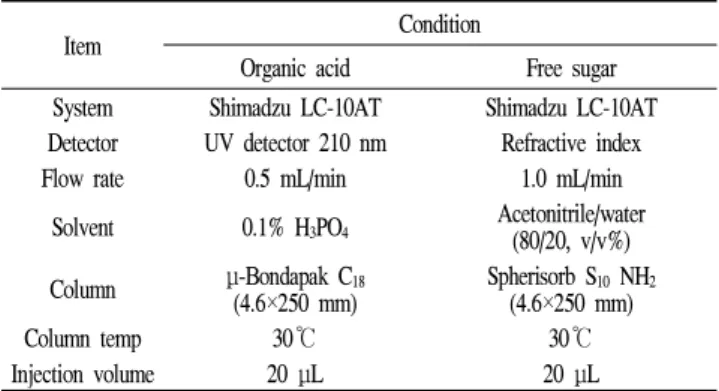
하고 0.45 μm membrane filter로 2회 반복 여과한 다음 다시 SepPak으로 여과하여 분리 정량하였으며, 유기산은 발효액 1 mL를 뚜껑달린 시험관에 취한다음 인산완충용액(0.05 M, pH 2.0)을 가하여 희석하고 0.45 μm membrane filter로 2회 반복 여과한 후 다시 SepPak으로 여과하여 유기산의 종류별 함량을 HPLC로 분리 정량하였다. 유리당과 유기산 분석조건은 Table 1과 같다.
Table 1. Operating conditions of HPLC for quantitative analysis of organic acids and free sugars
Item Condition
Organic acid Free sugar System Shimadzu LC-10AT Shimadzu LC-10AT Detector UV detector 210 nm Refractive index
Flow rate 0.5 mL/min 1.0 mL/min
Solvent 0.1% H3PO4 Acetonitrile/water (80/20, v/v%) Column μ-Bondapak C18
(4.6×250 mm) Spherisorb S10NH2 (4.6×250 mm)
Column temp 30℃ 30℃
Injection volume 20 μL 20 μL
발효음료의 항균효과
Jeong 등(17)의 방법에 따라 항균작용에 사용된 균주는 한국 균주보존협회로부터 분양받았으며 Gram 양성균으로 는Bacillus subtilis(KCTC 1021)와Staphyllococcus aureus (KCTC 1916)를, Gram 음성균으로는 Escherichia coli (ATCC 11105)와Salmonella typhimurium (KCTC 1925)을 사용하였다. 균주 배양용 배지는 nutrient broth (peptone 5 g, beef extract 3 g), micrococcus medium (peptone 5 g, beef extract 1.5 g, glucose 1 g, yeast extract 3 g)를 사용하였다.
9배 희석 산머루과즙의 발효 전(0일째)과 발효 후(15일째) 의 액을 비교하였으며, 여과지(Whatman No 2)로 여과하고 clean bench 내에서 0.45μm membrane filter로 여과하여 제 균한 다음 사용하였다.
생육저지환 시험은 paper disc법으로, 생육저해율 시험은 탁도 측정법으로 실험하였다. 생육저지환에 의한 생육저해 율 시험은 멸균된 petri dish에 배지를 분주하여 24시간 clean bench 안에서 응고시켜 배지 표면의 수분을 제거시키고 균액(104~105cells/mL)을 균일하게 도말하여 5~8시간 후 멸균된 6 mm filter paper disc(Whatman No 2)를 균이 접종된 plate 표면위에 disc를 밀착시키고 각 추출물을 200 ppm 흡수시켜 30℃ 또는 37℃ incubator에서 48시간 배양하여 disc 주위의 clear zone의 직경(mm)을 측정하여 항균효과를 비교하였다. 탁도에 의한 생육저해율 시험은 3회 계대배양 후 활성화시킨 균액 14 mL를 L자형 시험관에 분주하고, 0, 20, 50, 100% 농도로 조정한 발효액을 동일하게 1 mL씩 투여한 후 30℃ 또는 37℃에서 진탕배양 (HB-201SF, Hanback, KOREA) 하면서 광전비색계 (Tokyo coden 7A,
Ikemoto, JAPAN)로 660 nm에서 배양액의 탁도를 측정하였다.
통계처리
모든 데이터는 3회 반복 측정한 후 평균치±표준편차로 나타내었다.
결과 및 고찰
발효특성
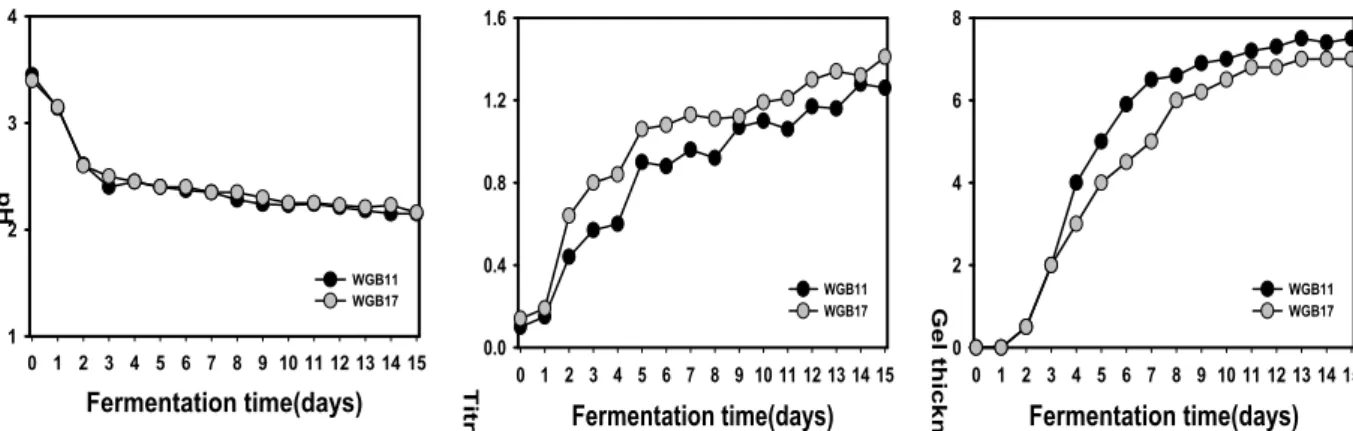
산머루과즙을 이용한 발효액의 발효일수(5일, 10일 및 15일)경과에 따른 경시적 외관변화는 Fig. 1과 같이 발효일 수가 증가함에 따라 배양액 상부에 산형음료에서 전형적으 로 볼 수 있는 피막(→부분)이 생성(17)되어 발효일수가 경 과 할수록 점점 더 두꺼워 짐을 관찰할 수 있었다. 발효배양 액의 발효 경과일에 따른 pH, 산도, 겔 두께 변화를 측정한 결과는 Fig. 2와 같다.
A B C
Fig. 1. Changes in image of fermentation bottle after acidic fermentation by Gluconacetobacter hansenii TF-2.
Gels(→) were produced by static culture of wild grape Juice for 5(A), 10(B) and 15(C) days at 30℃ with inoculation of seed gel.
Fermentation time(days)
0 1 2 3 4 5 6 7 8 9 10 11 12 13 14 15
pH
1 2 3 4
WGB11 WGB17
Fermentation time(days)
0 1 2 3 4 5 6 7 8 9 10 11 12 13 14 15
Titratable acidity(%, acetic acid)
0.0 0.4 0.8 1.2 1.6
WGB11 WGB17
Fermentation time(days)
0 1 2 3 4 5 6 7 8 9 10 11 12 13 14 15
Gel thickness(mm)
0 2 4 6 8
WGB11 WGB17
Fig. 2. Change in pH, total acidity and gel thickness of fermenting beverage during fermentation byG. hanseniiTF-2 at 30℃ incubator for 15th day.
Symbols represent dilution times of the juice: WGB11 (fermentation beverage of the wild grape juice 9 dilution times), WGB17 (fermentation beverage of the wild grape juice 6 dilution times). Values are mean of tree replication.
초기 pH 3.43~3.39에서 배양 1일째부터 감소하기 시작하 여 3일째는 pH가 2.50 이하로 감소하였다. 이후에도 지속 적으로 감소하여 배양 15일째에는 2.09~2.12로 pH가 안 정적으로 감소하는 경향이었다. 산도 변화는 배양 2일째부 터 크게 증가하였고 이후에도 지속적으로 증가하였다. 6배, 9배 희석 산머루과즙 발효액(Wild grape beverage 이하 WGB17, WGB11로 약함)의 산도는 0일째 각각 0.138%, 0.096%이었던 것이 배양 15일째 1.430%, 1.260%로 초기 산 함량에 비하여 약 10~13배 증가하였다. 겔의 두께는 배양 8일째 약 6~6.4 mm로 증가하여 15일째는 7.0~7.5 mm (Fig.
1, C:→부분)로 가장 두껍게 생성되었다. Tea fungus 배양시 Dragoljub 등(20), Jayabalan 등(21) 및 Keshk와 Sameshima(22) 의 보고에 따르면 홍차와 녹차 추출물로 발효한 액의 pH는 3.0~3.5 사이였으며, Jeong(23)의 동충하초 분말 추출물 배양 에서는 2.45~2.58로 pH가 2.5 부근이었다. 감귤착즙액 희석 액으로 발효한 Jeong 등(24)과 감귤농축액 희석액으로 발효 한 Choi 등(25)의 보고에서는 발효 후 pH가 감귤착즙액에서 는 2.8~3.1, 감귤농축액에서는 2.0~3.0 사이로, 본 실험의 산 머루과즙 발효시 pH 2.09~2.12 보다 높아 부재료에 따라 상당한 차이를 나타내었다. 미생물을 이용한 발효를 통하여 신맛이 강한 산머루과즙을 tea fungus 발효 후 특유의 강한 신맛을 감화시키고 신 맛과 단 맛, 신 향과 달콤한 향이 잘 어우러진 산머루 산형음료를 얻을 수 있었다.
발효음료의 유리당 분석
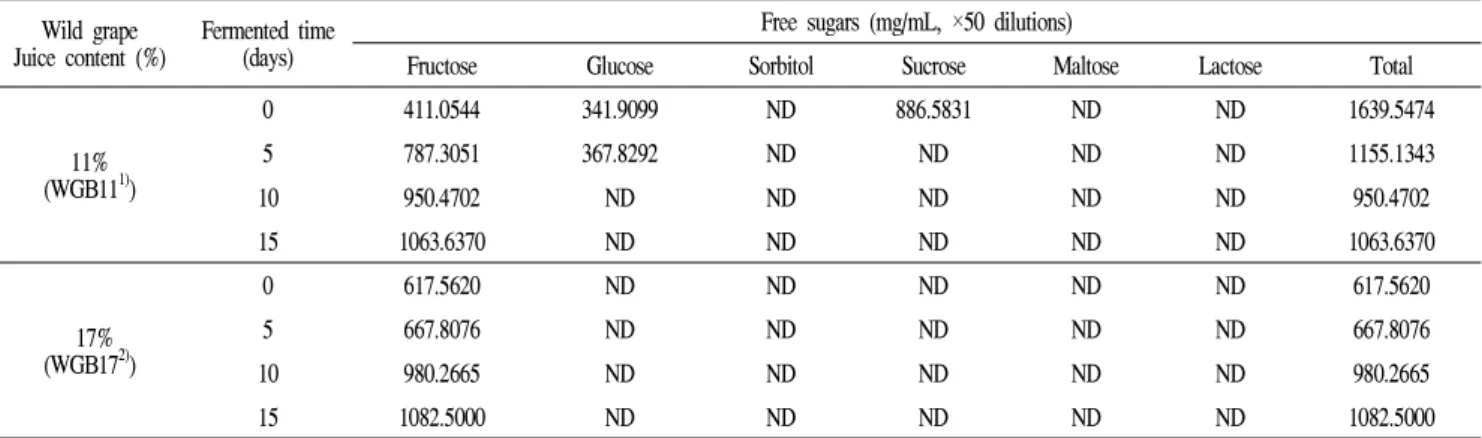
발효액의 유리당 함량 분석 결과는 Table 2 및 Fig. 3과 같으며, 발효특성 조사에 사용된 시료와 동일한 시료로 측 정하였다. 당의 종류로는 fructose, glucose, sorbitol, sucrose, maltose, lactose가 확인되었으며, 발효 전 과정에서 sorbitol, maltose 및 lactose는 검출되지 않았다. 발효 전반에서 fructose가 가장 많이 검출되었으며, 발효과정 중 지속적으
Table 2. Amount of free sugars fermenting beverage before and after fermentation Wild grape
Juice content (%) Fermented time
(days) Free sugars (mg/mL, ×50 dilutions)
Fructose Glucose Sorbitol Sucrose Maltose Lactose Total
(WGB1111%1))
0 411.0544 341.9099 ND 886.5831 ND ND 1639.5474
5 787.3051 367.8292 ND ND ND ND 1155.1343
10 950.4702 ND ND ND ND ND 950.4702
15 1063.6370 ND ND ND ND ND 1063.6370
(WGB1717%2))
0 617.5620 ND ND ND ND ND 617.5620
5 667.8076 ND ND ND ND ND 667.8076
10 980.2665 ND ND ND ND ND 980.2665
15 1082.5000 ND ND ND ND ND 1082.5000
1)WGB11: fermentation beverage of the wild grape juice 9 dilution times.
2)WGB17: fermentation beverage of the wild grape juice 6 dilution times.
3)ND: Not detected.
로 증가하였다. 또한, glucose와 sucrose가 초기에 검출되었 으나 발효가 진행되면서 모두 이용되어 전혀 검출되지 않았 다. 0일째 검출되지 않은 당은 발효가 진행되어도 전혀 검출 되지 않아, 감귤과즙을 이용한 연구에서 초기에 검출되지 않았던 fructose, glucose, sorbitol이 발효가 진행되면서 검출 되었다는 Jeong 등(24)의 보고와는 차이를 보였다.
발효음료의 유기산 분석
유기산 분석에 사용된 시료는 발효특성 조사에 사용된 동일한 시료로 측정하였다. 발효액의 유기산 함량 변화는 Table 3 및 Fig. 4와 같으며, WGB11에는 큰 폭의 변화 없이 서서히 증가하여 배양 10일째 가장 높았다가 다시 감소하 여 발효전과 비슷한 수치를 보였다. WGB17은 배양 5일째 증가하여 10일째 가장 높았다가 15일째는 다시 소폭 감소 하였다. Malic acid는 발효 초기에는 비슷한 함량이 검출되 었으나 발효 후기에는 전혀 검출되지 않아 발효후기에 이용 되는 것으로 보이며, succinic acid는 발효전반에 다량 검출
Table 3. Amount of organic acids fermenting beverage before and after fermentation Wild grape
Juice content (%) Fermented time
(days) Organic acids (ppm, ×50 dilutions)
Malic acid Acetic acid Citric acid Succinic acid Fumaric acid Total (WGB1111%1))
0 27.6747 ND 9.1644 41.6703 ND 78.5094
5 27.0342 40.6464 ND 20.9720 0.4026 89.0552
10 ND 83.5238 ND 21.3332 ND 104.8570
15 ND 21.1407 8.3244 49.6248 ND 79.0898
(WGB1717%2))
0 48.3020 ND 8.1591 60.4512 0.3390 117.2513
5 45.2636 22.7524 7.9827 63.3762 ND 139.3748
10 49.3452 ND ND 87.3164 ND 136.6616
15 ND ND 9.0162 77.4148 ND 86.4310
1)WGB11: fermentation beverage of the wild grape juice 9 dilution times.
2)WGB17: fermentation beverage of the wild grape juice 6 dilution times.
3)ND: Not detected.
되어 발효되면서 이용 또는 생성되는 것으로 보인다. 감귤 과즙을 이용한 Jeong 등(24)의 결과에서 동일 발효기간을 비교하면, acetic acid가 큰 폭으로 증가하였으며 이후 소폭 증가하여 acetic acid의 총 함량에 있어서는 감귤과즙 발효 액이 산머루과즙 발효액보다 5배 이상 더 높았다. WGB의 유기산 함량 변화는 크지만 전반적인 경향은 증가하였다가 배양 10일 이후에 다시 감소하는 비슷한 경향을 보였다.
Acetic acid bacteria는 초산을 생성하기 위해 gluconic acid 와 ethanol을, 이것은 glucose를 이용한다. Jayabalan 등(21) 은 녹차와 홍차를 이용한 kombucha 발효 연구에서 acetic acid가 주된 유기산으로 발효기간 동안 지속적으로 증가하 여 배양 15일째 가장 높은 함량을 나타내다가 이후 다시 감소하는 것으로 보고하였다. Acetic acid 다음으로는 glucuronic acid가 발효전반에 걸쳐 검출되었다. Lee 등(26)
의G. persimmonis를 이용한 농축 사과배지 발효 연구에서
는 succinic acid와 acetic acid가 크게 증가하는 것으로 보고 하였다. 산머루과즙 발효액에서는 succinic acid와 malic
0 2 0 0 4 0 0 6 0 0 8 0 0 1 0 0 0 1 2 0 0 1 4 0 0 1 6 0 0 1 8 0 0 2 0 0 0
0 5 1 0 1 5 0 5 1 0 1 5
1 1 % ( W G B 1 1 ) 1 7 % ( W G B 1 7 )
Freesugars(mg/mL)
Fructose Glucose Sorbitol Sucrose Maltose Lactose
Fig. 3. Amount of free sugars fermenting beverage before and after fermentation.
WGB11: fermentation beverage of the wild grape juice 9 dilution times.
WGB17: fermentation beverage of the wild grape juice 6 dilution times.
0 20 40 60 80 100 120 140 160 180 200
0 5 10 15 0 5 10 15
11% (WGB11) 17% (WGB17)
Organicacids(ppm)
Malic Acetic Citric Succinic Fumaric
Fig. 4. Amount of organic acids fermenting beverage before and after fermentation.
WGB11: fermentation beverage of the wild grape juice 9 dilution times.
WGB17: fermentation beverage of the wild grape juice 6 dilution times.
acid가 acetic acid 보다 우위를 차지하는 것으로 나타났으 나, Jeong 등(24)의 감귤과즙 발효액에서는 acetic acid와 citric acid가 우위를 차지하여 부재료에 따라 생성되는 유기 산에 상당한 차이를 나타내었다.
발효음료의 항균활성
항균활성 검정 시료의 pH 및 산도는 Table 4와 같이 발효 전 pH 3.39±0.00, 산도 0.14±0.00%에서 발효 15일째는 pH 2.12±0.09, 산도 1.43±0.02%로 pH는 낮아지고 산도는 높아 졌으며, WGB17을 사용하였다.
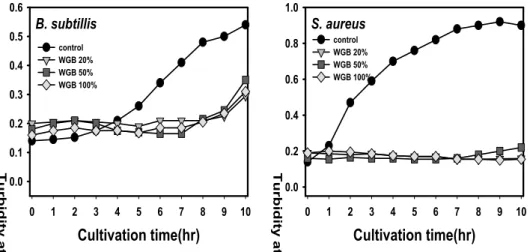
WGB17 발효액의 항균력에는 약간의 차이가 있었으나 검정균 모두에서 증식이 현저히 저해되어 paper disc 주위에 생육저지환을 뚜렷하게 생성하여Sal.typhimurium,E. coli,
S. aureus순으로 저지환이 뚜렷하게 생성되었다. 또한, 증
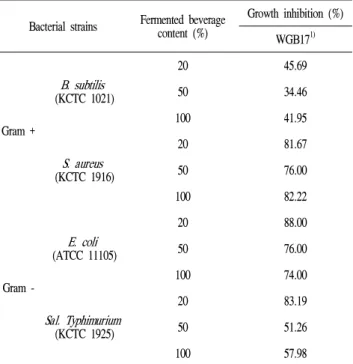
식저해 결과에서도 Fig. 5, 6 및 Table 6에서 보는 바와 같이 그람 양성균인B. subtilis와S. aureus는 발효액의 함량에는 유의적인 차이가 없이 저해되었으며, 그람 음성균인E. coli 와Sal.typhimurium은 발효액의 함량이 증가할수록 오히려
저해능력이 낮아지는 결과로 20% 첨가시 가장 항균효과가 큰 것으로 확인되었다. 그람 양성균, 음성균 모두에서 저해 능력을 갖는 것으로 확인되었으나, 그람 양성균보다 음성 균에 더 효과적이었다.
Table 4. pH and acidity of fermented beverage using antimicrobial activity of wild grape beverage
Beverage Chemical Fermented time (days)
0 15
WGB171) pH 3.39 ± 0.00 2.12 ± 0.09
Titratable acidity (%) 0.14 ± 0.00 1.43 ± 0.02
1)WGB17: fermentation beverage of the wild grape juice 6 dilution times.
Table 5. Diameter of inhibitory zone of food-related bacteria formed by fermented beverage without neutralization.
(unit: mm)
Bacterial strains WGB171)
Gram + B. subtilis 6.0 ± 0.1
S. aureus 7.5 ± 0.2
Gram - E. coli 7.8 ± 0.2
Sal. Typhimurium 8.1 ± 0.3
1)WGB17: fermentation beverage of the wild grape juice 6 dilution times.
Table 6. Changes in inhibition rate of food-related bacteria formed by the addition of fermented beverage.
Bacterial strains Fermented beverage content (%)
Growth inhibition (%) WGB171)
Gram +
B. subtilis (KCTC 1021)
20 45.69
50 34.46
100 41.95
S. aureus (KCTC 1916)
20 81.67
50 76.00
100 82.22
Gram -
E. coli (ATCC 11105)
20 88.00
50 76.00
100 74.00
Sal. Typhimurium (KCTC 1925)
20 83.19
50 51.26
100 57.98
1)WGB17: fermentation beverage of the wild grape juice 6 dilution times.
Cultivation time(hr)
0 1 2 3 4 5 6 7 8 9 10
Turbidity at 660nm
0.0 0.1 0.2 0.3 0.4 0.5 0.6
control WGB 20%
WGB 50%
WGB 100%
B. subtillis
Cultivation time(hr)
0 1 2 3 4 5 6 7 8 9 10
Turbidity at 660nm
0.0 0.2 0.4 0.6 0.8 1.0
control WGB 20%
WGB 50%
WGB 100%
S. aureus
Fig. 5. Comparison of inhibitory effects of fermented beverage on the surival of B. subtilis and S. aureus of gram positive.
WGB: fermentation beverage of the wild grape juice 6 dilution times.
Cultivation time(hr)
0 1 2 3 4 5 6 7 8 9 10
Turbidity at 660nm
0.0 0.2 0.4 0.6 0.8 1.0 1.2
control WGB 20%
WGB 50%
WGB 100%
E. coli
Cultivation time(hr)
0 1 2 3 4 5 6 7 8 9 10
Turbidity at 660nm
0.0 0.1 0.2 0.3 0.4 0.5 0.6 0.7
control WGB 20%
WGB 50%
WGB 100%
S. thypimurium
Fig. 6. Comparison of inhibitory effects of fermented beverage on the surival of E. coliand Sal. Typhimurium of gram negative.
Symbols are -●-: control -□-: WGB1) 20%, -◆-: WGB 50%, -△-: WGB 100%.
1)WGB: fermentation beverage of the wild grape juice 6 dilution times.
요 약
산머루과즙으로 새로운 산형음료 개발을 위해 tea fungus 로부터 분리한G. hanseniiTF-2 균을 이용하여 발효하였다.
과즙배지는 11~17%(v/v)의 산머루과즙에 초기 당도를 10
°Brix로 조정하였다. G. hanseniiTF-2에 의한 발효는 과즙 배지에 활성화시킨 seed gel의 5%(w/v)를 첨가하여 29±1℃
에서 15일 동안 배양하였다. 발효동안 발효 액 표면에 막을 생성시키고 산(acids)을 생성하였다. 산머루과즙 발효액의 유기산은 succinic acid와 malic acid가 acetic acid 보다 우위 를 차지하였으며, 발효 15일째 측정에 의하면 WGB의 succinic acid는 WGB11이 49.6 ppm, WGB17은 77.4 ppm이 검출되었다. 배양기간 동안 WGB의 유리당은 fructose,
glucose, sucrose가 확인되었으며, 발효 15일째에는 fructose 만이 1063.6~1082.5 mg/mL 검출되었다. 발효음료의 음용 시 식중독 유발균에 대해 WGB17이 34.46~88.00%의 저해 율을 나타내었으며 그람 양성균보다는 음성균에서 더 효과 적인 것으로 나타났다.
참고문헌
1. Lee BS (1999) Vitis coignetiae Pulliat ex Planch views and cultivation techniques. Korea Forest Service, 398,
97-101
2. National Statistical Office (www.nso.go.kr) (2006) Statistics of forest products yield
3. Choi SY, Cho HS, Sung NJ (2006) The antioxidative and nitrite scavenging ability of solvent extracts from wild grape(Vitis Conignetiea) skin. J Korean Soc Food Sci Nutr, 35, 961-966
4. Koh KH, Chang WY (1998) Changes of chemical components duringSeibel white grape must fermentation by different yeast strains. Korean J Food Sci Technol, 30, 487-493
5. Webb AD (1974) In Chemistry of Winemaking, American Chem. Society, Washington DC, p 107 6. Hariantono J, Yokota S, Tomita F (1991) Ethanol
production form raw starch by simultaneous fermentation using Schizosaccharomyces pombe and a raw starch saccharifying enzyme from Corticium rolfsii. J Ferment Bioeng, 71, 367-371
7. Kim SH (2008) Optimal condition for deacidification fermentation of wild grape wine by mixed culture. J Korean Soc Appl Biol Chem, 51, 17-23
8. Bartholomew A, Bartholomew M (1998) Kombucha tea for your health and healing. Access Publishers Network MI, p 13
9. Sievers M, Lanini C, Wever A, Schuler-Schmid U, Teuber M (1995) Microbiology and fermentation balance in a kombucha beverage obtained from a tea fungus fermentation. System Appl Microbiol, 18, 590 10. Dufresne C, Farnworth E (2000) Tea, Kombucha, and
health.: A review. Food Research International, 33, 409-421
11. Reiss J (1987) The tea fungus and its metabolic products.
Dusch Lebensm Rdsch, 83, 286-290
12. Reiss J (1994) Influence of different sugars on the metabolism of the tea fungus. Z Lebensm Onters Forsch, 198, 228-261
13. Lee SP, Kim CS (2000) Characterization of kombucha beverage fermented with various teas and tea fungus.
J Food Sci Nutr, 5, 165-169
14. Greenwalt CJ, Steinkraus KH, Ledford RA (2000) Kombucha, the fermented tea: Microbiology, composition, and claimed health effects. J Food Protec, 63, 976-981
15. Sreeraulu G, Zhu Y, Knol W (2000) Kombucha
fermentation and its antimicrobial activity. J Agric Food Chem, 48, 2589-2594
16. Park EJ (2002) Isolation of pellicle producing bacterium in fermentation system by tea fungus and establishment of the optimum composition for gel production. MS Thesis, Catholic University of Daegu
17. Jeong JS, Kim SH, Kim ML, Choi KH (2008) Acidic beverage fermentation using citrus juice and antimicrobial activity of the fermented beverage. J Korean Soc Food Sci Nutr, 37, 1037-1043
18. AOAC (1980) Official methods of analysis. 13th ed.
Association ofOfficial Analytical Chemists, Washington DC. 180
19. Gancedo MC, Luh BS (1986) HPLC analysis of organic acids and sugar in tomato juice. J food Sci, 51, 571-580 20. Dragoljub C, Sinisa M., Mirjana D, Dragisa S, Aleksandra V (2008) Specific interfacial area as a key variable in scaling-up kombucha fermentation. J Food Eng, 85, 387-392
21. Jayabalan R, Marimuthu S, Swaminathan K (2007) Changes in content of organic acid and tea polyphenols during kombucha tea fermentation. Food Chem 102, 392-398
22. Keshk S, Sameshima K (2006) Influence of lignosulfonate on crystal structure and productivity of bacterial cellulose in a static culture. Enzyme and Microbial Tech. 40, 4-8
23. Jeong JS (2001) Acidic beverage fermentation by tea fungus and anti-microbial activity of the fermented beverage. graduate school, MS Thesis, Catholic University of Daegu
24. Jeong JS, Kim SH, Kim ML, Choi KH (2008) Acidic beverage fermentation using citrus juice and antimicrobial activity of the fermented beverage. Korean J Food Cookery Sci, 24, 174-181
25. Choi KH, Jeong JS, Moon CH, Kim ML (2004) Effect of carbon source supplement on the gel production from citrus juice by Gluconacetobacter hansenii TL-2C. J Korean Soc Food Sci Nutr, 33, 170-175
26. Lee OS, Jang SY, Jeong YJ (2003) Effect of ethanol on the production of cellulose and acetic acid by Gluconacetobacter persimmonis KJ145. J Korean Soc Food Sci Nutr, 32, 181-184
(접수 2010년 9월 20일, 수정 2011년 1월 26일 채택 2011년 1월 28일)