Journal of Trauma and Injury Vol. 28, No. 1, March, 2015
� Address for Correspondence : Sun Pyo Kim, M.D.
Department of Emergency Medicine, Chosun University Medical School, 365 pilmun-daero, Dong-Gu, Gwangju, Repulic of Korea
Tel : 82-62-220-3285, Fax : 82-62-224-3501, E-mail : [email protected]
Submitted : October 8, 2014 Revised : January 2, 2015 Accepted : January 6, 2015
The present study was supported by grants from the Clinical Medicine Research Institute at Chosun University Hospital (2012).
다발성 외상 환자에서 Emergency Room Transfusion Score (ETS)를 이용한 응급수혈의 예측인자
조선대학교병원 응급의학과
조현규, 박용진, 김선표, 김성중, 조수형, 조남수
- Abstract -
Factors for Predicting the Need for an Emergency Blood Transfusion to a Multiple Trauma Patient Using Emergency Room Transfusion Score (ETS)
Hyeon Kyu Jo, M.D., Yong Jin Park, M.D., Sun Pyo Kim, M.D., Seong Jung Kim, M.D., Soo Hyung Cho, M.D., Nam Soo Cho, M.D.
Department of Emergency Medicine, College of Medicine, Chosun University, Gwangju, Korea
Purpose: The purposes of this study are finding the elements for a fast determination of the need for a transfusion to
a multiple trauma patient arriving at this clinic in the initial stage establishing objective bases for a doctor in an emer- gency department to determine the need for a transfusion immediately after a patient has arrived at the emergency department, and providing treatment by considering various factors based on the nine criteria suggested in the emer- gency room transfusion score (ETS).Methods: This study was conducted on 375 multiple-trauma patients who visited the Chosun University Hospital
Emergency Medical Center and activated the Emergency Trauma Team from January 2010 to December 2013. The patients were divided into the transfused group and the non-transfused group by retrospectively analyzing their medical records. Subsequently, the medical records were examined using the nine items suggested by the ETS and the results were analyzed.Results: Three hundred seventy-five patients with multiple traumas visited the Chosun University Hospital
Emergency Medical Center and activated the Emergency Trauma Team. Among them, 258 died and 117 recovered and left the hospital. The deceased patients consisted of 182 males and 76 females with an average age 45. Of the 375, 165 were transferred from other hospitals, and 245 were blunt trauma patients.One hundred sixty-nine patients were injured in traffic accidents, and 119 of those 169 who had systolic blood pres- sure less than 90 mm Hg died. Two hundred twenty-six (60.3%) out of the 375 patients with multiple traumas received
I. 서 론
다발성 외상 환자 사망 원인 중 가장 흔한 원인은 저혈량 성 쇼크이다. 실혈로 인해 혈액학적으로 불안정한 환자는 응 급의료센터에서 초기에 수혈이 필요하다. 그러나 오직 검사 실 소견 등에 의해 진단된 저혈량성 쇼크에서만 수혈이 이뤄 지는 경우 환자의 내원에서 혈액제제의 처방과 수혈이 시행 되기까지 지연이 야기되고 그로 인해 많은 합병증이 발생한 다. 하지만 한편으로는 실혈이 의심되는 환자에게 무분별하 게 혈액제제를 처방하는 것은 경제적으로 비효율적이며 혈액 제제의 폐기가 발생한다.
이에 저자는 본원에 내원한 다발성 외상 환자를 대상으로 초기에 수혈을 빨리 결정할 수 있는 요소를 찾기 위해 수혈 에 대한 9가지 기준을 설정하여 응급의학과 의사가 환자의 초기 진료 후 수혈을 결정 할 수 있는 객관적 근거를 찾고자 하였고 Emergency Room Transfusion Score를 적용하여 다발성 외상의 초기 치료에서 응급 수혈 예측에 대한 ETS의
진단적 가치를 분석, 비교하고자 본 연구를 진행 하였다.(1,2) II. 대상 및 방법
1. 대상 환자
2010년 1월부터 2013년 12월까지 본원 응급의료센터에 내원한 환자 37,470명 중 본원 응급외상팀 발동 적응증 (Table 1)에 따라 다발성 외상 환자로 인한 응급외상팀을 활 성화 시킨 환자 375명을 대상으로 하였다.
2. 방법
다발성 외상 환자의 의무기록을 후향적으로 분석하여 수혈 을 받은 군과 받지 않는 군으로 나누어 손상 기록지를 작성 후 성별, 연령, 병원 도착 경로, 손상의 타입, 손상 원인, 손 상 종류, 내원시 혈압, 의식상태, 복부 초음파 양상, 골반골
an emergency blood transfusion and their average age was 48. The 375 patients consisted of 156 males, 151 who had been transferred from other hospitals, 218 who presented with blunt trauma, 134 who had been injured in traffic acci- dents, 156 who had a systolic blood pressure less than 90 mm Hg, 134 who scored higher than 9 points on the GCS, and 162 who had a stable pelvic fracture of these 143 died.
Conclusion: During this study, 226 (60.3%) out of the patients with multiple traumas received an emergency blood transfusion. After analyzing the results related to emergency blood transfusion by using ETS, we found that an emer- gency blood transfusion had to be prepared quickly when patients were transferred from other hospitals when the sys- tolic blood pressure was less than 90 mmHg. when abnormalities had been detected by ultrasonography and when the patient presented with a stable pelvic fracture. [ J Trauma Inj 2015; 28: 1-8 ]
Key Words: Multiple trauma, Emergency, Transfusion
Table 1. Multiple trauma activation indication.
01. adult: systolic blood pressure < 90 mmHg (including blood pressure of the scene) 02. adult: heart rate < 50/min or > 120/min
02. child: out of normal range of heart rate
03. less than 6 year old child: systolic blood pressure � 60 mmHg 04. adult: respiratory rate � 10/min or � 30/min
05. airway obstruction, airway injury or intubation condition 06. GCS � 8
07. gunshot or stab wound of head and neck, thorax, back, abdomen, inguinal area 08. hemiplegia, qiadriplegia
09. transfered patient with transfusion 10. passenger died in traffic accident
11. seceded patient out of the car in traffic accident 12. more than 20 minutes for rescuing the patient
13. bike, bicycle, other vehicle: traffic accident over 40 km
14. fall downadult > 6 m, infant > 3 m (more than three times the height)
15. injury by explosion
골절 안정성 유무의 9가지를 이용하여 조사 후 서로 구분하 여 분석 하였다(Table 2).
3. 자료의 통계처리 및 분석 방법
수혈을 받지 않은 군과 수혈을 받은 군은 카이 제곱 검정 을 통해 분석하였으며, 환자군을 비교하여 의미 있는 인자로 수혈 예측 확률, odds ratio 파악을 위해 로지스틱 회귀분석 을 사용하였다. 각 환자당 ETS를 산출하여 ROC curve 통 계기법을 통해 cut off value, sensitivity, specificity를 파악하였다. 통계프로그램으로 IBM SPSS Statistics 22를 사용하였다.
III. 결 과
1. 응급 수혈을 받지 않은 환자의 분석
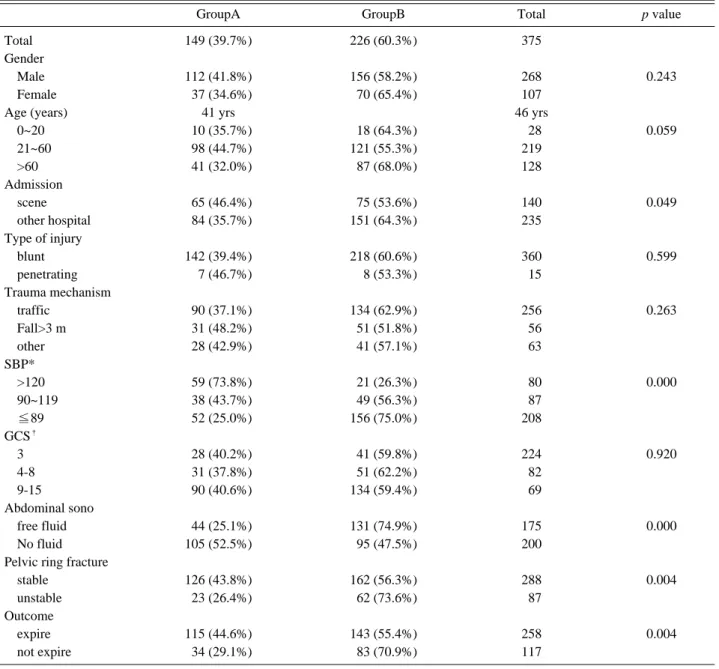
다발성 외상 환자 중에서 수혈을 받지 않은 환자는 149명 (39.7%)이었으며 남자가 112명이고 평균 연령은 41세다. 병 원에서 전원된 환자가 84명, 둔상 환자가 142명, 교통사고가 90명, 9점 이상의 GCS를 가진 환자가 90명으로 나타났고 복부 초음파에서 105명이 복부에 혈류가 보이지 않는 소견을 보였고 골반골 골절은 126명이 안정된 골절이었다(Table 3).
2. 응급 수혈을 받은 환자에 대한 분석
다발성 외상 환자 중 226명(60.3%)가 응급수혈을 받았는 데 평균 연령이 48세, 남자가 156명이었고 병원에서 전원된 환자가 151명, 둔상 환자 218명, 교통사고 환자가 134명이었 다. 내원시 90미만의 수축기 혈압의 환자가 156명, 90에서 119사이의 수축기 혈압 환자가 49명이었고 9점 이상의 GCS 를 가진 환자가 134명이었다. 복강내 초음파상 free fluid가 있는 환자가 131명, 안정한 골반골 골절을 가지고 있는 환자 가 162명이었으며 사망한 환자가 143명으로 나타났다.
수혈의 예측 변수를 가지고 단변량 분석을 시행하였으며 type of admission (p=0.049), 내원시 수축기 혈압
(p=0.000; SBP 90 mmHg 미만, p=0.000; sBP 90 mmHg 이상 120 mmHg 미만), 복강내 초음파상 free fluid 유무(0.000), unstable pelvic b.fx.의 유무(0.004) 가 의미있는 차이를 보이는 것으로 나타났다(Table 3).단변량 분석에서 의미있는 인자로 시행한 다변량 분석상 SBP 90 mmHg 미만(p=0.000 Exp (B)=8.556), sBP 90 mmHg 이상 120 mmHg 미만(p=0.000 Exp (B)=3.367), 복강내 초음파상 free fluid 유무(p=0.000 Exp (B)=2.703) 가 의미있는 차이를 보이는 것으로 나타났다(Table 4).
3. ETS의 민감도, 특이도, 양성예측도, 음성예측도
1) The emergency transfusion score (ETS)
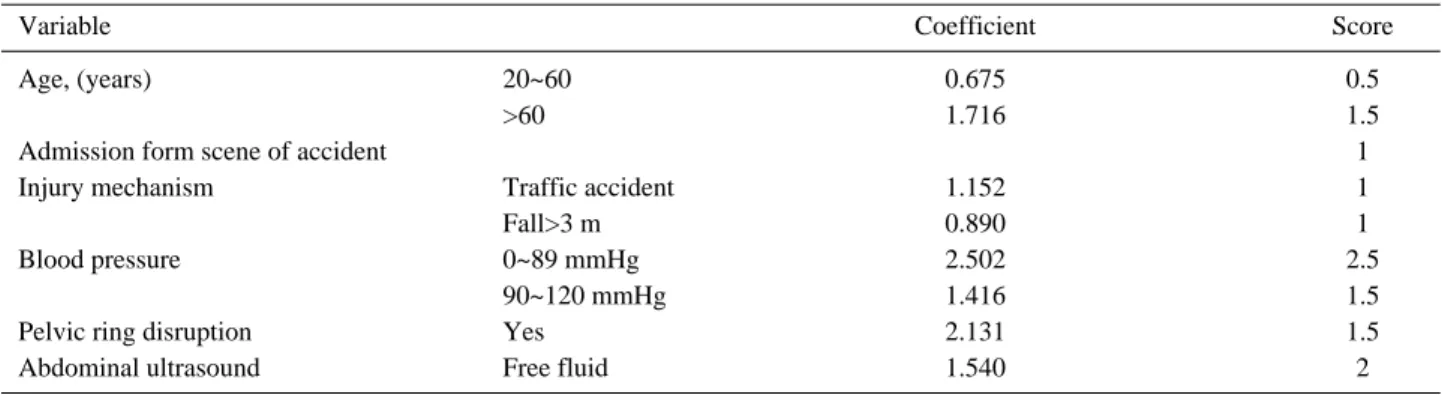
Ruchholtz 등(1)이 외상센터에 내원한 환자들을 대상으로 연구하여 수혈을 예측하는 인자를 정리하고 점수화하여 ETS를 개발하였다. ETS에 포함되는 각각의 인자는 Logistic regression analysis로 분석하였고 인자의 coef- ficients에 따라 다른 점수를 가진다(Table 5). ETS 1점에서 수혈 가능성 0.7%, 3점에서 5%, 9.5점에서 97%로서 기하급 수적으로 수혈의 가능성이 증가한다(Table 6).
환자에게서 ETS를 산출하여 ROC curve를 구하였고 이 에 따라 민감도, 특이도, 양성예측도, 음성예측도를 구하였 다(Fig. 1).
∴ cut-off value : ETS 3
민감도는 0.951, 특이도는 0.268, 양성예측도는 0.664, 음성예측도는 0.784이다.
∴ cut-off value : ETS 4
민감도는 0.863, 특이도는 0.423, 양성예측도는 0.694, 음성예측도는 0.670이다.
4. 전체 환자 중 사망에 대한 분석
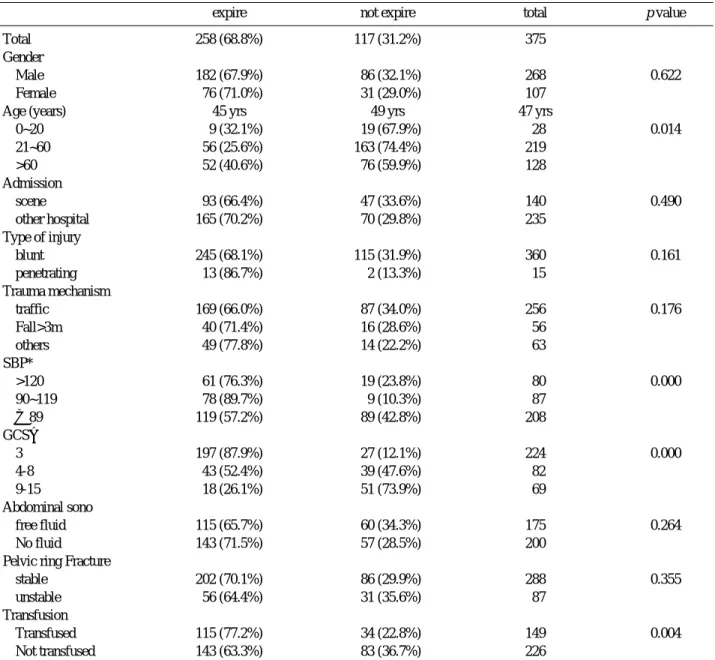
375명의 다발성 외상 환자가 내원하였고 본원 응급외상팀 을 활성화 시켰으며 258명(68.8%)이 사망하였고 117명 (31.2%)이 정상 퇴원하였다.
사망한 환자 중 남자 182명, 여자 76명, 평균 연령은 45세 이었으며 병원에서 이송된 환자가 165명이었고 둔상 환자가 245명으로 많았다.
손상의 원인은 교통사고가 169명으로 많았고, 수축기 혈압 은 90미만으로 측정된 환자가 119명으로 많았다. 3의 GCS 를 가진 환자가 119명, 내원과 동시에 시행한 초음파에서 복 부에 혈류가 보이지 않는 환자에서 143명 사망하였다. 골반 골 골절이 있는 환자에서 안정형 골절이 있는 환자가 202명 사망하였고 수혈을 받은 환자가 115명 사망하였고 수혈을 받 지 않은 환자가 143명 사망하였다.
사망군과 생존군으로 구분하여 단변량 분석을 시행하였으 며 나이(p=0.014), 내원시 수축기혈압(p=0.000), GCS (p=0.000), transfusion 유무(p=0.004)가 의미있는 차이 를 보이는 것으로 나타났다(Table 7).
IV. 고 찰
우리나라도 권역 외상센터가 생기고 닥터 헬기가 운영되고 있으면서 다발성 외상 환자에 대한 관심이 많아지고 예방가 능사망률을 낮출 수 있도록 노력하고 있다. 응급의료센터에
Table 2. Parameters with possible predictive value on red blood cell transfusion.
1 Gender
2 Age
3 Admission from scene or from another hospital 4 Type of injury Blunt or penetrating
5 Trauma mechanism
Car/truck, motor cyclist, pedestrian, fall from a height of less or more than 3 m, Fall from stairs, fall from a horse, gunshots, burns 6 Systolic blood pressure on admission
7 Initial Glasgow Coma Scale (GCS) on admission
Alternatively GCS on scene in patients arriving intubated in the Emergency Room 8 Abdominal ultrasound
9 Stability of the pelvic ring
Table 3. Univariate analysis of non-transfused (Group A) and transfused patients (Group B).
GroupA GroupB Total p value
Total 149 (39.7%) 226 (60.3%) 375
Gender
Male 112 (41.8%) 156 (58.2%) 268 0.243
Female 037 (34.6%) 070 (65.4%) 107
Age (years) 41 yrs 46 yrs
0~20 010 (35.7%) 018 (64.3%) 028 0.059
21~60 098 (44.7%) 121 (55.3%) 219
>60 041 (32.0%) 087 (68.0%) 128
Admission
scene 065 (46.4%) 075 (53.6%) 140 0.049
other hospital 084 (35.7%) 151 (64.3%) 235
Type of injury
blunt 142 (39.4%) 218 (60.6%) 360 0.599
penetrating 007 (46.7%) 008 (53.3%) 015
Trauma mechanism
traffic 090 (37.1%) 134 (62.9%) 256 0.263
Fall>3 m 031 (48.2%) 051 (51.8%) 056
other 028 (42.9%) 041 (57.1%) 063
SBP*
>120 059 (73.8%) 021 (26.3%) 080 0.000
90~119 038 (43.7%) 049 (56.3%) 087
�89 052 (25.0%) 156 (75.0%) 208
GCS
�3 028 (40.2%) 041 (59.8%) 224 0.920
4-8 031 (37.8%) 051 (62.2%) 082
9-15 090 (40.6%) 134 (59.4%) 069
Abdominal sono
free fluid 044 (25.1%) 131 (74.9%) 175 0.000
No fluid 105 (52.5%) 095 (47.5%) 200
Pelvic ring fracture
stable 126 (43.8%) 162 (56.3%) 288 0.004
unstable 023 (26.4%) 062 (73.6%) 087
Outcome
expire 115 (44.6%) 143 (55.4%) 258 0.004
not expire 034 (29.1%) 083 (70.9%) 117
* SBP: systolic blood pressure
�
GCS: glasgow coma scale
서 다발성 외상 환자 진료 시 초반 생체징후가 안정되어 있 다고 하지만 갑작스런 여러 요인에 의해 불안정화 되어 환자 가 사망할 수 있다. 환자의 사망 원인 중 가장 많은 원인이 저혈량성 쇼크이다. 저혈량성 쇼크는 예측하기 아주 어려운 인자로서 초기에 판단하던 것보다 더 빠르게 쇼크에 빠지게 되어서 급히 수혈을 하게 하는 경우가 적지 않다. 이러한 외 상환자 내원 시 저혈량성 쇼크에 빠지기 전에 수혈을 예측하 여 혈액을 미리 처방한다면 수혈까지의 시간을 단축하게 됨 으로써 보다 신속하고 효율적으로 응급상황에 처하여 환자의 좋은 예후를 예측할 수 있다.(3-5) 계속되는 실혈 및 외상성 응고병증으로 출혈성 저혈량성 쇼크의 위험에 처해있는 중증 외상환자를 치료할 때, 신속하고 적절한 수혈의 결정과 이어 지는 빠른 수술적 처치는 환자의 예후와 직접 연관 된다.(6,7) 응급수혈을 예측하는 인자로 여러 가지가 연구되어지고 있 Table 4. Coefficient of different risk factor for blood transfusion.
regression
SE* p Exp (B) 95%C.I.
�for Exp (B)
coefficient Lower Upper
Total Admission other hospital
scene 0.417 0.247 0.092 0.659 0.406 01.070
SBP
�>120
90~119 1.214 0.348 0.000 3.367 1.701 06.662
�89 2.095 0.314 0.000 8.128 4.389 15.055
Abdominal sono
free fluid 0.995 0.248 0.000 2.703 1.663 04.395
Pelvic ring fracture
stable 0.305
unstable 0.469 0.124 1.599 0.879 02.907
* SE: standard error
�
CI: confidence interval
�
SBP: systolic blood pressure
Table 5. Emergency transfusion score (ETS).
Variable Coefficient Score
Age, (years) 20~60 0.675 0.5
>60 1.716 1.5
Admission form scene of accident 1
Injury mechanism Traffic accident 1.152 1
Fall>3 m 0.890 1
Blood pressure 0~89 mmHg 2.502 2.5
90~120 mmHg 1.416 1.5
Pelvic ring disruption Yes 2.131 1.5
Abdominal ultrasound Free fluid 1.540 2
Table 6. Probability of red blood cell transfusion in the emer- gency room depending on the summarized scores.
Total score Probability of emergency room transfusion (%)
0 0.2
1 0.7
2 02
2.5 2.9
3 05
4 12
5 27
6 50
7 73
9.5 97
다. 최근 Ruchholtz 등(1)은 독일의 한 외상센터에 내원한 환자들을 대상으로 4년간 전향적으로 연구하여 수혈을 예측 하는 인자를 정리했다. 그들이 개발한 ETS (Emergency room transfusion score)계산에 포함되는 인자 중에서, 내 원 10분 이내 측정한 수축기혈압 90 mmHg 이하가 상관계 수 2.5 (2.5점)로 가장 중요한 인자다. 그 외에 수축기혈압 90~120 mmHg (1.5점), 복부 초음파(FAST; Focused assessment sonography in trauma)에서 복강 내 혈액 의심(2점), 불안정 골반뼈 골절(1.5점), 나이 20~60세(0.5 점), 나이 60세 이상(1.5점), 현장에서 바로 이송(1.0점), 교 통사고(1.0점), 3 m 이상의 추락(1.0점)이 수혈 여부를 결정 하는 인자를 구성하고 있다. 위 연구로 수축기 혈압, 복강 내 출혈, 불안정성 골반 골절, 나이, 현장에서의 직접 이송, 외 상의 원인 등으로 구성된 응급실 수혈 지수(emergency room transfusion score: ETS)를 발표했다.(1,2)
Kuhne 등(2)은 481명의 환자에게 ETS를 적용시킨 결과, 수혈결정시간이 이전보다 빨라졌으며, 민감도 97.5% 특이도 68%로, 임상의가 단독으로 결정했을 때의 민감도 97%, 특 이도 58%보다 좋은 결과임을 밝혔다. ETS 3점을 기준으로 했을 때 음성예측도가 99.7%이어서 초기 불필요한 수혈을 지양할 수 있음을 명시했고 불필요한 수혈을 줄임으로서 경 제적 손실을 줄일 수 있었다. Kuhne의 연구에 따르면 환자 에게 ETS에 따른 수혈 처방으로 평균 56.320 USD 비용이 들었고 응급의료센터의 판단에 따른 수혈 처방으로 평균 70.080 USD 비용이 들었으며 기본으로 10 pack의 농축적 혈구를 처방하였을 경우 평균 153.920 USD 비용이 들었다.
ETS에 따른 처방이 기본으로 10 pack의 농축적혈구를 처방
하였을 때보다 97.600 USD의 비용 절감을 보였다.
Yucel 등(8)은 다발성 둔상환자에서의 대량수혈예측으로 TASH(Trauma associated severe hemorrhage score) 점수를 제시하는 등 아직도 일관된 수혈예측인자에 대해 전 세계 여러 국가에서 연구가 진행되고 있다. ETS 점수를 통 해 수혈이 필요하지 않은 환자를 예측할 수 있으므로 불필요 한 혈액의 처방을 줄여 경제적인 손실을 줄이고 정말 필요한 환자에게 혈액을 사용하지 못하는 폐해를 줄여야한다.(9-11) 외상에서는 출혈과 치료 사이의 간격이 환자마다 다르고, 저혈량성 쇼크, 저체온이 빈번하며 지혈에 대한 모니터링 또 한 늦게 일어난다. 응고, 항응고, 섬유소, 혈소판, 내피 세포 와 같은 지혈의 모든 구성 요소 사이의 균형의 심각한 혼란 을 발생시키며 내인성 응고를 빠르게 진행시키고 심각한 조 직 손상 및 조직의 허혈 관류를 가져온다.(12-14)
수혈은 저혈량성 쇼크의 치료하는 첫 번째 치료이지만, 여 러 합병증 또한 간과해선 안 된다. 특히 대량수혈과 관련하 여 산증, 저체온증, 응고병증은 높은 사망률과 관련이 있다.
그 외 합병증으로 저칼슘혈증, 저마그네슘혈증, 저칼륨 혈 증, 고칼륨혈증과 같은 전해질 이상, 구연산 독성, 수혈 관련 급성 폐 손상이 있다.(15,16) 수혈은 여러 장기 부전, 전신 염 증 반응 증후군, 감염 증가, 사망률 증가의 독립적인 예측 인 자로 확인되었다. 저혈량성 쇼크 환자에서 수혈과 함께 수 술, 중재시술 등 출혈의 확실한 조절이 수혈에 의한 상기의 합병증을 최소화하기 위해 필요하다.(17-19)
응급의료센터에서 다발성 외상 환자의 초기 생체 징후의 안정과 사망률 감소를 위해 빠른 판단에 따른 신속하고 효 율적인 수혈은 매우 중요하다. 초기 혈액 처방은 응급의료센 터의 의사의 신체 검진에 따른 임의적인 판단이 대부분이며 이에 따른 수혈의 지연과 이어 환자의 불량한 예후에 영향을 줄 수 있다.
초기 수축기혈압 120 mmHg 미만의 환자, FAST상 복강 내 혈액이 보이는 환자, 불안정한 골반골 골절을 보이는 환 자에서는 응급수혈이 강력히 예상되므로 초기 혈액의 처방이 필요하다.
본 연구에서 후향적으로 다발성 외상 환자에게 ETS를 적
용하였을때 ETS 3을 기준으로 민감도 0.951, 특이도 0.268
였으며 ETS 4를 기준으로 민감도 0.863, 특이도 0.423이었
다. ETS 3과 ETS 4의 민감도 차이를 고려해보았을때 ETS
3을 응급수혈의 적응증으로 고려해볼 수 있으나 특이도가
0.268로 낮고 음성예측도 또한 0.784로 낮다. ETS는
Ruchholtz의 연구에서 각 인자의 coefficients에 따라 점수
를 매긴 것으로 Ruchholtz의 분석에서 유의한 인자로 판단
된 나이, 내원경로, 사고 기전, 골반골 안정성은 본 연구에서
는 유의하지 않은 것으로 결과가 도출되었으며 수축기혈압,
초음파상 복강 내 혈액 유무의 coefficient 결과 또한 차이가
나기 때문에 진단적 가치는 있으나 완전히 적용하기에는 문
Fig. 1. ROC curve of blood transfusion through ETS.
제가 있으며 그렇기 때문에 본원의 실정에 맞는 새로운 수혈 예측 인자의 개발 또한 추후 연구가 필요하다.
V. 결 론
응급의료센터내에서 응급수혈은 환자의 초기 예후를 결정 하는데 매우 중요하며 응급의학과 의사는 외상 환자에서 응 급수혈과 관련된 요인에 대해 파악하는 것이 필요하다. 응급 수혈에 대한 여러 가지 예측인자가 있으며 ETS는 가장 유용 하게 사용할 수 있는 예측인자 중 하나이다.
응급수혈에 관련된 요인을 분석한 결과 혈압이 90 미만으
로 낮은 환자, 응급초음파에서 이상을 보인 환자, 불안정한 골반골 골절을 가진 환자가 의미 있게 나타났다.
외상 환자에게 ETS를 적용한 결과 ETS 3을 기준으로 민 감도는 0.957, 특이도 0.268 양성예측도는 0.664, 음성예측 도는 0.784이다.
REFERENCES
01) Ruchholtz S, Pehle B, Lewan U, Lefering R, Miller N, Oberbeck R. The emergency room transfusion score (ETS):
prediction of blood transfusion requirement in initial resuscita- tion after severe trauma. Transfus Med 2006; 16: 49-56.
Table 7. Comparison of expire and not expire patients.
expire not expire total p value
Total 258 (68.8%) 117 (31.2%) 375
Gender
Male 182 (67.9%) 086 (32.1%) 268 0.622
Female 076 (71.0%) 031 (29.0%) 107
Age (years) 45 yrs 49 yrs 47 yrs
0~20 009 (32.1%) 019 (67.9%) 028 0.014
21~60 056 (25.6%) 163 (74.4%) 219
>60 052 (40.6%) 076 (59.9%) 128
Admission
scene 093 (66.4%) 047 (33.6%) 140 0.490
other hospital 165 (70.2%) 070 (29.8%) 235
Type of injury
blunt 245 (68.1%) 115 (31.9%) 360 0.161
penetrating 013 (86.7%) 002 (13.3%) 015
Trauma mechanism
traffic 169 (66.0%) 087 (34.0%) 256 0.176
Fall>3m 040 (71.4%) 016 (28.6%) 056
others 049 (77.8%) 014 (22.2%) 063
SBP*
>120 061 (76.3%) 019 (23.8%) 080 0.000
90~119 078 (89.7%) 009 (10.3%) 087
�89 119 (57.2%) 089 (42.8%) 208
GCS�
3 197 (87.9%) 027 (12.1%) 224 0.000
4-8 043 (52.4%) 039 (47.6%) 082
9-15 018 (26.1%) 051 (73.9%) 069
Abdominal sono
free fluid 115 (65.7%) 060 (34.3%) 175 0.264
No fluid 143 (71.5%) 057 (28.5%) 200
Pelvic ring Fracture
stable 202 (70.1%) 086 (29.9%) 288 0.355
unstable 056 (64.4%) 031 (35.6%) 087
Transfusion
Transfused 115 (77.2%) 034 (22.8%) 149 0.004
Not transfused 143 (63.3%) 083 (36.7%) 226
* SBP: systolic blood pressure
�