O R I G I N A L R E S E A R C H Open Access
External validation of multimodal
termination of resuscitation rules for out-of- hospital cardiac arrest patients in the
COVID-19 era
Haewon Jung 1 , Mi Jin Lee 1 , Jae Wan Cho 1 , Sang Hun Lee 2 , Suk Hee Lee 3 , You Ho Mun 4 , Han-sol Chung 1,5 , Yang Hun Kim 6 , Gyun Moo Kim 3 , Sin-youl Park 4 , Jae Cheon Jeon 2 , Changho Kim 1,5* and on behalf of the WinCOVID-19 consortium
Abstract
Background: Futile resuscitation for out-of-hospital cardiac arrest (OHCA) patients in the coronavirus disease (COVID)-19 era can lead to risk of disease transmission and unnecessary transport. Various existing basic or advanced life support (BLS or ALS, respectively) rules for the termination of resuscitation (TOR) have been derived and validated in North America and Asian countries. This study aimed to evaluate the external validation of these rules in predicting the survival outcomes of OHCA patients in the COVID-19 era.
Methods: This was a multicenter observational study using the WinCOVID-19 Daegu registry data collected during February 18 –March 31, 2020. The subjects were patients who showed cardiac arrest of presumed cardiac etiology.
The outcomes of each rule were compared to the actual patient survival outcomes. The sensitivity, specificity, false positive value (FPV), and positive predictive value (PPV) of each TOR rule were evaluated.
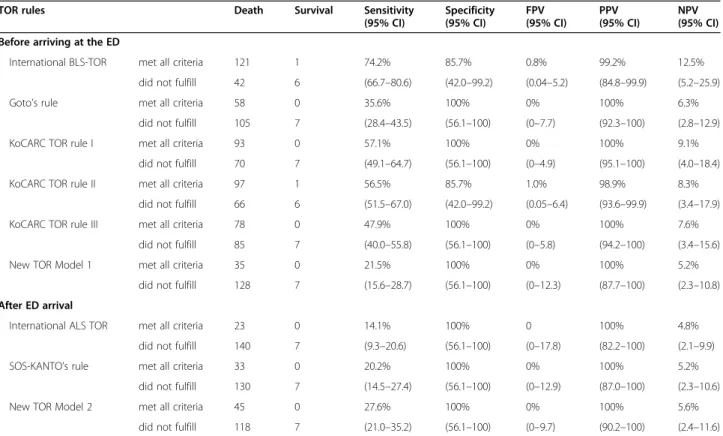
Results: In total, 170 of the 184 OHCA patients were eligible and evaluated. TOR was recommended for 122 patients based on the international basic life support termination of resuscitation (BLS-TOR) rule, which showed 85% specificity, 74% sensitivity, 0.8% FPV, and 99% PPV for predicting unfavorable survival outcomes. When the traditional BLS-TOR rules and KoCARC TOR rule II were applied to our registry, one patient met the TOR criteria but survived at hospital discharge. With regard to the FPV (upper limit of 95% confidence interval < 5%), specificity (100%), and PPV (> 99%) criteria, only the KoCARC TOR rule I, which included a combination of three factors including not being witnessed by emergency medical technicians, presenting with an asystole at the scene, and not experiencing prehospital shock delivery or return of spontaneous circulation, was found to be superior to all other TOR rules.
(Continued on next page)
© The Author(s). 2021 Open Access This article is licensed under a Creative Commons Attribution 4.0 International License, which permits use, sharing, adaptation, distribution and reproduction in any medium or format, as long as you give appropriate credit to the original author(s) and the source, provide a link to the Creative Commons licence, and indicate if changes were made. The images or other third party material in this article are included in the article's Creative Commons licence, unless indicated otherwise in a credit line to the material. If material is not included in the article's Creative Commons licence and your intended use is not permitted by statutory regulation or exceeds the permitted use, you will need to obtain permission directly from the copyright holder. To view a copy of this licence, visit http://creativecommons.org/licenses/by/4.0/.
The Creative Commons Public Domain Dedication waiver (http://creativecommons.org/publicdomain/zero/1.0/) applies to the data made available in this article, unless otherwise stated in a credit line to the data.
* Correspondence: [email protected]
1
Department of Emergency Medicine, School of Medicine, Kyungpook National University, 680, Gukchaebosang-ro, Jung-gu, Daegu 41944, Republic of Korea
5
Department of Emergency Medicine, Kyungpook National University Chilgok Hospital, Daegu, Republic of Korea
Full list of author information is available at the end of the article
(Continued from previous page)
Conclusion: Among the previous nine BLS and ALS TOR rules, KoCARC TOR rule I was most suitable for predicting poor survival outcomes and showed improved diagnostic performance. Further research on variations in resources and treatment protocols among facilities, regions, and cultures will be useful in determining the feasibility of TOR rules for COVID-19 patients worldwide.
Keywords: Heart arrest, Prognosis, Coronavirus disease, Ethics, Cardiopulmonary resuscitation
Background
The novel coronavirus disease (COVID-19) continues to be in a pandemic status and remains an important health concern worldwide [1]. Due to the presenting symptoms, complications, and transmission efficiency of COVID-19, we changed our standard treatment pro- cesses and personal protection strategies. In particular, resuscitation of cardiac arrest patients posed an espe- cially high risk of disease transmission to healthcare pro- fessionals [2, 3]. For in-hospital cardiac arrest (IHCA) patients, resuscitation was typically performed after es- tablishing whether the patient has COVID-19. However, for out-of-hospital cardiac arrest (OHCA) patients, re- suscitation was performed prior to any testing or con- firmation. Consequently, the OHCA group was of high risk to rescuers.
In the prehospital setting, emergency medical personnel screen patients for COVID-19 based on their symptoms (fever, dyspnea, cough, and sore throat) and inquired about any recent history of contact with in- fected individuals. However, this method has limitations because many carriers are asymptomatic [4, 5]. In addition, these asymptomatic COVID-19 patients admit- ted to the intensive care unit (ICU) pose a challenge to determining the need for wearing personal protective equipment (PPE) and utilizing medical resources. Pa- tients who failed to experience a return of spontaneous circulation (ROSC) in the event of a cardiac arrest were also often no longer transported to the hospital due to their low survival probability [6]. Accordingly, recent cardiopulmonary resuscitation (CPR) guidelines were changed to recommend that all healthcare providers as- sess the safety of the scene and wear higher levels of PPE for protection against infectious airborne droplets and detailing the criteria for the basic life support ter- mination of resuscitation (BLS-TOR) rule. These guide- lines stipulate that before terminating resuscitative efforts, the healthcare workers must check that (1) the arrest was not witnessed by emergency medical service (EMS) personnel or a first responder, (2) ROSC was not observed prior to the patient being transported to the emergency medical center (EMC), and (3) no electrical shocks were delivered [7 – 14].
We applied the rules that were typically selected de- pending on the country or region where the derivation
and validation phases were conducted. These included the (1) International BLS and advanced life support (ALS) rules derived and validated in the United States and Europe [8]; (2) Goto and KANTO-SOS rules devel- oped in Japan and Asian countries [13, 14]; and (3) Ko- rean OHCA registry-based TOR models, Korean Cardiac Arrest Research Consortium (KoCARC) TOR rules, and two new TOR models that were used in our previous studies [7, 11].
In Daegu metropolitan city, the number of patients with COVID-19 increased rapidly at the community level from February 18, 2020 concurrent with the pandemic outbreak in South Korea. During its 7-week peak, we resuscitated 184 OHCA patients at six EMCs. This was the first study to determine the efficacy of these TOR guidelines for an emerging infectious disease [7, 11, 12].
We were collecting prospective data for a registry of OHCA patients since 2017. However, as emergency rooms were shutdown, we recognized a need for add- itional research to improve the outcomes of OHCA pa- tients while concurrently protecting emergency department (ED) staff. Thus, this registry-based observa- tional study aimed to evaluate the external validation of these rules in predicting the survival outcomes of OHCA patients in the COVID-19 era.
Methods
Study design and variables
This study was approved by the Institutional Review Board of Kyungpook National University Hospital (Ap- proval no.: KNUH 2020–04-032).
We conducted a multicenter registry-based observa-
tional study using the WinCOVID-19 citywide OHCA
registry data. In March 10, ED personnel from six hospi-
tals in Daegu voluntarily discussed about data of
COVID-related factors. We evaluated patient demo-
graphics (age and sex), prehospital variables (e.g., place
of arrest, initial cardiac rhythm, whether the arrest was
witnessed by a bystander or EMS personnel, whether a
bystander performed CPR, whether an automated exter-
nal defibrillator was used and prehospital defibrillation
occurred, and whether ROSC occurred), and time inter-
vals. Response time was defined as the period from con-
tacting the EMS to them arriving at the scene, while
scene time was defined as the period from the EMS
arriving at the scene to them departing from the scene.
Resuscitation management and survival outcomes, in- cluding ROSC, survival to admission, survival to dis- charge, and neurological outcomes at discharge, after cardiac arrest were recorded as hospital-level variables.
Based on this collective data, we determined whether the patients met the existing TOR guidelines and qualified to be enrolled in this study. In South Korea, EMS personnel cannot terminate resuscitation unless OHCA patients show obvious signs of death [7, 11]; therefore, all EMS-treated OHCA patients should be transported to the hospital. Notably, these personnel use manual de- fibrillators and analyze electrocardiograms prior to the patients’ arrival at the hospital.
To evaluate COVID-related variables, we obtained data, including the clinical symptoms or signs (sore throat and cough), vital signs (fever was defined as a temperature of ≥37.5 °C]), recent exposure history, and chest X-ray findings, of patients with confirmed COVID-19 on admission from the electronic medical records.
Study setting and patients
Daegu is a metropolitan city with a population of 2.44 million people and is composed of two regional level I EMCs, four local level II EMCs, and 19 emergency facil- ities or clinics. In particular, there are six EMCs where ALS, post-cardiac arrest care, and cardiovascular
interventions are available. In this study, we evaluated adult patients (age > 18 years) who presented with pre- sumed OHCA and used the EMS system in Daegu.
Those who did not receive any resuscitation and those who experienced cardiac arrest in a primary care clinic or long-term care hospital were excluded.
Main outcome measures
The primary outcome measures were (1) the proportions of survival to hospital discharge defined as discharged to go home or transferred to another facility after admis- sion to the hospital and (2) survival with a favorable neurological outcome quantified using Cerebral Per- formance Category scores, with scores of 1 and 2 being the most favorable.
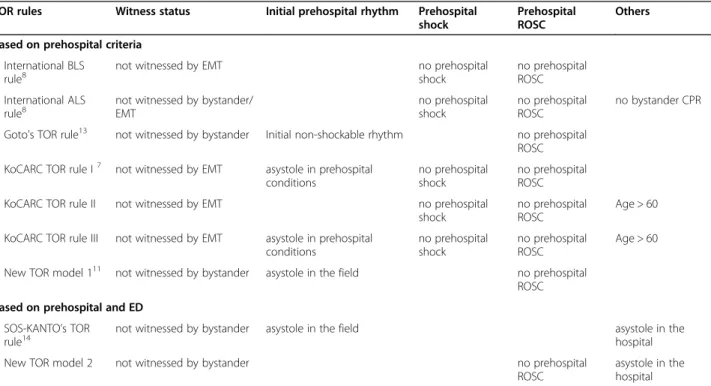
Meanwhile, the secondary outcome measures included external validation of previously researched TOR rules (Table 1). We identified OHCA patients who met all the TOR criteria and calculated the sensitivity, specificity, false positive ratios (FPR), false positive values (FPVs), positive predictive values (PPVs), negative predictive values (NPVs), and their respective 95% confidence in- tervals (CI) to identify patients with a risk of poor sur- vival [7, 8, 11, 13, 14].
Statistical analyses
The normality of the variables was determined using the Shapiro–Wilk test. Descriptive statistics were presented
Table 1 Criteria of the BLS-TOR and KoCARC BLS-TOR rules
TOR rules Witness status Initial prehospital rhythm Prehospital
shock
Prehospital ROSC
Others
Based on prehospital criteria International BLS
rule
8not witnessed by EMT no prehospital
shock
no prehospital ROSC International ALS
rule
8not witnessed by bystander/
EMT
no prehospital shock
no prehospital ROSC
no bystander CPR
Goto ’s TOR rule
13not witnessed by bystander Initial non-shockable rhythm no prehospital ROSC KoCARC TOR rule I
7not witnessed by EMT asystole in prehospital
conditions
no prehospital shock
no prehospital ROSC
KoCARC TOR rule II not witnessed by EMT no prehospital
shock
no prehospital ROSC
Age > 60
KoCARC TOR rule III not witnessed by EMT asystole in prehospital conditions
no prehospital shock
no prehospital ROSC
Age > 60
New TOR model 1
11not witnessed by bystander asystole in the field no prehospital ROSC Based on prehospital and ED
SOS-KANTO ’s TOR rule
14not witnessed by bystander asystole in the field asystole in the
hospital
New TOR model 2 not witnessed by bystander no prehospital
ROSC
asystole in the
hospital
ALS advanced life support, BLS-TOR basic life support and termination of resuscitation, CPR cardiopulmonary resuscitation, EMT emergency medical technicians,
KoCARC Korean Cardiac Arrest Research Consortium, ROSC return of spontaneous circulation, SOS-KANTO survey of survivors after cardiac arrest conducted in the
Kanto area in 2012 (2017)
as medians with interquartile ranges (IQR, 25th and 75th percentiles), whereas categorical variables were pre- sented as amounts and percentages. Significant differ- ences among the survival outcomes were determined using the Mann-Whitney test for continuous variables and chi-square tests or Fisher’s exact test for categorical variables.
Logistic regressions were performed for patients who met the criteria of the previous TOR rules. The outcome of interest was survival to hospital discharge (Table 1).
To determine the model calibration, the Hosmer- Lemeshow goodness of fit test was calculated. Odds ratio (OR) greater than 1 indicated an unfavorable effect on survival; ORs and 95% CIs were calculated for all covari- ates. The characteristics of the adjusted ORs were de- scribed using Forest plots. A receiver operating characteristic (ROC) curve, with the area under the curve (AUC), was used to determine the accuracy of such variables in predicting unfavorable survival out- comes at discharge. All tests were two-tailed, and p <
0.05 was considered statistically significant.
The diagnostic performances of all existing TOR rules were analyzed. Previous TOR rules were created based on FPR (1-specificity, i.e., the probability that the rule will suggest terminating resuscitation in case of patient survival) and PPV (i.e., the probability that the rule will suggest terminating resuscitation in case of patient death) of the rules. Current guidelines rec- ommend that when cessation of life-sustaining care is considered, the tool used to predict poor outcomes must be accurate and reliable, with an specificity (of
close to 100%) and a PPV (of > 99%, a narrow 95%
CI) [7, 15].
All statistical analyses were performed using IBM SPSS Statistics v. 25 (IBM Corp., Armonk, NY, USA) and MedCalc v. 17.4.4 (MedCalc Software, Mariakerke, Belgium).
Results
Patient characteristics
Demographic and prehospital characteristics of the 2017–2018 Korean nationwide OHCA and Daegu City- wide OHCAs were presented in Supplementary Table 1.
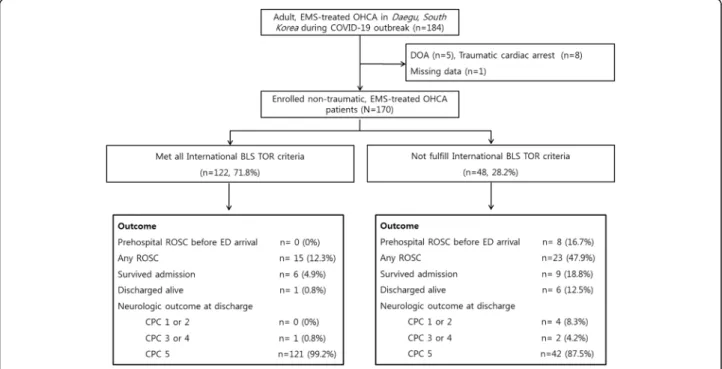
The prehospital and hospital characteristics of variables are almost similar. Of the 184 adults who developed OHCA between February 18, 2020 and March 31, 2020 (i.e., the peak of the COVID-19 outbreak), 170 patients (male, 63.2%) were included in this study (Fig. 1). In total, 76.0% of the arrest was witnessed by EMS personnel, 34.3% of the patients received CPR from a by- stander, 4.7% experienced ROSC prior to hospital arrival, 58.5% showed abnormal chest radiography findings, and 5.8% were confirmed to have COVID-19 via reverse transcription polymerase chain reaction. The patients’
baseline characteristics are summarized in Table 2.
Factors associated with survival
The rates of survival to discharge and survival with fa- vorable neurological outcomes were 4.7 and 2.9%, re- spectively. Compared to the patients who died, the survivors were younger, experienced more prehospital defibrillations, and achieved ROSC before arriving at the
Fig. 1 Study flowchart
ED (Table 2). Advanced age, arrest not being witnessed by emergency medical technician (EMT) personnel, receiving no shocks, and not developing ROSC before arriving at the ED were related to unfavorable survival outcomes.
Only ROSC before arriving at the ED was related to sur- vival to discharge (Fig. 2). Interestingly, age, witness status, and prehospital shock delivery were significantly associ- ated with survival outcomes in the univariate analysis, but not in the multivariable analysis (Table 3).
External validation of the TOR rules
On applying the existing international TOR rules to our registry, we found that 122 patients (71.8%) met all three criteria, but one survivor was discharged (Fig. 1). An- other patient met the criteria for the traditional BLS-
TOR and KoCARC TOR II rules, but he was also dis- charged (Table 4). The ROC curves of multimodal TOR categories for poor outcomes are shown in Fig. 2. Over- all, KoCARC TOR rule I and the current TOR rule II, with AUCs of 0.951 and 0.967, respectively, were the most effective for predicting in-hospital mortality (Fig. 3).
With respect to the specificity, FPR, FPV (narrow range of 95% CI) and PPV (> 99%), only KoCARC TOR rule I predicted poor survival outcomes, and it showed a higher diagnostic performance than did the other TOR rules (Table 4).
Discussion
This study validated the existing multimodal TOR rules using the WinCOVID-19 Daegu registry data on OHCA Table 2 General characteristics of the COVID-19 OHCA study population
Overall ( n = 170) Survival at discharge ( n = 7) Dead ( n = 163) P value
Age (years), median [IQR] 74 [62 –80] 62 [57 –69] 75 [63 –80] 0.027
Age more than 70 years 101 (59.4) 1 (14.3) 100 (61.3) 0.018
Male sex 108 (63.5) 5 (71.4) 103 (63.2) 0.996
COVID-19 related
Previous COVID-19 dx before OHCA 3 (1.8) 0 (0) 3 (1.8) 0.999
Presumed symptoms before OHCA 20 (11.8) 1 (14.3) 19 (11.7) 0.591
chest PA after CPR 140 (82.4) 7 (100) 133 (81.6) 0.356
Abnormal chest x-ray findings 100 (58.8) 5 (71.4) 95 (58.3) 0.701
Acquired RT-PCR test 80 (47.1) 5 (71.4) 75 (46.0) 0.258
Final confirmation of COVID-19 10 (5.9) 0 (0) 10 (6.1) 0.999
Comorbidities
Diabetes mellitus 52 (30.6) 2 (28.6) 50 (30.7) 0.999
Hypertension 59 (34.7) 3 (42.9) 56 (34.4) 0.695
Chronic renal disease 8 (4.7) 1 (14.3) 7 (4.3) 0.291
Malignancy, cancer 28 (16.5) 0 (0) 28 (17.2) 0.601
COPD, asthma 6 (3.5) 0 (0) 6 (3.7) 0.997
Heart failure, ischemic heart disease 26 (15.3) 0 (0) 26 (16.0) 0.597
Dementia, Parkinson disease 18 (10.6) 0 (0) 18 (11.0) 0.998
ICH, ischemic stroke 16 (9.4) 1 (14.3) 15 (9.2) 0.506
Liver cirrhosis, and others 17 (10.0) 0 (0) 17 (10.4) 0.998
Location of OHCA, public place 49 (28.8) 4 (57.1) 45 (27.6) 0.107
Prehospital parameters
Witnessed event, anyone 129 (75.9) 6 (85.7) 123 (75.5) 0.994
Prehospital mechanical CPR 134 (78.8) 5 (71.4) 129 (79.1) 0.640
Prehospital defibrillation 22 (12.9) 3 (42.9) 19 (11.7) 0.047
Time variables, median [IQR]
Response time interval (min) 8 [6 –10] 8 [7 –9] 8 [6 –10] 0.743
Scene time interval (min) 21 [15 –26] 15 [13 –25] 22 [16 –27] 0.205
Prehospital ROSC before ED arrival 8 (4.7) 6 (85.7) 2 (1.2) < 0.001
COPD chronic obstructive pulmonary disease, CPR cardiopulmonary resuscitation, ED emergency department, ICH intracerebral hemorrhage, IQR interquartile
ranges, OHCA out-of-hospital cardiac arrest, ROSC return of spontaneous circulation, RT-PCR reverse transcription polymerase chain reaction
patients. Among the nine existing TOR rules, KoCARC TOR rule I was found to be the best indicator of poor out- comes during the COVID-19 outbreak as evidenced by its highest specificity and PPV. To our best knowledge, this was the first study to determine the efficacy of these TOR guidelines for an emerging infectious disease.
Resuscitation of infected individuals greatly increases the risk of virus transmission to healthcare providers [1,
6, 16]. Current guidelines recommend emergency personnel to confirm the presence of COVID-19 in OHCA patients and wear high-level PPE, even in doubt- ful cases, before performing CPR. However, these mea- sures may have limited benefits because COVID-19 has a very high rate of disease transmission and approxi- mately 25% of the patients have asymptomatic infection [4]. Therefore, the COVID-19 era is a challenging and
Fig. 2 Forest plot for multivariate analysis of predictors of unfavorable survival of COVID-19 patients with OHCA. Data are adjusted for sex, age, location of event, witness status, bystander CPR, and any shockable rhythm
Table 3 Logistic regressions of factors associated with unfavorable survival outcomes
Dead Survival Univariate Multivariable
aCrude Odds
(95% CI) P value Adjusted Odds
(95% CI) P value
Age (years) 75 [63 –80] 62 [57 –69] 1.05 (1.00 –1.10) 0.070
Age > 70 years 100 (61.3) 1 (14.3) 9.52 (1.12 –80.97) 0.039 6.43 (0.28 –148.0) 0.244
Age > 60 years 127 (77.9) 4 (57.1) 2.64 (0.56 –12.36) 0.216 0.44 (0.02 –8.83) 0.591
Location, non-public places 118 (72.4) 3 (42.9) 3.49 (0.75 –16.24) 0.107
Not witnessed by bystander 64 (39.3) 3 (42.9) 0.86 (0.18 –3.97) 0.999
Not witnessed by EMT 139 (85.3) 4 (57.1) 4.34 (0.91 –20.63) 0.081 1.56 (0.06 –39.89) 0.782
No bystander CPR 108 (66.3) 4 (57.1) 1.47 (0.32 –6.81) 0.691
Initial acquired rhythm
Non-shockable rhythm in the field 152 (93.3) 3 (42.9) 18.42 (3.65 –92.8) 0.001 15.32 (0.04 –663.7) 0.378
Asystole in the field 107 (65.6) 0 (0) – 0.001 –
Asystole in the ED 127 (77.9) 0 (0) – < 0.001 –
No prehospital shock delivery 144 (88.3) 4 (57.1) 5.68 (1.18 –27.4) 0.047 6.06 (0.26 –101.1) 0.262 No prehospital ROSC 161 (98.8) 1 (14.3) 48.30 (3.83 –109.3) < 0.001 26.24 (1.48 –463.3) < 0.001 CI confidence interval, CPR cardiopulmonary resuscitation, ED emergency department, EMT emergency medical technician, OR odds ratio, ROSC return of spontaneous circulation
a
Adjusted for age, gender, location of arrest, primary electrocardiogram (ECG), witness status, and whether prehospital ROSC was achieved before arriving at
the ED
Table 4 External validations of multimodal TOR rules for predicting death prior to discharge ( n = 170)
TOR rules Death Survival Sensitivity
(95% CI)
Specificity (95% CI)
FPV (95% CI)
PPV (95% CI)
NPV (95% CI) Before arriving at the ED
International BLS-TOR met all criteria 121 1 74.2% 85.7% 0.8% 99.2% 12.5%
did not fulfill 42 6 (66.7 –80.6) (42.0 –99.2) (0.04 –5.2) (84.8 –99.9) (5.2 –25.9)
Goto ’s rule met all criteria 58 0 35.6% 100% 0% 100% 6.3%
did not fulfill 105 7 (28.4 –43.5) (56.1 –100) (0 –7.7) (92.3 –100) (2.8 –12.9)
KoCARC TOR rule I met all criteria 93 0 57.1% 100% 0% 100% 9.1%
did not fulfill 70 7 (49.1 –64.7) (56.1 –100) (0 –4.9) (95.1 –100) (4.0 –18.4)
KoCARC TOR rule II met all criteria 97 1 56.5% 85.7% 1.0% 98.9% 8.3%
did not fulfill 66 6 (51.5 –67.0) (42.0 –99.2) (0.05 –6.4) (93.6 –99.9) (3.4 –17.9)
KoCARC TOR rule III met all criteria 78 0 47.9% 100% 0% 100% 7.6%
did not fulfill 85 7 (40.0 –55.8) (56.1 –100) (0 –5.8) (94.2 –100) (3.4 –15.6)
New TOR Model 1 met all criteria 35 0 21.5% 100% 0% 100% 5.2%
did not fulfill 128 7 (15.6 –28.7) (56.1 –100) (0 –12.3) (87.7 –100) (2.3 –10.8) After ED arrival
International ALS TOR met all criteria 23 0 14.1% 100% 0 100% 4.8%
did not fulfill 140 7 (9.3 –20.6) (56.1 –100) (0 –17.8) (82.2 –100) (2.1 –9.9)
SOS-KANTO ’s rule met all criteria 33 0 20.2% 100% 0% 100% 5.2%
did not fulfill 130 7 (14.5 –27.4) (56.1 –100) (0 –12.9) (87.0 –100) (2.3 –10.6)
New TOR Model 2 met all criteria 45 0 27.6% 100% 0% 100% 5.6%
did not fulfill 118 7 (21.0 –35.2) (56.1 –100) (0 –9.7) (90.2 –100) (2.4 –11.6) ALS advanced life support, BLS-TOR basic life support and termination of resuscitation, CI confidence interval, ED emergency department, FPV false positive value, KoCARC Korean Cardiac Arrest Research Consortium in 2015 –2017; NPV negative predictive value, PPV positive predictive value, SOS- KANTO survey of survivors after cardiac arrest conducted in the Kanto area in 2012 (2017)
Fig. 3 Receiver operating characteristic curves for BLS-TOR rules to predict poor survival outcomes at hospital discharge
confusing time for healthcare workers in the medical and emergency fields [5]. Some OHCA patients were un- expectedly confirmed to be positive post-CPR or post- mortem, contributing to emergency room shutdowns and temporary closures [17]. As of September 2020, more than 20,000 people have been confirmed to have COVID-19 in South Korea, and 385 of these patients have died. In addition, more than 50% of these cases were in Daegu, the area of interest in this study, and its neighboring area Gyeongbuk [10]. Further, more than 130 healthcare workers and medical staff have been in- fected. One physician died after treating two confirmed patients.
Our findings, although preliminary, showed that the survival outcomes of OHCA patients in Daegu during the peak of the COVID-19 outbreak (4.1%) were signifi- cantly lower than those reported nationwide (9.8%) or in the city (8.8%) in 2018 [18]. Many variables were chan- ged in the COVID-19 era, including prehospital ROSC and pre-hospital transport time (see Additional file 1).
Although we could not describe the impact of the COVID-19 pandemic on the chain of survival and its negative effects on high-quality CPR, the risk-benefit ra- tio for CPR should be reconsidered [2]. Despite that there were several factors associated with good progno- sis in this study, including bystander CPR, EMS CPR, prehospital ROSC, and VF, no new factor was found for COVID-19. Other studies have also raised concerns on how CPR must be performed for IHCA patients with confirmed COVID-19. Considering the lower survival rate, physicians should establish goals of care or CPR preferences to reduce futile resuscitation by stratifying the survival probability of the IHCA patients, regardless of their COVID-19 status, at the time of hospital admis- sion [5, 19]. It is also important to consider prehospital TOR for out-of-hospital resuscitation in an infectious disease epidemic area.
The previous TOR rules can be divided into two sets of variables: one can be applied at the pre-hospital level and the other can be evaluated immediately after arriv- ing at the ED. In this study, we selected and analyzed the external validation of all nine multimodal TOR rules for OHCA patients during the COVID-19 epidemic period. These rules were commonly selected depending on the country or region where the derivation and valid- ation phases were conducted. These included the (1) International BLS (a combination of three criteria: arrest not being witnessed by EMTs, not receiving prehospital shock delivery, and not experiencing prehospital ROSC, Table 1) and ALS rules derived and validated in the United States and Europe [8]; (2) Goto and KANTO- SOS rules developed in Japan and Asian countries [13, 14]; and (3) the Korean OHCA registry-based TOR models, KoCARC TOR rules, and two new TOR rules
that were used in our previous studies [7, 11]. The inter- national BLS-TOR rules that can be enforced at the pre- hospital stage has high sensitivity and specificity, but also relatively high FPR (1-specificity) [9, 15]. Therefore, a continuous development of the TOR model has been proposed [7, 9]. A previous study that included acquired ECG asystole rhythm as a criterion also proposed a new TOR model applicable at the prehospital stage and an- other TOR model applicable immediately after arriving at the ED [11].
The previous four rules have been partially validated in other countries and in the setting of mechanical CPR or comprehensive post-resuscitation care [12, 20–23].
Previous validations of the TOR rule reported survival rates of less than 1% among TOR rule–positive patients in North America. In contrast, high FPR of survival has been reported in Asian countries (28.7% in Singapore, 25.9% in Taiwan, and 30.4% in South Korea). This dis- crepancy may be due to different prehospital practices and a relatively higher prevalence of non-shockable rhythm in patients in Asian countries [7]. However, the high false positive cases of survival in these Asian coun- tries, where the withdrawal of life-sustaining treatment is not commonly applied, are likely to be biased. Kajino et al. [24] validated the TOR rules for predicting poor neurologic outcomes in a Japanese population and con- cluded that more specific TOR rules for each region should be developed, despite the good performance of the TOR rules in their study. However, even if the COVID-19 outbreak was not considered, these previous results implied that the extrapolation to and implemen- tation of different TOR rules in regions with different organization of EMS treatment protocols, legislation, and socioeconomic characteristics might be problematic because the TOR rules would need to be adjusted to meet the regional situation.
In this study, we validated the existing multimodal TOR rules using the WinCOVID-19 Daegu registry data on OHCA patients. Our results indicated that of the 170 OHCA patients, we failed to screen one survivor of the seven survival discharges for the international BLS and KoCARC II rules. However, the remaining seven TOR rules were classified correctly. Current guidelines recom- mend that diagnostic tests that guide the cessation of life-saving efforts be accurate and reliable, with an FPV and FPR value close to 0% [7, 9]. Among the nine rules, KoCARC TOR rule I was found to be the most effective indicator for poor outcomes, as indicated by the lowest FPV (0% with narrow 95% CI) and highest PPV (> 99%).
This rule included the combination of three factors,
namely, not being witnessed by EMT, presenting with an
asystole at the scene, and experiencing no prehospital
shock or ROSC. It did not include the patient’s age or
ED parameters, thereby making it easy to use in
prehospital settings and applicable for OHCA patients in this current pandemic [7].
This study had several strengths and limitations. First, as with other multicenter observational studies, the integrity of the data could be biased. In addition, the observation period was only 2 months; hence, the effects on long-term survival outcomes, which are most important for OHCA research, remain unknown. In this regard, we will continue to conduct investigations until the COVID-19 pandemic has been effectively contained. Second, it has been specu- lated that poor survival outcomes are associated with fewer resuscitations and prolonged EMS scene and transport time to the hospital. Moreover, unfavorable neurological out- comes, as a primary outcome, is more suitable than survival to discharge. Because only four patients in our study dis- played favorable neurological outcomes, we could not per- form any secondary analyses or external validations. Third, the ratio of the survival outcomes was markedly lower in our study than that in previous Korean OHCA reports dur- ing the COVID-19 outbreak. This could be due to the dir- ect adverse effects of COVID-19 on the cardiovascular system, prolonged EMS scene time, and differences in treat- ment in different hospitals [25]. Fourth, the number of COVID-19 cases sharply decreased in April in Daegu.
Thus, the sample size was too small for a large-scale multi- factor analysis. Finally, facility or regional differences in EMS resources, CPR quality, and post-cardiac arrest care might affect the survival outcomes during the COVID-19 outbreak. TOR rules in the COVID-19 era and socio- ethical issues must be discussed further, and a consensus process must be developed.
Conclusions
Among the nine previously existing TOR rules, KoCARC TOR rule I is the most suitable for predicting poor survival outcomes, and it showed improved diag- nostic performance in the COVID-19 era. With regard to the specificity, FPV and PPV criteria, KoCARC TOR rule I was superior to all other TOR rules. Further re- search on variations in resources and treatment proto- cols (CPR quality and post-cardiac arrest care) among facilities, regions, and cultures will be useful in deter- mining the feasibility of TOR rules for COVID-19 pa- tients worldwide.
Supplementary Information
The online version contains supplementary material available at https://doi.
org/10.1186/s13049-021-00834-0.
Additional file 1.
Abbreviations
ALS: Advanced life support; AUC: area under the curve; BLS-TOR: Basic life support termination of resuscitation; CI: Confidence interval; COVID-19: Novel coronavirus disease; CPR: Cardiopulmonary resuscitation; ED: Emergency
department; EMC: Emergency medical center; EMS: Emergency medical service; EMT: Emergency medical technician; FPV: False positive value;
ICU: Intensive care unit; IHCA: In-hospital cardiac arrest; IQR: Interquartile range; KoCARC: Korean Cardiac Arrest Research Consortium; NPV: Negative predictive value; OHCA: Out-of-hospital cardiac arrest; OR: Odds ratio;
PPE: Personal protective equipment; PPV: Positive predictive value;
ROC: Receiver operating characteristic; ROSC: Return of spontaneous circulation
Acknowledgments Not applicable.
Authors ’ contributions
All authors have substantially contributed to the study design, data collection, data interpretation, and manuscript writing. All authors read and approved the final manuscript.
Funding
This study received no funding.
Availability of data and materials
The data supporting the findings of this study are available from the corresponding author upon reasonable request.
Ethics approval and consent to participate
The study was approved by the Institutional Review Board of Kyungpook National University Hospital (Approval number: KNUH 2020 –04-032).
Consent for publication Not applicable.
Competing interests
The authors declare that they have no competing interests.
Author details
1
Department of Emergency Medicine, School of Medicine, Kyungpook National University, 680, Gukchaebosang-ro, Jung-gu, Daegu 41944, Republic of Korea.
2Department of Emergency Medicine, Keimyung University Dongsan Hospital, Daegu, Republic of Korea.
3Department of Emergency Medicine, Catholic University of Daegu School of Medicine, Daegu, Republic of Korea.
4Department of Emergency Medicine, Yeungnam University College of Medicine, Daegu, Republic of Korea.
5Department of Emergency Medicine, Kyungpook National University Chilgok Hospital, Daegu, Republic of Korea.
6