DOI 10.17480/psk.2016.60.1.46
치주질환치료를 위한 국소적용 서방출성 리오겔
김기준 · 신영희# 경성대학교 약학대학
(Received January 18, 2016; Revised January 22, 2016; Accepted January 23, 2016)
Injectable Sustained Release Gel as a Local Drug Delivery for Periodontal Diseases
Ki-jun Kim and Young-hee Shin#
College of Pharmacy, Kyungsung University, Busan 48434, Korea
Abstract — The purpose of this study was the development of sustained-release lyogel of chlorhexidine in the treatment of periodontal diseases. A sustained-release chlorhexidine lyogel (CHX-G) was formulated, based on Eudragit® (1~3%), polyvinyl pyrrolidone (PVP) (0~10%), triacetin (20~40%), hydroxy ethyl cellulose (HEC) (1%) and glycerin. In vitro studies were performed to determine the release rate of chlorhexidine from CHX-Gs using dialysis tube. Our results suggest that the release rate of chlorhexidine from lyogel could be controlled by changing the lyogel compositions.
Keywords □ chlorhexidine, sustained-release, lyogel, periodontal diseases
치주질환의 치료에 있어서 가장 기본이 되는 것은 세균성 plaque 와 치석을 깨끗이 제거하여 bacteria의 번식에 유리한 환경을 만 들지 않는 것인데, bacteria의 증식을 억제하고 증상을 개선하기 위해 많은 항생물질들이 경구, 또는 국소로 적용되고 있다.1-4)그 러나 전신투여를 위한 경구용 제제는 국소에서의 유효농도 유지 의 어려움과 전신흡수에 의한 부작용 등의 문제점이 있으며, 국 소투여 제형은 약물의 체류성과 부착성 등에서 불충분한 점이 많 다. 이러한 문제점들을 개선하기 위하여 항생물질을 치주낭 (periodontal pocket) 내에 직접 투여하는 local drug delivery system에 관하여 film, strip 및 fiber 등을 이용한 많은 연구가 진 행되고 있다.5-7)그러나 이들은 투여하기가 까다롭고 일정시간 후 제거를 위해 전문가를 자주 방문해야 하는 불편함이 있다. 따라 서, gel type 제형은 단일 투여하여서 약물이 원하는 시간만큼 방 출된 후 특별한 작업 없이 자연적으로 제거 된다는 점에서 우수 한 장점을 가지고 있기 때문에 많은 연구가 이루어지고 있다.8-11)
이러한 local drug delivery system에 사용하는 약물 중 chlorhexidine은 낮은 농도에서 bacteriostatic 효과를 나타낸다.
Bacteria의 세포막은 특징상 음전하로 하전 되어 있는데, 양이온 성인 chlorehexidine 분자가 음전하를 띠는 세포 표면에 신속히 달라붙어 bacteria 세포막을 변화시키고 chlorhexidine은 내부 세 포막을 향해 끌려가게 된다. Chlorhexidine은 내부 세포막의 phospholipids와 결합하고 이것은 낮은 분자량의 물질이 투과되 게 만드는데 이 과정은 가역적이다. 높은 농도에서는 bacteriocidal 효과를 가지는데, bacteria 세포벽을 뚫어 세포질이 석출되기 때 문이다. 이러한 항균작용은 chlorhexidine이 조직에 6시간에서 12시간 정도 달라붙어 있으므로 더욱 오래 나타난다. 또한 이 물 질은 안전하고 체내 혈류로 이행이 적어많은 연구가 이루어지 고 있으며 다양한 제제로 쓰이고 있다.12-15)
본 연구에서는 periodontal diseases 치료를 위해 chlorhexidine 을 함유한 local drug delivery system의 일환으로 gel 제형을 연 구하였다. Gel 제형은 다른 제형에 비해 환자의 편의를 높일 수 있는 장점을 가지고 있으며 아울러 주성분인 chlorhexidine도 뛰 어난 항균작용과 안정성을 가지고 있다. 1회 적용으로 장시간 효 과를 나타낼 수 있을 것이라 기대되는 다양한 조성의 lyogel 들 을 조제하였고, 각각의 조성에 따른 chlorhexidine의 방출 연구
#
Corresponding Author Young-hee Shin
College of Pharmacy, Kyungsung University, Busan 48434, Korea Tel.: 051-663-4886 Fax.: 051-663-4809
E-mail: [email protected]
Short Report
종설를 수행하여 조성 성분들의 방출 영향을 검토하였다.
재료 및 방법
시약 및 기구
시험에 사용한 chlorhexidine diacetate salt hydrate, triacetin, 2-hydroxyethyl cellulose(HEC), methyl paraben, poly vinyl- pyrrolidone(PVP), phosphoric acid 및 triethylamine은 Sigma- Aldrich(St. Louis, MO, U.S.A)에서 구입하였다. Acetonitrile은 Merck(Darmstadt, Germany)에서 구입하였다. Eudragit(RS PO) 는 Evonik Röhm GmbH(Darmstadt, Germany)에서 제공 받아 사용하였다. 그 외 시약은 특급시약을 사용하였다.
Lyogel 조제에 사용한 homogenzier는 Kinematica AG(littau- lucerne, Switzerland)의 Polytron pt2100을 사용하였다. Membrane tube는 三光純藥(株)(Tokyo, Japan)에서 구입한 UC8-32-25를 사 용하였으며, 클로저는 Spectrum Lab.(Rancho Dominguez, CA, USA)의 12 mm모델을 사용하였다. 바이알은 Kartell(Noviglio, Italy)제품을 사용하였다. Water bath는 Eyela(Tokyo, Japan)의 Uni thermo saker NTS-1300을 사용하였다. HPLC는 Hitachi HPLC system[Tokyo, Japan; UV detector(L-2400), column oven(L-2300), autosampler(L-2200), pump(L-2130)]을 사용하였 다. 컬럼은 Phenomenex Gemini C18(5µm, 3.0×250 mm;
Torrance, CA, USA)을 사용하였다.
Lyogel의 조제
비커 A에 글리세린을 넣고 여기에 chlorhexidine을 가하여 magnetic bar로 혼합시켜 완전히 녹이고, 여기에 PVP를 첨가하 여 하루밤 방치하여 충분히 용해시킨 후, HEC를 가하고 10분간 교반하여 완전히 용해시켰다. 또한, 비커 B에 triacetin과 Eudragit®등을 넣고 충분히 용해시킨 다음 하루밤 방치하였다.
마지막으로 A비커의 글리세린 용액과 B 비커의 triacetin 용액을 혼합한 다음 homogenizer로 11,000 rpm에서 30초씩 4회 균질화 시켰다. Lyogel은 polymer를 유기용매에 용해하여 제조된 것을 말하며, 본 연구에서는 HEC, PVP 및 Eudragit®을 glycerine과 triacetine에 용해하여 제조하였다. 실험에 사용한 각종의 lyogel 은 Table I의 조성에 따라 조제하였다.
인공타액의 조제
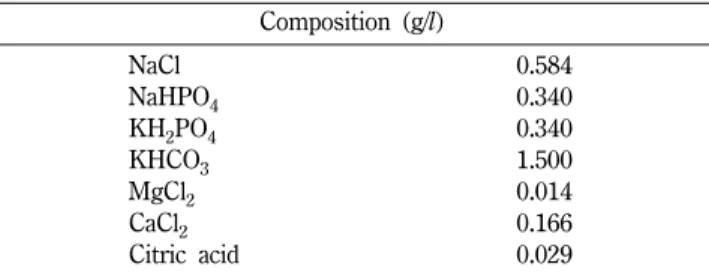
보통 타액의 pH는 6에서 7로 약간 산성이며, pH 5.3~7.8로 보고되어 있다.일반적으로 치주낭의 pH가 산성일 것으로 생각 되지만 대체로 중성에 가까우며실제 측정한 치주낭의 평균 pH 는 6.7이고 타액의 평균 pH는 6.5이다.16-18)여기에 기초하여 pH 6.7인 Ericsson’s solution을 In vitro 실험에 사용할 인공타액으 로 사용하였다.19,20)조성은 Table II에 나타내었으며 pH는 염산 으로 조정하였다.
In vitro release test
멤브레인 튜브(6 cm) 한쪽을 클로저로 봉하고 각각의 조성에 따라 조제한 lyogel을 0.5 g씩 담은 후 다른 한쪽을 클로저로 봉 하였다. 이렇게 만든 튜브를 뚜껑이 달린 바이알에 넣고 인공타 액 50 ml를 채웠다. 바이알을 수욕조에 넣고 37oC 100 rpm으로 유지하였다.21)일정 시간 간격으로 각각의 바이알에서 0.9 ml의 시험액을 채취하고, 0.9 ml의 신선한 인공타액을 보충하였다. 채 취한 시험액은 아래와 같은 HPLC 분석법으로 분석하였으며, 검 량선으로부터 chlorhexidine의 농도를 산출하였다.
Chlorhexidine의 정량분석
HPLC 분석 조건 − Chlorhexidine의 확인 및 정량에는 Xuguang 등의22)방법을 참고하여 실험하였다. 이동상으로는 acetonitrile : buffer(0.02 M potassium dihydrogen phosphate (pH 3.4) containing triethylamine 0.1%)=35 : 65(v/v%)을 사용 하였고 유속은 0.4 ml/min으로 분석하였다. 컬럼은 Phenomenex Gemini C18(5µm, 3.0×250 mm; Torrance, CA, USA)을 사용하 였고 컬럼온도는 40oC로 하였다. UV 검출기는 259 nm에서 측 정하였고, 시료는 20 µl씩 주입하였다.
분석법 Validation − 분석조건에서 설정된 분석방법에 대한 검 증을 국립독성 연구원 생체시료분석법 Validation에 의하여 특이 성, 직선성, 정밀성 및 정확성을 평가하였다.
특이성 − 이동상 내에서 chlorhexidine 과 내부표준물질인 methyl paraben의 분리 및 정량 분석 능력을 검토하였다.
검량선 작성 − Chlorhexidine 표준품과 내부표준물질인 methyl paraben을 메탄올에 녹여 1 mg/ml되도록 조제하여 표준액으로 하고 냉장고에 보존하였다. 이 표준액을 이동상으로 희석하여 농
Table II − Composition of artificial saliva
Composition (g/l)
NaCl 0.584
NaHPO
40.340
KH
2PO
40.340
KHCO
31.500
MgCl
20.014
CaCl
20.166
Citric acid 0.029
Table I − Compositions of lyogel
Composition (w/w %)
Eudragit (RS PO) 1~3
Poly vinylpyrrolidone 0~10
Triacetin 20~40
Chlorhexidine 0.5
Hydroxyethyl cellulose 1
Glycerin q.s
도가 각각 1, 2, 5, 10, 20, 50 및 100 µg/ml이 되도록 조제하였 으며, 내부표준물질은 희석하여 100 µg/ml이 되도록 조제하였다.
Chlorhexidine 희석액에서 각각 900 µl를 취하고 내부표준물질 함유액 100 µl를 취하여 섞은 뒤 vortexing 하여 시험액으로 하 였다. 이 시험액을 자동정량용 바이알에 100 µl씩 담고 HPLC에 20µl씩 주입하였다. 여기서 얻은 내부표준물질의 피크 면적에 대 한 chlorhexidine의 피크 면적 비로 검량선을 작성하였다. 재현 성을 확인하기 위해 하루 5번 실행하여 일내 재현성을 확인하고 연속하여 5일간 실행해서 일간 재현성을 확인하였다.
직선성 − 검량선 작성 시와 동일한 농도로 실험하여 얻어진 크 로마토그램으로부터 chlorhexidine과 내부표준물질의 피크면적 비를 구하여 검량선을 작성하고 직선성을 검증하였다.
정밀성 − 검량선 작성 시와 동일한 농도로 5일간 연속 실험 하 고, 일내 5회 연속 실험하여 얻은 크로마토그램으로 일간 및 일 내 정밀성을 평가하였다. 이때, 변동계수(coefficient of variation, CV)가 15%를 초과해서는 안 되며, 최저정량한계에서는 CV가 20%를 넘어서는 안 된다.
정확성 − 검량선 작성 시와 동일한 농도로 5일간 연속 실험 하 고, 일내 5회 연속 실험하여 얻은 크로마토그램으로 일간 및 일 내 정확성을 평가하였다. 이때, 평균값은 최저정량한계를 제외하 고는 실측값의 15% 이내여야 하고, 최저정량한계에서도 20%를 넘어서는 안 된다.
실험결과 및 고찰
Chlorhexidine의 정량분석 분석법 Validation
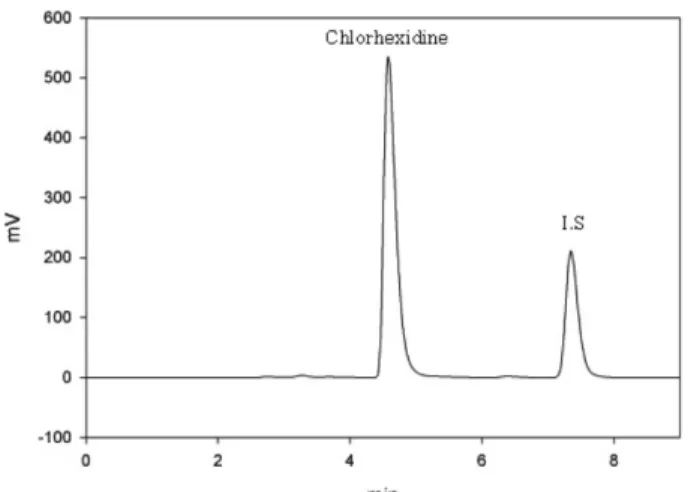
특이성의 검증 − 시험방법과 같이 검체와 내부표준물질(methyl paraben)을 HPLC로 분석했을때 얻어진 크로마토그램은 Fig. 1 에 나타내었으며, chlorhexidine 피크의 유지시간은 약 4.6분, 내 부표준물질의 피크 유지시간은 약 7.4분으로 크로마토그램 상에 나타난 바와 같이 Chlorhexidine과 내부표준물질은 잘 분리되었다.
검량선 작성 및 직선성 − 검량선은 1~100 µg/ml에서 양호한 직 선성을 나타내었으며, 본 실험에 사용한 검량선은 y=0.049x+0.0017 (R2=0.9998)(n=9)이었다(y: area ratio, x: chlorhexidine 농도).
정밀성 및 정확성 − 정밀성은 chlorhexidine의 피크면적 비의 표준편차를 피크면적 비의 평균값의 백분율(%)로서 구하였다. 하 루에 5번 시행하여 일내 정밀성(CV%)을 구하였고, 5일간 실험 을 반복 시행하여 일간 정밀성(CV%)을 구하였다. 본 분석방법 의 정밀성 CV%는 일내 정밀성, 일간 정밀성 모두 ±15% 이내 였다. 정확성은 검량선에 의하여 정량한 농도의 평균값을 기지 의 농도로 나눈 비의 백분율(%)로서 구하였다. 일내 정확성, 일 간 정확성 모두 전 농도 범위에서 ±15% 이내였다(Table III).
이로부터 chlorhexidne에 대한 상기의 HPLC 분석법은 본 실 험에 이용될 수 있는 충분한 감도, 특이성, 직선성, 정확성 및 정 밀성을 갖고 있음을 알 수 있었다.
Lyogel로부터 chlorhexidine의 방출패턴
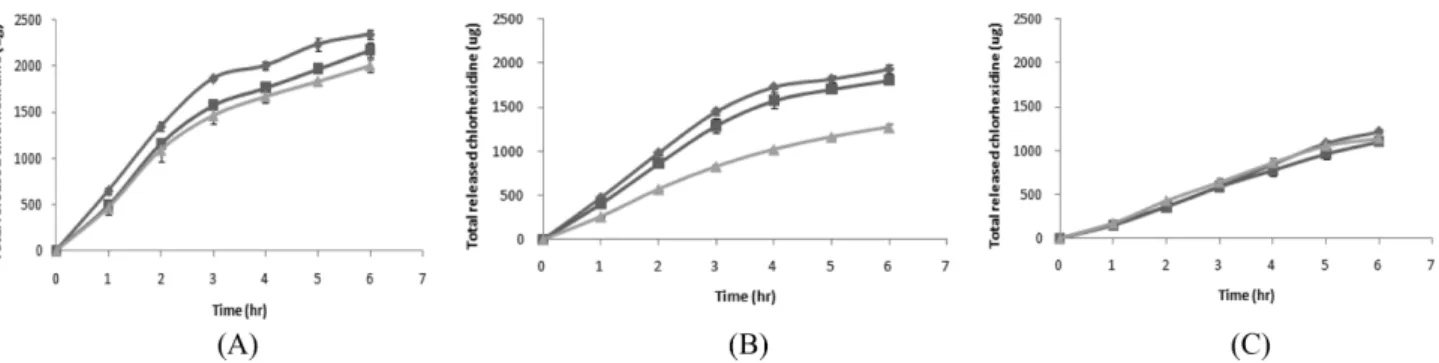
PVP 농도 변화에 따른 lyogel로부터 chlorhexidine의 방출 속도 변화 − Fig. 2에서 볼 수 있듯이 방출 속도를 조절하는 요인 중 Eudragit®, triacetin 및 HEC의 농도가 일정할 때, PVP의 농 도가 각각 0, 5, 10%로 증가할수록 서방출 특성이 증가하였다.
이는 PVP 농도가 증가함에 따라 점도가 증가하여 인공 타액이 제형 안으로 들어가는 시간이 늘어났기 때문인 것으로 보인다.
하지만 Eudragit®의 농도가 3%인 경우에는 유의성 있는 차이를 나타내지 않았다. 그 이유는 Eudragit®의농도가 높아 PVP의 점
Fig. 1 − HPLC chromatogram of chlorhexidine and methyl paraben
(I.S.).
Table III − Intra-day and inter-day precision and accuracy data for the HPLC analysis of chlorhexdine Conc.
(µg/ml)
Precision (CV%) Accuracy (%, Mean±S.D.)
Intra-day (n=5) Inter-day (n=5) Intra-day (n=5) Inter-day (n=5)
001
2.49 5.04
087.69±2.18 090.97±4.59002
1.18 1.77
094.48±1.11 093.76±1.66005
0.42 4.21
097.17±0.41101.21±4.26
010
0.59 2.23
099.08±0.58101.05±2.26
020
0.51 1.20
098.41±0.51 099.57±1.20050
1.39 1.04 101.00±1.40 102.03±1.06
100 0.11 0.69
099.45±0.11 099.83±0.69성으로는 더 이상 차이를 보이지 않은 것으로 사료된다.
Eudragit® 농도 변화에 따른 lyogel로부터 chlorhexidine의 방출 속도 변화 − 방출 속도를 조절하는 요인 중 PVP, triacetin 및 HEC의 농도가 일정할 때, Fig. 3에서 확인할 수 있듯이 Eudragit®의 농도가 각각 1, 2, 3%로 증가할수록 서방성이 커졌 다. 이는 Eudragit®이 많아지면 망목상구조가 치밀해져 약물의 방출 속도를 늦추는 것으로 보인다. 김 등에23)의해 이미 보고된 바와 같이 용매에 의하여 triacetine이 제거되고 그 후 Eudragit® 의망목구조가 형성되어 함유되어 있는 약물의 방출속도가 지연 되는 것과 같은 이유로 사료된다.
Triacetin 농도 변화에 따른 lyogel로부터 chlorhexidine의 방 출 속도 변화 − 방출 속도를 조절하는 요인 중 Eudragit®, PVP, HEC의 농도가 일정할 때, Fig. 4에서 볼 수 있듯이 triacetin 농 도가 각각 20, 30, 40%로 증가함에 따라 약물의 서방성이 커졌 다. 이는 triacetin이 많아지면 Eudragit®의 망목상구조 형성이 용이하기 때문인 것으로 보인다.
결 론
본 연구에서는 periodontal diseases의 치료를 위한 서방성
Fig. 2 − Release profiles of chlorhexidine from lyogel containing various PVP concentrations. Key, ◆: 0%, ■: 5%, ▲: 10%. Each data represents mean±S.D. n=3. (A) lyogel (Eudragit
®1%, triacetin 30%), (B) lyogel (Eudragit
®2%, triacetin 30%), (C) lyogel (Eudragit
®3%, triacetin 30%).
Fig. 3 − Release profiles of chlorhexidine from lyogel (PVP 0%, triacetin 30%) containing various Eudragit
®concentrations. Key, ◆: 1%, ■:
2%, ▲: 3%. Each data represents mean±S.D. n=3. (A) lyogel (PVP 0%, triacetin 30%), (B) lyogel (PVP 5%, triacetin 30%), (C) lyogel (PVP 10%, triacetin 30%).
Fig. 4 − Release profiles of chlorhexidine from lyogel (Eudragit
®2%, PVP 0%) containing various triacetin concentrations. Key, ◆: 20%, ■:
30%, ▲: 40%. Each data represents mean±S.D. n=3. (A) lyogel (Eudragit
®2%, PVP 0%), (B) lyogel (Eudragit
®2%, PVP 5%), (C)
lyogel (Eudragit
®2%, PVP 10%).
lyogel 제형 개발을 위해 Eudragit®, PVP, triacetin 및 HEC를 이용해 chlorhexidine을 함유한 제제를 조제한 후 이를 in vitro 약물방출 실험을 하여 제제의 특성을 비교 평가하였다. 점성을 증가시키는 PVP 및 Eugragit®의 농도 증가에 따라 서방출 효과 가 증대되었으며 아울러 Eugragit®의용매로 사용한 triacetn의 농도가 증가함에 따라 서방출성 패턴이 나타났다. 이상의 결과 로 Eudragit®, PVP 및 triacetin은 lyogel로부터 약물의 서방출 효과를 증대시킬 수 있는 요인임을 확인하였다. 또한, chlorhexidine의 HPLC 분석법을 확립하였으며, 이 분석조건은 직선성, 정확성 및 정밀성 등의 validation 조건을 만족하였다.
References
1) Allaker, R. P. and Douglas, C. W. I. : Novel anti-microbial therapies for dental plaque-related diseases. Int. J. Antimicrob.
Agents 33, 8 (2009).
2) Al-Tahami, K., Meyer, A. and Singh, J. : Poly lactic acid based injectable delivery systems for controlled release of a model protein, lysozyme. Pharm. Dev. Technol. 11, 79 (2006).
3) Heitz-Mayfield, L. J. : Systemic antibiotics in periodontal therapy. Aust. Dent. J. 54, Suppl 1 (2009).
4) Case, D. E. : Safety of hibitane. I. laboratory experiments. J.
Clin. Periodontol. 4, 66 (1977).
5) Dabhi, M. R., Nagori, S. A., Gohel, M. C., Parikh, R. K. and Sheth, N. R. : Formulation development of smart gel periodontal drug delivery system for local delivery of chemotherapeutic agents with application of experimental design. Drug Deliv. 17, 520 (2010).
6) Friesen, L. R., Williams, K. B., Krause, L. S. and Killoy, W. J. : Controlled local delivery of tetracycline with polymer strips in the treatment of periodontitis. J. Periodontol. 73, 13 (2002).
7) Gupta, R., Pandit, N., Aggarwal, S. and Verma, A. : Comparative evaluation of subgingivally delivered 10% doxycycline hyclate and xanthan-based chlorhexidine gels in the treatment of chronic periodontitis. J. Contemp. Dent. Pract. 9, 25 (2008).
8) Ji, Q. X., Zhao, Q. S., Deng, J. and Lü, R. : A novel injectable chlorhexidine thermosensitive hydrogel for periodontal application: Preparation, antibacterial activity and toxicity evaluation. J. Mater. Sci. Mater. Med. 21, 2435 (2010).
9) Jones, D. S., Woolfson, A. D., Djokic, J. and Coulter, W. A. : Development and mechanical characterization of bioadhesive semi-solid, polymeric systems containing tetracycline for the treatment of periodontal diseases. Pharm. Res. 13, 1734 (1996).
10) Kelly, H. M., Deasy, P. B., Ziaka, E. and Claffey, N. : Formulation and preliminary in vivo dog studies of a novel drug delivery system for the treatment of periodontitis. Int. J.
Pharm. 274, 167 (2004).
11) Loesche, W. J. and Grossman, N. S. : Periodontal disease as a specific, albeit chronic, infection: Diagnosis and treatment.
Clin. Microbiol. Rev. 14, 727 (2001).
12) Malkhassian, G., Manzur, A. J., Legner, M., Fillery, E. D., Manek, S., Basrani, B. R. and Friedman, S. : Antibacterial efficacy of MTAD final rinse and two percent chlorhexidine gel medication in teeth with apical periodontitis: A randomized double-blinded clinical trial. J. Endod. 35, 1483 (2009).
13) Mohammadi, Z. and Abbott, P. V. : On the local applications of antibiotics and antibiotic-based agents in endodontics and dental traumatology. Int. Endod. J. 42, 555 (2009).
14) Okonogi, S., Khongkhunthain, S., Bunyaratavej, P., Thusaphorn, T. and Umpriwan, R. : Development of local injectable dental gel: The influence of certain additives on physicochemical properties of glycerylmonooleate-based formulations. Drug Dev. Ind. Pharm. 30, 347 (2004).
15) Parthasarathy, V., Manavalan, R., Mythili, R., Siby, C. T. and Jeya, M. : Ethyl cellulose and polyethylene glycol-based sustained-release sparfloxacin chip: An alternative therapy for advanced periodontitis. Drug Dev. Ind. Pharm. 28, 849 (2002).
16) Humphrey, S. P. and Williamson, R. T. : A review of saliva:
Normal composition, flow, and function. J. Prosthet. Dent. 85, 162 (2001).
17) Rushton, A. : Safety of hibitane. II. human experience. J. Clin.
Periodontol. 4, 73 (1977).
18) Sauvetre, E., Glupczynsky, Y., Labbe, M., Yourassowsky, E. and Pourtois, M. : The effect of clindamycin gel insert in periodontal pockets, as observed on smears and cultures.
Infection. 21, 245 (1993).
19) Savage, A., Eaton, K. A., Moles, D. R. and Needleman, I. : A systematic review of definitions of periodontitis and methods that have been used to identify this disease. J. Clin. Periodontol.
36, 458(2009).
20) Vinholis, A. H., Figueiredo, L. C., Marcantonio Júnior, E., Marcantonio, R. A., Salvador, S. L. and Goissis, G. : Subgingival utilization of a 1% chlorhexidine collagen gel for the treatment of periodontal pockets. A clinical and microbiological study.
Braz. Dent. J. 12, 209 (2001).
21) Vyas, S. P., Sihorkar, V. and Mishra, V. : Controlled and targeted drug delivery strategies towards intraperiodontal pocket diseases. J. Clin. Pharm. Ther. 25, 21 (2000).
22) Xuguang, S., Yanchuang, L., Feng, Z., Shiyun, L. and Xiaotang, Y. : Pharmacokinetics of chlorhexidine gluconate 0.02% in the rabbit cornea. J. Ocul. Pharmacol. Ther. 22, 227 (2006).
23) Kim, M. O., Shin, Y. H., Kim, D. D. and Lee, C. H.: Physical properties and Release characterization of sustained release lyogel ointment. J. Kor. Pharm. Sci. 28, 51 (1998).