• 검색 결과가 없습니다.

A Rare Case of Tracheobronchitis Alternariosis in a Renal Transplant Recipient

N/A
N/A
Protected

Academic year: 2021

Share "A Rare Case of Tracheobronchitis Alternariosis in a Renal Transplant Recipient"

Copied!
2
0
0

로드 중.... (전체 텍스트 보기)

전체 글

(1)

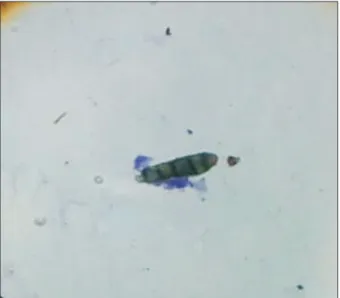
401 cough until 2014. On day 3, chest X-ray was performed, with negative results and did not show any opacity in right and left side chest. Bronchoscopy revealed of the left bronchus thick purulent secretions that on day 5, sent to the Bacteriol- ogy Laboratory of the hospital, no bacteria were identified by Gram stain, but in modified Ziehl-Neelsen stain showed macroconidia of Alternaria (Figure 1). In bronchial washings sample, did not bacterial growth on blood agar and MacCo- nkey agar, where it remained negative after 48 hours of incu- bation on day 7. The final diagnosis was tracheobronchitis alternariosis. The patient started antifungal therapy on day 12 with voriconazole (400 mg daily) and patient was relieved of symptoms within 6 weeks (on day +54).

Alternaria has worldwide distribution and is a large and complex genus that encompasses hundreds of species and several species being common saprophytes in soil

5

. Alter- Invasive filamentous fungal infections are an important

source of morbidity and mortality among the immunocom- promised population. Due to long-term immunosuppressive therapy, in organ transplant recipients have a highly increased risk of acquiring unusual opportunistic infections

1

. Alternaria alternata is an uncommon cause of invasive fungal infec- tion and the majority of cases of phaeohyphomycosis due to Alternaria species have been encountered in immunocom-

promised individuals

2

. In the immunocompromised patient, Alternaria is recognised as a source of sinus, nail, palatal, and ocular infections, especially Alternaria alternata

3,4

. We report a rare case of tracheobronchitis Alternaria species in an immu- nocompromised patient.

A 53-year-old female from Tabriz, Iran was referred to a central Hospital in Tabriz on June 24, 2014 (day 0). The patient presented with recurrent cough from 3 years ago, without sputum and blood that did cause dysphonia in this patient.

She had a clinical history of 6 years (in April 2008) kidney transplantation and she was treated by immunosuppressive therapy consisting of tacrolimus (1 mg twice a day orally), and mycophenolate mofetil (500 mg triple a day orally). Her post- transplantation course was uneventful, but 3 years after the transplantation in 2011 year she had some times recurrent

A Rare Case of Tracheobronchitis

Alternariosis in a Renal Transplant Recipient

Hossein Samadi Kafil, Ph.D.

1

, Saeedeh Bagherbandi, M.D., Ph.D.

2

, Abed Zahedi Bialvaei, Ph.D.

3

and Hamed Ebrahimzadeh Leylabadlo, M.Sc.

2

1

Drug Applied Research Center, Tabriz University of Medical Sciences, Tabriz,

2

Infectious and Tropical Diseases Research Center, Faculty of Medicine, Tabriz University of Medical Sciences, Tabriz,

3

Department of Microbiology, Faculty of Medicine, Iran University of Medical Sciences, Tehran, Iran

Address for correspondence: Hamed Ebrahimzadeh Leylabadlo, M.Sc.

Infectious and Tropical Diseases Research Center, Tabriz University of Medical Sciences, Tabriz 5166614711, Iran

Phone: 98-914-738-4585, Fax: 98-413-336-4661 E-mail: [email protected]

Received: Dec. 9, 2016 Revised: Mar. 3, 2017 Accepted: Mar. 10, 2017 Published online: Sep. 1, 2017

cc

It is identical to the Creative Commons Attribution Non-Commercial License (http://creativecommons.org/licenses/by-nc/4.0/).

Copyright © 2017

The Korean Academy of Tuberculosis and Respiratory Diseases.

All rights reserved.

Figure 1. This figure shows a macroconidium on microscopy of bronchial washings stained with a modified Ziehl-Neelsen tech- nique (×400).

LETTER TO THE EDITOR

https://doi.org/10.4046/trd.2016.0024

ISSN: 1738-3536(Print)/2005-6184(Online) • Tuberc Respir Dis 2017;80:401-402
(2)

HS Kafil et al.

402 Tuberc Respir Dis 2017;80:401-402 www.e-trd.org

naria can be isolated from nature normal human skin or as a laboratory contaminant therefore, its involvement in human infection must be equires cautious evaluation

6

. Alternaria has been associated with several types of infections such as para- sinusitis, ocular infections, oncychomycosis, and cutaneous and subcutaneous infections also granulomatous pulmonary disease and majority of the reported cases occurred in pa- tients who either had severe underlying disease or were im- munocompromised

7

.

The main clinical manifestation due to Alternaria is a re- spiratory disease such as, rhinitis, pneumonia, asthma and in more than 80% of patients the Alternaria infection occurs in immunosuppressed patients

8

. Secnikova et al.

9

in a study reported a case of Alternaria cutaneous and pulmonary infection in immunosuppressed man after heart transplanta- tion that treatment with posaconazole. We report a case of tracheobronchitis infection due to Alternaria spp. in a renal transplant recipient woman that is immunocompromised patient and treated with voriconazole. We report a rare case of tracheobronchitis with Alternaria spp. after renal transplanta- tion. Hence, it seems identifying Alternaria spp. as the patho- gen in an immunocompromised patient is necessary.

Conflicts of Interest

No potential conflict of interest relevant to this article was reported.

Acknowledgments

This study was supported by Infectious and Tropical Dis- eases Research Center, Tabriz University of Medical Sciences, Tabriz, Iran. We thank the staff of Imam Reza Hospital and Shahid Madani Hospital, Tabriz, Iran.

References

1. Leylabadlo HE, Kafil HS, Yousefi M, Aghazadeh M, Asghar- zadeh M. Pulmonary tuberculosis diagnosis: where we are?

Tuberc Respir Dis 2016;79:134-42.

2. Gilaberte M, Bartralot R, Torres JM, Reus FS, Rodriguez V, Alomar A, et al. Cutaneous alternariosis in transplant recipi- ents: clinicopathologic review of 9 cases. J Am Acad Dermatol 2005;52:653-9.

3. Kpodzo DS, Calderwood MS, Ruchelsman DE, Abramson JS, Piris A, Winograd JM, et al. Primary subcutaneous Alternaria alternata infection of the hand in an immunocompromised

host. Med Mycol 2011;49:543-7.

4. Leylabadlo HE, Kafil HS, Yousefi M, Aghazadeh M, Asgharza- deh M. Persistent infection with metallo-beta-lactamase and extended spectrum beta-lactamase producer Morganella morganii in a patient with urinary tract infection after kidney

transplantation. J Nat Sci Biol Med 2016;7:179-81.

5. Romero ML, Siddiqui AH. Photo quiz: cutaneous alternari- osis. Clin Infect Dis 2000;30:13, 174-5.

6. Pritchard RC, Muir DB. Black fungi: a survey of dematiaceous hyphomycetes from clinical specimens identified over a five year period in a reference laboratory. Pathology 1987;19:281-4.

7. Pastor FJ, Guarro J. Alternaria infections: laboratory diag- nosis and relevant clinical features. Clin Microbiol Infect 2008;14:734-46.

8. Horner WE, Helbling A, Salvaggio JE, Lehrer SB. Fungal aller- gens. Clin Microbiol Rev 1995;8:161-79.

9. Secnikova Z, Juzlova K, Vojackova N, Kazakov DV, Hoskova

L, Fialova J, et al. The rare case of Alternaria alternata cutane-

ous and pulmonary infection in a heart transplant recipient

treated by azole antifungals. Dermatol Ther 2014;27:140-3.

수치

Figure 1. This figure shows a macroconidium on microscopy of  bronchial washings stained with a modified Ziehl-Neelsen  tech-nique (×400).

참조

관련 문서

3 Research Center for Pulmonary Disorders, Chonbuk National University Medical School, 4 Research Institute of Clinical Medicine of Chonbuk National University−Biomedical

Department of Infectious Diseases, Asan Medical Center, University of Ulsan College of Medicine, 88 Olympic-ro 43-gil, Songpa-gu, Seoul 05505, Korea..

Department of Pharmacology, School of Medicine, Yasuj University of Medical Science 2 , Yasuj; Clinical Microbiology Research Center, Ilam University of Medical Sciences 3 ,

Mary’s Hospital, College of Medicine, The Catholic University of Korea, Seoul, Korea; 4 Division of Viral Disease Research, Center for Infectious.. Diseases Research, Korea,

Project Research Center for Nosocomial Infectious Diseases 1 , Hiroshima University, Hiroshima, Japan; Division of Infectious Diseases Laboratory, Department of Clinical Practice

Division of Infectious Diseases 1 , Department of Internal Medicine, Kyung Hee University School of Medicine; Department of Laboratory Medicine 2 , Kyung Hee University School

Project Research Center for Nosocomial Infectious Diseases 1 , Hiroshima University; Department of Bacteriology 2 , Hiroshima University Graduate School of Biomedical &

1 Division of Tropical and Infectious Disease, 2 Department of Internal Medicine, 3 Division of Hematology and Medical Oncology, Department of Internal Medicine, Faculty of