ISSN 2234-3806 • eISSN 2234-3814
https://doi.org/10.3343/alm.2018.38.4.381 www.annlabmed.org 381
Ann Lab Med 2018;38:381-383
https://doi.org/10.3343/alm.2018.38.4.381
Letter to the Editor
Clinical Microbiology
Multiple Intraabdominal Abscesses Caused by
Mycoplasma hominis Infection Following Simultaneous Pancreas-Kidney Transplantation
Yumiko Okumura, B.A.1,2,3, Toshiki Kajihara, M.D.4, Yumiko Koba, M.S.1,2,3, Makoto Onodera, B.A.1,2,3, Toshinori Hara, M.S.1,2,3, Hiroyuki Tahara, M.D.5, Hideki Ohdan, M.D.5, Hiroki Ohge, M.D.1,4, Michiya Yokozaki, M.D.1,3, and Motoyuki Sugai, D.D.S.1
Project Research Center for Nosocomial Infectious Diseases1, Hiroshima University, Hiroshima, Japan; Division of Infectious Diseases Laboratory, Department of Clinical Practice and Support2, Hiroshima University Hospital, Hiroshima, Japan; Division of Laboratory Medicine3, Hiroshima University Hospital, Hiroshima, Japan; Department of Infectious Diseases4, Hiroshima University Hospital, Hiroshima and Department of Gastroenterological and Transplant Surgery5, Hiroshima University, Hiroshima, Japan
Dear Editor,
Mycoplasma hominis is a member of the common urogenital flora with the potential to cause genital and extragenital infec- tions, the latter of which mainly occur in immunocompromised hosts [1]. M. hominis is frequently associated with post-trans- plant infection in extragenital cases. To expand our knowledge about post-transplant Mycoplasma infection of immunocompro- mised hosts, we report a case of M. hominis infection causing multiple abscesses around the pancreas graft after simultane- ous pancreas-kidney transplantation in a patient with diabetes.
Because this report is not a clinical trial/research, an approval from the Institutional Review Board was exempted.
The patient was a man in his 40s with a long history of type I diabetes, hypertension, and secondary hyperparathyroidism. In 2016, he received an allogeneic cadaver simultaneous pancreas- kidney transplantation. He was placed on immunosuppressive therapy from the day of surgery. On postoperative day 21, he complained of left-side abdominal pain and had a 38˚C spike- like fever, which increased to 39.0˚C the next day. Blood exami- nation revealed a white blood cell count of 8.17×10⁹/L and C- reactive protein level of 35.6 mg/L. Computed tomography (CT)
scanning revealed abscesses around the pancreas graft, and antimicrobial treatment with imipenem/cilastatin (0.5 g once a day) was started. On postoperative day 24, the abscesses around the pancreas graft were drained, but the bacterial culture was negative. The antimicrobial agent was changed to sulbactam/
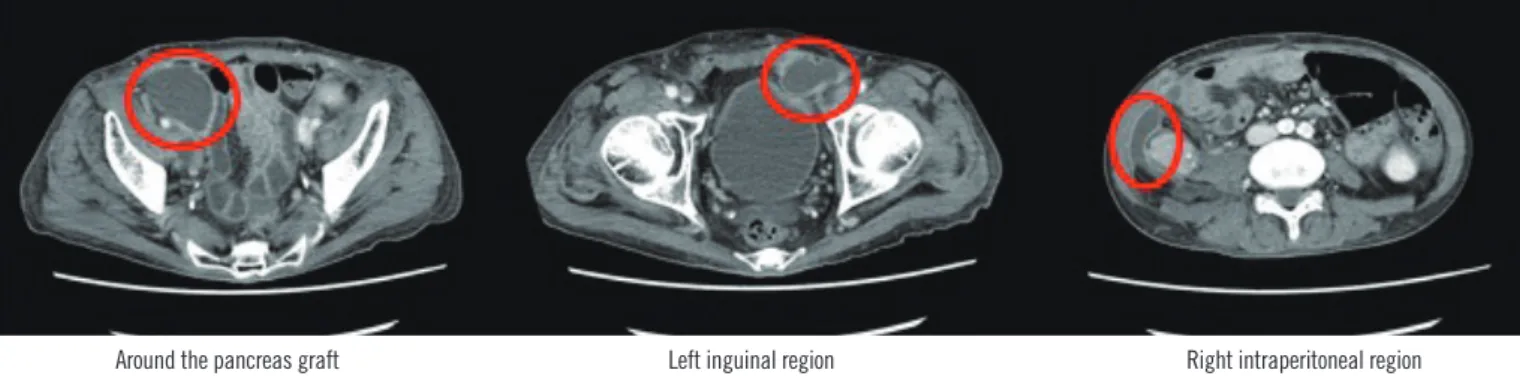
cefoperazone (1 g three times a day); however, his fever persisted and increased to 39.2˚C on postoperative day 29, and the white blood cell count rose to 10.7×10⁹/L. Another CT scan revealed the same abscesses around the pancreas graft as well as at the left inguinal and right intraperitoneal regions (Fig. 1).
On postoperative day 31, drainage was performed again and three abscess specimens were tested. Gram staining did not show any visible microorganisms. These specimens were then cultured on 5% sheep blood and chocolate agar media (Kyo- kuto Pharmaceutical Industrial Co., Ltd., Tokyo, Japan) under aerobic conditions with 5% carbon dioxide, bromothymol blue lactate (BTB) agar medium (Eikenkagaku Co., Ltd., Tokyo, Ja- pan) under anaerobic conditions, and ABHK/Bacteroides Bile Esculin (BBE) agar medium (Nissui Pharmaceutical Co., Ltd., Tokyo, Japan) under anaerobic conditions at 35˚C, respectively.
For two days, there was no apparent growth of microorganisms
Received: July 11, 2017
Revision received: October 19, 2017 Accepted: February 1, 2018
Corresponding author: Yumiko Okumura
Division of Infectious Diseases Laboratory, Department of Clinical Practice and Support, Hiroshima University Hospital, 1-2-3 Kasumi, Minami-ku, Hiroshimashi, Hiroshima 734-8551, Japan
Tel: +81-82-257-5546, Fax: +81-82-257-5546 E-mail: [email protected]
© Korean Society for Laboratory Medicine
This is an Open Access article distributed under the terms of the Creative Commons Attribution Non-Commercial License (http://creativecommons.org/licenses/by-nc/4.0) which permits unrestricted non-commercial use, distribution, and reproduction in any medium, provided the original work is properly cited.
1 / 1 CROSSMARK_logo_3_Test
2017-03-16 https://crossmark-cdn.crossref.org/widget/v2.0/logos/CROSSMARK_Color_square.svg
Okumura Y, et al.
M. hominis infection post-transplantation
382 www.annlabmed.org https://doi.org/10.3343/alm.2018.38.4.381 on 5% sheep blood/chocolate or BTB agar medium. However,
after three days, tiny translucent colonies slightly grew on the ABHK/BBE agar (Fig. 2A). After incubation for two more days, large water droplet-like colonies appeared on the ABHK/ BBE agar. A Gram-stained smear of colonies exhibited pink amor- phous structures without a distinct bacterial morphology (Fig.
2B). Therefore, we suspected mycoplasma. The colonies were sub-cultured on blood agar medium (Eikenkagaku Co., Ltd.) under aerobic conditions with 5% carbon dioxide at 35˚C and on Brucella HK agar medium (Kyokuto Pharmaceutical Indus-
trial Co., Ltd.) under anaerobic conditions at 35˚C.
The organism demonstrated more rapid growth under anaer- obic than aerobic conditions; colonies appeared on blood agar medium after 72-hour incubation and on Brucella HK agar me- dium after 48-hour incubation. A disk-diffusion test under an- aerobic conditions yielded a growth-inhibition zone around disks containing minocycline (MINO), clindamycin, ciprofloxacin, or levofloxacin, but not around those containing β-lactams or erythromycin. Based on the antimicrobial susceptibility profile, we suspected M. hominis infection. Amplification of part of the Fig. 1. Computed tomography (CT) scan of multiple abscesses. On postoperative day 29, the CT scan indicated abscesses around the pancreas graft and at the left inguinal and right intraperitoneal regions.
Around the pancreas graft Left inguinal region Right intraperitoneal region
Fig. 2. Bacteriological characterizations. (A) Colonies on the ABHK/BBE agar. Colonies grown on ABHK/BBE agar medium under anaero- bic conditions at 35˚C; tiny translucent colonies were slightly apparent after incubation for three days. (B) Gram-stained smear of colonies.
Gram stain (1,000×). No bacteria with complete cellular morphology were observed among the Gram-stained colonies, and only unclear structures such as granules were detectable.
A B
Okumura Y, et al.
M. hominis infection post-transplantation
https://doi.org/10.3343/alm.2018.38.4.381 www.annlabmed.org 383
16S rRNA region of chromosomal DNA from the colonies, using M. hominis-specific primers [2], yielded a 334-bp PCR product, confirming the identification of M. hominis from all specimens.
Therefore, on postoperative day 38, the antimicrobial agent was changed to MINO (100 mg twice a day); the patient’s fever re- solved, pathology improved, and he was discharged on postop- erative day 51.
Although rare, extragenital M. hominis infection is frequently associated with post-transplant infection of the lungs, heart, kid- ney, or liver [1, 3, 4]. Diabetes is the most common underlying condition of patients experiencing post-renal transplant infec- tion, with five of seven case reports published after 2,000 involv- ing diabetic patients [5-9].
Indeed, this patient was immunocompromised and at very high risk of infection following simultaneous pancreas-kidney transplantation. Generally, β-lactams are suggested for surgical- site antimicrobial prophylaxis; however, they are not applicable to M. hominis infection because this organism lacks a cell wall.
M. hominis is also resistant to clarithromycin and erythromycin [10], but is susceptible to clindamycin, tetracyclines, and fluo- roquinolones [1, 4].
Thus, M. hominis should be considered a potential etiological agent in the differential diagnosis of post-renal transplant surgi- cal-site infections, especially in immunocompromised patients and when there is no response to broad-spectrum β-lactams.
Blood cultures should be followed up for at least two - three days to monitor small colonies and recheck the Gram stain results.
Upon confirmation by PCR, suggestion of M. hominis infection that is unresponsive to clarithromycin and erythromycin is war- ranted to initiate appropriate treatment.
Authors’ Disclosures of Potential Conflicts of Interest
No potential conflicts of interest relevant to this article were re- ported.
REFERENCES
1. Meyer RD and Clough W. Extragenital Mycoplasma hominis infection in adults: emphasis on immunosuppression. Clin Infect Dis 1993;17:S243-9.
2. Blanchard A, Yañez A, Dybvig K, Watson HL, Griffiths G, Cassell GH.
Evaluation of intraspecies genetic variation within the 16S rRNA gene of Mycoplasma hominis and detection by polymerase chain reaction. J Clin Microbiol 1993;31:1358-61.
3. Sampath R, Patel R, Cunningham SA, Arif S, Daly RC, Badley AD, et al.
Cardiothoracic transplant recipient Mycoplasma hominis: an uncommon infection with probable donor transmission. EBioMedicine 2017;19:84- 90.
4. Horiuchi K, Matsumoto T, Ohno Y, Kasuga E, Negishi T, Yaguchi T, et al.
Intra-abdominal Mycoplasma hominis infection in a liver transplant re- cipient: a case report. Jpn J Infect Dis 2014;67:232-3.
5. Camara B, Mouzin M, Ribes D, Esposito L, Guitard J, Game X, et al.
Perihepatitis and perinephric abscess due to Mycoplasma hominis in a kidney transplant patient. Exp Clin Transplant 2007;5:708-9.
6. Geissdörfer W, Schörner C, Lohoff M. Systemic Mycoplasma hominis infection in a patient immunocompromised due to combined transplan- tation of kidney and pancreas. Eur J Clin Microbiol Infect Dis 2001;20:
511-2.
7. Loupy A, Join-Lambert OF, Bébéar CM, Legendre C, Anglicheau D. Uro- genital mycoplasma: an emerging cause of deep wound infection after kidney transplantation? NDT Plus 2008;4:239-40.
8. Pastural M, Audard V, Bralet MP, Rémy P, Salomon L, Tankovic J, et al.
Mycoplasma hominis infection in renal transplantation. Nephrol Dial Transplant 2002;17:495-6.
9. Rohner P, Schnyder I, Ninet B, Schrenzel J, Lew D, Ramla T, et al. Se- vere Mycoplasma hominis infections in two renal transplant patients.
Eur J Clin Microbiol Infect Dis 2004;23:203-4.
10. Pereyre S, Gonzalez P, De Barbeyrac B, Darnige A, Renaudin H, Char- ron A, et al. Mutations in 23S rRNA account for intrinsic resistance to macrolides in Mycoplasma hominis and Mycoplasma fermentans and for acquired resistance to macrolides in M. hominis. Antimicrob Agents Chemother 2002;46:3142-50.