1. INTRODUCTION
Today the hotel industry is one of the largest service industries and one that continues to expand (Gabor, 2003).
Since the hotel industry has reached the maturity stages of its life cycle (Lewis & Chambers, 2000), size of market already reached its’ maximum capacity. To survive in this challenging environment, many marketers and researchers have devel- oped various marketing strategies to help hotel survive in the competitive environment. Strategic, brand differentiation and brand extension are the key methods of brand characteristics, or a brand personality , that differentiates the brand from its competitors(Jiang, Dav, & Rao, 2002; Keller & Aaker, 1992).
This research focuses on recognizing and empirically testing
a relationship between brand personality congruence and brand extension, which can lead to effective marketing stra- tegies for the hotel industry. The objective of this research is to identify how brand personality congruence affects brand extension and to address how hotels should extend their brands. Many researchers have found that brand personality is the key issue in distinguishing a brand, developing an emotional side of that brand, and increasing the personal meaning of the brand to the customers (Crask & Laskey, 1990;
Landon, 1974; Levy, 1959; Ouwersloot & Tudorica, 2001).
Furthermore, Kotler (1991) stated that brand personality pro- duces a more consistent and stable outcome than brand image in environmental stimuli. Aaker (1997) insisted that brand personality has a positive impact on customer brand choice.
Information available at the Culinary Society of Korea (http://www.culinary.re.kr/)
Culinary Science & Hospitality Research
Journal & Article Management System: https://cshr.jams.or.kr/
http://dx.doi.org/10.20878/cshr.2017.23.6.010
Influence of Brand Extension on the Updated Hotel Brand
Personality Congruence and Attitude toward the Extended Brand
Hyungseo Ryu
President of O.T. Medical
KEYWORDS ABSTRACT
Brand personality, Brand personality
congruence, Brand extension, Image congruence, Attitude toward brand.
This research focused on recognizing and empirically testing a relationship between brand pers- onality congruence and brand extension, which can lead to effective marketing strategies for the hotel industry. The objective of this research was to identify how customer's brand personality con- gruence affect brand extension and to then address what the most appropriate brand extension types for hotel brands are. This study offered a better approach to assess the broader impact of extension strategy for the marketer managers. The methodology for achieving these objectives were described in the following sections: developing measurements based on extensive reviews of literature and analyzing data utilized a exploratory factor analysis and a series of simple linear re- gression analyses. The result of this study showed customer’s brand personality congruence had a great impact on the customer’s positive attitude toward core brand. However, customer’s attitude toward core brand had no impact on the updated attitude. The findings provided some theoretical and managerial implications for hotel operators.
Corresponding author: Hyungseo Ryu, President of O.T. Medical, Haeundae-gu, Songjung dong, Busan 48073, South Korea, Tel. +82-10-6618-9314,
Fax. +82-51-701-9314, E-mail: [email protected]
Brand personality may also be useful as an evaluation tool to identify customer brand acceptance. It is apparent then, that brand personality may have considerable on hotel brand extension. little research has been conducted about the rela- tionship between brand personality and brand extension, before and after extension, in the hospitality industry. There- fore, this research is designed to empirically test a relationship between pre and post -brand personality congruence and brand extension, in the hotel industry. Findings of this study will allow us to better assess the broader impact of extension strategy for the marketer.
2. LITERATURE REVIEW
2.1. Brand Personality
Marketing researchers defined brand personality in various ways. Brand personality refers to the set of human charac- teristics associated with a brand (Aaker, 1997) and as one of the core dimensions of the brand identity (Aaker, 1996). Brand personality as the concept of self-expression is defined as "the totality of the individual's thoughts and feelings having refe- rence to one self as an object" (Rosenberg, 1979). Customers use brands as symbolic devices to explain and express their own particular personality (De Chernatony & McWilliam, 1990).
King (1973) suggested that "people choose their brands the same way they choose their friends; in addition to the skills and physical characteristics, they simply like them as people."
Brand personality is created by the combination of all the experiences the consumer has with a brand (Ouwersloot &
Tudorica, 2001; Kotler, 2003). A well-established brand per- sonality can result in consumers having stronger emotional ties to the brand and greater trust and loyalty (Siguaw, Mattila, & Austin, 1999; Johnson, Soutar, & Sweeney, 2000).
Many researchers have found that brand personality is the key issue in distinguishing a brand, developing an emotional side of that brand, and increasing the personal meaning of the brand to the customers (Crask & Laskey, 1990; Landon, 1974;
Levy, 1959; Ouwersloot & Tudorica, 2001). Furthermore, Kotler (1991) stated that brand personality produces a more consis- tent and stable outcome than brand image in environmental stimuli. Ouwersloot and Tudoria (2001) argued that one ad- vantage of having strong brand personality is that it helps consumers differentiate between brands. Aaker (1997) insisted that brand personality has a positive impact on customer brand choice. Brand personality may also be useful as an eva-
luation tool to identify customer brand acceptance. It is appa- rent then, that brand personality may have considerable on hotel brand extension.
2.2. Brand Personality Congruence
Since Cooley (1902) suggested the self-concept theory, many researchers (Gardner & Levy, 1985; Onkvisit & Shaw, 1987;
Sirgy & Samli, 1985) have studied self-congruency theory and also have concluded that consumers have a preference for products with images that are congruent with their self-image.
Many marketing researchers have found a positive relation- ship between self-concept, ideal self-concept and brand choice.
Birdwell (1968) was the first researcher to measure the extent to which self-image is congruent with purchase. He concluded that personality affects an individual's choice of automobile and purchasing behavior consistent with a particular brand that conveys symbolic meaning of a customer's physical ex- tension of his/her personality. In many cases, consumers tend to express themselves by what they purchase. Consumers often purchase products or brands that maintain and/or en- hance their self image (Graeff, 1996). Consumer self-concept links to higher order needs like social or self-esteem needs (Maslow, 1970). The consumer's desire to promote self-consis- tency and self-esteem motivates him or her towards positive evaluations of a brand if user imagery is congruent with his or her desired self image (Fournier, 1998; Hogg, Cox, & Kee- ling, 2000, Sirgy, 1986; Aron & Debra, 2003). Consumers achieve self-consistency by holding positive attitudes toward and purchasing brands that they perceive to be similar to their self-concept. Brand (and associated personality) let consumers express that they are what they are, where they are, and how they want to be viewed by other people (Timothy, 1996).
Fournier (1998) also studied how consumers identify them- selves with brand by using idiographic analysis. According to Sirgy's congruence theory, the customers tend to behave favorably toward the brand when making purchasing and repurchasing decisions
2.3. Brand Extension
During the last decade, brand extension strategy has been the core of strategic growth for a variety of firm (Aaker, 1991;
Doyle, 1994). Brand extension strategy is performed on a
brand's own products or services for which the brand was not
originally created. Certain brands have such strong recog-
nition and identity that they can be used successfully to market other products. Aaker and Keller (1990) explained that brand extension involves the use of an established brand name to enter a new product category. Extensions are a natural strategy for the firm looking to grow by exploiting its assets.
Kotler (1991) defined brand extension as any effort to extend a successful brand name to launch new or modified products or product line. Brand extension is the practice of introducing a new brand (differentiated by market segment) using a well-established brand name as leverage (Jiang et al., 2002).
The leverage of a strong brand name can substantially reduce the risk of including a product in a new market by using consumer familiarity with and knowledge of an established brand. It also has been argued that when an extension uses well-established brand positioning, its chance of success is increased (Aaker & Keller, 1990; Boush & Loken, 1991; Sunde
& Brodie, 1993). Well-organized brand extension substantially reduces introductory marketing expenses and enhances success by helping gain retailer and consumer acceptance (Keller &
Aaker, 1992). Many managers use brand extension as a vehicle for growth (Springen & Miller, 1990). Aaker and Keller (1990) explored the assumptions in consumer behavior for success in brand extension: (1) consumers hold positive belief's and favorable attitudes toward the original brand; (2) these positive associations help form positive beliefs and favorable attitudes about the brand extension; and (3) negative asso- ciations are neither transferred to nor created by the brand extension.
2.4. Brand Extension Fit
Previous brand extension research has emphasized pri- marily the role of "fit" or similarity between the two products as an evaluation tool involved in creating a brand extension.
Tauber (1988) observed 276 actual extensions and concluded that perceptual fit, “Consumers perceiving the new item to be consistent with the parent brand.” Categorization judg- ment and the transfer of parent brand associations to the extension are particularly affected by consumer perceptions of fit (Aaker & Keller, 1990). The extension needs to fit the brand. The customer needs to be comfortable with the concept of the brand name being on the extension. If the fit is poor, desired associations will not transfer but will instead, distract, or even precipitate ridicule. When fit increases, con- sumers can more confidently transfer their favorable asso- ciations to an extension product (Aaker & Keller, 1990; Ottesen
& Gronhaug, 2002) and reduce the perceived likelihood of negative outcomes (DelVccchio & Smith, 2005). Park, Milberg, and Lawson (1991) concluded that different types of brand extension fit, specifically brand concept consistency and product level similarity, moderate the evaluation of extension products using the direct brand extension strategy. Therefore, different types of brand extension fit also may have different effects on the degree office customer's evaluation of the brand extension. The impact of brand extension fit on brand personality depends upon the perceived quality of the core brand.
For instance, JW Marriott and Marriott Marques are using the same brand name, "Marriott" and these two brands also provide upscale service to customers.
2.5. Attitude Toward a Brand (Extended Brand Personality)
When extension is accomplished, marketers and consumers can evaluate the extended brand. The success of brand extension is mainly explained by how the consumers evaluate the extension (Klink & Smith, 2001). According to Aaker and Keller (1990), consumer evaluations of brand extensions are determined primarily by the quality of the parent brand and the fit between the original and extension products categories. For the most part, brand acceptance and favorable attitudes toward the extended brand are tools for measuring brand extensions. Ries and Trout (1981) provide evidence that the wrong kind of brand extension may strip away invest- ments, time and resources, market opportunities, and brand trust. Loken and John (1993) also find that unsuccessful brand extension can dilute brand names by diminishing the favo- rable attitude beliefs that consumers have learned to associate with the brand name. Extending the brand could have an impact on the brand's personality dimensions (Diamantopou- los, Smith, & Grime, 2005).The similarity of brand personalities and the attitude toward the extended brand will be the evaluation tool to determine if a brand extension is successful.
The ideal result would be that the extended brand personality
would have the same brand personality or even improve the
level of a personality trait. In light of this, brand personalities
that define the brand extension should be used to evaluate
successes or failures. According to the interpersonal relation-
ship theory, when people evaluate another person, their per-
sonality is one of the most important factors of appraising
that person's value. Kotler (2003) stated in his marketing ma-
nagement book that personality leads to relatively consistent and enduring responses to environmental stimuli. Therefore, using the core brand personality as an independent variable and the brand personality of extended brands as a dependent variable should measure a hotel brand extension's success.
2.6. Hypothesis Development
Based on the review literature, research hypotheses of the effect of brand personality congruence of brand extension arc presented in this section. Because human personality and brand personality share many similar concepts (Epstein, 1977), brand personality can trigger a deep and strong relationship between customer and a brand, creating a special and per- sonal meaning to a customer (Aaker, 1996). King (1973) claimed that brand congruence was useful in evaluating a consumer's attitude level toward a brand. Thus, the greater the con- gruence with the brand personality, the more appealing and favorable the attitude toward the brand will be. Therefore, hypothesis 1 is suggested.
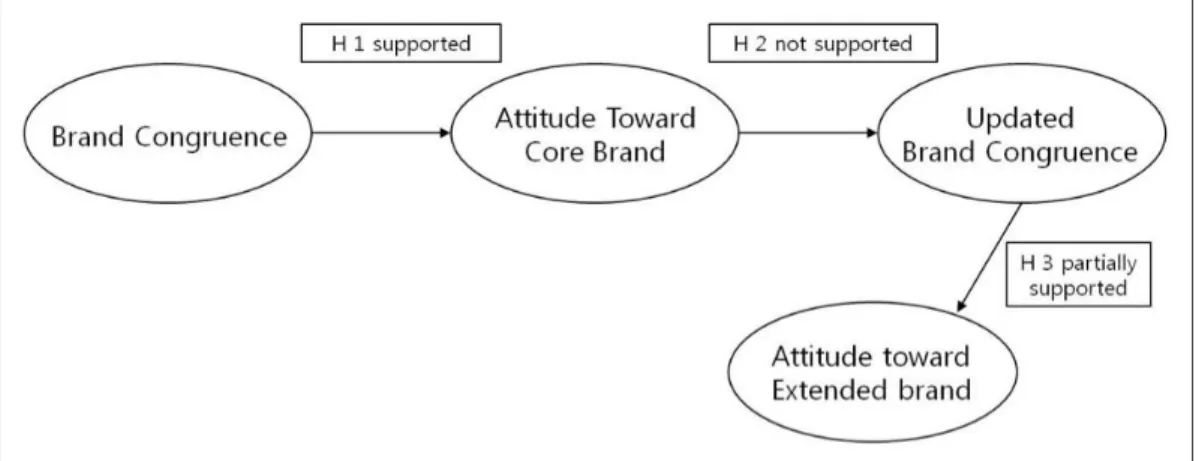
H 1: Brand personality congruence is positively associated with attitude toward the core brand.
Extending the brand could affect the brand's personality (Diamantopoulos et al., 2005). Loken and John (1993) also found that unsuccessful brand extension could dilute a brand name by diminishing the favorable attitude and beliefs that consumers have learned to associate with the brand name.
Ajzen and Fishbein (1980) stated that attitude directly in- fluences behavior, so in this study, we expect that brand extensions (similar and less similar) will affect customer atti- tudes toward a brand with a concomitant change in customer behavior due to brand congruence level and brand choice.
H 2: Attitude toward the core brand is positively associated with updated brand congruence.
A customer's experience with brand extension leads to a cumulative knowledge of product or service. This knowledge is stored in the customer's memory as product or service related intimacy and information (Park, Mothersbough, &
Feick, 1994). A new attitude forms or an existing attitude is retrieved from previous memory (Yi & Bagozzi, 1989). Exten- ding the brand may impact the brand's personality dimen- sions and customer attitudes toward a brand and service.
(Diamantopoulos et al., 2005). Thus, the updated brand con- gruence formed by brand extension may affect the customer's post experience attitude toward a brand.
H 3: Updated brand congruence positively affects one's attitude toward the extended brand.
3. METHODOLOGY
3.1. Measurement Development
Aaker and Maheswaran's (1997) 42 brand personality des- criptors were adapted to represent respondents' self-con- gruency with a hotel brand. A pilot test was conducted with a convenience sample of 65 social members in a Midwestern university was asked to participate in the pilot test before their bible study as a preliminary test of the final question- naire to ensure the appropriateness of measurements. One of the of the purposes pilot test was for modifying Brand per- sonality trait (BPT) to make it suitable for application in the lodging industry. The participants were asked to "Take a mo- ment to think about hotel, and then describe this hotel by personality adjectives such as friendly, confident, exciting, secure, original, or any personality expression listed below."
Perceptions from the BPT were evaluated using a five-point Likert-type scale from 1, "not at all," to 5, "extremely." The four items to measure personality congruence was adapted and modified from Sirgy's congruence theory (1982). A 7 -point Likert-type scale for personality congruence (e.g., "The typical guest at the Marriott hotel has personality characteristics similar to mine as perceived by others.") was used to assess brand personality congruence.
A factor analysis, descriptive analysis, and reliability analysis
were performed on the consumption emotion measure for
item reduction. A factor analysis was performed on the mea-
sure to identify the dimensions of brand personality in the
lodging industry. The factor analysis showed the possible
number of brand personality dimensions in the lodging
industry Following the pre-test, a pilot test of the instrument
was conducted prior to data collection as a preliminary test
of the final questionnaire. The pilot test was modified to in
further refine Aaker's (1997) BPT to increase construct validity
for the lodging industry. A convenience sample of 65 social
members in a Midwestern university was asked to participate
in the pilot test. Personality descriptors were modified based
on participant responses. One factor and 27 personality de-
scriptors were eliminated, leaving 13 brand personality descriptors for the questionnaire.
The sample population in this study was composed of include residences in Midwestern Southern area and, under- graduate/graduate students from a variety of majors as well as faculty members at a Midwestern and Southern universities.
The questionnaire consisted of the modified 13 personality descriptors, 13 self concepts, 4 subject brand personality and 4 attitudes toward brand. After reading the instructions, participants responded to a series of brand personality and self personality describing adjectives, assessing attitude to- ward core and extended brand. 458 include residences in Midwestern Southern area and, undergraduate/graduate stu- dents from a variety of majors as well as faculty members at a Midwestern and Southern universities were asked to participate in the study. Two hundred sixteen responses were returned out of 458 distributed questionnaires, resulting 32%
of response rate.
In this study, two extension scenarios were presented. Case 1 (retirement community) has the similar segment and pro- vide comparable style service to the core brand (Marriott hotel). Bhat and Reddy (1997) stated that the more similar the extension is to a parent brand, the more likely are consumers to identify the parent characteristics with the extension. So, Case 1 names as a good fit. Case2 was initiated as bad fit.
Organic food store is totally different segment and provide different type of service to customers. Extended brand per- sonality was evaluated by assessing the respondents' attitudes toward the extended brand and the brand personality congruence to the core brand. Attitude toward the extended brand was adapted from Oliver (1993), Oliver, Rust, and Varki (1997). A 7-point Likert-type scale (e.g., "When I need to go to a hotel, this hotel brand is the first hotel brand in my mind") was used to discover the attitude toward the extended brand.
4. RESULTS
4.1. Demographic Information
The mean for respondents' hotel stay was 6 days per year and the standard deviation was 7.5. The majority of respon- dents (64.8%) indicated that their annual household income was in the range of $20,001 to $50,000. Fifty-six percent of the respondents were female, and the mean age was 27 years old. Also, most respondents (54%) were Caucasian.
4.2. Descriptive Analysis and Factor Analysis
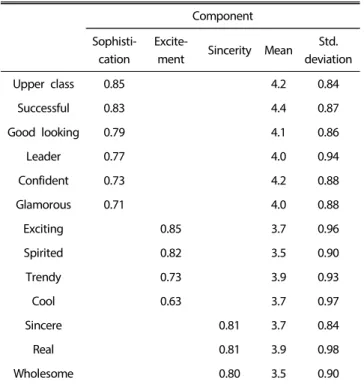
Descriptive analyses were performed on all attributes of brand personality, personality congruence and updated brand congruence in the questionnaire. A factor analysis and des- criptive analysis were performed on the brand personality measure for item reduction. The Kaiser-Meycr-Olkin Measure of Sampling Adequacy, which indicates the appropriateness of using factor analysis, was .68, which is an adequate level for conducting factor analysis (George & Mallery, 2001). Principal component analysis with VARIMAX rotation extracted three components, which accounted for 68.1% of the total variance explained. The variables "sophistication" and "competence"
were combined into one factor—“sophistication". The variable
"ruggedness" did not have a strong relationship with any component. Thus, this brand personality descriptor was dropped. A total of 3 factors and 13 brand personality items were finalized after the factor analysis.
For Case 1, the mean for the Personality item, "successful", had the highest value (4.4), followed by "upper class" (4.3),
"confident" (4.2), "good looking" (4.2), "Leader" (4.0), "gla- morous" (4.1), "trendy" (3.9), "real" (3.9), "cool” (3.7), "exciting"
(3.7), "sincere" (3.6), "spirited" (3.4), and "wholesome" (3.4).
These mean values for the Marriott hotel brand personality
Table 1. Factor analysis result
Component Sophisti-
cation
Excite-
ment Sincerity Mean Std.
deviation
Upper class 0.85 4.2 0.84
Successful 0.83 4.4 0.87
Good looking 0.79 4.1 0.86
Leader 0.77 4.0 0.94
Confident 0.73 4.2 0.88
Glamorous 0.71 4.0 0.88
Exciting 0.85 3.7 0.96
Spirited 0.82 3.5 0.90
Trendy 0.73 3.9 0.93
Cool 0.63 3.7 0.97
Sincere 0.81 3.7 0.84
Real 0.81 3.9 0.98
Wholesome 0.80 3.5 0.90
The mean score stated as 1 (not at all descriptive) to 5 (extremely
descriptive).
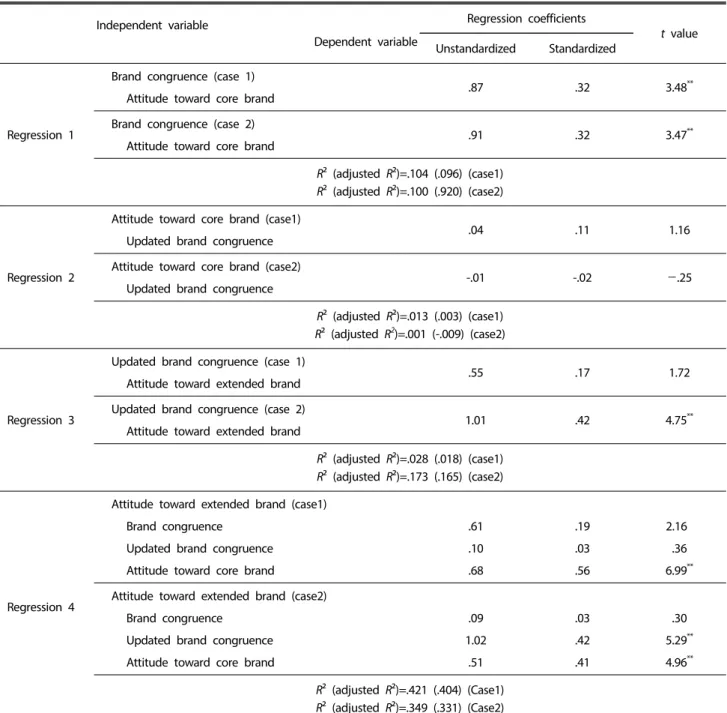
Table 2. Regression estimates of equations
Independent variable
Dependent variable
Regression coefficients
t value Unstandardized Standardized
Regression 1
Brand congruence (case 1)
Attitude toward core brand .87 .32 3.48
**Brand congruence (case 2)
Attitude toward core brand .91 .32 3.47
**R² (adjusted R²)=.104 (.096) (case1) R² (adjusted R²)=.100 (.920) (case2)
Regression 2
Attitude toward core brand (case1)
Updated brand congruence .04 .11 1.16
Attitude toward core brand (case2)
Updated brand congruence -.01 -.02 -.25
R² (adjusted R²)=.013 (.003) (case1) R² (adjusted R
2)=.001 (-.009) (case2)
Regression 3
Updated brand congruence (case 1)
Attitude toward extended brand .55 .17 1.72
Updated brand congruence (case 2)
Attitude toward extended brand 1.01 .42 4.75
**R² (adjusted R²)=.028 (.018) (case1) R² (adjusted R²)=.173 (.165) (case2)
Regression 4
Attitude toward extended brand (case1) Brand congruence
Updated brand congruence Attitude toward core brand
.61 .10 .68
.19 .03 .56
2.16 .36 6.99
**Attitude toward extended brand (case2) Brand congruence
Updated brand congruence Attitude toward core brand
.09 1.02
.51
.03 .42 .41
.30 5.29
**4.96
**R² (adjusted R²)=.421 (.404) (Case1) R² (adjusted R²)=.349 (.331) (Case2)
**