Introduction
BK virus-associated nephropathy (BKVAN) is an impor-
tant factor for allograft kidney prognosis in kidney trans- plant recipients (KTRs) [1,2]. One research study reported that the mean rate of graft loss by BKVAN was 46.2% [3].
There are a number of different prevalence and prognos- tic factors of BKVAN because each center has variable immunosuppressant protocols [3,4]. It is well known, based on many studies on BKVAN in kidney transplanta- tion (KT), that the short-term prognosis of patients with BKVAN is good [5], but the long-term prognosis is still uncertain.
The purpose of this study is to present the long-term prognosis and risk factors of graft failure in KTRs with BKVAN.
Long-term prognosis of BK virus-associated nephropathy in kidney transplant recipients
Woo Yeong Park
1,3, Seong Sik Kang
1,3, Kyubok Jin
1,3, Sung Bae Park
1,3, Misun Choe
2,3, Seungyeup Han
1,31
Department of Internal Medicine, Keimyung University School of Medicine, Daegu, Korea
2
Department of Pathology, Keimyung University School of Medicine, Daegu, Korea
3
Keimyung University Kidney Institute, Daegu, Korea
Background: The long-term prognosis of BK virus-associated nephropathy (BKVAN) in kidney transplant recipients (KTRs) is uncertain. We evaluated the long-term prognosis in KTRs with BKVAN and the clinical significance of BKVAN on post-transplant clinical outcome.
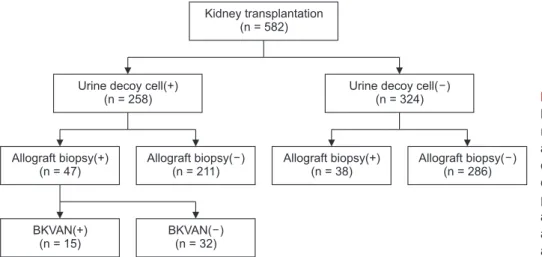
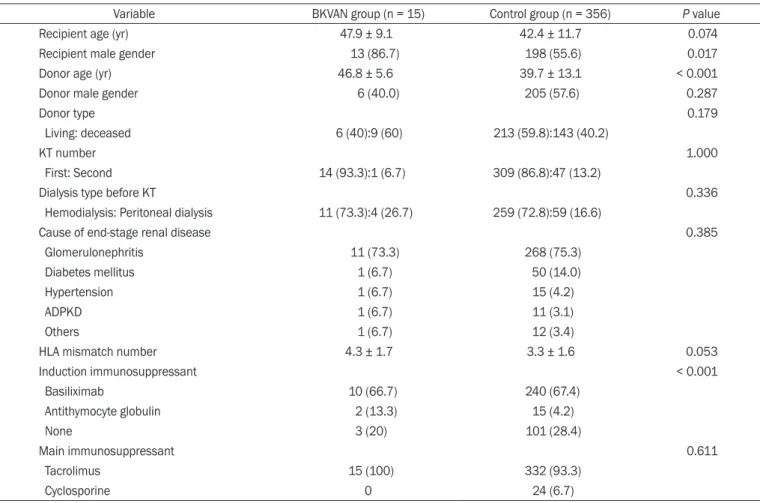
Methods: We retrospectively analyzed the medical records of 582 patients who underwent kidney transplant (KT) between 2001 and 2014. We divided the patients into a BKVAN group (15 patients) diagnosed by allograft biopsy and a control group (356 patients).
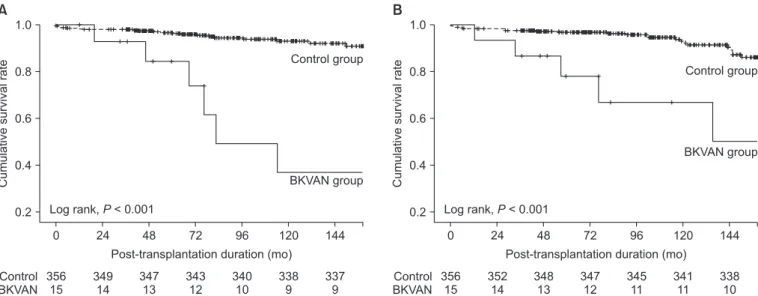
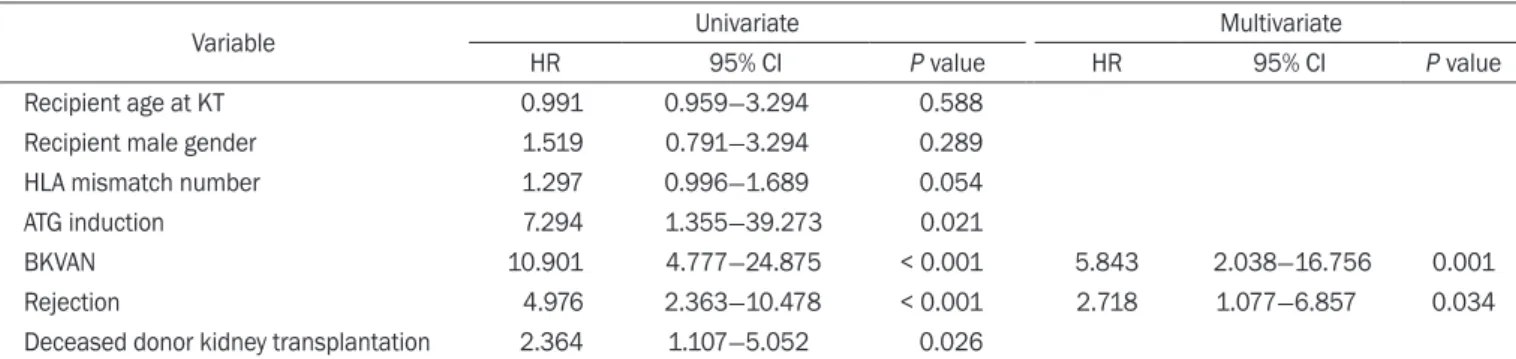
Results: The incidence of BKVAN was 4.0%, and the mean follow-up duration was 93.1 ± 52.3 months. Median time from KT to BKVAN diagnosis was 5.9 months (interquartile range [IQR], 4.4-8.7). In the BKVAN group, 9 (60.0%) KTRs with combined acute rejection progressed to graft failure, and the median time from BKVAN diagnosis to graft failure was 36.2 months (IQR, 9.7-65.5). Death-censored graft survival rate and patient survival rate in the BKVAN group were significantly lower than those in the control group. BKVAN and rejection were independent risk factors for graft failure. In the subgroup analysis, death-censored graft survival rate of KTRs with BKVAN with acute rejection was significantly worst in comparison with similar patients without BKVAN regardless of acute rejection (P < 0.001).
Conclusion: The long-term prognosis of BKVAN with acute rejection was very poor because of graft failure caused by inadequate treatment for acute rejection considering BKVAN. Therefore, we should carefully monitor the allograft status of KTRs through regular surveillance tests after treatment for BKVAN with acute rejection.
Keywords: BK virus, Graft survival, Kidney transplantation, Prognosis, Rejection
Kidney Res Clin Pract 37:167-173, 2018(2) pISSN: 2211-9132 • eISSN: 2211-9140 https://doi.org/10.23876/j.krcp.2018.37.2.167
KIDNEY RESEARCH
AND CLINICAL PRACTICE
Received December 13, 2017; Revised March 20, 2018;
Accepted April 23, 2018 Correspondence: Seungyeup Han
Department of Internal Medicine, Keimyung University School of Medicine and Keimyung University Kidney Institute, 56 Dalseong-ro, Jung-gu, Daegu 41931, Korea. E-mail: [email protected]
ORCID: http://orcid.org/0000-0002-7561-6534 Copyright © 2018 by The Korean Society of Nephrology
CC