• 검색 결과가 없습니다.

Culprit-Lesion-Only Versus Multivessel Revascularization Using Drug-Eluting Stents in Patients With ST-Segment Elevation Myocardial Infarction: A Korean Acute Myocardial Infarction Registry-Based Analysis

N/A
N/A
Protected

Academic year: 2021

Share "Culprit-Lesion-Only Versus Multivessel Revascularization Using Drug-Eluting Stents in Patients With ST-Segment Elevation Myocardial Infarction: A Korean Acute Myocardial Infarction Registry-Based Analysis"

Copied!
8
0
0

로드 중.... (전체 텍스트 보기)

전체 글

(1)

718

Open Access

Culprit-Lesion-Only Versus Multivessel Revascularization Using Drug-Eluting Stents in Patients With ST-Segment Elevation Myocardial Infarction: A Korean Acute Myocardial

Infarction Registry-Based Analysis

Hyun Su Jo, MD

1

, Jong Seon Park, MD

1

, Jang Won Sohn, MD

1

, Joon Cheol Yoon, MD

1

, Chang Woo Sohn, MD

1

, Sang Hee Lee, MD

1

, Geu Ru Hong, MD

1

, Dong Gu Shin, MD

1

, Young Jo Kim, MD

1

, Myung Ho Jeong, MD

2

, Shung Chull Chae, MD

3

, Seung Ho Hur, MD

4

, Taek Jong Hong, MD

5

, In Whan Seong, MD

6

, Jei Keon Chae, MD

7

, Jay Young Rhew, MD

8

, In Ho Chae, MD

9

, Myeong Chan Cho, MD

10

, Jang Ho Bae, MD

11

, Seung Woon Rha, MD

12

, Chong Jin Kim, MD

13

, Dong Hoon Choi, MD

14

, Yang Soo Jang, MD

14

, Jung Han Yoon, MD

15

,

Wook Sung Chung, MD

16

, Ki Bae Seung, MD

16

, and Seung Jung Park, MD

17

1

Division of Cardiology, Department of Internal Medicine, Yeungnam University Hospital, Daegu,

2

Department of Internal Medicine, Chonnam National University Medical School, Gwangju,

3

Department of Internal Medicine, Kyungpook National University

College of Medicine, Daegu,

4

Department of Internal Medicine, Keimyung University College of Medicine, Daegu,

5

Department of Internal Medicine, Pusan National University School of Medicine, Busan,

6

Department of Internal Medicine, Chungnam National University College of Medicine, Daejeon,

7

Department of Internal Medicine, Chonbuk National University College of Medicine, Jeonju,

8

Department of Internal Medicine, Jeonju Presbyterian Medical Center, Jeonju,

9

Department of Internal Medicine, Seoul National University College of Medicine, Seongnam,

10

Department of Internal Medicine, Chungbuk National University College of Medicine, Cheongju,

11

Department of Internal Medicine, Konyang University College of Medicine, Daejeon,

12

Department of Internal Medicine, Korea University College of Medicine, Seoul,

13

Department of Internal Medicine, Kyunghee University College of Medicine, Seoul,

14

Department of Internal Medicine, Yonsei University Severans Hospital, Seoul,

15

Department of Internal Medicine, Yonsei University Wonju Christian Hospital, Wonju,

16

Department of Internal Medicine, The Catholic University of Korea Seoul St. Mary’s Hospital, Seoul,

17

Department of Internal Medicine, Asan Medical Center, University of Ulsan College of Medicine, Seoul, Korea

ABSTRACT

Background and Objectives: In patients with ST-segment elevation myocardial infarction (STEMI) and multivessel dis- ease, complete revascularization (CR) for non-culprit lesions is not routinely recommended. The aim of this study was to compare the clinical outcomes of multivessel compared with infarct-related artery (IRA)-only revascularization in patients undergoing primary percutaneous coronary intervention (PCI) for STEMI. Subjects and Methods: From the Korean Acute Myocardial Infarction Registry (KAMIR) database, 1,094 STEMI patients with multivessel disease who underwent primary PCI with drug-eluting stents were enrolled in this study. The patients were divided into two groups: culprit-vessel- only revascularization (COR, n=827) group; multivessel revascularization, including non-IRA (MVR, n=267) group. The primary endpoint of this study included major adverse cardiac events (MACEs), such as death, myocardial infarction, or tar- get or nontarget lesion revascularization at one year. Results: There was no difference in clinical characteristics between the two groups. During the one-year follow-up, 102 (15.2%) patients in the COR group and 32 (14.2%) in the MVR group ex- perienced at least one MACE (p=0.330). There were no differences between the two groups in terms of rates of death, myo- cardial infarction, or revascularization (2.1% vs. 2.0%, 0.7% vs. 0.8%, and 11.7% vs. 10.1%, respectively; p=0.822, 0.910, and 0.301, respectively). The MACE rate was higher in the incompletely revascularized patients than in the completely revascu- larized patients (15% vs. 9.5%, p=0.039), and the difference was attributable to a higher rate of nontarget vessel revascular- ization (8.6% vs. 1.8%, p=0.002). Conclusion: Although multivessel angioplasty during primary PCI for STEMI did not re- duce the MACE rate compared with culprit-vessel-only PCI, CR was associated with a lower rate of repeat revascularization after multivessel PCI. (Korean Circ J 2011;41:718-725)

KEY WORDS: Myocardial infarction; Coronary artery disease; Angioplasty.

Received: Fabruary 22, 2011 / Revision Received: March 16, 2011 / Accepted: June 20, 2011

Correspondence: Jong Seon Park, MD, Division of Cardiology, Department of Internal Medicine, Yeungnam University Hospital, 170 Hyeonchung-ro, Nam-gu, Daegu 705-717, Korea

Tel: 82-53-620-3847, Fax: 82-53-654-8386, E-mail: [email protected]

• The authors have no financial conflicts of interest.

cc
This is an Open Access article distributed under the terms of the Creative Commons Attribution Non-Commercial License (http://creativecommons.org/li-

censes/by-nc/3.0) which permits unrestricted non-commercial use, distribution, and reproduction in any medium, provided the original work is properly cited.

(2)

Introduction

The incidence of acute myocardial infarction (AMI) in South Korea increased 2.6-fold from 1997 to 2007.

1)

From the Korean Acute Myocardial Infarction Registry (KAMIR) data between November 2005 and December 2007, ST-segment elevation myocardial infarction (STEMI) accounted for 60%

of all AMI cases,

2)

with 52% of the STEMI patients having sig- nificant stenosis of the noninfarct-related arteries.

3)

The pa- thophysiological process in AMI is not limited to a single co- ronary lesion but involves the whole coronary arterial tree.

4)

These patients with multivessel disease are at a higher risk of cardiogenic shock as well as in-hospital and long-term morta- lity than the cases of single-vessel disease.

5)6)

Moreover, pati- ents with multiple complex lesions have a high incidence of re- current acute coronary syndrome and revascularization;

4)

how- ever, in multivessel coronary intervention in the context of AMI, there are concerns about procedure-related complica- tions,

7)

lower success rates,

8)

and increased contrast use and nephropathy.

9)

Therefore, both the American College of Car- diology/American Heart Association (ACC/AHA) 2004 gui- delines and the ACC/AHA/Society for Cardiac Angiography and Interventions 2005 guidelines have recommended that simultaneous coronary intervention for nonculprit lesions sh- ould not be performed in hemodynamically stable patients because this approach may be associated with an increased risk of adverse outcomes.

10)11)

Recently, due to advances in de- vices, antiplatelet therapy, and technology, complete revas- cularization (CR) can safely be accomplished,

8)

and a recent randomized trial has shown that in a contemporary homoge- neous cohort of patients with STEMI and multivessel coronary artery disease (CAD) treated with primary percutaneous coro- nary intervention (PCI), culprit-lesion-only angioplasty was associated with the highest rate of cardiac events compared with multivessel treatment, with the patients scheduled for st- aged revascularization experiencing a similar rate of major ad- verse cardiac events (MACEs) as the patients undergoing com- plete simultaneous treatment of noninfarct-related artery (IRA).

12)

Therefore, the optimal management of patients with multi- vessel disease in this setting remains still unclear.

The aim of this study was to compare the one-year clinical outcomes between the two different strategies during prima- ry PCI with drug-eluting stents (DES) in patients with STEMI and multivessel CAD.

Subjects and Methods

Patient population and study design

This study is based on a database collected by KAMIR. KA- MIR is a prospective, multicenter, observational registry de- signed to examine current epidemiology, in-hospital manage- ment, and outcome of patients with AMI in South Korea in

commemoration of the 50th anniversary of the Korean Cir- culation Society.

13)14)

Fifty hospitals with facilities for prima- ry PCI participated in this study. Well-trained study coordi- nators collected data based on the standard protocol, and registered onto the web-based program. The ethics commit- tee of each participating hospital approved the study proto- col. The purpose and methods used to register patients in the KAMIR study have been previously described.

15)

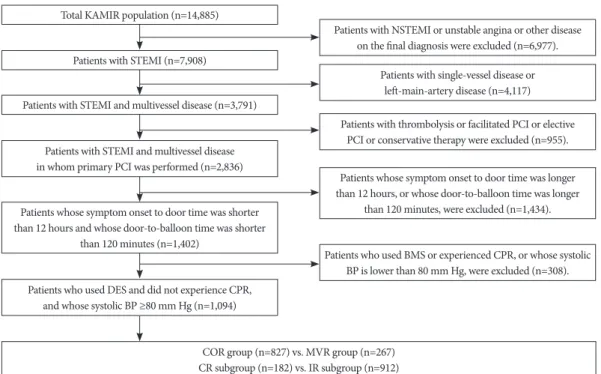
From the KAMIR database (14,885 patients), data of 3,791 eligible STEMI patients with multivessel CAD (defined as

>70% diameter stenosis of two or more epicardial coronary ar- teries or their major branches by visual estimation) and who underwent primary PCI using drug-eluting stents within the period from November 2005 to November 2008 were collected.

ST-segment elevation myocardial infarction patients with prolonged (more than 30 minutes) chest pain starting less than 12 hours before hospital arrival, typical electrocardiogra- phy changes, and a door-to-balloon time of less than 120 min- utes were included (Fig. 1).

Patients with cardiogenic shock at presentation (systolic blo- od pressure: ≤90 mm Hg), left main coronary disease (≥50%

diameter stenosis), and receiving bare-metal stents were ex- cluded from the study. The eligible patients were divided into two groups and were further divided into two subgroups:

1) Culprit-vessel-only revascularization (COR) group: the IRA only was dilated, and the other arteries were left untreat- ed during the primary procedure or index hospitalization.

2) Multivessel revascularization (MVR) group: revascula- rization of more than one vessel.

3) Complete revascularization subgroup: the IRA was op- ened, followed by dilatation of all other significantly narrowed arteries during the primary procedure or index hospitaliza- tion.

4) Incomplete revascularization (IR) subgroup: the IRA was successfully opened, followed by dilatation of only the signi- ficantly narrowed artery in three-vessel disease during the pri- mary procedure or index hospitalization.

Definitions and endpoints

The diagnosis of AMI was based on clinical presentations, increased levels of cardiac biomarkers (increase in levels of creatine kinase-MB, troponin-I, or troponin-T), and 12-lead electrocardiographic findings. Among these patients, patients with an ST-segment elevation of at least 1 mm in two or more contiguous limb electrocardiographic leads or 2 mm in pre- cordial leads were defined as STEMI patients.

The primary endpoint of the study was the incidence of

MACE defined as cardiac or noncardiac death, reinfarction,

and repeat coronary revascularization (target vessel or nontar-

get vessel PCI) at one year. As the follow-up period was count-

ed from the date of discharge, in-hospital events (death, rein-

farction) were not defined as MACE. For repeat revascula-

(3)

rization, all PCIs or coronary artery bypass grafts (CABGs) occurring after the baseline procedure were included. Recur- rent myocardial infarction was defined as recurrent symp- toms with new electrocardiographic changes reflecting MI or increased levels of cardiac biomarkers at least twice the upper normal limit.

16)

Target lesion revascularization (TLR) was defined as PCI for restenosis or other complications of treated lesion segment from 5 mm proximal to 5 mm distal to the stent.

17)

Target vessel revascularization (TVR) was de- fined as repeated PCI for any segment of the entire coronary artery proximal and distal to target lesion, except for TLR.

Percutaneous coronary intervention procedures and follow-up

All patients had coronary lesions with ≥50% stenosis in ≥2 coronary arteries. Coronary arterial lesion type was determin- ed according to the ACC/AHA classification. The diagnosis of the culprit vessel was based on coronary angiographic find- ings, 12-lead electrocardiogram, two-dimensional echocar- diogram and noninvasive stress test, if possible. All patients re- ceived loading doses of aspirin 100-300 mg and clopidogrel 300-600 mg before PCI. A 50-70 U/kg dose of unfractionat- ed heparin was used before or during PCI to maintain an ac- tivated clotting time of 250-300 seconds. After PCI, daily main- tenance doses of aspirin 100 mg and clopidogrel 75 mg were prescribed. A glycoprotein IIb/IIIa inhibitor was used in pa- tients with large thrombotic burden on angiography at the operator’s discretion. Clinical follow-up was performed for 12 months.

Statistical analysis

Continuous variables are presented as mean±SD, and cat- egorical variables as percentages. Categorical variables were compared among groups using the χ

2

test, whereas continu- ous variables were compared with the analysis of variance test.

Kaplan-Meier curves were used to represent the survival and cumulative incidence of events to the follow-up. For the end- point “death,” the patients were censored at the time of death or at the 12-month follow-up if alive. For MACE, the patients were censored at the date of first MACE or at the 12-month follow-up. All tests were two-sided, and a p of less than 0.05 was considered statistically significant. All analyses were per- formed using the Statistical Package for the Social Sciences software, version 18.0 for Windows.

Results

Baseline characteristics

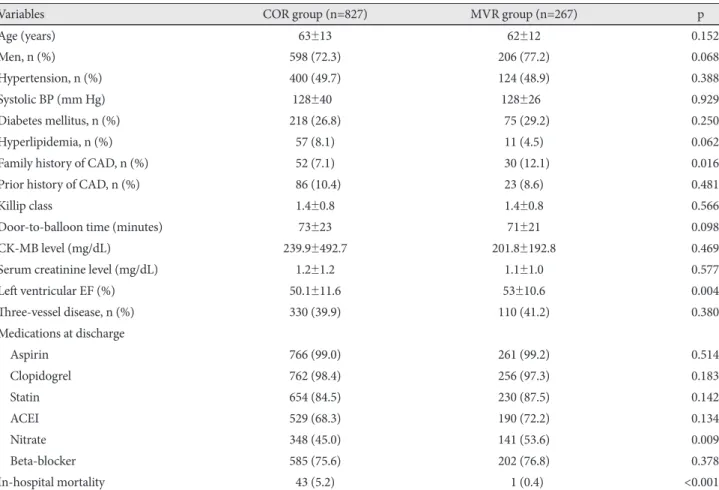
One thousand and ninety four patients with STEMI and multivessel CAD who met the inclusion criteria were in- cluded in the follow-up (Fig. 1). The mean age was 63.1±12.7 years, and 804 (73.5%) were men. The COR group included 827 (75.6%) patients, and the MVR group 267 (24.4%) pa- tients. The CR subgroup included 182 (16.6%) patients, and the IR subgroup included 912 (83.4%) patients (Fig. 1). Ta- ble 1 and 2 show the distribution of the baseline characteris- tics between the two groups. The two groups were similar in terms of age, gender, risk factors, enzymatic infarct size, Thrombolysis in Myocardial Infarction (TIMI) flow grade,

Total KAMIR population (n=14,885)

Patients with NSTEMI or unstable angina or other disease on the final diagnosis were excluded (n=6,977).

Patients with single-vessel disease or left-main-artery disease (n=4,117) Patients with thrombolysis or facilitated PCI or elective

PCI or conservative therapy were excluded (n=955).

Patients whose symptom onset to door time was longer than 12 hours, or whose door-to-balloon time was longer

than 120 minutes, were excluded (n=1,434).

Patients who used BMS or experienced CPR, or whose systolic BP is lower than 80 mm Hg, were excluded (n=308).

Patients with STEMI (n=7,908) Patients with STEMI and multivessel disease (n=3,791)

Patients with STEMI and multivessel disease in whom primary PCI was performed (n=2,836)

Patients whose symptom onset to door time was shorter than 12 hours and whose door-to-balloon time was shorter

than 120 minutes (n=1,402)

Patients who used DES and did not experience CPR, and whose systolic BP ≥80 mm Hg (n=1,094)

COR group (n=827) vs. MVR group (n=267) CR subgroup (n=182) vs. IR subgroup (n=912)

Fig. 1. Flowchart of patients who participated in the study. KAMIR: Korean Acute Myocardial Infarction Registry, NSTEMI: non-ST-elevation

myocardial infarction, STEMI: ST-elevation myocardial infarction, PCI: percutaneous coronary intervention, BMS: bare-metal stent, CPR: car-

diopulmonary resuscitation, BP: blood pressure, DES: drug-eluting stent, COR: culprit-vessel-only revascularization, MVR: multivessel re-

vascularization, CR: complete revascularization, IR: incomplete revascularization.

(4)

and creatinine level, whereas there was a difference in the mean left ventricular ejection fraction (LVEF) (higher in the MVR group). Nitrate therapy was more frequent in the MVR group, whereas the two groups had similar propor- tions of other therapies.

Cardiovascular events

Forty-four (4.0%) patients died during index hospitaliza-

tion, 31 (2.8%) from cardiac causes. Of them, 43 (5.2%) pati- ents were in the COR group and in the IR subgroup, and 1 (0.4%) patient was in the MVR group and in the CR subgr- oup. The in-hospital mortality was higher in the COR group than in the MVR group (p<0.001). However, the multivariate analysis after adjusting for age, sex, Killip class, post-MI TIMI flow, systolic blood pressure, LVEF, existence or nonexist- ence of complications, and serum creatinine, did not show that Table 1. Baseline clinical characteristics

Variables COR group (n=827) MVR group (n=267) p

Age (years) 63±13 62±12 0.152

Men, n (%) 598 (72.3) 206 (77.2) 0.068

Hypertension, n (%) 400 (49.7) 124 (48.9) 0.388

Systolic BP (mm Hg) 128±400 128±260 0.929

Diabetes mellitus, n (%) 218 (26.8) 075 (29.2) 0.250

Hyperlipidemia, n (%) 57 (8.1) 11 (4.5) 0.062

Family history of CAD, n (%) 52 (7.1) 030 (12.1) 0.016

Prior history of CAD, n (%) 086 (10.4) 23 (8.6) 0.481

Killip class 1.4±0.8 1.4±0.8 0.566

Door-to-balloon time (minutes) 73±23 71±21 0.098

CK-MB level (mg/dL) 239.9±492.7 201.8±192.8 0.469

Serum creatinine level (mg/dL) 1.2±1.2 1.1±1.0 0.577

Left ventricular EF (%) 50.1±11.6 53±10.6 0.004

Three-vessel disease, n (%) 330 (39.9) 110 (41.2) 0.380

Medications at discharge

Aspirin 766 (99.0) 261 (99.2) 0.514

Clopidogrel 762 (98.4) 256 (97.3) 0.183

Statin 654 (84.5) 230 (87.5) 0.142

ACEI 529 (68.3) 190 (72.2) 0.134

Nitrate 348 (45.0) 141 (53.6) 0.009

Beta-blocker 585 (75.6) 202 (76.8) 0.378

In-hospital mortality 43 (5.2) 01 (0.4) <0.001

BP: blood pressure, CAD: coronary artery disease, CK-MB: creatine kinase-myocardial band isoenzyme, EF: ejection fraction, ACEI: angio- tensin-converting enzyme inhibitor, COR: culprit-vessel-only revascularization, MVR: multivessel revascularization

Table 2. Baseline angiographic characteristics

Variables COR group (n=825) MVR group (n=267) p

Culprit artery

LAD, n (%) 375 (45.5) 119 (44.6) 0.832

RCA, n (%) 367 (44.5) 106 (39.7) 0.178

LCX, n (%) 83 (10.1) 042 (15.7) 0.015

Type B2/C lesion, n (%)* 649 (84.9) 211 (81.8) 0.237

Preprocedural TIMI flow 0.8±1.1 0.9±1.2 0.131

Postprocedural TIMI flow 2.9±0.4 3.0±0.3 0.005

Stent size for target lesion (mm) 26.0±6.40 26.0±6.70 0.937

Total number of stents 1.3±0.6 2.4±1.0 0.001

*Based on the American College of Cardiology/American Heart Association coronary artery lesion definition. LAD: left anterior descending

artery, RCA: right coronary artery, LCX: left circumflex artery, TIMI: Thrombolysis in Myocardial Infarction, COR: culprit-vessel-only revas-

cularization, MVR: multivessel revascularization

(5)

the culprit-only PCI was significantly associated with higher in-hospital mortality (p=0.995) which had a significant p in the univariate analysis. Low post-TIMI flow (odds ratio:

0.191; 95% confidence interval: 0.044-0.834; p=0.028) and the existence of complications during index hospitalization (odds ratio: 21.916; 95% confidence interval: 1.145-419.361;

p=0.028) were significantly associated with higher in-hospi- tal mortality. The in-hospital mortality was also higher in the IR subgroup than in the CR subgroup (p=0.002).

The rates of complications during the procedure were simi- lar between the two groups. All four acute CVA patients were in the COR group. One patient with acute thrombosis was in the MVR group and in the CR subgroup. Of the three rein- farction patients, two were in the COR group, and one was in the MVR group and in the CR subgroup. One case of acute renal failure was in the MVR group and in the IR subgroup.

The other complications were ventricular tachycardia, ventri- cular fibrillation, atrial fibrillation, cardiogenic shock, multi- organ failure, bleeding, and atrioventricular block.

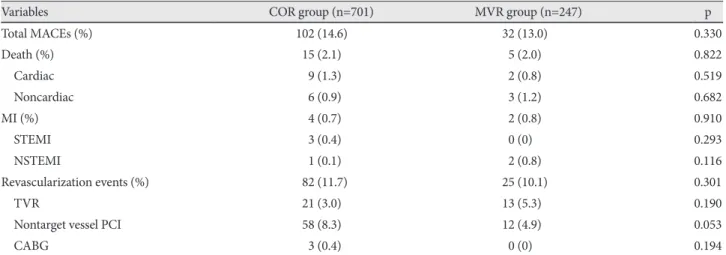
After a mean follow-up of 9.0±4.2 months from the date of discharge, 23 (2.4%) patients died, 14 (1.5%) from cardiac causes. Throughout the follow-up, 134 (14.4%) patients ex- perienced at least one MACE, 102 (14.9%) in the COR group and 32 (13.0%) in the MVR group (p=0.379). Seven patients (five in the COR group and two in the MVR group) experi- enced reinfarction (MI) while 107 patients (82 in the COR group and 25 in the MVR group) underwent re-PCI or CA- BG (Table 3). The Kaplan-Meier analysis showed no signifi- cant difference between the two groups for survival free of total MACE and of all kinds of MACE (Fig. 2).

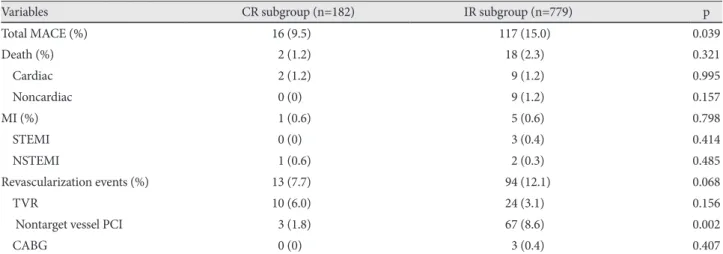
However, the Kaplan-Meier analysis showed significant differences between the two subgroups (the CR and IR sub- groups) for survival free of total MACE and nontarget vessel PCI (Table 4). The survival free of total MACE and nontar- get vessel PCI was lower in the IR subgroup (p=0.039 and

0.002, respectively) (Fig. 3). Fifteen of 85 patients in the MVR group and in the IR subgroup experienced at least one MACE.

Of them, nine patients underwent nontarget vessel PCI.

Discussion

This study was designed to compare MVR with COR in patients with STEMI and multivessel CAD; it is the first study to compare MVR with COR in patients with STEMI in Asia.

The main finding of the present study was that in hemodyna- mically stable patients with multiple coronary lesions treated by primary PCI using DES, MVR had a lower rate of in-hos- pital mortality and, after a mean follow-up of 9.0±4.2 months, it had better clinical outcomes in non-target vessel PCI-relat- Table 3. One-year MACE in the COR and MVR groups

Variables COR group (n=701) MVR group (n=247) p

Total MACEs (%) 102 (14.6) 32 (13.0) 0.330

Death (%) 015 (2.1) 05 (2.0) 0.822

Cardiac 009 (1.3) 02 (0.8) 0.519

Noncardiac 006 (0.9) 03 (1.2) 0.682

MI (%) 004 (0.7) 02 (0.8) 0.910

STEMI 003 (0.4) 00 (0) 0.293

NSTEMI 001 (0.1) 02 (0.8) 0.116

Revascularization events (%) 082 (11.7) 25 (10.1) 0.301

TVR 021 (3.0) 13 (5.3) 0.190

Nontarget vessel PCI 058 (8.3) 12 (4.9) 0.053

CABG 003 (0.4) 00 (0) 0.194

MACEs: major adverse cardiac events, MI: myocardial infarction, STEMI: ST-segment elevation myocardial infarction, NSTEMI: non-ST-seg- ment elevation myocardial infarction, TVR: target vessel revascularization, PCI: percutaneous coronary intervention, CABG: coronary artery bypass graft, COR: culprit-vessel-only revascularization, MVR: multivessel revascularization

Fig. 2. One-year MACE-free survival in the COR and MVR groups.

MACE: major adverse cardiac event, COR: culprit-vessel-only re- vascularization, MVR: multivessel revascularization.

1.0

0.8

0.6

0.4

0.2

0.0

Follow up duration (days)

M AC E fre e s ur vi va l

0 100 200 300 400 Total MACE, Log-rank p=0.330

COR group

MVR group

(6)

ed events than with the treatment of IRA alone. However, the additional treatment of non-IRA during primary PCI or in- dex hospitalization, resulted in a similar risk of death, MI, TVR, and CABG compared with the culprit-vessel-only procedure.

Revascularization of the nonIRA probably prevented myo- cardial ischemia, and these differences were associated with better clinical outcomes in the multivessel PCI group of the present study.

Due to the increased numbers of implanted coronary stents, multivessel PCI was prone to higher in-stent restenosis rates.

18)

However in the present study, the TLR and TVR rates were statistically similar between the two groups. The reason for the higher in-hospital mortality rates in the culprit-vessel-only group despite the absence of differences in the baseline clini-

cal characteristics and complications is not clear. It might be associated with other factors, such as indications for PCI (elec- tive, urgent, and emergent), presence of chronic total obstruc- tion, and duration of procedure.

According to the current guidelines, PCI should be perform- ed only in IRA, at least in patients without cardiogenic sh- ock.

10)11)

However, data from the National Cardiovascular Data Registry showed that multivessel PCI should not be performed in even hemodynamically unstable patients.

19)

This is based on the hypothesis that single-vessel PCI has a more favorable benefit-to-risk ratio and better financial im- plications. Some studies suggest that the more conservative strategy of treating only the IRA could avoid the complica- tions arising from longer procedures, such as the larger use of Table 4. One-year MACE rate in the CR and IR subgroups

Variables CR subgroup (n=182) IR subgroup (n=779) p

Total MACE (%) 16 (9.5) 117 (15.0) 0.039

Death (%) 02 (1.2) 018 (2.3) 0.321

Cardiac 02 (1.2) 009 (1.2) 0.995

Noncardiac 00 (0) 009 (1.2) 0.157

MI (%) 01 (0.6) 005 (0.6) 0.798

STEMI 00 (0) 003 (0.4) 0.414

NSTEMI 01 (0.6) 002 (0.3) 0.485

Revascularization events (%) 13 (7.7) 094 (12.1) 0.068

TVR 10 (6.0) 024 (3.1) 0.156

Nontarget vessel PCI 03 (1.8) 067 (8.6) 0.002

CABG 00 (0) 003 (0.4) 0.407

MACEs: major adverse cardiac events, MI: myocardial infarction, STEMI: ST-segment elevation myocardial infarction, NSTEMI: non-ST-seg- ment elevation myocardial infarction, TVR: target vessel revascularization, PCI: percutaneous coronary intervention, CABG: coronary artery bypass graft, CR: complete revascularization, IR: Incomplete revascularization

Fig. 3. A: one-year MACE-free survival in the CR and IR subgroups. B: one-year nontarget vessel percutaneous coronary intervention-free sur- vival in the CR and IR subgroups. MACE: major adverse cardiac event, CR: complete revascularization, IR: Incomplete revascularization.

1.0

0.8

0.6

0.4

0.2

0.0

1.0

0.8

0.6

0.4

0.2

0.0

Follow up duration (days) Follow up duration (days)

M AC E fre e s ur vi va l N on -ta rg et ve ss el PC I f re e s ur vi va l

0 100 200 300 400 0 100 200 300 400

Total MACE, Log-rank p=0.039 Non-target vessel PCI Log-rank p=0.002

IR group IR group

CR group CR group

A B

(7)

a contrast medium with a potentially increased risk of con- trast-induced nephropathy (CIN), increased administration or radiation, as well as the danger of ischemia in noninfarct- ed myocardial regions.

20)21)

In recent years, with the development of new advanced devices and the use of platelet glycoprotein IIb/IIIa inhibitors, the outcome of multivessel PCI has markedly improved.

22)23)

Some reports have indicated that the multivessel approach is safe and cost-effective. Brener et al.

24)

retrospectively examin- ed more than 100,000 patients with acute coronary syndro- mes, and demonstrated a similar incidence of in-hospital ev- ents between patients receiving single and multivessel treat- ment. Ijsselmuiden et al.

8)

randomly assigned 219 patients with acute coronary syndromes to culprit-only versus MVR, and they found that the multivessel approach had better outcomes by decreasing the need for further interventions.

A recent randomized trial by Politi et al.

12)

has shown that in 214 patients with STEMI and multivessel CAD treated with primary PCI, COR angioplasty was associated with the high- est rate of MACE compared with multivessel treatment, and that the patients scheduled for staged revascularization ex- perienced a similar rate of MACE as the patients undergoing complete simultaneous treatment of non-IRA during the mean 2.5-year follow-up period. The findings in the present study were similar to those of the randomized trial by Politi et al. in which the incidence of repeat revascularization and in-hospital mortality were higher in the single-vessel strategy.

As the definition of MACE and the follow-up duration in the present study were different from those in the trial discussed above, the total MACE results were different. Although the study by Kim et al.

25)

using the same KAMIR data focused on NSTEMI patients, the findings in the present study were also similar to those of the said study, in which the incidence of in- hospital mortality was higher in the culprit-only group, MVR reduced nonTVR, and there were no significant differences in the TLR.

Only one case of CIN was observed in the MVR group and in the IR subgroup. The rates of the other procedure-related or procedure-nonrelated complications were not different be- tween the COR and MVR groups. Therefore, it was found that compared with the single-vessel approach, MVR is safe and is associated with a lower risk of nontarget PCI at a mean follow-up of 9.0±4.2 months. Moreover, CR is associated with a low risk of MACE. This result is attributable mainly to the lower incidence of nontarget vessel PCI in the CR subgroup compared with the COR group, and the result is mainly at- tributable to the nine added events of nontarget vessel PCI in 85 patients of the MVR group but of the IR subgroup. A pos- sible explanation for the protective effect of multivessel PCI is that it allows a more complete treatment of other potentially unstable plaques. Indeed, the inflammatory reaction arising during acute coronary syndromes, and responsible for plaque

instability is not limited to the culprit lesion, but involves the entire coronary tree.

4)

Although simultaneous revascularization was not distingu- ished from staged revascularization, the results suggest that the multivessel and complete approach during primary PCI or index hospitalization is safe and is possibly less expensive than an incomplete approach, through a reduction in the probability of further unplanned procedures.

Limitations

The possible limitations of the present study were the im- balance in the number of patients in the two groups and the difference in the LVEF. The lack of data on stent thrombosis and CIN during the follow-up period also limits the compari- son of safety between MVR and culprit-only revasculariza- tion. The present study was not a randomized controlled tri- al, and a selection bias may have existed. However, due to the absence of significant differences in the baseline characteris- tics in this study, propensity score matching was not needed in the present study.

Since protocol on selection did not exist, the selection of the culprit vessel under similar conditions varied among op- erators. In patients with multivessel PCI, simultaneous PCI could not be distinguished from staged PCI during index hospitalization. The registry has no information on this dis- tinction. Although, the analysis was conducted by adjusting all the possible confounding factors, other factors could be as- sociated with the clinical outcomes.

Conclusions

In-hospital mortality was higher in the culprit-vessel-only PCI group than in the multivessel angioplasty group, and was also higher in the IR subgroup than in the CR subgroup.

Although multivessel angioplasty during primary PCI with DES for STEMI did not reduce the rates of death, rein- farction, TLR, TVR, and CABG compared with culprit-ves- sel-only PCI at one year, CR was associated with reduced non- TVR events. This finding of the present study should be fur- ther corroborated in a randomized controlled trial, and if con- firmed, it may eventually lead to the recommendation of mul- tivessel and CR for patients with STEMI and multivessel CAD.

REFERENCES

1) Hong JS, Kang HC, Lee SH, Kim J. Long-term trend in the incidence of acute myocardial infarction in Korea: 1997-2007. Korean Circ J 2009;39:467-76.

2) Sim DS, Kim JH, Jeong MH. Differences in clinical outcomes be- tween patients with ST-elevation versus non-ST-elevation acute myo- cardial infarction in Korea. Korean Circ J 2009;39:297-303.

3) Lee MG, Jeong MH, Ahn Y, et al. Impact of the metabolic syndrome on the clinical outcome of patients with acute ST-elevation myocardial infarction. J Korean Med Sci 2010;25:1456-61.

4) Goldstein JA, Demetriou D, Grines CL, Pica M, Shoukfeh M, O’Neill

WW. Multiple complex coronary plaques in patients with acute myo-

(8)

cardial infarction. N Engl J Med 2000;343:915-22.

5) Muller DW, Topol EJ, Ellis SG, Sigmon KN, Lee K, Califf RM. Mul- tivessel coronary artery disease: a key predictor of short-term progno- sis after reperfusion therapy for acute myocardial infarction: Throm- bolysis and Angioplasty in Myocardial Infarction (TAMI) Study Group.

Am Heart J 1991;121:1042-9.

6) Parodi G, Memisha G, Valenti R, et al. Five year outcome after pri- mary coronary intervention for acute ST elevation myocardial infarc- tion: results from a single centre experience. Heart 2005;91:1541-4.

7) Shishehbor MH, Topol EJ, Mukherjee D, et al. Outcome of multives- sel coronary intervention in the contemporary percutaneous revascu- larization era. Am J Cardiol 2006;97:1585-90.

8) Ijsselmuiden AJ, Ezechiels J, Westendorp IC, et al. Complete versus culprit vessel percutaneous coronary intervention in multivessel dis- ease: a randomized comparison. Am Heart J 2004;148:467-74.

9) Marenzi G, Assanelli E, Campodonico J, et al. Contrast volume dur- ing primary percutaneous coronary intervention and subsequent con- trast-induced nephropathy and mortality. Ann Intern Med 2009;150:

170-7.

10) Antman EM, Anbe DT, Armstrong PW, et al. ACC/AHA guidelines for the management of patients with ST-elevation myocardial infarc- tion: a report of the American College of Cardiology/American Heart Association Task Force on Practice Guidelines (Committee to Revise the 1999 Guidelines for the Management of patients with acute myo- cardial infarction). J Am Coll Cardiol 2004;44:E1-211.

11) Smith Jr SC, Feldman TE, Hirshfeld Jr JW, et al. ACC/AHA/SCAI 2005 guideline update for percutaneous coronary intervention: a re- port of the American College of Cardiology/American Heart Associa- tion Task Force on Practice Guidelines (ACC/AHA/SCAI Writing Committee to Update 2001 Guidelines for Percutaneous Coronary In- tervention). J Am Coll Cardiol 2006;113:e166-286.

12) Politi L, Sgura F, Rossi R, et al. A randomized trial of target-vessel versus multi-vessel revascularization in ST-elevation myocardial infarc- tion: major adverse cardiac events during long-term follow-up. Heart 2010;96:662-7.

13) Lee KH, Jeong MH, Ahn YK, et al. Gender differences of success rate of percutaneous coronary intervention and short term cardiac events in Korea Acute Myocardial Infarction Registry. Int J Cardiol 2008;130:

227-34.

14) Kwon TG, Bae JH, Jeong MH, et al. N-terminal pro-B-type natriuretic peptide is associated with adverse short-term clinical outcomes in pa-

tients with acute ST-elevation myocardial infarction underwent prima- ry percutaneous coronary intervention. Int J Cardiol 2009;133:173-8.

15) Lee SR, Jeong MH, Ahn YK, et al. Clinical safety of drug-eluting st- ents in the Korea Acute Myocardial Infarction Registry. Circ J 2008;72:

392-8.

16) Thygesen K, Alpert JS, White HD. Universal definition of myocardial infarction. Eur Heart J 2007;28:2525-38.

17) Cutlip DE, Windecker S, Mehran R, et al. Clinical end point in coro- nary stent trials: a case for standardized definitions. Circulation 2007;

115:2344-51.

18) Ellis SG, Roubin GS, King SB 3rd, et al. Angiographic and clinical pre- dictors of acute closure after native vessel coronary angioplasty. Cir- culation 1988;77:372-9.

19) Cavender MA, Milfort-Beland S, Roe MT, Peterson ED, Weintraub WS, Rao SV. Prevalence, predictors, and in-hospital outcomes of non-infarct artery intervention during primary percutaneous coro- nary intervention for ST-segment elevation myocardial infarction (from the National Cardiovascular Data Registry). Am J Cardiol 2009;104:

507-13.

20) Roe MT, Cura FA, Joski PS, et al. Initial experience with multivessel percutaneous coronary intervention during mechanical reperfusion for acute myocardial infarction. Am J Cardiol 2001;88:170-3.

21) Corpus RA, House JA, Marso SP, et al. Multivessel percutaneous coronary intervention in patients with multivessel disease and acute myocardial infarction. Am Heart J 2004;148:493-500.

22) Kornowski R, Mehran R, Satler LF, et al. Procedural results and late clinical outcomes following multivessel coronary stenting. J Am Coll Cardiol 1999;33:420-6.

23) Moussa I, Reimers B, Moses J, et al. Long-term angiographic and clinical outcome of patients undergoing multivessel coronary stenting.

Circulation 1997;96:3873-9.

24) Brener SJ, Milford-Beland S, Roe MT, Bhatt DL, Weintraub WS, Brindis RG. Culprit-only or multivessel revascularization in patients with acute coronary syndromes: an American College of Cardiology National Cardiovascular Database Registry report. Am Heart J 2008;

155:140-6.

25) Kim MC, Jeong MH, Ahn Y, et al. What is optimal revascularization

strategy in patients with multivessel coronary artery disease in non-ST-

elevation myocardial infarction? Multivessel or culprit-only revascula-

rization. Int J Cardiol 2010 [Epub ahead of print].

수치

Fig. 1. Flowchart of patients who participated in the study. KAMIR: Korean Acute Myocardial Infarction Registry, NSTEMI: non-ST-elevation  myocardial infarction, STEMI: ST-elevation myocardial infarction, PCI: percutaneous coronary intervention, BMS: bare-
Table 2. Baseline angiographic characteristics
Fig. 2. One-year MACE-free survival in the COR and MVR groups.
Fig. 3. A: one-year MACE-free survival in the CR and IR subgroups. B: one-year nontarget vessel percutaneous coronary intervention-free sur- sur-vival in the CR and IR subgroups

참조

관련 문서

Second, immediate CR was performed in 69% of patients versus staged-CR in 31% during the index admission. Regardless of CR strategy, both immediate CR and staged-CR were

Purpose: The optimum loading dose of clopidogrel has not been established in Asian patients with ST-segment elevation myocardial infarction (STEMI) under- going primary