• 검색 결과가 없습니다.

Clinical Characteristics and Outcomes of Acute ST-Segment Elevation Myocardial Infarction in Younger Korean Adults.

N/A
N/A
Protected

Academic year: 2021

Share "Clinical Characteristics and Outcomes of Acute ST-Segment Elevation Myocardial Infarction in Younger Korean Adults."

Copied!
10
0
0

로드 중.... (전체 텍스트 보기)

전체 글

(1)

Korean Circulation Journal

Introduction

Acute myocardial infarction (AMI) is one of the most common causes of death worldwide, and it is more common in persons of advancing age.

1)

Because of world population ageing, many countries have attempted to reduce the incidence and mortality rate of AMI. The representative primary and secondary prevention measures for cardiovascular disease are smoking cessation, weight reduction, lowering the blood pressure, and decreasing the glucose and cholesterol levels. In Korea, like other developed countries, a national effort has resulted in a decrease in the overall incidence of AMI over the last few years.

2)

However, there is no significant

Print ISSN 1738-5520 • On-line ISSN 1738-5555

Clinical Characteristics and Outcomes of Acute ST-Segment Elevation Myocardial Infarction in Younger Korean Adults

Seung Hun Lee, MD 1 , Ju Han Kim, MD 1 , Myung Ho Jeong, MD 1 , Hyukjin Park, MD 1 , Yun Ah Jeong, MD 1 , Youngkeun Ahn, MD 1 , Jong Hyun Kim, MD 2 , Shung Chull Chae, MD 3 , Young Jo Kim, MD 4 , Seung Ho Hur, MD 5 , In Whan Seong, MD 6 , Taek Jong Hong, MD 7 , Donghoon Choi, MD 8 , Myeong Chan Cho, MD 9 , Chong Jin Kim, MD 10 , Ki Bae Seung, MD 11 , Wook Sung Chung, MD 11 , Yang Soo Jang, MD 8 , Jeong Gwan Cho, MD 1 , Jong Chun Park, MD 1 , Seung Jung Park, MD 12 , and Other Korea Acute Myocardial Infarction Registry Investigators

1
The Heart Center of Chonnam National University Hospital, Gwangju,

2

The Cardiovascular Center, Hanseo Hospital, Busan,

3

Department of Internal Medicine, Kyungpook National University Hospital, Daegu,

4

Department of Internal Medicine, Yeungnam University Hospital, Daegu,

5

Department of Internal Medicine, Keimyung University Dongsan Medical Center, Daegu,

6

Department of Internal Medicine, Chungnam National University Hospital, Daejeon,

7

Department of Internal Medicine, Pusan National University Hospital, Busan,

8

Department of Internal Medicine, Yonsei University Severans Hospital, Seoul,

9

Department of Internal Medicine, Chungbuk National University Hospital, Cheongju,

10

Department of Internal Medicine, Kyunghee University College of Medicine, Seoul,

11

Department of Internal Medicine, The Catholic University of Korea Hospital, Seoul,

12

Department of Internal Medicine, Asan Medical Center, University of Ulsan College of Medicine, Seoul, Korea

Background and Objectives: This study aims to investigate the clinical features, angiographic findings, and outcomes of younger Korean ST-segment elevation myocardial infarction (STEMI) patients.

Subjects and Methods: We analyzed major adverse cardiac events (MACE) in the Korea Acute Myocardial Infarction Registry from November 2005 to October 2010. The registered patients were divided into two groups; young age group (<65 years) and old age group (≥65 years).

Results: The young age group included 5281 patients (age, 53±7.8 years), and the old age group included 4896 patients (age, 74.3±6.5 years). Male gender, smoking, family history, dyslipidemia, and metabolic syndrome were more frequently observed in the young age group than in the old age group (89.5% vs. 59.3%, p<0.001; 77.3% vs. 47.2%, p<0.001; 11% vs. 4.6%, p<0.001; 11.2% vs. 7.7%, p<0.001; 67.6% vs.

62.9%, p<0.001). Most of the young Korean adults with STEMI complained of typical chest pain (89.8%), and they had a shorter symptom- to-door time (12±53.2 hours vs. 17.3±132 hours, p=0.010). The young age group showed a favorable prognosis, which was represented by the MACE, compared with the old age group at one month (1.8% vs. 2.8%, p=0.028), six months (6.8% vs. 8.2%, p<0.001), and twelve months (10.1% vs. 11.9%, p=0.025). However, there was no significant difference in the adjusted MACE rate at one month {hazard ratio (HR) 0.95, 95% confidence interval (CI) 0.60-1.51, p=0.828} and twelve months (HR 0.86, 95% CI 0.68-1.10, p=0.233).

Conclusion: Younger Korean adults with STEMI have clinical outcomes similar to old aged patients, and therefore, they should be treated intensively like the elderly patients. (Korean Circ J 2015;45(4):275-284)

KEY WORDS: Myocardial infarction; Young adult; Prognosis.

Received: March 3, 2015 Revision Received: April 8, 2015 Accepted: April 9, 2015

Correspondence: Ju Han Kim, MD, The Heart Center of Chonnam National University Hospital, 42 Jebong-ro, Dong-gu, Gwangju 501-757, Korea Tel: 82-62-220-6246, Fax: 82-62-223-3105

E-mail: [email protected]

• The authors have no financial conflicts of interest.

This is an Open Access article distributed under the terms of the Creative Commons Attribution Non-Commercial License (http://creativecommons.

org/licenses/ by-nc/3.0) which permits unrestricted non-commercial use,

distribution, and reproduction in any medium, provided the original work

is properly cited.

(2)

change in the incidence of AMI in younger patients.

Previous studies showed an approximately 2 to 10% incidence of AMI in younger patients.

3-5)

Remarkable changes in lifestyle and diet, and improvement in the socio-economic status have been noted in Korea over decades. These changes have led to obesity, increased levels of blood pressure, glucose, and cholesterol in younger Korean adults. As a result, these patients are in an increased atherothrombotic state.

Because the emerging risk factors, clinical manifestations, and outcomes of acute ST-segment elevation myocardial infarction (STEMI) in younger Korean adults are unclear, this study aims to investigate the clinical profiles of younger STEMI patients through a one-year follow-up.

Subjects and Methods

Korea Acute Myocardial Infarction Registry (KAMIR) is a Korean, prospective, open, observational, multicenter on-line registry of AMI supported by the Korean Society of Cardiology. The collected data were merged with an intention to improve the statistical power.

Protocols and details of KAMIR have been published elsewhere.

6)

 The registry protocols were verified and approved by the Institutional Review Board of each participating center. AMI was diagnosed by the characteristic presentation, serial changes on electrocardiogram (ECG) suggesting infarction, and an increase in cardiac enzymes.

7)

STEMI was defined as a new ST elevation in ≥2 contiguous leads, measuring >0.2 mV in leads V1-3 or 0.1 mV in all other leads, or a new left branch bundle block on a 12-lead ECG with a concomitant increase in troponin-I or -T.

Study design and patient population

From November 2005 to October 2010, 27852 patients with a final diagnosis of AMI were enrolled in the KAMIR. Among them, we selected the patients with STEMI and excluded the patients whose recorded data, including demographic features, angiographic findings, and procedure details, were invalid or incomplete. We divided the patients into two groups according to the age at admission: young age group (under the age of 65 years) and old age group (65 years of age or older).

8)

Finally, a total of 10177 patients were enrolled in this study.

Study variables

Demographic data and baseline clinical characteristics including age, gender, body mass index (BMI) at admission, presenting symptoms, classical cardiovascular risk factors {hypertension (HTN), diabetes mellitus (DM), dyslipidemia (DL), smoking status, and family history of coronary heart disease (CHD)}, and other co-morbidities

were identified. Initial vital signs including systolic blood pressure, diastolic blood pressure, and heart rate were measured. Obesity was defined as BMI ≥25 kg/m².

9)

Metabolic syndrome was defined according to the revised National Cholesterol Education Program Adult Treatment Panel III criteria.

10)

Attending physicians and/or cardiologists evaluated the patients using the Killip classification and also analyzed the electrocardiogram findings in all patients.

Blood samples for baseline laboratory tests were collected at admission or before percutaneous coronary intervention (PCI). Also, blood was collected for lipid profile after an overnight fast. The left ventricular ejection fraction (LVEF) was measured by two- dimensional electrocardiography using the biplane Simpson’s method before discharge.

11)

Initial treatment strategy for STEMI included primary PCI, facilitated PCI, thrombolysis, or conservative treatment, which was at the discretion of the attending physicians and/or cardiologists.

Primary PCI was defined as emergent PCI performed within 12 hours after admission,

12)

and/or PCI in patients with continuing ischemic symptoms, cardiogenic shock, and acute severe heart failure, even after 12 hours.

13-15)

During the index PCI, the interventional cardiologists had made some important decisions about using balloon pre-dilatation and intracoronary stents. Pre- procedure and post-procedure coronary flow in the target vessel was graded according to the classification used in the Thrombolysis In Myocardial Infarction (TIMI) trials.

16)

All of the patients with STEMI were treated with optimal medications which were recommended by the evidence-based guidelines during hospitalization and after discharge.

Clinical outcomes

We analyzed the major adverse cardiac events (MACE) defined as a composite of cardiac death, myocardial infarction (MI), and repeated PCI (target lesion or target vessel revascularization, or non-target vessel revascularization) or coronary bypass graft (CABG). Cardiac death was defined as death due to pump failure, arrhythmia, or mechanical complications including ventricular septal rupture and free wall rupture. Follow-up data were obtained by reviewing the medical records and/or telephone interview of patients. All data were entered into an electronic web-based case- report form.

Statistical analysis

For discrete variables, differences were expressed as counts and

percentages, and differences between groups were analyzed using

the Chi-square test (or Fisher’s exact) as appropriate. For continuous

variables, differences between groups were evaluated using the

unpaired t-test or Mann-Whitney rank-sum test. Multivariate Cox

(3)

regression analyses were performed using all available variables that could be of potential relevance in determining the impact of different age groups on clinical outcomes. In addition, multivariate

logistic regression analyses were performed to determine the factors predicting cumulative one-year MACE in the young and old age groups. First, all of the variables such as the initial clinical

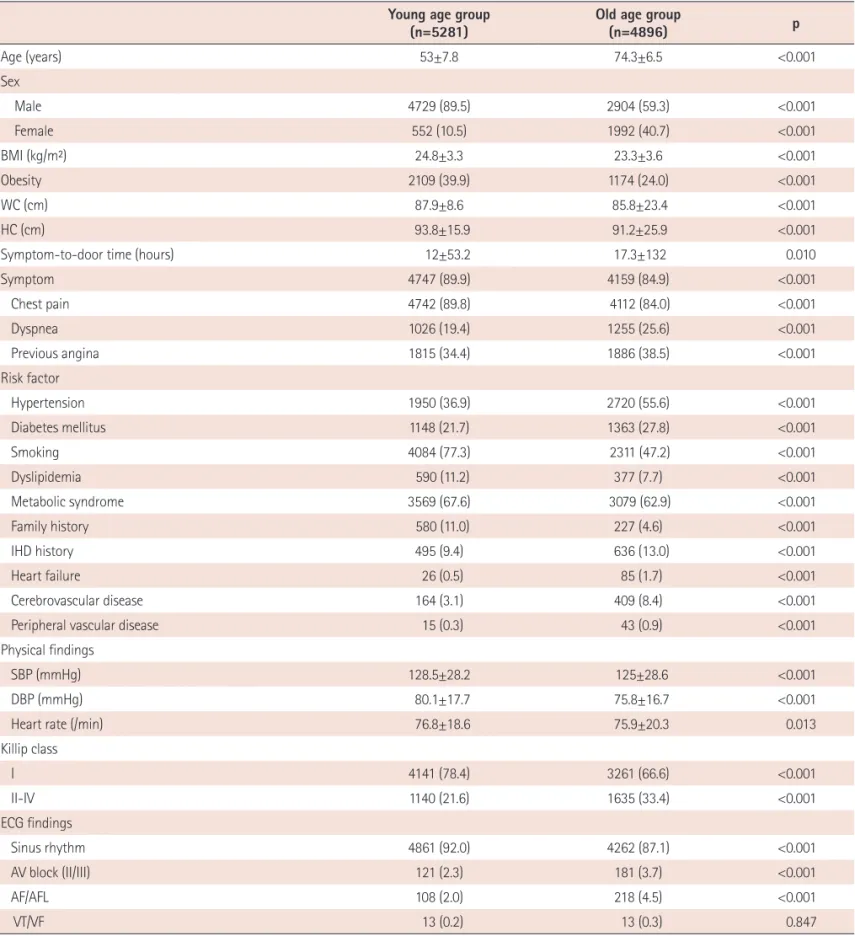
Table 1. Baseline clinical characteristics

Young age group

(n=5281) Old age group

(n=4896) p

Age (years) 53±7.8 74.3±6.5 <0.001

Sex

Male 4729 (89.5) 2904 (59.3) <0.001

Female 552 (10.5) 1992 (40.7) <0.001

BMI (kg/m²) 24.8±3.3 23.3±3.6 <0.001

Obesity 2109 (39.9) 1174 (24.0) <0.001

WC (cm) 87.9±8.6 85.8±23.4 <0.001

HC (cm) 93.8±15.9 91.2±25.9 <0.001

Symptom-to-door time (hours) 12±53.2 17.3±132 0.010

Symptom 4747 (89.9) 4159 (84.9) <0.001

Chest pain 4742 (89.8) 4112 (84.0) <0.001

Dyspnea 1026 (19.4) 1255 (25.6) <0.001

Previous angina 1815 (34.4) 1886 (38.5) <0.001

Risk factor

Hypertension 1950 (36.9) 2720 (55.6) <0.001

Diabetes mellitus 1148 (21.7) 1363 (27.8) <0.001

Smoking 4084 (77.3) 2311 (47.2) <0.001

Dyslipidemia 590 (11.2) 377 (7.7) <0.001

Metabolic syndrome 3569 (67.6) 3079 (62.9) <0.001

Family history 580 (11.0) 227 (4.6) <0.001

IHD history 495 (9.4) 636 (13.0) <0.001

Heart failure 26 (0.5) 85 (1.7) <0.001

Cerebrovascular disease 164 (3.1) 409 (8.4) <0.001

Peripheral vascular disease 15 (0.3) 43 (0.9) <0.001

Physical findings

SBP (mmHg) 128.5±28.2 125±28.6 <0.001

DBP (mmHg) 80.1±17.7 75.8±16.7 <0.001

Heart rate (/min) 76.8±18.6 75.9±20.3 0.013

Killip class

I 4141 (78.4) 3261 (66.6) <0.001

II-IV 1140 (21.6) 1635 (33.4) <0.001

ECG findings

Sinus rhythm 4861 (92.0) 4262 (87.1) <0.001

AV block (II/III) 121 (2.3) 181 (3.7) <0.001

AF/AFL 108 (2.0) 218 (4.5) <0.001

VT/VF 13 (0.2) 13 (0.3) 0.847

Data are expressed as number (%) or mean±standard deviation. BMI: body mass index, WC: waist circumference, HC: hip circumference, IHD: ischemic

heart disease, SBP: systolic blood pressure, DBP: diastolic blood pressure, ECG: electrocardiogram, AV: atrioventricular, AF: atrial fibrillation, AFL: atrial

flutter, VT: ventricular tachycardia, VF: ventricular fibrillation

(4)

characteristics, angiographic findings, and procedural findings were analyzed by the univariate logistic regression analysis. From this analysis, we constructed the multivariate logistic regression model using variables that were clinically significant (p<0.05). Hazard ratios and 95% confidence intervals were identified. All of the analyses were 2-tailed, with clinical significance defined as p<0.05.

Statistical analysis was performed with SPSS 20.0 for Windows (SPSS-PC, Chicago, IL, USA).

Results

Baseline clinical characteristics

Among the 10177 patients, the young age group included 5281 patients (age, 53±7.8 years) and the old age group included 4896 patients (age, 74.3±6.5 years). Baseline characteristics are listed in Table 1. The young age group had a higher proportion of males and a higher incidence of obesity than the old age group, and patients in the young age group complained of typical chest pain more frequently. Smoking, family history, dyslipidemia, and metabolic syndrome were more frequently observed in the young age group than in the old age group (77.3% vs. 47.2%, p<0.001; 11% vs. 4.6%, p<0.001; 11.2% vs. 7.7%, p<0.001; 67.6% vs. 62.9%, p<0.001). The patients in the young age group were more frequently classified into the Killip class I (78.4% vs. 66.6%, p<0.001) and had a higher prevalence of sinus rhythm (92% vs. 87.1%, p<0.001), in comparison with the patients in the old age group.

Baseline laboratory findings

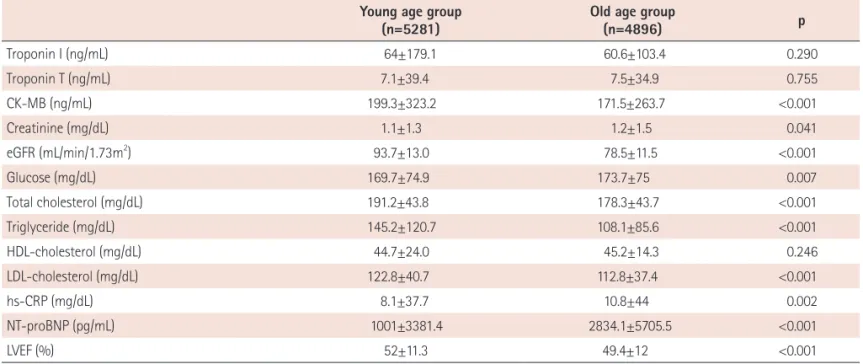
Baseline laboratory findings and echocardiographic findings are listed in Table 2. The levels of creatinine kinase-MB (CK-MB), total cholesterol (TC), triglyceride (TG), low-density lipoprotein cholesterol (LDL-C), and LVEF were higher in the young age group (199.3 ng/mL vs. 171.5 ng/mL, p<0.001; 191.2 mg/dL vs. 178.3 mg/dL, p<0.001;

145.2 mg/dL vs. 108.1 mg/dL, p<0.001; 122.8 mg/dL vs. 112.8 mg/

dL, p<0.001; 52% vs. 49.4%, p<0.001). The levels of creatinine, glucose, high-sensitivity C-reactive protein, and N-terminal pro- B-type natriuretic peptide were lower in the young age group (1.1 mg/dL vs. 1.2 mg/dL, p=0.041; 169.7 mg/dL vs. 173.7 mg/dL, p=0.007; 8.1 mg/dL vs. 10.8 mg/dL, p=0.002; 1001 pg/mL vs.

2834.1 pg/mL, p<0.001). There were no significant differences in the troponin-I, troponin-T, and high-density lipoprotein cholesterol (HDL-C) between the two groups. The estimated glomerular filtration rate by using the Chronic Kidney Disease Epidemiology Collaboration (CKD-EPI) equation,

17)

which considers the age and sex, was higher in the young age group (93.7 mL/min/1.73m

2

vs.

78.5 mL/min/1.73m

2

, p<0.001).

Treatment modalities for ST-segment elevation myocardial infarction

There was no significant difference in the rate of undergoing primary and facilitated PCI (Table 3). While patients in the young age group underwent thrombolysis more frequently (7.5% vs. 4.9%, p<0.001), patients in the old age group were more frequently treated conservatively (10.6% vs. 7.2%, p<0.001).

Table 2. Baseline laboratory and echocardiographic findings

Young age group

(n=5281) Old age group

(n=4896) p

Troponin I (ng/mL) 64±179.1 60.6±103.4 0.290

Troponin T (ng/mL) 7.1±39.4 7.5±34.9 0.755

CK-MB (ng/mL) 199.3±323.2 171.5±263.7 <0.001

Creatinine (mg/dL) 1.1±1.3 1.2±1.5 0.041

eGFR (mL/min/1.73m

2

) 93.7±13.0 78.5±11.5 <0.001

Glucose (mg/dL) 169.7±74.9 173.7±75 0.007

Total cholesterol (mg/dL) 191.2±43.8 178.3±43.7 <0.001

Triglyceride (mg/dL) 145.2±120.7 108.1±85.6 <0.001

HDL-cholesterol (mg/dL) 44.7±24.0 45.2±14.3 0.246

LDL-cholesterol (mg/dL) 122.8±40.7 112.8±37.4 <0.001

hs-CRP (mg/dL) 8.1±37.7 10.8±44 0.002

NT-proBNP (pg/mL) 1001±3381.4 2834.1±5705.5 <0.001

LVEF (%) 52±11.3 49.4±12 <0.001

Data are expressed as mean±standard deviation. CK-MB: creatine kinase-MB, eGFR: estimated glomerular filtration rate, HDL: high-density lipoprotein,

LDL: low-density lipoprotein, hs-CRP: high-sensitivity C-reactive protein, NT-proBNP: N-terminal pro B-type natriuretic peptide, LVEF: left ventricular

ejection fraction

(5)

Baseline coronary angiographic findings and procedure characteristics

The young and old age groups showed a similar door-to-balloon time (106.4 min vs. 106.6 min, p=0.847) (Table 3). The younger

adults had a fewer number of diseased vessels, and a lower percentage of left main (LM) complex disease and American College of Cardiology/American Heart Association (ACC/AHA) lesion type C.

In the young age group, the left anterior descending artery was Table 3. Treatment strategy, baseline coronary angiographic findings, and procedural characteristics in patients who underwent CAG

Young age group

(n=5281) Old age group

(n=4896) p

Primary PCI 4321 (81.8) 3977 (81.2) 0.442

Facilitated PCI 153 (2.9) 123 (2.5) 0.232

Thrombolysis 397 (7.5) 241 (4.9) <0.001

Conservative treatment 382 (7.2) 518 (10.6) <0.001

Door-to-balloon time (min) 106.4±54.3 106.6±52.4 0.847

Number of involved vessels (%)

1 2771 (52.8) 1969 (41.4) <0.001

2 1496 (28.5) 1495 (31.5) 0.001

3 904 (17.2) 1146 (24.1) <0.001

LM complex 69 (1.3) 130 (2.7) <0.001

LM isolated 7 (0.1) 12 (0.3) 0.172

Target lesion location (%)

LAD 2874 (54.9) 2387 (50.4) <0.001

LCX 509 (9.7) 435 (9.2) 0.356

RCA 1803 (34.5) 1837 (38.8) <0.001

LM 46 (0.9) 76 (1.6) 0.001

ACC/AHA types (%)

Type A 206 (4.3) 169 (3.9) 0.341

Type B1 986 (20.6) 722 (16.7) <0.001

Type B2 1370 (28.6) 1247 (28.8) 0.826

Type C 2222 (46.4) 2185 (50.5) <0.001

Pre-procedure TIMI flow 0 2807 (56.2) 2510 (55.1) 0.309

Post-procedure TIMI flow 3 4612 (93.9) 4047 (90.8) <0.001

Stent type (%)

Bare metal stent 381 (7.9) 430 (10.0) <0.001

Paclitaxel-eluting stent 1139 (23.6) 1041 (24.1) 0.536

Sirolimus-eluting stent 1556 (32.2) 1262 (29.2) 0.002

Zotarolimus-eluting stent 818 (16.9) 760 (17.6) 0.388

Everolimus-eluting stent 542 (11.2) 456 (10.6) 0.320

Other DES 424 (8.8) 389 (9.0) 0.687

Stent length (mm) 24.4±6.6 24.7±6.6 0.018

Stent diameter (mm) 3.5±0.6 3.3±0.6 <0.001

Total stents per patient (n) 1.4±0.7 1.5±0.8 0.002

Multi-vessel PCI 761 (15.2) 733 (16.3) 0.154

PCI success rate (%) 5044 (99.0) 4541 (99.0) 0.922

Data are expressed as number (%) or mean±standard deviation. CAG: coronary angiogram, PCI: percutaneous coronary intervention, LM: left main, LAD:

left anterior descending artery, LCX: left circumflex artery, RCA: right coronary artery, ACC/AHA: American College of Cardiology/American Heart

Association, TIMI: thrombolysis In myocardial infarction, DES: drug-eluting stent

(6)

involved more frequently, while the right coronary artery was involved more frequently in the old age group. Shorter, larger, and fewer number of stents were used in young patients (24.4 mm vs.

24.7 mm, p=0.018; 3.5 mm vs. 3.3 mm, p<0.001; 1.4 vs. 1.5, p=0.002) during the index PCI. Drug-eluting stents, especially sirolimus-eluting stents, were used more frequently in the young age group. Although there was no significant difference in pre- procedure TIMI flow 0, the younger patients had a higher incidence of post-procedure TIMI flow 3.

Comparison of the prescribed medications

We compared the prescribed medications at the time of discharge (Table 4). The use of aspirin, clopidogrel, beta-blockers, angiotensin- converting enzyme inhibitors, and statin was more frequent in the young age group (98.5% vs. 97.7%, p=0.003; 99.7% vs. 95.9%, p=0.033; 80.1% vs. 74.6%, p<0.001; 68.9% vs. 63.9%, p<0.001;

77.2% vs. 73.4%, p<0.001).

Clinical outcomes

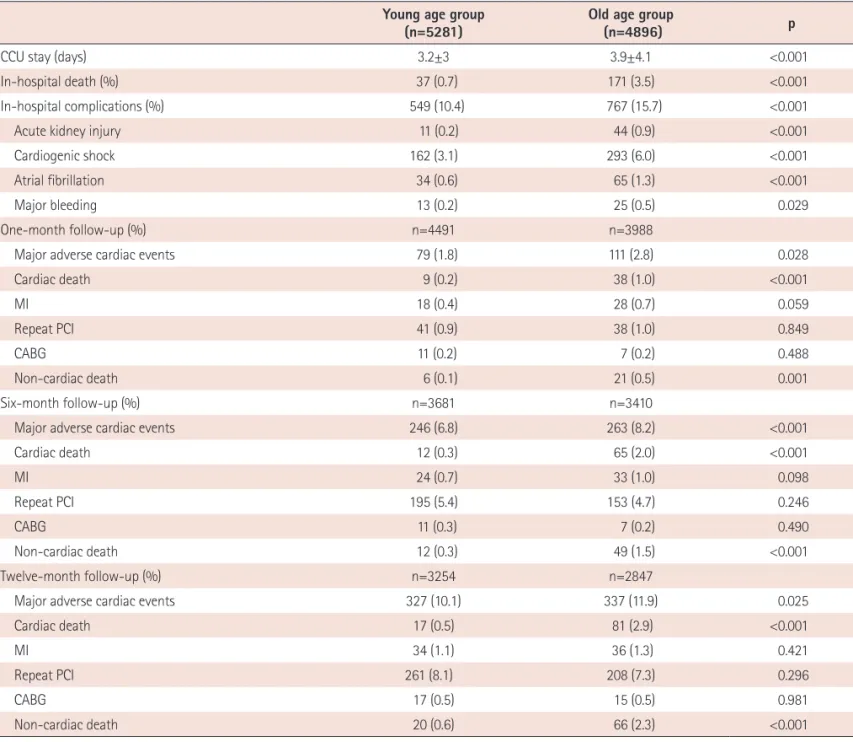
Table 5 shows in-hospital mortality, complications, and cumulative clinical outcomes during the follow-up period. According to our analyses of cumulative clinical outcomes, patients in the young age group stayed in the coronary care unit for a shorter time period (3.2 days vs. 3.9 days, p<0.001). The old age group had a higher rate of

in-hospital death (3.5 % vs. 0.7 %, p<0.001) compared with the young age group. The rates of one-month, six-month, and twelve- month MACEs were lower in the young age group. The adjusted MACE rates, by Cox regression analyses, at one month and twelve months were not different between the two age groups (Table 6).

These results were consistent with the adjusted all-cause death rate (Fig. 1).

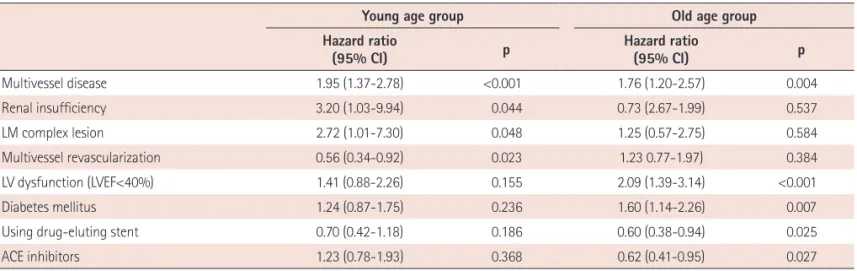
In the multivariate logistic regression analysis, the presence of multivessel disease, renal insufficiency, and LM complex lesion were independent predictors of MACE at one year after STEMI in younger adults (Table 7). On the contrary, complete multivessel revascularization during the index PCI in younger STEMI patients was associated with favorable outcomes.

Discussion

This is the first, large, multicenter, prospective study in younger Korean patients with STEMI. About half of the STEMI patients (52%) were less than 65 years of age. Previous studies have demonstrated that the young age group has a higher proportion of males, smokers, DL, family history, and a lower incidence of HTN and DM than the old age group.

3)5)18)19)

The results of our study in younger Korean adults were in agreement with those of previous studies in many aspects (Table 1). Cigarette smoking was the most common Table 4. Comparison of the prescribed medications

Young age group

(n=5222) Old age group

(n=4693) p

Aspirin 5166 (98.5) 4617 (97.7) 0.003

Clopidogrel 5073 (99.7) 4533 (95.9) 0.033

Cilostazol 1674 (31.9) 1430 (30.3) 0.074

Dual anti-platelet therapy 3595 (68.8) 3296 (70.2) 0.134

Triple anti-platelet therapy 1627 (31.2) 1397 (29.8) 0.134

Beta-blockers 4199 (80.1) 3524 (74.6) <0.001

ACE inhibitors 3611 (68.9) 3021 (63.9) <0.001

Angiotensin II receptor blockers 866 (16.5) 926 (19.6) <0.001

Calcium channel blockers 359 (6.8) 311 (6.6) 0.599

Statin 4049 (77.2) 3468 (73.4) <0.001

Nitrate 2468 (47.1) 2121 (44.9) 0.030

Nicorandil 1155 (22) 1062 (22.5) 0.589

Loop diuretics 751 (14.3) 1319 (27.9) <0.001

Spironolactone 367 (7.0) 511 (10.8) <0.001

DM medications

Oral hypoglycemic agents 443 (8.4) 356 (7.5) 0.094

Insulin 65 (1.2) 58 (1.2) 0.957

Data are expressed as number (%). ACE: angiotensin-converting enzyme, DM: diabetes mellitus

(7)

and modifiable cause of AMI in younger patients in our study.

Smoking is a major independent risk factor for ischemic heart disease, cerebrovascular disease, and total atherosclerotic cardiovascular disease.

20)

It is well known that smoking has an adverse effect on serum lipids, and it is associated with insulin resistance,

21)

enhanced prothrombotic state, elevated fibrinogens, and increased platelet activity.

22)

The relative benefits of smoking cessation are equivalent in young and old patients.

23)

Since the rate of smoking in younger STEMI patients is high, it is more important to encourage smoking cessation in patients of the young age group than in those of the old age group.

The other risk factor among younger adults with STEMI was

obesity. Obesity has been known to be an independent risk factor for CHD.

24)

It causes some changes in lipid metabolism, elevation of TG, LDL-C, and lowers the concentration of HDL-C.

25)

We observed that the incidence of dyslipidemia was higher in younger Korean STEMI patients than in older Korean STEMI patients. Finally, the incidence of metabolic syndrome was higher in younger adults with STEMI. For these metabolically unhealthy obese younger adults with STEMI, regular exercise and weight reduction are necessary to improve the metabolic state. Because younger adults with STEMI had higher levels of TC, TG, and LDL-C (Table 2), it is clear that the use of statin in younger STEMI patients will be beneficial in treating lipid abnormalities.

Table 5. Cumulative clinical outcomes

Young age group

(n=5281) Old age group

(n=4896) p

CCU stay (days) 3.2±3 3.9±4.1 <0.001

In-hospital death (%) 37 (0.7) 171 (3.5) <0.001

In-hospital complications (%) 549 (10.4) 767 (15.7) <0.001

Acute kidney injury 11 (0.2) 44 (0.9) <0.001

Cardiogenic shock 162 (3.1) 293 (6.0) <0.001

Atrial fibrillation 34 (0.6) 65 (1.3) <0.001

Major bleeding 13 (0.2) 25 (0.5) 0.029

One-month follow-up (%) n=4491 n=3988

Major adverse cardiac events 79 (1.8) 111 (2.8) 0.028

Cardiac death 9 (0.2) 38 (1.0) <0.001

MI 18 (0.4) 28 (0.7) 0.059

Repeat PCI 41 (0.9) 38 (1.0) 0.849

CABG 11 (0.2) 7 (0.2) 0.488

Non-cardiac death 6 (0.1) 21 (0.5) 0.001

Six-month follow-up (%) n=3681 n=3410

Major adverse cardiac events 246 (6.8) 263 (8.2) <0.001

Cardiac death 12 (0.3) 65 (2.0) <0.001

MI 24 (0.7) 33 (1.0) 0.098

Repeat PCI 195 (5.4) 153 (4.7) 0.246

CABG 11 (0.3) 7 (0.2) 0.490

Non-cardiac death 12 (0.3) 49 (1.5) <0.001

Twelve-month follow-up (%) n=3254 n=2847

Major adverse cardiac events 327 (10.1) 337 (11.9) 0.025

Cardiac death 17 (0.5) 81 (2.9) <0.001

MI 34 (1.1) 36 (1.3) 0.421

Repeat PCI 261 (8.1) 208 (7.3) 0.296

CABG 17 (0.5) 15 (0.5) 0.981

Non-cardiac death 20 (0.6) 66 (2.3) <0.001

Data are expressed as number (%) or mean±standard deviation. CCU: coronary care unit, MI: myocardial infarction, PCI: percutaneous coronary

intervention, CABG: coronary artery bypass grafting

(8)

Table 6. Cox regression analyses of age difference (young age group vs. old age group) with one-month and twelve-month MACEs Model

One-month MACEs Twelve-month MACEs

Hazard ratio

(95% CI) p Hazard ratio

(95% CI) p

Unadjusted 0.94 (0.71-1.25) 0.677 0.77 (0.66-0.89) 0.001

Adjusted for sex 0.85 (0.63-1.15) 0.295 0.73 (0.62-0.86) <0.001

Adjusted for selected variables* 0.90 (0.65-1.24) 0.517 0.74 (0.62-0.88) 0.001

Multivariable adjusted

0.95 (0.60-1.51) 0.828 0.86 (0.68-1.10) 0.233

*The variables of baseline clinical characteristics; sex, BMI, presence of typical symptoms, chest pain and dyspnea, history of previous angina, initial vital signs (systolic blood pressure, diastolic blood pressure, and heart rate), Killip classification on admission, symptom-to-door time, arrhythmia, cardiovascular risk factors (hypertension, diabetes mellitus, dyslipidemia, smoking, family history of coronary heart disease, and previous ischemic heart diseases), cerebrovascular or peripheral arterial diseases, and heart failure. †The variables considered potentially relevant on univariate analyses were included; all of the variables mentioned above as the selected variables, treatment strategy, door-to-balloon time, angiographic findings (number of diseased vessels, lesion location and type), procedural findings (stent type, length and diameter, and number of implanted stents), cardiovascular medications (aspirin, clopidogrel, beta-blockers, calcium channel blockers, angiotensin-converting enzyme inhibitors, Angiotensin II receptor blockers, statin, nitrate, spironolactone, and diuretics), renal insufficiency (estimated glomerular filtration rate<60 mL/min/1.73m

2

), and left ventricular dysfunction (left ventricular ejection fraction<40%). MACE: major adverse cardiac event , CI: confidence interval

Table 7. Multivariate logistic regression analysis for predicting the one-year major adverse cardiac events in patients of the young age and old age groups

Young age group Old age group

Hazard ratio

(95% CI) p Hazard ratio

(95% CI) p

Multivessel disease 1.95 (1.37-2.78) <0.001 1.76 (1.20-2.57) 0.004

Renal insufficiency 3.20 (1.03-9.94) 0.044 0.73 (2.67-1.99) 0.537

LM complex lesion 2.72 (1.01-7.30) 0.048 1.25 (0.57-2.75) 0.584

Multivessel revascularization 0.56 (0.34-0.92) 0.023 1.23 0.77-1.97) 0.384

LV dysfunction (LVEF<40%) 1.41 (0.88-2.26) 0.155 2.09 (1.39-3.14) <0.001

Diabetes mellitus 1.24 (0.87-1.75) 0.236 1.60 (1.14-2.26) 0.007

Using drug-eluting stent 0.70 (0.42-1.18) 0.186 0.60 (0.38-0.94) 0.025

ACE inhibitors 1.23 (0.78-1.93) 0.368 0.62 (0.41-0.95) 0.027

CI: confidence interval, LM: left main: LV: left ventricular, LVEF: left ventricular ejection fraction, ACE: angiotensin-converting enzyme

MACE-free survival Death-free survival

Duration of follow-up (days) 0 100 200 300 1.00

0.95

0.90

0.85

1.00

0.99

0.98

0.97

0.96

0.95 Young age group

Young age group

Old age group

Old age group

HR 0.82 (0.51-1.30), p=0.398 HR 0.86 (0.68-1.10), p=0.233

0 100 200 300 Duration of follow-up (days)

A B

Fig. 1. Adjusted MACE-free survival (A) and death-free survival at 12 months by multivariate Cox regression analyses (B). MACE: major adverse cardiac

event, HR: hazard ratio.

(9)

The younger STEMI patients complained of typical chest pain more frequently, but they experienced angina less frequently before hospitalization. According to the analysis of the initial coronary angiogram, the young age group had a higher frequency of single vessel disease than the old age group. These observations suggested that the proposed mechanism causing AMI in the young age group was sudden interruption of coronary blood flow before preconditioning caused by plaque rupture, followed by rapid progression of atherothrombosis rather than atherosclerosis.

Shorter, larger, and fewer number of stents were used in the younger adults, and this indicated that thrombosis generally affected a single, large, and short segment of the coronary artery.

On the other hand, the elderly patients experienced severe atherosclerosis leading to multi-vessel disease, LM disease, and systolic dysfunction, which were correlated with poor prognosis.

3)

Since typical symptoms were experienced more frequently by younger patients, they visited the emergency room much earlier.

The higher level of CK-MB in the younger adults indirectly indicated this finding. Actually, our data showed a shorter symptom-to-door time in young patients than in old patients. Meanwhile, there was no significant difference in door-to-balloon time between younger patients and elderly patients in this study. Consequently, the patients in the young age group may have more chance of reducing the ischemic time. However, unfortunately, the mean door-to- balloon time exceeded 90 minutes in both groups. To improve the prognosis of Korean STEMI patients, the physicians and/or the interventionist must make an effort and should pay attention to the methods that can reduce the door-to-balloon time. In the multivariate logistic regression analysis, we determined the independent predictive factors of one-year MACE in the young age group (Table 7). They were multivessel disease, renal insufficiency, and LM complex lesion, but these factors were not statistically different from those in the old age group except for multivessel disease. We could not determine the reason for this discrepancy.

In the present study, we analyzed the clinical outcomes of AMI patients such as the in-hospital outcomes and out-of-hospital outcomes (Table 5). As expected, the young age group showed excellent prognosis in terms of in-hospital death and complications, one-month, six-month, and twelve-month MACE. There were significant differences in the incidence of cardiac death and non- cardiac death between the two groups; however, the young age group did not have a lower incidence of MI, repeat PCI, and CABG compared to the old age group. Because there were significant differences in the baseline clinical characteristics between the two groups, they exerted an influence on the prognosis. When we performed multivariate Cox regression analyses using all of the affecting variables, the age difference was not important as before

(Table 6). There was no significant clinical benefit in the young STEMI patients at the one-month and twelve-month follow-up (Fig.

1). We concluded that younger patients should be treated continuously like elderly patients with close follow-up. The elderly patients, regardless of their age, should also be treated aggressively.

Our study had several limitations. First, since our study included only diseased patients, we could not accurately identify the risk factors for AMI in young healthy individuals. Second, the long-term prognosis would be more important in young AMI patients;

however, a maximum one-year follow-up data were available in the current study. Third, a randomized prospective study, which shows that intensive medical treatment of younger adults improves the clinical outcomes, is needed.

In conclusion, younger Korean STEMI patients included a higher proportion of males and had higher incidences of smoking, obesity, DL, metabolic syndrome, and family history compared with elderly patients. The young age group had more favorable in-hospital outcomes. However, after adjustment for the potential confounders, the clinical outcomes of patients in the young age group were not superior to those of patients in the old age group at the one-year follow-up. Therefore, younger patients should also consistently receive intensive medical treatment like the old aged patients for preventing the MACE.

References

1. Rosamond W, Flegal K, Furie K, et al. Heart disease and stroke statistics--2008 update: a report from the American Heart Association Statistics Committee and Stroke Statistics Subcommittee. Circulation 2008;117:e25-146.

2. Kim RB, Kim BG, Kim YM, et al. Trends in the incidence of hospitalized acute myocardial infarction and stroke in Korea, 2006-2010. J Korean Med Sci 2013;28:16-24.

3. Zimmerman FH, Cameron A, Fisher LD, Ng G. Myocardial infarction in young adults: angiographic characterization, risk factors and prognosis (Coronary Artery Surgery Study Registry). J Am Coll Cardiol 1995;26:654-61.

4. Choudhury L, Marsh JD. Myocardial infarction in young patients. Am J Med 1999;107:254-61.

5. Morillas P, Bertomeu V, Pabón P, et al. Characteristics and outcome of acute myocardial infarction in young patients. Cardiology 2007;107:217-25.

6. Lee SR, Jeong MH, Ahn YK, et al. Clinical safety of drug-eluting stents in the Korea acute myocardial infarction registry. Circ J 2008;72:392-8.

7. French JK, White HD. Clinical implications of the new definition of myocardial infarction. Heart 2004;90:99-106.

8. Bhatia LC, Naik RH. Clinical profile of acute myocardial infarction in elderly patients. J Cardiovasc Dis Res 2013;4:107-11.

9. Kanazawa M, Yoshiike N, Osaka T, Numba Y, Zimmet P, Inoue S. Criteria

and classification of obesity in Japan and Asia-Oceania. World Rev Nutr

(10)

Diet 2005;94:1-12.

10. Grundy SM, Brewer HB Jr, Cleeman JI, et al. Definition of metabolic syndrome: report of the National Heart, Lung, and Blood Institute/

American Heart Association conference on scientific issues related to definition. Circulation 2004;109:433-8.

11. Quinones MA, Waggoner AD, Reduto LA, et al. A new, simplified and accurate method for determining ejection fraction with two- dimensional echocardiography. Circulation 1981;64:744-53.

12. Keeley EC, Boura JA, Grines CL. Primary angioplasty versus intravenous thrombolytic therapy for acute myocardial infarction: a quantitative review of 23 randomised trials. Lancet 2003;361:13-20.

13. Schömig A, Mehilli J, Antoniucci D, et al. Mechanical reperfusion in patients with acute myocardial infarction presenting more than 12 hours from symptom onset: a randomized controlled trial. JAMA 2005;293:2865-72.

14. Hochman JS, Sleeper LA, Webb JG, et al. Early revascularization in acute myocardial infarction complicated by cardiogenic shock. SHOCK Investigators. Should we emergently revascularize occluded coronaries for cardiogenic shock. N Engl J Med 1999;341:625-34.

15. Wu AH, Parsons L, Every NR, Bates ER; Second National Registry of Myocardial Infarction. Hospital outcomes in patients presenting with congestive heart failure complicating acute myocardial infarction: a report from the Second National Registry of Myocardial Infarction (NRMI-2). J Am Coll Cardiol 2002;40:1389-94.

16. The Thrombolysis in Myocardial Infarction (TIMI) trial. Phase I findings.

TIMI Study Group. N Engl J Med 1985;312:932-6.

17. Levey AS, Stevens LA, Schmid CH, et al. A new equation to estimate

glomerular filtration rate. Ann Intern Med 2009;150:604-12.

18. Barbash GI, White HD, Modan M, et al. Acute myocardial infarction in the young--the role of smoking. The Investigators of the International Tissue Plasminogen Activator/Streptokinase Mortality Trial. Eur Heart J 1995;16:313-6.

19. Jinnouchi H, Sakakura K, Wada H, et al. Clinical features of myocardial infarction in young Japanese patients. Int Heart J 2013;54:123-8.

20. Jee SH, Suh I, Kim IS, Appel LJ. Smoking and atherosclerotic cardiovascular disease in men with low levels of serum cholesterol: the Korea Medical Insurance Corporation Study. JAMA 1999;282:2149-55.

21. Facchini FS, Hollenbeck CB, Jeppesen J, Chen YD, Reaven GM. Insulin resistance and cigarette smoking. Lancet 1992;339:1128-30.

22. Newby DE, Wright RA, Labinjoh C, et al. Endothelial dysfunction, impaired endogenous fibrinolysis, and cigarette smoking: a mechanism for arterial thrombosis and myocardial infarction. Circulation 1999;99:1411-5.

23. Critchley JA, Capewell S. Mortality risk reduction associated with smoking cessation in patients with coronary heart disease: a systematic review. JAMA 2003;290:86-97.

24. Poirier P, Giles TD, Bray GA, et al. Obesity and cardiovascular disease:

pathophysiology, evaluation, and effect of weight loss: an update of the 1997 American Heart Association Scientific Statement on Obesity and Heart Disease from the Obesity Committee of the Council on Nutrition, Physical Activity, and Metabolism. Circulation 2006;113:898-918.

25. Howard BV, Ruotolo G, Robbins DC. Obesity and dyslipidemia.

Endocrinol Metab Clin North Am 2003;32:855-67 .

수치

Table 1. Baseline clinical characteristics
Table 2. Baseline laboratory and echocardiographic findings
Table 5 shows in-hospital mortality, complications, and cumulative  clinical outcomes during the follow-up period
Table 5. Cumulative clinical outcomes
+2

참조

관련 문서

Comparison of clinical risk factors and distribution of age, sex of patients aged ≧80 years and &lt;80 years... Comparison of the stroke subtype and thrombolysis of

Drug-intoxicated patients were predominantly male, with the highest incidence of intoxication among patients above the seventh decade of age(21.5%) and the

Therefore, cTnT is a recommended biomarker for use in the detection of myocardial infarction (MI) and in acute coronary syndromes.[8] Indeed, several authors

As more people have travelled to foreign countries recently, so has the importance of the bonus mileage that airlines offer. However, the previous studies

The characteristics of Korea youth class unemployment are as follows. First, in the standpoint of age, the unemployment rate of youth was considerably higher than those of other

Among the sub-factors of self-esteem, positive, male was higher than female, and on the contrary, negative In this study, females were higher than males,

Among them, the educational value and importance of the play, which makes up the largest proportion of the activities of young children in early childhood,

When comparing substandard housing conditions for young adults with other age groups, the proportion of young renters living in the substandard housing conditions in Korea