목초액 처리가 인삼 잎 조직 및 지하부 생육에 미치는 영향
성봉재* ・ 한승호* ・ 김선익* ・ 김현호* ・ 조진웅**†
*충청남도 농업기술원, **충남대학교 농업생명과학대학
The Effect of Pyroligneous Acid on Leaf Tissue and Root Growth of Ginseng(Panax Ginseng C. A. Meyer)
Seong Bong-Jae*, Han Seung-Ho*, Kim Sun-Ick*, Kim Hyun-Ho*, and Cho Jin-Woong**†
*Chungnam Agricultural Research & Extention Service, Keumsan 312-804, Korea
**College of Agricultural and Life Sciences, Chungnam National University, Daejeon 305-764, Korea
97
†
Corresponding author: (Phone) +82-42-821-5725 (E-mail) [email protected]
<Received 8 December, 2013; Accepted 8 January, 2014>
한작지(Korean J. Crop Sci.), 59(1): 97~100(2014) DOI : http://dx.doi.org/10.7740/kjcs.2014.59.1.097
ABSTRACT To explore the possibility of using pyro- ligneous acid for environmentally friendly ginseng farming, this study observed samples of ginseng whose shoots were treated with pyroligneous acid sprays beginning in mid June, which is after foliation stage. The spongy tissue structure got thickened from triple layers to quadruple layers with the pyroligneous acid regardless of the concentration. The upper and lower epidermis cell of the leaves as well as the leaf mesopyll cells also became thicker. Compared to the no-treatment group, the overall growth and development of ginseng roots treated with pyroligneous acid were excellent. Accordingly, it is believed that pyroligneous acid can be an environmentally friendly alternative to conventional agro-chemicals applied to ginseng that can be used to facilitate the growth and development of ginseng.
Keywords : ginseng, pyroligneous acid, epidermis cell, root weight
최근무공해 또는 청정 농산물에 대한 사회적 인식이 매우 높고, 건강보조식품 또는 의약품으로 인삼에 대한 수요량이 증가되고 있다. 따라서 국민생활 선진화에 따른 친환경농산 물의 수요가 집중되고 있는 시대적 흐름에서 인삼을 친환경 적 농법으로 재배할 수 있는 방제약제 대체재의 개발이 시
급하고, 친환경자재의 올바른 사용법 확립이 그 어느 때보 다 절실히 요구되고 있다. 그러나 친환경 농산물에 대한 성 장세가 급등하는 추세에도 불구하고 전체 농경지 중에 친환 경재배면적은 약 2.7%이며 친환경농산물 생산량은 전체 농 산물 중 약 4.4%에 불과한 실정이다(Jeong et al., 2007). 현 재, 농약이나 화학비료 중심의 농업에서 저 농약, 저 비료의 생태적 지속형 농업으로의 전환을 위한 친환경 농자재로 사 용되고 있는 품목으로는 목초액, 목탄, 현미식초, 키토산, 생선아미노산, 석회보르도액, 전해 산성수 등이 있으며 이 중 목초액과 키토산이 많이 사용하고 있다(Jeong et al., 2007).
목초액은 참나무류(Quercus spp.)나 소나무(Pinus densiflora) 등의 천연목재를 400~700℃로 가열하여 탄화시키는 과정 에서 발생하는 연기와 수증기를 포집하여 냉각, 응축한 후 이를 정제한 담갈색의 산성 액상 천연물질로 주성분은 초산 으로 알려져 있다 (Jun et al., 1998; Jeong et al., 2007). 목 초액은 토양선충을 방제하며, 작물의 생육촉진, 과실의 신 선도 유지 및 축사의 악취제거에도 효과가 있는 것으로 알 려져 있다(Geon et al., 2005; Jeong et al., 2007; Jun et al., 1998; Kim et al., 2005). 따라서 본 연구의 목적은 목초액 을 인삼에 사용할 경우 인삼 엽 조직 및 인삼생육에 미치는 영향을 규명하고, 인삼의 친환경재배 가능성 여부를 알아보 기 위하여 수행하였다.
ISSN 0252-9777(Print) ISSN 2287-8432(Online)
한작지(KOREAN J. CROP SCI.), 59(1), 2014 98
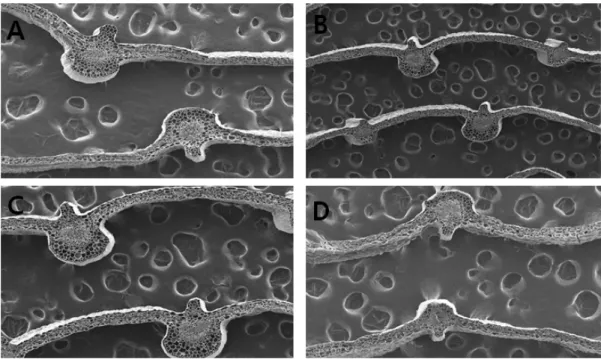
Fig. 1. Leaf vein change of 3-year-old ginseng by different dilution of pyroligneous acid. A; control, B; 500x , C; 800x and D; 1000x dilution.
재료 및 방법 실험재료 및 처리방법
본 시험은 충청남도 금산군 금산약초시험장 실험포장에 서 실시하였다. 시험에 이용된 인삼은 연풍 3년근을 이용하 였다. 인삼포장은 이랑넓이를 90 cm로 하고, 두둑높이는 30 cm였으며, 두둑방향은 동서방향을 남으로 약 20도의 편각 을 두어 작성하였다. 재식밀도는 30 cm × 10 cm로 하였으 며 시험구배치는 난괴법 3반복으로 작성하였다. 목초액은 참나무를 가열하여 탄화시키는 과정에서 얻어진 것으로 원 액을 기준으로 500배, 800배액 그리고 1,000배액으로 조제 한 후 6월 12일, 7월 2일, 7월 23일 그리고 8월 13일 등 4회 에 걸쳐 목초액을 엽면에 살포 처리하였으며 관행적인 재배 구를 대조구로 시험을 수행하였다.
잎 조직 분석
목초액 처리가 인삼 엽조직 변화에 미치는 영향을 조사하 기 위하여 인삼 잎의 중앙소엽을 대상으로 소엽의 중앙 부 위를 대상으로 하였다. 채취한 시료를 고정액(GA + DW + Cacodylate buffer + Acrolin)에 3시간 고정한 후 Et-OH와 TBA(tert-butyl alcohol)로 50%, 75%, 90%, 95% 그리고 100% 용액을 사용하여 탈수한 후 냉동 건조하여 코팅하였 다. 냉동 건조된 시료를 rotary microtome를 이용하여 10 μm 두께의 연속절편을 만든 다음 Akashi 사(japan)의 SR-50
Scanning Electron Microscope으로 주맥부위의 유관속조직 과 잎의 횡단면의 변화를 관찰하였다.
생육조사 및 통계분석
목초액을 4회 엽면시비처리한 후 10월 상순에 임삼 뿌리 를 채취하여 근장과 근경을 측정한 후 뿌리의 무게를 측정 하였다. 각각의 형질은 처리구마다 10개체씩 표본을 채취하 여 조사하였다. 통계분석은 통계처리 프로그램인 SAS 9.2 를 이용하여 분산분석 후 평균값 비교(DMRT)를 하였다.
결과 및 고찰 인삼 잎의 형태적 특성
2년근 인삼의 지상부에 목초액을 6월부터 20일 간격으로 4회에 걸쳐 엽면 살포한 후에 인삼 엽육조직을 SEM으로 분석한 결과 목초액 500배 처리구의 엽육조직이 가장 치밀 하게 발달 되었으며 목초액 처리에 다른 엽맥에 미치는 영 향을 살펴본 결과 500배액의 목초액 처리가 주맥과 이어진 측맥의 발달이 다른 배액이나 무처리보다 현저하게 발달한 것으로 관찰되었다(Fig. 1).
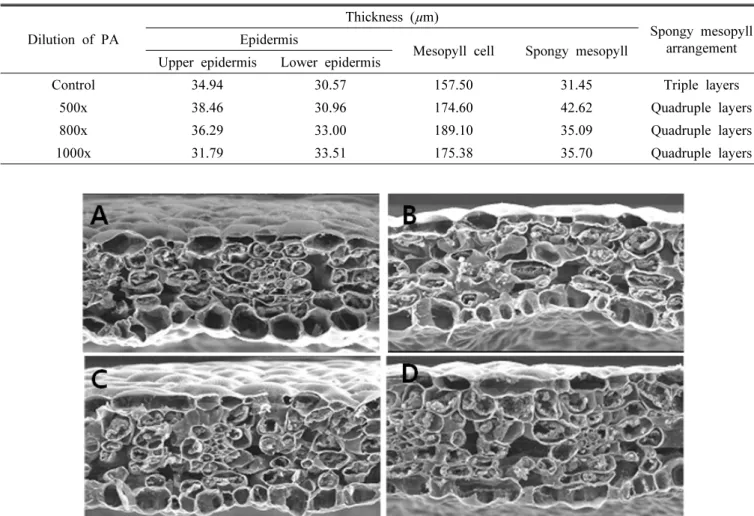
목초액 처리에 따른 표피 두께를 살펴보면 상층부의 표피 는 무처리가 약 34.94 µm였지만 500배액과 800배액 목초 액을 처리한 인삼 잎의 두께가 각각 38.46 µm과 36.29 µm 로 표피 두께가 두꺼워지는 것을 보였으며 인삼 잎의 하층
목초액 처리에 따른 인삼 생육효과 99
Table 1. The effect of the different dilution of pyroligneous acid (PA) on the leaf of 3-year-old ginseng.
Dilution of PA
Thickness ( µm)
Spongy mesopyll arrangement Epidermis
Mesopyll cell Spongy mesopyll Upper epidermis Lower epidermis
Control 34.94 30.57 157.50 31.45 Triple layers
500x 38.46 30.96 174.60 42.62 Quadruple layers
800x 36.29 33.00 189.10 35.09 Quadruple layers
1000x 31.79 33.51 175.38 35.70 Quadruple layers
Fig. 2. Cross-section of Leaf in 3-year-old ginseng by 400-power SEM with different dilution of pyroligneous acid. A; control, B; 500x, C; 800x and D; 1000x dilution.
부 표피는 목초액 처리로 더욱 두꺼워지는 것을 알 수 있었 다(Table 1). 또한 엽육세포의 두께를 살펴보면 무처리보다 목초액 처리를 할 경우 더 두꺼워지는 경향을 보였는데 500 배액이 174.60 µm, 1,000배액이 175.38 µm 그리고 800배 액이 189.10 µm으로 가장 큰 엽육세포 크기를 보였다. 그 리고 해면상조직의 엽육세포의 크기 역시 목초액 처리로 커 지는 경향을 보였으며 500배액의 목초액을 처리했을 때 42.62 µm로 가장 두꺼운 두께를 보였다. 일반적으로 광합 성은 엽육세포에서 작용하는데 목초액 처리에 따른 작물의 수량 향상은 엽육세포의 두께가 더 두꺼워진 결과로 생각된 다. 한편, 해면상 조직의 엽육세포의 배열을 보면 무처리가 3층으로 배열되어 있지만 목초액 처리는 배액에 관계없이 모두 4개층으로 배열되어 있는 것을 관찰할 수 있었다. Jun et al.(1998)은 목초액 처리에 의해 병발생과 곤충의 식상 피해를 효과적으로 감소시킨다고 하였는데 이는 해면상조 직의 두께가 두꺼워져 병해충의 피해가 감소되는 것으로 생
각된다.
생육특성
목초액 희석배수에 따른 인삼 지하부 생육을 살펴보면 1,000배액으로 희석 처리했을 때 근장이 26.7 cm로 가장 좋았으며 500배액과 800배액은 무처리의 23.3 cm와 큰 차 이를 보이지 않았다. 또한 인삼 뿌리 수량은 목초액 처리로 무처리의 개체당 11.4 g보다 많았으며 특히 500배액의 목 초액 처리가 15.2 g으로 가장 많은 수량을 보였다. 이와 같 이 목초액 처리에 따른 수량 증가 효과는 목초액에는 페놀 성분이 함유되어 있어 이들 물질이 상승작용에 의한다는 보 고(Kim et al., 2003; Kim et al., 2005)와 목초액은 IAA를 파괴하는 peroxidase 활성이 감소되어 뿌리의 생장을 촉진 한다는 보고(Smith, 1976)를 보면 인삼 뿌리의 수량 증가는 페놀성분과 peroxidase 활성 감소의 상승효과의 결과로 생 각되어진다. 그러나 Uhm et al.(2002)은 고추의 경우 목초
한작지(KOREAN J. CROP SCI.), 59(1), 2014 100
Table 2. Effect of the different dilution of pyroligneous acid(PA) on the growth of 3-year-old ginseng roots.
Dilution of PA Root length (cm) Root diameter (mm) Root weight (g)
Control 23.3ab
♩13.0b 11.4b
500x 24.5ab 15.7a 15.2a
800x 24.3ab 15.2a 14.6a
1,000x 26.7a 14.4a 14.8a
♩
means followed by different letters within the same column are significantly (p<0.05) different according to DMRT.
액 처리가 관행재배보다 낮은 수량을 보였다고 하였으며, Geon et al.(2005)은 한국잔디의 경우 목초액 처리효과가 크지 않는다는 보고도 있다.
적 요
목초액을 친환경 인삼재배에 이용하기 위하여 전엽기 이 후인 6월 중순부터 지상부에 엽면시비로 살포하여 3년생 인삼 잎의 형태적특성과 수량에 미치는 영향을 조사하였다.
목초액을 처리하면 처리농도에 관계없이 해면조직의 배열 이 3층에서 4층으로 증가하였다. 또한 인삼 잎의 상표피와 하표피의 두께가 두꺼워지고, 엽육세포도 두꺼워지는 효과 를 보였으며 지하부의 생육에도 영향을 미쳐 무처리에 비해 뿌리의 생육이 증진되었으며 인삼 뿌리의 수량도 증가하였 다. 따라서 목초액의 혼합사용은 인삼의 생육을 촉진시키 고, 병해를 극복하여 인삼을 친환경재배 할 수 있는 대안이 될 것이다.
사 사
본 논문은 2012년도 충남대학교 학술연구비 지원에 의하 여 연구되었음.
인용문헌