인삼의 생육시기와 재식위치에 따른 엽록소 형광반응 및 광합성 특성
오동주*·이충열*†·김성만*·이관영*·이수지*·황대연*·손홍주*·원준연**
*부산대학교 생명자원과학대학, **중부대학교 한방건강관리학과
Effects of Chlorophyll Fluorescence and Photosynthesis Characteristics by Planting Positions and Growth Stage in Panax ginseng C. A. Meyer
Dong Joo Oh
*, Chung Yeol Lee
*†, Seong man Kim
*, Guan Ying Li
*, Su Ji Lee
*, Dae Yon Hwang
*, Hong Joo Son
*and Jun Yeon Won
***
Natural Resources & Life Science, Pusan National University, Miryang 627-906, Korea.
**
Department of Oriental Health Care, Joongbu University, Kumsan 312-702, Korea.
ABSTRACT : As cool-season plant, Panax ginseng C. A. Meyer is planted under shade-installation with tall front and low rear. However, at different planting positions, distinct differences come out because ginseng grows at the same position within 3~5 years and the growth circumstance changes a lot by the shade-installation. So, in this study, changes of tempera- ture, photosynthesis and chlorophyll fluorescence with varieties of shading material and planting position were investigated.
Light transmittances by polyethylene shade net and silver-coated shading plate as planting materials were measured accord- ing to different planting positions. Photosynthetic rate and chlorophyll fluorescence were measured by LI-6400-40 (Li-Cor).
According to different planting positions, light intensity was higher in silver-coated shading plate than in polyethylene shade net, and higher at front than rear. Also, photosynthetic rate showed the same tendency, which had a positive correlation to light intensity. But this treatment caused a lower Fo compared with polyethylene shade net because of the stress by light and temperature. Also, Fv/Fm and ETR were higher in silver-coated shading plate. Fo was similar at front and rear according to silver-coated shading plate and ETR was higher at front.
Key Words : Panax ginseng, Planting Positions, Chlorophyll Fluorescence, Photosynthesis Characteristics, Growth Stage
서 언
인삼은 일반식물과 달리 반음지 호냉성 식물로서 고온 및 고광 조건을 선호하지 않아 인위적으로 해가림 시설을 설치하 여 재배하는 작물로 인삼에 있어서는 해가림 시설이 매우 중 요하다 .
현재 널리 사용하고 있는 인삼의 해가림 구조를 살펴보면 ,
전주가 높고 후주가 낮아서 해가림의 경사도에 따라 유입되는 광량이 인삼의 재식 위치 즉 전주와 후주에 따라 차이가 있고
(Kim et al ., 1982; Lee et al ., 1987), 해가림 시설의 방향과
그 자재에 따라서도 인삼의 생육에 큰 영향을 받는다고 보고 되어 있다 (Lee 2007a; Lee 2007b; Won et al ., 2008;
Kim et al ., 2009).
인삼의 수확량을 높이기 위해서는 가능한 한 건전한 잎을 오랫동안 지속시켜 생육후기까지 광합성작용을 계속 유지할
수 있도록 최적의 환경조건을 만들어 물질생산을 증대시켜야
한다 . Park 등 (1986) 은 일반적으로 해가림 내의 광량이
3,000 lux 이하로 낮을 경우에는 근의 비대가 현저히 떨어지며 ,
반대로 광량이 최적 상태보다 과다하면 엽록소의 파괴로 잎의 기능이 저하되고 조기낙엽이 유도되어 수량감소를 가져온다고 하였고 , Lee 등 (1982) 은 인삼 해가림 내에서 광량이 많은 전 주부근에서 성장한 인삼 잎은 광포화점이 10,000 lux 인데 반하 여 , 광량이 부족한 후주부근에서 성장한 인삼 잎은 광포화점 이 4,000 lux 로 , 전·후주 위치에 따라 서로 다른 광 조건에서
생육한 인삼 잎의 광합성능력은 차이를 보인다고 보고한 바 있다 . 또한 , Lee 등 (2007) 은 봄철 저온기에서 여름철 고온기 로 환경이 변화하는 과정에서 인삼의 생육이 진행됨에 따라 광합성능력이 감소하는 경향이 있다고 보고 하였으며 , 이러한 원인은 인삼 잎이 여름철의 고온기에 받는 스트레스에 기인하 는 것 (Lee et al ., 1987) 이라고 보고한 바 있으나 , 그 원인에
†
Corresponding author: (Phone) +82-55-350-5503 (E-mail) [email protected]
Received 2010 March 9 / 1st Revised 2010 April 5 / 2nd Revised 2010 April 12 / Accepted 2010 April 18
대하여는 구체적으로 구명되어 있지 않다 .
인삼에 있어서 광은 광합성을 위한 에너지원으로서 필수적 인 요소이나 과다할 경우 광합성작용에 손상을 미칠 수 있고
(Aro et al ., 1993; Chown, 1994; Long et al ., 1994) 광량 이 많아짐에 따라 인삼 잎은 많은 손상을 입어 광화학 반응계 가 저해된다 (Baker, 1991) 는 보고가 있으나 , 인삼의 엽록소형 광 반응과 이에 관련된 광합성 등에 관한 연구는 많이 이루어 지지 않았다 .
따라서 , 본 연구에서는 인삼의 생육시기별로 재식위치에 따
라 엽록소 형광반응과 광합성속도 및 기공전도도 등을 조사하 여 인삼의 광스트레스에 대한 생리적 특성을 구명하고자 실시 하였다 .
재료 및 방법
1. 시험재료 및 재배관리
본 실험은 2008 년 1 년생 묘삼 ( 자경종 ) 을 인삼재배 독농가 로부터 분양을 받아서 부산대학교 부속농장에 이식하였다 . 재 배방법으로서 , 예정지 관리는 잘 썩은 퇴비 ( 청초 70% + 톱밥
20% + 축분 10%) 를 2,000 ㎏ /10a 의 수준으로 전면에 고루 뿌 린 다음 , 로터리로 잘 뒤섞은 후 두둑과 이랑을 만들었다 . 두 둑과 이랑은 두둑높이 25 ㎝ , 폭 90 ㎝ , 이랑 폭 90 ㎝로 만
든 다음 묘삼 이식기를 이용하여 조간 15 ㎝ 간격으로 칸
(180 × 180 ㎝ ) 당 6 행 9 열 , 54 주를 이식하였다 . 포장에 인삼을 이식한 후 상토의 상면을 볏짚으로 덮어 잡초의 발생 및 수분 의 증발을 방지하였다 . 해가림 재료는 비누수 광반사 차광판 을 이용하였으며 , 해가림 구조는 후주연결식으로 전주높이는
180 ㎝ , 후주높이는 100 ㎝로 설치하였다 . 기타 재배관리는 농 촌진흥청 인삼표준재배법에 준하여 실시하였다 .
2. 엽록소 형광반응 및 광합성속도 측정
생육조사는 정상적으로 생육하고 있는 3 년생 인삼 잎을 대 상으로 엽록소 형광반응 , 광합성속도 , 기공전도도 , 엽록소 함 량 및 광량을 생육시기별로 조사하였다 . 광량의 측정은 Li-Cor
사의 LI-2000 을 이용하여 재식위치를 전주 , 중주 , 후주로 구분 하여 인삼 잎의 위치에서 광량을 측정하였고 , 광합성속도는 Li-Cor 사 (USA) 의 LI-6400-40 을 이용하였는데 , 정상적으로 생 육한 개체에서 완전히 전개한 인삼 잎을 측정 대상으로 하여 전 생육 기간 동안 동일한 잎을 3 반복으로 측정하였다 . 측정 조건으로서 Flow rate 는 500, CO
2농도는 350 으로 고정하였으 며 , 인공광선은 0, 50, 150, 200, 400, 600, 800, 1000
µ㏖
−2s
−1의 광량을 인위적으로 조사하여 측정하였다 . 엽록소 형 광반응은 Li-Cor 사의 LI-6400-40 을 이용하여 측정하였는데 , 측
정 전 인삼의 잎을 일정한 시간 동안 암처리하여 암에 적응된
잎에 광을 조사하여 PS II 형광에 대한 양자수율을 측정하고 ,
바로 이어서 최적 광을 일정한 시간 동안 인삼의 잎에 조사하
여 광의 강도에 적응시킨 후 PS II 의 흡수 광에 대한 광화학
효율을 측정하였다 . 광합성속도 및 엽록소 형광반응의 측정이
종료된 후 , 인삼 잎의 엽록소 함량을 미놀타 SPAD 502 로 조
사하여 SPAD 값으로 표기하였다 .
결과 및 고찰
1. 재식위치별 광량의 일변화
재식위치에 따라 해가림의 광 환경을 조사하기 위하여 생육
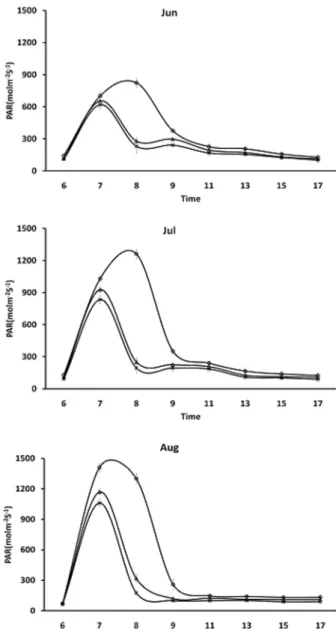
시기별로 광량을 측정한 결과는 Fig. 1 에서 보는 바와 같다 .
Fig. 1.
Changes of PAR(photosynthetic active radiation) according
to different planting positions and growth stages (
○:
Front,
△: Center, ×: Rear)
.재식위치별로 입사광량을 살펴보면 , 아침 일사량이 먼저 차단 되는 후주가 가장 적은 경향을 보였으며 , 전주는 아침 일사량 이 늦게까지 들어옴으로서 광량이 가장 많았고 , 중주는 그 중
간을 나타내었으나 후주에 가까운 광량을 보였다 . 광량의 차 이는 인삼의 근수량에도 영향을 미쳐 , 후주보다 전주부근의 인 삼 개체중이 큰 것으로 알려져 있다 (Jo et al ., 1998). 생육 시기별로는 6 월에서 8 월로 갈수록 광량이 높은 경향이었는데 , 8 월의 평균 광량은 PAR (Photosynthetic active radiation) 1,500 µ㏖
−2s
−1을 나타낸 반면에 6 월의 PAR 은 900 µ㏖
−2s
−1정
도를 나타내고 있다 . 일중 시간대별로 조사된 광량은 6 월과 7
월 및 8 월 모두에서 오전 8 시를 정점으로 감소하는 경향을 보 이고 있는데 , 이는 관행 및 개량해가림의 광합성 일변화와 유 사한 경향이나 감소폭에는 다소 차이가 있다 (Jo et al ., 1998).
2. 재식위치별 엽록소 형광반응의 차이
생육시기에 따라 재식위치별 인삼 잎의 엽록소 형광반응은
Fo (ground fluorescence, 융기 ( 隆起 ) 된 상태의 광화학계 II (PS II) 의 형광수율 ), Fv (maximum variable fluorescence)/
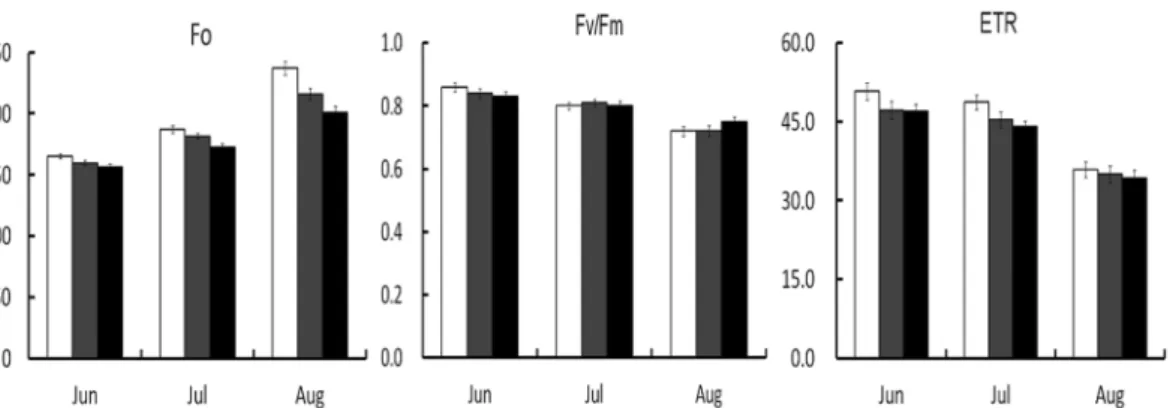
Fm (maximun variable fluorescence) 비 및 ETR (Electron transport rate) 로 표기하여 Fig. 2 에 나타내었다 . 그림에서 보 는 바와 같이 재식위치에 따른 Fo 는 후주위치의 인삼보다는 전주위치의 인삼이 높은 경향이었으며 , 생육시기가 진행될수 록 Fo 값이 증가하는 경향을 보여 고온과 고광에 의한 스트레
스를 많이 받는 것으로 나타났다 . 후주위치의 인삼은 상대적
으로 낮은 수치를 보임으로서 고온과 고광에 대한 스트레스를 적게 받는 경향이었는데 , 이는 Lee 등 (1980) 의 결과와 일치 하였다 . 생육시기별 조사에서는 6 월에는 전주 , 중주 , 후주의
Fo 값이 비슷하였으나 , 생육이 진행됨에 따라 차이를 나타내어
8 월에는 전주의 Fo 값이 큰 폭으로 증가하였는데 , 이는 인삼이
6 월 저온기에는 광에 대한 스트레스가 적어 전주 , 중주 , 후주 간의 큰 차이가 발생하지 않았지만 , 생육이 진행 할수록 8 월
의 고온시기에는 고광에 의한 스트레스를 많이 받는 것으로 사료된다 . 또한 , 6 월 저온시기에는 엽록소 함량이 높고 잎의
생육이 왕성하지만 고온시기에 고광을 받은 전주의 경우 , 엽 록소 함량이 낮아지고 잎이 쇠약해져 여러 병 장해를 받을 뿐 만 아니라 생육도 저해되는 경향이 있어 고온시기에는 고광에 대한 잎의 스트레스를 줄이는 기술이 필요할 것으로 생각하 며 , Cheon 등 (2004) 생육시기별 광량 조절과 농가에서 봄 ,
가을 보다 여름철에 차광을 두껍게 하여 재배 할 때 생육이 더 좋은 경우도 광에 의해 잎에 스트레스를 적게 받기 때문이 라고 밝힌 바 있다 .
Fv/Fm 값은 광이 억제된 잎에서 광계 II 의 기능을 측정할
수 있는 지표로서 , 식물은 높은 광량보다 낮은 광량에서 생장
되었을 때에 광 억제에 더욱 민감하다 (Demming and
Bjorkman, 1987). 낮은 광량에서 적응된 식물이 높은 광량에
노출되었을 때 광 억제가 민감한 이유는 광계 II 에서 , 낮은 광 량에서 자란 식물의 안테나 크기가 높은 광량에서 자란 식물 보다 크고 , 광합성율이 낮으며 , 크산토필 회로에 의한
zeaxanthin 형성 능력의 저하로 D1 단백질의 수전율이 감소하
기 때문이라는 보고 (Powles, 1894; Tyystjarvi et al ., 1991)
도 있다 .
본 실험에서 Fv/Fm 값을 조사하였던 바 , 생육시기가 진행
될수록 Fv/Fm 값이 감소하는 경향이었고 , 재식위치별로는 일
정한 경향은 없었으나 전주의 경우 , 생육시기가 진행될수록
Fv/Fm 값이 감소하는 경향이었다 .
Gent et al . (1989) 이 제시한 방법으로 chlorophyll 형광으로
부터 전자전달속도 즉 ETR (Electron transport rate) 을 추정
하여 보았던 바 , 재식위치별로 조사된 ETR 은 광량이 높은 전 주가 후주보다 높은 경향이었으며 , 생육시기가 진행될수록 전 자전달속도도 감소하였다 . 이는 6 월 저온시기에 잎이 고광을 받아 전자전달 속도가 높아지는 경향이 있으며 , 생육시기가 진 행 할수록 8 월에는 고온 , 고광에 대한 스트레스가 높아져 잎 의 생육이 저해를 받아 전자전달 속도도 감소하는 경향이 있 다 . 그러므로 , 봄철에 인삼의 생육이 왕성하였다가 , 여름철이
후 ETR 값이 적어져 생육이 낮아지는 요인으로 분석 된다 .
Fig. 2.
Changes of chlorophyll fluorescence according to different planting positions and growth stages (
□: Front, : Center,
■: Rear)
.3. 광 강도별 광합성속도 및 기공전도도의 변화
인삼의 생육시기에 따라 재식위치별로 광합성속도 및 기공
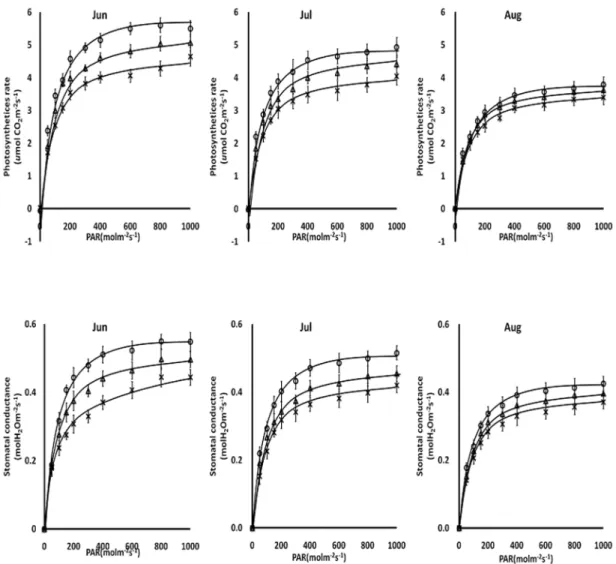
전도도를 측정한 결과 , Fig. 3 에서 보는 바와 같다 . 인삼의 광
합성은 모든 재식위치에서 광의 강도가 증가함에 따라 광합성 속도도 증가하는 경향이었는데 , PAR 200~400 µ㏖
−2s
−1부근에
서 최고치를 보였으며 그 이후의 광량에는 큰 변화없이 일정 한 경향을 보였고 , 광량을 많이 받는 전주에서 광합성속도가 더 증가하는 경향을 보였다 . 생육시기가 진행될수록 광합성속 도는 감소하는 경향이었는데 , 6 월에는 전주 , 중주 , 후주에 따 라 인삼의 광합성속도가 큰 폭의 차이를 보였으나 , 8 월에는 재 식위치별에 따라 큰 차이를 보이지 않았다 . 이와 같은 결과는
생육초기 비교적 저온시기의 경우 , 광량이 많을수록 광합성속
도가 증가하고 , 생육후기의 고온기에는 광량이 많을 경우 광 합성속도가 감소하며 전주 , 중주 , 후주별 광합성속도의 차이는
8 월보다 6 월에서 크게 나타난 바 , 인삼 잎은 저온시기에 동일
광량에 대하여 광합성 효율이 높아지는 것으로 사료된다 .
기공전도도는 기공개도의 척도를 측정하는 중요한 요소로서 광합성과 매우 중요한 관련형질이다 . 따라서 생육시기별 재식 위치에 따라 기공전도도를 측정한 결과를 동일 그림에서 살펴 보면 , 광의 강도가 증가할수록 광합성과 같이 증가하는 경향
이었는데 , PAR 이 200~400 µ㏖
−2s
−1까지 증가한 후에는 거의 일정한 경향을 보였는데 , 이는 Won 등 (2008) 의 보고와도 일 치하였다 . 재식위치별로는 후주보다 전주의 위치에서 기공전 도도가 더욱 증가하는 경향을 보였고 , 생육시기가 진행될수록 기공전도도는 감소하는 경향을 보이고 있는데 , 이는 잎의 노 화가 진행되고 엽록소 함량이 감소함에 따라 기공저항이 증가 한 결과로 판단된다 . 이상의 결과에 검토한 바와 같이 인삼은
광 환경에 따라 광합성과 기공에 매우 민감한 반응을 보이며 엽록소 형광반응과 밀접한 관계가 있는 것으로 사료된다 .
Fig. 3.