Research in Plant Disease pISSN 1598-2262, eISSN 2233-9191 www.online-rpd.org
The Korean Society of Plant Pathology
This is an open access article distributed under the terms of the Creative Commons Attribution Non-Commercial License (http://creativecommons.org/licenses/
by-nc/4.0/), which permits unrestricted non-commercial use, distribution, and reproduction in any medium, provided the original work is properly cited.
식물병연구
Research Article Open Access
Res. Plant Dis. 24(1): 26-32 (2018) https://doi.org/10.5423/RPD.2018.24.1.26
딸기 수경재배에서 시들음병 발생에 배양액 pH와 EC 효과
Effect of Nutrition Solution pH and Electrical Conductivity on Fusarium Wilt on Strawberry Plants in Hydroponic Culture
남명현1* · 이희철1 · 김태일1 · 이은모1 · 윤혜숙2
1충남농업기술원 과채연구소 논산딸기시험장, 2경남농업기술원
Myeong Hyeon Nam1*, Hee Chul Lee1, Tae il Kim1, Eun Mo Lee1, and Hae Suk Yoon2
1Nonsan Strawberry Experiment Station, Fruit Vegetable Research Institute, Chungnam ARES, Nonsan 32914, Korea
2Horticultural Research Division, Gyeongnam ARES, Jinju 52733, Korea
Fusarium wilt on strawberry plants caused by Fusarium oxysporum f. sp. fragariae (Fof) is a major disease in Korea. The prevalence of this disease is increasing, especially in hydroponic cultivation in strawberry field.
This study assessed the effect of nutrition solution pH and electrical conductivity (EC) on Fusarium wilt in vitro and in field trials. pH levels of 5.0, 5.5, 6.0, 6.5, 7.0, and 7.5 were assayed in vitro and in field trials. EC levels at 0, 0.5, 0.8, 1.0, and 1.5 dS∙m-1 were assayed in field trials. Mycelial growth of Fof increased with increasing pH and was highest at 25oC pH 7 and lowest at 20oC, pH 5.0 in vitro. The incidence of Fusarium wilt was lowest in the pH 6.5 treatment and highest in the pH 5 treatment in field trials. At higher pH levels, the EC decreased in the drain solution and the potassium content of strawberry leaves increased. In the EC assay, the severity of Fusarium wilt and nitrogen content of leaves increased as the EC increased. These results indicate that Fu- sarium wilt is related to pH and EC in hydroponic culture of strawberry plants.
Keywords: Disease index, Fragaria x ananassa, Nitrogen
서 론
Fusarium oxysporum f. sp. fragariae (Fof)에 의한 딸기 시들 음병은 신엽이 1-2엽이 작아지는 기형잎(짝잎)과 생육저하로 결국은 묘가 고사되는 피해로 인해 딸기 재배포장에서 큰 문 제가 되고 있는 병해이다(Kim 등, 1982). 특히 국내 딸기의 주 요 품종인 ‘설향’은 2006년부터 꾸준히 증가하여 2016년 전국 의 83.4%를 차지하고 있으며(Korea Rural Economic Institute,
2017), 이 품종은 시들음병에도 감수성으로 매년 병 발생이 증 가하고 있다(Nam 등, 2011). 또한 국내 딸기 수경재배 면적도 매년 증가 추세를 보이며 2016년에는 1,148 ha로 재배면적의 19.2%를 차지한다. 이처럼 딸기 재배에서 단일품종의 우점적 재배와 수경재배 면적 증가로 인한 상토 소독 미흡 및 작은뿌 리파리와 복합피해(Nam 등, 2017), 기후변화에 따른 온도 상승 (Fang 등, 2011) 등은 토양병해인 시들음병 발생 증가에 주요한 원인으로 보여진다.
딸기 시들음병은 1962년 호주에서 최초 보고(Winks와 Williams, 1965)된 이후 국내에도 1982년에 발생이 보고되었다 (Kim 등, 1982). 딸기 시들음병은 토양전염성 병해로 이병토양 (Burgess, 1981)과 묘에 감염된 이병 식물체(Nam 등, 2011)가 주
*Corresponding author Tel: +82-41-635-6348 Fax: +82-41-635-7931 E-mail: [email protected]
Received November 11, 2017 Revised December 11, 2017 Accepted December 12, 2017
https://doi.org/10.5423/RPD.2018.24.1.26
요 전염원이다. 딸기 시들음병 방제로는 저항성 품종, 정식 전 토양 소독, 생물적 방제, 윤작, 무병묘, 위생, 장비 소독 등이 있 다(Gordon 등, 2016; Koike와 Gordon, 2015). 시들음병은 발생 이 된 상태에서는 방제가 어렵기 때문에 토양이나 상토 소독외 재배적 방제가 중요한 역할을 한다.
Fusarium spp.에 의한 작물의 시들음병 발생은 산성토양 (Fang 등, 2012), 낮은 electrical conductivity (EC)와 미생물 활 성(Santos와 Bettiol, 2003), 높은 질소시비(Duffy와 Défago, 1999) 등에서 병 발생이 증가한다. 딸기 시들음병은 산성토양 에서 발생이 증가하며(Nam 등, 2005), asparagus에 발생하는 시들음병의 경우 토양의 pH를 중성 pH (6.0)으로 유지함으로써 병 발생을 억제할 수 있었다(Elmer, 2015). 반면, 토양의 높은 EC 는 Sclerotium rolfsii에 의한 bean 식물의 잘록병을 감소시키지 만(Santos와 Bettiol, 2003), F. oxysporum f. sp. lactucae에 의한 lettuce의 시들음병 발생에는 영향이 없었다(Chitarra 등, 2013).
특히 딸기재배에서 수경재배가 증가하면서 시들음병 발생도 증가하고 있어, 이에 따른 수경재배 배양액의 EC가 시들음병 발생과 어떤 관련이 있는지 검토할 필요가 있다. 또한 시들음 병 발생에는 영양원도 중요한 역할을 하는데 그 중 질소가 관 련성이 크다(Duffy와 Défago, 1999; Gatch와 du Toit, 2015).
F. oxysporum f. sp. dianthi는 토양에서 암모늄태질소보다 질산 태질소가 병 발생을 억제하는데 질산태질소는 후막포자의 형 성을 억제하고 분해를 증가시키기 때문이라고 한다(Gullino 등, 2015).
따라서 본 연구에서는 딸기 수경재배에서 시들음병 발생을 줄일 수 있는 방법으로 배양액의 pH와 EC 수준에 따른 시들음 병 억제효과를 검토하였다.
재료 및 방법
In vitro 상에서 pH에 따른 시들음병균의 균사생장. pH에 따른 딸기 시들음병균의 균사생장률은 pH 5.0, 5.5, 6.0, 6.5, 7.0, 7.5 수준으로 20, 25, 28oC의 온도에서 조사하였다. 2003년 논 산지역의 ’사마베리’ 품종의 관부에서 분리한 딸기 시들음병균 Fo79 균주를(Nam 등, 2005) 질산과 수산화칼륨으로 pH를 조
정한 potato dextrose agar (PDA, Difco, USA) 배지에서 배양하 였다. 균사 생장률은 배지에 접종 3일 후 균사 반경을 측정하 였다.
식물체와 배양액. 딸기 재배포장에서의 배양액 pH와 EC에 따른 시들음병 이병률 조사는 논산딸기시험장 병 검정 비닐하 우스에서 실시하였다. 시험품종은 ‘설향’으로 조직배양묘를 모 주로 육묘한 3-4장의 잎을 가진 자묘를 시험에 이용하였다. 자 묘는 딸기전용상토(코코피트:피트모스:펄라이트=65:17:10, 푸 르미, 서울바이오)가 충진된 플라워 박스(쌍우3호, 57×18 cm) 에 박스당 3-5주씩 정식하였다. 시험구 배치는 완전임의배치 3 반복으로 처리당 9-15주를 조사하였다. 시험에 사용한 배양액 (Table 1)으로 pH 시험에는 추비용 관주비료(N-P-K: 30-10-10, 1000배, EC 0.63, 퍼티케어, ㈜도프(평택, 한국))를 질산과 수산 화칼륨으로 pH를 조절하였으며, EC 시험은 일본원시조성액으 로 EC를 조정하여 사용하였다. 시험기간 동안 시험포장의 기상 환경은 평균온도 20-29oC, 평균 상대습도 40-65%였다.
딸기 재배포장에서 배양액 pH에 따른 시들음병 억제효 과. 배양액 pH 수준은 5.0, 5.5, 6.0, 6.5, 7.0의 5처리로 1차 시험은 4월 28일부터 6월 6일까지 2분/1회/일, 2차 시험은 6월 24일부터 7월 12일까지 4분/2회/일 동안 배양액을 공급 하였다. 딸기 시들 음병균 접종 은 Fo79 균주를 MM배지 (Correll 등, 1987)에서 28oC, 200 rpm으로 진탕배양 7일 후 1×10⁶ conidia/ml의 포자농도로 주당 50 ml씩 1차 시험은 5월 4일 건전 상토에, 2차 시험은 6월 30일 이병 상토에 접종하였다.
처리 후 시기별 이병지수를 조사하였다. 이병지수는 0은 무병 징, 1은 1-2엽이 휘어지고 신엽이 황화하며 하엽의 엽병이 적색 을 띰, 2는 모든 잎이 휘어지고 짝잎이 발생, 3은 잎이 황화되고 식물체의 반 이상이 시듦 증상, 4는 식물체 전체가 시듦, 5는 식 물체 전체가 고사이다(Nam 등, 2005).
딸기 재배포장에서 배양액 EC에 따른 시들음병 억제효 과. 배양액의 EC 수준은 0, 0.5, 0.8, 1.0, 1.5 dS·m-1로 1차 시험 은 7월 15일부터 8월 29일까지 4분/2회/일 공급하였고, 2차 시
Table 1. Composition of nutrient solution applied to strawberry plants Nutrient solution
composition
Macro-element concentration (me/L)
NO3-N NH4-N NH2-N P K Mg Ca
Commercial fertilizer 4.6 3.1 36.7 9.4 4.6 2.1 0
NHRSa 16.0 1.34 - 4 8 4 8
aNHRS; National Horticultural Research Station in Japan.
Research in Plant Disease Vol. 24 No. 1 28
험은 10월 10일부터 12월 23일과 다음 해 4월 6일부터 5월 16일 까지 4분/2회/일 동안 배양액을 공급하였다. 위의 방법과 동일 하게 딸기 시들음병균 포자현탁액을 조제 후 주당 50 ml씩 1차 시험은 7월 21일, 2차 시험은 10월 16일에 건전 상토에 접종하 였다. 처리 후 시기별 이병지수 조사는 위의 방법과 동일하게 실 시하였다.
상토, 배액 및 식물체 분석. 상토와 배액의 pH는 pH meter (FieldScout pH400, Spectrum Co., Aurora, IL, USA)로 측정하 였고, EC는 EC meter (WT1000B, 미래센서(서울, 한국))로 측 정하였다. 배액은 1일 동안 수집된 각 처리별 배양액을 측정하 였다.
식물체 잎의 무기함량 분석은 식물체의 3번째 잎을 채취하여 건조 시킨 후 완전히 분쇄하여 농촌진흥청 농업과학기술원의 토양과 식물체 분석법에 준하여 분석하였다(National Institute of Agricultural Science and Technology, 2000). 식물체 무기 성분은 유도결합 플라즈마분광분석기(Inductively coupled Plasma Spectroscopy, GBC Integra, XL, Braeside, VIC, Australia) 를 이용하여 분석하였다. 처리간 비교는 CoStat 통계 프로그램 (CoHort software, Berkeley, CA, USA)을 이용해 Duncan multiple range test (P<0.05) 분석으로 실시하였다.
결과 및 고찰
In vitro 상에서 pH에 따른 시들음병균의 균사생장률. 딸기 시들음병균의 균사생장은 in vitro 상에서 pH가 증가할수록 증 가하였으며, 25oC에서 pH 7.0이 가장 높았고, 20oC에서 pH 5.0 가 가장 낮았다(Fig. 1). 국내 딸기 시들음병균의 pH에 따른 균 사생육은 pH가 낮을수록 감소하였으며 25oC가 20oC나 28oC
처리보다 높은 균사생장률을 보였다.
미국의 딸기 시들음병균은 pH 5-8 범위에서 배양 시 처리간 유의성은 없었으며 균사생육은 pH가 낮을수록 낮아지는 경향 을 보였다(Islas, 2012). Soybean에 발생하는 F. oxysporum 균도 15oC, pH 5에서 가장 낮은 균사생장률을 나타내(Cruz 등, 2015) 국내 분리균과 비슷한 경향을 보였다. 토마토 시들음병균의 포 자는 pH 6.5가 포자형성에 가장 좋은 반면 chlamydospores 의 발아는 pH 4.5에서 가장 최대라고 하였다(Tyagi와 Paudel, 2014). 또한 F. soloni f. sp. phaseoli의 chlamydospores는 높은 pH에서 carbon의 손실이 높으며 이런 토양조건은 미생물작용 을 증진시키는 효과가 있으므로(Mondal과 Hyakumachi, 1998) 추후 pH와 chlamydospores의 생장에 대한 실험이 실시되어야 할 것으로 사료된다.
배양액 pH에 따른 시들음병 억제효과. 재배포장 검정에서 시들음병 발생은 배양액의 pH 6.5가 다른 처리보다 가장 낮았 으며 pH 5가 가장 높은 경향을 보였다(Fig. 2). 배양액의 pH가
Fig. 1. Mycelial growth of temperature and pH on Fusarium oxysporum f.
sp. fragariae on PDA medium.
Fig. 2. Disease index [(A) 1st trial, (B) 2nd trial] of Fusarium wilt by pHs of nutrition solution in hydroponic culture of ‘Seolhyang’ strawberry plants.
상승함에 따라 상토의 pH는 떨어지는 경향을 보였으나 EC는 처리간 유의성이 없었다(Table 2). 또한 배양액의 pH가 높아질 수록 배액의 EC는 감소하였으나 pH는 증가하는 경향을 보였다.
배양액 pH수준별 처리 후 식물체 분석 결과 배양액 pH증가에 따라 잎의 칼륨농도는 증가하는 경향을 보였으며 다른 무기원 소는 처리간 뚜렷한 경향을 보이지 않았다(Table 3).
Fang 등(2012)은 토양재배에서 pH 6.7인 토양이 다른 pH 토 양보다 시들음병 발생이 가장 적다고 하여 본 결과와 비슷한 경 향을 보였다. 토양의 pH에 따른 딸기 시들음병균 발생은 병원 균의 접종농도를 5×10² cfu/g로 낮게 처리할 경우 pH 6-7 처리 가 이병률이 가장 낮았으나 접종 농도가 5×10⁴ cfu/g 이상의 균 농도에서는 pH 수준에 따른 시들음병 이병률 차이는 볼 수 없 다고 한다(Islas, 2012).
근권부의 pH 변화는 작물의 비료흡수 특성, 관개수의 중탄 산농도, 비료의 조성, 상토의 종류에 따르며 정상적인 생장이 이루어지면 pH는 변화하며 근권부의 pH가 5.5-6.5를 유지할 경우 작물의 생장은 우수하다(Nelson, 2003). 딸기 수경재배에 서 적정 pH 범위는 5.5-6.2(토양 6.2-6.7)로 딸기는 양이온 흡 수량이 높아 근권부의 pH가 낮은 작물이며(Choi 등, 2010; Shin 등, 2013), 토양은 산성화가 될 경우 근권부의 Ca 및 Mg의 불용
화에 따른 흡수량 저하가 발생한다고 한다(Nelson, 2003). 특 히 ‘설향’ 품종은 NH4나 K 등 1가 양이온 흡수량이 많고 근권 부의 pH를 산성 쪽으로 변화시키는 독특한 특성이 있다(Lee 등, 2015). 대부분의 작물은 pH가 낮아지면 사이토카닌이나 옥 신의 활성이 떨어져 뿌리 발근이나 신장이 나빠진다고 한다 (Yamazaki, 1982). 위의 결과에서 배양액 pH가 높을수록 시들 음병 발생은 감소하고 배액의 pH는 증가하는 경향은 배액의 pH가 높은 것은 뿌리의 활성이 양호하나 pH가 낮은 것은 뿌리 의 활성이 낮다는 결과(Jun 등, 2011)와 관련이 있을 것으로 사 료된다.
본 결과에서는 배양액 pH가 높아질수록 식물체의 칼륨농 도는 증가하는 경향을 보였는데 토마토 시들음병의 경우에도 배지의 pH가 산성보다는 알칼리성에서 병 발생이 감소하였 고 pH가 증가할수록 식물체의 칼륨 함량이 증가하여(Borrero 등, 2004) 본 결과와 비슷한 경향을 확인할 수 있었다. Table 3 에서의 pH수준별 식물체 무기성분 함량을 분석한 시기는 딸 기 육묘기(3-8월)이다. 이 시기에 대부분의 딸기재배농가에서 는 자묘의 영양번식이 목적이기 때문에 표준화된 양액조성 대 신 농축액을 만드는 번거로움을 피하고 생육상태에 따라 비료 Table 2. pH and electrical conductivity (EC) of substrate and drain
solution by pHs of nutrition solution in hydroponic culturea
pH Substrate Drain solution
pH EC (dS∙m-1) pH EC (dS∙m-1)
5.0 4.8 ab 1.20 a 5.0 a 2.65 a
5.5 4.7 a 1.58 a 4.5 d 2.69 a
6.0 4.3 b 1.22 a 4.7 c 2.67 a
6.5 4.1 bc 1.12 a 4.8 bc 2.53 b
7.0 4.0 c 1.11 a 4.9 ab 2.49 b
aSurvey date: 3 June.
bMeans within a column followed by the same letter are not sig- nificantly different by Duncan multiple range test (P<0.05).
Table 3. Nutrient status of strawberry leaves grown in pHs of nutrition solution in hydroponic culture of ‘Seolhyang’ strawberry plantsa
pH P K Ca Mg Na Mn B Fe Zn Cu
% mg/kg
5.0 0.53 ab 2.60 ab 1.20 a 0.59 a 303 ab 252 b 88 a 173 ab 34 a 2 a
5.5 0.48 a 2.61 ab 1.15 ab 0.57 a 272 ab 309 a 92 a 196 ab 31 a 2 a
6.0 0.53 a 2.55 b 1.18 ab 0.58 a 326 a 273 ab 81 a 210 a 34 a 2 a
6.5 0.51 a 2.83 a 1.16 ab 0.59 a 329 a 285 ab 90 a 168 ab 33 a 2 a
7.0 0.47 a 2.71 ab 1.06 b 0.55 a 262 b 252 b 76 a 153 b 31 a 1 a
aSampling date: 3 June.
bMeans within a column followed by the same letter are not significantly different by Duncan multiple range test (P<0.05).
Table 4. Disease index of Fusarium wilt by electrical conductivity (EC) levels of nutrition solution in hydroponic culture of ‘Seolhyang’
strawberry plantsa
EC (dS∙m-1) 1st trial 2nd trial
0 0.9 cb 0.6 c
0.5 2.3 b 2.4 b
0.8 3.4 ab 2.4 b
1.0 3.1 ab 2.7 b
1.5 3.9 a 3.5 a
aSurvey date: 29 August, 2016 (1st trial), 16 May, 2017 (2nd trial).
bMeans within a column followed by the same letter are not sig- nificantly different by Duncan multiple range test (P<0.05).
Research in Plant Disease Vol. 24 No. 1 30
조성을 쉽게 바꿀 수 있도록 복합비료를 사용하고 있다(Lee 등, 2015). 복합비료는 생리적으로 산성, 중성, 알칼리성에 따라 작 물의 흡비 특성에 차이가 있는데 딸기 생육이 가장 우수한 알 칼리성 200비료(Lee 등, 2015) 처리시 식물체 인산과 칼륨 함량 은 본 결과의 pH 6-7.0 수준과 비슷한 경향을 보였다.
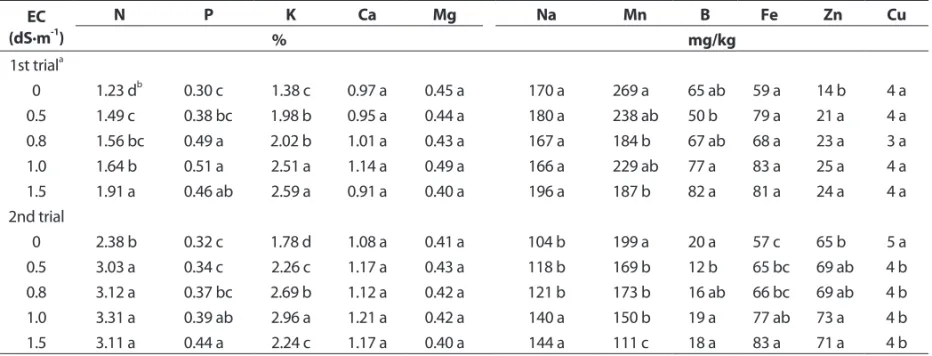
배양액 EC에 따른 시들음병 억제효과. 재배포장에서 배양 액 EC가 증가할수록 시들음병 발생은 증가하는 경향을 보였으 나 EC 0.0과 1.5 dS·m-1를 제외한 처리간 유의성은 2차 시험에서 는 보이지 않았다(Table 4). 상토와 배액의 EC는 배양액 EC가 증 가할수록 증가하였다(Table 5). 또한 식물체 분석 결과 질소는
EC 증가에 따라 증가하는 경향을 보였으나 다른 무기원소는 뚜 렷한 차이를 볼 수 없었다(Table 6).
Lettuce (Chitarra 등, 2013)와 토마토(Borrero 등, 2004)의 시 들음병은 EC에 따른 영향은 적다고 하여 본 연구와 다른 결과 를 보였다. 그러나 본 결과에서는 배양액의 EC가 증가할수록 시 들음병 발생은 증가하였고 질소농도도 증가하는 경향을 보여 질소가 시들음병 발생에 중요한 역할을 할 것으로 사료된다. 토 마토 시들음병은 암모늄태 질소와 NaHPO4·H2O, Fe-EDDHA, MnSO4, MoO3, ZnSO4·7H2O 농도가 증가할수록 병 발생은 증가 하였으나 질산암모늄의 적정농도(N 100 mg/l)에서는 생체중도 증가하였고 시들음병 발생도 감소하는 경향을 보였다(Duffy 와 Défago, 1999). 또한 암모니아태질소/질산태질소 비율이 높 을수록 토마토 시들음병(Borrero 등, 2012)과 오이 시들음병 (Wang 등, 2016)은 증가하는 결과를 보였다. Spinach의 시들 음병 발생은 NH4-N과 높은 상관관계를 보였으며(Gatch와 du Toit, 2015), 토마토 시들음병은 질산태질소와 CuSO4·5H2O 처리 에서 발생이 감소하였고(Duffy와 Défago, 1999), 셀러리 시들음 병은 KNO3가 다른 질소형태보다 병 발생이 감소한다고 하였다 (Schneider, 1985). 비록 in vitro 상에서 바나나 시들음병균의 균 사생육은 암모늄농도 증가에 따라 생육은 억제되었고(Zhang 등, 2013), 수박의 시들음병 발생도 질소원에 따른 영향이 없다 고(Hopkins와 Elmstrom, 1976) 하여 딸기 재배포장에서도 질 산태질소와 암모늄태질소 시비에 따른 시들음병 발생경향이 추후 조사되어야 할 것이다.
Table 5. Electrical conductivity (EC) of substrate and drain solution by EC levels of nutrition solution in hydroponic culturea
EC (dS∙m-1)
Substrate Drain solution
1st trial 2nd trial 1st trial 2nd trial
0 0.58 eb 0.14 e 0.47 b 0.05 d
0.5 0.60 d 0.25 d 0.71 b 0.28 c
0.8 0.94 c 0.42 c 1.30 a 0.51 b
1.0 1.15 b 0.58 b 1.43 a 0.58 b
1.5 1.43 a 0.95 a 1.56 a 1.02 a
aSurvey date: 1 August, 2016 (1st trial), 26 October, 2016 (2nd trial).
bMeans within a column followed by the same letter are not sig- nificantly different by Duncan multiple range test (P<0.05).
Table 6. Nutrient status of strawberry leaves grown in electrical conductivity (EC) levels of nutrition solution in hydroponic culture of
‘Seolhyang’ strawberry plants EC
(dS∙m-1)
N P K Ca Mg Na Mn B Fe Zn Cu
% mg/kg
1st triala
0 1.23 db 0.30 c 1.38 c 0.97 a 0.45 a 170 a 269 a 65 ab 59 a 14 b 4 a
0.5 1.49 c 0.38 bc 1.98 b 0.95 a 0.44 a 180 a 238 ab 50 b 79 a 21 a 4 a
0.8 1.56 bc 0.49 a 2.02 b 1.01 a 0.43 a 167 a 184 b 67 ab 68 a 23 a 3 a
1.0 1.64 b 0.51 a 2.51 a 1.14 a 0.49 a 166 a 229 ab 77 a 83 a 25 a 4 a
1.5 1.91 a 0.46 ab 2.59 a 0.91 a 0.40 a 196 a 187 b 82 a 81 a 24 a 4 a
2nd trial
0 2.38 b 0.32 c 1.78 d 1.08 a 0.41 a 104 b 199 a 20 a 57 c 65 b 5 a
0.5 3.03 a 0.34 c 2.26 c 1.17 a 0.43 a 118 b 169 b 12 b 65 bc 69 ab 4 b
0.8 3.12 a 0.37 bc 2.69 b 1.12 a 0.42 a 121 b 173 b 16 ab 66 bc 69 ab 4 b
1.0 3.31 a 0.39 ab 2.96 a 1.21 a 0.42 a 140 a 150 b 19 a 77 ab 73 a 4 b
1.5 3.11 a 0.44 a 2.24 c 1.17 a 0.40 a 144 a 111 c 18 a 83 a 71 a 4 b
aSampling date: 29 July, 2016 (1st trial), 18 April, 2017 (2nd trial).
bMeans within a column followed by the same letter are not significantly different by Duncan multiple range test (P<0.05).
요 약
Fusarium oxysporum f. sp. fragariae (Fof)에 의한 딸기 시들 음병은 국내에서 중요한 병해이다. 특히 딸기재배에서 시들음 병 발생은 수경재배 면적이 증가하면서 증가하는 경향을 보이 고 있다. 따라서 이 연구에서는 딸기 수경재배에서 시들음병 발 생에 배양액의 pH와 EC의 영향을 in vitro와 재배포장에서 조사 하였다. pH는 5, 5.5, 6, 6.5, 7, 7.5로 in vitro와 재배포장에서 검 정하였고 EC는 0, 0.5, 0.8, 1, 1.5 dS·m-1로 재배포장에서 조사하 였다. In vitro 상에서 딸기 시들음병균의 균사생육은 pH가 증가 하면서 증가하였고 25oC, pH 7에서 최대였으며 20oC, pH 5에서 가장 낮았다. 재배포장에서 딸기 시들음병 발생은 pH 6.5에서 가장 낮았고 pH 5에서 가장 높은 경향을 보였다. 배양액의 pH 는 높아질수록 배액의 EC는 감소하였고 딸기 잎의 칼륨함량은 증가되었다. EC 검정에서 배양액 EC가 상승함에 따라 딸기 시 들음병 발생과 잎의 질소함량은 증가하였다. 이런 결과로 딸기 시들음병 발생은 수경재배에서 pH와 EC가 관련이 있다는 것을 알 수 있었다.
Conflicts of Interest
The authors declare that they have no competing and com- mercial interests in this work.
Acknowledgement
This research was supported by a grant (Project No.
PJ01188604) from Rural Development Administration, Republic of Korea.
References
Borrero, C., Trillas, M. I., Ordovás, J., Tello, J. C. and Avilés, M. 2004.
Predictive factors for the suppression of Fusarium wilt of to- mato in plant growth media. Phytopathology 94: 1094-1101.
Borrero, C., Trillas, M. I., Delgado, A. and Avilés, M. 2012. Effect of ammonium/nitrate ratio in nutrient solution on control of Fusarium wilt of tomato by Trichoderma asperellum T34. Plant Pathology 61: 132-139.
Burgess, L. W. 1981. General ecology of the Fusaria. In: Fusarium:
Diseases, Biology and Taxonomy, eds. by P. E. Nelson, T. A. Tous- soun and R. J. Cook, pp. 225-235. The Pennsylvania State Uni- versity Press, PA, USA.
Chitarra, W., Pugliese, M., Gilardi, G., Gullino, M. L. and Garibaldi, A.
2013. Effect of silicates and electrical conductivity on Fusarium
wilt of hydroponically grown lettuce. Commun Aqric. Appl. Biol.
Sci. 78: 555-557.
Choi, J. M., Kim, T. I., Jeong, S. K., Yoon, M. K., Kim, D. Y. and Ko, K. D.
2010. Causes, Diagnosis, and Corrective Procedures of Nutri- tional Disorders in Strawberry. Mirae Gihock, Suwon, Korea. (In Korean)
Correll, J. C., Klittich, C. J. R. and Leslie, J. F. 1987. Nitrate nonutiliz- ing mutants of Fusarium oxysporum and their use in vegetative compatibility tests. Phytopathology 77: 1640-1646.
Cruz, D. R., Leandro, L. F. and Munkvold, G. P. 2015. Effects of Tem- perature and pH on Fusarium oxysporum and Soybean Seedling Disease. 2015 APS Annual Meeting, The American Phytopatho- logical Society.
Duffy, B. K. and Défago, G. 1999. Macro- and microelement fertil- izers influence the severity of Fusarium crown and root rot of tomato in a soilless production system. HortScience 34: 287-291.
Elmer, W. H. 2015. Management of Fusarium crown and root rot of asparagus. Crop Prot. 73: 2-6.
Fang, X., Phillips, D., Li, H., Sivasithamparam, K. and Barbetti, M. J.
2011. Comparisons of virulence of pathogens associated with crown and root diseases of strawberry in western Australia with special reference to the effect of temperature. Sci. Hortic. 131:
39-48.
Fang, X., You, M. P. and Barbetti, M. J. 2012. Reduced severity and impact of Fusarium wilt on strawberry by manipulation of soil pH, soil organic amendments and crop rotation. Eur. J. Plant Pathol. 134: 619-629.
Gatch, E. W. and du Toit, L. J. 2015. A soil bioassay for predicting the risk of spinach Fusarium wilt. Plant Dis. 99: 512-526.
Gordon, T. R., Daugovish, O., Koike, S. T., Islas, C. M., Kirkpatrick, S. C., Yoshisato, J. A. and Shaw, D. V. 2016. Options for management of Fusarium wilt of strawberry in California. Int. J. Fruit Sci. 16:
160-168.
Gullino, M. L., Daughtrey, M. L., Garibaldi, A. and Elmer, W. H. 2015.
Fusarium wilts of ornamental crops and their management.
Crop Prot. 73: 50-59.
Hopkin, D. L. and Elmstrom, G. W. 1976. Effect of soil pH and nitro- gen source on Fusarium wilt of watermelon on land previously cropped in watermelons. Proc. Fla. State Hort. Soc. 89: 141-143.
Islas, C. M. 2012. Fusarium wilt caused by Fusarium oxysporum f. sp.
fragariae: an emerging disease of strawberry in California. M.S.
thesis. University of California, Davis, USA.
Jun, H. J., Byun, M. S., Liu, S. S. and Jang, M. S. 2011. Effect of nutrient solution strength on pH of drainage solution and root activity of strawberry ‘Sulhyang’ in hydroponics. Kor. J. Hort. Sci. Technol.
29: 23-28. (In Korean)
Kim, C. H., Seo, H. D., Cho, W. D. and Kim, S. B. 1982. Studies on va- rietal resistance and chemical control to the wilt of strawberry caused by Fusarium oxysporum. Korean J. Plant Prot. 21: 61-67. (In Korean)
Koike, S. T. and Gordon, T. R. 2015. Management of Fusarium wilt of
Research in Plant Disease Vol. 24 No. 1 32
strawberry. Crop Prot. 73: 67-72.
Korea Rural Economic Institute. 2017. Outlook 2017. KREI. 824 pp. (In Korean)
Lee, H. S., Jang, H. H., Choi, J. M. and Kim, D. Y. 2015. Influence of fertilizer type on physiological responses during vegetative growth in ‘Seolhyang’ strawberry. Kor. J. Hort. Sci. Technol. 33: 39- 46. (In Korean)
Mondal, S. N. and Hyakumachi, M. 1998. Carbon loss and germina- bility, viability, and virulence of chlamydospores of Fusarium soloni f. sp. phaseoli after exposure to soil at different pH levels, temperatures, and matric potentials. Phytopathology 88: 148- 155.
Nam, M. H., Jung, S. K., Kim, N. G., Yoo, S. J. and Kim, H. G. 2005. Re- sistance analysis of cultivars and occurrence survey of Fusarium wilt on strawberry. Res. Plant Dis. 11: 35-38. (In Korean)
Nam, M. H., Kang, Y. J., Lee, I. H., Kim, H. G. and Chun, C. H. 2011.
Infection of daughter plants by Fusarium oxysporum f. sp.
fragariae through runner propagation of strawberry. Kor. J. Hort.
Sci. Technol. 29: 273-277. (In Korean)
Nam, M. H., Kim, H. S., Park, M. S., Kim, T. I., Lee, E. M. and Kim, H. G.
2017. Damage and potential of fungus gnat as a Fusarium vec- tor in the strawberry plants in Korea. Acta Hortic. 1156: 857-861.
National Institute of Agricultural Science and Technology. 2000.
Methods of Soil and Plant Analysis. Suwon, Korea. (In Korean) Nelson, P. V. 2003. Greenhouse operation and management. 6th ed.
Prentice Hall, Upper Saddle River, NJ.
Santos, I. and Bettiol, W. 2003. Effect of sewage sludge on the root and seedling damping-off of bean plants caused by Sclerotium rolfsii. Crop Prot. 22: 1093-1097.
Schneider, R. W. 1985. Suppression of Fusarium yellows of celery with potassium, chloride, and nitrate. Phytopathology 75: 40-48.
Shin, W. K., Kang, H. J., Yun, H. S. and Choi, J. M. 2013. Hydroponic Culture on High Raised Bed of Strawberry Plants. Rural Devel- opment Administration. (In Korean)
Tyagi, S. and Paudel, R. 2014. Effect of different pH on the growth and sporulation of Fusarium oxysporum: the causal organism of wilt disease of tomato. Int. J. Basic and Appl. Biol. 2: 103-106.
Wang, M., Sun, Y., Gu, Z., Wang, R., Sun, G., Zhu, C., Guo, S. and Shen, Q. 2016. Nitrate protects cucumber plants against Fusarium oxysporum by regulating citrate exudation. Plant Cell Physiol. 57:
2001-2012.
Winks, B. L. and Williams, Y. N. 1965. A wilt of strawberry caused by a new form of Fusarium oxysporum. Queensland J. Agric. Anim. Sci.
22: 475-479.
Yamazaki, K. 1982. The Whole Book for Hydroponics. Hakyusha, Tokyo, Japan.
Zhang, M., Chen, P., Zhang, M., Ruan, Y., Li, R., Zhu, Y. and Shen, Q.
2013. Influence of nitrate/ammonium on Fusarium oxysporum f. sp. cubense of banana wilt disease. Plant Nut. Fert. Sci. 19: 232- 238.