• 검색 결과가 없습니다.

Wood Classification of Japanese Fagaceae using Partial Sample Area and Convolutional Neural Networks

N/A
N/A
Protected

Academic year: 2021

Share "Wood Classification of Japanese Fagaceae using Partial Sample Area and Convolutional Neural Networks"

Copied!
13
0
0

로드 중.... (전체 텍스트 보기)

전체 글

(1)

Wood Classification of Japanese Fagaceae using Partial Sample Area and Convolutional Neural Networks 1

Taufik FATHURAHMAN 2,3 ⋅P. H. GUNAWAN 2 ⋅Esa PRAKASA 3,† ⋅Junji SUGIYAMA 4

ABSTRACT

1)

Wood identification is regularly performed by observing the wood anatomy, such as colour, texture, fibre direction, and other characteristics. The manual process, however, could be time consuming, especially when identification work is required at high quantity. Considering this condition, a convolutional neural networks (CNN)-based program is applied to improve the image classification results. The research focuses on the algorithm accuracy and efficiency in dealing with the dataset limitations. For this, it is proposed to do the sample selection process or only take a small portion of the existing image. Still, it can be expected to represent the overall picture to maintain and improve the generalisation capabilities of the CNN method in the classification stages. The experiments yielded an incredible F1 score average up to 93.4% for medium sample area sizes (200 × 200 pixels) on each CNN architecture (VGG16, ResNet50, MobileNet, DenseNet121, and Xception based). Whereas DenseNet121-based architecture was found to be the best architecture in maintaining the generalisation of its model for each sample area size (100, 200, and 300 pixels). The experimental results showed that the proposed algorithm can be an accurate and reliable solution.

Keywords: wood, microscopic image, sample selection, classification, convolutional neural network

1. INTRODUCTION

Wood is the most dominant forest product for com- mercial use in various industries as raw material and to support the daily life of humans, such as building materials, furniture, craft arts, and many others. In identifying the wood, the visual inspection of various wood tissues is a common method (Hwang et al., 2020). Wood species are very diverse, but still have

unique characteristics that can be distinguished from each other. Therefore, an accurate and reliable wood classification system based on the image classification method needs to be developed.

Several previous works related with microsopic ana- laysis of the wood surface can be mentioned as follows. Savero et al. (2020) investigate wood charac- teristics of 8-year-old superior teak from Muna Island by observing macroscopic and microscopic anatomical

1 Date Received August 25, 2020, Date Accepted August 6, 2021

2 School of Computing, Telkom University, Bandung, Indonesia

3 Computer Vision Research Group, Research Center for Informatics, Indonesian Institute of Sciences, Bandung, Indonesia

4 Division of Forestry and Biomaterials Science Faculty / Graduate School of Agriculture, Kyoto University Kitashirakawa- Oiwakecho, Sakyo-ku, Kyoto 606-8502, Japan

† Corresponding author: Esa PRAKASA (e-mail: [email protected], ORCID: 0000-0003-4685-6309)

Original Article

(2)

characteristics. This study showed differences in the characteristics of the higher wood portion, wood tex- ture, growing ring width, and wood specific gravity which were categorized as a Strength Class of III (Savero et al., 2020). Furthermore, Jeon et al. (2020) researched the anatomical characteristics of Quercus mongolica which was attacked by oak wilt disease, the anatomical structure of infected wood, deadwood, and healthy wood. The results of the study that showed a big difference between wood affected by oak wilt and healthy wood was the tyloses ratio (Jeon et al., 2020). Finally, Jeon et al. (2018) conducted a study on the characteristics of Korean commercial bamboo species (Phyllostachys pubescens, Phyllostachys nigra, and Phyllostachys bambusoides). The research re- sulted in crystal properties, vascular bundle, fiber length, vessel diameter, and parenchyma, as well as the length and width of the radial and tangential sec- tions (Jeon et al., 2018).

Salma et al. (2018) proposed a wood identification algorithm by combining Daubechies Wavelet (DW) and Local Binary Pattern (LBP) methods (Salma et al., 2018) as the pattern extractor. The pattern was then classified by using support vector machine (SVM) classifier. Sugiarto et al. (2017) developed a wood identification algorithm based on cooperation between the histogram of oriented gradient (HOG) and the SVM classifier (Sugiarto et al., 2017). Meanwhile, Kobayashi et al. (2019) developed a method for stat- istically extracting the anatomical features of Fagaceae (Kobayashi et al., 2019). This approach could help to reveal some new aspects of wood anatomy that might be difficult in conventional observation. The next ref- erence is reported by Hadiwidjaja et al. (2019). The paper implemented the LBP and Hough transform methods to improve the extract of the wood feature.

Classification has become one of the main topics that has attached much attention in recent years. Many methods have been developed for classification

purposes. Nowadays, the convolutional neural network (CNN) emerges as a powerful visual model with an outstanding performance in various visual recognition and classification problems, for instance, as presented in the papers of Yu et al. (2017), and Levi and Hassner (2015). Yu et al. (2017) developed an efficient CNN architecture to boost the hyperspectral image classi- fication discriminative capability. Levi and Hassner (2015) proposed a simple convolutional net archi- tecture that can be used even when the amount of learn- ing data is limited. Their method was evaluated with the Adience benchmark for age and gender estimation and successfully outperformed other current methods.

The Adience dataset is a dataset of face images ac- quired at common imaging conditions. Therefore, var- iations of object appearance, poses, and environmental light are found since the photos were taken in free situations. The CNN method can provide excellent classification results, but it still has a challenge in the number of data sets needed to make the classifier well trained (Yu et al., 2017; Levi and Hassner, 2015;

Maggiori et al., 2016; Marmanis et al., 2015).

Several previous studies that became references in

the use of CNN in the classification and identification

process include works of Kwon et al. (2019), Kwon

et al. (2017) and Yang et al. (2019). In the first paper,

Kwon et al. (2019) used the ensemble model LeNet2,

LeNet3, and MiniVGGNet4 to classified Korean soft-

wood with the F1 score reaching 0.98. In the second

paper, Kwon et al. (2017) developed an automatic

wood species identification system utilising CNN

models such as LeNet, MiniVGGNet, and their

variants. The research showed a sufficiently fast and

accurate result with 99.3% accuracy score by LeNet3

architecture for five Korean softwood species. In the

last paper, Yang et al. (2019) used the ensemble meth-

ods of two different convolutional neural network

models, i.e., LeNet3 and NIRNet. The ensemble meth-

ods were applied to lumber species with the average

(3)

F1 score of 95.31%.

In this wood classification research, we attempted to identify the microscopic wood image. By following the successful example in the paper discussed earlier, the CNN method becomes one of the potential ap- proaches to solve the microscopic wood image classification. In overcoming the small number of wood datasets to train the CNN classifier, as men- tioned in several studies in the paragraph above, to get a good CNN classifier requires an adequate quan- tity of datasets in the training process. A sample se- lection process is proposed before the microscopic im- age of wood dataset enters the classification stage us- ing the CNN method. Inside the sample selection proc- ess, the wood image is cropped into several sections at a specific size. We assumed that even though it only uses certain image segments, it has some character- istics that can distinguish one species from another, such as vessel size, the density of vessels, colour, and transverse wood fibre.

The remaining part is organised as follows. Section 2 presents the data sets used in the research, the sam- ple selection process, the proposed CNN architectures, and the proposed classification algorithm. Section 3

furthermore presents all experimental results started from the sample selection, training, and testing results.

The last section, Section 4, provides the conclusion and future work.

2. MATERIALS and METHODS

2.1. Wood Dataset

The wood species is commonly recognised by ex- amining a small piece of wood as a sample. In this Japanese Fagaceae wood classification research, we observed the microscopic features of the wood. The commonly observed microscopic features are vessels, parenchyma, rays, and others (Schoch et al., 2004;

Prislan et al., 2014). Observations are made by collect- ing micro cores and observing them under a light mi- croscope (Prislan et al., 2014).

This research used a wood dataset obtained from the Research Institute of Sustainable Humanosphere (RISH), Kyoto University, Japan. The dataset con- sisted of microscopic images of nine species of Fagaceae woods. Table 1 presents the list of wood.

Each image in the dataset was stored as a TIFF file

Academic Name Japanese

Common Name Number of

Individual Wood Number of

Images Data and Kyoto University ID (KYOw number)

Castanea crenata Kuri 10 20 10246 10293 10294 10997 10997

11596 12944 13755 13760 13830

Fagus crenata Buna 10 12 458 972 1116 1294 8305

458 972 1116 1294 8305

Table 1. Nine species of Japanese Fagaceae

(4)

Academic Name Japanese

Common Name Number of

Individual Wood Number of

Images Data and Kyoto University ID (KYOw number)

Fagus japonica Inubuna 9 12 354 1613 5368 8306 8308

13836 13955 17510 18594

Quercus accuta Akagashi 10 19 342 1615 2867 2957 4920

8312 9277 13837 14477 14679

Quercus actissima Kunugi 10 30 60 1120 1617 5540 5668

8314 8315 12092 15352 17763

Quercus crispula Mizunara 10 18 62 411 462 2963 8203

8320 10297 11421 13841

Quercus gilva Ichiigashi 10 26 2958 4973 5535 5663 8317

9279 11593 13839 14829 18722

Quercus glauca Arakashi 10 15 5536 5664 9280 12846 12847

12942 13743 15619 17789 18774

Quercus variabilis Abemaki 7 13 1620 6576 8332 8333 10328

14129 17782

Table 1. Continue

(5)

with the 4140 × 3096 - pixel dimension. The existing dataset was divided into three groups: training data, validation data, and test data. Data for test consisted of 27 images (3 images from each species), data for validation consisted of 18 images (2 images from each species), and data for train consisted of 120 images (as the rest of images).

2.2. Selection of Featuring Sub-images

The proposed method used a small segment of the image as an input. This procedure was defined by con- sidering the size of the original image and limited da- taset availability of 165 images. The image had a di- mension of 4140 × 3096 pixels with a size of approx- imately 38 MB. The implementation of an image proc- essing algorithm on an image with a large size could cost the computer resources and computational time.

Moreover, as informed from the previous section, the minimum number of datasets can result in overfitting and low generalisation capabilities of the CNN model.

The process of taking specific segments of the input image consisted of 3 categories based on the sample area size. The first category was small that would crop the image with a size of 100 × 100 pixels and pro- duced 1230 sample areas for each image. The second category was medium that would crop images with a size of 200 × 200 pixels and produced 300 sample areas for each image. Moreover, the last one was the

large category to crop images with a size of 300 × 300 pixels and produced 130 sample areas for each image.

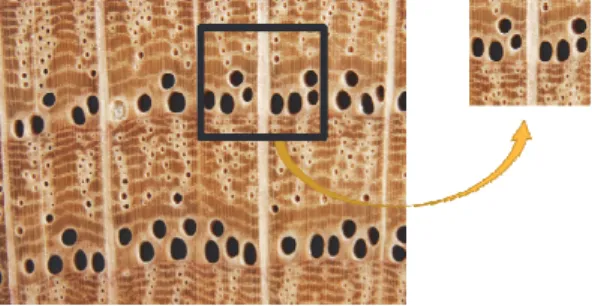
Fig. 1 depicts the more specific and detailed fea- tures provided by the selected area sample. The CNN model trained on specific and detailed features re- sulted in a CNN model that had excellent generational capabilities though with the limited dataset provided.

2.3. Implementation of Convolutional Neural Networks

CNN is a neural network architecture used for pre- diction when the input observations are images, which is the case in a wide range of neural network applica- tions (Seth, 2019). In principle, CNN mimics the visu- al cortex. I t is based on studies as conducted by Neocognitrons in 1980 (Fukushima, 1980), which gradually evolved into what is now called as convolu- tional neural networks (Géron, 2019). CNN is very similar to ordinary neural networks and still consists of neurons with weights that can be learned from data.

Each neuron receives several inputs and performs a dot product. In general, CNN has three main layers:

the convolution layer, pooling layer, and fully con- nected layer (Sewak et al., 2018).

Fig. 2 shows that the typical CNN architecture piles up several convolutional layers (followed by activa- tors), and pooling layer. Several convolutional layers (followed by activators), other pooling layers, and so on until the final layer produces several predictions (for instance, the softmax layer outputting several esti-

Fig. 1. The illustration of the sample selection process

on the image. Fig. 2. Convolutional Neural Networks (CNN)

architecture.

(6)

mated class probabilities) (Géron, 2019).

In practice nowadays, very few people train entire convolutional networks from scratch. They do not choose this way for several reasons, such as many data required in the process to train the CNN model; lots of parameters (weights) to be trained and to avoid overfitting. The transfer learning is a solution for the problem. Five CNN architectures have been designed by applying transfer learning to fit in the sample se- lected data set.

Transfer learning is a machine learning technique that reuses the trained and developed models from one task into the second task. It refers to the situation whereby what has been learned in one setting is ex- ploited to improve optimization in another setting (Hussain et al., 2019). Some examples of popular pre-trained models for transfer learning are VGG-16,

MobileNet, ResNet-50, and DenseNet.

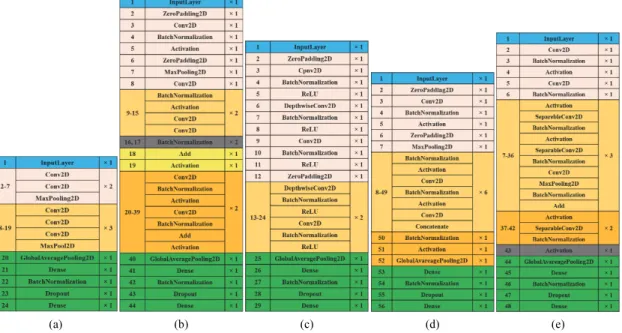
Fig. 3 illustrates the architecture of each model.

Each base architecture was cut into a particular net- work depth, such as VGG16 (Simonyan and Zisserman, 2014) at the 19 th layer, ResNet50 (He et al., 2016) at the 39 th layer, MobileNet (Howard et al., 2017) at the 23 rd layer, DenseNet121 (Huang et al., 2017) at the 51 st layer, and Xception (Chollet, 2017) at the 42 nd layer. All layers were cut after the specified layers.

Furthermore, a new fully connected layer would be used to fit the nine species/class of wood. The use of shallow network depth aimed to prevent the net- work from losing the essential features of the wood.

The deeper the network, the more detailed the features will be produced; and this can affect the sample se- lected image with the features that are sufficiently de- tailed to be lost.

(a) (b) (c) (d) (e)

Fig. 3. Five architectures of CNN, VGG16 (a), ResNet50 (b), MobileNet (c), DenseNet121 (d), and Xception

(e) based architecture. For each architecture, the first column is the layer number, the second and the third

one is the layer type, and the number of blocks, respectively. Colour differences indicate the differences in

architectural blocks. Light blue blocks indicate input layers, green blocks indicates fully connected layers, and

light orange, grey, gold, yellow, and orange blocks indicate feature extractor layers.

(7)

2.4. Proposed Algorithm

Algorithm development consisted of two main steps.

The training process initiated the step (Fig. 4) followed by the testing process (Fig. 5) as the second step.

The training process began with a sample selection process, as described in subsection 2.2. Furthermore, each architecture as in subsection 2.3 was trained in each sample selection size category (small 100 × 100 pixels, medium 200 × 200 pixels, and large 300 × 300), therefore each architecture could produce 3 mod- els, and in total for 5 architectures, there would be 15 models.

In the testing process, augmentation data would be added to the test sets. The addition of data augmenta- tion aimed to add data variation and make the testing process able to describe a more general situation. The augmentation process was carried out by rotating the image, thereby increasing the total number of test data to 54 images. Furthermore, test sets entered the sample selection stage. However, the difference was that not all sample areas for each image was going to be used.

The optimal number of sample areas would be sought, which could produce high accuracy while still consid-

ering computational costs. For example, for one image with a sample area of one size (100, 200, or 300), it would take five images. Furthermore, all sample area images were classified by each CNN model.

From all prediction results, the mode value was searched to be the final prediction result for each im- age (the real image). Fig. 5 illustrates this process.

3. RESULTS and DISCUSSION

3.1. Sample Selection Process Analysis

In the proposed algorithm, as described in sub- section 2.4, every wood image data must be entered into the sample selection process. The sample selection process produced three categories of sample areas (small, medium, and large) as illustrated in Fig. 6.

Fig. 5. The testing process in getting the classification result.

Fig. 6. Sample selection results for Quercus variabilis species (small, medium, and large sample area).

Fig. 4. The training process in getting the CNN model.

(8)

The training process used all sample areas from each original image (1230 sample areas for small size, 300 sample areas for medium size, and 130 sample areas for large size). Meanwhile, for the testing proc- ess, we sought the most optimal number of sample areas with accuracy and computational cost. Fig. 7 presents ten trials using different numbers of data sam- ples (1, 3, 5, 7, 9, 11, 13, 15, 21, and 25).

Large sample area sizes and VGG16 architecture were used in this process. The results of this process analysis would be used in the next process. The most optimal result was achieved when the number of sam- ples in the test set was 5. The next process was to

evaluate 15 CNN models using the number of sample areas defined in this section.

3.2. Training Process Analysis

The training process for all CNN models used the same parameters to produce the valid benchmarks. The first training experiment set the following parameters:

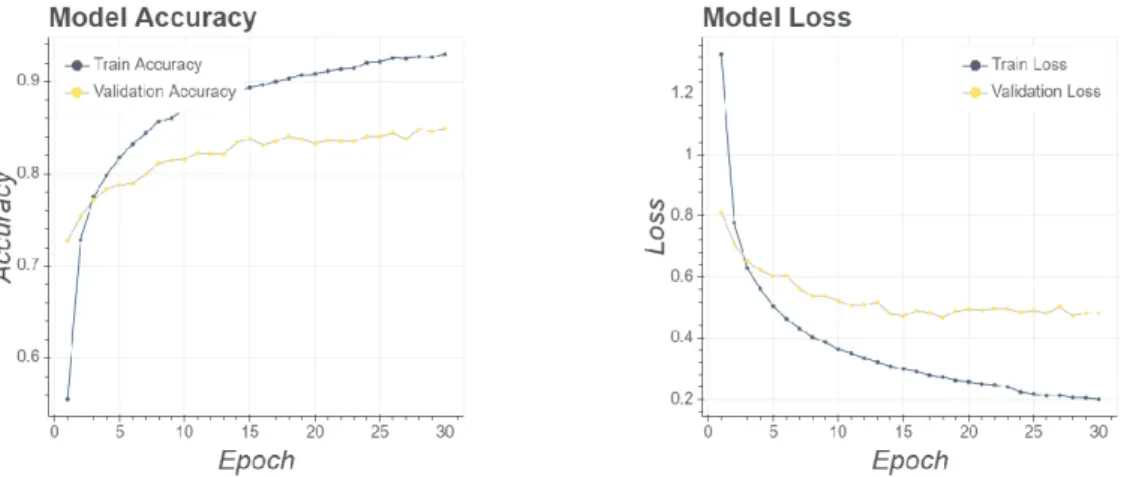
the number of epochs (30 epochs), learning rate (0.0001), and the optimiser (Adam optimiser). If the training accuracy has not increased in 10 epochs, the training process would be terminated without waiting for the maximum number of epochs. Furthermore, if in 5 epochs training process did not increase, the learning rate would be reduced by multiplying it by a factor value of 0.6. By lowering the learning rate, the process of updating the weight became smoother to increase accuracy. A total of 15 training processes have been completed. Fig. 8 displays a history of training from the VGG16 architecture with a sample size area of 200 pixels.

Fig. 8 shows the architecture designed to accept wooden datasets properly. From each epoch, score ac- curacy continued to increase, and score loss continued to decrease. Scores between the validation and the Fig. 7. The correlation between the number of test sets

and the resulting accuracy.

Fig. 8. The accuracy and loss progressions are plotted based on the results of the CNN model with the partial

sample area.

(9)

training were not far apart showing that the model did not overfitting. Furthermore, to test the performance and generalisation of the models, a testing process was carried out on the wood testing dataset that has been prepared.

3.3. Testing Process Analysis

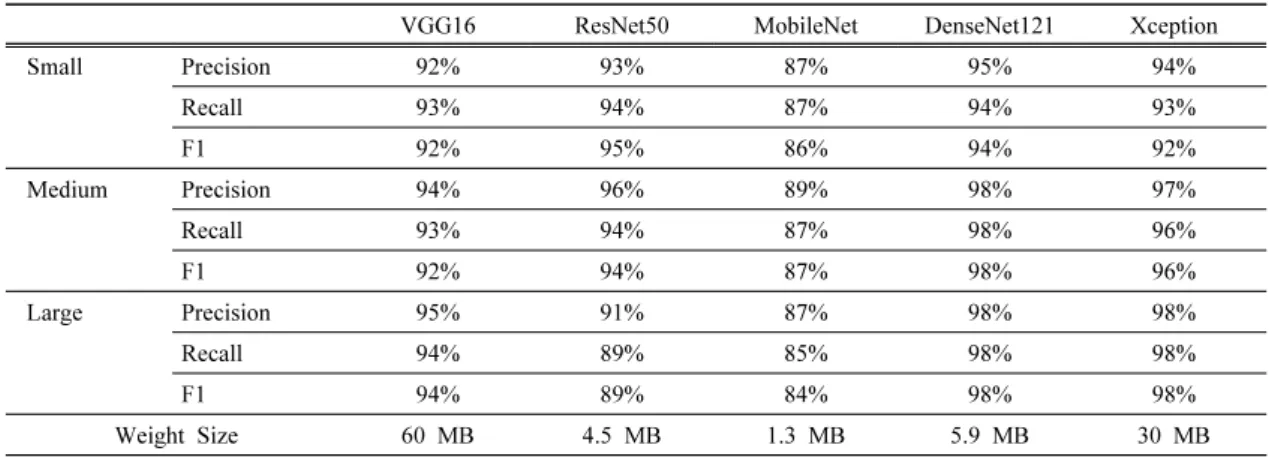
The testing process was done by evaluating each CNN models with the prepared testing data set. In de- tailed, the results of the testing process are presented in Table 2.

Based on test results, the accuracy score generally increased following the size of the input image. With a sample area size = 100, the average F1 scores of VGG16, ResNet50, MobileNet, DenseNet121, and Xception were 92, 95, 86, 94, and 92% respectively.

With a sample area size = 200, the average F1 scores of VGG16, MobileNet, DenseNet121, and Xception increased to 92, 87, 98, and 96% respectively, and for ResNet50 it decreased to 94%. Finally, for sample area size = 300, the average F1 scores increased for VGG16 and Xception to 94, and 98%, ResNet50 and MobileNet decreased to 89, and 84%, and for DenseNet121 it was unchanged from 98%.

Test result data in Table 2 provides a correlation

between the size of the sample area and the capa- bilities of the resulting CNN model. The size of the sample area is related to the number of features con- tained in the image. As shown in Fig. 6, the smaller sample area could make the surface features of the wood disappeared due to the cutting process. The sam- ples of medium category area appeared as the most optimal size in maintaining features contained in wood images. This area could create samples containing the most detailed and specific wood features compared to other 2 categories. Proved by the average F1 score of the medium size, each CNN architecture achieved 93.4%. Although the large category sample area had more features, it was not more specific than the me- dium category sample area. Thus, the results from large area samples did not produce a more general CNN model compared to medium area samples.

Furthermore, Table 2 informs that the DenseNet121- based model became the most general CNN archi- tecture for all sample area sizes and considered to be the best CNN model for Japanese Fagaceae wood identification. DenseNet121-based produced F1 scores above 94% for every size of the sample area (100, 200, and 300 pixels). Meanwhile, MobileNet-based became the CNN architecture providing the lowest accuracy. However, it should be taken into account to

VGG16 ResNet50 MobileNet DenseNet121 Xception

Small Precision 92% 93% 87% 95% 94%

Recall 93% 94% 87% 94% 93%

F1 92% 95% 86% 94% 92%

Medium Precision 94% 96% 89% 98% 97%

Recall 93% 94% 87% 98% 96%

F1 92% 94% 87% 98% 96%

Large Precision 95% 91% 87% 98% 98%

Recall 94% 89% 85% 98% 98%

F1 94% 89% 84% 98% 98%

Weight Size 60 MB 4.5 MB 1.3 MB 5.9 MB 30 MB

Table 2. CNN models performance evaluation by applying the proposed algorithm

(10)

use, with the given size of the resulting weight to be the lightest. Although accuracy is not as high as other architectures, it can be the most portable architecture option in use.

To prove how the proposed algorithm could over- come the problems of generalization ability, dataset limitation, and accuracy, several comparisons have been made by making a CNN model that did not go through the sample selection process. In other words, it directly used the original image. As a sample of the training process carried out, Fig. 9 displays the history of the VGG16 architecture training process.

The training process used a similar architecture and parameters as in the training process described in Section 2.4. However, this stage excludes the sample selection process. It resulted in 94% validation accu- racy values and validation loss values continuing to approach 0. Implementation of the partial sample area during the training stages does not significantly im-

prove compared to the step with the whole sample area. However, the testing stage obtained different results. As presented in Table 3, most of the CNN ar- chitectures provide parameters values at lower levels.

The unfavourable testing results in Table 3 in- dicated that the model was overfitting and had low generalizability. This comparison showed the advan- tages and benefits of using the sample selection process. With the similar limited dataset, the sample selection process could overcome the overfitting prob- lem and the low generalizability of the CNN model.

4. CONCLUSION

CNN has become a popular deep learning model widely used for image and visual analysis. In the ap- plications, it requires many datasets to learn a robust classifier. In this wood classification research, the mi- croscopic images taken from the laboratory were in

Fig. 9. The accuracy and loss progressions are plotted based on the results of the CNN model with the whole image area.

VGG16 ResNet50 MobileNet DenseNet121 Xception

Precision 86% 88% 51% 71% 83%

Recall 81% 81% 63% 67% 70%

F1 80% 81% 54% 62% 70%

Table 3. CNN models performance evaluation without applying the proposed algorithm

(11)

a limited number and had a large size of around 38 Mb and a dimension of 4140 × 3096 pixels. Therefore, a well-designed algorithm has been proposed, which could handle the dataset limitations and identify wood species accurately and efficiently. The proposed algo- rithm principle was to implement the sample selection process before the dataset entered the classification stage using VGG16, ResNet50, MobileNet, DenseNet121, and Xception based architectures.

The experimental results showed that the sample se- lection process could produce CNN models with some good generalisation capabilities. The experimental re- sults proved that by making sample areas more specif- ic and detailed, it can produce a powerful CNN model.

The medium area sample category (200 × 200 pixels) appeared as the most optimal sample area. While the CNN DenseNet121 architecture became the most opti- mal architecture when used with medium sample areas.

The availability of more microscopic images is rec- ommended in the future to improve the classification accuracy of the proposed algorithm. The results of this wood classification research are expected to be widely used. With a small size of the CNN model, it can be potentially applied to the mobile devices.

ACKNOWLEDGMENT

The author would like to thank the Indonesian Institute of Sciences (Lembaga Ilmu Pengetahuan Indonesia) and the Research Institute of Sustainable Humanosphere (RISH), Kyoto University, Japan for the assistance and provision of datasets supporting this wood classification research.

DATA AVAILABILITY STATEMENT

The microscopic images used in the experiment are available from Kyoto University Research Information Repository (https://repository.kulib.kyoto-u.ac.jp/dspace/

handle/2433/250016).

REFERENCES

Chollet, F. 2017. Xception: Deep Learning with Depthwise Separable Convolutions. In: Proceedings of the IEEE Conference on Computer Vision and Pattern Recognition, pp. 1251-1258.

Fukushima, K. 1980. Neocognitron: A self-organizing neural network model for a mechanism of pattern recognition unaffected by shift in position.

Biological Cybernetics 36: 193-202.

Géron, A. 2019. Hands-On Machine Learning with Scikit-Learn, Keras, and TensorFlow, 2nd Edition.

O’Reilly Media.

Hadiwidjaja, M.L., Gunawan, P.H., Prakasa, E., Rianto, Y., Sugiarto, B., Wardoyo, R., Damaryati, R., Sugiyarto, K., Dewi, L.M., Astutiputri, V.F. 2019.

Developing wood identification system by local binary pattern and hough transform method. Journal of Physics: Conference Series 1192(1): 012053.

He, K., Zhang, X., Ren, S., Sun, J. 2016. Deep Residual Learning for Image Recognition. In: Proceedings of the IEEE Conference on Computer Vision and Pattern Recognition, pp. 770-778.

Howard, A.G., Zhu, M.C., Kalenichenko, D., Wang, W., Weyand, T., Andreetto, M., Adam, H. 2017.

Mobilenets: Efficient convolutional neural networks for mobile vision applications. ArXiv Preprint ArXiv: 1704.04861.

Huang, G., Liu, Z., Van Der Maaten, L., Weinberger, K.Q. 2017. Densely Connected Convolutional Networks. Proceedings of the IEEE Conference on Computer Vision and Pattern Recognition, pp.

4700-4708.

Hussain, M., Bird, J.J., Faria, D.R. 2018. A Study on Cnn Transfer Learning for Image Classification.

In: Lotfi A., Bouchachia H., Gegov A., Langensiepen

C., McGinnity M. (eds) Advances in Computational

(12)

Intelligence Systems, pp. 191-202.

Hwang, S.-W., Tazuru, S., Sugiyama, J. 2020. Wood identification of historical architecture in Korea by Synchrotron X-ray microtomography-based three- dimensional microstructural imaging. Journal of the Korean Wood Science and Technology 48(3):

283-290.

Jeon, W.S., Kim, Y.K., Lee, J.A., Kim, A.R., Darsan, B., Chung, W.Y., Kim, N.H. 2018. Anatomical characteristics of three Korean bamboo species.

Journal of the Korean Wood Science and Technology 46(1): 29-37.

Jeon, W.S., Lee, H.M., Park, J.H. 2020. Comparison of anatomical characteristics for wood damaged by oak wilt and sound wood from quercus mongolica.

Journal of the Korean Wood Science and Technology 48(6): 807-819.

Kobayashi, K., Kegasa, T., Hwang, S.W., Sugiyama, J. 2019. Anatomical features of Fagaceae wood statistically extracted by computer vision approaches:

Some relationships with evolution. PloS One 14(8):

e0220762.

Kwon, O., Lee, H.G., Lee, M.R., Jang, S., Yang, S.Y., Park, S.Y., Yeo, H. 2017. Automatic wood species identification of Korean softwood based on convolutional neural networks. Journal of the Korean Wood Science and Technology 45(6):

797-808.

Kwon, O., Lee, H.G., Yang, S.Y., Kim, H., Park, S.Y., Choi, I.G., Yeo, H. 2019. Performance enhancement of automatic wood classification of Korean softwood by ensembles of convolutional neural networks. Journal of the Korean Wood Science and Technology 47(3): 265-276.

Levi, G., Hassner, T. 2015. Age and Gender Classification Using Convolutional Neural Networks. In: Proceedings of the IEEE Conference on Computer Vision and Pattern Recognition Workshops, pp. 34-42.

Maggiori, E., Tarabalka, Y., Charpiat, G., Alliez, P.

2016. Convolutional neural networks for large-scale remote-sensing image classification. IEEE Transactions on Geoscience and Remote Sensing 55(2): 645-657.

Marmanis, D., Datcu, M., Esch, T., Stilla, U. 2015.

Deep learning earth observation classification using ImageNet pretrained networks. IEEE Geoscience and Remote Sensing Letters 13(1): 105-109.

Prislan, P., Gričar, J., Čufar, K. 2014. Wood sample preparation for microscopic analysis. University of Ljubljana, Department of Wood Science and Technology.

Salma, S., Gunawan, P., Prakasa, E., Sugiarto, B., Wardoyo, R., Rianto, Y., Dewi, L.M. 2018. Wood Identification on Microscopic Image with Daubechies Wavelet Method and Local Binary Pattern. In: 2018 International Conference on Computer, Control, Informatics and its Applications (IC3INA), pp. 23-27.

Savero, A.M., Wahyudi, I., Rahayu, I.S., Yunianti, A.

D., Ishiguri, F. 2020. Investigating the anatomical and physical-mechanical properties of the 8-year-old superior teakwood planted in muna island, Indonesia. Journal of the Korean Wood Science and Technology 48(5): 618-630.

Schoch, W., Heller, I., Schweingruber, F.H., Kienast, F. 2004. Wood Anatomy of Central European Species. Swiss Federal Institute for Forest.

Seth, W. 2019. Deep Learning from Scratch. O’Reilly Media.

Sewak, M., Karim, M.R., Pujari, P. 2018. Practical Convolutional Neural Networks: Implement Advanced Deep Learning Models Using Python. Packt Publishing Ltd.

Simonyan, K., Zisserman, A. 2014. Very deep convolutional networks for large-scale image recognition. ArXiv Preprint ArXiv: 1409.1556.

Sugiarto, B., Prakasa, E., Wardoyo, R., Damayanti, R.,

Dewi, L.M., Pardede, H.F., Rianto, Y. 2017. Wood

(13)

identification based on histogram of oriented gradient (HOG) feature and support vector machine (SVM) classifier. In: 2017 2nd International conferences on Information Technology, Information Systems and Electrical Engineering (ICITISEE), pp. 337-341.

Yang, S.Y., Lee, H.G., Park, Y., Chung, H., Kim, H., Park, S.Y., Yeo, H. 2019. Wood species

classification utilizing ensembles of convolutional neural networks established by near-infrared spectra and images acquired from Korean softwood lumber.

Journal of the Korean Wood Science and Technology 47(4): 385-392.

Yu, S., Jia, S., Xu, C. 2017. Convolutional neural networks for hyperspectral image classification.

Neurocomputing 219: 88-98.

수치

Table  1.  Nine  species  of  Japanese  Fagaceae
Fig.  1  depicts  the  more  specific  and  detailed  fea- fea-tures  provided  by  the  selected  area  sample
Fig.  3  illustrates  the  architecture  of  each  model.
Fig.  5.  The  testing  process  in  getting  the  classification  result.
+4

참조

관련 문서

• Pathology.. 출처: American Joint Committee on Cancer staging system for thyroid cancers using the TNM classification. Harrison 18 th Edition.. Postsurgical hypoparathyroidism.

웹 표준을 지원하는 플랫폼에서 큰 수정없이 실행 가능함 패키징을 통해 다양한 기기를 위한 앱을 작성할 수 있음 네이티브 앱과

각 브랜드의 강점과 약점이 서로 상충되는 경우, 각 브랜드에 있어서 어떤 속 성의 약점을 다른 속성의 강점에 의해 보완하여 전반적인 평가를 내리는 것.

The key issue is whether HTS can be defined as the 6th generation of violent extremism. That is, whether it will first safely settle as a locally embedded group

The “Asset Allocation” portfolio assumes the following weights: 25% in the S&P 500, 10% in the Russell 2000, 15% in the MSCI EAFE, 5% in the MSCI EME, 25% in the

1 John Owen, Justification by Faith Alone, in The Works of John Owen, ed. John Bolt, trans. Scott Clark, "Do This and Live: Christ's Active Obedience as the

The sample group that satisfied the 10% capital adequacy ratio, the sample company that achieved the net income of 2 billion standard requirement, the

The number of the sample apartment houses is 949, the sale price was determined as the subordinate variables and the characteristics of structure,