731
Bibliometrics Review of the Korean Journal of Urology from 1960 to 2008: Trends and Future Directions
Sang-Kuk Yang, Se Joong Kim1, Kwangsung Park2
From the Department of Urology, College of Medicine, Konkuk University, Chungju, 1Ajou University College of Medicine, Suwon, 2Chonnam National University Medical School, Sexual Medicine Research Center, Gwangju, Korea Purpose: To identify chronologic trends and characteristics, and to gain some insights into the future direction of the Korean Journal of Urology (KJU), all articles published in the KJU over the past 5 decades were analyzed.
Materials and Methods: The bibliometric data of the entire 6,730 articles published in the KJU were classified according to publication type (original articles, review articles, case reports), publication content (experimental articles, clinical articles), and 8 genitourinary fields: oncology, voiding dysfunction/female urology, endourology/urolithiasis, urinary tract infec- tion (UTI), sexual dysfunction/infertility, pediatric urology, trauma, and medical/miscellaneous. The data were analyzed in the following chronolo- gical order: 1960s, 1970s, 1980s, 1990s, and 2000s.
Results: The number of articles published in the KJU has continuously increased annually. The proportion of original articles, which constituted 72.9% of articles overall, significantly increased in the 2000s (79.5%). Arti- cles in the field of oncology constituted the largest proportion (37.6%) of total articles. The oncology and voiding dysfunction/female urology fields showed an increasing trend, but the UTI field showed a decreasing trend.
The fields of sexual dysfunction/infertility and voiding dysfunction/
female urology began to increase in the 1990s. The percentage of experi- mental articles, which was 8.4% in the 1970s, and 9.0% in the 1980s, increased to 20.4% in the 1990s. Recently, the KJU was registered in some international journal databases in recognition of its scientific excellence.
Conclusions: These results make up an index reflecting academic and practicing performances in urology. We hope that the KJU will soon be recognized as one of the high-quality international peer-reviewed journals.
(Korean J Urol 2009;50:731-738)
Key Words: Bibliometrics, Korea, Urology, Publications
Korean Journal of Urology Vol. 50 No. 8: 731-738, August 2009
DOI: 10.4111/kju.2009.50.8.731
Received:July 27, 2009 Accepted:August 4, 2009
Correspondence to: Kwangsung Park Department of Urology, Chonnam National University Medical School, 8, Hak-dong, Doung-gu, Gwangju 501-757, Korea TEL: 062-220-6701 FAX: 062-227-1643 E-mail: [email protected]
Ⓒ The Korean Urological Association, 2009
INTRODUCTION
From the first publication in January 1960 to the issue of December 2008, the Korean Journal of Urology (KJU) has published 49 volumes. The number of articles in the KJU has steadily increased. The KJU has maintained a unique status as a national scientific journal in the discipline of urology in Korea. The KJU has been registered in Scopus1 and Excerpta Medica Database (EMBASE),2 the international scientific
search engines on the web. The Korean Urological Association (KUA) has provided an increased possibility of being covered by high-quality international journal databases such as PubMed3 or SCI(E),4 which would raise the international prestige of the KJU. The KJU’s research results reflect the time flow of the Korean Urological Association. Through bibliographic analysis of the last 50 years, this review attempts to outline the developmental flow of the KJU up to the present. Scrutinizing the work of the KJU and analyzing characteristics will help to establish future trends.
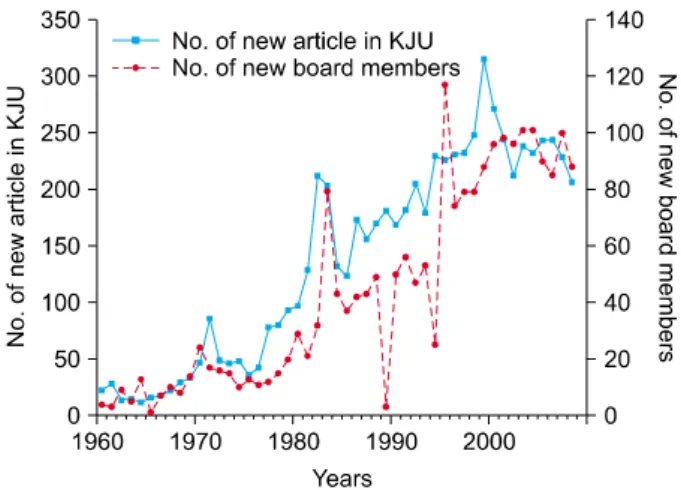
Fig. 1. Growth and correlation of the number of articles in the Korean Journal of Urology (KJU) compared with the number of new board members in the Korean Urological Association.
MATERIALS AND METHODS
Changes based on a 10-year cycle were analyzed by using the bibliometric data of the total 6,730 articles recorded in the KJU from 1960 through December 2008.5 In April 1998, the author (S Yang) prepared and distributed the database−
containing theme, author, affiliated organization, abstract, year of publication, number of pages, and key words−to be incor- porated in Urology Database Management System (URODMS), which was mandatory for the inspection of training hospitals.6 This prototype database with newly added data after 1998 to 2008 was used as the material data set. The database was classified by publication type, content, and field of specialty.
Correlations among the increases in the number of articles published each year, the number of urologists, and the number of training hospitals were evaluated.
Only 3 types of articles (review articles, original articles, and case reports) are available in the KJU. Original articles were also subclassified by content into 2 types (experimental articles and clinical articles). There were cases in which a precise differentiation between an experimental article and a clinical one was difficult. However, classification was carried out subjectively by the author in consideration of the principal purpose of an article. Each article was generally classified into 8 fields: oncology, voiding dysfunction/female urology, endo- urology/urolithiasis, urinary tract infection, sexual dysfunction
& infertility, pediatric urology, trauma, and medical/miscella- neous. Some articles, for which classification by field was impossible, were included in the category of medical/mis- cellaneous. The oncology field was further classified by each organ into 6 items: kidney, pelvis & ureter, bladder, prostate, testis, and others (penis, urethra, scrotum, spermatic cord, vas deferens, vulva, adrenal gland, and retroperitoneal space).
Articles for which any association with a specific main organ could not be clarified were included in the category of “others”.
For the sake of convenience, articles were classified by the cycle of a decade into 1960s (1960-1969), 1970s (1970-1979), 1980s (1980-1989), 1990s (1990-1999), and 2000s (2000- 2008). The characteristics and trends in the articles published were analyzed for these years. A score test for trend and correlation coefficients of the SAS program (version 6.12; SAS Institute Inc, Cary, USA) were used for data processing, and values with p<0.05 were considered statistically significant.
BIBLIOMETRIC DATA OF THE KJU OVER 5 DECADES
1. Annual growth of KJU articles
The number of articles published has steadily increased since 1960. There were 214 articles published in the 1960s and 606 articles in the 1970s; however, the number rapidly increased to 1,577 articles in the 1980s. As many as 2,215 articles were published in the 1990s, and as many as 2,118 articles were published in the 2000s, right up to December 2008. As shown in Fig. 1, the increase in the number of articles each year was correlated with the number of newly admitted urologists (r=0.80 p<0.01),7 the number of accumulative urologists (r=0.92, p<0.01), and the number of accumulative training hospitals (r=0.80, p<0.01).
A steady increase in the number of articles published in the KJU would be an index that reflects the level of activity in the discipline of urology. The rapid increase in the number of articles in 1982 might have a close relationship with the submitting of articles required in the resident training programs, because the number of specialists doubled in 1983 compared with 1982. However, the number of articles rapidly decreased in the early 2000s as opposed to the increasing number of urologists. This phenomenon reflects the increased rate of article rejection by editorial boards to improve the quality of articles. Another reason for this temporal drop in the number of articles in the early 2000s may be a decrease in the number of newly entered urologists and research capability due to the
Table 1. The number of articles in the Korean Journal of Urology according to the publication types during the last 5 decades
Chronology Original articles (%)a Case reports (%) Review articles (%) Total
1960s 1970s 1980s 1990s 2000s
134 (62.6) 377 (62.2) 997 (63.2) 1,711 (77.2) 1,684 (79.5)
80 (37.4) 228 (37.6) 580 (36.8) 501 (22.6) 410 (19.4)
0 (0) 1 (0.2) 0 (0) 3 (0.1) 24 (1.1)
214 606 1,577 2,215 2,118
Total 4,903 (72.9) 1,799 (26.7) 28 (0.4) 6,730
a: p<0.01 by score test for trend
Fig. 2. The trend and proportion of original articles and case reports. The proportion and number of original articles gradually increased during the last 5 decades. Although the overall proportion of case reports decreased, the percentage of oncology field slowly increased.
struggle of domestic doctors against the separation of dis- pensary from medical practice. There have been 2 notable rapid drops in the number of new urologists: in 1989 and in 1994.
The rapid drop in 1989 was related to the increase in the training period from 3 years to 4 years for urology residency, and the rapid drop in 1995 was related to the increased failure rate of board certificate examination.
2. Increasing number and proportion of original articles
When articles were classified by type such as original work, case study, and review, the proportions of original works were 62.6% in the 1960s, 62.2% in the 1970s, and 63.2% in the 1980s. The number rapidly increased to 77.2% in the 1990s and to 79.5% in the 2000s (Table 1). Up to the 1990s, 4 review articles were published. One review was published in 2000 and 3 reviews were published in 2003. Starting from the year 2004, however, 4 reviews have been published every year, and 12
reviews will be published by well-known domestic and foreign scholars in each field annually from the year 2009. The increased proportion of original articles along with the increased number of articles is thought to be associated with substantiality of the contents of articles on account of limited space in the journal. There was a review entitled ‘genetics and clinical practice’ in the 1970s. However, proper urological reviews such as ‘prostatitis’, ‘diagnosis and treatment of impo- tence in the outpatient clinic’, and ‘various clinical problems of vesicoureteral reflex’ were all published in the 1990s.
The number of case reports markedly decreased from the 1990s. The trend in the number of case reports parallels that in other SCI(E) journals. Although case reports contributed traditional medical knowledge and new ideas in medicine, single case reports are now discouraged in most SCI(E) journals because of the rise of evidence-based medicine, the increased cost of publication, and the consideration of the impact factor
Table 2. The number of articles in the Korean Journal of Urology according to 8 genitourinary fields during the last 5 decades
Fields 1960s (%) 1970s (%) 1980s (%) 1990s (%) 2000s (%) Total (%)
Oncologya
Voiding dysfunction & female urologya Endourology & urolithiasis
Urinary tract infection
Sexual dysfunction & infertility Pediatric urology
Trauma
Medical & miscellaneous
45 (21.0) 3 (1.4) 19 (8.9) 55 (25.7) 20 (9.3) 28 (13.1) 10 (4.7) 34 (15.9)
147 (24.3) 13 (2.1) 52 (8.6) 97 (16.0) 44 (7.3) 122 (20.1) 54 (8.9) 77 (12.7)
549 (34.8) 50 (3.2) 179 (11.4) 181 (11.5) 148 (9.4) 275 (17.4) 135 (8.6) 60 (3.8)
910 (41.1) 193 (8.7) 223 (10.1) 154 (7.0) 278 (12.6) 234 (10.6) 123 (5.6) 100 (4.5)
879 (41.5) 330 (15.6) 271 (12.8) 152 (7.2) 204 (9.6) 117 (5.5) 59 (2.8) 106 (5.0)
2,530 (37.6) 589 (11.1) 744 (11.1) 639 (9.5) 694 (10.3) 776 (11.5) 381 (5.7) 377 (5.6) Total (%) 214 (100.0) 606 (100.0) 1,577 (100.0) 2,215 (100.0) 2,118 (100.0) 6,730 (100.0)
a: p<0.01 by score test for trend
Fig. 3. The trend of articles related to quality of life in Korean Journal of Urology during the last 5 decades. The number of articles in the fields of voiding dysfunction/female urology and sexual dysfunction began to increase in the 1990s.
of the journals.8,9 Although the total number of case reports decreased, the proportion of case reports in the field of oncology gradually increased as follows: 32% in 1960s, 35%
in 1970s, 46% in 1980s, 54% in 1990s, and 60% in 2000s (Fig.
2).
3. Changing trends in specific genitourinary fields
When articles were classified into 8 fields, a steadily increasing trend was seen in the fields of oncology and voiding dysfunction/female urology (p<0.01; Table 2). The oncology field slowly increased from 21% in the 1960s to 24.3% in the 1970s. However, the oncology field rapidly increased to 34.8%
starting from the 1980s, and was 41.8% in the 1990s and 41.5%
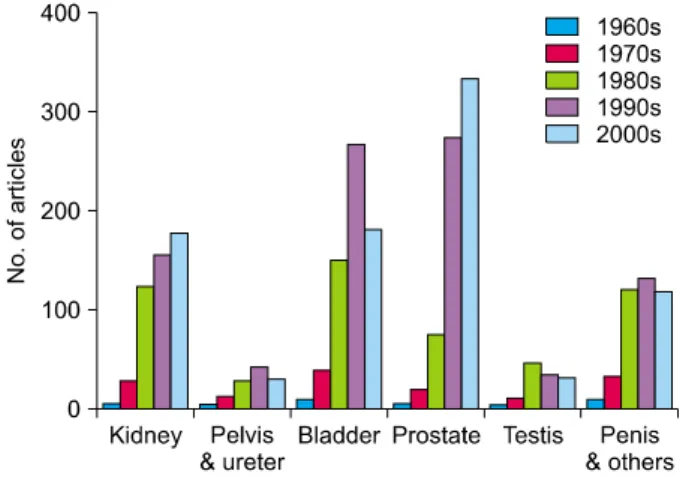
in the 2000s. This remarkable increase in oncology-field articles is believed to be related to changes in lifestyle, an increase in the elderly population, early diagnosis and new treatment of malignancies owing to vigorous activities of health exami- nation, and increased experimental articles on the patho- physiologic mechanisms of malignancy. The classification of all articles in the oncology field by organs revealed that prostate- related articles increased markedly in the 1990s and the 2000s.
Other than prostate, articles related to the bladder and kidney also showed a steady increase.
Sexual dysfunction and voiding dysfunction & female urology began to increase in the 1990s (Fig. 3). These fields have the common characteristic that the diseases are closely related to quality of life, but less related to mortality. The voiding dysfunction/female urology field made up 1.4% of articles in the 1960s, but it gradually increased to 15.6% in the year 2000.
The increase in the voiding dysfunction & female urology field in the 2000s is due to the emerging concept of overactive
bladder, new antimuscarinics, and novel treatment modalities for stress urinary incontinence. The numbers of sexual dys- function & infertility articles published were 20 articles in the 1960s and 204 articles in the 2000s. The overall proportion was 9.3% in the 1960s, 7.3% in the 1970s, 9.4% in the 1980s, 12.6% in the 1990s, and 9.6% in the 2000s, showing not much change. Studies on sexual dysfunction showed a remarkable increase at the end of the 1990s and in the 2000s, which would be associated with the development of phosphodiesterase type 5 (PED5)-inhibitors. On the contrary, infertility showed the trend of a gradual decrease from the 1960s. This phenomenon is in contrast with increased activities seen in the obstetric specialty. It reflects the reality of a limited role of urology in the field of infertility.
With respect to the endourology/urolithiasis field, the intro-
Fig. 4. Chronological proportion of the experimental articles in the Korean Journal of Urology according to 8 genitourinary fields.
Table 3. The number of experimental and clinical articles in the Korean Journal of Urology during the last 5 decades
Chronology Experimental (%) Clinical Total 1960s
1970s 1980s 1990s 2000s
39 (18.2) 51 (8.4) 142 (9.0) 452 (20.4) 270 (12.7)
175 555 1,435 1,763 1,848
214 606 1,577 2,215 2,118
Total 954 5,776 6,730
duction of extracorporeal shock wave lithotripsy (ESWL), an epochal treatment method, in the 1990s led to a new era of urolithiasis treatment. With a rising concern and increased preference for minimally invasive therapy, including laparoscopy and robotic surgery, articles in this field are expected to increase.
Articles relating to the urinary tract infection field made up a high proportion at 25.7% of all articles published in the 1960s. However, this field showed a decreasing trend, and made up only 7.2% of all articles in the 2000s. The effect of improvements in health sanitation directly reflect a decrease in the field of infectious disease. In the 2000s, articles on prostatitis were largely reported. Appearance of resistant strains following antibiotic abuse led to increased interest in this field.
The field of pediatric urology increased to 20.1% in the 1970s, but it decreased gradually to 11.9% in the 1990s.
However, this field represented the second largest proportion following the oncology field from the 1970s to the 1990s.
Then, the proportion gradually decreased to 5.5% in the 2000s.
This decreasing trend can be explained both by the low birth rate and the relatively small change in the concepts represen- tative of pediatric urology, such as vesicoureteral reflux, ureteropelvic junction obstruction, and hypospadias.
The trauma field exhibited a drastic decrease in the number of articles from 5.6% in the 1990s to 2.8% in the 2000s. The promotion of safety awareness regarding traffic accidents seems to have played a significant role in reducing the number of reports in the trauma field.
Overall, fields in which the proportion increased over time were oncology, voiding dysfunction/female urology, and endo- urology/urolithiasis, and fields in which the proportion de- creased over time were pediatric urology, urinary tract infec- tion, and trauma.
4. Increasing number of experimental articles
With respect to article classification by content, the pro- portions of experimental articles were high at 18.2% in the 1960s, but the proportion decreased to 8.4% in the 1970s and to 9.0% in the 1980s. Then, the proportion rapidly increased to 20.4% in the 1990s and 12.7% in the 2000s (p<0.01; Table 3). The principal reason for the increase was the increased number of experimental articles in the oncology field in the 1990s. Experimental reports of the oncology field were 205 cases in the 1990s, which would be 7.3 times that of the 1980s.
It grew to 45.4% of all experimental reports. The sexual dysfunction/infertility field made up 22.6% of the reports in the 1990s and 26.3% in the 2000s, revealing the second highest rate (Fig. 4). The proportion of reports from the urinary tract infection and endourology/urolithiasis fields, which were quite important in the 1980s, decreased in the 1990s and 2000s. The proportion of experimental reports in the voiding dysfunction/
female urology field increased drastically.
The numbers of experimental articles by field in the 2000s in decreasing order were oncology (30.4%), sexual dysfunction
& infertility (26.3%), and voiding dysfunction & female urology (20.0%). The main reason for the decrease in experi- mental articles in the 2000s in the KJU, which peaked in the 1990s, is believed to be related to an increased submission of
Fig. 5. Chronological proportion of 6 genitourinary organ-related articles in the Korean Journal of Urology.
high-quality experimental articles by KUA members to SCI(E) journals since 2002. This phenomenon can be verified by reviewing the titles and contents published in SCI(E) articles by the KUA members.
5. Changing trends in specific genitourinary organs
Experimental articles in the oncology field by organ con- sisted of the prostate (28.2%), bladder (25.8%), and kidney (19.5%), which made up 73.5% of the entire oncology-field articles. Examining the increasing proportion by specific organs in the oncology field by year revealed that the prostate organ exhibited the most remarkable rate of increase in proportion (p
<0.01; Fig. 5). A rapid increase in prostate cancer has a close association with the entry of a screening test with prostate- specific antigen (PSA). Among all reports, the articles of the oncology field have made up the largest proportion since the 1970s.
All oncology-field articles and experimental articles of the oncology field made up 25.8% and 58.8% of reports for the bladder, 28.2% and 17.6% for the prostate, and 19.5% and 11.3% for the kidney, respectively. A high proportion of the experimental articles dealt with the bladder. This phenomenon can be associated with transurethral resection of bladder tumor (TURBT) being the most frequent surgery at urology depart- ments of training hospitals in Korea.
Classifying the oncology field by important organ and analyzing the proportional rate by year revealed no remarkable changes from the 1960s to the 1980s. However, the analysis did show a rapid increase in the prostate field in the 1990s, which made up the second largest proportion following that of
the bladder. Eventually, it made up the largest proportion in the 2000s. This situation is directly associated with a high level of scientific and social awareness of benign prostatic hyper- plasia (BPH) and prostate cancer since the 1990s.
THE PAST AND THE PRESENT OF THE KJU
During the early phase of the foundation of KUA, the
‘Bulletin for Venereal Disease Prevention Association of Korea Dermatology and Urology’ was first issued in January 1949, but was discontinued after the second issuance of the bulletin.
Then, the first issue of the KUA journal was published in January 1960. The journal was published twice a year. This journal increased its publication to four times a year from 1968 through 1977. Starting from March 1978, the journal was published bimonthly 6 times a year and continued its publi- cation until 1993.10 Two additional issuances were temporarily published in 1982 due to an increased number of accepted articles. Ever since 1994, the journal has been published monthly 12 times a year, and the 12th issue of volume 49 was published in December 2008.
The KJU completed ISSN registration in 1987. Also, the KJU has twice published an index book for those articles published in the KJU: in 1988 and in 1991.11,12 Article searching then became possible by subject and author in both Korean and English. An index book for all KJU articles was distributed as a CD ROM in 2003.
The Korean title of the KJU was the ‘Taehan Pinyogikwa Hakhoe Chapchi’ by the August 1979 issue. However, it was renamed as the ‘Taehan Pinyogikwa Hakhoe chi’ on the 10th issue in 1979. The KJU, an official publication of the KUA, became the ‘Korean Journal of Urology’ in February 2009.
Owing to the recognition of its scientific excellence, the KJU was registered in Scopus and EMBASE in 2008. Scopus is a database for 16,000 scientific journals in the world, which is on a par with SCI. EMBASE is a database operated by Elsevier that includes 5,000 scientific journals in medicine and pharmacology. The fact that KJU has been registered in this international scientific search engine signifies that the scientific value of the articles published in KJU will be recognized internationally.
On the basis of the aforementioned scientific achievements, the KJU has a heightened opportunity to become registered in PubMed or SCI(E), which would raise its international prestige.
However, the ‘Taehan Pinyogikwa Hakhoe chi’, the Korean pronounced name of the KJU, would be an awkward name in an international English search tool. Thus, the title of the official journal of the KUA was renamed as the ‘Korean Journal of Urology’. For this reason also, many other Korean medical journals are changing their Korean titles to English ones.
The limitations of this review are as follows. First, there was an obscure boundary in classifying some articles by field and by organ, which created the possibility for classification errors due to the author's subjective judgement.6 However, such arti- cles were rare and they would not influence the overall publishing trends in the KJU. The second limitation is the absence of a qualitative assessment of articles. In other words, original articles were not classified as descriptive studies, cohort studies, case-control studies, cross-sectional studies, or clinical trials. Also, the incorporated statistical methods and the appropriateness of the statistical processes used were not analyzed.
Significantly incorrect methodological and statistical appli- cation was reported in the Korean Journal of Academy of Family Medicine.13 This limitation seems to be the same before 2005 in the case of the KJU. Since May 2005, however, the KJU has invited a biostatistics consultant and has put forth effort to improve the quality of the journal by evaluating the statistical processes reported. This issue calls for a continuous effort in the future to improve the quality of the KJU.
FUTURE DIRECTIONS OF THE KJU
The official language of the KJU is Korean and English;
however, the language of the journal is changing to English.
The core reason to write articles for the KJU in English is that English is the universal language through which research articles are read and cited. Even if journals in the Korean language are registered in SCI(E), the language barrier would result in a low impact factor due to a low level of quotation of articles internationally. Thus, the KJU has attempted to publish entire articles in English. The KJU receives manuscripts from international authors, and the peer review process of the KJU includes international reviewers as well as members of the international editorial board.
In the event of contribution of an article by a member of the KUA, citation of relevant KJU articles will increase the
index of citation per paper of KJU, which will further speed up SCI(E) registration. The KJU is currently registered in KoreaMed Synapse,14 which is strongly recommended by the Korean Association of Medical Journal Editors. Therefore, the technical format of KJU’s digital files has been raised to the international standard of open-access on-line journal. The KJU attempts to cope with the demand of its members, to publish articles of various forms in a timely manner, to organize articles by each field of specialty, and to put forth efforts to carry out prompt online publication on the KJU website5 before the printed version. In view of English localization of KJU, some members pointed out the necessity of a Korean language journal. This issue can be accommodated by sharing the role with the KUA and its subspecialized association. In other words, the KJU should maintain its international competi- tiveness with its scientific journal published in English with original articles in full force. The subspecialized journals of KUA would operate a Korean language journal focusing pri- marily on education with reviews or study cases. These aspects are particulars that require the sharing of perspective and close collaboration of KUA and its subdivisions.
The KJU has a goal of being an internationally peer-reviewed English journal. Considering the background and the recognized prestige of the KUA as a scientific organization of excellence, the current situation calls for earnest efforts of the KUA and its members in order for KJU to overcome the hurdle of registration in SCI(E)-level journals.
SUMMARY AND CONCLUSIONS
Data classified by bibliographic information, type, content, field, and organ from 6,730 articles published in the KJU for the last 50 years from January 1960 through December 2008 were entered into a database and then analyzed. Generally, in decreasing order, articles were published in the fields of oncology, 37.6%; pediatric urology, 11.5%; endourology/
urolithiasis, 11.1%; sexual dysfunction/infertility, 10.3%;
urinary tract infection, 9.5%; and voiding dysfunction/female urology, 8.8%. With respect to the urinary tract infection field, it decreased from 25.7% in the 1960s to 11.3% in the 1990s to 7.2% in the 2000s. In the 2000s, increases in the ratios of oncology (41.5%) and voiding dysfunction/female urology (15.6%) were remarkable.
In the 1990s, the oncology field, especially of the prostate,
showed a remarkable increase in the number of articles.
Although the KJU is being published mainly in the Korean language, this scientific journal is already registered in SCOPUS, EMBASE, the international scientific search engines on the web. In the aspect of information exchange, which is the most important role of a scientific journal, conversion to an English journal has become required in this time of globalization. The KUA and its members are just one step away from the final fruition of their heartfelt efforts.
ACKNOWLEDGMENTS
The authors thank to Dr. Hong Chung for his enthusiastic data collection and analysis of all the KJU articles.
REFERENCES
1. Scopus Overview: What is it? [Internet]. Amsterdam, Nether- lands; [cited 2009 Aug 7]. Available from: http://info.scopus.
com/overview/what/.
2. What is EMBASE.com? [Internet]. Amsterdam, Netherlands;
[cited 2009 Aug 7]. Available from: http://info.embase.com/
about/what.shtml.
3. PubMed Overview [Internet]. Bethesda (MD), USA; [updated 2008 May 1; cited 2009 Aug 7]. Available from: http://www.
ncbi.nlm.nih.gov/pubmed/.
4. Science Citation Index [Internet]. New York (NY), USA; [cited
2009 Aug 7]. Available from: http://thomsonreuters. com/
products_services/science/science_products/a-z/science_citation _index.
5. The Korean Urological Association>Journal Search [Internet].
Seoul, Korea; [cited 2009 Aug 7]. Available from: http://
www.urology.or.kr.
6. Yang SK. Statistical and chronological analysis of Korean Journal of Urology from 1960 to 1997. Konkuk J Med Sci 1999;8:149-57
7. Hwang TK. Comprehensive book of the Korean Urological Association. Busan: SeriYoon Publisher; 2008
8. Kasim NH, Abdullah BJ, Manikam J. The current status of the case report: Terminal or viable? Biomed Imaging Interv J 2009;5:1-4
9. Vandenbroucke JP. Case reports in an evidence-based world.
J R Soc Med 1999;92:159-63
10. Koh SK, Park YI, Yoon MS. The history of The Korean Urological Association: 1945-1998. Seoul: Korea Medical Book Publisher; 1998
11. Choi H, Mah SY, Lee TY. Index book of the Korean Journal of Urology. Seoul: Seoheung Publisher; 1988
12. Choi H, Mah SY, Lee TY. Index book of the Korean Journal of Urology: a revised edition. Seoul: Seoheung Publisher; 1991 13. Sim KW, Lee KJ, Lee ES, Park WM, Lee SH, Lee HS, et
al. Analysis of papers published in journal of the Korean academy of family medicine. J Korean Acad Fam Med 1998;
19:353-63
14. KoreaMed Overview [Internet]. Seoul, Korea; [cited 2009 Aug 7]. Available from: http://www.koreamed.org/Overview.php#
Introduction.